




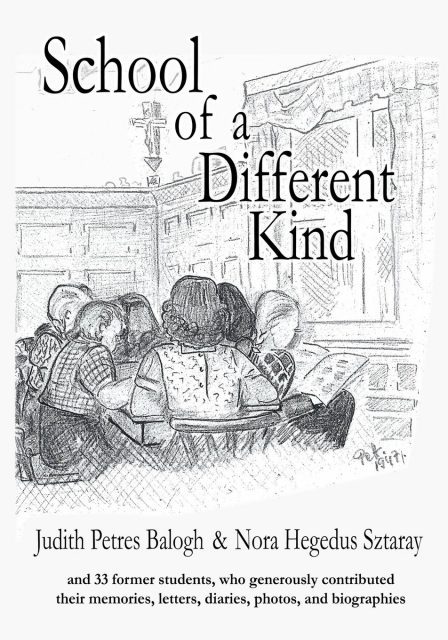
 The following is the text of introduction to the presentation and book signing by Judith Petres Balogh at the Cleveland Hungarian Heritage Museum on the evening of July 14, 2015, hosted by the Museum and in particular by Mr. and Mrs. Steve and Susan Szappanos. Mrs. Szappanos, who is the sister of Judith Petres Balogh and who had also attended the schools featured in the book, had invited Dr. Mártha Pereszlényi-Pintér to give the introduction. The book, SCHOOL OF A DIFFERENT KIND, is available for purchase at the Cleveland Hungarian Heritage Museum, and also from the Amazon.com website as well as that of Barnes and Noble. The book has also been named “Book of the Year” by the Hungarian Association and will be featured at their annual conference in November.
***
About the author: In 1945, at the tender age of 11 or 12, Judith Petres leaves Hungary with her mother and younger sister, Zsuzsa, and flees to the West. She is eventually among the first students to arrive in Niederaudorf, Germany, at the Hungarian Gimnázium in 1946. (Later, the school was relocated to Reisach.) Her latest book, School of a Different Kind, which includes contributions from her schoolmates and teachers, fills in the gaps of her life between 1946 and 1951.
In 1951 the Petres family immigrated to the United States and settled in Cleveland, Ohio. Judith was first employed in Solon, Ohio. Soon she was married and eventually had three children. In 1968 she enrolled at Kent State University where she earned her BS degree magna cum laude in Education, and subsequently a postgraduate degree in Special Education. She somehow found time to assume responsibility of the only Hungarian picture magazine of the time, the Képes Világhiradó, which she published in Cleveland from 1967 until 1978. [Copies are available for browsing in the library of the Cleveland Hungarian Heritage Museum. They give a remarkable picture of Hungarian society and immigrant life of the time.]

In 1978 she moved to Germany and taught at the Rhein-Main Air Force Base School for US military personnel as a teacher of gifted and talented children, as well as at Hanau, Babenhausen, and Darmstadt, and in the employment of the US Defense Department. Although living in Europe she also attended Dayton University during a sabbatical in 1983, where she received a Master’s Degree in School Administration, and after earning this second Master’s Degree, she was promoted to school administration in Germany. She is a Kappa Delta Pi member, a Jennings Scholar, and was awarded with a Scroll of Appreciation by the 414th Base Support Battalion for outstanding services as assistant principal at the Hanau (Germany) military base.
Judith Petres Balogh is the author of eight books in Hungarian and in English: her two books in Hungarian are Keresztút in 1973 and shortly thereafter a Hungarian children’s book, Aranyhomok. Several books in English followed: This Old House by the Lake (2002), Beyond Conventions (2002-2003), The Countess and Her Daughter (2003), Julia (2005), and Sunset (2006). This book, School of a Different Kind (2015), is her latest work. [Note: Some works have been republished in later editions or in paperback.]
Today, Judith Petres Balogh is widowed and lives in Zalaszabar by the enchanting Lake Balaton! She is also traveling, writing and taking active part in the local community’s intellectual and religious life. She has contributed and continues to contribute to several Hungarian newspapers and is a well-known speaker at literary functions.
***
About the book: School of a Different Kind is about children and adolescents forced to leave their Hungarian homeland, but who survived the aftermath of the Second World War. It vividly describes the cold, the hunger and above all the homelessness. In the words of its numerous contributors, it also describes the later and post-Germany difficult years of again finding a new home, and settling in a strange environment scattered across three continents (North and South America, Australia), where they did not know the language nor had any familiarity with the customs, and where they were viewed with suspicion for being immigrants from a country that was a former ally of Nazi Germany.
School of a Different Kind is thus about an unusual school and its young students, those whose lives had been had been radically altered by WW II and its aftermath. These children and adolescents found themselves coping with adverse conditions forced upon them by ensuing and difficult circumstances. They were now basically living as innocents but facing a brave new world in which both roof and rug had been torn from above and below them.
In addition to Judith Petres Balogh and Nóra Hegedűs Sztáray (who wrote the original manuscript upon which the books is based), there are 33 additional contributors who offered their memories, memoirs, letters, diaries, photos, drawings, interviews, eyewitness accounts, and biographies. Of course there were negatives, but amazingly, the narrative focuses on the positive in all aspects of the children’s and adolescents’ education in a world of no libraries, no books, no paper nor pencils, no food, and no basic necessities like soap, wood, warm water, heat, decent clothing, winter coats, or shoes.
Historical facts are inserted to help the American reader or anyone who is unfamiliar with the period and Hungary’s role in it, along with the personal glimpses of individual lives. It describes a segment of postwar life which is relatively unknown even to history buffs. For us in Cleveland at least, we are pretty familiar with what happened DURING the war from what the adults who lived through it told us, and what happened AFTER the “DP’s” or “Displaced Persons” immigrated to the USA in the 1950s along with the hardships they encountered. But there is a gap – a “sandwich generation” so to speak – as to what happened to the generation of children and adolescents in the post-war to pre-immigration period, to those who were the truly innocent victims of WW II, and to their lives between 1945-46 and 1950-51. This is the generation that was deprived of what they would have had in Hungary – the schools, the dances, the parties, the debutante balls – the common, everyday things that today their sons and daughters and grandchildren and great-grandchildren take for granted.
Besides no heat, there was never, ever enough food. I was struck by how many times each of the contributors to the book mentioned the lunch or dinner of single small potato with bits of black spots which were actually pieces of blood sausage (= véres hurka, a delicacy not always appreciated by those who have not yet acquired the taste!). They would have gladly eaten more – there was never enough of even that. A book with reminiscences like this makes you think of your own – when I was in my very early days of Cleveland Hungarian scouting, for our typical camping breakfast we ate “zsíros kenyér,” or bread thickly smeared with lard and sprinkled with salt and red paprika – and we not only ate it, we actually liked it – we even went home and made some more – to the horror of our American friends!
Thus I was particularly struck by the constant references to food – how there was so little or none of it for the students, but how despite constant gnawing hunger, they still managed to survive and learn their lessons well. It again reminded me of an incident in my own life. When I was a little girl, maybe 7 or 8, I dropped a raw egg on the kitchen floor and it splattered. I was nonchalantly going to clean it up and throw it away, but my own post-WW II and DP immigrant mother went ballistic. She made me scoop it up and she cooked it and she made me eat it. Her own traumatic memories of near starvation in the refugee camps of post-WW II Austria were so strong she could not bear wasting food. My father often repeated his own refugee camp story of a little Austrian boy he spied biting into an apple, and which after one bite, the boy threw it away. My father retrieved the apple, cut off the part where the child had bitten into it, cut it into three pieces and shared it with himself, my mother, and his mother-in-law. That was their dinner that night. That was how scarce food was. My cousin, born here in Cleveland, often told me that her own mother, also a post-WW II DP, would make her and her brother when they were still little children kiss a piece of bread and eat it if it happened to fall onto the floor. Bread was life. It was sacred.
My mother also told me of seeing a horse back in the refugee camp in Austria, neighing and pawing as it was led to slaughter for food, and how she could not bear to eat any of it later when it was served as a meal for the refugees, even though she herself was starving, knowing where it had come from. She knew she was pregnant with me, when the American soldier supplied ubiquitous peanut butter and its smell made her nauseated. Subsequently in America, I could not stand the smell either since it must have been transmitted in the womb, and I was constantly subjected to teasing by having lunchroom peanut butter and jelly sandwich shoved under my nose by my American grade school classmates.
I have a question for the audience – How much waste does the average American student carrying a packed lunch produce each school year? Is it:
- 67 pounds B. 54 pounds C. 38 pounds
Answer: Sixty-seven pounds of waste per student ads up to a whopping 18,000+ pounds of waste produced by an average-sized elementary school in one year. Compare that to what the students in the post-war refugee schools had, or did not have.
I read one review of this book on Amazon.com where the commentator stated that while reading this book, she kept thinking of the author Charles Dickens… “It was the best of times, it was the worst of times,” or Dickens’ famous opening sentence which introduces the universal nature of his book, A Tale of Two Cities, and the drama depicted within. And if you saw the film version of Oliver (again based on a Dickens novel, Oliver Twist), the most poignant scene is when the little boy goes to the school master and begs, “Please, Sir, more food!” and then he is severely punished for this transgression. It must have been heartbreaking for the administration of the schools depicted in School of a Different Kind to know that even had the children asked, there was no more food to give them.
Then one story is often repeated by several different contributors, and it is about one little girl nicknamed Markóczi who became so sick she could not walk or even eat what little there was. Her schoolmates put her in a wooden hand cart which they called their “ambulance” and pulled her to see a doctor who diagnosed this as malnutrition, and which several of the children in passages scattered throughout the book just called “hunger edema” (pp. 58, 156, 201 and others). I immediately knew it was just another way of saying “kwashiorkor,” the third world wasting disease caused by severe malnutrition that you see on horribly poor little African children with swollen bellies but with mere sticks for arms and legs. How could this happen in Europe? Even in post-war Europe?
How spoiled we are – sleeping on a Posturepedic® or Temper-Pedic® or pillow-top or memory foam mattress, and all kinds of fancy stuff. The children at this school slept on the same straw mattresses all year long – and some of them described how the straw eventually got all lumpy and smelly – we did that in the early days of Hungarian scout camping in the Americas too, sleeping in tents on straw, but only for a week or so – doing that for a whole year or more seems unimaginable today. What was really impressive though, was how so many of the girls mentioned that they never complained about anything in their letters home to the parents – already at their tender age they were aware of the sacrifices their parents were making to send them to school at all, so they did not want to add to the parents’ heartbreak and burden.
Having the opportunity of free public education is taken for granted by many in the USA and in other parts of the Western world. Maybe the hardships that these children and adolescents in School of a Different Kind had to endure made them so much stronger and determined though. No matter what kind of time it was, there is no doubt that the children all came away with a superior education. But for us today, imagine having no books, no paper on which to take notes, maybe not even pencils to write with. The children in this story, when they were occasionally able to get paper and pencils, sewed together their own books made up of notes from all contributors, and they all shared this one book.
The preferred method of learning included memorization of poems, very long ones, but of course anyone of a certain age or who was a Hungarian scout or who attended a Hungarian ethnic school can remember doing that. But irrespective of the teaching methodology, this is a powerful true story of how a highly motivated generation of parents, students and teachers used their determination and creativity, to turn the worst of times, even if not into the best of times, into at least bearable times of love and learning, which resulted in the students often surpassing their peers in German schools of the same period.
And what was truly amazing was the way the determination to succeed was carried forward to whatever host country was lucky enough to receive them as immigrants – each and every one of the girls and boys was later, in his or her own away, if not an overachiever at least a super-achiever. Very sadly, it was also what we could call today a “brain drain” – I am certain Hungary would be much more prosperous today had this generation been able to contribute their talents had they been able to remain in Hungary – what was Hungary’s loss of course was the new country’s gain.
On page 46, and I believe it was written by Judith herself – she mentions Hillary Rodham Clinton (– my apologies to the Republicans in the crowd – !). But it was Hillary’s “It take a village to raise a child” quotation. And not only was the resourcefulness of the teachers, but also the resourcefulness of the parents was truly amazing. I marveled at the story of the mother of a girl named Klára: in 1945-46, the authorities in charge of the refugees would award knitting yarn, but only on the condition that it be made into one single item. So, Klára’s mother made one truly gigantic coat of which the authorities approved, but after which she secretly unraveled the whole thing thread by thread to make sweaters for Klára’s dad, brother, sister and Klára herself (p. 192). Markóczi’s mother was able to barter for materials to turn into skirts and dresses – material from former kitchen curtains, colorful bed sheets, and even a Russian parachute (p. 104)!
About medical conditions – today we can run to any pharmacy or doctor or emergency clinic or even just consult the Internet for medical assistance – but I was particularly stuck by the story of a girl named Jutka (actually, Judith herself) who slipped on a wet floor on a bathing day (which only happened once a week by the way, when they actually had warm water instead of cold), and she broke her little toe. The unwritten rule for refugees was no doctor unless it was severe and unstoppable bleeding, a definite heart attack, or a third degree burn, and if you were probably going to die anyway, why bother with a doctor?
The children in this book had to deal with the problem of evil, that no adult has yet resolved. One paragraph that Judith herself wrote on p. 51 of her book remains with me:
“We understood that diseases, often horrible ones, natural disasters and death, are part of the human condition. What we found so unacceptable was the monstrosity of what was willfully done to others; such deeds that were not necessary and could have been avoided. The awful realization that we were witnessing not the human condition of predictable and unavoidable events, but the wickedness of Man and his capability to hurt his fellowman in ways worthy of Satan, frightened us. People with smooth, benign faces, perfect social behavior, often with brilliant education, who enjoyed art and felt spiritually uplifted while listening to classical music, could and did sit down at a polished conference table to make decisions about actions one usually associates with totally demented minds. Other individuals – and not just a few, but hundreds and thousands – who were known to be sober, hardworking men at other times and in other conditions, turned bestial without the slightest thought about decency, morals, feelings.”
Anne Frank, Helga Weiss, and Nobel Prize winner Imre Kertész wrote about Jewish children and youth living or disappearing in the horror of the Holocaust; Esther Hautzig recounted Jewish children deported to the Soviet Union; Helen Szablya and Tibor Fischer wrote about youth surviving in Communist Hungary just after World War Two. Now this is a story about Hungarian families who were forced to overcome the ordeal of witnessing the collapse of the familiar. The parent generation lost their home, their future, their security. But they never lost their ideals and values and managed to transmit to their children, or to their students, those very values and ideals which were the very foundation of their former life.
In summary, this return to peer into a mid-20th century world that is unknown to most is truly heartwarming, because it demonstrates what the human mind and an indomitable spirit can achieve when love, devotion and dedication such as that which the children, adolescents, parents and teachers selflessly and nobly displayed toward one another, replace cynicism, despair, and hopelessness. School of a Different Kind, despite the descriptions of severe hardships during evil times, is uplifting, positive, touching, and in a word: beautiful. The book should be made into a movie. I hope it will be, and very soon.
Dr. Mártha Pereszlényi-Pintér
Chairperson, Department of Classical and Modern Languages and Cultures at
John Carroll University, Cleveland, Ohio USA
July 14, 2015






Splendid,right.Remarkable history present for new generation living in and out of U.S. Dont’forget where are you from❗
R@❄