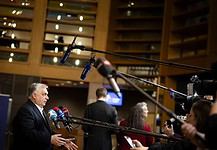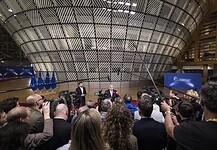



Speaking to the press on Friday morning, the prime minister noted that Hungary, the Czech Republic, and Slovakia had previously opposed taking out the 90-billion-euro loan intended for Ukraine.
Viktor Orbán added that the three countries later agreed to allow the significant loan to be taken out without their participation. “At that time, the Druzhba pipeline was still operational. As I said yesterday:”
If they had imposed an oil embargo on us back then, I would never have agreed—even without Hungary—to disburse a loan to Ukraine,”
he stated in Brussels. He explained that he had made it clear at the EU summit: for Hungary, the question of whether there is oil or not is a matter of survival.

“They brought up this situation 30 days before the election. Despite the jabs, jostling, and shoving, we stood our ground. I can see that this does not sit well with them,” he said, describing the mood at Thursday’s meeting.
“We won the first battle: if there is no oil, there is no money. But there is another battle: it will be on April 12. They are talking openly about it here. Yesterday, the European People’s Party even announced that they expect the opposition to oust the national government,” he said.
In Orbán’s opinion, they will not even open the Friendship Pipeline if there is a political change in Hungary:
In that case, however, gasoline prices will reach 1,000 forints (2.54 euros), and the utility bill cuts will be a thing of the past. He also spoke about two dangers looming on the horizon of European politics, both of which are connected to the Middle East.
“The first is the migration crisis: there are four million Afghan refugees in Iran, and the rate of internal migration within the country is already enormous due to the war,” he said. He added that it is only a matter of time before millions of people begin moving toward Türkiye and from there northward through the Balkans toward Europe.
He also mentioned that a document had been drafted on the subject, stating that “we must not repeat the mistake of 2025.”
Essentially, it calls for the same regulations that are already in effect in quite a few countries—including Hungary,”
he said.
Orbán added that it was reported on Thursday that it will take four to five years to restore the Qatari energy resources destroyed in the war with Iran.
This means that a prolonged energy crisis is unfolding in the global economy.
In light of this, everyone—including us Hungarians—must defend ourselves,”
he declared.
The prime minister stated that another crisis is looming, so the current era of threats stems not only from war but also, once again, from migration and a global oil crisis.

Slovak Prime Minister Robert Fico also criticized the situation: In his view, the EU has not done enough to force Ukraine to resume oil shipments. Fico spoke of a fuel emergency and indicated that Slovakia might even take further steps against Ukraine. He also accused Volodymyr Zelenskyy of interfering in Hungarian domestic politics.
Cover image: In a photo released by the Prime Minister’s Communications Department, Prime Minister Viktor Orbán (k) makes a statement as he leaves the summit of heads of state and government of the EU member states in Brussels on March 20, 2026. Next to him is János Máté, State Secretary Head of the Prime Minister’s Program Office. Photo: MTI/Prime Minister’s Communications Department/Ákos Kaiser