Home Blog Page 16

Almost 100,000 Applications Received for New Family Subsidies

Almost 100,000 families have applied for some kind of subsidy provided via the government’s family protection action plan since it was launched on July 1, the Ministry of Human Resources said on Friday.

Most of the applicants are interested in availing of the state-subsidised prenatal baby support loan or a grant to buy a car, the ministry said in a statement, adding that the action plan’s housing subsidies were also popular.

Some 60,000 couples have applied for state-subsidised prenatal baby support loans, it said, adding that 46,000 couples had already signed their loan contracts.

Some 23,000 families have applied for grants to buy a car and close to 8 billion forints have been paid out to winning applicants, the ministry said.

Almost 15,000 families have availed of the government’s various housing subsidies, the statement added.

From Jan. 1, the government will launch a programme to allow grandparents to take over their children’s child-leave, and exempt mothers with at least four children from personal income tax, the ministry noted.

(Hungary Today / MTI)

Reklám
Tas J Nadas, Esq

A Hungarian Response to Education

Fighting the legacy of the communist period in Hungary is not just a political task. It is also an educational one. To this purpose, a Budapest-based institution — Mathias Corvinus Collegium — has been expanding operations in most of the Hungarian-populated areas of Central and Eastern Europe.

Mathias Corvinus Collegium (MCC) is an elite training institution that has been in operation since 1996. The goal of the enterprise was clear from the very beginning: to nurture and develop responsible opinion makers and leaders willing to work on behalf of their communities.

Operated by the Tihanyi Foundation, a private initiative started by András Tombor and his father Balázs Tombor, MCC is based on a community of shared values. By providing students with world-class professional skills, the MCC aims to develop patriots who will be able to promote their national interests at a high level across the world.

The MCC selects highly talented individuals and, through its various programs, provides them with education and training (free-of-charge). It targets Hungarians living in the Carpathian Basin — from age 10 to the end of their university studies. This supplements the general education they receive from public schools.

At the beginning, the MCC community only had a handful of students. Today it has around 2,500. This active community attracts many young people who, as students, exhibit open-mindedness, sharpen their abilities to tackle complex problems, and develop team-working skills. In fact, the motto of MCC is: “Bonus intra, melior exi!”, which translates into: “Enter as a good person, leave as a better one!”

Its educational offering comprises: the Young Talents Program, which is open to applicants starting at age 10. This program focuses on individual growth and development, and uses the methodology of ‘experiential education’. Students are introduced to relevant, everyday topics, which may include law and finances, the science of robotics, how to perform CPR, and trying out as reporters. Currently 650 students participate in the program, which is constantly expanding. Participants are located not only in the six biggest cities of Hungary but also in the Hungarian-populated areas of Transcarpathia (today a region of Ukraine), such as the town of Beregszász, among others.

MCC’s secondary school program (abbreviated in Hungarian as “KP”) offers unique e-learning-based training with courses providing insights into contemporary history, law, economics, and international relations. Currently around 1,800 students participate in this program. The program not only aims to improve students’ competitiveness in the education system and in university admissions, it also seeks to increase their self-awareness. It also offers them personalized skill development and ongoing career guidance.

The most intense experience is offered by the residential university program, which is only open to 20-25 of the best applicants. In the first year of the program, students attend various courses on political philosophy, logic, argumentation techniques, and presentation skills. Other courses focus on the development of specific skills. The first year is followed by two years of specialized training in the fields of law, economics, history, international relations, media and communications, and psychology. About three-fourths of the professors teaching in MCC’s program are visiting professors from renowned international universities.

Students’ general university studies do not need to correspond to the specializations eventually chosen in the program. This results in creative, new ideas and stimulating, productive debates. Beyond their MCC studies, other requirements that students must meet include participating in an internship (organized with the assistance of MCC) and contributing to a team project while at the MCC.

In Transylvania (which today is a region of Romania), in order to lend a helping hand to youths that are part of the Hungarian community, MCC operates a center in the town of Kolozsvár. There, it offers the Transylvanian Secondary School Program and the Kolozsvár University Program, both of which follow the model of successful secondary school and university programs in Hungary.

Also in Transylvania, a postgraduate Political School has been started which is open to young people within the Hungarian community who are interested in public affairs. Additionally, the Sub-Carpathian Public Leadership Program and the Women’s Public Leadership Program (currently available only in Hungary) were created with a similar purpose in mind. These postgraduate training programs are designed for those who already take an active part in public life — but who aspire to take on an even bigger role.

The efforts made by the MCC to support the Roma minority in Hungary are also worth mentioning. Thus, mentoring and training courses aimed at developing the skills and abilities of highly talented Roma secondary school students and university students are also offered by the MCC.

On account of its professional background, MCC also functions as a kind of think-tank. The institution has published several books and has organized numerous panel discussions, trade forums, and conferences. In March of 2019, for example, it organized a unique global conference under the title of the “Budapest Summit on Migration — The Biggest Challenge of Our Time?” Attended by analysts, experts, researchers, and decision-makers from dozens of countries around the world, the event featured presentations and discussions by people such as Frank Füredi, Douglas Murray, Theodore Dalrymple, Nicolas Sarkozy, and Prime Minister Viktor Orbán.

Beyond the founder’s initial financial support and active intellectual input, numerous other prominent decision-makers — both from within and beyond Hungary — have rallied to support the MCC and its activities. They include, for example, the late Hungarian-American historian John Lukacs, the former president of Hungary Ferenc Mádl, and Ferenc Rabár, who served as finance minister during the first conservative government after the democratic transformation.

The MCC also receives active support from other luminaries such as Hungarian philosopher András Lánczi, currently rector of Corvinus University who simultaneously serves as president of MCC; the orientalist linguist and philosopher Miklós Maróth; and numerous other conservative political leaders, executives from various Hungarian enterprises, and many others.

In the past 25 years, the MCC has gone a long way to become a dominant elite training institution, serving the needs of Hungary and nearby Hungarian communities. But it has also become a leading conservative think-tank serving both Hungary and the CEE region. By meeting local educational needs with an eye on long-term educational attainment and success, it has truly become a model enterprise.

Gergely Szilvay is the senior journalist at Mandiner, a Hungarian news portal. He earned M.A. degrees in history and communications at Péter Pázmány Catholic University, and is currently a doctoral candidate in political theory. His first book, published in Hungary in 2016, critically explored the arguments surrounding same sex marriage and gender theory.

(European Conservative)

Reklám
Tas J Nadas, Esq

Hungary plans close cooperation on family protection issues with Washington

“Hungary plans close cooperation on family protection issues with the United States, Poland and Brazil”, the Ministry of Human Capacities State Secretary for Family and Youth Affairs Katalin Novák declared in Washington after participating in a family policy conference in the U.S. capital on Wednesday.

This was the second time the family policy conference was held in Washington, but in contrast to the previous occasion Wednesday’s meeting was not just a Hungarian-American discussion, but an international one at which Poland and Brazil were also represented.

In addition to Director of the White House Domestic Policy Council Joe Grogan, American republican politicians, the leaders of conservative political and religious organisations, and experts from Brazil and Spain also took part in the discussion in the Capitol Building.

“It is good to see that people in the United States are regarding the Hungarian family support system as a model, are striving to transpose some of its elements, and appreciate Hungarian family policy in general”, Ms. Novák said in summary in a statement to Hungarian news agency MTI following the conference. She said one indication of this acknowledgement was the fact that a high-ranking White House official and republican congressman Andy Harris from Maryland both gave speeches at the meeting, adding that it is important that non-governmental organisations who are fighting for the acknowledgement and preservation of family values also took part in the conference.

“It is a fundamental piece of experience that certain successful practices can be fully transposed in other countries, or adapted to local conditions”, the State Secretary said. As an example of this she cited the family tax benefit system, which was French practice. “Although much has changed in France, the Hungarian government is following the well-established French example”, she added.

In reply to a question, the politician told the press: “A partnership is being formed with the participation of the United States, Hungary, Brazil and Poland, under the name: Partnership for Families. “We announced it on Wednesday of this week in the UN” she said, underlining the fact that the initiators are not planning a loose cooperation, but an extremely close one. “In practice, this means joint action against anti-family measures that are pushing family life into the background”, she explained.

“But we don’t want to act against something, but in the interests of something, and would specifically like to put forward proposals that facilitate the prosperity of families. We would not like to react to processes, but on the contrary, to be at the forefront of proposals that help families”, Ms. Novák emphasised to MTI.

(Website of the Hungarian Government / MTI)

Reklám
Tas J Nadas, Esq

Sir Roger Scruton foresaw threats of illegal migration

London, 2019. december 3. Orbán Viktor miniszterelnök (b) átadja a Magyar Érdemrend középkeresztje a csillaggal polgári tagozata kitüntetést Sir Roger Scruton brit író-filozófusnak Magyarország londoni nagykövetségén 2019. december 3-án. MTI/Szigetváry Zsolt

Sir Roger Scruton foresaw the threats of illegal migration and defended Hungary against unjust critics, Prime Minister Viktor Orbán said on Tuesday in London. The Prime Minister handed over a decoration to the British writer-philosopher.

President of the Republic János Áder conferred upon Sir Roger – a fellow of the British Academy and the Royal Society of Literature, Research Professor of Buckingham University and Visiting Professor of Oxford University – the Hungarian Order of Merit Middle Cross with Star.

The decoration was handed over by Prime Minister Viktor Orbán at the Hungarian Embassy in London on Tuesday.

In his laudation address, the Prime Minister highlighted that so far Sir Roger has honoured Hungary with his friendship, but today Hungary can honour him with this decoration on behalf of the Hungarian people.

“We have learnt from our beloved professor that Conservativism is anything but an ideology; in fact, it is the antidote to ideology,” the Prime Minister said.

Conservativism is fundamentally a theory, but it teaches us that the world cannot be explained by theory, and that practice is far more important than abstract ideas, he added.

According to Mr Orbán, Sir Roger Scruton, too, is a man of practice. At the time when the Soviet Union still existed, he was not just opposed to communism on philosophical grounds; he was an ardent and active ally to anti-communist forces in Central and Eastern Europe, and helped us in so many ways that we cannot list them all, the Prime Minister said.

He added that Professor Scruton has always sided with reality and truth, and helped us fight against communism while the Soviets still occupied Central and Eastern Europe.

At the same time, he did not blindly support the idea of open societies either as he was awake enough to see its flaws and warn about its dangers. He also foresaw the threat of illegal migration and defended Hungary against unjust critics, Mr Orbán stressed.

The Prime Minister stated that Sir Roger was and is a loyal friend of freedom-loving Hungarians, and he knows that this freedom relies on nation states and Christian civilisation.

In his reply, Professor Scruton highlighted that Hungary has shown an example by preserving its valuable identity also in times when everywhere else there is pressure to accept global uniformity and to eliminate national differences.

He added that if the decoration stands in recognition of the jointly held view that the nation state is both the foundation and building block of European politics, then for him this is a most valuable tribute.

(Website of the Hungarian Government / MTI)

Reklám
Tas J Nadas, Esq

Orbán: Christian Persecution Is ‘Organized Attack on an Entire Culture’

Budapest, HUNGARY — Prime Minister Viktor Orbán told a packed hall in the capital Hungary is proud of its Christian heritage and will do all in its power to defend its Christian identity.

“We are proud that our king Saint Stephen built the Hungarian State on solid ground and made our country a part of Christian Europe one thousand years ago,” Mr. Orbán said, citing Hungary’s constitution. “We recognise the role of Christianity in preserving nationhood.”

The prime minister said “Saint Stephen, our first Christian king, was an enlightened monarch, a visionary who wrote a guide for his son Emeric called ‘Admonitions’ that we Hungarians read as a personal message to each of us, both as a nation and as individuals, and it has been a source of our strength and flourishing.”

Along with urging him to preserve the Christian faith, the Admonitions also contained precious counsel for good citizenship and good government, Mr. Orbán noted.

“Be merciful to all who are suffering violence, keeping always in your heart the example of the Lord who said: I desire mercy and not sacrifice,” Mr. Orbán recited. “Be patient with everyone, not only with the powerful, but also with the weak.”

“Finally, be strong lest prosperity lift you up too much or adversity cast you down. Be humble in this life, that God may raise you up in the next,” he quoted.

In his speech, broken up periodically by enthusiastic applause, the leaderr echoed words written by Pope John Paul II in the year 2000 to commemorate the 1000th anniversary of Hungary as a Christian nation.

“When St Stephen wrote his Admonitions for his son Emeric, was he speaking only to him?” the Polish pope asked. “Did he not write his Admonitions for all future generations of Hungarians, for all the heirs of his crown?”

“Your holy king, dear brothers and sisters of the Hungarian nation, left you as an inheritance not only the royal crown,” he said. “He left you the spiritual testament, a heritage of fundamental and indestructible values: the true house built upon the rock.”

In Tuesday’s address, Mr. Orbán said that despite its small size, Hungary has an important mission to play in the world.

“Hungarians make up only 0.02 percent of the world’s population, so how much difference can it make? Is it worth it?” Mr. Orbán asked.

He then proceeded to invoke the historical example of the 12 apostles, who changed the world by their Christian witness to the death and resurrection of Jesus.

“Standing up for our persecuted brothers and sisters engenders courage in ourselves and others,” the prime minister continued. “When we raised Aid to Persecuted Christians to the level of a government ministry, who would have known how it would grow and influence others?”

Mr. Orbán also shared some sobering facts about the extent of the real-world drama of Christian persecution.

“Four out of 5 people persecuted for their faith are Christians and some 245 million Christians around the globe suffer extreme persecution,” Orbán noted, along with scores of vandalized churches and numerous deaths.

“And yet Europe remains silent again and again!” he said. “European politicians seem paralyzed and unable to do anything, insisting that it is all a matter of generic ‘human rights.’”

“But Christian persecution is not just a humanitarian issue,” Orbán insisted. “It is not just violence against individual persons or groups but an organized attack on an entire culture, including here in Europe.”

This attack takes many forms, some overt and some more subtle, he said, which includes “population exchange through mass migration, stigmatization, mockery, and the muzzle of political correctness.”

The prime minister also criticized Western Europe’s indiscriminate acceptance of mass migration as a time bomb for the future.

“Western Europe has already provided dozens of militants to the Islamic State,” he noted, “and uncontrolled immigration has produced a radical change in the demographics of the population.”

The only solution, he suggested, is for Europe to rediscover its Christian roots, its Christian identity.

(Thomas D. Williams, Ph.D. / Breitbart)

Reklám
Tas J Nadas, Esq

The Law on Language still remains in focus

The Law on Language still remains in focus – a statement by Ildikó Orosz on the investigation of the Venice Commission

Last September, the Ukrainian parliament adopted a new law on education, which not only makes it difficult, but also impossible, for minority schools to teach in their national languages. According to the law, Hungarian educational institutions should gradually switch to Ukrainian-language teaching from the 5th grade onwards. This is also in contradiction with Ukraine’s constitution and international commitments.

As it is known, a delegation of the Venice Commission was again investigating the law at the end of October in Kiev, and is expected to issue a resolution on the adopted language law by December. At the same time, Ukrainian Deputy Minister of Foreign Affairs Vasil Bodnar told the Ukrainian newspaper Segodnya that Kiev will not abolish the 2017 Law on Education or the law on the functioning of Ukrainian as a state language, but is ready for an equal dialogue and an agreement with Hungary.

Ildikó Orosz, the rector of the Ferenc Rákóczi II Transcarpathian Hungarian Institute and the president of the Transcarpathian Hungarian Pedagogical Association spoke to us on the aforementioned statement and the possible upcoming changes.

– In 2017, Ukraine adopted the Law on Education, including its ominous Article 7, which is both unconstitutional and contradicts the Ukrainian law and the international commitments Ukraine has made, as well as agreements on cooperation, the President said.

According to the Venice Commission, this regulation needs to be changed as it negatively affects minorities’ acquired rights to education in their native language. It should be noted that former Ukrainian President Petro Poroshenko made a commitment to do so. He said that the proposals of the Venice Commission would be implemented. Unfortunately, I have to say that no progress has been made on this issue. The new government, with an absolute majority, has not taken any steps to address the issue, and in the last minute, the previous parliament had introduced an amendment to the law on education that will worsen the situation, despite the proposals of the Venice Commission.

According to the Law on Higher Education of 2014, privately owned higher educational institutions are free to choose the language of instruction, in line with the position of the Venice Commission. There has been a backlash since the law passed in 2017 has adopted the language of education at all levels to be Ukrainian, and the law adopted in 2014 was adjusted accordingly. This is contrary to the position of the Venice Commission. Therefore, we have concerns about whether there is any political intent to change this situation.

In primary and secondary schools there is a problem with teaching the native language and the foreign language. At present, students may learn Hungarian in the hours given for foreign languages. In the curriculum for elementary schools, a table showing the number of hours in different languages indicates the total number of hours that can be given to develop language competences and how much of these should be devoted to Ukrainian. The rest of the lessons can only be used for foreign and native language education. This means that teachers in Hungarian schools and nationality schools have to decide whether they will teach their native language or a foreign language.

When we raise this question, we get answers that, after all, the native language is a foreign language in Ukraine. Therefore, the Ukrainian Ministry of Education believes that the native languages of minorities a foreign languages and therefore does not provide a required number of hours. Or maybe they don’t want the children to learn a third foreign language, which would be natural in the 21st century. For the sake of clarity, the presidency of the Transcarpathian Hungarian Pedagogical Association held a meeting, and we also made suggestions to the new Ministry of Education to address the issues of nationality education.

During the past semester, we were not contacted to make any progress on any issue. We can’t wait anymore, it’s November, and it would take some work to start making meaningful decisions this school year. In any case, we will take the first steps, formulate our concerns, and send them to every organization in Ukraine that has the ability and authority to decide on the issues in question.

The eternal problem, that is, the matter of textbooks, remains unchanged. There are new obstacles to the provision of textbooks. Although it is November, there is no alphabet book for the first grade yet. Recently, we have read in the papers that, due to staff reductions, the only full-time head and staff member of the Hungarian textbook editorial office of the Lviv State Publishing House „Svit” has been dismissed. This practically eliminates the Hungarian textbook editorial office.

Referring to the fact that in Slovak schools students are taught entirely from Slovak textbooks, in Bulgarian schools they are taught from Bulgarian textbooks, we have also introduced Hungarian textbooks. We got permission for that. Thus, a year ago we succeeded in being able to teach the first grade from the alphabets and workbooks published in Hungary as alternative textbooks. It should be noted here that a workbook has not been issued to the first grade since Ukraine has existed. The Transcarpathian Hungarian Pedagogical Association has prepared it so that the children can learn. We managed to import textbooks last year, but we have had our books kept in Beregsurány for a year because the committee, which is in charge for declaring these books a humanitarian aid first rejected our request and secondly invited the representative of the Association and a lawyer to justify why these books are needed, stating that Ukraine supplies books to Hungarian schools. Permission has recently been granted, but it still takes two weeks to ship them. We are approaching December, and the first graders have not yet received the alphabet books.

Closing the textbook publishing is also an interesting question. Contrary to the committee’s announcement that all classes have textbooks, we read in the newspaper that the textbook publishing house will be closed from January. That is why we are going to turn to the Ministry for clarification, as we have been informed of the news from the newspaper and we have not read any official statements about it. If the decided not to publish books at all and do not want to allow foreign books, then how do they intend to support minority education, in this case Hungarian education and its development?

There are also problems with higher education. At the time of the 2014 law, Ukrainian Minister of Education Serhiy Kvit announced the opening of higher education towards Europe. He then hoped that within ten years the proportion of professors working in higher education would reach 20 percent. This will bring Ukraine closer to the level of the European system of higher education.

Contrary to Serhiy Kvit’s statement, foreign professors are still being blocked by various internal laws. For example, the title of a professor will only be taken into consideration for the qualification of an educational institution if the individual is naturalizing their scientific degree in a Ukrainian educational institution, which means almost a new procedure, that is, a one-year long procedure. Another difficulty is having to obtain work and temporary residence permits, which entails a great deal of bureaucracy. Currently, six such professors are employed by the institute as part of the Makovecz program. Two of them have residence permits for this year. However, the status our other four professors is pending. It is already November, but they still haven’t received their permission for the current academic year. It is strange to us, as they are very well-known, internationally recognized professors. At the same time, we read in the newspapers that anyone can get a temporary residence permit. Not to mention that the professors are granted a residence permit for just one year, and we would like them to be granted the permit at least for the teaching cycle so that they could be here to help the local teachers. That would be reasonable.

Kárpátalja.ma

Reklám
Tas J Nadas, Esq

Orbán: Central Europe, ‘Europe’s Future’

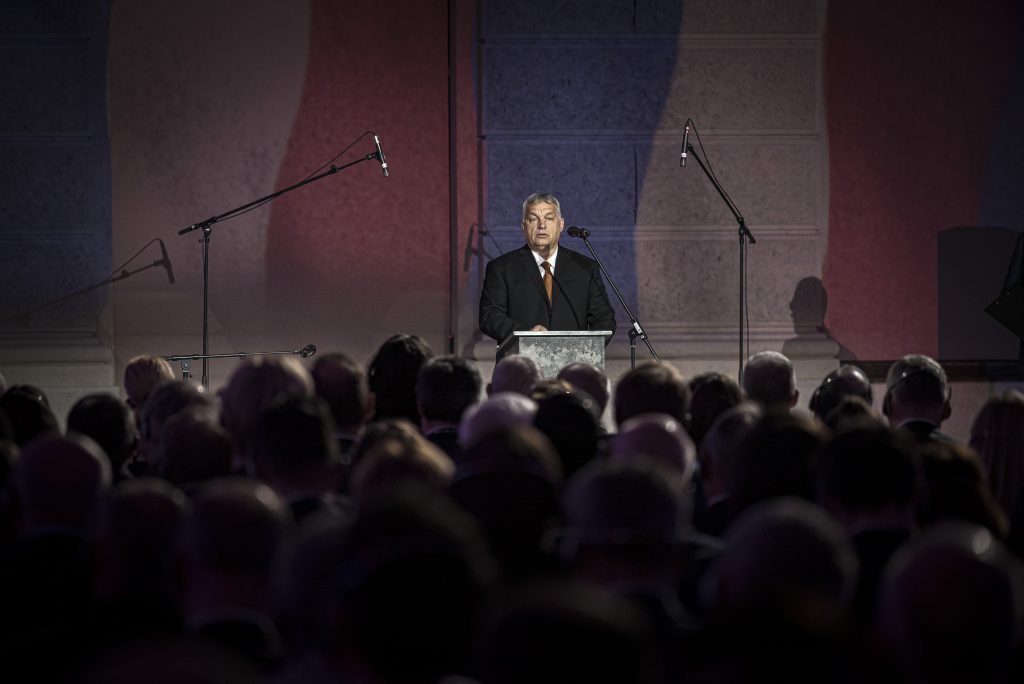
Addressing a celebration of the 30th anniversary of the Velvet Revolution in Prague on Sunday, Prime Minister Viktor Orbán said that thirty years ago central Europeans had been self-confident enough to declare their region Europe’s future. “And knowing our achievements in light of Europe’s situation we can say with all due modesty that, today, we are indeed the future of Europe”.

“We are ready for this mission,” Orbán said. “Thirty years ago we central Europeans showed that we could not only die for our countries and for Europe but could live and work for them too.”

“Today, we share not only a common destiny but common goals too. The cooperation of central European countries is written into the hearts of the people of central Europe”.

This is why the coming years would be about the success of central Europe and the Visegrad Group, he added.

Orbán said that the Czech and Polish anti-communist resistance had served as a model for young Hungarians in the 1980s. This helped Hungarians to begin dismantling the communist system, he said, adding that it was now clear that belonging to the ’68 generation meant something radically different in West than in central Europe.

Photo by Vivien Cher Benko/MTI

He said that whereas the ’68 generation of the West strived to dismantle the Europe of free nation states and Christian culture, “our ’68-ers want to regain and protect these values.”

The message of 1968 in central Europe is still the same, he said. “We want to decide our own destiny.” “We want to live as a free nation, not as an imperial colony or subordinate,” Orbán said.

“We are central European democrats and we must protect the sovereignty of nation states. Because abandoning this [principle] would end our democracy.”

He said it was not a new ideological system that would improve Europe today. “We need simple human things: to live our own central European lives, to honour and protect our families, to enjoy our freedom, love our country and to be proud of our nation.”

Orbán said that

“Central Europeans have their own language: the language of freedom, independence and solidarity with one another. This language gives us an independent and distinct voice in the large family of European nations. This is why central Europe today is not only a geographical concept but a political, economic and cultural reality.”

All the premiers of the Visegrad countries — Czech leader Andrej Babis, Polish leader Mateusz Morawiecki and Slovakian premier Peter Pellegrini — addressed the commemoration, together with Wolfgang Schauble, President of the German Bundestag.

Orbán in Pozsony: Slovakia, Czech Rep also fought for Hungary’s freedom in Velvet Revolution

Slovakia and the Czech Republic also fought for Hungary’s freedom in the Velvet Revolution, Prime Minister Viktor Orbán said in connection with the commemoration of the 30th anniversary of Prague’s Velvet Revolution.

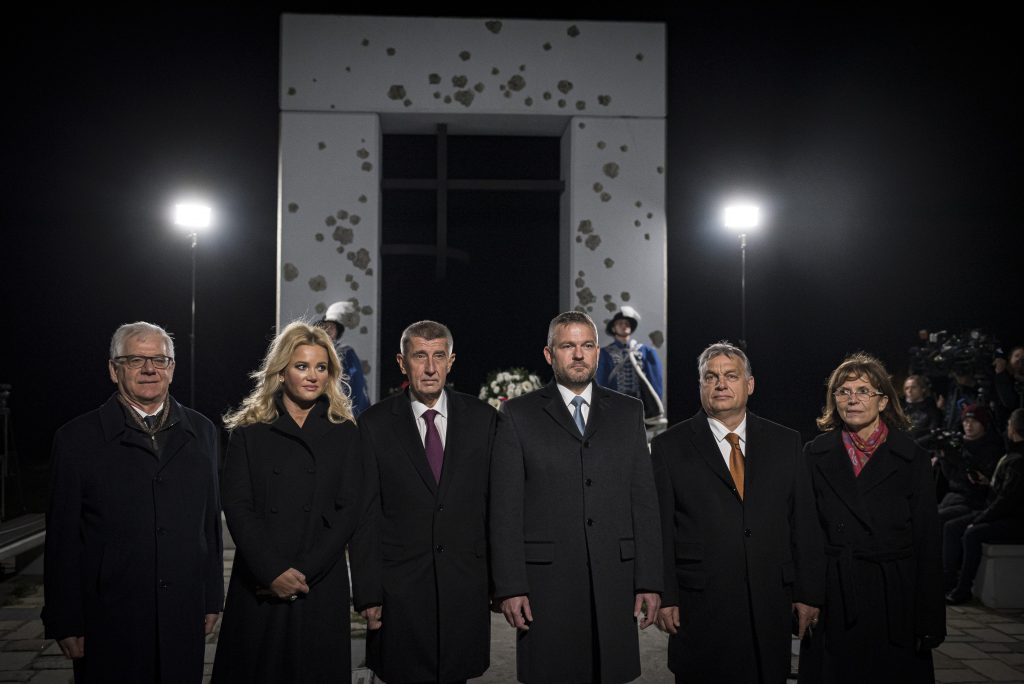
From eight to left: Anikó Lévai (PM Orbán’s wife), PM Viktor Orbán, Slovakian PM Peter Pellegrini, Czech PM Andrej Babic, his wife, Monika Babisova, and Polish Foreign Minister Jacek Czaputowicz. Photo by Vivien Cher Benko/PM’s Press Office

“I’m here to pay tribute to Slovakia and the Czech Republic for their brave acts during these very important days, when they also fought for Hungary, thereby contributing in a significant way to Hungary’s freedom…” Orbán told journalists in Pozsony (Bratislava).

Orbán noted that the countries of the region had experienced the same fate — the Soviet occupation and the lack of freedom in private and public life — in different ways but for the same reason. This is why, he added, that successive revolutions triumphed in a chain reaction.

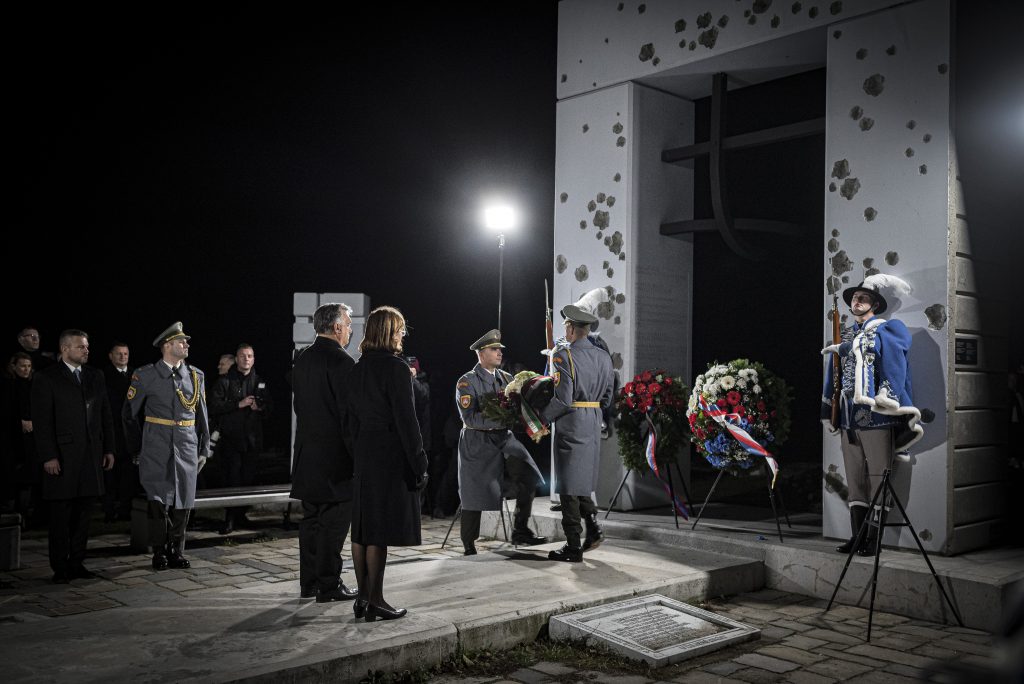
PM Orbán and his wife, Anikó Lévai, at the Gate of Freedom Memorial. Photo by Vivien Cher Benko/PM’s Press Office

Meanwhile, commenting on cooperation with his Slovakian counterpart Peter Pellegrini, Orbán said central Europe was strong again. The post-Soviet transformation into a free society and economy had been difficult, he said. “Now Slovakia is a successful country … and we’re on the road to catching up with more fortunate western countries.”

He said success did not depend on a single individual. “Slovakia has good leadership, so Slovakia is a successful country,” he said.

Orbán said he must give Pellegrini credit for his commitment to good Hungary-Slovakia ties and for being a good friend of Hungarians living in Slovakia as well of Hungary itself. “I’m ready to work with him.”

In the featured photo: PM Orbán in Prague. Photo by Vivien Cher Benko/PM’s Press Office

(Hungary Today / MTI)

Reklám
Tas J Nadas, Esq

In Memoriam Dr. Béla Bognár 1931-2019

Washington, DC – Members of the Hungarian American Coalition (Coalition) were deeply saddened to learn that Dr. Béla Bognár, Professor Emeritus of the Departments of Social Work and Medicine in Society at Wright State University and founder of the Coalition’s Bognár Family Hungarian Scholarship Fund passed away on September 24, 2019. He was 88 years old.

Dr. Béla Bognár

Professor Dr. Béla Bognár was born on September 20, 1931, in Pakod, Zala County, Hungary. Dr. Bognár attended the Piarist High School in Veszprém for two years. After the communists abolished the Catholic high schools, he transferred to and graduated from Révai High School, Győr. His dream was to become a Latin and Hungarian Literature teacher, but he was only accepted for Teachers’s College in Pécs as a mathematics and chemistry major. After a year in Pécs (1952-53), he transferred to Eötvös Lóránd University in Budapest and joined a group of Catholic students who worked with 2 children (with their parents’ permission) to instill religious principles. Typically, members of the group spent many hours with the children on Saturdays and Sundays.

In 1954 before the fall semester began, five members of the clandestine group were kicked out of the university, one of whom was Dr. Bognár. They were also kicked out of Budapest. Dr. Bognár found a factory job (at EDASZ) in Győr where he worked until the summer of 1956 and played soccer on the factory team. He left Győr to rejoin some of his former classmates who also went back to Budapest and together joined the Petőfi Circle.

He participated in the fight against the Russians from October 23 to November 9, 1956. He was part of a small group which fought on the streets from Üllői to Soroksári Roads. On November 10 he went home to Zala to pick up his French dictionary, his prayer book and his ski boots. On November 11, 1956 he crossed the border to Austria and headed for Leuven, Belgium, to start a new life.

Dr. Bognár began by finishing the Ecole Social de Louvain in 1961 (BS with Magna Cum Laude). In Belgium, Dr. Bognár met and married Andree Vandermotte, with whom he would eventually have two sons.  After immigrating to the US, he attended the University of Wisconsin where he obtained MS and PhD degrees in gerontology, health and mental health policies. He continued his post-doctorate studies in mental health and aging at the University of California at Berkeley and at the University of Southern California, receiving certificates in both institutions.

Beginning in 1974, Dr. Bognár taught a generation of professionals who worked in the fields of social work and aging. He wrote four textbooks and countless articles on health and aging policies. For 15 years he was an advisor to the Ohio Department of Aging in the area of gerontology education. In 1988, he was given the Gerontology Teacher Award by the Ohio Network of Educational Consultants in the Field of Aging (ONECA).

In 1999 Dr. Béla and his 2nd wife, April Bognár established the Bognár Family Hungarian Scholarship Fund (BFHSF; originally named the Hungarian Scholarship Fund) to provide assistance to qualified Hungarian university students living and/or studying in Hungary, Romania, Ukraine, Slovakia, Serbia, and the United States.

In the spring of 2014 Dr. Béla and April Bognár requested the Coalition to become the administrator of their scholarship fund as part of the Coalition’s comprehensive leadership training and educational portfolio. Since its inception, the scholarship fund has awarded more than $700,000 to 255 Hungarian students in the US and the Carpathian Basin raised from members of the Hungarian American community; churches; organizations; the Sunshine Lady Foundation (SLF), directed by Mrs. Doris Buffett; and recently, by the Ambassadors of the Future.

Dr. Béla Bognár was also honored by the Hungarian government with the Knight’s Cross of the Order of Merit (Magyar Érdemrend Lovagkeresztje) on August 20, 2015.

In 2017, one of the major supporters of BFHSF, the Ambassadors of the Future also honored Dr. Bognár for his life-long work in supporting Hungarian students in need. In his video message thanking the organizers, Dr. Bognár recalled that it was his grandmother who inspired him to establish the scholarship fund. When departing from Hungary in 1956, she said a few farewell words, which guided his life from then on: “Remember my little Béla what I repeated to you throughout these years: what you do for others, gives meaning to your life”.

Dr. Bognár is survived by his loving wife, April, his two sons, Steven and John Bognár, their respective spouses, Julia and Jenniffer, his step-daughter Melissa, his granddaughters Lola and Lela, and his great-grandchildren Beau and Dory.  In lieu of flowers, Dr. Bognár’s family requests donations be made to the Bognár Family Hungarian Scholarship Fund. Details on his memorial service to be held in the Dayton, Ohio vicinity will be released at a later date.

The Hungarian American community mourns the loss of this true Hungarian patriot, deeply committed to the Hungarian-American community and his homeland, a selfless philanthropist, and a genuinely good man.

September 27, 2019 | Washington, DC

Source: hacusa.org

Reklám
Tas J Nadas, Esq

Kövér: ‘Having Children is Public Affair’

House Speaker László Kövér said in his speech at the Budapest Demographic Summit III on Thursday, that “having children is a public affair of the most personal kind”.

The Fidesz politician suggested that it should be made “the most important public issue in social, economic, cultural, and political terms” in each European country to help the bloc survive.

Kövér added that the Hungarian government’s aim was to promote childbirth and increase the country’s reproduction rate to 2.1 by 2030.

Featured photo by Szilárd Koszticsák/MTI

Source: hungarytoday.hu

Reklám
Tas J Nadas, Esq

Film Premiere! – The Hungarian film director who conquered Hollywood

A film has been made about the life of Hungarian film director Michael Curtiz (Mihály Kertész), famous for his greatest work, the world-famous “Casablanca.” The official premiere of the movie, “Curtiz – The Hungarian who subverted Hollywood,” can be watched on 12th September.

“Mihály Kertész realised such an international career that it is desired by the majority of film directors; however, regarding his personality, he was unable to ‘Americanise,’ which served as the basis of humorous situations. This was also intended to be shown in the film, apart from drawing attention to his memory that we can be proud of, despite his grumpy and grouchy personality,” said Yvan Tamás Topolánszky, the film’s director and screenwriter. He also added that Michael Curtiz is one of the few Hungarians whose life and personality are interesting on an international level as well.

As igenyesferfi.hu describes, the story starts in 1942 when the Hungarian-born filmmaker, Mihály Kertész, worked on his romantic film “Casablanca,” and the United States entered World War II. In order to support war propaganda, state leadership ordered officials for the supervision of filmmakers, as a result of which, the director had to overcome several barriers, in addition to the challenges in his private life.

“The film depicts reality in 85%, and only some differences can occur in timing. He added that the character of the officer, Johnson, who inspected Curtiz, is not real; however, film control really existed. Kertész had a daughter who wanted to get in touch with her father, but it is questionable whether this happened during the period of directing Casablanca,” reported Zsuzsanna Bak, the film’s screenwriter.

The main character of the black-and-white biographical movie is acted by Ferenc Lengyel. Curtiz’s daughter is played by Evelin Dobos. Apart from them, foreign actors can be seen, such as the American twins Yan and Rafael Feldman, Declan Hannigan, and Scott Alexander Young.

The film won the Award of the 42nd Montreal International Film Festival.

“When we were filming the movie, we got in contact with Curtiz’s family and received a personal relic, a belt with the director’s monogram on it,” recalled Claudia Sümeghy, the film’s producer.

In Hungary, the film is distributed by test screening before the official premiere on 12th September.


Featured image: www.facebook.com/CurtizFilm/

Source: igenyesferfi.hu / dailynewshungary.com

Reklám
Tas J Nadas, Esq

Hungary ready to continue cooperation with Italy, Orbán tells Conte

Prime Minister Viktor Orbán has congratulated Giuseppe Conte on his appointment as prime minister of Italy, in a letter, Orbán’s press chief said on Saturday.

“I salute you as a Prime Minister of Italy who has recently proved his commitment to the development of relations between our two countries,” Bertalan Havasi quoted Orbán as writing in the letter.

“I trust that, as in our joint efforts to date, in the future we will also be able to rely on you in the further enhancement of Hungarian-Italian cooperation and the creation of a competitive Europe comprising strong nations,” Orbán wrote, assuring his counterpart that Hungary was ready to continue working with Italy.

“I wish you good health and much success in the continuation of your responsible work,” Orbán concluded.

Italy’s new coalition government between the anti-establishment Five Star Movement and the centre-left Democratic party (PD) was sworn in on Thursday.

Source: MTI / dailynewshungary.com

Reklám
Tas J Nadas, Esq

Ohio National Guard Airmen train Hungarian partners on airfield management

Eight Airmen assigned to an Ohio National Guard mobile training team conducted an intermediate airfield management course for members of the Hungarian Defence Forces July 29-Aug. 2 at Pápa Air Base.

National Guard members taught the course alongside air advisers from Ramstein Air Base in Germany. The Ohio National Guard conducts regular engagements focused on sharing best practices and learning from Hungary, its state partner for the last 26 years as part of the Department of Defense State Partnership Program.

“We taught various facets of managing the airfield to include parking plans for various types of aircraft and having a plan in place to run the airfield while maximizing safety,” said Tech Sgt. Andrew Lipian, an aviation resource manager assigned to the 164th Operations Squadron at the 179th Airlift Wing in Mansfield, Ohio. “We taught the hierarchy within the airfield management career field and we engaged in real-world exercises.”

During the training period, the Airmen also taught a familiarization course focused on flight line safety emergency procedures, cargo handling and air base occupational health.

This year’s course built on the foundation of the information presented last year during the beginner’s course, and is part of a three-course series focusing on joint training and sharing best practices.

“Ohio has been the state that has supported us in several areas,” said Brig. Gen. Nándor Kilián, the inspector of the Hungarian air force. “There is a lot of room to improve. The basic thing is to exchange the knowledge, exchange the possibilities and to learn from each other. This is the main goal, to cooperate.”

One aspect of the course was firefighting training, as the mobile team and air advisors trained Hungarian military members on firefighting techniques to improve flight line safety knowledge and skills. They also showcased how firefighters work closely with airfield management and air traffic controllers to improve the overall effectiveness of in-flight emergency response.

Another teaching point of the course was familiarization with occupational health. Ohio National Guard occupational health specialists assessed and provided insight on the Hungarian Defence Force’s current program. Based on their observations, they were able to teach medical triage and advise their partners on additional ways to treat their service members who are exposed to environmental hazards.

At the end of the training, the Hungarians and Ohioans participated in a joint demonstration to showcase how air traffic controllers, airfield management, firefighters and medics all work together in an emergency response situation.

Ohio is dedicated to continuing building and strengthening its 26-year partnership with Hungary. With an increasingly unstable global environment, this partnership increases strength in peacetime, which will improve Ohio-Hungary joint capabilities in times of conflict.

“This is a long-term relationship,” said Brig. Gen. Todd Audet, the Ohio deputy assistant adjutant general for Air. “The more we work together, the more our relationship with the Hungarians strengthens. As the Hungarian air force transforms, we’re right there alongside them, helping them in that transformation.”

Ohio’s partnership with Hungary provides mutually beneficial training, builds cultural understanding and showcases the accomplishments of two nations collaborating to achieve security cooperation goals. Through military exchanges like the airfield management course, both nations are able to learn from each other and improve their policies and procedures.

“A great way to learn is by teaching,” Audet said. “You learn what your partners know and you learn what you’re teaching even better by sharing the information. Both the Hungarians and the Ohio National Guard service members have benefited in that regard.”

Since 1993, Ohio and Hungary have developed a partnership and friendship that has allowed both nations to come together and work as a united force. This partnership has transcended military training alone and developed relationships that will prepare both entities’ forces for the future.

Source: dvidshub.net

Reklám
Tas J Nadas, Esq

Sziget: Jane Goodall Inspires Festival-Goers to Change with Impressive Speech

This year’s Sziget Festival’s main message, ‘Love Revolution’ is about environmental consciousness and sustainable development. In this spirit, renowned primatologist, environmentalist, and UN Messenger of Peace Jane Goodall held a short but positive and inspiring lecture for the “Szitizens” about her life, motivation and hopes.

Goodall entered the stage right after legendary Franz Ferdinand finished their concert; although she noted that people were here primarily for the music, it was exciting to observe that hardly anyone left the area after the British band had said goodbye to the festival.

Organisers gave her only a mere 10 minutes, which apparently wasn’t enough for her to go into details, or to reveal something previously unknown but proved to be enough to make big impression and a change in view, which, hopefully, will result in better decisions regarding the world that surrounds us and living creatures.

Jane Goodall, aged 85, is considered to be the world’s foremost researcher of chimpanzees. Founder of the Jane Goodall Institute, she has worked extensively on conservation and animal welfare issues. She has served on the board of the Nonhuman Rights Project since its founding in 1996. In April 2002, she was named a UN Messenger of Peace.

Stylishly, she started off by imitating a chimpanzee greeting. First, she talked about her childhood memories, about the origins of her fondness of animals and Africa. How she had been observing chimpanzees’ behaviour through sixty years, how she realized that their behaviour resembles men’s.

The (chimpanzee) males compete for dominance, swaggering, looking big and strong, reminding me very much of many human, male politicians today”

She also told, how her dog taught her that not only human beings have mind, personality, and emotions, despite what some “scientist” said. When she first had to face climate change and that chimpanzees’ habitat was in danger, she realized that without the improvement of local people’s life, animal protection is unimaginable too.

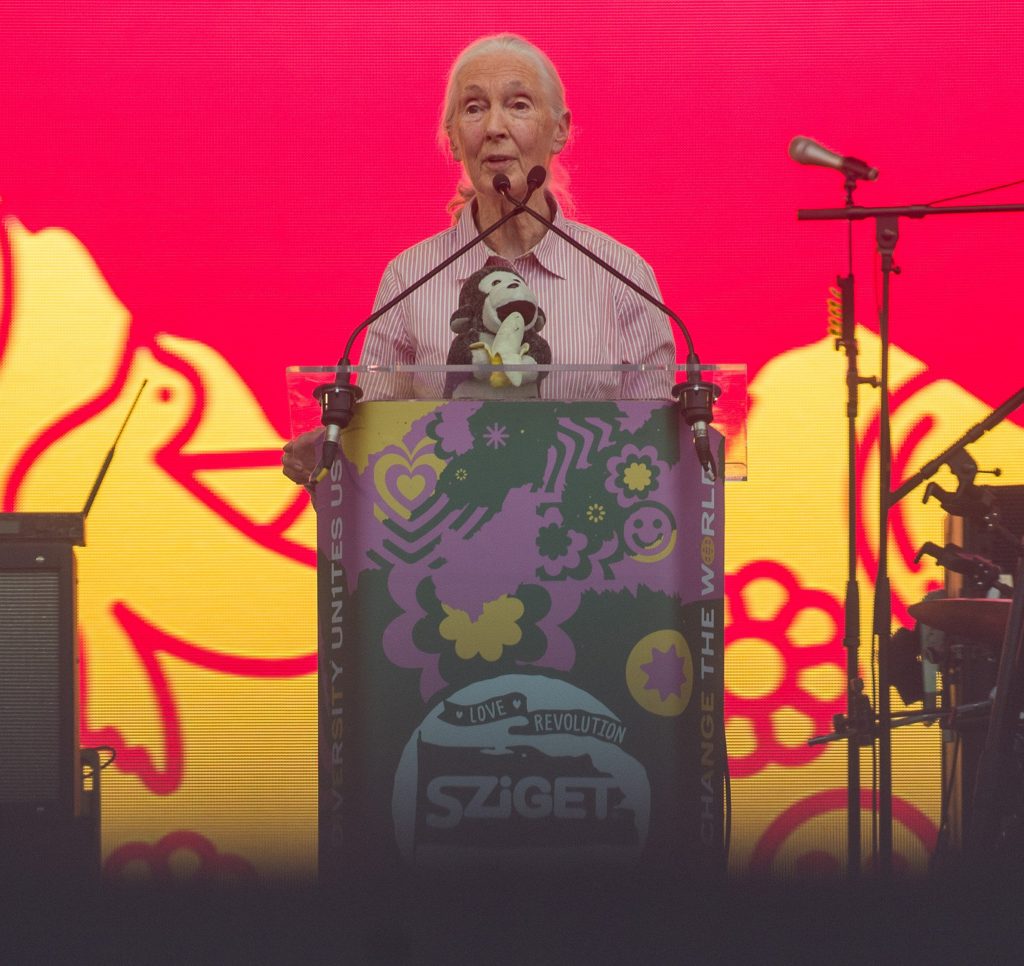
Jane Goodall at the Sziget Festival. Photo by Zoltán Balog/MTI

Perhaps, the most interesting and encouraging part was when she spoke about how she sees the future. She expressed her hope that the younger generations will understand problems, take action, and together change the world.

We can save the world, if we get together; we will save the world if we get together”

she concluded.

You can see her lecture in its entirety below (her speech starts at 8:20 min):

Following her appearance at the Sziget Festival, today, Goodall will visitSzeged too, where she will attend the opening ceremony of famous Hungarian wildlife photographer Bence Máté’s open-air photography exhibition.

featured image by MTI/Zoltán Balogh 

Source: hungarytoday.hu

Reklám
Tas J Nadas, Esq

Teqball: The Latest Sporting Craze Taking the World by Storm, Invented by Hungarians

Teqball, the new football-based sport invented by Hungarians, an exciting and fast-paced cross between football and ping pong is taking Brazil and the whole world by storm.

The sport was invented by former professional football player Gábor Borsányi and computer scientist Viktor Huszár. Among its fans and ambassadors, Teqball counts Carles Puyol, Robert Pires and Christian Karembeu, as well as Luis Figo and Gianfranco Zola. CNN has just discovered the game and published a lengthy article about the new “sporting craze taking the world by storm.” The article says that former Teqball ambassador, the Brazilian former superstar footballer Ronaldinho is also a self-confessed addict, who sometimes even play up to six hours with the football-based game.

YouTube player

This is not the first time the Hungarian invention has received international recognition. Prince Albert II of Monaco tried the game in his palace last summer, while the Brazilian team, who are using the game as part of their training regime, have brought it to the football World Cup with them to Russia.

In 2016, Ronaldinho arrived in Hungary to popularize the sport and film a commercial for the Hungarian company.

Source: hungarytoday.hu

Reklám
Tas J Nadas, Esq