Home Blog Page 17

Ursula Von Der Leyen on Twitter: ‘Good Talk with PM Orbán’

Ursula von der Leyen, the incoming President of the European Commission, and Prime Minister Viktor Orbán met in Brussels to prepare the work program of the next European Commission on Thursday. After the meeting the Hungarian PM seemed confident, telling public media that supporting the German politician for the job had proved to be a good decision. Recently, Von der Leyen also talked about the discussion in a similar, positive way, tweeting she had a good talk with Orbán.

After the meeting, no press conference was set up or press release issued but the Hungarian prime minister talked to state television M1. Summarizing his impressions about von der Leyen, Viktor Orbán saidthat the new EC president is pragmatic, capable of thinking like the Central Europeans, with similar thoughts to the Hungarian government on many issues.

When describing her first meeting with the Hungarian leader, the EC President-elect words were also positive.

In her recent Twitter post, von der Leyen agreed with the Hungarian prime minister that the EU needed a fresh start and pragmatic solutions in respect of migration. During the meeting, the key topic was the competitiveness of the European Union. Von der Leyen added that they had agreed that the EU institutions should be brought closer to member states. The EC President-elect also emphasized in her “report”, unlike Orbán, that the rule of law was indispensable and applied to everyone. She also added that a strong defense union was needed.

During the past week, the German politician had discussions with Polish Prime Minister Mateusz Morawiecki, Czech Prime Minister Andrej Babiš and Croatian Prime Minister Andrej Plenković.

Central European governments had backed von der Leyen’s candidacy in an effort to prevent Socialist Dutch politician Frans Timmermans to become head of the Commission. In an interview, Orbán said the main reason for the Visegrád countries not to support him is because they thought that “he is a fighter of ideologies and he is against anyone who has a different view of the world”.

Featured photo by Szilárd Koszticsák/MTI.

Source: hungarytoday.hu

Reklám
Tas J Nadas, Esq

Honvéd to File Appeal against Craiova After Referee Gets Injured by Romanian Fans

Yesterday, after 119 minutes of goalless play, the referee was hit on the head by a lighter, after a flare exploded right next to him in the Europa League qualifying match between Craiova and Honvéd. The incident resulted in the match being suspended for more than 30 minutes then the referee decided to continue the match and the Romanian side won the penalty shootout. Honvéd takes legal steps as the Hungarian club thinks the referee should have called off the game after the serious violation of the rules.

With the score 0-0, as it was in the first leg, a brawl broke out between players in the last minute of extra time. A smoke bomb was thrown from the stands at the pitch and exploded near referee Arnold Hunter. Within moments a lighter struck the referee and he needed treatment. An ambulance arrived on the pitch and the match did not restart for more than half an hour.

The referee team walked off amid lengthy discussions over how to deal with the escalating scenes. Honvéd manager Giuseppe Sannino appeared to demand the tie be called off, but in the end, the game resumed with the fourth official taking a charge. In the shootout, in which only former Liverpool striker David N’gog scored for Honvéd, Craiova won 3-1 and progressed into the third qualifying round.

Hungarian side Honvéd said in a statement that the match should have been called off following the scandalous scenes during the game. The club announced that they will file a complaint against the decision to continue the match, as

What happened at the end of the match was unacceptable to our club. The leadership of Honvéd decided to lodge a complaint over the decision to continue the match under these circumstances, putting the referee or even players at risk.

According to the Europa League rules, a club may lodge a complaint to the European Football Association within 24 hours of the end of the match, if it objects to the validity or outcome of the game. The rules also state that clubs in the Europa League must take responsibility for the behavior of their players, officials on behalf of the club as well as their supporters. The home team is also responsible for pre-match, mid-term and post-game security.

Origo asked former referee Ferenc Bede about the case, who said that a few years back rules had changed. According to the new rules, in these cases, it is now necessary to strive to complete the match, as a so-called isolated case. He also talked about the need to consider the scandal in case the referee calls off the match.

A former Romanian FIFA referee, Ion Crăciunescu, also spoke on the matter: he told Digi Sport that he was aware of two similar cases where the game continued after a member of the referee team was thrown with an object but later, in both cases, UEFA took the win from the team responsible for the incidents. This could mean that it is possible that Craiova will lose the match due to their supporters’ aggressive behaviour. Crăciunescu also said that the referee could only request a replacement if he was that injured he could not continue the match, however, Hunter made decisions and given out cards before the fourth referee took the charge.

Source: hungarytoday.hu


Reklám
Tas J Nadas, Esq

Kossuth House News

KOSSUTH FOUNDATION ANNOUNCES SIGNIFICANT DEVELOPMENTS TOWARD RE-ESTABLISHMENT OF A HUNGARIAN CULTURAL CENTER IN WASHINGTON, D.C.

Washington DC. The Kossuth Foundation is pleased to announce that the Government of Hungary has purchased the historic Kossuth House.  This property has served as a center in Washington DC for the Hungarian-American community and will once again be a community center for those of Hungarian ancestry and visiting Hungarian nationals. Named the Kossuth House, after the Hungarian freedom fighter of the 1848 Revolution in Hungary, Lajos Kossuth, the building had served as the home of a nonprofit fraternal life insurance company, the Hungarian Reformed Federation of America (HRFA), which was established in 1896 with a Federal charter approved by Theodore Roosevelt.  For decades, the building served as a meeting place for visiting Hungarian artists and dignitaries and as the unofficial embassy of “Free Hungary” during the Communist era.

The building will continue to be managed by the Kossuth Foundation, an independent, not for profit; the successor to the charitable work carried out by HRFA under a long-term management arrangement with the Government of Hungary.  The building is being purchased from a joint venture (JV) established between the Kossuth Foundation and a New York real estate developer, Silverback Development.  In 2017, the building was reacquired by this Joint Venture after litigation to resolve ownership rights brought by the successor life insurance company that merged with HRFA in 2011.

The government of Hungary, in partnership with the Kossuth Foundation, has agreed to provide the funding needed for some essential repairs.  These improvements would provide needed upgrades to the existing two-story structure built in in 1934 and designed by noted architect, Gertrude Sawyer.

The legal work was performed by Robert Gage and Edward Dix of Covington & Burling LLP. Their professionalism and excellent counsel over the past seven years helped the Foundation to successfully conclude this complex international real estate transaction.

 “We are delighted to complete this transaction which will fulfill the dream of maintaining a Hungarian American community center in Washington DC” said Gábor (Gabe) Rózsa, Executive Director and Chairman of the Foundation’s Board of Directors.  The building will continue to be home to a Hungarian lending library, language classes and a variety of lectures, films, educational and cultural programs for the Hungarian-American community in the DC metro area under the direction of the Foundation.  We look forward to working with the Government of Hungary, and members of the Hungarian American community, make the Kossuth House fulfill the role it has served over several decades.”

Source: kossuthfoundation.org

Reklám
Tas J Nadas, Esq

Orbán Meets Caputova: Hungary, Slovakia Important Partners

    Prime Minister Viktor Orbán met Slovak President Zuzana Caputova for talks on bilateral ties, cooperation in the Visegrad Group, as well as European Union issues in Budapest on Thursday, Orbán’s press chief, told MTI.

    Orbán and Caputova agreed that Hungary and Slovakia consider each other important partners “in light of a shared past and with regard to ethnic minorities” Bertalan Havasi said. He quoted Orbán as saying that Hungary-Slovakia ties have been continuously improving since 2010 and the two countries “have achieved excellent results together”.

    Parties at the talks noted the “strategic importance” of the Visegrad cooperation, Havasi said.

    At the talks, Orbán congratulated Caputova, who took her post last month, and thanked her for selecting Hungary as one of her first foreign destinations as Slovak president.

    Featured photo by PM’s Press Office

    Source: hungarytoday.hu

    Reklám
    Tas J Nadas, Esq

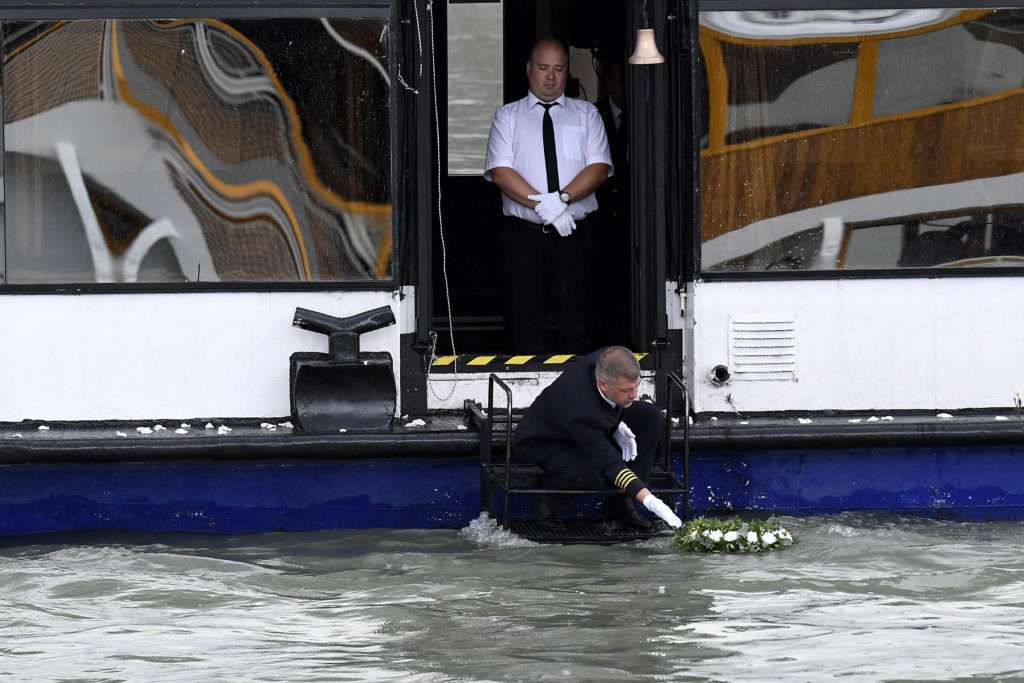
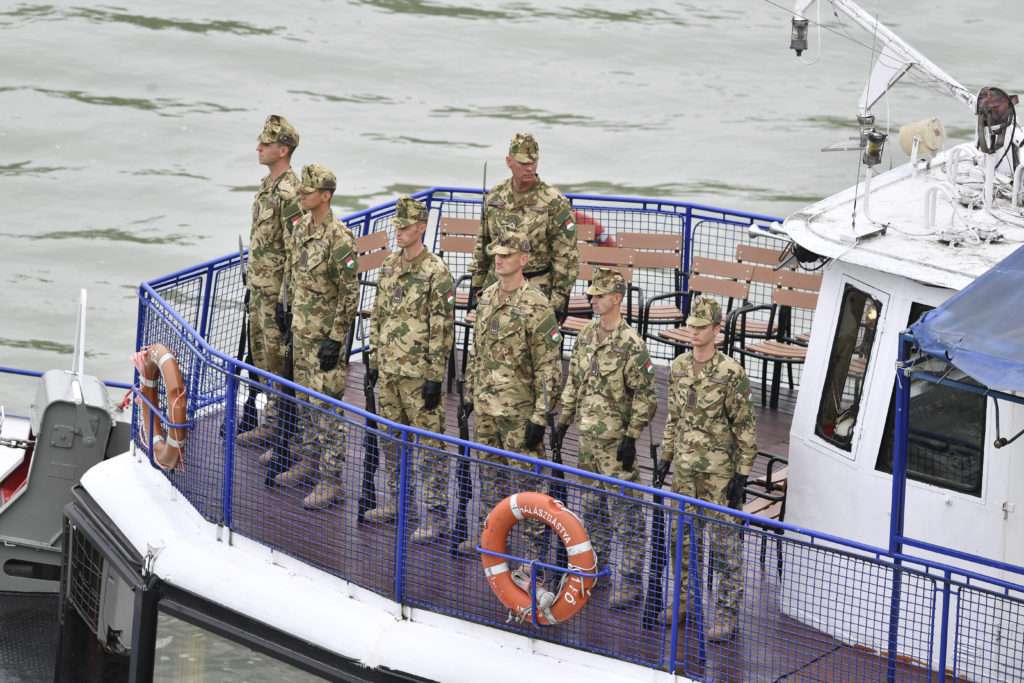
    Ship collision in Budapest – Memorial event held on Danube River

    A commemoration were held near central Budapest’s Margit Bridge on Friday.

    They paid tribute to the Hungarian crew of the Hableány sightseeing boat which capsized and sank in the river on May 29.

    Ship collision in Budapest - Memorial event held on Danube RiverPhoto: MTI
    Ship collision in Budapest - Memorial event held on Danube RiverPhoto: MTI

    The vessel was carrying 33 South Korean tourists and a crew of two Hungarians when it collided with a large cruise ship. Seven tourists were rescued from the River Danube but all others died in the collision.

    The ceremony was held simultaneously on several ships, started at 11am today.

    The urn containing the ashes of the sailor of the sunken boat is placed from a ship into Danube by a ship’s captain during the funeral ceremony of the two Hungarian victims.

    Ship collision in Budapest - Memorial event held on Danube RiverPhoto: MTI

    The remains of the captain of the boat will be buried on the land later.

    Participants joined the commemoration on the Pest side of the river south of Margit bridge.

    Ship collision in Budapest - Memorial event held on Danube RiverPhoto: MTI
    Ship collision in Budapest - Memorial event held on Danube RiverPhoto: MTI
    Ship collision in Budapest - Memorial event held on Danube RiverPhoto: MTI
    Ship collision in Budapest - Memorial event held on Danube RiverPhoto: MTI
    Ship collision in Budapest - Memorial event held on Danube River

    As we wrote a week ago, a body found in the River Danube near Makád, around 50km south of Budapest, has been identified as a victim of the sinking of the sightseeing boat Hableány. A search continues along the river downstream from the city to recover the body of one South Korean tourist still missing. Read more HERE.

    Source: MTI

    Reklám
    Tas J Nadas, Esq

    Ruling Parties’ Majority Lifts Opposition MP Demeter’s Immunity

    Parliament has voted to lift the immunity of LMP lawmaker Márta Demeter on Friday, with 131 votes in favour and 52 against.

    The two-thirds of votes cast followed a call by public prosecutor Péter Polt for Demeter to face criminal prosecution. Demeter stands accused of disclosing confidential military information on social media.

    Last October, Demeter submitted questions to the interior and defence ministers asking them why a minor named Flóra Orbán, whom Demeter had wrongly assumed to be the prime minister’s daughter, had been allowed to travel on an Airbus operated by the Hungarian army.

    Demeter said she was ready to defend herself in court. She insisted that her “case of high treason” was aimed at intimidating deputies “so that they are discouraged from asking questions and from controlling the government”. She added that she had been doing her job by asking questions, and she called the charges against her “baseless”.

    Source: hungarytoday.hu

    Reklám
    Tas J Nadas, Esq

    Fidesz: Opposition Can Lose Positions after Campaign in EP against Ruling Parties

    Fidesz group leader Máté Kocsis told opposition Democratic Coalition party MEP Csaba Molnár that they could lose parliamentary positions in Hungary if they continue their campaign against Fidesz nominees in the European Parliament. Prior to the open letter, Hungarian opposition parties — the Democratic Coalition, Socialists (MSZP) and Momentum — managed to postpone the vote for three committees since it was doubtful if the Fidesz nominees could get the required support. On the other hand, Tamás Deutsch and Kinga Gál (of ruling party Fidesz) acquired the necessary votes in their committees and Lívia Járóka of Fidesz was also elected EP’s Vice-president despite the opposition’s campaign.

    Hungarian liberal opposition party Momentum has started to campaign in the European Parliament against the appointment of Fidesz politicians as leaders of the committees, when ruling Fidesz’s MEP Lívia Járóka was nominated vice-president of the European Parliament, and leftist Democratic Coalition and Socialists (MSZP) soon joined them. Since only the candidates’ party families are written on the ballot, the Hungarian opposition found it important to note that some European People’s Party nominees are from Fidesz, the Hungarian ruling party widely-criticized in Europe for its suspected abuse of the rule of law and “anti-European politics” among other things. Fidesz has been suspended in the EPP for months and its fate has yet to be decided.

    However, as of now, the Hungarian leftist-liberal opposition parties haven’t really achieved their goal as both MEP Deutsch and MEP Gál were elected to their committees, and MEP Járóka’s aspiration for EP Vice-president also resulted in success. The decision about Balázs Hidvéghi and László Trócsányi (Committee on Civil Liberties), and Andrea  Bocskor (Committee on Culture and Education) are still up in the air.

    But the anti-Fidesz campaign angered the ruling parties as in their opinion, the opposition parties were agitating against their home countries. In a letter posted on Facebook on Thursday, Máté Kocsis, the group leader of Fidesz, said that they had information that DK had instigated a vote against Fidesz candidates for EP committee positions in the EP’s Social Democratic Group.

    Kocsis said the move was unprecedented in Hungarian and EP history, adding that Hungary’s interest is to have as many Hungarian EP committee members as possible.

    You have done nothing other than turn round the will of the electorate … and the democratic decision of Hungarians”

    Kocsis concluded.

    The EP proceedings regarding the committee leaders are based on the European party family’s strength and not on nationality. It’s up to the party families to weigh the nominations accordingly to the member parties’ strength. So if Fidesz’s nominees fail, then EPP will probably name other, non-Hungarian candidates.

    The Fidesz politician voiced his opinion that, for the leftist parties, “pro-migration politics are more important than the interest of the nation.”

    In addition, he threatened the opposition party of losing its positions in the Hungarian parliament’s committees, emphasizing that after all that happened in Brussels it’s hardly arguable that a “pro-migration politician” could hold a leading position. Kocsis even named three DK politicians (László Varju, Ágnes Vadai, and Lajos Oláh) who are in risk of losing their chairmanships, adding that Fidesz has a sweeping majority in the Hungarian parliament to easily make such a decision.

    The pro-Fidesz media has also quickly begun to demand retribution for the opposition’s anti-Fidesz (in their view, anti-Hungarian) campaign in the EP. In Magyar Nemzet, Fidesz-founder and No. 1 opinion leader Zsolt Bayer accused the opposition parties of ‘dismantling the rule of law’ in Hungary, arguing that since Momentum, DK and the Socialists broke the ‘unwritten law’ of backing every Hungarian candidate in the EP, the ruling parties should do the same in Hungary and strip their politicians of their parliamentary positions immediately. He wrote that ‘against these people,’ the ruling parties cannot act like gentlemen. Pro-Fidesz Pestisrácok’s columnist, Tamás Pilhál, went as far as writing that these politicians are ‘sly assassins’ and they are not opponents but enemies. He added that ‘DK, Momentum and the Socialists represent the interest of Western superpowers, they are agent organizations under foreign hire. He advised that in defense against ‘enemies,’ any means are legitimately allowed in the fight.

    Although the Fidesz group leader addressed his open letter to the Democratic Coalition, the Socialists can also be affected as they took part in the EP anti-Fidesz campaign as well. However, Momentum has no MP in the Hungarian parliament.

    DK vows to stay course on its policies despite ‘threat’ of losing parliament committee positions

    Addressing a press conference on Friday, DK deputy group leader Ágnes Vadai said her party was proud to have convinced the Social Democratic Group to vote against the Fidesz candidates. She said that by doing so, they had “prevented Hungary’s ruling anti-European criminal organisation from acquiring important European positions.”

    MP Ágnes Vadai. Photo via DK’s Facebook page

    She said DK “doesn’t care about the mafia-like threats of the Orbán regime.”

    The opposition politician emphasized that “DK will not fall in line and will not assist the enemies of Europe and a European Hungary” even if the party would be stripped of its parliamentary committee positions “or if we wake up with horse heads in our beds.”

    In the featured photo: Máté Kocsis. Photo by Zoltán Balogh/MTI

    Source: hungarytoday.hu

    Reklám
    Tas J Nadas, Esq

    “I felt an overwhelming nostalgia for Hungary, which gave me the strength to work for Hungarians in Venezuela” – Interview with a Three-Generation Scout Family

    How do three different generations experience the severe political and economic crisis in Venezuela? How can the Hungarian Scout Association help, and how can the scouts even exist after years of Hungarians constantly leaving the country? Judit Kristóffy Nyisztor fled to Venezuela from the Soviet occupation of Hungary with her parents at the age of 10 – she says that now they experience almost the same uncertainty that she did as a child. Her daughter was born in Venezuela, while her granddaughter is a true Venezuelan-Hungarian girl who not only represents, but also educates the new generation of Hungarian scouts in the South American country. Hungary Today’s sister site, Ungarn Heute had the opportunity to talk to the 3-generation scout family, Judit Kristóffy Nyisztor (JKNY), her daughter, Ildikó Nyisztor (INY) and granddaughter, Zsófia Mirabal (ZSM) at the annual Friends of Hungary Conference, where the Hungarian Scout Association received the ‘Friend of Hungary‘ Award.

    ***

    You arrived on the last plane to Hungary from Venezuela. After the plane took off, the country’s airspace closed for a few days. What did you think in that moment?

    JKNY: We didn’t think it would be the last plane for a short time, but we were very happy to make it on board. It was not a smooth journey: we first landed in Curacao, then Lisbon, where we missed the connecting flight. We traveled a total of 29 hours before we arrived in Hungary.

    From the perspective of three different generations, do you see and experience the Venezuelan crisis differently?

    INY: We surely live it differently. My mother is 84 years old,  has been through the Second World War, and then she had to flee her home country from Soviet occupation. It would be difficult for her to start over and come back to Hungary. I’m still young for a change, but I’ve built my life in Venezuela, everything ties me there: my apartment, my job, and my daughter.

    ZSM: I’m only 18 years old, I’m still going to school, I’m going to graduate from high school now; but I also really want to stay at home in Venezuela and go to university there.

    Of course, the situation is difficult, which is why the idea arose to come to either Hungary or Germany to continue my studies.

    However, for me, Venezuela means home. I love it dearly and imagine my life there.
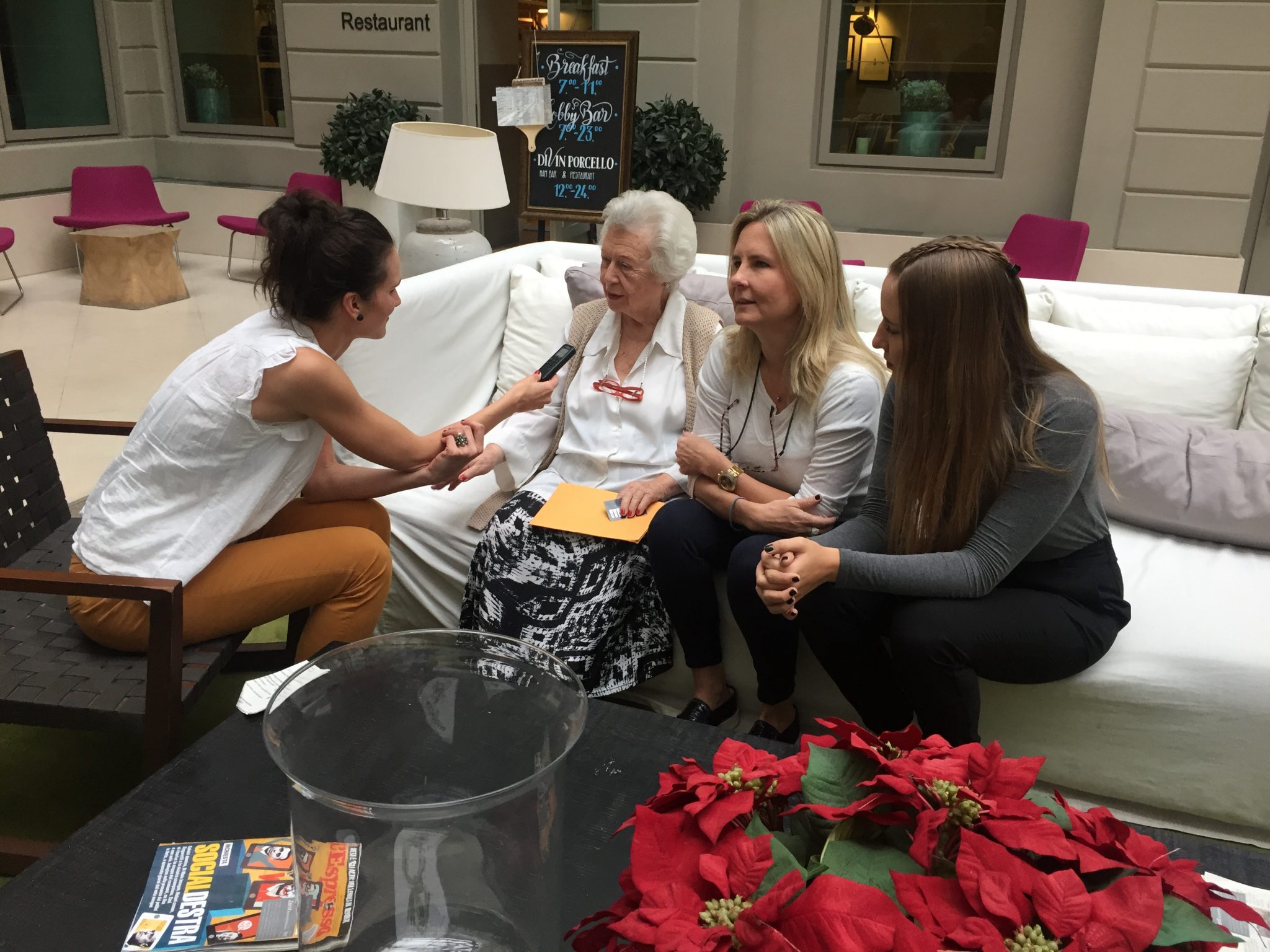
    From left to right: Judit Kristóffy Nyisztor, her daughter, Ildikó Nyisztor and granddaughter, Zsófia Mirabal.

    There is a lot to see and hear about Venezuela in the news, yet it’s hard to imagine everyday life. What’s the hardest part?

    JKNY: Shopping is a big problem, for one. Where do I get sugar or flour? Sometimes you have to go from one place to another to get everything. Our material circumstances have also changed a lot. The hyperinflation is so high, everything became so expensive that almost every meal is a problem. We lowered our needs a bit, we eat much more modestly. Imported, fine foods have not been available for a long time now, but of course we are fine without them as well. I have already lived like this when we fled to Austria and then to France after ’45… Back then, we learned how to divide up what little we had.

    INY: The other issue is public safety.

    We take Zsófi everywhere by car, we do not let her go anywhere alone. So her freedom is also limited; but you have to take care.

    After 7-8 p.m, the streets are empty and it is very dangerous to leave the house at night. This is something that would make me consider leaving the country.

    This is a constant worry for a parent. How does an 18-year-old see this? Zsófi, are you afraid to go out in the streets? Is it even possible to deal with this issue more casually at a younger age?

    ZSM: This is a very difficult question, because obviously, young people there also like to go out to parties,  meet with friends, or sit in a restaurant, just like anywhere else… I always have to go everywhere by car. We live this way, and I have accepted it. I love Venezuela.

    Is this situation transforming the communities? A lot of Hungarians have recently come back home…

    JKNY: Yes, of course, it transforms the community. There is a very nice place, our “Hungarian House,” where we always had a very active social life: we organized lunches, sports teams, and scouts still get together there. It has now reduced to minimal activity. Scout life and activities are limited, as fewer children are able to come to the events. And with the repatriation program, many Hungarians have come home from Venezuela. So the numbers of the Hungarian community have fallen quite a lot.

    Can such a crisis situation strengthen the role of scouting?

    INY: Yes, because the social work done by scouts is even more necessary. We can help and try to improve the situation of many poor people. Obviously, this work has become more difficult for us as well, because our numbers are falling, but we are trying to adapt to this situation.

    JKNY: Because of the worsening public safety situation, the number of scouting trips has also decreased. We have to look at carefully where we are going, what parts of the country we can safely travel to. Caracas is a beautiful city, there is a giant mountain, there would be many places to go to, but now, in this situation, we cannot let the children go alone.
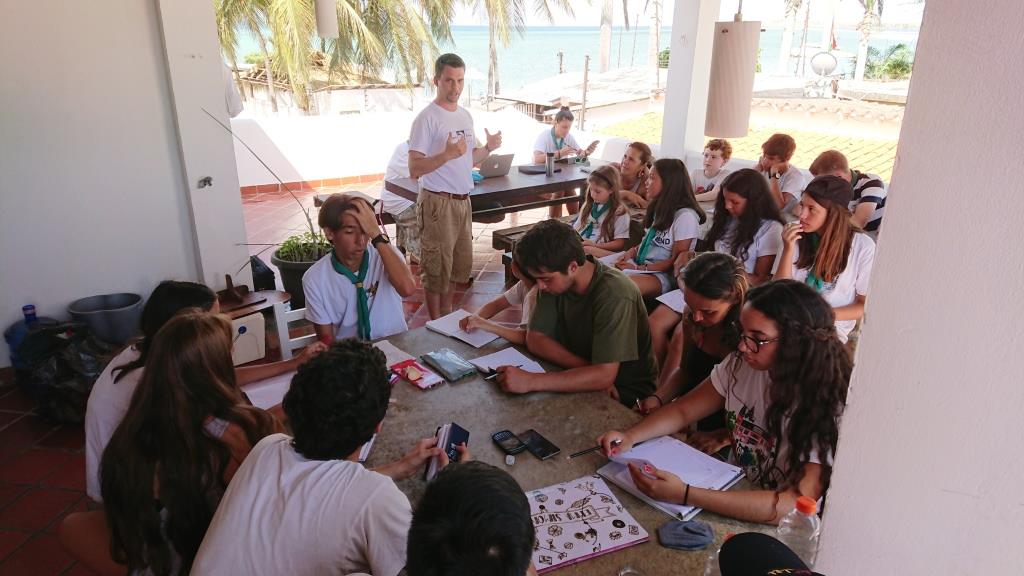
    Hungarian scouts in Venezuela. (photo: venezuelaimagyarok.blog.hu)

    And that is one of the main features and essence of scouting that older children are watching out for the smaller ones; more precisely, they teach the little ones a lot of things. Does the crisis overwrite this habit?

    INY: Yes, of course. For example, every year we have a 1-week camp at Easter. This year, it was only 3 days long, because of the crisis. Parents, completely understandably, were afraid to let their children go for a longer time and further away.

    Schoolchildren learn Hungarian folk dance, windsurfing and even the “Hungarian Knot” on Isla de Margarita in 2016. (photo: venezuelaimagyarok.blog.hu)

    Can politics filter into the life of scouting? Does it let the communities work?

    INY: Fortunately, politics is letting us do everything our way, and we still have the freedom in the work we do. Of course we are not politicizing, perhaps because of this. We are trying to work for the people and to pass along  ‘Hungarianness’ to the children.

    Zsófi, I guess you were born into the scouts, or at least you became involved at an early age?!

    ZSM: Yes, I became a scout at the age of 7, and since then I’ve been an active member. Not long ago, I completed the group leader training in Fillmore, NY.

    Although the situation in Venezuela is not that good now, it is great that at least we have scout groups.

    They may be small, but we carry on and work: we have two groups, one is the girl’s group, St. Elizabeth, and the other is St. Stephen, for the boys. Whatever happens, we’ll continue it, even if there are just seven of us now. We love Venezuela, Hungary and Hungarian Scouting. The goal is to preserve and pass along our Hungarian identity.

    You mentioned several times that the number of Hungarian Scouts has dropped a lot. Are there any exact statistics on this?

    JKNY: Yes, unfortunately this is the case. While 30 years ago there were 60-60 scouts per team, this number started to reduce over the years. 20 years ago, we only had 45-50 members. Now, together with the leaders in the two groups combined, there is a total of 25 scouts here.

    Hungarian Scouts in Venezuela.

    The Hungarian community is also shrinking, and many have come back to Hungary in recent years. Does this also make it more difficult to recruit new members?

    JKNY: There are still many Hungarians, but not all of them live in Caracas, so maybe this makes it more difficult as well. We are primarily trying to reach those who live here. But the number of Hungarians not only reduced because many have gone back home, but also because the number of births has dropped as well. There are fewer young couples and thus, fewer children. It is very interesting that mixed marriage has become more common in the third generation. More interestingly, from those families, where the mother is the one who is not Hungarian, comes to us at the Hungarian House. For them, scouting is a guarantee that their children will grow and succeed. So, I can say that it seems Venezuelan moms now support our scouting more than the Hungarians.

    The aim of Hungarian scouts around the world is to preserve and pass on Hungarian identity and traditions. What can be said about it that gives it a special Venezuelan trait?

    JKNY: We are an integral part of the Hungarian Scout Association as well. They create the programs, according to  age groups, worldwide. Local variation is perhaps the use of language; as many people do not speak Hungarian, Spanish is often used in scouting groups. And we can also see the Latin American influence on us.

    We are different from the other Hungarian scouts in the world since we live here. The North Americans or Australians might have a different attitudes.

    We smile more, we are more relaxed. We’ve became a bit more like Latin-Americans.

    How often can the scouts meet and what does such an occasion look like?

    ZSM: We sing many Hungarian songs, we learn the scout laws, we talk in two languages – besides Hungarian, of course, Spanish, because, as we have already mentioned, many do not speak Hungarian.

    But we also try to teach them the language so that we can keep the Hungarian identity alive.

    You never lived in Hungary. You “became Hungarian” thousands of kilometers from here. What do you think about the country?

    ZSM: In May, many of us came home to Budapest for the Friends of Hungary Conference, some of whom have never spent any time here in Hungary, but we all have Hungarian roots. Yet when we came back by bus from Esztergom,

    everyone knew the Hungarian songs and we sang them together. It was so beautiful and I felt at home.

    I certainly feel that way since my grandmother has told me a lot about Hungary.

    JKNY: I was 10 years old when I left Hungary. We first fled to Austria, then to France, and later we ended up in Venezuela. We were refugees, we fled from Soviet troops. Hungary was taken by the Soviets on April 4th, and we had already crossed the border to Austria by Sopron on March 31st. My parents didn’t want to live under Soviet occupation. I have come home several times since the regime change, and I still have relatives here as well.

    How did you experience fleeing the country as a child?

    JKNY: Many times I have thought about whether it has left me with trauma or not. I don’t think it has, but it  has certainly impacted my life. When we crossed the Hungarian border in 1945 and I looked back, I had a feeling that I wouldn’t come back here for a long time.

    Since then, I always had an overwhelming nostalgia for Hungary, which later also gave me the strength to work for the Hungarians in Venezuela.

    The two-years until we arrived in Venezuela was very hard.

    ZSM: My grandmother told me a lot about this. I know it was terribly difficult for her to flee her home country. Now that the situation has become difficult in Venezuela as well, I can see the stories she told me in a different light. I feel like I have just come to understand what she experienced.

    Have you ever planned to come home?

    INY: We never planned on coming back to stay, but we have visited many times. We lived well in Venezuela. Of course, this is changing now, but we’re still not planning to move back.
    From left to right: Judit Kristóffy Nyisztor, her daughter, Ildikó Nyisztor and granddaughter, Zsófia Mirabal.

    Zsófi, do your Venezuelan friends ask you about Hungary? It is really far from Venezuela, they must not really hear much about us.

    ZSM: Yes, I talk about it a lot, and I always say it’s my second country- that it is a very nice country and I love it. I have a friend to whom I have told so much about Hungary that he wants to come to Budapest with me and he would be happy to study here as well.

    Then scouting is pretty good image-building for Hungary…

    JKNY: Yes, we say many good things about Hungary. Hungarians living abroad can advertise the country very well. And indeed, for many people it is actually their first time hearing that there is such a country in Europe.

    ***

    Interview by Zsófia Nagy-Vargha/Ungarn Heute

    Translation by Fanni Kaszás/Hungary Today

    featured photo: Judit Kristóffy Nyisztor, founder of the Hungarian Scouting groups in Venezuela.

    Source: hungarytoday.hu

    Reklám
    Tas J Nadas, Esq

    Hungary Inks Deal on Trieste Port

    The state of Hungary on Friday signed an agreement on establishing a port and logistics base in Trieste to give Hungarian companies easier access to export markets.

    Hungary has purchased a 32-hectare plot with 300 m of seafront for 31 million euros in the framework of a 60-year concession agreement, Péter Szijjártó, the foreign affairs and trade minister, said at a joint press conference with Italian Interior Minister Matteo Salvini.

    Investments worth close to an additional 100 million euros will be carried out at the site, he added.

    Traffic passing through the port is expected to reach about 2 million tonnes a year, or 78,000 containers.

    Szijjártó called the agreement “one of the most important deals in recent years”, saying it was a strategically important one for Hungarian firms and the country. The minister said the deal would open a new chapter in Hungarian-Italian relations, adding that cooperation between the two countries “has never been this encouraging”.

    Szijjártó noted that Italy was Hungary’s fifth largest trading partner and the fifth most important investor in the country. He noted that there are some 700 Italian firms doing business in Hungary employing over 15,000 people.

    Salvini said he and Szijjártó had discussed cooperation in the areas of energy, farming and food production. The sides also touched on partnering on big infrastructure projects, he added.

    Szijjártó initially announced the government’s plans to set up a port in Trieste in June.

    featured image via MTI/KKM/Zsolt Burger 

    Source: hungarytoday.hu


    Reklám
    Tas J Nadas, Esq

    László Hámos remembered in the Hungarian Parliament

    Minority Leaders Recall His Professional Excellence, Personal Integrity

    On July 1, a memorial gathering in the Hungarian Parliament recalled the life and work of László Hámos, founder and president of the Hungarian Human Rights Foundation (HHRF), who passed away April 16 in New York.  Nearly 150 invited guests filled the Parliament’s Delegation Room, including family, friends, allies and co-workers from many countries.

    The memorial speeches gave eloquent testimony to László’s remarkable life and personal legacy. The first speaker was Zsolt Németh, president of the Parliamentary Committee on Foreign Affairs, who noted that Hungarian organizations in the Western diaspora, such as HHRF, acted as important catalysts for regime change in Hungary. Árpád János Potápi, Secretary of State for National Policy, praised László’s dedication over more than four decades of professional activity on behalf of human rights for Hungarian minorities. Bishop László Tőkés, the Hungarian Reformed minister whose resistance to the Ceausescu regime’s campaign of terror and intimidation sparked the Romanian revolution in 1989, expressed his personal gratitude to László, who fought relentlessly and successfully to keep Hungarian minority issues on the international agenda. Other minority leaders also expressed their indebtedness to HHRF’s literally life-saving actions during the Communist era: Miklós Duray, twice imprisoned by Czechoslovak authorities, whose case was championed internationally by HHRF; Géza Szőcs, a former editor of the “Ellenpontok” clandestine newsletter, whose first-hand information on the plight of the Hungarian minority in Romania was obtained, translated and disseminated by HHRF; and László Józsa, a leader of the Hungarian community in former Yugoslavia.

    Hunor Kelemen, president of the Democratic Alliance of Hungarians in Romania (RMDSz), noted that László’s unimpeachable reputation literally opened doors for Hungarian minority leaders visiting U.S. officials in Washington D.C. A statement by László Brenzovics, president of the Cultural Alliance of Subcarpathia (Ukraine) was read by his colleague György Kota, a former intern at HHRF, who added his personal recollections of László during the 1990’s. László’s niece, Ildikó Hámos, poignantly recalled László’s supportive love for family members and special capacity for listening. Finally, Zsolt Szekeres, HHRF’s newly appointed president, briefly touched on HHRF’s future direction, building upon the foundations laid by László.
    Also in attendance was László Kövér, president of the Hungarian Parliament. László Gy. Kiss, noted tárogató artist (traditional Hungarian wind instrument), provided musical interludes during the program.

    The entire program maybe viewed here.

    The memorial was organized and sponsored by:

    • Hungarian Human Rights Foundation (Magyar Emberi Jogok Alapítvány)
    • Foundation for the European Representation of Hungarian National Communities
      (Alapítvány a Magyar Nemzeti Közösségek Európai Érdekképviseletéért)
    • Pro Minoritate Foundation  (Kisebbségekért – Pro Minoritate Alapítvány)

    On June 22, László was posthumously awarded the Magyar Örökség Díj (Hungarian Heritage Award) in Budapest, in recogition of his four decades of activities to protect and promote the human rights of Hungarian minorities. Árpád Hámos, László’s brother, accepted the award on his behalf.

    YouTube player

    Source: Hungarian Human Rights Foundation newsletter

    Reklám
    Tas J Nadas, Esq

    Socialist Board Suspends Former MEP Szanyi’s Membership

    The national board of the opposition Socialists (MSZP) has suspended the memberships of Tibor Szanyi, outgoing MEP of the party, and Zoltán Fekete, Socialist leader of Pest county, the party told MTI in a statement on Friday.

    According to the statement, the board passed its unanimous decisions in the wake of “remarks and acts” by the two politicians in the opposition’s preselection campaign before the upcoming mayoral election, which it said have harmed the party’s reputation.

    Szanyi’s and Fekete’s membership will be suspended until completion of a disciplinary procedure, the statement said.

    Szanyi has publicly criticised the party’s leadership since the European Parliament election, in which he could not renew his mandate.

    A letter written by Fekete was published in the press in February, in which he accused party leaders of sweeping financial irregularities under the carpet.

    In the featured photo: Tibor Szanyi. Photo by Tibor Szanyi’s Facebook page

    Source: hungarytoday.hu

    Reklám
    Tas J Nadas, Esq

    Hungary Gross Wages Climb Annual 9 percent in April

    The average gross monthly wage for full-time workers in Hungary rose by an annual 9.0 percent to 371,131 forints (EUR 1,150) in April, the Central Statistical Office (KSH) said on Friday.

    Net wages grew at the same pace, reaching 246,802 forints.

    Calculating with twelve-month CPI of 3.9 percent in April, real wages were up by 4.9 percent.

    Excluding the 101,900 Hungarians in fostered work programmes, the average gross wage rose by 7.9 percent to 381,749 forints, while net wages grew at the same rate to 253,863 forints.

    Excluding fostered workers, the average gross wage in the business sector, which includes state-owned companies, rose by 10.2 percent to 390,243 forints. The average wage in the public sector increased by 0.8 percent to 364,073 forints.

    Full-time fostered workers earned gross 82,506 forints in April, 0.4 percent less than a year earlier.

    The data sources show that in January-April average gross monthly wage was highest in the finance and insurance sector, at 671,600 forints, and lowest in social health care services, at 234,000 forints.

    Men employed full-time earned monthly gross 391,400 forints on average during the period, while women earned 322,900 forints. The rates rose by 11.3 percent and 9.2 percent, respectively, on an annual basis.

    Analyst: slower wage grow surprise

    Analyst Péter Virovácz of ING Bank said the April single digit wage growth came as somewhat of a surprise, as it was last seen in January 2017. The slower pace of wage increases was certainly tied to lower wage increases in the government sector.

    Wages in the private sector still kept growing at a double-digit rate, with the pace above average in the construction and manufacturing sectors and below average in some segments of the services sector. In 2019 wage growth could average around 10 percent in the economy as a whole.

    Analyst András Horváth of Takarékbank said wages could grow by a little more than 10 percent this year and real wage growth could be 6.5 percent with chances of it being higher. Wage growth in April was driven by a shortage of skilled labour and the increase of minimum wages for said skilled workers.

    Featured photo by 123rf.com

    Source: hungarytoday.hu

    Reklám
    Tas J Nadas, Esq

    Hungary and Austria mark 30th anniversary of Iron Curtain opening

    The foreign ministers of Hungary and Austria, Péter Szijjártó and Alexander Schallenberg, marked the 30th anniversary of the symbolic dismantling of the Iron Curtain in Sopron on Thursday.

    The commemoration was held at the exact spot where then Hungarian Foreign Minister Gyula Horn and his Austrian counterpart, Alois Mock, opened the sealed border by symbolically cutting the barbed wire fence on June 27, 1989.

    “The Iron Curtain imprisoned Hungarians, but it was only a matter of time before … the core characteristics of the Hungarian people would surface…” Szijjártó said in his speech. “This is what the desire for freedom is like.”

    He said central Europe today is home to “robust, developing, proud” countries which are able to cooperate according to national interests and contribute substantially to Europe’s economy and security.

    Support for the Hungarian government is overwhelming, he said, giving it a mandate to stand up for national interests in debates over the European Union’s future.

    Schallenberg said the message of 1989 was “never to forget what we owe to European integration”. Today, the continent enjoys stability and wealth it didn’t have before, he said.

    The unification process is not yet finished because many feel that some are closer to power than others, Schallenberg said. The European Union should work to change that, he said.

    Before the commemoration, Szijjártó and Schallenberg discussed bilateral cooperation.

    Source: MTI

    Reklám
    Tas J Nadas, Esq

    Hungarian visiting lecturer position opens at CSU from fall 2020

    BREAKING NEWS: On June 24, 2019, the Cleveland State University and the Ministry of Foreign Affairs and Trade of Hungary (through the Balassi Institute) established a Hungarian visiting lecturer position at the university. The position is for 4 years, beginning from the fall 2020 semester. The lecturer will teach Hungarian and will educate CSU students about the Hungarian culture. It is a further requirement that the lecturer engage with the broader Hungarian community in Cleveland.

    The preparatory work has been supported by Dr. Endre Szentkiralyi, the president of the United Hungarian Societies, by Dr. Gregory M. Sadlek, Dean of the College of Liberal Arts and Social Sciences, and Dr. Zita Bencsik, the Consul General of Hungary from Chicago who helped the negotiations regarding this bi-lateral agreement.

    The present Fulbright scholar program between CSU and Hungary will be transferred from the College of Liberal Arts and Social Sciences to the Washkewicz College of Engineering.

    The interview with Dr. Zita Bencsik about this news (in Hungarian) will be aired first at Bocskai Radio, the voice of Hungary at WJCU 88.7 FM on Sunday June 30th at 3 p.m. and on bocskairadio.org

    BREAKING NEWS

    BREAKING NEWS: On June 24, 2019, the Cleveland State University and the Ministry of Foreign Affairs and Trade of Hungary (through the Balassi Institute) established a Hungarian visiting lecturer position at the university. The position is for 4 years, beginning from the fall 2020 semester. The lecturer will teach Hungarian and will educate CSU students about the Hungarian culture. It is a further requirement that the lecturer engage with the broader Hungarian community in Cleveland.The preparatory work has been supported by Dr. Endre Szentkiralyi, the president of the United Hungarian Societies, by Dr. Gregory M. Sadlek, Dean of the College of Liberal Arts and Social Sciences, and Dr. Zita Bencsik, the Consul General of Hungary from Chicago who helped the negotiations regarding this bi-lateral agreement. The present Fulbright scholar program between CSU and Hungary will be transferred from the College of Liberal Arts and Social Sciences to the Washkewicz College of Engineering. The interview with Dr. Zita Bencsik about this news (in Hungarian) will be aired first at Bocskai Radio, the voice of Hungary at WJCU 88.7 FM on Sunday June 30th at 3 p.m. and on bocskairadio.org

    Posted by Bocskai Rádió the Voice of Hungary at WJCU on Thursday, June 27, 2019

    Reklám
    Tas J Nadas, Esq