Home Blog Page 30

PM ORBÁN TO HOLD TALKS WITH CHANCELLOR KURZ IN VIENNA

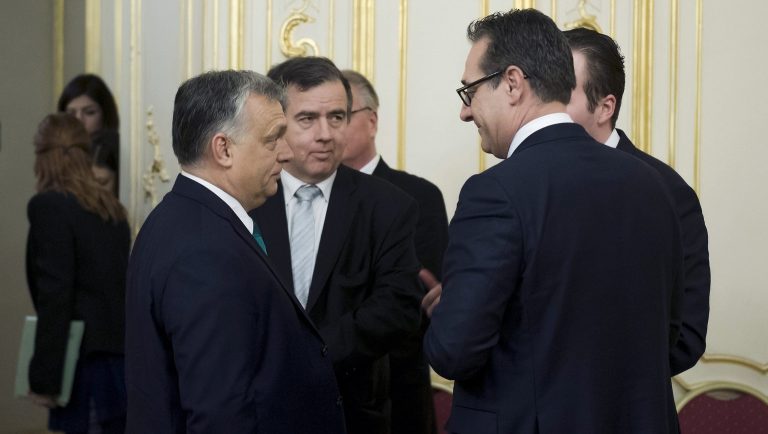
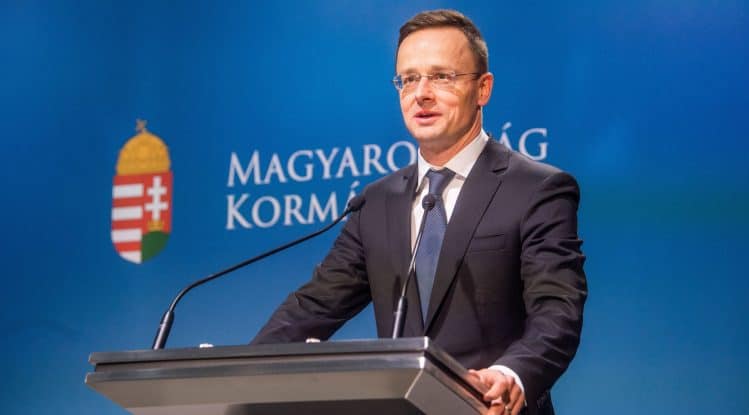
PM Orbán with Heinz-Christian Strache, Vice-Chancellor and head of the Freedom Party of Austria (FPÖ) at the Hungarian Embassy in Vienna. Photo: Koszticsák Szilárd/ MTI.

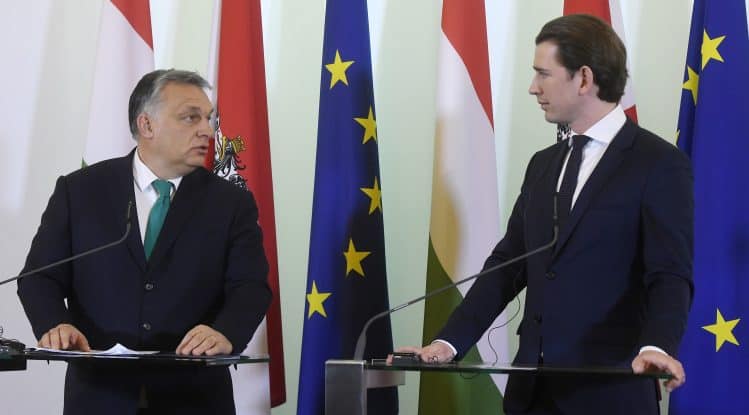
Yesterday PM Viktor Orbán paid an important visit to hold talks with Austrian counterpart Sebastian Kurz in Vienna. As HT reported earlier, after the elections in Austria an improve in relations was expected by many. This was the first time they met and discussed a number of issues.

On Paks expansion, PM Orbán said that is not an Austrian-Hungarian issue but a European one to be settled by European legal forums and Hungary will make every possible effort to ensure that the difference in opinions about nuclear energy does not harm bilateral relations. Sebastian Kurz voiced the Austrian government’s protest against the involvement of state aid in the project, which he said should be investigated. If regulations are broken, Austria will exercise its options for legal action. Last March European Commission granted its approval to the Hungarian state’s aid which allows to expand Paks power plant, however Austria decided to launch a lawsuit against this decision.

One of the main topics to discuss was that Austria has recently announced to plan to cut family benefits for resident’s children living in other countries. This would affect about forty thousand Hungarian children as well, as approx. 72,000 hungarians work in Austria. Seemingly, no agreement or promise has been made as PM Orbán said at press conference that he had asked Kurz to ensure that Hungarians working in Austria receive fair treatment as regards eligibility for family subsidies and called the European Commission to supervise the issue citing that the EC is the guardian of treaties and if it learns of developments that go against the European Treaty, it is obliged to take action.

With the victory of right-wing parties in Austria in October many expected that the two governments would be on the same page regarding the much debated issue of migration. Orbán highlighted again that the future of Europe and the Christian culture should be protected. Kurz agreed that quotas are ineffective, EU’s migrant redistribution scheme had proven ineffective, illegal migration must be stopped and a new European asylum system is needed. Receiving countries should be the ones to decide whom they want to admit, he added.

PM Orbán with Heinz-Christian Strache, Vice-Chancellor and head of the Freedom Party of Austria (FPÖ) at the Hungarian Embassy in Vienna. Photo: Koszticsák Szilárd/ MTI.

PM Orbán has then met Austrian Vice-Chancellor Heinz-Christian Strache, head of radical Freedom Party of Austria (FPÖ). Speaking at a press conference held jointly with Strache, Orbán said that up until recently, Austria had an “anti Hungarian” government that was hostile towards Hungary, but his has now changed and he had met Strache because the two most important topics that affect Hungarians in terms of bilateral relations, security and infrastructure development, belong to the smaller coalition party. Strache praised Orbán’s efforts in pushing for the protection of the EU’s external borders and the sealing of the Western Balkan migration route. He said he and Orbán had also discussed their countries’ shared goals, infrastructure development, economic cooperation, digitalisation, innovation as well as transportation links between Austria and Hungary.

via hungarymatters.hu

image via Koszticsák Szilárd/ MTI

Source: hungarytoday.hu

Reklám
Tas J Nadas, Esq

HUNGARIAN EXODUS: EXAMINING EUROPE’S FALLING POPULATION FROM AN ECONOMIC PERSPECTIVE

Since Johann Herder, Hungarians have been frightened of ‘national death’. In his diary, the 18th century German philosopher predicted that the Hungarian language, and with it the Hungarian nation, would disappear and become assimilated by surrounding Slavic peoples; this prophecy caused considerable uproar in Hungary, and has shaped the country’s self-image, and beliefs about its regional role, ever since. Fortunately, the prophecy hasn’t become true, and seems to be no longer a threat, simply because those other Slavic people around us are dying out as well; therefore, there is no place to become assimilated.

Nowadays we talk more and more about negative demographic trends in Eastern Europe. United Nation research shows that, of the top 10 countries in the world with the fastest shrinking populations, most are from the Eastern European region (Bulgaria, Latvia, Moldova, Ukraine, Croatia, Lithuania, Romania, Serbia, Poland and Hungary among them). These countries are estimated to see their populations shrink by more than 15% by 2050. This population loss is chiefly driven by main three factors: falling fertility rates, massive out-migration and relatively high mortality.

In Hungary, the “Hungarian exodus” of workers leaving the country has become the most popular political issue after the ongoing refugee-migrant crisis. The opposition has been trying to blame the government for the large number of (particularly young) people leaving the country, while Prime Minister Viktor Orbán casually dismissed these criticisms, claiming that those leaving the country are not being forced out of the country by economic forces, but are merely “adventurous” and beneficiaries of the economic freedom of the European Union.

But if we look into the net migration statistics, Hungary does not perform badly in comparison to its neighbors. The World Bank’s net migration data from 2012 shows that Romania has a net migration rate of -21.80, Serbia -13.89, Poland -0.46, Croatia 1.39, Slovakia 0.22 and Hungary 1.33.  This means, for example in the case of Romania, that 21.8% more people left the country over the course of a year than entered it. According to these statistics, at least, Hungary’s migration numbers seem much more favorable.

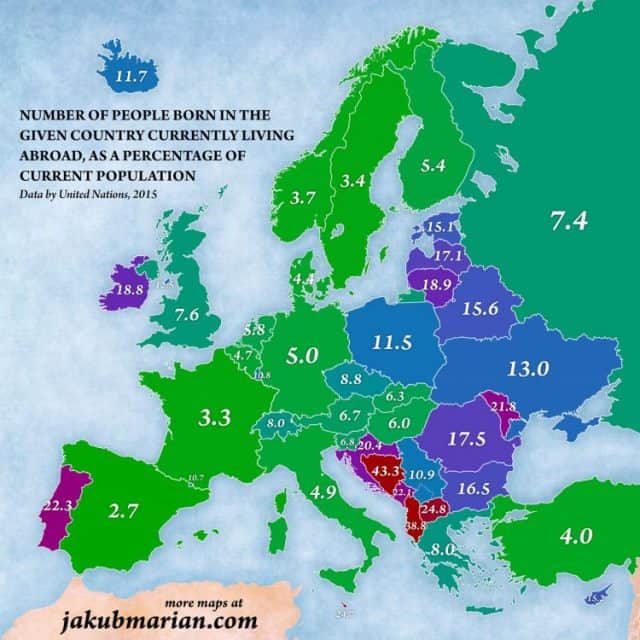
Another statistic which just came to light in the last year paints a more optimistic picture. A Czech mathematician collected UN data, and showed that Hungary has the lowest percentage of its population living abroad among European countries. For example, 11 % of Poland’s population now is living abroad, while for Romania this number is at 17%.

So, am I saying that emigration is not a Hungarian problem? No, but it seems that it is a smaller matter than we think, or at least it is a disadvantageous international trend which has impacted the country less severely than other countries in Eastern Europe.

So then, why do people leave Hungary? In my opinion, the answer is easy: because they can earn more in other European countries. The Neoclassical economic theory of migration states that the main reason for labor migration is wage difference between two geographic locations. These wage differences are usually linked to geographic labor demand and supply. It can be said that areas with a shortage of labor but an excess of capital have a high relative wage while areas with a high labor supply and a dearth of capital have a low relative wage. Labor tends to flow from low-wage areas to high-wage areas. Often, with this flow of labor comes changes in the sending as well as the receiving country.

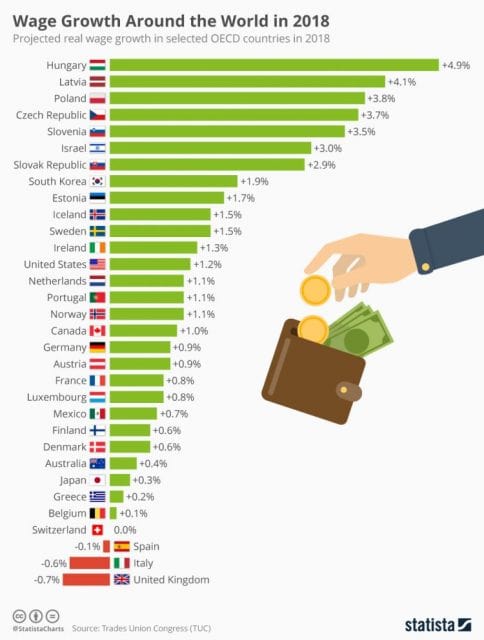
If we consider this model working, we can see that emigration could be the engine for economic equality in Europe. If our workforce surplus meets with Western Europe’s shortage, it will stop the wage growth in the West, but could make wages higher here in Eastern part of the Union. In some ways, the process has already begun. The estimates of the Trade Union of the United Kingdom show wages in all Eastern European (usually sending) countries are growing, but the traditional “big economies” (usually receiving countries) are at the bottom of the list.

The gap between the two areas won’t disappear overnight due to the law of supply and demand, but it seems that now what might otherwise be a natural, long-term economic process is becoming increasingly politicized. Last year, opposition party Jobbik launched its “Wage Union” initiative, calling for “equal pay for equal work” across the EU. While the plan’s advocates argue that this could be a way to successfully equalize wages between the western and eastern halves of the bloc, critics, as well as the Orbán government, have argued that the plan is essentially impossible to implement, as Hungarian companies lack the funds to pay, low-skill workers as much as companies in Western Europe do, while multinationals who opened large offices in Budapest (and who represent a significant chunk of the Hungarian GDP as a whole) due to the country’s low wages, would likely move their businesses elsewhere.

In any case, income inequality between European countries should decrease in the years to come, meaning that one of the main causes of inter-European migration would decrease as well. We already have a few professions in which higher Western wages don’t give enough motivation for leaving. For instance, in the field of programming, professionals don’t earn much more in Western Europe, especially when one factors in a higher cost of living. In addition, programmers can often be hired by Western companies while working in their home countries.

If Hungarian wages consolidate, the negative decline of the population could also be viewed in a better light. Despite current fears, Eastern Europe as a whole, and Hungary in particular, will not just die out as has been worried about for centuries. In the medium-term, the worst case scenario is that our population shrunk to 8.5 million by 2050, but is this really a disaster? Switzerland now has 8.3 million people. In which country would you rather live: a prosperous, wealthy, and functioning country with a population of 8.3 million, or in a relatively functioning country which has 10 million, but is whining about its passing?


By Gábor Sarnyai


About the author:

Originally from Serbia’s Vojvodina region, Gábor Sarnyai holds a degree in political science from Budapest’s Corvinus University, and has worked as a journalist at numerous Hungarian news outlets.


Images via salemnet.vo.llnwd.net, jakubmarian.com, and statista.com

Source: hungarytoday.hu

Reklám
Tas J Nadas, Esq

HUNGARIAN FOREIGN MINISTER: HUNGARY TO QUIT UN TALKS ON MIGRATION PACKAGE IF DRAFT STAYS ‘PRO-MIGRATION’

Hungary will start proceedings to quit talks in the United Nations on the UN’s migration package unless “there is a positive shift towards Hungary’s position”, said Péter Szijjártó, Minister of Foreign Affairs and Trade, at a press conference in Budapest on Wednesday.

MTI reported that the government has instructed Szijjártó to review the first draft of the package, to be published on February 5, and launch the procedure to quit the talks if the document is “as pro-migration” as its basis, the 2016 declaration in New York, in which the UN General Assembly agreed to spend two years negotiating the pact on  migration, and the UN Secretary General’s recent statement, where he said:

Migration is a positive global phenomenon. It powers economic growth, reduces inequalities, connects diverse societies and helps us ride the demographic waves of population growth and decline.

According to the foreign minister, the package is scheduled to be adopted at the end of this year and although inter-governmental negotiations have not started yet, the secretary-general “has already announced the results”.

Szijjártó also insisted that the so-called “Soros Plan”, the alleged plans of US financier George Soros concerning migration, did exist “as a clear concept” and “there seems to be a parallel” with the UN chief’s recent statement.

The foreign minister said that both the stance of the UN declaration and of the secretary-general’s statement were in conflict with Hungary’s position and interests in connection with migration. They suggested that “migration is good and unavoidable”, while according to the Hungarian government, migration is “not a positive trend” and it “poses serious security risks and can be stopped.”

It occurs that if Hungary will quit the talk, it will not be able to take part in the vote either. Szijjártó acknowledged that if a country quits the negotiations, it quits all of its elements.

In an interview with the Times of Malta, Deputy State Secretary Kristóf Altusz responded to questions about Hungary’s stance on migrants and its relationship with the EU by insisting that the country had already taken in about 1,300 refugees over the course of 2017 alone. This seems to contradict to the government’s rhetoric, which in the past two years alone, has launched several major campaigns around the issue of Europe’s migrant and refugee crisis.

via Hungary Matters, Index, New York Times

featured photo: MTI / Zoltán Balogh

Source: hungarytoday.hu

Reklám
Tas J Nadas, Esq

ReConnect Hungary+ is a special, one-time birthright trip for those over age 29

You already know about ReConnect Hungary, so you are super excited for this incomparable cultural, social and education immersion experience in Hungary. You will have the best 16 days of your life, form lasting connections and a professional network with each other, as well as with the people you’ll meet on the journey​.
We are offering this amazing opportunity concurrent with our June 16-July 1, 2018 program.
You can also go on ReConnect Transylvania (July 1-8), a 7-day excursion immediately following the Hungarian birthright trip.
Click here to learn more about ReConnect Hungary+ and email us by January 31 to hold your spot if you are interested. We look forward to seeing you on this exciting adventure of self-discovery!

Spotlight on our ReConnected Participant, Joe Glasgow (RH’16)

Joe went on ReConnect Hungary in 2016, where he finally got the chance to learn more about Hungary where his great-grandparents came from:

YouTube player
Keep ReConnect Hungary Attainable
Our one-of-a-kind program needs your support to continue our service to future generations of Hungarian Americans and Canadians.
■ Please make your secure online contribution to ReConnect Hungary.
■ You can also download, print and mail our sponsorship form.
■ Shop at smile.amazon.com, and Amazon will donate 0.5% of your purchases to ReConnect Hungary. Please select our parent organization, Hungarian Human Rights Foundation, as your charity of choice.
Spread the Word, Stay Involved, and Raise Support!

Thank you for your support! Köszönjük!

Source: ReConnect Hungary – Hungarian Birthright Program

Reklám
Tas J Nadas, Esq

AHF Meets with Congressman Andy Harris

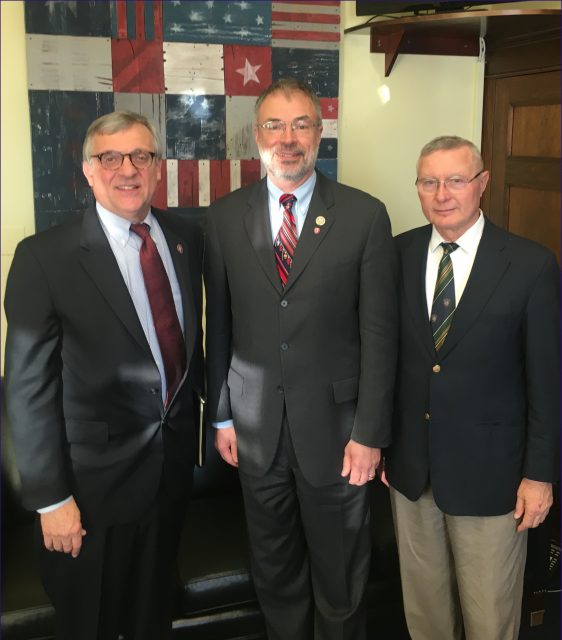
On December 19, 2017,  representatives of the American Hungarian Federation (AHF) met with U.S. Congressman Andy Harris, co-chair of the Hungarian Congressional Caucus, and his legislative director, Timothy Daniels, Esq. to discuss matters of mutual interest to AHF and the Caucus.

The discussion focused on AHF’s recent letter to Assistant Secretary of State Wess Mitchell objecting to a funding proposal by the Bureau of Democracy, Human Rights, and Labor of $700,000 of U.S. taxpayers money to private groups in Hungary to establish a media resource to counter what the State Department contends is one-sided press coverage of Hungary’s government and policies. Congressman Harris agreed with AHF’s concerns that the funding proposal is unwarranted and inappropriate and will also look into the matter [read Congressman Harris’ letter to Secretary of State Tillerson].  Congressman Harris, who is of Hungarian descent, is a long time friend and ally of the Federation.

AHF representatives attending the meeting were Paul Kamenar AHF’s General Counsel and member of AHF’s International Relations Committee (IRC), and Dr. Imre Nemeth, AHF Vice-President and member of IRC.

Source: americanhungarianfederation.org

Reklám
Tas J Nadas, Esq

IN WASHINGTON, FOREIGN MINISTER SZIJJÁRTÓ CLAIMS A “NEW PHASE” IN US-HUNGARY RELATIONS HAS ARRIVED

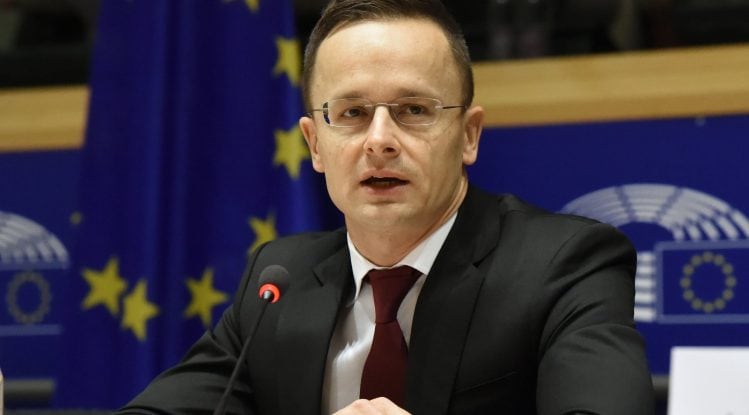
Hungarian Foreign Minister Péter Szijjártó, starting an official visit to Washington, DC, has claimed that a new phase in Hungary-US ties has arrived. The minister argued that significant changes were afoot at the State Department.

He cited as an example the appointment of Wess Mitchell (who was chosen last fall) as the official responsible for the central European region, which he said presaged a new chapter in the Hungarian-American political relationship. He said economic ties and cooperation in defence were “excellent”, and he underlined Hungary’s unswerving commitment to NATO and the fight against terrorism.

Political ties, however, have not functioned properly, he said. “We had to face many unfair criticisms, and in several cases we experienced a lack of understanding when it came to America’s assessment of Hungarian measures,” Szijjártó said, adding that now a new chapter could begin with Mitchell’s appointment. “Taking into account the last few years, now is our best chance for political relations to develop to the level of our ties in the economy and defence.” “Over the past seven years, Hungary has been brought back from the edge of the abyss … and today it is one of the dominant countries of the central European growth engine; and this is recognised here in America,” he said.

Szijjártó claimed that US-Hungary ties have started to see a revival recently. He argued that one sign of this was that in November, a US congressional delegation visited Budapest, while another will come in late January, and plans are underway for American politicians to visit Budapest in March as well. “The current American administration represents a similar position to the Hungarian government’s on a number of important international issues,” the minister said.

Szijjártó also welcomed a letter sent by Republican lawmakers to Rex Tillerson urging the State Department to take steps to improve US-Hungary ties and immediately suspend a US program to fund “objective media in Hungary.”

After 2016’s US presidential elections, many speculated on what the Trump administration would mean for Hungary, and many were initially optimistic in this regard. Viktor Orbán was among the first to express sympathy for the then president-elect, and had said he expected that “things will improve” under the Trump administration. However, so far it seems that, despite similar ideological outlooks and encouraging early signals, Hungarian Prime Minister Viktor Orbán has failed to forge a strong relationship with Donald Trump.

via hungarymatters.hu

image via KKM

Source: hungarytoday.hu

Reklám
Tas J Nadas, Esq

AMID CONTROVERSY, HOME-BIRTH MIDWIFE AND ACTIVIST ÁGNES GERÉB SENTENCED TO TWO YEARS IN PRISON

On Tuesday, the Budapest Court of Appeals upheld a previous conviction leveled against obstetrician, mid-wife, and home-birth activist Ágnes Geréb. The 65-year-old has been sentenced to two years in prison, and in addition has been barred from practicing her profession for the next ten years.

Geréb was arrested by police in October 2010. In February 2012 the appeal court in Budapest sentenced her to two years in prison in connection with two cases of home births. One involved assisting with the birth of twins, one of whom was born dead. In the other case, she assisted in the birth of a baby who suffered severe complications and died six months later. Geréb and her attorney later appealed for a retrial, citing newly submitted opinions by experts.

The Budapest Court of Appeals said on its website that the newly submitted information was insufficient to prove that the complications resulted from neonatal infection.

Giving Birth at Home in Hungary 

Home births in Hungary have a long, controversial history. Naturally, before the rise of the modern medical and hospital system in the mid-20th century, home births were the norm, and made up the overwhelming majority of births in the country. As was the case elsewhere in the world, however, over time hospitals began to become the preferred place for births, a shift which led to a drop in the country’s infant mortality rate.

The roots of Hungary’s contentious modern relationship with the practice have their roots in the Communist era. As in other Warsaw Pact countries, home birthing was outlawed, as healthcare, and childbirth alongside it, came fully under the power of the state. While people continued to give birth at home, they had to do so surreptitiously, and cover their tracks by claiming to have had no other choice, for fear of prosecution. Despite the end of the Soviet-controlled Communist regime in 1989, Hungary’s ban on home births remained in place, and those who wished to give birth at home continued to be forced to do so in secret.

This legal limbo officially came to and end in 2011, when the Orbán government passed a law legalizing home births “under strict safety conditions.” But while this law may have partially brought home births out from the shadows, it created a number of issues of its own, since the state currently does not provide any financial support for the practice of home birth. More critically, to this day Hungary does not have a fully worked-out accreditation system for doulas and home-birthing experts, and the practice continues to be heavily discouraged.

Likewise, Geréb’s career has similarly been both long and controversial. After receiving a medical degree from the University of Szeged in 1977, she began working as an obstetrician and gynecologist in hospital settings, and from the very beginning was one of the first doctors in Hungary to allow fathers into the birthing room. Over time, however, she began increasingly to move toward the still underground world of home births. Speaking to Index, the midwife said that she had overseen roughly 3,500 home births before her arrest in 2010, all of which had officially been illegal.

The incidents that led to Geréb’s arrest and subsequent conviction occurred in 2003 and 2007. In the first case, one twin was born without any issues, but the other went 12 minutes without oxygen, suffered severe brain damage, and died twelve months later as a result. In the second case, a baby died during childbirth as a result of shoulder dystocia, a rare labor condition in which the infant’s shoulder cannot pass below the pubic one. These incidents triggered a series of legal cases and appeals that culminated in this week’s ruling by the Budapest Court.

Responding to her conviction, the controversial gynecologist said that

These lawsuits and criminal proceedings against me are actually about the fact that there has been an increasing societal need for home births. The right to these could not be suddenly accepted in a situation where, for decades, the bribery-based medical establishment dismissed the expert truths that were linked to my person…The solution has been to violently push me aside as the ‘black sheep’ of home-birthing, without whom the previously ‘dangerous and prosecutable’ practice can be viewed as nice and good.

Public Reactions 

Within Hungary, opinions regarding Geréb’s decision have been decidedly mixed. Many feel that Geréb is essentially being persecuted for her work to bring home birthing into the mainstream, and for attempting to provide Hungarian families with an option that is a recognized right in other Western countries. These critics note that many women don’t feel comfortable or safe in hospitals, and want to be able to give birth in the comfort and security of their own homes. They also argue that Geréb is a medical professional who has helped countless families, and is being punished for events that could have happened in a hospital setting as well.

These views were shared by Nick Thorpe, the BBC’s Budapest correspondent, whose children Geréb helped bring into the world. In a Facebook post, the journalist wrote the following:

Agnes Geréb, the woman who has done most to make birth in Hungary, at home or in hospital, a better, safer experience…

Posted by Nick Thorpe on Tuesday, January 9, 2018

In another post, Thorpe claimed that shoulder dystocia, the issue that caused one of the children’s deaths, is a rare problem that “is the nightmare of all obstetricians.” He added that “on average 7 babies die each year in Hungarian hospitals from this. The doctors are never even prosecuted, let alone fined, or jailed. Ági was prosecuted, and persecuted, because she dared to work independently of the state.”

On the other hand, many others, including members of the press and medical community, have been highly critical of Geréb’s practices, and view her conviction as just. Writing for the news outlet HVG, György Balavány argued that, regardless of how good her intentions may have been, Geréb broke the law, and two children died as a result. In particular, the columnist argued that the midwife had repeatedly, and knowingly, broken the law, and that those whom the public should truly feel sympathy for are

the children who were her victims, and their parents.

Likewise, a caller on Hungary’s Klub Radio criticized Geréb’s professional qualifications and her practices. The caller, who identified herself as a doctor, argued that the midwife had, in fact, not been keeping herself to professional standards in her home births. In particular, the caller claimed that, while there are those in Hungary who are qualified to perform home births, Geréb is clearly not one of them. The caller further claimed that Geréb had, at times, agreed to burn the placenta or bury it in the backyard at parents’ request, a practice which, according to the caller, is a clear indication of unprofessional and inappropriate behavior.


By Tom Szigeti

Via MTI, index.hu, hvg.hu, Facebook, and klubradio.hu

Image via nlcafe.hu

Source: hungarytoday.hu

Reklám
Tas J Nadas, Esq

Aniko Marshall: Paprika Princess

Food lies at the heart of our bodies and our culture; it is there for celebrations and sustenance. NOMaste features a local fierce foodie each month, in four weekly segments. First, an interview, then a top 10 list, followed by a recipe to share, and finally a food review. This food corner will not just feature local chefs but also restaurateurs, buyers, suppliers — any woman involved in any aspect of the food chain, from farm to food truck. Join us each week as we get to know another Foodie in the city.

When you meet some people and get to know them, you simply can’t imagine another version of them different than that. It just wouldn’t make sense, as if the universe would implode. That is how I felt when Aniko told me that she had only been making sausage and cured meats for about four years, and her gardening passion was only fully realized a few years before that. I cannot imagine a world in which Aniko is not making sausage and harvesting her yard for the next years’ food.

“I was never into cooking,” Aniko said. “I told my parents it’s the stupidest thing — it takes forever, you have to go shopping, think about what you’re going to buy, then you spend time cooking, then it’s a bunch of time cleaning — and what — you ate for 15 minutes. It’s ridiculous!”
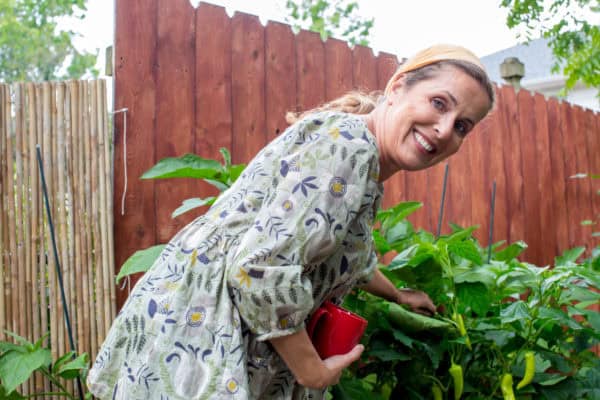
A crazier statement I could not imagine. Especially when you see her in her television-ready gigantic kitchen, with large expanses of cement countertops, three separate fridges, two separate sink areas, and as much storage as any person could ever dream of. Dried herbs hang from every available beam overhead, next to a fully loaded pot rack. Jars of dried and canned vegetables line the tops of every cabinet, and there is always a large bowl of something on the counter, and smoked meats on a tray ready to devour.

Aniko is a force of nature, who seems to know everything and everyone related to food and cooking in this town. But that was not always the case. A true city girl, born and raised in the bustling capital city of Budapest, Aniko grew up and lived in Hungary until 1994. Living in a place where delicious and affordable food was aplenty, there seemed to be no need to cook when you could just as easily grab a delicious quick meal at the local butcher shop or restaurant. So Aniko never developed the habit of collecting recipes and learning to cook one dish at a time. Not until a move to America — and motherhood — forced her to take up the pan and the pot.

Mostly out of homesickness, and the sad realization that American fare was a pale comparison to the rich, delicious meals of her homeland, Aniko started to make the basics that she yearned for from Hungary. Dishes like chicken paprikash and goulash were things she slowly learned and made regularly, but still, with the busy life of raising three children, caring for a home and a husband, and navigating a new life in a new country, she did not have a lot of time to spend in the kitchen. Certain things were verboten even then, like microwaving your vegetables until they were an unrecognizable mush.
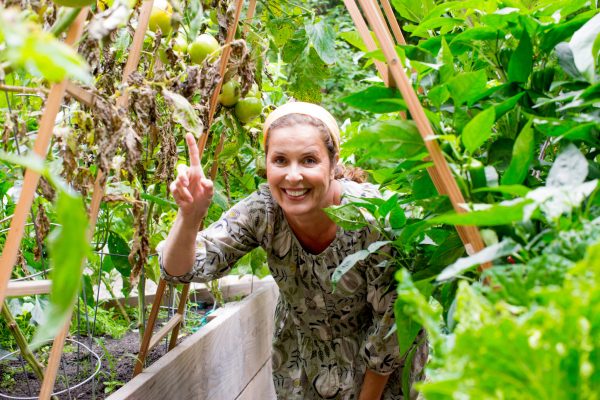
“Steamed vegetables never made any sense to me. Throwing broccoli in the microwave? Why? To me cooking still meant something substantial. Home cooking is just three things — know your ingredients, know your technique, and know your tools. Any combination of those three things will turn into an awesome dish. You don’t need to follow any recipe. Throwing broccoli in the microwave isn’t cooking.” Amen!

Fast forward a few decades, with her wonderful children either in or about to go into college, and Aniko found herself with more time to fulfill some culinary dreams she had simmering on the back burner — and it’s around this time that we had first met. At the time, I had started a modest vegetable garden on my front lawn, and promptly removed all the grass to make way for veggies and flowers. In this spirit, Aniko and I are twins — we balk against the norm. We started chatting about gardens, how and what to plant, when to start seeds, etc.

Aniko quickly developed a plan (spreadsheet) to put in a large, fenced-in vegetable garden on her front lawn in the suburbs of Amherst, and quickly surpassed my basic knowledge.

“The veggie garden started because living in ‘suburbatory’, it is a very sterile environment, and I wasn’t used to it. I couldn’t get used to it… I don’t belong here. The general consensus is that you should behave, you shouldn’t paint your house pink, you shouldn’t do things different from your neighbors; you should have similar everything. You have to be a cookie cutter. So at one point I said, ‘I’m done being a cookie cutter.’ That’s how the garden started.” The front garden boasts an asparagus patch, raspberry bushes, potatoes, eggplants, and, of course, every Hungarian item you can imagine.

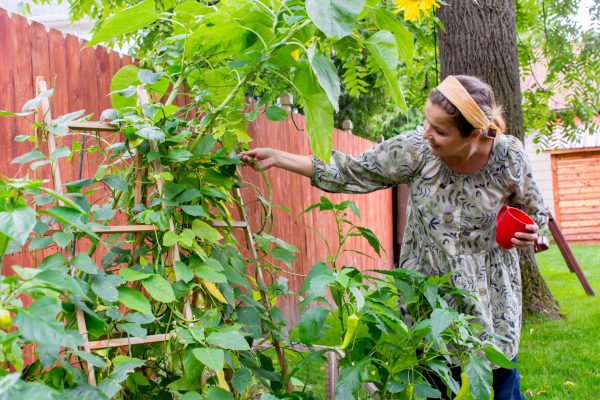
The garden started out front because the back was in complete shade from a large family of ash trees. A few years after the front garden was established, the ash trees had died and needed to be removed. This gave way to clear skies, sunshine, and room for a full-on back garden. With her front garden well established, and having learned every trick she needed, she was ready to expand to a mini-farm side plot out back. There, she has everything from a mushroom patch, to grapevines, to large tomato bushes, to a multitude of spices and leafy greens. Aniko grows enough food to feed her entire family of five for a year. She eats all she can in the summer when everything is fresh, and then prepares everything as each crop is ready to harvest, either canning, freezing, drying, or preparing into frozen meals to thaw and enjoy later. Aniko doesn’t have to buy any produce — she grows and stores all of it on her own. She is a one-woman pioneer lady.

I asked her for some examples on how she can be diverse and creative with her larder. “I have tomatoes — some I have as-is, not even cut or peeled, just thrown in the freezer. Let’s say I make a stew — I just toss it in and it works beautifully. It has that summer flavor and it’s not tampered with at all — no sugar, nothing. I have dried tomatoes I can throw into any liquid (like chicken stock, simple syrup, or orange juice) to rehydrate them, and they are now flavor bombs…they are a lot more than just tomatoes. Then I put them in whatever recipe I want.” It is this ability to work off the cuff, taking a simple tomato and both saving them and rejuvenating them in multiple ways that makes her a renaissance woman of the kitchen.

After the vegetables came the sausage — what Aniko is most famous for. About four years or so ago, a neighbor and fellow Hungarian who was in his 80s at the time, showed Aniko the ropes of sausage-making that only an old timer who had been doing this for decades could.

“I could get a recipe and try, but […] the recipe is not going to tell you how to mess up. I think you know what you are actually doing […] once you know how you can mess up, and how to fix that. Then you know you’re trade.”

John guided her through her first sausage batch, and after that she had the confidence to try it on her own. “When I first did the sausage from the beginning to end and it was edible and tasty and what it should be, from the buying, the grinding, the seasoning, the stuffing, the hanging, the smoking, the drying, the whole thing, I was like, ‘Wow, I guess I can!’ And after that it was like, BOOM.” And she has been on a tear ever since, making 100 pounds of Hungarian sausage at a time each winter, along with smaller batches throughout the year. She even helped me make a small batch of sausage one day — a lesson I still hold dear.

Alongside the first sausage adventure was joining a local Charcuterie Club on Facebook, where she got to meet and talk meat with local like-minded people who were interested in smoking and curing. This brought her into the larger food world of Buffalo, where she got to meet and become friends with people like Steve Gedra, a fellow Hungarian, of The Black Sheep (formerly of Bistro Europa). Aniko decided to have a backyard cookout for the Charcuterie Club, since her fellow Hungarian and sausage-making neighbor wanted to show off what real Hungarian food was to the group. “One of the first Hungarian cookouts I did for the Charcuterie Club, Steve came with his dad. Then the next one he came with his dad and his grandmother — how cool is that?! Since then, when I go to Hungary, I bring a kilo of paprika for him, because he appreciates it — he knows what the difference is. Most people don’t know, but he understands.”

She also got to meet Harry Zemsky at a gathering of the club at Hydraulic Hearth, the week before it opened. “He gave us the space just for our meeting and I always show up with food, so I showed up with liver pâté that came from a recipe from a friend in Hungary. Harry liked it […] so I showed the chef how to make it.”  It’s not every day something you bring to a party gets the attention of a restaurant owner, and quickly becomes added to the menu after you give the head chef a tutorial on how to make it. This is all part of Aniko’s urban legend status in my eyes.

The local Charcuterie Club paved the way for her to get into an international one, called the Salt Cured Pig. Here she got to communicate with people all over the world, swapping recipes, tricks, and tips, and making friends. This is how she ended up with a warm and adventurous Dutch woman named Barbara at her doorstep one night, and they ended up hanging out all night at the Black Sheep, talking about animal lard and meats with Steve. Later, she ended up introducing her to a local pig farmer that Aniko now goes to for her pig needs. This would have never happened had she not asked John to tell her everything he knew about sausage-making a few years before.

It’s not just the homegrown vegetables and sausage that makes Aniko a maverick of the kitchen and local food world. She also knows where the ingredients she doesn’t grow come from. She has several farms she purchases her meats from, so she knows where her chickens and pigs are coming from. “The general idea behind all this is that growing up I learned you should not rely on what you can get your hands on at any given time, you need to rely on yourself. I can live here for a good year without going to the store. I don’t go to the shop to buy a chicken every other week, I buy 15 chickens and I am good for a while. I don’t go to the store and buy two pork chops, I get a whole pig and I am good for a year.”

Aniko’s most recent adventure was butchering her own whole pig in the traditional American style. Next up is butchering a pig this fall in the traditional Hungarian style. She already has the pig picked out, and it has a name — Skippy. Skippy is currently on a loving farm, free to roam, being well-fed and cared for.
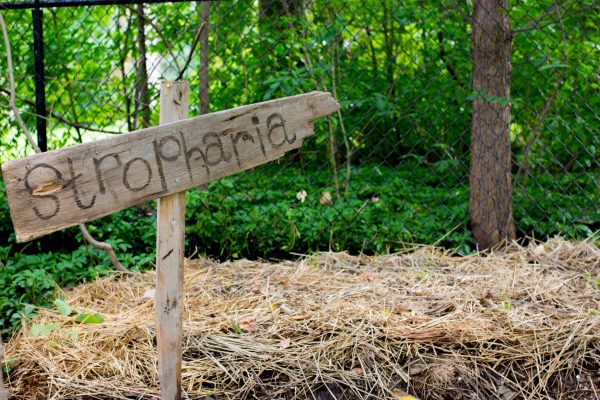
I asked Aniko if she had this passion in her from the start, since she spent a majority of her life a thoroughbred city girl, away from the fields and the animals. Turns out, there was something in the back of her mind all these years. “One summer, I went to visit my grandfather in the countryside and I stayed there for two weeks. It was in a small tiny village, maybe 20 houses max. Behind each house was a gigantic field, farm, and animals, the whole nine yards. I learned to hunt a deer, pick mushrooms, cook pasta, how to run in a field of freshly cut hay so it doesn’t poke your feet, I learned how to kill a chicken.  I don’t remember any other summer […] except the farm. That was heaven.”

Recalling another memory of taking her daughters to a horse farm to work and earn riding time, she reminisces, “I would […] smell the hay and horse shit, and think, ‘My god it smells like freedom.’

So how did Aniko become a NOMaste feature? She is not a chef in a restaurant, doesn’t have a farm that sells to the public, nor is a professional in the greater food world. Yet, because of her enthusiasm, acumen, and élan, she has become a figure in those circles. In the short years that she decided to turn her passion into reality by bringing her culture to life in America, she has mastered skills that not many possess or care to spend the time learning. She is the manifestation of what happens through dedication and single-mindedness. She has entrenched herself in the greater food world both in Buffalo and abroad, solely because she believes in what she is doing, knows what is good, and is pursuing that at full speed.

Source: qweencity.com

Reklám
Tas J Nadas, Esq

HUNGARIAN SKIER EDIT MIKLÓS ON HER LATEST INJURY: “STAYING POSITIVE IS DIFFICULT”

After injuring her knee just over a year ago, Hungarian slalom skier Edit Miklós was able to recover, and looked poised to make an appearance at this year’s Winter Olympic Games in in PyeongChan. As a recent article by Hungarian daily Magyar Nemzet makes clear, however, Miklós’ hopes were dashed again over the weekend, when she tore her knee ligament at the Alpine Skiing World Cup at Bad Kleinkirchheim in Austria on Saturday

Miklós, who placed 7th in slalom at the 2014 Sochi Olympics, underwent surgery on Saturday night, and by Sunday afternoon she was available for comment on the incident. When asked about how disappointed she is, and if she is upset with someone or at something she replied with the following:

Honestly, the only thing I regret, the only reason I am angry, is that I participated in this race. It’s likely that I could have avoided all of this, but trouble seems to find me eventually.

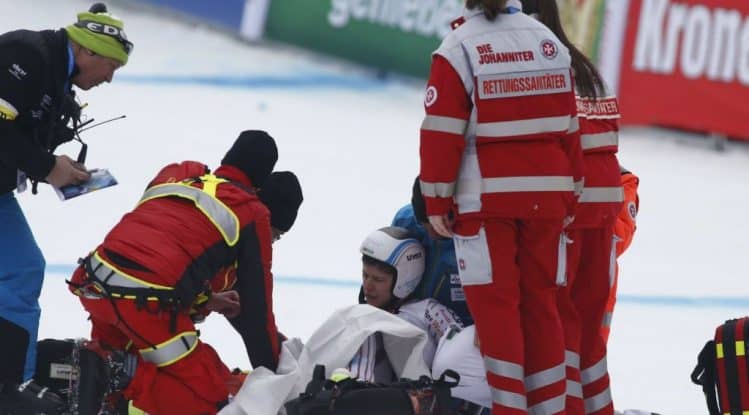
During Saturday’s Super Giant Slalom event, Miklós had crossed the finish line when she lost her balance, fell backwards, rolled a number of times, and lay still for several minutes. She had to be carried away on a stretcher, and taken via helicopter to the hospital in Villach, where she was X-rayed; the doctor who performed last year’s operation on her, Christian Schenk, announced that another operation had to be performed. The surgery happened that Saturday night, successfully, at Schruns.

YouTube player

At a private clinic in Austria, Edit told Magyar Nemzet, via telephone, that although the course wasn’t in perfect condition, she had wanted to prepare for Saturday’s Super-G and Sunday’s downhill tournament, where it was expected that the course would also be in a “crunchy, hard” state.

I considered Saturday’s race to be practice. If I could turn back time then of course I wouldn’t have participated, but at the time I didn’t seriously think about leaving out the run, I am just thinking back that I could have decided to not go through with it.

Last year, almost to the day, both her knees had to be operated on after her accident in Austria. After her successful rehabilitation, by August she was once more training on snow, and in December she was still among the leaders in her sport, with a 14th place finish in the world cup. After her success at the Olympics 4 years ago, Miklós Edit was clear in her resolve: she wanted to be an Olympic medalist, perhaps even a gold medalist, and wasn’t ready to let go of her dreams. But after a while, so many people questioned her capabilities that she became more reserved with her ambitions when she speaking to reporters.

“Despite all this, my goals remain the same; that is, I still wish to come home a champion,” she had told the press at the end of October 2017.

Considering all this, it is even more difficult to accept that she will be absent from February’s Olympics. After last year’s incident, the Hungarian downhill skier was eager to prove her worth, but instead the same path to recovery awaits her once more.

This accident has left me weary, and feels worse than last year’s. I am trying to stay positive, this is the only way I can go forward.

She didn’t feel a lot of pain before her surgery, but her hope that she only damaged the lateral collateral ligament was dashed when it turned out that the inner ligament was affected as well. Edit said that she didn’t reopen the old injury, and that, as far as she could tell, this was a new injury altogether.

“Sometimes we fall down, but it’s important to get back up again to continue on our path!” she posted later on her social media account. The 29-year-old Alpine skier will be able to walk again in 3 weeks; patience is the most important virtue for her at this time.

Via mno.hu

Image via MTI/AP/Giovanni Auletta

Video via YouTube

Source: hungarytoday.hu

Reklám
Tas J Nadas, Esq

Application deadline for ReConnect Hungary 2018 extended until January 31

Don’t miss this once-in-a-lifetime opportunity! Since 2012, ReConnect Hungary has been a life-changing experience for Hungarian diaspora youth, just like you! Our amazing cultural, social and educational program provides selected participants with the resources to form a fresh connection to their heritage.

AM I ELIGIBLE?
You must be of Hungarian heritage, between the ages 18-28, U.S. or Canadian citizen, and not have lived in Hungary past the age of 12. See all requirements

HOW TO APPLY? 
Click here to read more about the application process.

WHAT IS THE DEADLINE?
You must submit your application by January 31, 2018.

WHEN WILL I FIND OUT IF I HAVE BEEN SELECTED?
Once you have completed your application and submitted all your documents, it only takes 2 weeks to find out if you will be among the lucky few chosen.

WHEN IS THE BIRTHRIGHT TRIP?
ReConnect Hungary 2018 will take place June 16 – July 1.

NEW! ​One-time Hungarian birthright trip for ​those over age 29

ReConnect Hungary+ is a special, one-time birthright trip for Hungarian-Americans and Canadians, aged 29 and older, that we are offering concurrent with our June 16-July 1, 2018 program. This unique cultural, social and education immersion program provides you the opportunity to form lasting connections and a professional network with each other, as well as with people you’ll meet in Hungary.
Application deadline for ReConnect Hungary+ is January 26, 2018.
Please email us if you are interested to learn details and to hold your spot.


Spotlight on our future ReConnected Participant, Jordyn Barone (RH’18)

Jordyn Barone

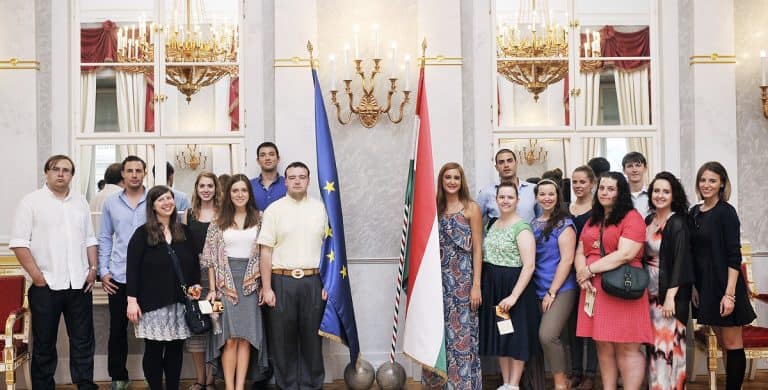
A generous 2017 ReConnected Participant provided the special scholarship for one 2018 participant ​to take ​a Cleveland State University ​Online Hungarian Course starting this January. Congratulations to the winner, Jordyn Barone. She is a fourth generation Hungarian-American from New Jersey. ​“I am very excited to see where ​my ancestors came from,”says Jordyn. She was among ​the first applicants for this year’s program, and now she will be able to hone her Hungarian language skills ​before the trip.

Keep ReConnect Hungary Attainable
Our one-of-a-kind program needs your support to continue our service to future generations of Hungarian Americans and Canadians.

Spread the Word, Stay Involved, and Raise Support!

Thank you for your support! Köszönjük!

ReConnect Hungary – Hungarian Birthright Program


Reklám

Tas J Nadas, Esq

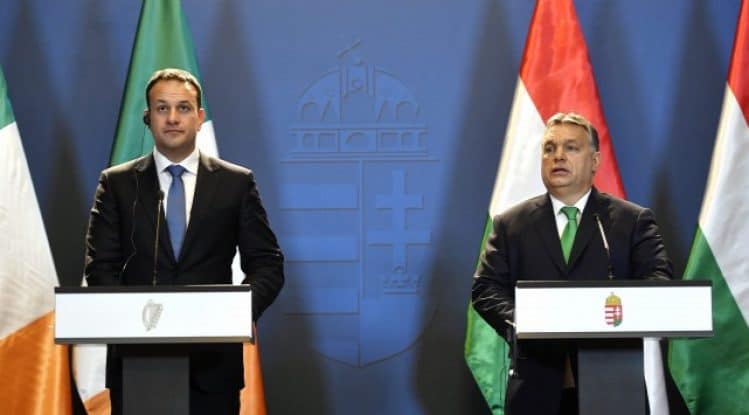
PRIME MINISTERS VARADKAR AND ORBÁN: IRELAND AND HUNGARY ARE IMPORTANT PARTNERS

The Irish and Hungarian Prime Ministers held talks in Budapest on Thursday. During their meeting, they negotiated on issues such as Brexit, agriculture, the EU, taxation, and migration.

“If we want to have a strong EU, each of us will have to do our own bit on the home front,” Orbán said, emphasizing again the importance of national economies. Concerning Brexit, the Hungarian Prime Minister assured that Hungary supports Ireland’s special viewpoints. About taxes, he said he is against harmonising taxes at a European level as taxation is an important component of competition. At the same time, Orbán claimed that the EU’s farm policy shouldn’t be changed and that the agricultural sector should “receive the same [subsidies] in the future as were granted in previous years”.

On migration, the Hungarian PM reiterated his usual talking points on migration, arguing that Hungary will insist on retaining its own identity, culture and achievements. He added that Schengen rules and external borders must be enforced and protected.

Leo Varadkar began by noting that 12,000 Hungarians currently reside and work in Ireland. He expressed appreciation for the Hungarian government’s understanding of the specific Irish points of view with regard to Brexit, especially the Irish-Northern Irish border issue. He highlighted the importance of establishing as close links as possible with the UK after Brexit takes place. Varadkar also said that Ireland agrees with Hungary that the best way of ensuring stability in the Western Balkans is to take steps towards the EU integration of the former Yugoslav countries and Albania.

The Irish Premier expressed his view that he and Orbán share the same views on tax harmonisation as well as on maintaining EU budget and development aid without changes. On migration, however, Varadkar said that, in contrast to the Hungarian point of view, Ireland supports the concept of joint burden-sharing within the EU.

via hungarymatters.hu / hungarytoday.hu

Reklám

Tas J Nadas, Esq

LEAD-SINGER OF FAR-RIGHT HUNGARIAN ROCK BAND KÁRPÁTIA BANNED FROM ROMANIA FOR 3 YEARS

János Petrás, front-man for the far-right nationalist rock band Kárpátia, has been banned from performing in Romania, and in addition has been fined 9000 Lej (approximately 2000 euros) for expressing what a Romanian appeals court ruled was “hate speech” at a concert held in the Transylvania city of Csikszereda in 2014.

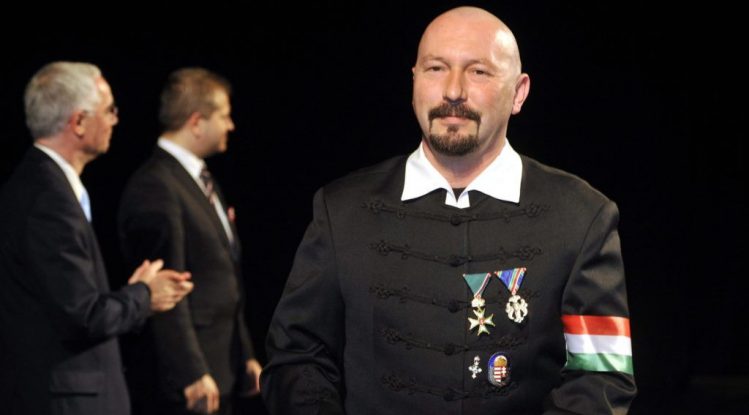
Kárpátia, which was formed in 2003, is a far-right Hungarian “national rock” group. Its songs, some of which call for an “unblemished nation”, often draw their lyrics from folk songs and traditional military tunes. The band has been described in the press as “the house band of the extreme-right Jobbik party.” In the past, the band has participated in a march organized by the since-banned paramilitary group Magyar Gárda (the Hungarian Guard). In 2013, Petrás become the center of political controversy when he received the Hungarian Gold Cross of Merit from the government of Prime Minister Viktor Orbán. You can listen to some of Kárpátia’s songs below:

YouTube player

According to the Romanian court, at a concert held on June 6th, 2014, Petrás sang songs and made statements to the crowd that violated Romania’s laws banning “the promotion of personality cults of individuals responsible for crimes against humanity, as well as of fascist, racist, or xenophobic ideologies.” According to prosecutors, through his songs and comments, the Kárpátia singer called on Hungarians to battle on the model of Russians in Crimea in order to regain territories lost following the 1920 Treaty of Trianon, in which Hungary ceded two-thirds of its territory and roughly 64% of its population (including over 30% of ethnic Hungarians) to neighboring countries. In addition, Romanian authorities claimed that he called for armed battle, criticized the contents of the Treaty of Trianon, and described Romanians as oppressive.

Petrás, who was first charged in December 2015, has proclaimed his innocence, arguing that every Hungarian has a right to express his opinion regarding Trianon. In addition, he claimed that the songs he performed were not written by Kárpátia, but rather were historical military songs that praised the heroism of Hungarian soldiers.

Jobbik Reaction

Responding to the Romanian court’s ruling in a statement, Jobbik (which has, in the past several years, worked to shed its image as a far-right, anti-Semitic, racist party) stood by Petrás, calling the ruling “anti-Hungarian.”

Going further, the party, which is currently gearing up for parliamentary elections this coming spring, claimed that Petrás was not expressing racist or hateful views, but was rather

“Proudly standing by his Hungarian identity, proclaiming the unity of the Hungarian nation, and paying respect to heroes who have fallen in defense of the Hungarian homeland.”

Via 444.hu, 24.hu, MTI, dw.com, and szekelyhon.ro

Image via 24.hu

Video via YouTube

Source: hungarytoday.hu


Reklám
Tas J Nadas, Esq

2018-ban is folytatódik a Mikes Kelemen Program.

2018-ban is folytatódik a Mikes Kelemen Program.

A gyűjtőpontra történő könyvgyűjtés egyelőre felfüggesztésre került, jelenleg szervezeti és személyi irathagyatékok gyűjtése zajlik, melyek az adott címről lesznek elszállítva. A programnak három kutatója van az Egyesült Államokban február legvégéig. Deák Nóra a keleti parton, New York központtal, dr. B. Stenge Csaba Közép-Nyugaton (Chicago, Detroit, Cleveland) Chicago központtal, és Sághy Miklós a nyugati parton, San Francisco központtal. Ha tudnak olyan történeti értékű hagyatékról, melynek hosszú távú fennmaradása itt nem biztosított, és elküldenék Magyarországra a programon keresztül, kérjük, vegyék fel a kutatókkal a kapcsolatot a térségek központi magyar szervezetein keresztül, illetve az alábbi telefonszámokon:

B. Stenge Csaba: (312) 723-3200,

Deák Nóra: (732) 862-7504,

Sághy Miklós: (650) 381-4664.

Segítségüket előre is köszönjük!

Reklám
Tas J Nadas, Esq

“WE SHALL DO OUR UTMOST TO ENSURE THAT EUROPE REMAINS EUROPEAN” – HUNGARIAN PM VIKTOR ORBÁN CHRISTMAS MESSAGE IN FULL

Source: hungarytoday.hu

“This year, a historical task has been put before European countries: defending Christian culture”, Hungarian Prime Minister Viktor Orbán wrote in his Christmas message published by right-wing daily Magyar Idők over the holiday weekend. Below we are sharing the full English translation of the original Hungarian text.

***

“We await the Christian world’s great festival: the birth of our Lord Jesus Christ. In silent waiting we raise our eyes, we free ourselves from the worries of everyday life, and the soul’s horizon opens up. In this special atmosphere we can sum up the past year and think once more about the nature of our tasks in the world for the year ahead.

Whether or not we admit it or realise it, we Europeans live in a culture ordered in line with the teachings of Christ. Here I can quote the well-known words of an earlier Hungarian prime minister, the late József Antall: “In Europe, even an atheist is Christian.” We Hungarians rightly regard ourselves as a Christian nation. Our mother tongue, through which we have grasped and shaped reality, is not related to that of any other European nation. This also has valuable consequences.

From Mihály Babits we know that the Hungarian spirit was born when our Eastern character met Western Christian culture. And we can add that this was the source of the Hungarian worldview and mentality. But this has also caused much difficulty, incomprehension, loneliness and, occasionally, a feeling of being strangers to those around us. Nevertheless, for a thousand years our Christian essence and our living faith have kept us in the heart of Europe. This is why, right down to the present, we remain true to the culture of our mother tongue, and we are proud of the contribution made to the rise of Europe by our nation’s achievements over the course of a millennium.

According to the Gospel of Saint Mark, Christ’s second commandment is “Love your neighbour as yourself”. There has been much talk of Christ’s commandment in Europe nowadays. It is used to rebuke us for declaring ourselves to be Christian, while at the same time declaring that we do not want millions of people from other continents settling in Europe – and that we even refuse to let them in.

But this commandment consists of two parts, and our accusers have forgotten the second part: we must love our neighbour, but we must also love ourselves. Loving ourselves also means accepting and protecting everything that embodies what we are and who we are. Loving ourselves means that we love our country, our nation, our family, Hungarian culture and European civilisation. Within these contexts, our freedom – Hungarian freedom – has unfolded, and can unfold, time after time.

For centuries our lives were shaped by the knowledge that Hungary’s freedom was also a guarantee of Europe’s freedom. It was with this sense of mission that we stood our ground during the period of Ottoman conquest, it was this which sharpened the blades of Petőfi and his fellow rebels, and it was this which emboldened the Lads of Pest. Our Fundamental Law says, “We are proud that our king Saint Stephen built the Hungarian state on solid ground and made our country a part of Christian Europe one thousand years ago”, and “We recognise the role of Christianity in preserving nationhood”.

When we draw the boundaries of our identity, we mark out Christian culture as the source of our pride and sustaining strength. Christianity is a culture and a civilisation. It is within this that we live. The essence is not how many people go to church, or how many pray with true devotion. Culture is the reality of everyday life: how we speak and behave towards one another; the distance we keep from one another and how we approach one another; how we enter this world, and how we leave it. For European people, Christian culture determines the morals of our daily lives. In borderline situations, this gives us a benchmark and a compass. Amidst the contradictions of life, Christian culture shows us the way. It determines our understanding of justice and injustice, the relationship between men and women, family, success, work and honour.

Our culture is the culture of life. Our starting-point – the alpha and omega of our philosophy of life – is the value of life, the dignity that every person has received from God. Without this we could not evaluate “human rights” and similar modern conceptions. This is why we doubt whether we can export this into the life of civilisations built on other foundations.

The fundamental elements of European life are now under attack. There is now a threat to the self-evident nature of European life: those things one should not need to think deeply about, but on which one only has to act. The essence of culture is that if it is not self-evident, we the people will lose our reference points: one will have no footholds, and one will have nothing against which to check one’s clock or one’s compass. Regardless of whether or not we attend church – or if so, which one we attend – we do not want to be forced to celebrate Christmas behind drawn curtains to avoid hurting the feelings of others.

We do not want our Christmas markets to be rebranded, and we definitely do not want to have to retreat behind concrete barriers. We do not want our children to be deprived of the joys of Saint Nicholas, Santa Claus and the Christmas angels. We do not want to be robbed of the Feast of the Resurrection. We do not want our religious festivals and ceremonies to be haunted by anxiety and fear. We do not want our women and daughters to be molested in crowds of New Year’s Eve revellers.

We Europeans are Christians. All this is ours, and this is how we live. Hitherto we have seen it as natural that Jesus was born, died on the cross for us and then rose from the dead. For us our religious festivals are self-evident, and we look to them to give meaning to our everyday lives. Culture is similar to the human body’s immune system: as long as it is working properly, we do not even notice it. It becomes noticeable and important to us when it is weakened. When crosses are airbrushed from photographs, when people seek to remove the cross from a statue of Pope John Paul II, when they try to change how we celebrate our festivals, then every right-thinking European citizen bristles with anger. This is also true of those for whom Christianity – as Gyula Juhász brilliantly put it – is “just paganism with holy water”. And it is even true of those like Oriana Fallaci, who feared for Europe as “an atheist Christian”.

Today the attack is targeting the foundations of our life and our world. Europe’s immune system is being deliberately weakened. They do not want us to be who we are. They want us to become something which we do not want to be. They want us to mix together with peoples from another world and, so that the process will be smooth, they want us to change. By the light of Christmas candles we can clearly see that when they attack Christian culture they are also attempting to eliminate Europe. They want to take our life from us, and exchange it for something that is not our life. In return for the life we have lived up to now they are promising one which is new and more enlightened. This, however, is a utopia: not the essence of real life, but distilled from abstract, theoretical sophistry. Utopias are dreams: potentially wonderful, and therefore alluring. But they are just as incoherent, impenetrable, obscure and meaningless as dreams are. One cannot live in them, or be guided by them.

We cannot claim that Christian culture is the peak of perfection. This is precisely the key to Christian culture: we are aware of imperfection, including our own imperfection; but we have learned to live with this, to draw inspiration from it and to derive impetus from it. This is why for centuries we Europeans we have been striving to improve the world. The gift borne by imperfection is that we are given the opportunity to improve. Those who promise a beautiful, new, mixed world now want to take this opportunity from us. Now they also want to destroy everything that we must preserve for future generations; our duty to do so is derived from the knowledge that, when called upon to do so, our ancestors shed blood to preserve it for us.

Although the fact was forgotten for a while, ever more frequently nowadays I hear that sixty years ago the European Union’s founding fathers marked out the route: Europe, as Robert Schuman said, will be Christian, or it will be nothing. The year 2017 has presented European countries with a historic task. A new task has been given to the free nations of Europe and the national governments elected by free citizens: we must protect Christian culture. We must do this not to oppose others, but to defend ourselves, our families, our nation, our countries and Europe, “the homeland of homelands”.

In 2017 we also saw that leaders of the European countries approach the task in different ways: there are those who say that this problem does not exist; others believe that this is progress itself; and still others have set out on the path of surrender. There are also some who sit on their hands and wait for someone else to solve this problem for them. Hungary’s one-thousand-year history proves that we are not like this. We tread a different path. Our starting-point has always been that we have the right to our own life. And we have defended this right whenever we have had the strength to do so. That is why for years we have been working to strengthen Hungary so that it can finally stand on its own feet again.

As far as 2018 is concerned, we can say that for as long as the national government leads the country, we shall work intelligently, calmly but uncompromisingly to ensure that our homeland remains a Christian culture and a Hungarian country. And we shall do our utmost to ensure that Europe remains European.

 I wish everyone a Happy Christmas.”

***

via magyaridok.hu and miniszterelnok.hu

Source: hungarytoday.hu

Reklám
Tas J Nadas, Esq