Hungarian short track speed skater Shaolin Sándor Liu, part of the Olympic champion short track speed skating team on 5000m Relay, finished second in the overall standings at the 2018 World Short Track Championships in Montreal, Canada, after winning the Men’s 3000m Super Final, an event open only to the top eight skaters in overall standings following the first three individual events of the competition.
For a time it seemed that, for the first time since 2014, the Hungarian team would head home without a medal, but Shaolin Sándor Liu finished first in the 3000m Super Final, 0.03 seconds ahead of China’s Xu Hongzhi, and the pair finished only eight seconds before the rest of the athletes, including the Russian Semen Elistratov and Canadian Charles Hamelin.
Canadian Charles Hamelin won the overall at worlds with 81 points, nearly double the points of the silver medalist Liu, while South Korean Hwang Dae-Heon took overall bronze with 44 points, only one point behind the Hungarian.
This is the sixth world championship medal for the 22-year-old skater, including a world champion title in the 500m race. He said after the medal ceremony that
I wasn’t expecting this medal, it’s such a big thing for me. I only qualified for the A Final in the 1500; I didn’t get an individual medal. I’m not a long-distance skater and it was such a surprising thing. After the race I saw I was third overall, and then I looked up again and I saw I was in second place. I was so shocked.
The 1000m did not go as the Hungarian team expected: Petra Jászapáti dropped out in the quarter finals, Shaoang Liu in in the semi-finals, while his brother Shaolin Liu and the two relay teams got in to the B finals. Shaolin won his final and finished sixth.
This was the 43rd World Short Track Speed Skating Championships, and was held from 16 to 18 March 2018 in Montreal.
170th years ago, on March 15th1848, the young poet and revolutionary Sándor Petőfi read a poem aloud to the gathering crowd in downtown Budapest. By the end of the poem everyone was chanting the refrain together as they began to march around the city, seizing the presses, liberating political prisoners, and declaring the end of Habsburg rule in Hungary.
Liberty and love /These two I must have. / For my love I’ll sacrifice / My life. / For liberty I’ll sacrifice My love.
wrote Sándor Petőfi in one of his famous poems, and indeed he ultimately sacrificed his life for Hungary’s freedom. Having played a leading role in the literary life of the pre-revolutionary era, Petőfi greatest day in his painfully short life came on 15 March 1848.
The talented poet, a member of the so-called radical youth movement the “Youths of March”, was co-author and author, respectively, of the two most important written documents of the revolution: the 12 points (political demands) and his revolutionary poem Nemzeti Dal. Both were presented by Petőfi himself on the front steps of the National Museum on March 15th.
After Petőfi was unable to secure a seat in the post-revolution National Assembly, he decided to join the Hungarian Revolutionary Army and fought under the Polish Liberal General Józef Bem, in the Transylvanian division. He was last seen alive in the Battle of Segesvár (Sighișoara, Romania) on 31 July 1849, where he is presumed to have been killed in the fighting .
In honor of the 170th anniversary of the 1848-49 Revolution and War for Independence, here is Petőfi’s “National Song”, in English and Hungarian:
Nemzeti dal (Hungarian)Talpra magyar, hí a haza! Itt az idő, most vagy soha! Rabok legyünk, vagy szabadok? Ez a kérdés, válasszatok! – A magyarok istenére Esküszünk, Esküszünk, hogy rabok tovább Nem leszünk!
Rabok voltunk mostanáig, Kárhozottak ősapáink, Kik szabadon éltek-haltak, Szolgaföldben nem nyughatnak. A magyarok istenére Esküszünk, Esküszünk, hogy rabok tovább Nem leszünk!
Sehonnai bitang ember, Ki most, ha kell, halni nem mer, Kinek drágább rongy élete, Mint a haza becsülete. A magyarok istenére Esküszünk, Esküszünk, hogy rabok tovább Nem leszünk!
Fényesebb a láncnál a kard, Jobban ékesíti a kart, És mi mégis láncot hordunk! Ide veled, régi kardunk! A magyarok istenére Esküszünk, Esküszünk, hogy rabok tovább Nem leszünk!
A magyar név megint szép lesz, Méltó régi nagy hiréhez; Mit rákentek a századok, Lemossuk a gyalázatot! A magyarok istenére Esküszünk, Esküszünk, hogy rabok tovább Nem leszünk!
Hol sírjaink domborulnak, Unokáink leborulnak, És áldó imádság mellett Mondják el szent neveinket. A magyarok istenére Esküszünk, Esküszünk, hogy rabok tovább Nem leszünk!
National Song (English)On your feet now, Hungary calls you! Now is the moment, nothing stalls you, Shall we be slaves or men set free That is the question, answer me! By all the gods of Hungary We hereby swear, That we the yoke of slavery No more shall wear.
Slaves we have been to this hour, Our forefathers who fell from power Fell free and lived as free men will, On land that was their own to till, By all the gods of Hungary We hereby swear, That we the yoke of slavery No more shall wear.
Whoever now his life begrudges Deserves his death with thieves and drudges, For setting his own worthless hide Above his country’s need and pride. By all the gods of Hungary We hereby swear, That we the yoke of slavery No more shall wear.
The sword shines brighter than the fetters It is the finery of our betters, Of slaves and fetters we grow bored. Leap to my side, ancestral sword. By all the gods of Hungary We hereby swear, That we the yoke of slavery No more shall wear.
Magyars, once more our name and story Shall match our ancestors’ in glory The centuries of shame and hurt Can now be washed away like dirt. By all the gods of Hungary We hereby swear, That we the yoke of slavery No more shall wear.
And wheresoever we may perish Grandchildren those graves shall cherish Singing our praises in their prayers To thank us that our names are theirs. By all the gods of Hungary We hereby swear, That we the yoke of slavery No more shall wear.
Operas: Ferenc Erkel’s Bánk Bán; Karl Goldmark’s The Queen Of Sheba; János Vajda’s Mario and The Magician, and Béla Bartók’s Bluebeard’s Castle
Ballets: New Productions of Swan Lake (Rudi van Dantzig); Don Quixote (Michael Messerer), and a Program of Classic Modern Works by Hans van Manen
Ferenc Erkel’s Bánk Bán – The Opera House – Rudi van Dantzig’s Swan Lake
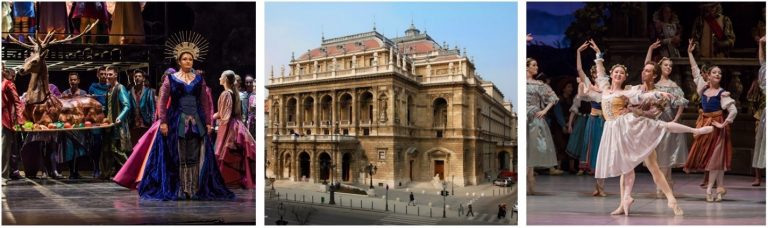
Three hundred and fifty singers, dancers and musicians from the Hungarian State Opera will take over the David H. Koch Theater for two weeks when the Hungarian State Opera and Hungarian National Ballet make their U.S. debuts, October 30-November 11, in programs featuring a series of U.S. premieres and new productions. The announcement of the engagement was made by Szilveszter Ókovács, General Director of the Hungarian State Opera today (March 14) at the Hungarian Consulate in New York City.
The first week of the engagement features the Hungarian State Opera in U.S. premiere performances of Ferenc Erkel’s Bánk Bán and János Vajda’s Mario and the Magician, as well as Karl Goldmark’s rarely seen The Queen of Sheba, and Béla Bartók’s Bluebeard’s Castle.
The second week features two full length ballets including the U.S. premieres of new productions of Swan Lake and Don Quixote, plus a third program of contemporary dance classics by Hans van Manen. The 100-member Hungarian State Opera Orchestra will play live for all performances during the two weeks.
Additionally, the Hungarian State Opera and Hungarian National Ballet will host a gala on Sunday, November 4 at 8:00 p.m. Further ancillary events to be announced.
THE OPERAS
The Hungarian State Opera has a remarkable tour history. The company has been seen around the world for a century, with performances being staged in numerous European capitals and in countries from Egypt to Japan, making these first performances in the U.S. particularly significant.
Considered Hungary’s national opera, Ferenc Erkel’s Bánk bán (1861) is the traditional season-opener of the Hungarian State Opera. The composer, who also wrote Hungary’s national anthem, is considered the father of Hungarian grand opera and in 1884 founded the Hungarian State Opera, serving as its first music director. Bánk bán features a libretto by Béni Egressy based on Hungarian poet and playwright József Katona’s 1819 historical tragedy of the same title, one of the most important works in Hungarian literature. Centering on the character of Bánk, a medieval court official who becomes involved in a conspiracy against the king’s German-born wife, the play reflects Hungarian resistance to foreign rule and was famously staged at the outbreak of the Hungarian Revolution of 1848.
Bánk bán will be performed Tuesday, October 30 at 8:00 p.m. and Saturday, November 3 at 8:00 p.m.
The Queen of Sheba is the first opera by Hungarian-born composer Karl Goldmark, who spent most of his life in Vienna. Following the success of the opera’s 1875 premiere, it was performed at the Vienna Opera nearly every year until 1938. The Queen of Sheba had its U.S. premiere at the Metropolitan Opera House on December 2, 1885 and was last performed there on January 27, 1906. It has not been fully staged in New York since. The Queen of Sheba will be performed Wednesday, October 31 at 8:00 p.m. and Friday, November 2 at 8:00 p.m.
The Hungarian State Opera gave the world premiere of Bartók’s Bluebeard’s Castle on May 24, 1918 and has since staged more than 500 performances. From May 24 to 27, 2018, the company celebrates the opera’s centennial with a new production premiere and additional outdoor performances of the opera in the plaza outside the opera house. János Vajda’s Mario and the Magician, premiered by the company in 1988, is one of Hungary’s most successful contemporary operas. The libretto is based on Thomas Mann’s 1929 anti-fascist novella Mario und der Zauberer, which criticizes Italian nationalism and tells the story of a manipulative hypnotist. A double-bill of Bluebeard’s Castle and Mario and the Magician will be performed Thursday, November 1 at 8:00 p.m. and Saturday, November 3 at 1:00 p.m.
THE BALLETS
Although American audiences won’t have their first glimpse of the Hungarian National Ballet in live performance until the gala on November 4, the dancers are visible on screen in the newly released film “Red Sparrow,” whose ballet scenes were set on the stage of the Opera House in Budapest. Tamás Solymosi, a former principal dancer with American Ballet Theatre, is ballet director and artistic director of the 120-member company.
The dancers’ impeccable technique, stylistic and dramatic versatility will be front and center in all three New York City programs beginning with Rudi van Dantzig’s opulent 1988 production of Swan Lake. While using the traditional story of the Marius Petipa and Lev Ivanov 1895 classic, much of van Dantzig’s choreography is completely original. Both the new choreography, as well as the spectacular new sets created for the Hungarian staging and the flawless dancing and acting were greeted with great acclaim when the ballet was first performed by the Hungarian National Ballet in 2015. Swan Lake will be performed Tuesday, November 6 at 7:00 p.m., Wednesday, November 7 at 7:00 p.m., and Thursday, November 8 at 7:00 p.m.
The balletic history of Don Quixote is almost as old as the art form itself, with the first version of the ballet premiering in 1740 followed by notable reinterpretations by Marius Petipa (1871) and Alexander Gorsky (1902), among others. The Hungarian National Ballet will present its newest staging of the classic ballet created in 2012 by Michael Messerer, who sought to preserve elements of the Petipa and Gorsky versions while emphasizing the dramatic narrative of the ballet. Don Quixote will be performed Friday, November 9 at 7:00 p.m. and Saturday, November 10 at 7:00 p.m.
The trio of Hans van Manen works scheduled for the Koch was performed by the Hungarian National Ballet last year for a celebration of the choreographer’s 85th birthday. With each demanding different skills from its performers―Black Cake, bubbling with giddy froth, Gnossiennes, austere and starkly modern, and 5 Tangos, a dance of multiple changing moods―the dances showcase the breadth of the performers’ dramatic and technical gifts. The all-van Manen program will be performed on Sunday, November 11 at 1:00 p.m. and 7:00 p.m.
Please note: casting and production details for operas and ballets as well as ticket information to follow in future press announcements.
The Hungarian State Opera was founded in 1884 by the Government of the Kingdom of Hungary, and its first directors were Ferenc Erkel, a Hungarian conductor, composer, and key figure in Hungarian opera culture, and Frigyes Campilli, a dancer, choreographer and ballet master of Italian-German origin, who founded the first ballet troupe in Hungary. With two theaters―the opulent neo-Renaissance-style Opera House and the more modern Erkel Theatre―the company can accommodate an audience of more than 3,200 people on a single night. Repertoire includes well- and lesser-known Hungarian and international operas and ballets, as well as contemporary and commissioned works. Each year, the company presents more than 200 performances of 60-70 operas, more than 100 ballet performances, as well as musicals, and orchestra concerts, making it one of the busiest opera houses in the world. The Hungarian State Opera contracts a roster of 150 singers, and has three ensembles: a 200-member symphony orchestra; the first and largest professional chorus in Hungary, which also has 200 members including the children’s chorus; and the only classical ballet company in Hungary with its 130 members. For more information, visit opera.hu.
# # #
HUNGARIAN STATE OPERA HUNGARIAN NATIONAL BALLET U.S. Debut Performances
October 30 – November 11, 2018 David H. Koch Theater, Lincoln Center
Tuesday, October 30 at 8:00 p.m.:
FERENC ERKEL: Bánk bán (U.S. premiere)
Wednesday, October 31 at 8:00 p.m.
KARL GOLDMARK The Queen of Sheba
Thursday, November 1 at 8:00 p.m.
JÁNOS VAJDA Mario and the Magician (U.S. premiere)
BÉLA BARTÓK Bluebeard’s Castle
Friday, November 2 at 8:00 p.m.
KARL GOLDMARK The Queen of Sheba
Saturday, November 3 at 1:00 p.m.
JÁNOS VAJDA Mario and the Magician
BÉLA BARTÓK Bluebeard’s Castle
Saturday, November 3 at 8:00 p.m.
FERENC ERKEL Bánk bán
Sunday, November 4 at 8:00 p.m
OPERA / BALLET GALA
Tuesday, November 6 at 7:00 p.m.
Wednesday, November 7 at 7:00 p.m
Thursday, November 8 at 7:00 p.m.
RUDI VAN DANTZIG Swan Lake (U.S. production premiere)
Friday, November 9 at 7:00 p.m.
Saturday, November 10 at 7:00 p.m.
MICHAEL MESSERER Don Quixote (U.S. production premiere)
Sunday, November 11 at 1:00 p.m. and 7:00 p.m.
LOL: Three Pieces by Hans van Manen
HANS VAN MANEN Trois Gnossiennes
HANS VAN MANEN 5 Tangos
HANS VAN MANEN Black Cake
Ticketing information and casting and production details for operas and ballets to follow in future press announcements.
St. Emeric Parish has made arrangements with the City of Cleveland to have four consecutive hours of free parking in either of the West Side Market parking lots when there is Mass or other programs at the church, this includes the Hungarian School and Scout/Folk Ensemble meetings.
The ticket which you receive at the parking lot entrance gates may be validated in the church building. The validator is located in a box on the wall of the room where the stairs lead up to the organ loft. Simple instructions for its use are also located by the box.
After four hours, you must pay $1/hour, up to a maximum $10/day. Generally, parking is free for everyone for the first 90 minutes every day from 6 a.m. to 6 p.m. After the 90 minutes, and also every day from 6 p.m. to 6 a.m, you must pay $1/hour, up to a maximum $10/day, if your ticket is not validated for the four free hours.
Having just arrived home from one of our travels, I was sad to learn that John, you are no longer with us.
My condolences and deepest sympathy to your lovely wife Edith and family. We lost a great community leader, a true gentleman and a cherished friend of Hungary. You will be missed! But in our thoughts and memories you will stay alive.
John, I will always remember your friendly smile and engaging personality as I had the privilege and pleasure of meeting you at various technical, business, and civic events and witnessing your smart intellect. Many of these meetings were connected to hosting various government, business, and academic leaders from Hungary. One of such most memorable event for me was my hosting of Antall Jozsef (Prime Minister of Hungary) and his 18 member delegation at TRW in 1991. Because I knew that you, John was a good friend of Hungary I made sure that you would seat at the head table with Antall (as shown below). It was a pleasure to see you John interact at this event with not only the Prime Minister and his delegation but with many of the over 80 invited US Mid-West business leaders as you became a more effective promoter of doing business in Hungary than Antall himself. Thank you, John for your effective participation and sharing with me and many others – especially your lovely wife, Edith – a strong desire to help Hungary succeed. For this, naturally, I’m also very thankful to Edith.
John, it was a privilege to know you and share with you some interesting and meaningful moments.
Thanks for the memories. My wife, Kati and I wish lots of strength and good heath for your family and sending our love to Edith.
It is with deep sadness that the family of John N. Lauer announces his passing on February 23, 2018. He had just turned 79, and by anyone’s measure, lived a full, adventurous, impactful, incredible life. During the last eight months of his life he waged a heroic battle against cancer. He died at home, surrounded by his loving family.
John was a devoted family man, outstanding business executive, philanthropist, community leader and role model to many.
He was born in 1939 in Washington, DC to Clarence and Louise Lauer and was the beloved big brother of Ann Lauer Kennedy. As was typical in that era, he grew up living within several blocks of most of his relatives. As many of the men fought in World War II, the women of the family raised the children together. John was an active Scout and athlete at Northwestern High School, and served in the Army Reserves between 1956-1963. He attended the University of Maryland where he received a B.S. in Chemical Engineering in 1963. That same year he married Edith Kish, who had emigrated in 1957 from Hungary. They began their 54 year-long marriage in Kingsville, Texas and subsequently moved to ten other locations in the U.S. and Europe where John pursued his career.
They had two daughters: Kriszta Lauer Nagy (Robert) of Plano, TX, and Andrea Lauer Rice (Barton) of Roswell, GA; two beloved grandchildren – Nicholas and John Patrick. John was the cherished uncle to many nieces and nephews and godchildren.
In 1969, John earned an MBA from Texas A&M University, in Kingsville, TX.
He had a long and distinguished business career beginning at Celanese Corp. as a young chemical engineer where he was known as a troubleshooter. In 1987, John was a top executive when the company was bought by the German Hoechst AG. Two years later, he moved to Cleveland, OH to serve as President and COO of BF Goodrich. In 1997, he became President and Chairman of Oglebay Norton Company, where he created a unique performance-based executive compensation plan. After joining the Diebold Board of Directors in 1992, he served as the Non-Executive Chairman from 2005 until his retirement in 2013.
During this time, Lauer also served on several non-profit boards including the Visiting Nurses Association, The Cleveland Opera, and The Moreland Courts Condominium Association. He was an avid supporter of arts and culture throughout his life. In 2000 he was a co-founder of the University of Maryland College Park Foundation for the benefit of his beloved alma mater, eventually serving as its Chairman. He remained a devoted member and was an active leader of the Board for many years of the Sigma Alpha Epsilon National Fraternity.
In 2016, he joined the Board of The Phillips Collection in Washington, DC, as a liaison with the University of Maryland.
Because of his strong commitment to higher education, Lauer established The John N. Lauer Banneker/Key Scholarship at the University of Maryland in 1997 that provides merit-based awards for outstanding students who pursue science.
Due to his wife’s Hungarian background, after the fall of communism in 1989, he gained thorough first-hand knowledge of Hungary, Romania and Slovakia through dozens of visits to the region. Named an Honorary Hungarian in 1993 by Hungarian Ambassador Pal Tar, he was an active supporter of many Hungarian causes and organizations, primarily the Washington-based Hungarian American Coalition. The Lauer Family’s Pannonius Foundation provided major support for educational and cultural projects such as the Godparents’ Program for students of the Hungarian Reformed Kollegium of Kolozsvar in Romania, and the Madach Posonium Publishers and the Posonium Literary Awards in Slovakia.
John Lauer was an avid fisherman, hunter and enthusiastic world traveler with a special interest in Mayan civilization and culture, the American Civil War and the European battlefields of WW I and II. He published extensive travelogues of his trips and had a keen interest in ancestry. He loved the opera, was a gourmet chef and a voracious reader. He was happiest when surrounded by family and friends, and was actively involved in the education and accomplishments of his grandsons. All those whose lives he touched, especially the young people in the US and Europe, have been inspired by his example and will keep his memory alive.
The Lauer family is grateful to the doctors and nurses of the Cleveland Clinic Taussig Cancer Center and Hospice of the Western Reserve for their outstanding care.
A Memorial Service will be held at The Cleveland Institute of Music at 4:30 PM on Saturday, March 17, 2018. A Celebration of Life will take place at the University of Maryland Memorial Chapel at 10:30 AM on Saturday, April 14, 2018.
In lieu of flowers, memorial contributions can be made to UMCP Foundation, Inc. 4603 Calvert Road, College Park, MD, 20740 – please note “Lauer Banneker/Key Scholarship” on check or go to https://go.umd.edu/lauer or to the Sigma Alpha Epsilon National Fraternity, 1856 Sheridan Road, Evanston, IL 60201- 3837 with “John N Lauer Excellence in Leadership Award” noted on check or go to https://saefoundation.givingfuel.com/johnlaueraward
To send flowers or a memorial gift to the family of John N. Lauer please visit our Sympathy Store.
As an enthusiastic film and Oscars fan, I have attempted nothing less than to predict the odds for Ildikó Enyedi’s On Body and Soul for the Academy Awards in the category of Best Foreign Language Film, compared to other nominees.
My top contenders, besides Enyedi’s film, are Chile’s entry, Sebastian Lelio’s AFantastic Woman, and the Swedish The Square, directed by Ruben Östlund; however, Oscar winners are always hard to predict and Lebanon’s first entry, The Insult, and Russia’s Loveless are also really strong films. So, here, then are the factors that may affect why Hungary may – or may not – win its third consecutive Academy Award this Sunday.
Women rights, #metoo and #TimesUp vs LGBTQ
2018 is the year of women. Last year, after sexual abuse scandals and the hashtag #metoo blew up on social media sites with millions of hashtags on Twitter and Facebook and countless stories from women – and men – of their abusers, including Hollywood producer Harvey Weinstein and actor Kevin Spacey, this year has already seen its new movement, #TimesUp, with a similar result. Time’s Up has been supported by some of Holywood’s most prominent women’s rights advocates, including Oprah, Eva Longoria, Emma Watson, Natalie Portman, Reese Witherspoon and many others, and at the year’s first major Hollywood event, the Golden Globes in January – and later at the BAFTAs in the UK – a whole profession, males and females, stood together and wore black on the red carpet, in support of sexual harassment victims, women’s rights in every other profession, and a greater inclusion of female talent both at award ceremonies and behind the camera.
After Natalie Portman’s vocal criticism of the Foreign Press Association, when presenting the Best Director Award at the Golden Globes, for not nominating any women, it is not surprising that several categories for this year’s Academy Awards have women nominees, including Best Director (Greta Gerwig for Lady Bird), only the fifth woman in 90 years to be nominated in the category, as well as the first ever female nominee for Best Cinematographer (Rachel Morrison for Mudbound). So, after this rather lengthy introduction, I think that from this point of view, Enyedi, as the only woman among the directors nominated for the best foreign language film, has a distinct advantage in her quest to bring home the golden statuette on Sunday.
However, there’s another important, and underrepresented movement in Hollywood, which in the last couple of years finally made its way into award ceremonies – LGBTQ inclusion. After last year’s surprising Best Picture win of Moonlight, we can surely say that the Academy continues to realize the topic’s importance, as this year, they have included more than one LGBTQ themed films. For one, my personal favorite, Call Me By Your Name, has been nominated in three categories. But the foreign language film category also has a film that fits – and in my opinion will win. A Fantastic Woman examines gender identity and focuses on a transgender singer, who – after the death of his lover – is misgendered, accused of murder and harassed. Another supporting argument for A Fantastic Woman: the leading actress of the film, Daniela Vega, who herself is also transgender, is presenting an award – as a foreigner among the other English speaking presenters, and the first ever transgender actress to present an award. The question is, how much can the Academy leave its comfort zone after the so-called “Moonlight effect” and award a film about gender identity – but in case Gerta Gerwig doesn’t win the “big” category with Lady Bird, I think Enyedi stands a great chance as well.
erlinale’s Golden Bear vs Palme d’Or in Cannes
If we look at the previous prizes and nominations of each films, we can see that – not surprisingly – all candidates bagged a number of prestigious awards at recognized international film festivals. In this aspect, The Square is the frontrunner – besides the Oscar nomination, it was nominated for a Golden Globe in the same category, and has won six European Film Awards, including Best European Film, not to mention the most important, the top prize of the Cannes Film Festival, the Palme d’Or. The Russian film Loveless is also a strong competition for Enyedi, with its win in the Cannes Jury Prize, two European Film Awards, Russia’s Golden Eagle Award and the Los Angeles Film Critics for Best Foreign Film besides its Golden Globe and BAFTA nominations.
Streaming Company vs Traditional Theatrical Distributor
It is important to mention the distributors of the nominated films as well. On Body and Soul is the only film out of the five Foreign Language Oscar nominees which is distributed by a streaming company, Netflix; this makes it more likely that Enyedi’s film will have the largest potential viewing audience. However, even though the 8000 members of the academy will certainly be more likely to view the Hungarian movie before the votes, and hopefully more people will choose it, in this regard Hollywood is slightly old-fashioned: the Academy still has not quite figured out how to approach streaming sites and their original and distributed films. In Cannes, even head of the jury, director Pedro Almodóvar talked about Netflix films and the potential risk they pose on theatrical displays:
I personally don’t perceive the Palme d’Or [should be] given to a film that is then not seen on the big screen, All this doesn’t mean that I am not open or celebrate new technologies and opportunities, but [as long as] I’m alive I’ll be fighting for the capacity of hypnosis of the large screen for the viewer. (Vanity Fair)
The other films are displayed on the “big screen” first: A Fantastic Woman is distributed by Sony Pictures Classics, The Square by Magnolia Pictures, while the Lebanese The Insult is by Cohen Media Group, distributor of last year’s Foreign-Language winner, The Salesman.
Animal rights vs politics and satirical social commentary
Enyedi’s film is a beautiful drama about an unusual love story, and as such did not draw the same level of controversy as some of the the other nominees, although critics said the setting of the film – a slaughterhouse – was upsetting for some of the audience. They said that the climax of the film, the penultimate scene – which I do not want to spoil for those who haven’t seen it yet – was shocking for some people, and there were some who even left the screenings. Anikó Návai, Hungary’s Hollywood correspondent, has argued in Hungarian talkshow Mokka that animal activists may also find some parts offensive, mainly the slaughter of the animals.
The Square is set in a museum, where the manager of the museum’s PR team goes too far with publicity plans to make buzz around an installation, sparking a public uproar and exposing the hypocrisy of the media. Critics said that, despite the film’s popularity in Europe, US audiences and film critics were not as amused by it; they were confused by the absurd humor, satirical social commentary, and humorous parts of the film. Additionally, satirical films tend not to do particularly well at the Oscars – let’s just say, not everyone likes to be mocked (not to mention that the setting is the world of artists).
Likewise, the Russian Loveless courts controversy in that it criticizes Putyin’s Russian society through the struggle of a family to find their lost son. So, if the Academy is concerned about controversy and would like to exclude politics, On Body and Soul may yet stand a good chance.
Finally, looking at the the odds of the betting pages, Enyedi’s film is ranked third with an average multiplier of 7.5, following A Fantastic Woman (2) and The Square (2.5). However, looking at the winners of recent years, members of the academy often surprise us with their choices: sometimes the least probable winners get the award. In fact, based on last year’s gala, it is possible that someone will win even when another crew is already on the stage giving an acceptance speech.
Whatever the outcome might be, a third Oscar nomination in a row is in itself a huge success, and I can only hope that Enyedi’s film will follow in István Szabó’s and László Nemes Jeles’s footprints, and that after the victories of Mephisto in 1981 and Son of Saul in 2016, On Body and Soul will bring home yet another Foreign Language Oscar, and Hungary’s third consecutive Academy Award following last year’s win by Kristóf Deák’s short film Sing.
By Fanni Kaszás
via oscars.org, Entertainment Weekly, Vanity Fair, The Ringer
Cryptocurrency will be a decade old this year, and in recent months Bitcoin, as well as cryptocurrencies in general, have become more prevalent in the public realm. However, there are many misconceptions that are being circulated, and the media sensation doesn’t help in giving them an objective introduction. We spoke with Barnabás Debreczeni, one of Hungary’s top experts on cryptocurrencies.
Barnabás’ company is Shinrai, the first Bitcoin ATM and first online Bitcoin exchange in Hungary. He is a member of the board of the Hungarian Bitcoin Association, the chief organizer of Bitcoin Meetup Budapest, and a programmer by trade.
This interview has been edited for clarity and concision, and translated from the original Hungarian.
Would you introduce to us, in broad terms, what is a Bitcoin or cryptocoin?
Bitcoin is the first digital currency which has value, and can be transferred to anyone, anywhere in the world. With the help of the Internet, information flows freely, and thanks to the various cryptocurrencies- the first, and most popular being Bitcoin- this is true of valuables (money) as well. As for its history, “its foundation” was in 2008, and is tied to the publication of a character calling himself Satoshi Nakamoto. However, we don’t know who or what this name is referring to. It may have been a marketing tool, who knows, but in any case, they finalized and maximized the number of “released” Bitcoin to twenty-one million. Storing cryptocurrency works simply by downloading an application, a “wallet”, on a smartphone, in which it is stored.
We often hear that Bitcoin mining is possible. What does this term cover exactly?
In regards to mining, roughly, what it means is that the more money and energy that is invested, the less will be yielded. The “miners” are machines on the network, which verify public transactions, authenticate them, and put them in order. Therefore, in return for their ‘work’ they receive newly issued Bitcoins. The work here is the processor machine’s time, which consumes a lot of power, and therefore -due to increasing competition – is becoming less profitable. The process has long been happening with machines built for this purpose that are difficult to access and very expensive.
Can you say a few words on the situation of the use of cryptocurrencies in Hungary?
Overall, nationally it really hasn’t become a popular form of payment by merchants. In Hungary, approximately fifty thousand people own cryptocurrency, and who primarily speculate; that is, they trade with it or retain it. It’s absolutely just an estimate, but there are only a few thousand people who use it on a daily basis. It hasn’t spread so much here at home that stores or other locations will accept it as payment. There are several reasons for this: the NAV’s (Hungarian Tax Authority) rules are controversial so far; for a very long time it was unclear if they needed to be recorded or accounted for. Nor has there been a good, working, Hungarian-language POS (a payment tool that accepts cryptocurrencies – as well as being used for credit card payments as well) terminal that works with forints either , which would simplify cryptocurrencies’ use and conversion. Currently, the number of domestic enterprises that accept payment with cryptocurrency is somewhere between fifty and a hundred; the range is also very wide: lawyers, catering facilities, babysitting, hairdressers and even a beekeeper is among them.
You are also a member of the Hungarian Bitcoin Association; what do you deal with exactly?
At present, we primarily deal with information. Many questions come in, for example, asking which software is more reliable to store the Bitcoin, or which cryptocurrency is suspected to be a pyramid scheme, etc. We share this information on Facebook, in which case we may even sacrifice money in order to reach more people. Later, we’ll likely expand to advocacy activities in some capacity, as we’re constantly expanding.
What regulations exist at present? For example, are there taxes on cryptocurrencies?
Of course, all cryptocurrencies are taxed income. This is one of NAV’s, I think, most questionable resolutions according to which, (crypto) is considered as income for private individuals. The European Court of Justice has ruled that cryptocurrencies should be legal tender in terms of VAT, which means that there is no VAT on it. I think this argument can be applied to personal income tax and corporation tax, as well.
What is the rest of world’s stance on them; could you give us some examples?
In Japan it is considered legal tender since 1 April 2017, in Switzerland you can pay taxes in cryptocurrencies, and as of a few weeks ago it was introduced in the state of Arizona, so that local taxes can been settled there (with crypto). Otherwise, even where it is not accepted it is not prohibited, except in dictatorships, because obviously cryptocurrency gives a sense of financial freedom to people, which isn’t really in the interest of oppressive regimes.
You also hear a lot about how different cryptocurrencies are often used by criminal groups.
When the Internet burst into popularity, even then there was talk about how the internet will be used for illegal trafficking, bomb recipes, porn, etc. But, just as the internet had become overly demonized, with the cryptocurrency it is the same case. Obviously, there are dark markets where you can buy drugs online and to pay for it with cryptocurrency, but their turnover is minimal. In this, the data that was published online after the FBI’s closing of the largest drug market, AlphaBay, is telling. This shows that the largest site of this kind was responsible for just 0.01% of the US drug trade. Anyway, if I was a dealer, I would not use cryptocoins either, because as I mentioned earlier, every transaction is public; what’s secret is the identity behind them. The largest law enforcement agencies (FBI, MI6, etc.) already have an eavesdropping apparatus which can connect these real users based on metadata. Despite all this, evidently registration can be done with different tricks, and it’s imaginable that in the future there will be a cryptocurrency that provides almost complete anonymity, but even then, the main financiers of illegal trade channels won’t be cryptocurrencies.
What are the banks’ stance on cryptocurrency?
Undoubtedly, they were initially quite against it, now that is far from the case. There are those who continue to oppose it, but it is also telling that there are those that call us every two weeks to give lectures at banks, where we quickly end up with Bitcoin. More and more banks take on board the crypto ideology, and there is no other choice anyway. With the rise of the internet, whatever new thing that didn’t build an online presence in the ’90s has surely fallen out of business nowadays. It is also rumored that there is a Hungarian bank, which will provide Bitcoin-based services soon, but for now it’s just a rumor.
The “bubble” has already burst several times, if we wish to use this term. The cryptocurrency otherwise resembles exchange trading, there’s rise and fall here too, but is still at a much higher ‘amplitude’ and with more risk. As information-based services are already almost completely Internet-based, cryptocurrencies can be the beginning to digitalization of services and value-transfers. The initial function of the Internet was for information (e-mail) or to send a file, but it is now only one of many. I see Bitcoin similarly; it is still in a very early stage, sending-receiving money is just one thing, so in my opinion, is still very far from being phased out.
Do you think that Cryptocurrency may become part of everyday life? Will it soon be possible to pay with it in stores?
By all means, this is the trend. Soon, it will probably be used in stores as tender; in Japan, North America, and many places it already is. It would become more prevalent in everyday use, if there would be a cryptocurrency with an exchange rate that is stable. Several projects are looking for solutions to this, including the Hungarian Augmint, which wants to set the exchange rate against the euro. Nowadays, however, the price has risen to such an extent that those who can, would rather hold onto it. In 2014, the then price of a beer paid in Bitcoin at the Anker club would be worth $500 at the current exchange rate!
Ivett Toth sure knows how to stand out in a crowded field of female figure skaters for the 2018 Winter Olympics. Her solution: bring out the AC/DC. During the women’s figure skating short programs on Tuesday night in PyeongChang, Hungary’s Toth surprised crowds — both at the rink and around the world — with her unorthodox choice of music. And to many, she’s become an instant rock hero. Toth may be just 19, but there’s no doubt her clear love for the classic rock band transcends generational taste.
Most figure skaters have been sticking to more traditional soundtracks: the scores of Tchaikovsky classic Swan Lake and Bizet’s Carmen could be heard throughout Tuesday night at the Gangneung Ice Arena. Former champion Evgenia Medvedeva went a little more abstract, selecting a Chopin nocturne and incorporating the sound of her own breathing and a few words.
But it was Toth who raised eyebrows — and grabbed attention — with the “Back in Black” and “Thunderstruck” medley. She topped that off by coming costumed in a studded leather pant-and-vest combo with fingerless gloves, a far cry from her competitors’ delicate skirts and balletic tutus. Naturally, the internet was agog with her bold performance. And although Toth finished after the short program with 53.22 points, well behind the top-ranked Olympic athletes from Russia, she won’t soon be forgotten — even if she doesn’t make it to the medal podium.
Hungary’s short-track speedskating team has won Hungary’s first ever Winter Olympic gold medal in a new Olympic record time at the Pyeongchang Winter Games.
The Hungarian team of Shaolin Sándor Liu, his brother, Shaoang Liu, Csaba Burján and Knoch Viktor, won the race with an amazing Olympic record of 6:31.971, while China took silver and Canada came third. You can watch the moments of the victory here:
OLIMPIAI BAJNOK A MAGYAR KORCSOLYAVÁLTÓ! ??? ??? Gratulálunk!Amennyiben lemaradtatok volna róla, itt megnézhetitek a versenyt:
Posted by Eurosport on Thursday, February 22, 2018
Hungary’s most recent medal in the history of the Winter Olympics happed 38 years ago, in 1980 at the Lake Placid Winter Olympics, where Krisztina Regőczy and András Sallay ice dancers won silver medal. With today’s first place, we now have a gold, two silver and four bronze medals alltogether. This year, besides the Hungarian speedskating team’s gold, we have a fourth, two fifth and a sixth place.
The medal ceremony of the 5000m Relay will be held on Friday, around 11 a.m.
In a video message posted to his Facebook page on Tuesday, Prime Minister Viktor Orbán criticized recent comments by his Belgian counterpart Charles Michel, who had earlier had suggested punishing Visegrád 4 countries (a grouping which includes Hungary, Poland, the Czech Republic, and Slovakia) if they continued to reject the EU’s agreed-upon refugee quota plan.
Orbán first noted that the national board of the ruling Fidesz party yesterday discussed a comment by the Belgian prime minister that central European countries would ‘have to accept migrants’. He then claimed that “We cannot give in to extortion. For us, Hungary is first. We will fight those who want to change the Christian identity of Hungary and Europe.” In his comments, the Belgian PM had said that the European Council, together with heads of government and of state, would decide on Europe’s migration policy by a qualified majority at a summit in June. He said an ultimatum would be issued to Visegrad Group (V4) countries that chose to “reject solidarity”.
Fidesz spokesman Imre Puskás claimed that Brussels had completely ignored the Visegrad countries’ opposition to the migrant quotas; he claimed that the Belgian PM’s announcement was a part of the supposed ‘Soros plan‘ (a term which the Orbán government has been employing in recent months to attack Hungarian-American billionaire George Soros in the lead-up to April’s parliamentary elections).
In Bratislava, Foreign Minister Péter Szijjártó said that Michel’s “ultimatum” is “coercion” that Hungary will never yield to and that the words of the Belgian PM are “shocking” as this was supposedly the first occasion when Brussels openly prepared for pushing through migrant quotas, disregarding the opinions of certain EU countries.
Thus far, the Visegrad countries have generally been on the same page with regards to opposing the quota system; if the EU’s governing bodies truly wish to push forward with their plan a harsh diplomatic battle can be expected, as the V4 countries together represent a powerful group within the EU. It remains a question, however, if they can stick together, as there were signs in the past that Slovakia, for example, could be convinced to side with the EU in the event of a dispute.
István Veres of Babel Restaurant clinched a bronze medal. Photo: Hungarian Bocuse d’Or Academy.
Ádám Pohner and his commis chef Richárd Csillag will represent Hungary in the European final of Bocuse d’Or, the world’s most prestigious cooking competition. The Hungarian chef prevailed following an intense competition that included six top chefs and their teams, and that was judged by some of the world’s top chefs.
Following the selection in December, which was a private event, the final competition was held during SIRHA Budapest, a premium 3-day international HoReCa (Hotel Restaurant Catering) and retail show which attracted many spectators and gastronomy enthusiasts. At stake was Torino and the European Final, which Tamás Széll, currently the most famous Hungarian chef won, 2 years ago. This unexpected success helped light a new fire under Hungarian gastronomy. After his victory at the European level, Széll ultimately took home a fourth place finish at the world final in Lyon.
István Veres of Babel Restaurant clinched a bronze medal. Photo: Hungarian Bocuse d’Or Academy.
Taking a look at the enthusiastic crowd gathered for the competition yesterday, one can clearly see the heightened interest that Hungarian gastronomy has accrued over the past several years. While waiting for the contest to take place, spectators could wander through SIRHA’s stalls, tasting and trying out a number of products.
The event’s commentators were famous Hungarian gastro-blogger András Jókuti and Italian-Hungarian restaurant owner Gianni Annoni, who together provided the crowd with interesting anecdotes and background information. The 24-person jury included many important chefs from throughout Europe, and was presided over by Enrico Crippa, chef of the 3-Michelin-starred Italian restaurant Piazza Duomo.
Ingredients were selected to correspond to the principles of the Italian final, while there were two surprise elements announced one day before the event as well. Teams had 5 hours and 35 minutes to prepare a vegetarian and a meat dish. All the six teams came from top-end Hungarian restaurants. They all were obviously very motivated and concentrated after an exhausting preparation.
Ádám Pohner is the sous-chef (the second in command) at Kistücsök (‘little cricket’) restaurant located in Balatonszemes, on the south shore of lake Balaton. Kistücsök, owned by Balázs Csapody, is one of the pioneers of fine-dining outside the boundaries of Budapest and is renowned for its special emphasis on local ingredients, such as fish from the lake. Mr. Pohner is just 24 years old, meaning that there seems to be an extremely bright future ahead of him. Despite, his youth, however, he is experienced as well, as he has already worked in many great restaurants such as Olimpia or Alabárdos and has participated as a commis chef in a number of Bocuse d’Or rounds in the past several years.
In any case, after 2016’s success, Ádám Pohner may go far in Italy, where the president of the competition’s jury will be none other than Tamás Széll. The Bocuse d’Or’s European final will be held in Torino, capital of the Piedmont region, which is home to a great many Michelin-starred restaurants, and which features an interesting melting pot of Italian and French cuisine.
Bishop Nelson Perez had a busy week after returning from a nine-day pilgrimage for peace to the Holy Land with nine other Hispanic bishops.
His first day back, Jan. 29, he stopped at St. Emeric Parish in Cleveland to visit with a group of priests hosted by Father Andras Mezei, St. Emeric pastor. Father Mezei cooked a Hungarian-Transylvanian style meal for his guests.
After dinner, Bishop Perez toured the church and visited with students of the Hungarian School and Scouts. Father Mezei said St. Emeric is a place where Hungarian Catholics can attend Sunday Masses in their native language and enjoy social activities. He said the parish has about 700 members coming from many communities in the diocese.
At the Hungarian School, children and adults learn the language and learn to improve their language skills. The Scout-Regösök Folk Dance Group also trains at the parish.
Children and teachers helped the bishop learn to say a few words in Hungarian including ”Hogy vagy?” (How are you?) and “Isten áldjon meg” (God bless you). Father Mezei said the bishop easily learned how to say “pizza” in Hungarian, since it’s the same as in English.
He said Bishop Perez spoke with everyone and encouraged them to cherish and save their Hungarian heritage.
This was the second time the bishop visited a Hungarian parish in the diocese. In October, he celebrated Mass at St. Elizabeth of Hungary for the 125th anniversary of the parish, the oldest Hungarian parish in the diocese. St. Emeric was founded in 1904.
Bishop Perez also travelled to Holy Spirit Parish in Garfield Heights on Jan. 31 to install Franciscan Father David Nestler as pastor. A reception followed the Mass.
Father Nestler has served at Holy Spirit since summer 2017. A Pennsylvania native, he is a graduate of Borromeo Seminary in Wickliffe. He was ordained in 1989 and worked as a parish priest for six years, then as director of his community’s novitiate program for 10 years. In 2006, he became director of the Paul VI Pastoral Center in Wheeling, West Virginia, followed by six years’ work in provincial administration.
Holy Spirit is a collaboration of the former St. Catherine of Alexandria, St. Timothy and St. Henry parishes. It was established on Jan. 1, 2008, with the first Mass celebrated on Jan.; 6, 2008 by Auxiliary Bishop emeritus Roger Gries.
Bishop emeritus Richard Lennon entrusted the parish to the care of the Capuchin-Franciscan Friars of the Province of St. Augustine. Since its establishment, Holy Spirit also has welcomed parishioners from nearby St. Cecilia, Epiphany and St. Adalbert (which reopened), as well as several other nearby parishes.
Father Nestler replaced Franciscan Father Philip Bernier, the first pastor, who was reassigned to a new ministry with Capuchins in formation by his province.





























 Bishop emeritus Richard Lennon entrusted the parish to the care of the Capuchin-Franciscan Friars of the Province of St. Augustine. Since its establishment, Holy Spirit also has welcomed parishioners from nearby St. Cecilia, Epiphany and St. Adalbert (which reopened), as well as several other nearby parishes.
