





The Hungarian government is ready to cooperate for a peaceful settlement of the Russia-Ukraine war.
Reklám


The Hungarian government is ready to cooperate for a peaceful settlement of the Russia-Ukraine war.

As a German language teacher and linguist, Gergely Tóth went to the University of Berkeley, California 26 years ago for a doctoral program, where he soon became immersed in local Hungarian community life. Since then, his voluntary work extended from making oral history interviews to photographing objects and markers on four continents, and collecting archival material of the Hungarian diaspora. The results are preserved on his website and in his home. Later, he plans to place this digital and archival wealth on the ‘table of the nation’.

The issue of EU competitiveness was one of the most important agenda points of the summit. Prime Minister Viktor Orban held a press conference with European Commission President Ursula von der Leyen and European Council President Charles Michel.

Propaganda driven by party politics has prevented a meaningful debate in the European Parliament.

Source: hungarianconservative.com
On 27 September the latest edition of the online conference series organized jointly by the Diaspora Project Network of the University of Pécs (PTE) and Kerko Media Ltd. featured Hungarian communities and their collaborations in San Francisco and its vicinity. The moderator of the event was Deputy Rector Dr. Ákos Jarjabka. The livestreamed discussion was followed in more than ten countries around the world. It was an impressive presentation of the diverse voluntary activities and exemplary cooperation of Hungarian organizations in North California. The series will continue on 25 October with displaying additional local Hungarian organizations from the San Francisco Bay Area.
Honorary Consul Éva Voisin gave a brief presentation about the Hungarian presence in California. According to the latest U.S. census data, there are some 1.4 million people of Hungarian origin in the U.S., of which she estimates that some 120,000 live in California, the majority of them in the larger Los Angeles area; and about 6,000 in the San Francisco area. She presented the short biographies of several famous Hungarians who were or are living in California. For instance, Ágoston Haraszthy founded California winemaking in 1850 and established the Buena Vista winery; Hungarian Corvin Chain Recipient Dr. Edward Teller, the ’father of the hydrogen bomb’, lived on the Stanford University campus; Nobel Prize winner János Harsányi was a professor at the University of California, Berkeley; Dr. András Grove was the co-founder and CEO of Intel Corporation living in Santa Clara; and Dr. Balázs Bodai, a well-known cancer surgeon lives in Sacramento. In the world of entertainment, there are Oscar winner cinematographer Vilmos Zsigmond; three-time Oscar-winning composer Miklós Rózsa; Kossuth Prize-winning composer Éva Szörényi—who also supported the erection of the Gloria Victis statue—; and Peter Falk, the actor who played detective Columbo. In the field of sports, the names of several Olympic gold medal-winning athletes were also mentioned including water polo player Sándor Tarics, fencer and coach György Jekelfalussy-Piller, water polo player Ervin Zádor, and fencer Dániel Magay. We were informed that Hungary is currently represented in California by Consul General István Gróf in Los Angeles, TéT diplomat Nóra Mészáros, and Honorary Consul Éva Voisin.
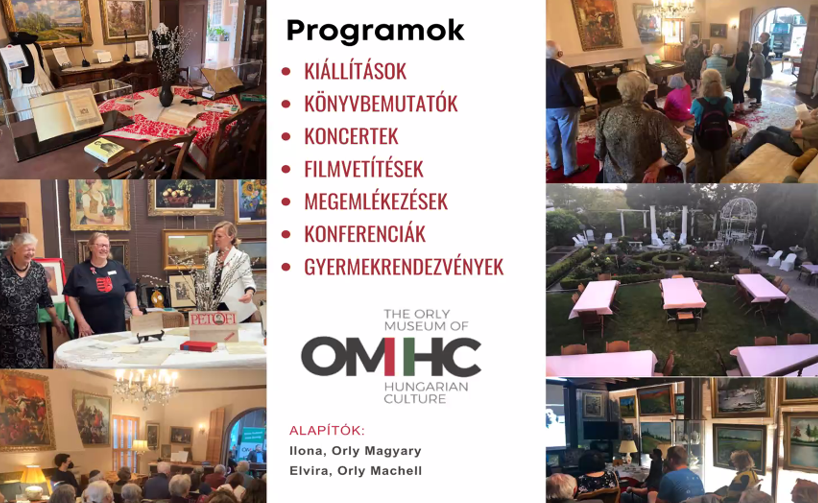
Éva Szabó, the director of the Orly Museum of Hungarian Culture, founded by the Orly sisters in 2019, explained the museum’s mission: to raise awareness and appreciation of Hungary’s rich culture and its long and eventful history. As mentioned, the museum’s diverse programs (exhibitions, book presentations, concerts, film screenings, commemorations, lectures, meetings and museum education, etc.) provide interactive and inspiring experiences for visitors of all ages, whether Hungarian, American or of any nationality. Éva informed us also about the number of the museum’s visitors: 500 in 2021, 700 in 2022 and 1,000 in 2023, with more non-Hungarians than Hungarians overall. Two Saturdays a month, the museum and its programs are free of charge. The library and archives that are being compiled include more than 4,000 Hungarian volumes.
As Szilvia Gilbert explained, the mission of the Hungarian Heritage Foundation is to preserve and transmit the values of Hungarian culture and to make those known to the American public as well as to provide financial support to local non-profit organizations. There are two events they are most proud of: since 1958 they have celebrated Hungary’s national holiday, 20 August in Golden Gate Park, the city’s most famous landmark, with 250–300 people. Furthermore, since 2012 they have been organizing the Hungarian Heritage Festival on the second weekend in each May at Twin Pines Park in Belmont, which attracts 2,500–3,000 guests annually. It showcases Hungarian cultural and gastronomic treasures with folk programs and guest artists from Hungary, such as András and István Berecz. This year they presented spring folk customs. During the nine years of the life of this festival so far, 1,500 volunteers have helped them.
Ildikó Rónyai-Harris informed us about the prehistory of the new Hungarian Cultural Center founded in 2024: the Hungarian House was a long-standing dream of the local community, made possible by the recent sale of the building of the local Reformed Church and of the previous Hungarian House as well as by generous donations. The Hungarian Cultural Center is the result of the cooperation of Hungarian people and organizations to preserve, enrich and pass on their Hungarian culture, heritage and traditions. This year, the Reformed Church purchased a property with a separate building for the Center adjacent to the church, which, although owned by the church, functions as a secular institution. It’s a community space that hopefully will ensure the survival of Hungarian culture for the next generation. They plan to organize historical and cultural events as well as commemorations. One of their objectives is to strengthen connections with people interested in the Hungarian diaspora and to launch a cultural exchange program with a Hungarian partner organization.
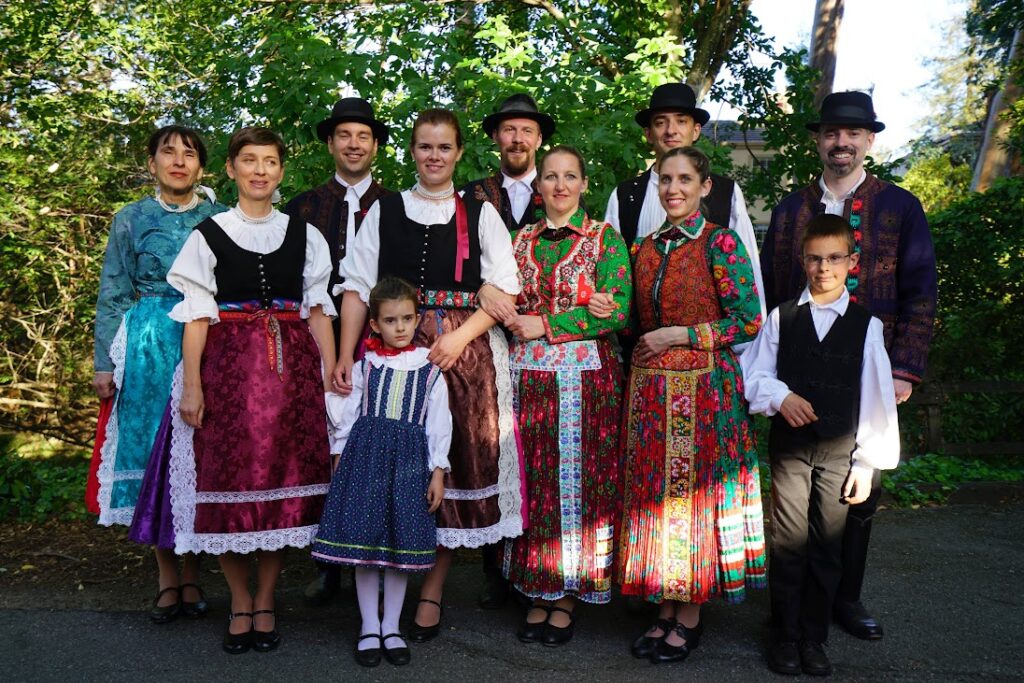
Attila Egyedi, as the business manager of the Eszterlánc Ensemble, explained that the ensemble was founded in 1977 by a Hungarian folk dancer at Stanford University. They currently have 15–18 adult members and hold three-hour-long rehearsals every Friday evening. Their goal is to display and pass on Hungarian folk dance and music traditions to other nationalities, therefore they perform at local events and festivals. They also aim to build the community with at least one dance hall (táncház) event per year, supported by a live band, the members of which they invite from elsewhere in the U.S. and Canada. They have some local musicians and are able to provide live music for the children’s táncház. They are supported by Kőrösi Csoma Sándor Program (KCSP) scholars. They are proud of their folk costumes, which include unique old pieces brought from Hungary by former members; they occasionally receive costumes as donations and recently had new ones sewn in Hungary, with the assistance of a KCSP scholar. They train in dance camps, cooperate with the scouts who they teach every other weekend, they are regular performers of the annual Heritage Festival, and in cooperation with the Cultural Center they will soon launch a monthly dance course for the general public. As Attila said, the Mazsola Children Folk Dance Ensemble, founded in 2007 and revived in 2022 by KCSP scholar Ilka Dajka, is the cornerstone of the future of the Eszterlánc Ensemble, with more and more children joining. Currently, they hold rehearsals with 15–20 children on Saturday mornings, where they learn folk dance, songs and traditions in a playful way. Last year’s Heritage Festival was their first performance in a long time.
Éva Pápai presented the triple motto of the Hungarian Catholic Mission: faith, culture, and charity, which defines their trifold activities. We learned that in the early 1950s, Hungarian priest Dr. József Jaszovszky began to unite the Catholic Hungarians around the San Francisco Bay Area and held occasional services for them. In 1956 Benedictine monks from Pannonhalma settled in the San Francisco Bay Area; Dr. Egon Jávor and six others founded the Woodside Priory Benedictine Community and School in Portola Valley. The Mission was officially established in the early 1960s. Under the leadership of Father Jaszovszky, the venue of the regular Hungarian mass was moved to Portola Valley. The Mission’s emphasis was to preserve Hungarian cultural identity. Together with the Hungarian Reformed Church, they founded a local scouting troop. Father Jaszovszky retired in 1984 and was succeeded by Benedictine Father Kristóf Hites, who was succeeded in 1994 by Father Maurusz Németh, who now runs the Mission with Father Máté. Today, every Sunday there is a Hungarian Holy Mass held at 11 am which is available online along with the recordings of previous masses. There’s an agape afterwards, which has greatly strengthened the community. One of their main goals is to earmark the proceeds of their charity events to support Hungarians in Transylvania and Transcarpathia, the Institute for the Blind in Budapest, orphanages and Catholic church renovations in the Carpathian Basin. Father Maurus often travels to the beneficiaries to personally hand over the funds raised. National holidays are a special priority for them, celebrated either in the chapel or outside the building in the context of some cultural event. The school also has three community rooms, where cultural events are regularly organized and artists from Hungary are also welcomed. As Éva Pápai explained, first communion and confirmation are new events for them, as the chapel has only recently been authorized for these services (they previously had a contract with another church for use as the service venue). They work very closely with the scouts: the Santa Claus celebration and nativity play are joint events, hosted by the Mission. Their own event is a yearly pig dinner. It’s promising news that a younger group has recently taken over organizing this event from the founding members.
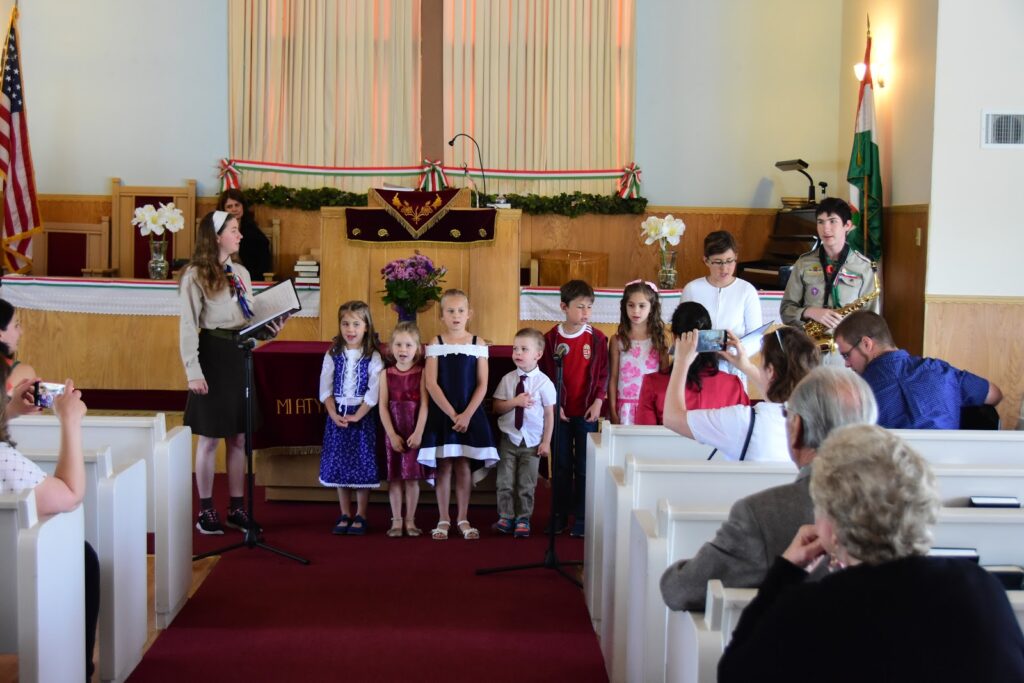
Pastor Gábor Magyari-Köpe introduced the Hungarian Reformed Church of San Francisco and Vicinity, whose congregation is the oldest in the area, with a history dating back to 1927. The church was officially established at the Pentecost of 1951. Its first building was purchased by Pastor Lajos Illés in 1951, funded by the 35 members and donors. The church was led by General Archdeacon Antal Borbás for the longest time, from 1961 to 1982, with a firm and skilful leadership, increasing the membership from 35 to over 100. In 1984 the building was sold, and the congregation moved to Redwood City, where in 1989 they managed to purchase a second church, with a dining room enabling cultural events. The 13 years of pastor Jenő Katona’s service resulted in a busy community life, which the current pastor has served since 2003. In 2022, the church was sold again, and they moved to a rented building on the east side of the Bay Area, which was purchased in May 2024. This is a huge step, perhaps the biggest in the history of the church, the pastor said. They have worships every Sunday, once a month in English and bi-weekly Bible studies. In addition to church and national celebrations, secular events such as a pig roast picnic, bake sale, autumn bazaar, concerts, and literary performances are also organized regularly.
At the end of the conference, North American Regional President of the Diaspora Council Ildikó Mónika Pataki presented the organization founded in 2011 as a common advocacy forum for Hungarian diaspora communities around the world. After praising the Kőrösi Csoma Sándor scholarship program, she called our attention to the Hungarian American Schools Meeting (AMIT) on 5–6 October at the Consulate General in New York.
Finally, at the organizers’ request, Ildikó Antal-Ferencz (Denville, New Jersey) introduced herself: she is a freelance journalist living in the U.S. for more than two years and by now she has written more than 200 articles for different Hungarian newspapers about the Hungarian diaspora in North America. Her interviews have been published in two volumes, Being Hungarian in America I and II, as the courtesy of Bocskai Radio in Cleveland. She is currently working on the third volume of this series and also on an English-language compilation. Julio Schmidt (Bogota, Colombia) also introduced himself: he is the author of the vlog anéKdotiKas and one of the founders of the Talking-Speaking Circle that holds a thematic forum on the first Thursday of every month.
Ildikó Antal-Ferencz
Source: hungarianconservative.com

Source: hungarianconservative.com
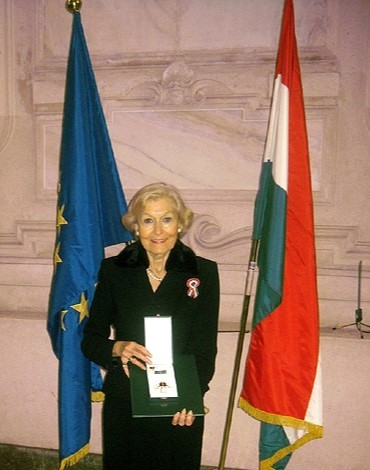
Éva Voisin fled Hungary with her family as a child in 1956 and settled in Los Angeles in 1959. She quickly became involved in the Hungarian community there. She met her French husband while studying in Paris and they moved to San Francisco in 1968, where she joined a small but very active Hungarian community. Since the fall of communism in Hungary, which she followed closely, she has been an enthusiastic and active supporter of Hungarian–American diplomatic, economic and cultural relations. She was appointed Honorary Consul of Hungary in 1993, a role she still undertakes with great energy.
***
Most ‘56ers arrived and settled on the East Coast. Your family didn’t… Why?
We left Hungary on 1 January 1957, just before the borders were sealed by the Communist authorities. It was a very difficult decision to make and my parents hesitated till the last minute. I recall long, animated discussions at home and with friends. It was a very difficult moral and personal decision because we didn’t want to leave Hungary, our roots and our families. But Hungary was such a different world at that time. As a child, I remember the oppression and the isolation from the rest of the world. We couldn’t travel, we couldn’t get news of the outside world, except occasionally and clandestinely from Radio Free Europe, when the emission wasn’t scrambled. I learned that there are two versions of history and truth, the one you hear at home and the one you hear and say in school.
Due to our late departure, most countries’ refugee quota was filled so we had to wait for two years in Austria. My parents wanted to move to a neutral country in Europe, like Switzerland, but the wait was too long and they found sponsors in Los Angeles, with a large Hungarian community there, so they chose that city. The Schwechat Castle was converted into a refugee camp. My parents helped there in its library. My sister and I went to the Hungarian school in Iselsberg, Tyrol, named after its founder Queen Juliana of Holland, who established it to benefit Hungarian children. Later I studied at the Sacré Coeur in Vienna. We left for California in 1959.
When and how did you get involved in the Hungarian community?
I was always involved in the Hungarian community, wherever I lived. In 1959 Los Angeles had two or three churches and a dance group. Béla Fesztori, who had been a scout in Hungary before it was banned by the communists in 1949, invited my sister Ildikó and I to help him form a scout troop right after we arrived. Thus, we’re founding members of Brother Julianus Troop No. 8. I’ve recently received a little commemorative medal reminding me of those times. My sister still lives in Los Angeles; she is a founding member of the Old Scouts Association composed of many of those who were active in the ‘60s. I started a similar group during Covid in San Francisco. I’m still in touch with my former scout friends and occasionally attend the Scout Ball in Los Angeles. In San Francisco it is an annual event I support.
We also joined the Hungarian Students’ Association and an informal Hungarian group at the University of California at Los Angeles (UCLA) that we both attended. Our parents were also active and they met numerous previous friends and acquaintances from Budapest, who had started their immigrant journeys after WWII or in 1956 somewhere in South America or Canada and arrived in California about the same time as us.
Later, while studying in Paris, I found that the local Hungarian community centered around Saint Elisabeth of Hungary Catholic church. Attending there was the first time my husband met Hungarians. 55 years later, he still reminds me that Paris was the only place where Hungarians served pálinka and goose liver after mass! He has always been very supportive of my activities.
Why did you study in Paris? Why did you move to San Francisco afterwards?
I studied French at St Monica’s High School, and continued it at UCLA, which had a study abroad program. I actually attended the Sorbonne for a year after I graduated. There I met and married my husband in St. Severin, a fabulous gothic church. I already knew and loved San Francisco from my prior travels, only a short flight from Los Angeles where my parents and sister lived. I felt it would be a great place to settle and beneficial for both our careers.
Your son is thus an American born of a Hungarian–French marriage. To what extent were you able or willing to involve him in the Hungarian community?
I was determined to teach him and involve him in every aspect of becoming a Hungarian, while keeping in mind that he had three cultures to navigate. My son spoke Hungarian very well when he was young, because I spoke Hungarian to him. My mother used to visit us often till she could and that also helped. At that time, however, unlike today, there were no Hungarian weekend schools, no scouts, no online schools, no outside reinforcements of what the children learned at home and no support for the parents. We must also add the all-pervasive ‘melting pot’ mentality that existed in the United States till about ten years ago, when it started slowly being replaced by ‘ethnic pride’. While my son had the chance to visit an extensive family and attended various camps in France, this wasn’t possible in Hungary. The closest he got to a Hungarian school was the Woodside Priory, a school founded by Hungarian Benedictines in 1957, where he didn’t learn Hungarian but received a rigorous education from Hungarian priests.
In the early ’70s, for a short time, we organized, and Father Kristof Hites at the Hungarian Catholic Mission hosted a Hungarian school on Friday nights. Our son went there for two years and he is still friends with the children he met. The parents, mainly mixed-language couples, are still in touch. When the local scout troop was established in the mid ‘70s, the Friday night Hungarian classes were taken over by the scout program. I fully supported them. As a former scout leader, I knew the founders, Tamas Csoboth who was my instructor at the Fillmore Scout training camp in New York. Wherever I go, whatever the occasion, worldwide, I run into current or former scouts. I think the scouts were and are the answer to educate those who live outside of Hungary. Now they are starting children in pre-kindergarten, realizing that they should start as early as possible. Today, there are Hungarian playgroups and pre-kindergartens at both churches in San Francisco. The scouts’ pedagogy requires that the children speak fluent Hungarian, which I fully agree with. However, because of this requirement, the Friday night group couldn’t continue in the weekend Hungarian school. These are the children and their parents who need special attention. Otherwise, they are pretty much left to their own resources.
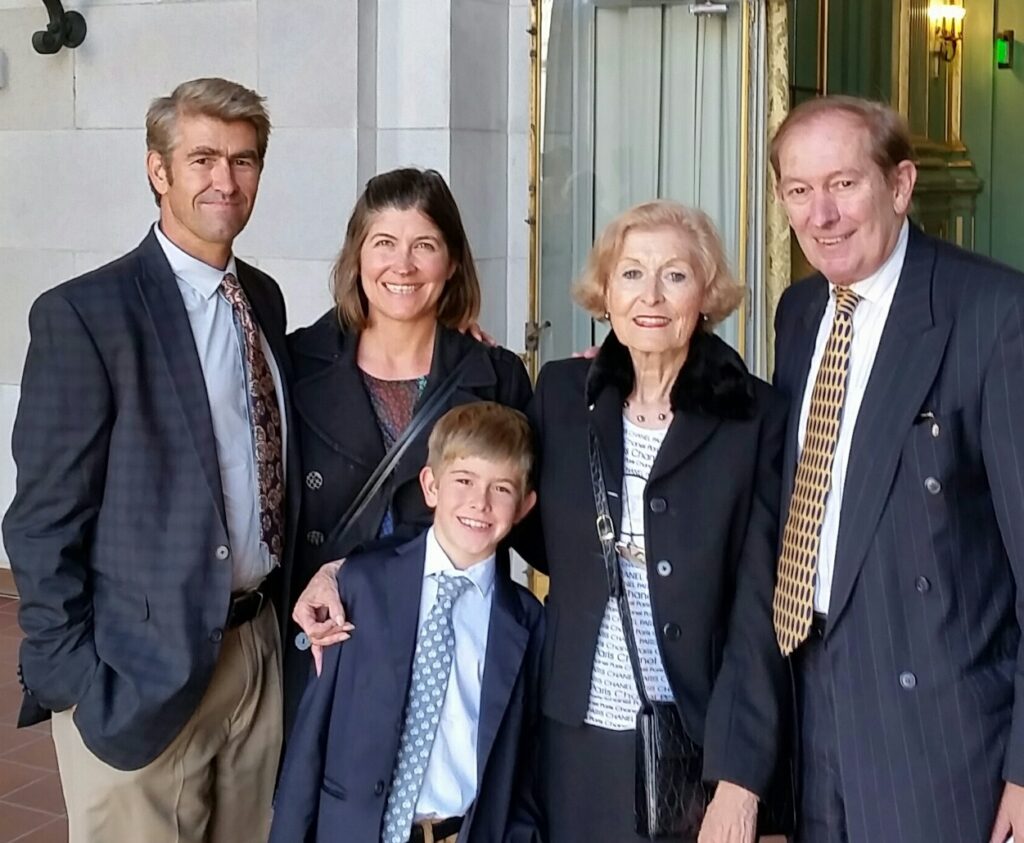
My son attended the pivotal events of the local Hungarian community. He served at the opening of the Honorary Consulate, he facilitated Dr. Teller’s virtual communications with the other 11 recipients of the Corvin Chain, when Dr. Teller couldn’t travel to Budapest anymore. He helped and volunteered at all the programs I organized. He visited Hungary many times since 1990, way after the critical age of language learning, but he knows Hungarian culture, tradition, history and cuisine. He is getting ready to send his son to Reconnect Hungary next summer.
The preservation of the Hungarian language is a delicate issue… How do you see it?
I think we must do everything to teach it since the ultimate goal is to speak Hungarian and participate in the Hungarian diaspora life. It’s easier for children if you have two Hungarian parents who are able to take the children to Hungarian weekend schools and the Hungarian scouts. Language is one of the most important components of our national identity. However, so is commitment to and knowledge of our heritage, culture, customs, history, literature and a willingness to participate in Hungarian community life. I see hundreds of people every year in my legal or consular capacity with varying degrees of language proficiency. Some go back three-four generations and some even go back to the civil war in the U.S. The last census tells us that there are 1,4 million people declaring to be of Hungarian origin.
I’m a realist and a pragmatist, always looking for the best solution to reach out to these people. We must see how we can reach more of them and ignite their interest in Hungary. Firstly I send them my newsletter, in English, including information about online language classes and scholarships now available for adults and their children. I make sure that they visit our Orly Museum and some other cultural events we host. I suggest that being a Hungarian is more than just speaking the language. They can still be ‘good’ Hungarians in other ways besides the language. If I succeed in getting then to attend a heritage festival, or send their children or grandchildren to study in Hungary, or getting them to set up a scholarship fund for Hungarian American children, or a foundation to repair art objects in Hungary or benefit various causes that further the Hungarian community, that is being Hungarian as well and they are then part of the now global Hungarian diaspora. I think we need to reach out to all! It’s also important for the future of the diaspora to have people who don’t necessarily speak Hungarian, but are emotionally connected, interested in their ancestors and willing to participate or actively help with Hungarian initiatives. That’s the need I try to fill, to cater to these people as well.
Is this why you write consular newsletters in English? Why aren’t they bilingual?
The question is who we are trying to reach and what is the most efficient way to do it. Besides informing the Hungarian community, I see this newsletter as a first step to reconnect with those second, third, fourth generation Hungarians, who have been lost linguistically. The first step is to give them information and to get them to reunite with their Hungarian ancestry. I want to integrate them into our community, get them interested in their Hungarian identity and cultural heritage. For that, they need information they understand. But I also include language learning opportunities in all my newsletters. And it’s also a matter of resources. I’d love to have the newsletter in Hungarian as well, but I don’t have the time or energy. In an ideal world, I would hand the whole newsletter to a media professional, and it would be in Hungarian as well. But I create it personally. It’s an honor for me to represent Hungary, to do this wonderful job, which is why I’ve been doing it for 33 years. But since I’m an Honorary Consul, all my community work, travel expenses and events I organize, or host are self-financed. I try to maximize my own time and resources. I’m always looking for volunteers to support me.
As a Consul I serve the American public as well. I want to enhance Hungary’s image, to promote Hungary and our Hungarian events and causes. The consulate is the face of Hungary to the general public, who turn to me with all kinds of questions, comments and requests. I write the newsletter to inform the general public, Hungarian, American and other nationalities.
Why and how did you become an Honorary Consul?
I first visited Hungary in April 1968, while studying in Paris. Since then, I always followed events in Hungary as closely as possible, often wondering what my life would be like had my family stayed there in 1956? Our information about the political situation was limited, and our only news sources were visitors, like the journalist and poet Tollas Tibor, who edited a newspaper in Germany and brought us news about Hungary and the samizdat movement in the ‘80s. I used to host literary evenings for Tibor, to share his news with my local community.
In March 1989, we suspected that something was going to happen, when Prime Minister Károly Grósz came to speak at the World Affairs Council. Noone from communist Hungary had been here or addressed nearly 300 people in San Francisco. The fall of the communist regime was a magical time. Hungary was finally free, and we were elated with all the new possibilities to have direct and open contact with Hungary and everything Hungarian. I wanted to witness this change. I wanted to support the new Hungary, and I had a front row seat to history! I witnessed 1956 and 1990, two pivotal moments in Hungarian history. I was unable to move back in 1990, so I participated and contributed to the transition from here. I feel I had the ability, I spoke several languages, and my legal profession gave me the needed skills for diplomacy. I decided to attend the first free parliamentary elections set for March 10, 1990, and write about the legal changes in Hungary. I met a journalist who was writing for the Christian Science Monitor, so I volunteered to translate for him. I had a press pass then, so we could really get involved in the political-historical events of the time. During those two weeks we did lots of interviews with everyone preparing for the elections, including Viktor Orbán and Ernő Rubik, the world-famous creator of the Rubik’ Cube. I have wonderful memories of election fever and transformation.
While in Hungary I realized how important it was for Hungary to integrate economically with the Western world. So upon my return, I founded the Hungarian American Chamber of Commerce (HACC), a nonprofit organization that promotes mutual exchange and development of business. The change permitted Hungary to expand its diplomatic representation to the West Coast and open a new consulate. I lobbied hard to be in San Francisco, or at least the Commercial, Science and Technology office to be located here. When it was decided to be located in Los Angeles, the Hungarian Embassy asked me to be the Honorary Consul in San Francisco. The Vice Consulate only opened in San Francisco 26 years later, in March, 2016.
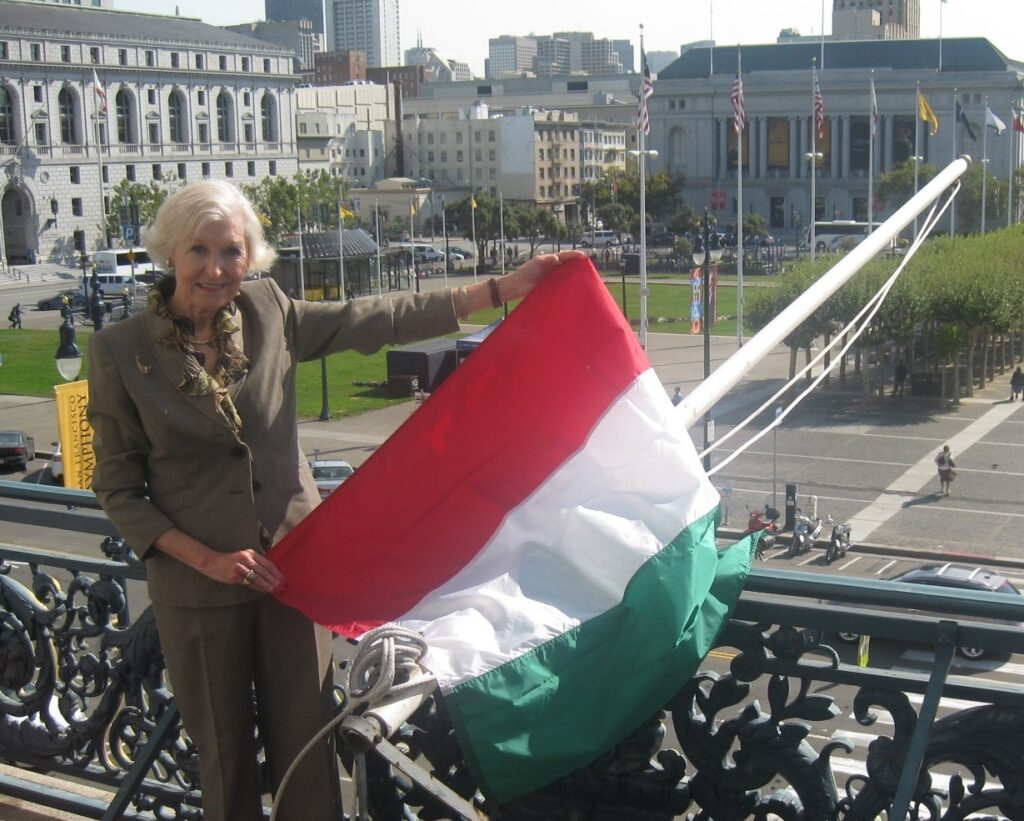
I went to the opening of the Consulate in Los Angeles in March 1992, in the midst of great publicity and many, including Zsazsa and Eva Gabor, were in attendance. My appointment letter was signed by Géza Jeszenszky, Foreign Minister in 1993. I was delighted to undertake this position. It isn’t just a title, it means that you do the work of a diplomat gratis, but that you are officially representing Hungary, appointed by the Hungarian Foreign Ministry and recognized by the U.S. Department of State. During my tenure, I had many unique experiences. It was fascinating to be present in Palo Alto when Dr. Teller received the Corvin Chain, which I personally hand carried back to Budapest when he passed away. I also had the task of returning the microscope of Dr. Bekessy, who won the Nobel prize for Audiology, to the Postal Museum in Budapest. I raised the flag at San Francisco City Hall, I sat in the prime minister’s motorcade when all the traffic stopped for us. The honorary consular network has expanded since then. I think it’s a great idea. It supports Hungary with no financial burden to the government by dedicated professionals.
What kind of issues or tasks do you deal with?
The authority is based on the Vienna Consular Convention. Our first and foremost duty is to support the Hungarian community living, working, studying or just as tourists here. This involves publishing important information to them, about community events, security warnings, notice of elections, report of lost/found passports, scholarship application deadlines. In addition to the Consular newsletter, I organize a quarterly ‘Coffee with the Consul’, a Q&A session, now held digitally. There are certain mandatory consular tasks, such as notarization of documents.
I represent Hungary on many other platforms. Beyond the community outreach, there are cultural, economic and diplomatic aspects. I attend all forums, briefings and receptions by California, city governments, the U.S. State Department, the Governor’s office, the Office of Emergency Management; also, the EU opened a West Coast office three years ago. They often brief us about laws already in effect within the EU, regarding AI and the digital marketplace. I also keep in touch with the other 65 consulates in San Francisco, including the EU office, a large group of government official bodies and civic organizations, like museums, the Rotary Club and the Red Cross. I attend most programs to maintain my network current, so I can leverage it when the need arises to organize events or programs for visitors from Hungary.
I organized many cultural programs to mark some of Hungary’s historic milestones, like the 1100th anniversary of Hungary’s settlement in the Carpathian Basin. I hosted three major events. I started at S.t Mary’s Cathedral, with an interfaith Service. I held a reception at the Museum of Fine Arts on August 20, and terminated the year with a big ball. On other occasions I hosted a reception to celebrate St. Stephen’s Day, Hungary joining NATO and the EU. I organize the annual commemorations of the October 23 Revolution at our famous Gloria Victis statue and at major milestones such as the 50th and 60th anniversary. I also hold a program at the San Francisco War Memorial Opera. I’ve partnered with the Red Cross to do emergency training for the community in my office, due to the potential for earthquakes in California.
But focusing on Hungarian American business is one of my personal priorities. I feel we have to take advantage of our location and contacts in Silicon Valley at Google, Apple, Tesla, Airbnb, etc. We don’t have that many Hungarian businesses here, but we have a lot of intellectual capital to potentially bring together startups and promote Hungarian innovation and business. We have a very exciting Hungarian Scientists and Innovators Club, with serious technical lectures held at the Consulate. The HACC also provides a wide network of experts.
Having an own conference room is a huge advantage; many diaspora events can’t take place as they don’t have a venue of their own, and the rental costs are a big hit to the budget…
I think that’s the reason that people who have their own professional network and their office to host events are chosen and add a great deal to the honorary consular network. When I was appointed, I decided to do my job to the maximum my skills and ability take me. I had my own successful law office which provided financial support and a large, professional space for all my community events. I’m happy to share my conference room as my contribution to the success of the community events. Currently I regularly sponsor the HACC and the Hungarian Innovators. We have had hundreds of meetings here. I hosted the HATOG (Hungarians Americans Getting Together) conferences of the Hungarian American Coalition (HAC), wine tastings from Tokaj, ambassadors’ visits, delegations from many organizations, judges, police delegations, academic groups and entrepreneurship seminars.
Finally, let’s talk briefly about the local Hungarian communities. How many people and organizations are in your ‘jurisdiction’?
My jurisdiction is San Francisco and 34 counties of Northern California. If you add up the residents of those counties, it totals about one million. So that keeps me pretty busy, but that does not mean people from other states don’t call. Unfortunately, I don’t have exact figures for the Hungarian community. Many Hungarians come to study, teach or research at universities, but only some of them get in touch with or are active in the Hungarian community. According to the latest census statistics, 1,4 million people of Hungarian origin live in North America. My assumption is that approximately 120,000 reside in California, and 6–8,000 in San Francisco.
I’m incredibly proud of our small, but very active, talented, creative and productive Hungarian community with several unique organizations, whose hard and dedicated work allows us to retain our Hungarian roots and heritage and transmit them to the newest generation. We meet virtually once a year to coordinate our calendars among the following groups. We have the Hungarian Catholic Mission and the Hungarian Reformed Church of San Francisco and Vicinity, the Hungarian Heritage Foundation, the Örly Museum of Hungarian Culture and the Eszterlánc and Mazsola Folk Dance Groups. We are happy to have an additional new resource to celebrate, the Hungarian Cultural Center, operated by the Reformed Church which will open this October 19, 2024. We have two schools: the Sándor Kányádi Hungarian School operating together with the scouts troops in the Bay Area, and the Walnut Creek Hungarian School. Hungarian language is also taught at the University of California at Berkeley and Stanford University. We have the Kodály Foundation for Music Education and the Kodály Center, founded in 1969 at Holy Names College and housed by the University of Redlands since 2023. The First California Hussar Regiment, founded by Colonel Ferenc (Frank) Bakonyi in 2001 is quite unique for our community; it doesn’t exist in other states. We support two sister cities of Tokaj–Sonoma and Siófok–Walnut Creek. Finally, as mentioned, there is the HACC and the Silicon Valley Hungarian Innovators. They’ll introduce themselves at the upcoming two-part online conference organized by the PTE Diaspora Project Network, Hungary, to be held on September 27 and October 25.
Ildikó Antal-Ferencz
Source: hungarianconservative.com

Source: hungarianconservative.com
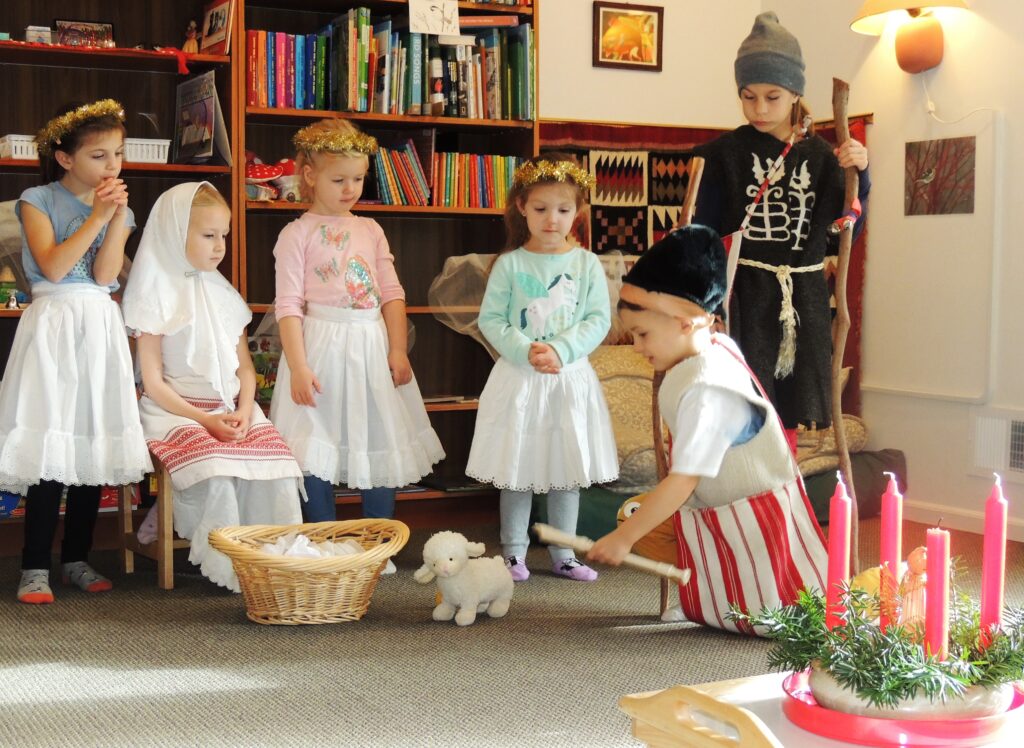
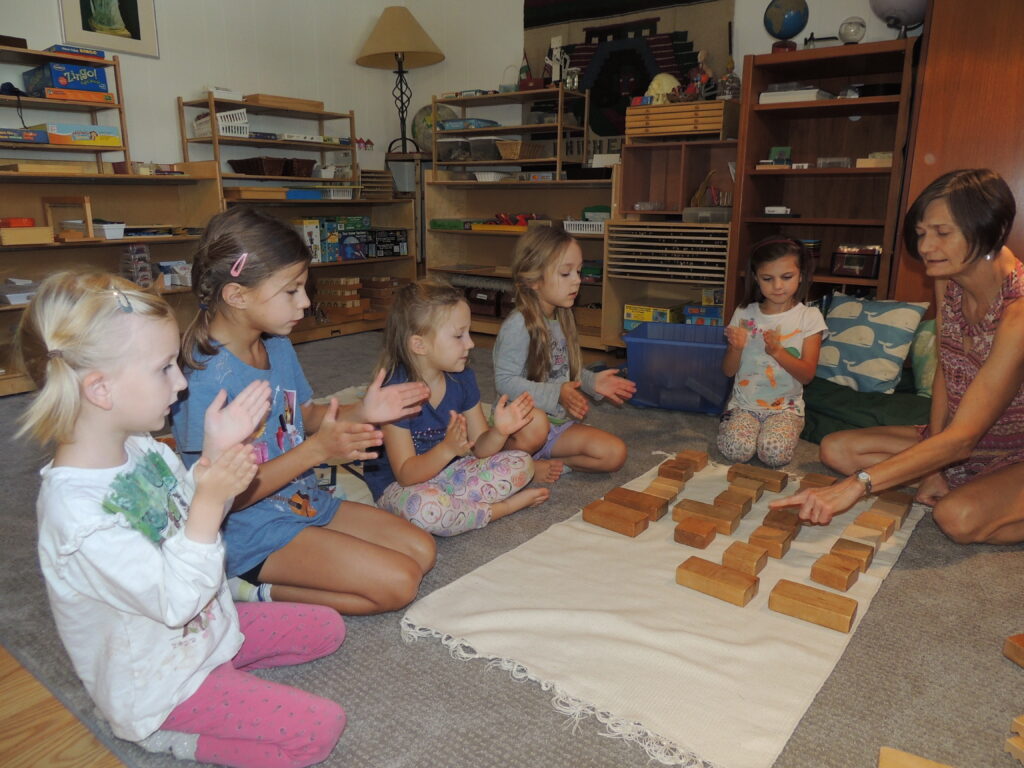
Enikő Gorondi is the founder and headmaster of perhaps the only daily Hungarian educational institution in the U.S., the Aprókfalva Hungarian Preschool in Piscataway, New Jersey. It is a Montessori-based learning pod that has been in operation for the last 18 years. Enikő came to the U.S. at the age of ten and has made her home here, both as an American citizen and as a member of the Hungarian community in New Brunswick, New Jersey. Her daughter, Réka works as a teacher at Aprókfalva, is a Hungarian scout leader and also a folk dance teacher of the youngest group of the local Mákvirág Hungarian folk dance ensemble in New Brunswick.
***
Why and how did your family come to the U.S.?
Enikő: My parents were Catholics in Hungary. My mother was a very talented preschool and kindergarten teacher and my father was a tool and die maker. Still, we remained second class citizens, because my parents refused to join the communist party. To make matters worse, they were part of a Catholic youth group that disguised themselves as a hiking club. They went for hikes in the hills of Hungary, and the priest would hold mass in the woods. My parents made sure my brother Zsolt and I received religious education in secret. For me, as a child, living with this moral duality was both difficult and confusing. At the same time, I was having difficulty in school, hindered by both the shortcomings of a traditional educational system run by under-qualified party members and by partisan teachers who rewarded grades partly based on the child’s family background rather than personal achievement in class. In 1967, my father was awarded a pass to be part of a bus tour in Vienna for his company’s outing. He never returned from that trip. The police came to our house to search for evidence of his whereabouts, but came up empty-handed. My father hadn’t warned any of us of his plans to dissent. It was a very difficult time. The police interrogated my mother several times, she lost her job because of the scandal, we had to sell everything we owned and still didn’t get to eat every day. After my mother was institutionalized for a nervous breakdown, we managed to settle down in the country with the help of some relatives. Finally, we got a letter from our father informing us that he was fine. After spending a year in Austria, as an illegal and then a refugee, he received a visa to emigrate to the U.S.
When did you manage to follow him?
Enikő: My mother spent years trying to get a visa to the U.S. She took my brother Zsolt and me with her to various government offices to help plead her case of reuniting the family. My father couldn’t return, but we could go to him perhaps. Our relatives all encouraged her to move on and remarry—even my father’s family. But she stayed true to him. She worked hard to keep us afloat and did a very good job of it. In truth, she didn’t want to leave. She kept hoping that the Soviet regime would fall and her husband would return. But in 1972, the communist regime was still in power and the long-awaited visa arrived for us to go to the States and live with my father. My mother burst into tears. She was torn by the news. As a ten-year-old, I was livid. I didn’t want to leave my home, my friends, and my family. When we arrived in the States, things only got worse for me. None of us spoke the language and, for a place dubbed ‘the land of the free’, it sure felt like a prison. In Budapest, I had wandered wherever I wished, on foot or public transportation. In the States, there was nowhere you could go without a car. It was tough. To me, my father was a stranger. I often got beat up at school. But, at least, we had a place to live in the St. Ladislaus Hungarian Catholic Church’s building in New Brunswick. The church is still there, but in recent years the diocese has been working on closing the parish. Now, the doors are locked unless there’s mass or other programs. Back then, their doors were always open and I found myself there often to calm my restless soul. I didn’t feel at home in the U.S. I kept dreaming of being old enough to go back. I was 16 when I first got to visit Hungary again. It was a strange feeling. By then, I was a fluent English speaker and had picked up many American customs and ways of thinking. Hungary didn’t feel like home anymore. It was a frustrating realization. I felt like I didn’t belong anywhere until I met my husband.
How did you meet him?
Enikő: Jancsi Gorondi’s family is originally Hungarian, all his brothers were born there. My father-in-law was in the military during World War II, so they were persecuted under the Soviet takeover of Hungary. They spent several difficult years in refugee camps in Italy, battling even starvation at times. There was no school for the three young boys, either. Finally, they were accepted to emigrate to Argentina, where Jancsi was born in 1951. His father was originally a fencing champion in Hungary, so Jancsi decided to follow in his footsteps. He was a junior national champion and even won the South American continental championship while in high school. He was preparing for the Olympics when the first of three consecutive guerrilla wars broke out in the country. He served as an agent in the Federal Police before getting a scholarship to study in the U.S. He was just about done with university and was planning on returning to Argentina to dedicate himself to resurrecting the economy and improving life for the people when we met at a Catholic retreat. Father Ádám was a Jesuit priest and university professor, who had undertaken to hold a retreat for Hungarian American teenagers once a year with the support of the Hungarian Knights of Malta. It was a safe environment for like-minded youths to meet from around the area. I was 17 and rather innocent, he was 11 years older. We got married as soon as I turned 19. We’d both finally made a home of the U.S.
In addition to your two daughters, you had adopted two more. Why?
Enikő: I always wanted a lot of children. I kept hearing about all the orphans in the world, so I was very motivated to adopt. Still, I wanted to practice on my own children first because everyone kept telling me how much harder it is to raise children you’re not related to. So we had our two daughters, Csilla in 1983 and Réka in 1985. After that, we were turned away by adoption agencies. They didn’t want to give children out to couples that were able to have their own, and there were other bureaucratic complications. So I had given up on that. Then a situation arose with my niece Lizzy, my brother-in-law’s daughter. For various reasons, she wound up joining our family when she was 11, but she had spent every summer home-schooled by my daughters in the two years leading up to that. She didn’t speak any Hungarian, but decided to learn of her own volition in order to join her sisters in extracurricular activities: the Hungarian Scouts, the Hungarian School, and hanging out with other Hungarian American friends. At one point, after my parents had retired to Hungary, we sent her to an equestrian camp in Hungary. She came back speaking fluently. We are very proud of her. The last child to join our family isn’t an official member, but we all consider her family all the same. She is a Chinese immigrant from Taiwan and Csilla’s high school classmate, Samantha. In her case, it was more that she adopted us than the other way around. Her parents were in Taiwan and she didn’t get along so well with her official guardian here. She just moved in one day, joined the Széchenyi Hungarian Saturday School’s adult class and seamlessly blended right in.
Where did the idea of starting a daily Hungarian kindergarten come from?
Enikő: I didn’t actually start that. Ágnes Gergácz wanted her grandchildren to speak Hungarian and was determined to have a daily preschool and kindergarten for that purpose. Her daughter Magdi was very good at finances. They’re the ones that recruited my mother to start up the daily Hungarian Preschool in a building owned by the St. Ladislaus church in New Brunswick. That’s what later became one of the buildings of the current Széchenyi István Hungarian Saturday School and Kindergarten. They were able to gather a few Hungarian fairy tale books, a doll and a teddy bear. That’s all they had, but my mother was very creative, running a very educational and interactive program for children, teaching them songs, rhymes, and movement games. I was sixteen at the time, but I also helped out, even substituting for my mother when she got sick. She stayed there as a preschool teacher until both of my daughters started kindergarten. By then, the Hungarian population in New Brunswick had diminished. There wasn’t enough interest to keep the daily preschool open, but it continued on as a weekend school.
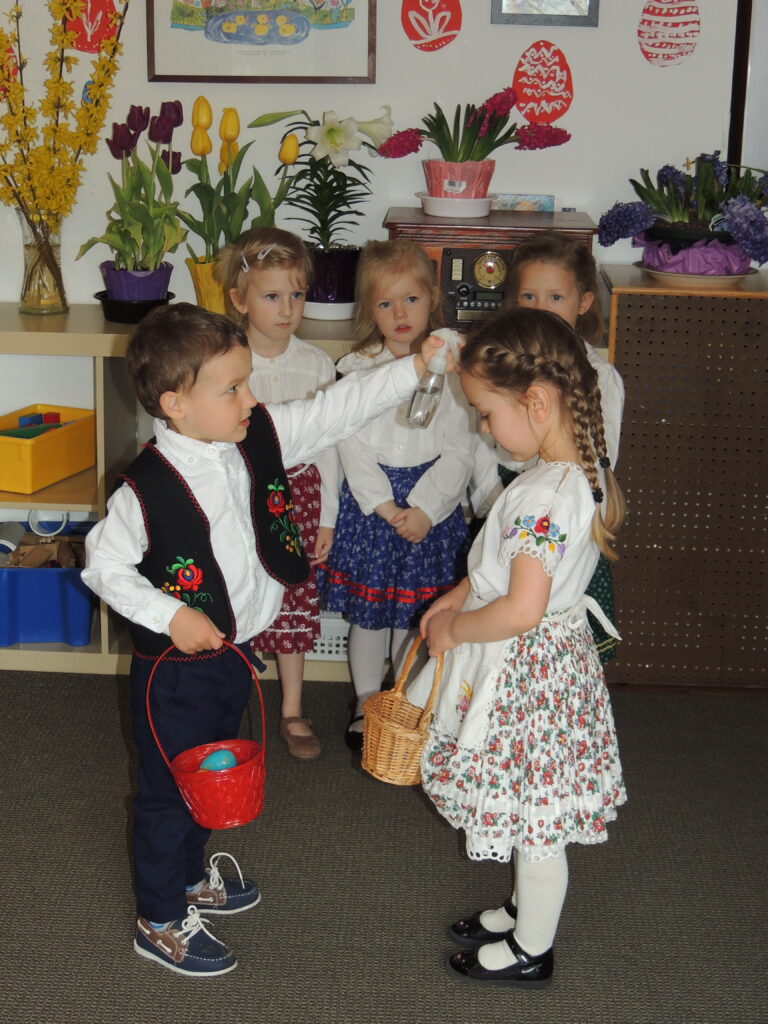
How did the family kindergarten in its current form actually start?
Enikő: Personally, I didn’t want to be a preschool or kindergarten teacher. I saw how much time and energy my mother put into it and I felt that these would be better spent on raising my own children. But as my children were growing up, I started to miss it. I decided to complete a Montessori training course in Princeton and I worked at an American Montessori kindergarten. When Jancsi lost his job, I had to find something that paid better. So I worked at a regular kindergarten, but that was very frustrating. I felt that a lot of the staff was less concerned about what would be the best for the children and much more so about avoiding lawsuits. A lot of focus was put on memorizing things children often didn’t understand yet, while physical education, self-care skills, and problem-solving were completely neglected. This is very limiting for child development. During this time some parents contacted me about resuming my mother’s work, providing daily education in Hungarian. After much consideration and failing to secure a building for it, Jancsi and I decided to convert the ground floor of our house and open the Montessori Preschool there. We opened our doors in September 2006, starting with five very young children and one nanny. The number of applicants grew rapidly and we have been operating at maximum capacity ever since. My primary role is, of course, teaching the children, but I find it equally important to educate my staff and the parents as well. Children attend Aprókfalva for a few years, but they live with their parents most of their lives. If the lessons we teach here are not reflected at home—not just academic lessons, but values, world views, and problem-solving skills—then it’s all for naught.
‘My primary role is, of course, teaching the children, but I find it equally important to educate my staff and the parents as well’
Réka: At the time, I completed a bachelor’s degree at Rutgers, then completed my veterinarian degree at Szent István University in Budapest. In the meantime, I got married, bought a house with my husband Torda, and we were expecting our first child. The reason we could afford the house was because it was in serious need of renovation. But we needed to live somewhere, so we moved upstairs at my parents’ house. Since I was home with a baby, later with a baby and a toddler, I helped out where I could. That’s how my first two children were literally born into Aprókfalva. During free play, the children liked to play with the baby and I could help with the administrative duties in the meantime. We moved out once we finished renovating our house, but I continued to bring the children—by that time we had three—to the preschool. When the children became old enough to attend officially, I started working there full time. When my oldest was about to start public school, the pandemic broke out. Public education became remote, therefore we opened the upstairs of the house as well and added a learning pod group to Aprókfalva: children ranging from first to third grade. I taught this mixed age group. We took a great deal of precautions and got through the pandemic without any problems. It was a lot of work. There was a vast age range of children and we had to cook for 30 people every day. Since then, most of them have returned to public school, but we still have a small group of students in the learning pod, including the older two of my three children.
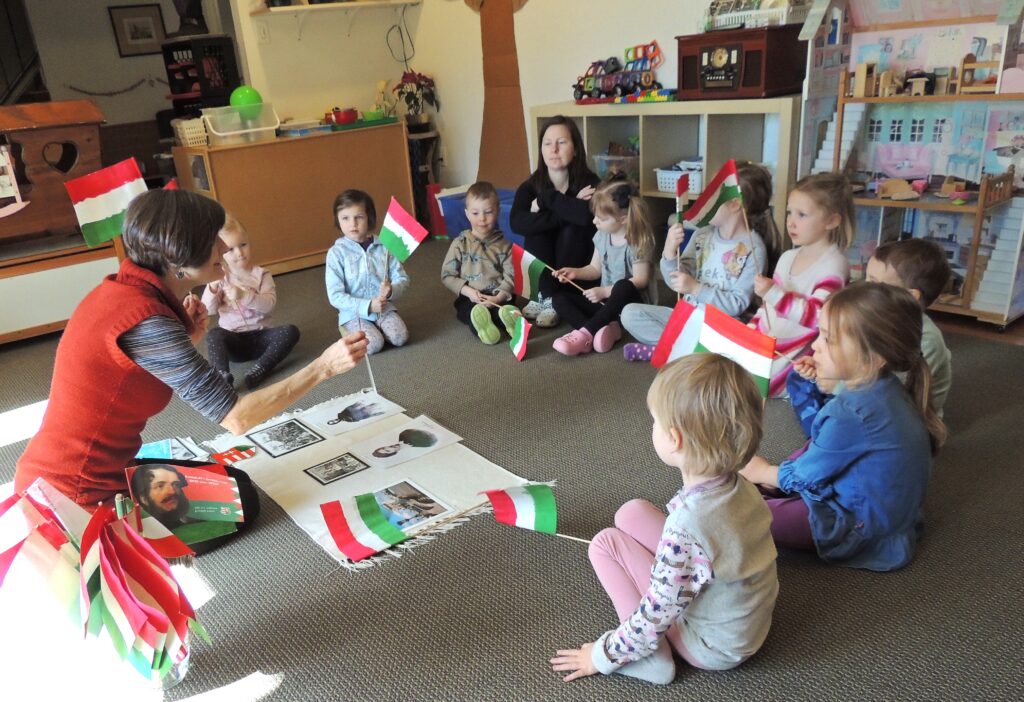
You also volunteer a lot in the Hungarian community: you are an active adult scout leader and an instructor at the local children’s folk dance group.
Réka: I grew up as a Hungarian scout and a member of the local folk dance group. When I turned 16, I became a scout leader and joined the adult dance group Csűrdöngölő. I learned a lot from the older dancers, especially Denisa Varga-Bott, who did serious research on dance theory, regional particularities, and even showed us old documentaries of local traditional dancers. I had to leave all that behind when I was studying in Hungary, then motherhood and the preschool—I had a lot on my plate. When my children got old enough to start dancing and participating in scouting, I became active again in both as well. I wanted them to get as much a quality program as I did, so it was natural to help out. For instance, there just aren’t enough youth leaders in the New Brunswick troop of the Hungarian scouts, so adults are also needed. There was a similar problem for the dance groups, so I volunteered to teach the youngest group.
Enikő: The Hungarian community is not a business. There are people that dedicate their time solely to a program that they are passionate about. But that’s not enough to keep that program running. Throwing money at the problem won’t solve it. The people that are interested in having that program have to participate and/or volunteer. That’s why a lot of parents become active again when their children are there. I quit dancing when I got married, because Jancsi didn’t dance. I was forty already when my daughters encouraged me into joining Csűrdöngölő, and I’m really glad I did. It was a lot of fun.
‘The Hungarian community is not a business’
You both sang at the Christmas Vigil of the Catholic Church, the Voice of Poems programs at the Reformed Church, as well as Sunday masses. Where does this heritage come from?
Enikő: My mother always sang at home. Now I do, too. I have always liked folk songs, and even won a folk song competition when I was 8 –9 years old. Here in the U.S. we continued to sing at the scouts, folk dance, and church. I learned more Hungarian folk songs in the U.S. than back home. Pastor Imre Bertalan organized a children’s choir open to all denominations, so I joined. Later, singer Ildikó Rozs took over the program. Currently, Pastor Zsolt Ötvös holds two ecumenical services a year. Many people used to participate, much less nowadays. I believe the two Hungarian congregations should cooperate to help hold the community together.
The Voice of Poems was organized by Gyöngyvér Harkó. That’s her passion and she put decades of her life into it. My parents were both big fans of poetry, so they joined. They and my brother had the ability to express poetry rather than just recite it. I never liked to read or memorize poetry, but I like listening to it. Going to their shows, I got to meet amazing people like Zoltán Nyeste, who could speak in poems; they flowed from him like the skilled story-teller he was. He had memorized thousands of poems, not just the classics and published writers, but all the poems of his cellmates over the years he spent in a Russian gulag at Recsk. I have always thought that if I had heard poetry like this when I was in school, I wouldn’t have hated the subject so much. It’s only one of many subjects that I feel traditional education sucks all the wonder out of. The Voice of Poems brought that sense of wonder back for me. I sing for them to help transition the mood from one topic to the next. Sometimes my daughters come along to sing, too.
Réka: I feel like singing has always been a natural part of our lives and of the Hungarian community as a whole. As scouts, we sing a lot, but not always authentically. I joined the Életfa Band as a folk singer after returning to the U.S., so I pay much more attention to this now than when I was younger. There are annual summer camps, where Hungarian scouts come from all over the world—South America, Europe, Australia—and we can all sing together. I think that is monumental.
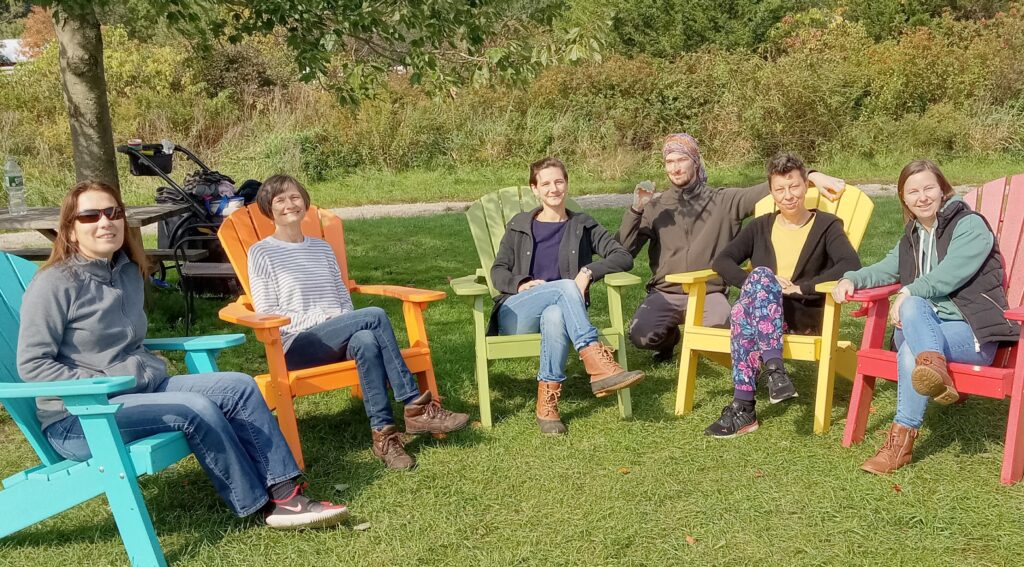
You are planning a big change regarding your family kindergarten… Why?
Enikő: I will retire next year. I have always had a very close relationship with my grandchildren and I don’t want to lose that. My youngest grandchildren are both finishing first grade here, but I wouldn’t be able to work with them next year. Just as I spent my time with my children when they were young, I want to be able to spend time with my grandchildren, too. Running the Aprókfalva is very intensive work. Between that and caring for my ailing father, I have no time for anything else. On top of that, our daughters are moving out of New Jersey, so Jancsi and I want to follow them. I told all the parents that if this program is important to them, they should find someone who’s willing to take over. They don’t need to have a teaching degree, just have to be willing to learn, dedicate themselves to this work and have a passion for children and quality education. I’m willing to stay on a little longer to teach them and get them started. If it’s not so important to the community, then that’s fine, too. Our materials—all the poems, games, teaching tools that we have gathered or made over the years—will not be lost, just set aside. They won’t become obsolete, these are basic materials of general education, Montessori principles, and Hungarian values that will be just as useful in teaching my great-grandchildren and their peers as they have been till now. I confess, my heart is a bit heavy since we’ll be closing our doors before our 20th anniversary. I’ll miss it greatly.
Why don’t you take it over, Réka?
Réka: At my age, my mother didn’t want to run a kindergarten, either. She wanted to spend her time and energy on her own children. It’s the same for me. Right now, I teach my own children and some of their peers in the learning pod. I’m willing to continue that for now, but I’d like to eventually put my veterinarian degree to use. The reason I got a doctorate was to go into that line of work. Life has given me a bit of a detour, but that’s still my passion. For someone to take over Aprókfalva, children and early childhood education has to be their passion.
Ildikó Antal-Ferencz
Source: hungarianconservative.com

Over the past few decades, Budapest has become a beloved filming location, hosting numerous
blockbuster productions that have achieved Oscar success. The Kultura magazine present a curated selection of these acclaimed films, captured through the evocative analogue photographs of director Péter Varsics.

The Hungarians are freedom-loving people, they want to decide how to live their own lives, what to do, what their goals are, and what the rules they want to follow are. From a historical point of view also, we Hungarians don’t like to be dictated from outside, the Hungarian PM’s political director pointed out on BBC’s news program HARDTalk on Friday.

“Europe’s asylum and migration system is clearly not working and a legal and political review is needed in order to meet today’s challenges,” Hungary’s EU affairs minister said Friday on his Facebook page, giving details of his statement to the Austrian newspaper Kurier.

This interview was first published in Hungarian on reformatus.hu.
Source: hungarianconservative.com
Zsolt Jakabffy is a Hungarian Reformed pastor with five children who moved to Los Angeles from Partium (Western Romania) in 2001. Uncharacteristic of the diaspora, he also runs the Hungarian Sunday school, which he sees as a mission. The Reményik Sándor Christian Hungarian School, which works closely with the church, is perhaps the most robust Hungarian educational institution in the North American Hungarian diaspora, with a student drama group, a folk-dance group, a library and a school newspaper. The school and the church organize two balls and a May Festival every year, and they put an increasing emphasis on their family-oriented spiritual programs, too.

Source: cleveland.com
WASHINGTON, D.C. — “The cause of America, in great measure, is the cause of all mankind,” remarked Thomas Paine in his pamphlet “Common Sense,” published in the consequential year of 1776. Paine addressed the common man in America, but the heroic struggle of the colonists for their traditional rights against despotic imperial overreach inspired millions worldwide, including those living under Habsburg rule in central Europe.

A painting by artist Sándor Bodó of Michael Kováts de Fabriczy, a Hungarian nobleman who fought with the American side in the American Revolution and was killed in battle. The painting was photographed by Zoltán Pintér. Used with permission.Zoltán Pintér
“Golden liberty cannot be purchased with yellow gold,” wrote Michael Kováts de Fabriczy, a Hungarian nobleman, as translated from the Latin, in his letter to Benjamin Franklin, who was then serving as the American commissioner to Paris.
Kováts wished to set off “as soon as possible to live or die in uninterrupted military service” for the American cause, wherever it was most needed. French ships carried him and hundreds of other distinguished noblemen and experienced European soldiers to join the American Revolution as newspapers from Pressburg (today’s Bratislava in Slovakia) to Paris published weekly reports about Gen. George Washington’s battles.
The American War of Independence was unique in its revolutionary yet conservative philosophical underpinnings, and it badly needed the help of well-trained, reliable military officers from abroad. Almost every European nation, one way or another, participated in the American Revolution.
Commissioned as a colonel under Washington, Kováts along with Polish Count Kazimierz Pułaski came to be credited as the founders of the American cavalry. Together, they turned the inexperienced and poorly equipped local militias into a disciplined force capable of winning decisive battles against the most formidable British forces. Kováts’ brought to bear decades of expertise fighting under the Habsburg ruler Maria Theresa, the Prussian monarch Frederick the Great, and alongside freedom fighters in Poland. From drafting guidelines on uniform designs to instructions on saddle maintenance and providing the organizational structure of the light cavalry, he helped hone militiamen into the American Continental Army.
When Charleston, the South’s most crucial port, became the primary British target, Pułaski and Kováts were sent south to stop the redcoats.
Bravely engaging the enemy, the Pulaski Legion was soon overpowered. Pułaski survived, but Kováts fell.
In an unmarked grave lies the American Revolution’s unsung hero, the Hussar colonel from the small Hungarian town of Karcag who did more to train, organize, and launch the first American cavalry units than anyone else. He was revered by his troops and respected by his enemies. According to his opponent, British Major F. Skelly, he trained the “best cavalry the rebels ever had.”

Kováts’ life was, in a sense, the true American dream. It was the life of someone who, through hard work and diligence rose upwards through the ranks. A life lived with grit and courage, a life that was ultimately sacrificed far from his homeland in dedication to the cause of American independence.
Hungarians celebrated his heroism this year, the 300th anniversary of Kováts’ birth year, by issuing a commemorative stamp which features the brave Hussar with crossed American and Hungarian flags.
Americans have worked to preserve his memory, as well. Part of the Cleveland Hungarian Museum’s permanent exhibit is dedicated to Kováts. And across the county, a playground and square in New York City; frescoes in a church in Pennsylvania; a statue in Washington, D.C.; a commemorative relief on the grounds of the Citadel; and even a U.S. military aircraft carrier were named after him. The nation’s oldest patriotic organization, the Society of the Cincinnati, founded by George Washington’s officer corps in 1783, proudly possesses an equestrian statuette of the Colonel Commandant.

A national hero for Hungarians and Americans alike, Michael Kováts de Fabriczy embodies moral clarity at a time when much was at stake for Western civilization.
Whether or not the cause of America’s liberty, which inspired millions at home and abroad, succeeds or not is of utmost significance for the entire West. And it will take courage and a return to common sense to preserve it.
Marc Wheat is chairman of the History Committee of the American Revolution Institute of the Society of the Cincinnati. Anna Smith Lacey is executive director of the Hungary Foundation in Washington, D.C.
Source: cleveland.com

According to the former French president, who has long maintaine an excellent relationship with Orban, restoring communication channels is the first step on the road to peace.

On 1 July 2024, Hungary took over the Presidency of the Council of the European Union, the opening ceremony of which was held in Brussels on Monday evening. As is tradition, the opening cultural event of the six-month presidency was held at Bozar in Brussels.

