
Home Blog Page 5

‘My mission is to pass on my Hungarian identity to children of Hungarian origin living outside Hungary’

Csizmadia Bernadett és osztálya

On 19 May, a musical version of Zsigmond Móricz’s novel Be Faithful Unto Death was performed in the event hall of the Hungarian American Athletic Club (HAAC) of New Brunswick, NJ to celebrate the 50th anniversary of the Széchenyi Hungarian School and Kindergarten. The show, created over months of hard work and performed by students, teachers and parents, was a huge success. It was conceived and put on stage by Bernadett Csizmadia, who has been teaching at the school for ten years and has served as vice principal since 2023.  

***

Why did you become a teacher and how did you end up in the US?

Before life led me to teaching, I faced a few bumps along the way. I was interested in many things, mostly related to people and acting. I applied to a high school in Miskolc that offered a drama curriculum but didn’t succeed. Then I wanted to be a reporter, but one of my high school teachers told me that I wouldn’t succeed as one, because that implies too much elbowing, which was not part of my character. I also considered majoring in psychology, but I soon dismissed it. During my studies, I always had classmates whom I helped catch up. Thus, it was slowly becoming apparent what I was really made for: teaching. Since I loved literature and grammar, I decided to become a Hungarian language teacher. After graduating at the faculty of the College of Nyíregyháza, I came to the US because I always thought that living abroad was my only chance to earn money and learn a language, since I came from a poor family in Mezőcsát in Borsod-Abaúj-Zemplén County. I started in Lakewood, New Jersey, like so many other people: with cleaning. I’ve never been afraid of physical work, but the harsh treatment was difficult to accept. While cleaning, I also started to babysit, which made it difficult for me to focus on my original chores, but it is due to the love I received from the children that helped me survive those years and so I didn’t give up.

How did you end up in the Hungarian school? What age group do you teach?

When I found out that there was a weekend Hungarian school in New Brunswick, I sent my CV to the principal at the time, Ildikó Bézi, and soon after I started working as a teacher and I have been teaching here ever since. I’ve worked with children of different ages, but in the end, it always turned out that the children closest to my heart were those aged 6–12. I’m that mother hen type of teacher. I consider them not a class, but a family or a team in which everyone is equally important.

The fact that we are Hungarians unites us, and whatever hardship we may suffer, we must never forget this.

I’m very grateful to the Széchenyi Hungarian School and to America for showing me what my real mission is. Before I left my homeland, I had no idea how important my Hungarian identity was to me. Over the years, I’ve realized that nothing makes me as happy as holding the hands of these little souls and singing the Hungarian national anthem together. It’s a miracle. Beyond teaching, my mission is to pass on my Hungarian identity to children of Hungarian origin living beyond Hungary’s borders.
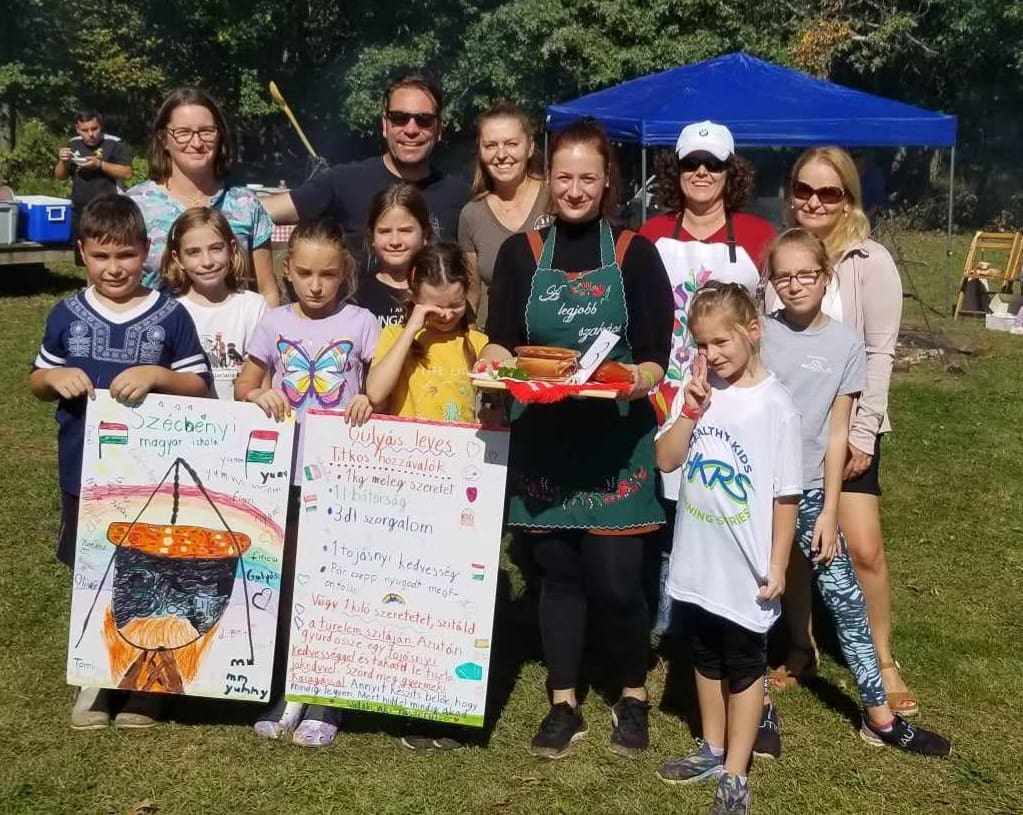
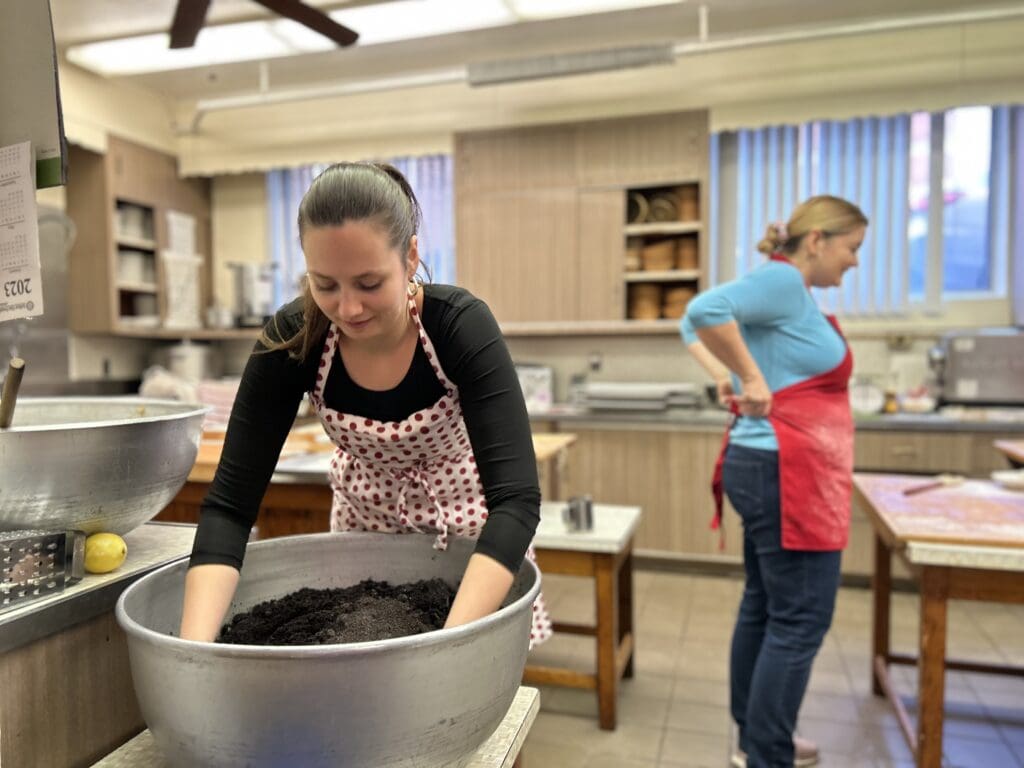
A school cookout where traditional Hungarian goulash soup was prepared. PHOTO: courtesy of Bernadett Csizmadia

Let’s move on to the unique event with which you celebrated the 50th anniversary on May 19. How did you have the courage to volunteer for such a big project?

This was an old dream of mine and I thought there couldn’t be a better time for it. The aim of the show is to awaken the slowly fading Hungarian identity of second and third generation Hungarian families, and to practice the Hungarian language in an experiential way in a foreign environment. This is not just a show; it represents the unity of our community, the cooperation of our past and present students, teachers and parents; and, most importantly, our identification as Hungarians in a foreign country. I started here ten years ago with no teaching experience – which I am very happy about retrospectively, as I didn’t have any fixed preconceptions tied to the Hungarian school system , and worked with several classes, age groups, and tried various methods. I strongly believe in experiential and drama pedagogy, where students are part of their own learning process as active participants in acquiring knowledge. In today’s dynamic and fast-paced world, certain abilities, skills, and competencies, such as effective communication, creativity, ability to collaborate, or critical thinking have become more valuable. At the same time, we shouldn’t forget that Saturday is the sixth day of school for these children, which is not mandatory, so we must make them love the Hungarian school, the Hungarian language and culture. Education can become effective if it responds to these challenges, which is unimaginable with traditional methods.

I’m in my fourth year teaching my current class. I don’t know if it’s due to my method or the ability of the class, but I remember that during a drama class, while the children were solving the assigned task in groups, I was recording a video of them for the parents and suddenly realized that the kids were instructing themselves as if I had done it myself. From that point, they’ve been happy to perform in any kind of school celebration. Maybe I was confident because I knew they could pull off even this huge show. Honestly, I had no idea whether I would be able to do it, and where the other characters would come from. My belief in children and my ‘nothing is impossible’ mentality have driven me forward. A few years ago, we performed the musical The Jungle Book directed by Timea Zsédely in cooperation with the Jókai Theatre from Békéscsaba. We played it in an off-off Broadway theatre in Manhattan, New York; I played Ka, the serpent. To be able to perform, we first needed to raise money by touring with smaller shows. I didn’t know what difficulties Timi had to face as a director, but I was part of a large-scale show and could learn from professional actors. It was a great experience and memory. With all these experiences behind me, I took the plunge…

Why did you choose Zsigmond Móricz’s novel, Be Faithful Unto Death?

I was sure I didn’t want a simple children’s piece. I knew I wanted to send a strong message, make people think and convey values. I believe that when we are born, we are good and pure. Then, as the years go by, a series of disappointments come upon us, and life begins to harden us.

As children, we learn from tales that good always triumphs and evil always gets its just punishment. Today, however, the opposite seems to be true.

Although Misi Nyilas’s fate is not revealed at the end of the script, his truth is revealed, so good triumphs eventually! I also knew that this novel was not for children of my class. But based on the experience of the past few years, I was also aware that there is no text or reading material that children cannot understand or learn. I didn’t throw the whole novel at them; instead, in the first weeks, we slowly got to know Misi Nyilas and his classmates through drama play. We imagined and acted out different characters and situations and shared our feelings and thoughts with each other. I also started using rarely used words and objects from the novel, writing them on paper and putting them in a box that I called pakk* from then on. We could only dedicate an hour of school time to rehearsals as I didn’t want to take more time away from regular teaching, but the play was present in the classroom all the time: songs from the musical were constantly played when they arrived in the morning and during the breaks. Thus, the children absorbed the ‘feeling of being faithful unto death’ without the slightest effort. When Friday and Sunday rehearsals started, the classroom buzzed with stories about shared moments, exciting events, and tales. I have always considered time spent together outside school important; it bring us closer together.
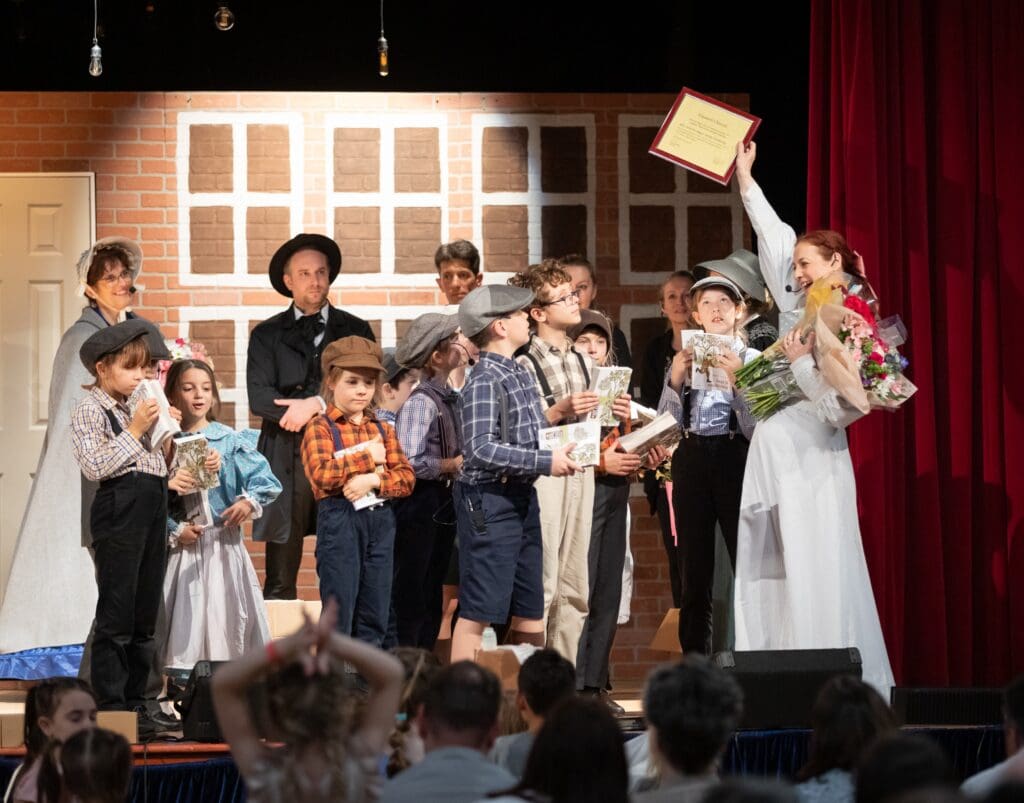
A scene from the play PHOTO: Széchenyi Hungarian School and Kindergarten

How did the casting procedure go?

Since we were preparing for the 50th anniversary of the school, I felt it was important to involve members of the local Hungarian community: past and present students, parents, and teachers. I thought it was a common cause. I also thought of it as a bit of a gift to Gyula Varga, who founded our school 50 years ago. I couldn’t imagine anything better to celebrate! Young and old performing together in Hungarian the musical version of this timeless novel, which is about human attitudes, faith, and love. Since it’s a musical, the casting wasn’t easy, because besides acting, it was important for the actors to be able to sing. I didn’t want to impose any role on anyone. I knew we had a big job ahead of us, and someone who only undertook it out of a sense of duty would not be able to put their heart and soul into it, and without that, it wouldn’t work. There were a lot of changes across the whole process. I had to rewrite the script several times, cutting parts and adding new ones. Nevertheless, those who performed would never forget Misi Nyilas, Zsigmond Móricz or his novel. Their Hungarian vocabulary has expanded, their acting skills have improved, and they have been enriched with a community experience that will stay with them for the rest of their lives. They owe this to their Hungarian identity and to their Hungarian weekend school.

Wasn’t there a regular, all-actor rehearsal process?

Not really. We had to rehearse in many small instalments, because I couldn’t put together a proper reading rehearsal, even online, let alone in person. Some adults had difficulty with reading Hungarian. I couldn’t ask the children to read the whole novel or even to watch the old black-and-white movie because they certainly wouldn’t have wanted to be part of the show afterwards. For a very long time, the children didn’t see the entire performance from start to finish, although they were aware of their own roles. The whole performance consisted of ten scenes, each very long and including choreography, vocals, and prose. I had to break up the scenes into parts, and once the parts were memorized, we rehearsed the whole scene together. I wanted to make the most of our time, knowing how tight everyone’s schedule was, so I planned the rehearsals weekly, usually on Mondays, coordinated with everyone, and held the Saturday scene rehearsals depending on who was available that week. For Saturday mornings, I scheduled singing rehearsals for the adults, with the music director, whilst I rehearsed the scenes with the children, or learned choreography or sang with them, depending on our progress. After school, there were scene rehearsals later on, followed by all-day Sunday rehearsals, and sometimes we had to rehearse on Friday nights as well. Until mid-April, the show wasn’t put together yet, so for a long time, the actors had no idea about the sequence of the scenes. I started every rehearsal by explaining where we were in the story and what everyone’s role was. This required constant consultation and a very systematic approach.
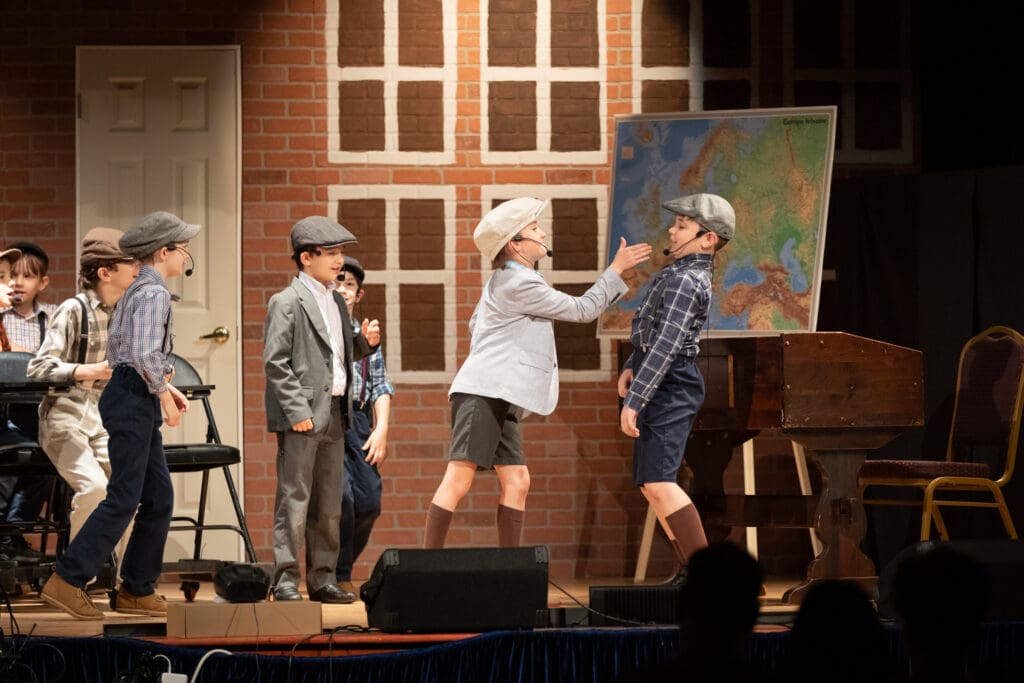
A scene from the play PHOTO: Széchenyi Hungarian School and Kindergarten

It wouldn’t have worked if the actors hadn’t given their best, shown up as agreed and taken it seriously. So big kudos to the final cast for their dedication!

Can you tell us a bit more about the actors?

József Petkes Siklódi became Misi Nyilas not because he has a superb voice, but because he embodies Misi with his childlike innocence and purity. Choosing the main character required also a supportive parental background, because Misi is present in all ten long scenes, with many prose parts, lyrics and choreography. Her mom, Tünde Siklódi, wholeheartedly supported this effort and gave up all other programs for the whole school year to be able to focus entirely on the show. Besides József, her two other children, Nicole and Adam, also acted. The music director was originally supposed to be Anna Tóth, our former school principal, but at the very end of last year she suddenly moved back to Hungary with her whole family, i.e. five actors, so I asked Ildikó Rozs to be the music director. She worked with the cast on the songs every Saturday in the Reformed Church for months and she also accepted to play Mrs. Doroghy’s role. Edina Lotzin, who played Viola, brought her two youngest children to rehearsals, and her daughter Violetta was also inspired to join. Lehel Orbán, playing János Török, loves to sing. Originally, I didn’t intend this big a role for him; however, by March, I changed his minor role to that of János Török, and in three weeks, he learned all his songs and lyrics. For Teacher Valkay’s role, I casted for a very long time and eventually found Dániel Jarisz Indri, a KCSP (Kőrösi Csoma Program) scholar from New York. He had to commute from the City for rehearsals, which wasn’t easy, but he could manage it.

What about your role?

I wanted to perform from the beginning; that’s why I started this project. Initially, I planned to have Viola’s role, but Edina Lotzin was much better suited for that. I approached a lot of people for Bella’s role, but teenage girls just weren’t interested, so it remained mine. During the process, however, I realized how difficult it is to perform and direct at the same time. I couldn’t fully immerse myself in my role because I had to oversee the scenes from an external viewpoint. This dual task was incredibly challenging and required a lot of concentration. It didn’t get easier even after setting the scenes since we had to continuously adapt the rehearsal process. We could have full rehearsals on the Hungarian Club’s stage only a few times and we could only start them just a week before showtime. Another challenge was that we had to dismantle and store the whole stage set after each rehearsal, because the main stage was needed for other club events. When we couldn’t rehearse there, we used the nearby Scout Home. Our first major rehearsal was there, sometime in mid-April. Two weeks before showtime, we still didn’t know the transitions between scenes, which also had to be carefully planned, but it was extremely difficult without a stage.
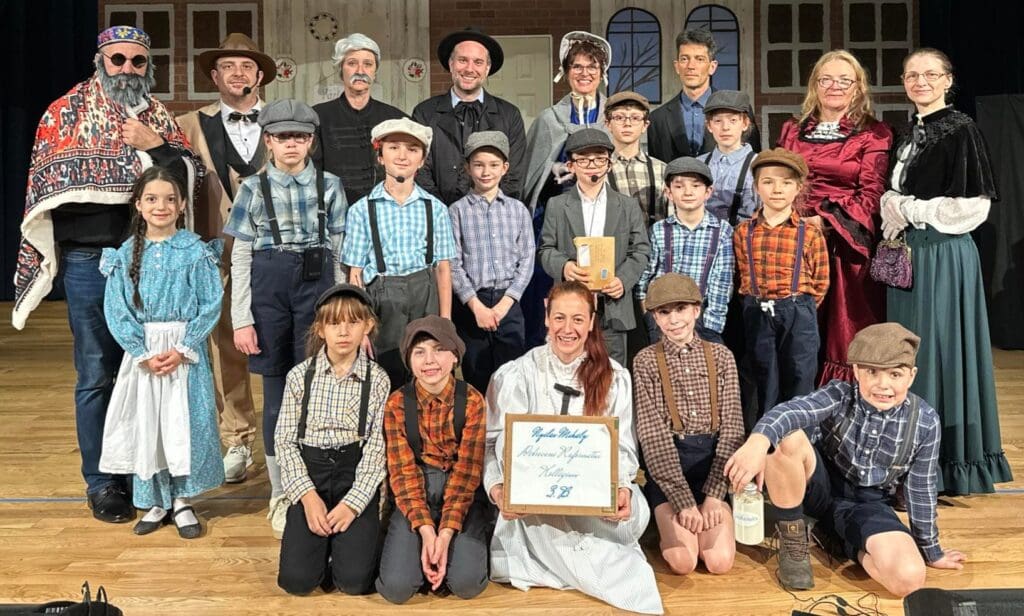
The cast of the play PHOTO: Széchenyi Hungarian School and Kindergarten

Who helped you during this challenging process?

When I started, I knew I couldn’t do it alone. The most important was the music director’s role, and Ildikó Rozs gladly accepted the challenge and worked with the cast on the songs for months. The original set design team started with four people, but in the end only Lívia Schachinger remained, whose two younger children also played. Zsolt Hodossy, the father of one of the children actors, built and managed the woodwork. Léna Elmes joined them on the day of staging the show. Another crucial help was that of the sound technician. Attila Szabó immediately said yes when I approached him about it and assured me he would help with everything. From the moment we started rehearsing with microphones, he was present at every rehearsal, even though he has no connection to the school; he’s a member of the Club. Sometimes, he had to be there at six in the morning so we could start the rehearsal with full sound technology at eight. During the last week before showtime, KCSP scholars Lili Balogh and István Dániel Molnár joined Attila as helpers with the technology.

I already mentioned Edina Lotzin, who was my right hand overall. Initially, she didn’t want to act. She is a working mother of four who also teaches at the school on Saturdays and sings in church on Sundays. But eventually, she joined. She also compiled the program booklet and provided the English translation, with Ildikó Bézi’s help. Since there would have been no performance without a venue, I must thank the leaders of the Scout House, Reformed Church pastor Zsolt Ötvös, Catholic priest Father Imre, Denisa Bott-Varga and István Varga from the Club for providing us with a place to rehearse and play. I am immensely grateful to all the parents and grandmothers who supported us, bringing the children to the rehearsals and feeding us along the way. On the day of the show, parents made and sold cakes and sandwiches to support the school in addition to the sale of tickets.

In summary, it was the dedication of everyone involved as well as of of the whole Hungarian community that made this performance possible,

despite all the challenges.

After the show, people contacted you asking to take the show on the road…

In fact, I was contacted even before by the Liszt Institute and the Hungarian Consulate General in New York. Since I had never directed a play of this size before, and because of the challenges, I couldn’t eat or sleep in the last few weeks before the show. When they approached me, I asked them to come to see it and if they still liked it, we would be happy to perform it again as we put so much work into it. I said this also because at the outset we were not taken seriously by the Hungarian community in New Brunswick. This made me even more determined to prove them wrong. After the performance, Consul Nikolett Szántovszki and Program Manager Noémi Sallai wanted us to perform in New York in June. However, we have Memorial Day weekend at the end of May, followed by the Hungarian Festival on the 1st of June, and then the end of the season comes. I even asked the parents, but in the end, I concluded: we were too tired for this. It would have been rushed, and I didn’t want to compromise on quality. So, I replied that from September on we will happily perform anywhere, we only need a month of rehearsals. Since then, Prof. Judit Kerekes has also approached me and asked me to stage the show at the annual meeting of Hungarian American Schools (AMIT) on the first weekend of October. I said yes, and they have already advertised it. The rest is still on the drawing board, but we are happy to take the show to any other Hungarian community in North America.


*Pakk is a loan word from German, meaning package, used much less now than in Zsigmond Móricz’s time. In the Móricz novel, when students received a package from home, it is referred to as a pakk.

Source: hungarianconservative.com

Reklám
Tas J Nadas, Esq

‘Folk dance training doesn’t end in the rehearsal room’

The Hungarian community in New Brunswick has been hosting Kőrösi Csoma Program (KCSP) scholars specialized in folk dance for quite a while now, and over the last two years directly from the Angyalföld Vadrózsa Dance Ensemble. Lili Balogh and István Dániel Molnár have not only been involved in training five folk dance groups in New Brunswick, but have also helped a number of local Hungarian organizations in multiple ways and in relation to several Hungarian events.

***

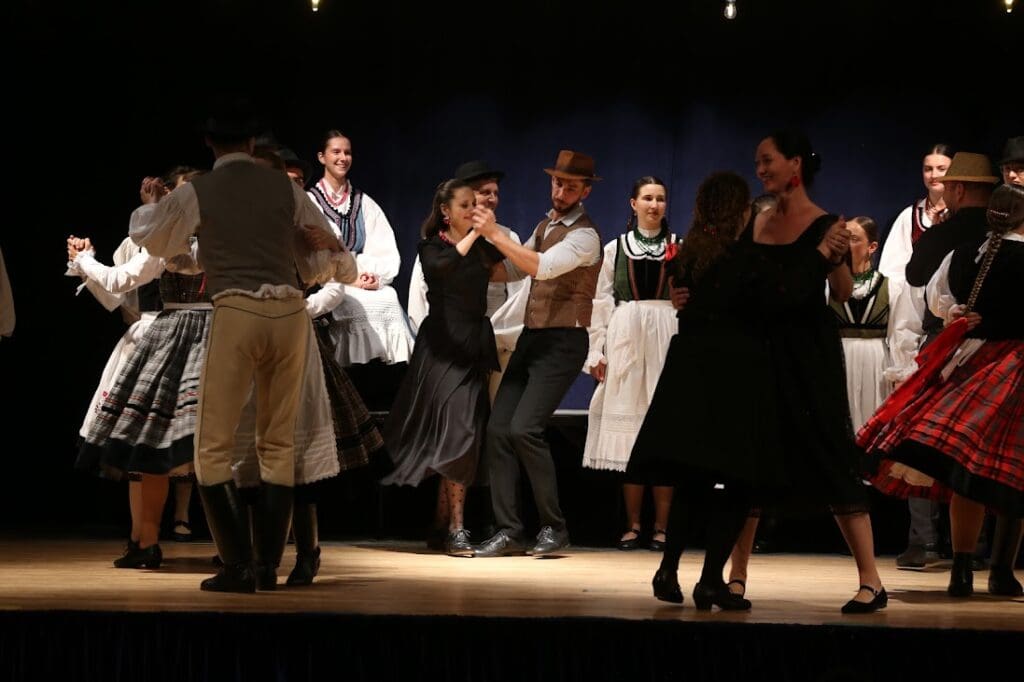
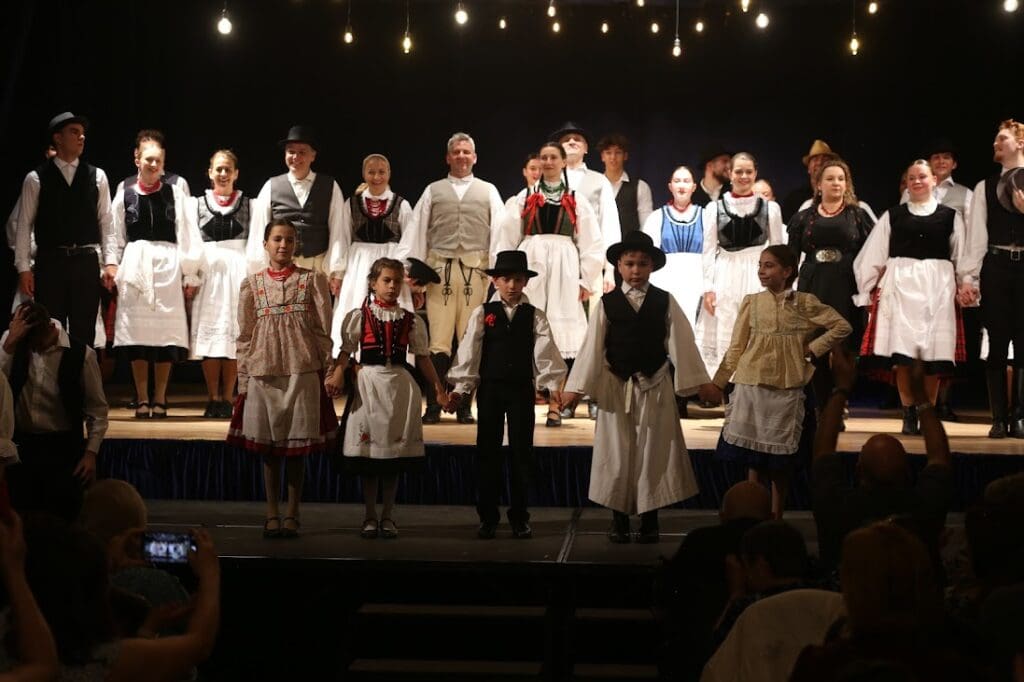
Lili Balogh and István Dániel Molnár dance in the middle at the year-end gala PHOTO: Hungarian American Athletic Club (HAAC)/Facebook

Where are you from and what do you do at home?

Lili: I was born in Dunaújváros, Hungary. At the age of 18, I applied to the Faculty of Teacher Training College of the Károli Gáspár Reformed University in Budapest, and then I immediately started working as an English teacher and elementary school teacher in Budapest.

Isti: I was also born in Dunaújváros. We both grew up in the long-established Vasas Dance Ensemble of Dunaújváros. I joined its teaching staff in 2012, and in 2015 I took over the artistic direction of an ensemble in a nearby village. I joined Vadrózsa in October 2018, having previously danced with the Szentendre Dance Company. Lili and I found each other in 2018, and a year later we lured her to Vadrózsa. There, I first helped with the talent program, preparing soloists for competitions, and in 2022 the lead trainer role of the most senior group was assigned to me. Before we came to the U.S., I also worked for five years as a music and folk dance teacher in an elementary school in Ercsi. This is a municipality with a lot of disadvantaged families living in deep poverty, so this was a big mission for me. I was also working part-time at the Urbán Verbunk art school in Gödöllő dealing with 10⁠⁠12-year-old children. This is the only dance theatre company in the country for juniors, with a lot of acting involved. They are accepting me back full time as soon as we get home.

How did the connection between Vadrózsa and New Brunswick come about?

Lili: The Vadrózsa Dance Ensemble was founded in 1992. The current artistic directors, Kristóf Fundák and Lili Fundák-Kaszai, took over the artistic direction in 2009. They have entered the group to the national folk dance movement, where they have been achieving good results in professional forums and competitions for several years. It is among the top non-professional folk dance companies at this point. In addition, Lili and Kristóf have been active in the Hungarian American diaspora for many years. They have been regular guests at the Csipke Tábor (Lace Camp) organized by József Salamon and his wife, Andrea annually for 15 years. They also often travel to Canada, visiting Calgary, Winnipeg, Montreal, and Detroit to organize Hungarian folk dance workshops there. In the Csipke Tábor they have developed a close relationship with the Hungarian folk dance community from New Brunswick. The Mákvirág children group in New Brunswick and the Vadvirág children group in Budapest became sister groups.

Prior to the Covid pandemic, Dénes Kovács and Vivien Nagy were KCSP scholars in Los Angeles at the Kárpátok Dance Ensemble, then led by Lívia Schachinger, who has since moved to New Brunswick and is now one of the leaders of the Szilvafa Dance Group and one of the KCSP-mentors, along with Melinda Török, who leads Mákvirág.

Why did you apply for the KCSP scholarship?

Lili: Last June, we were approached by the 2022⁠–⁠23 New Brunswick KCSP scholars Gábor Szanyó and Viola Kovács. They suggested that we should step in their shoes and apply for the 2023⁠–⁠24 cycle. We thought about it for a day or two and decided to take it on. Our employers were also very flexible about it, we could both take unpaid leave and agreed to come back in a year. Back in June we already had an online meeting where we met our mentors, Melinda and Lívia.

Isti: Even though everybody tried to provide us with all the information, we realized quite quickly that there is no way to prepare for this scholarship. As we arrived late, we were in the fortunate position of being immediately involved in the community’s life: we arrived on Thursday, and the next day we had a rehearsal for the Csűrdöngölő, where we were welcomed as if we had known each other for months. Lívia and her family picked us up at the airport and brought us here, where we were greeted with a small gift basket with enough food and drink for a few days, which was very nice, because we hadn’t thought about that before. These are the very first, very positive impressions that I think will last a lifetime.

Lili Balogh PHOTO: courtesy of Lili Balogh and István Dániel Molnár

Is this your first time in America?

Lili: Actually, it was the first time we had ever flown, the first time we had been overseas, so we were very excited about this trip. And well, America is a very different culture, so at the beginning we were just scratching our heads… Without a car, it’s practically impossible to go shopping, so we had to rely on others, which was a bit difficult at first, at least for me, because I don’t like asking for favors; but then we developed good relationships with a lot of people who we could always rely on. One of the dancing mothers, Enikő Kovács, said: ‘In three days you picked up the rhythm and blended into the Hungarian community as if you had been here for years.’ Obviously, it depends on your personality how quickly you can integrate, but this community has also done its best.

I wouldn’t dare to embark on such a journey alone, but together everything went easier, including integration.

Let’s talk about your KCSP tasks in more detail.

Lili: New Brunswick has a lot of folk dancers, so the main thrust for us was folk dance education and strengthening the dance communities. We taught in the two older children’s groups at Mákvirág, the young adult Csűrdöngölő, the older Szilvafa and the Regös scout folk dancers. We both taught at the Széchenyi Hungarian school on Saturdays. Every Wednesday we helped at the Reformed Church, from office work to cooking and from packing to organizing the archives. On Thursdays, we helped at the Hungarian Museum. They’ve recently started an archiving project, so there were times when they had to type it up, but otherwise it was mainly physical work: preparing for the monthly market, setting up tables, displaying handicrafts, packing, moving books, preparing exhibitions, etc.

Isti: On Fridays we were at the Club (the Hungarian American Athletic Club, HAAC) when we were needed. There we usually had to help with the cooking if there was a Friday night dinner, or digitize pictures, set the table and wipe glasses for balls. Back in October, all the organizations sat down with us and clarified when and what they were expecting us to do. We didn’t receive such a request from the HAAC at that time, only later and rather strangely: we were often called unexpectedly to drop in immediately and they didn’t understand why we weren’t available. There was no proper communication, which was also due to the fact that at that time there was a big mess at the Club’ leadership which made our stay difficult at the beginning, but when the HAAC management was sorted out by the spring, communication became much better. We recommend to the next KCSP scholars to sit down with each Hungarian organization at the outset and clarify what the expectations are. Obviously unexpected things can always happen and it’s good to be flexible, but it is always worth knowing the duties and keeping the limits.

What was your specific task in terms of folk dancing?

Lili. We tried to show each folk dance group something new, while strengthening their community. This year there was no Pontozó, the biggest Hungarian folk dance competition in the U.S., but Melinda wanted a bigger folk dance show. She first thought about the Toborzó, which is a bit like a folk dance festival in Hungary. We started organizing this three-day event in the autumn, but in the end we decided that it would be too much, so instead we had the end-of-season gala on 11 May, and they also performed their shows partly at the Hungarian Festival on 1 June.

Isti: We were expected to put together a gala show of at least an hour, preferably with as much dancing and as little music or prose as possible. We therefore tried to keep the choreographies long enough, but still enjoyable. In addition, we tried to show everything that is relevant to the various regions and to convey it in a way that does not detract from the experience. To us, from the moment the dancers take to the stage, it is no longer a folk dance but a show. It is authentic folk dance that was danced in barns in the 1940s, 1950s and 1960s, and then in folk dance halls from the 1980s onwards. But as soon as we put it on stage, it becomes a show. People here have had to understand and accept that if they want to be on stage, they have to put a lot more work into it as opposed to just dancing for themselves. If they are dancing for the audience, they have to capture their interest from the first second to the last. That’s why we pay attention to the view, not just the dance and the music. Obviously, Hungarian folk dance is very spectacular, but we still have to make it exciting. Gabi Vajtay had a very good saying in relation to the Hungarian Festival: she would like to see something exciting, and not a 50th folk dance from Szék… The stage production has to be appropriate for today’s audience, both in terms of visual and audio experience. Authentic folk dance, however, no longer serves this purpose; you have to add a lot of extras, but from then on you can no longer call it folk dance. I think they got what I was trying to convey. I always tell my groups in Hungary: you can learn folk dance, but you won’t go on stage at year-end.

Lili: Different practices and rules apply everywhere. Here, the dance teachers do a mind-boggling and endless job, constantly adapting and looking for solutions to things that they shouldn’t even be dealing with… If you want to belong to a community, you should submit to its rules. Here we have seen the opposite, especially in the children’s groups: teachers subordinate themselves to children. In the case of the two older Mákvirág groups, we have managed to make them understand our point and we are very confident that the group will act accordingly next year. It is in their interest.

Mákvirág PHOTO: Hungarian American Athletic Club (HAAC)/Facebook

We haven’t even mentioned whether they’d come to the rehearsals or not…

Isti: True, but we want everything. We strive for our students to learn how to dance, so they can master all the steps and motifs we teach them and can use them freely when they go to parties, dance clubs or at home. There is obviously a big difference between being able to apply what they have learned freely and being able only to dance the sequence they have learnt. In the latter case, if they are in a different venue or stage, they can easily get confused and lose track of where they are. Our main goal—and not only in America, but also in Hungary—is that they learn the dance material at a native level, at least the motifs and figures we teach them. Building on this, we can start to produce series of movements and choreographic elements.

Lili: Folk dance groups in the Hungarian diaspora are in a more difficult situation in this respect, because they only have one rehearsal per week. In that 2,5 hours they have to get the children to like and learn folk dance, master the motifs and stylistic elements of the regions, and even put together a choreography, so that they can perform at the May show and at the Hungarian Festival. In Hungary there are usually two rehearsals per week, and there are summer camps and regular weekend camps. Here, if a kid is sick, if it’s snowing heavily and people can’t get into town, if there’s a longer scouting program, then there’s no dancing for two weeks… However,

we believe that folk dance training doesn’t end in the rehearsal room,

so we’ve made an effort to organize some kind of a team-building camp or day for every group. The impact was very impressive. For example, we held a two-day training camp for the Regös group back in October. These two days together started a close bonding between the young people that gave a very good impetus to the whole year. Previously the group went with six couples and about 12 children, this year there are now 25 children. The older and the middle group of Mákvirág had a training camp in January, but we also organized a party night for the older ones. Almost everyone participated and they had a great time.

Isti: But the biggest camp experience was with the adult group Csűrdöngölő for whom we had a three-day training camp they had never had before. They’ve had long Saturday or weekend rehearsals, but never before have the 25 dancers traveled somewhere for three days. We were aware that not everyone could get away for three days, so we didn’t make it compulsory, but we did state that only those who would be attending the camp would be involved in the choreography, because we would put it together only there and not during the regular rehearsals. We promised that by the time the training camp started at Magyar Tanya, Pennsylvania, everyone would be able to dance so freely from the material they had heard all year that we would put the choreography together in three days. They were reluctant at the beginning, very tense and worried, but practically half of the choreography was done on the first night, and from then on the camp was very good fun. In terms of community building, it’s very important to have long weekends, not just long days together. They need weekends like this, so that they can do what they love to do, stress-free, relaxed and unhurried…and together. Hopefully they’ll continue it from now on.

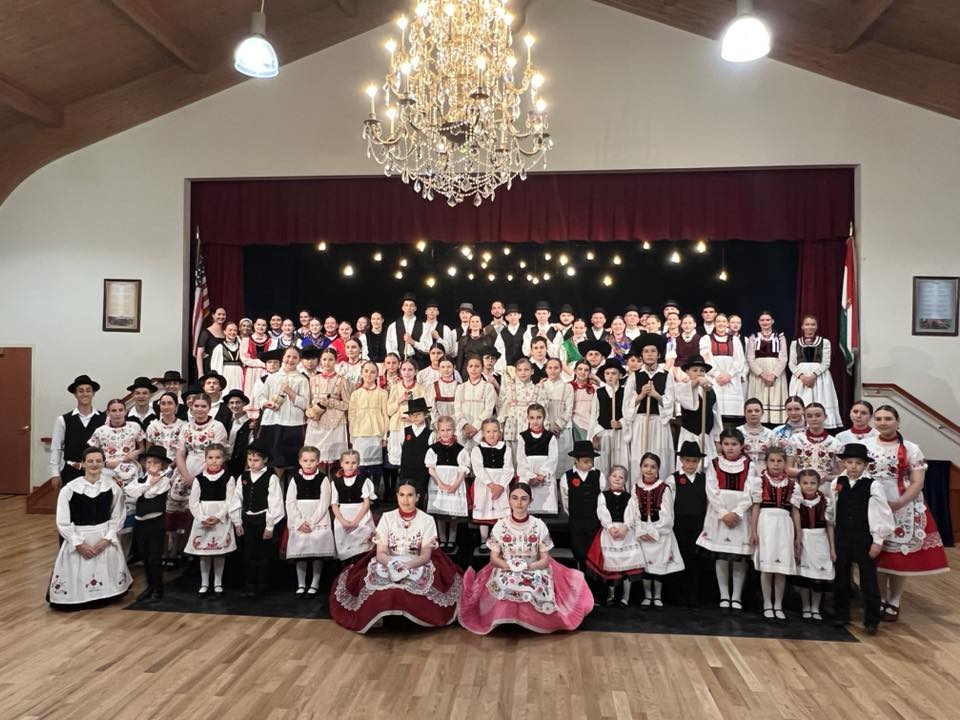
Year-end gala PHOTO: Hungarian American Athletic Club (HAAC)/Facebook

How have you been involved in the preparations for the Hungarian Festival, the biggest event in the local Hungarian community life?

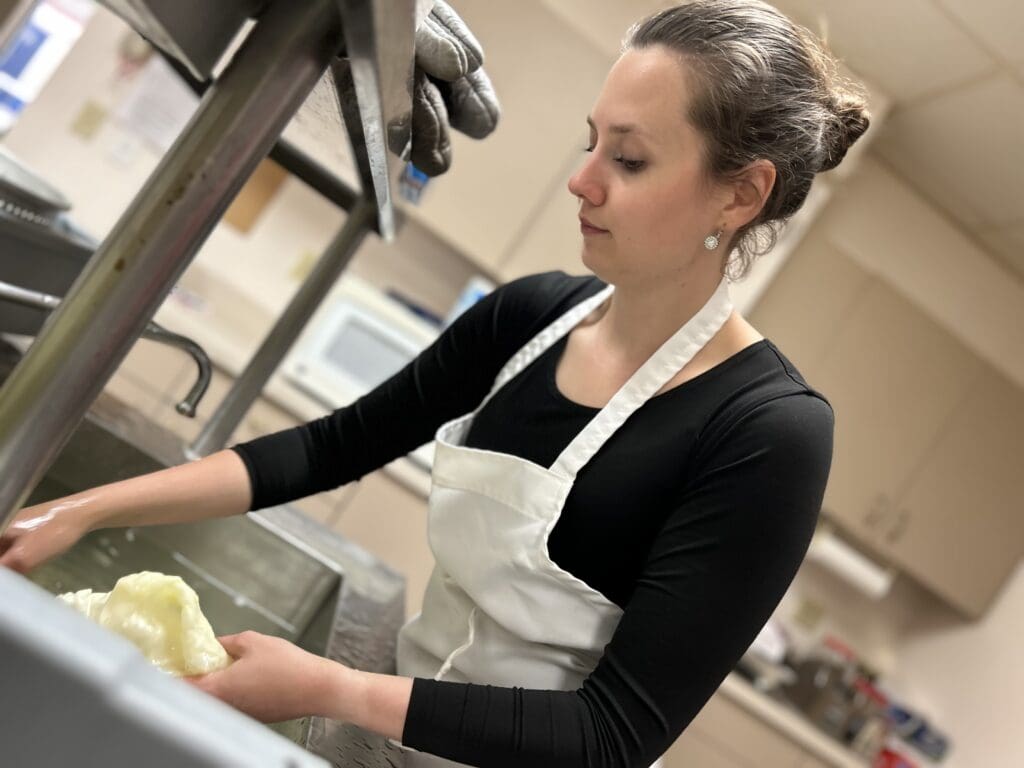
Lili: We indicated to our mentors and to the local organizations that we would be completely free during the week of the festival, we only asked them to let us know in time when and where they needed us. Everything went smoothly; there was only one day of tension, the previous Friday, when we had to make chicken paprikash for 800 people at the Club. Everybody knows how good a cook Łívia is, but she has never made chicken paprikash in such quantity, so she said: whatever happens, it’s everyone’s responsibility, not just hers. As we heard back, it was delicious, but on the day we worked from 9am to 9pm, lifting big pots and pans to and from the stoves, and cleaning 1,600 chicken legs and continuously stirring the paprikash…

Isti: …it made everyone sweat. We were racing against time, checking the clock every minute, which stressed us. But maybe next year it will be easier. Otherwise everything else went smoothly, and overall we had a good time at the Festival.

Lili Balogh (L) PHOTO: courtesy of Lili Balogh and István Dániel Molnár

Tell us about what you’ve seen of the U.S. beyond work and New Brunswick.

Lili: We visited nearby New York several times. We also got to Cleveland once but unfortunately haven’t had time to go back since then, even though we promised.

Isti: We accompanied the New Brunswick Regös dance troop to the Golden Wedding because they were invited by the Cleveland Regös dance group, whom they had met at various scouting events and developed a close relationship. The two groups tried several times to put together a troop-building weekend, but it didn’t work out due to the busy schedules and long distance. The show was the first foreign Hungarian cultural event that was shockingly amazing to experience. We had no idea that Cleveland would have such a deep bench and ecosystem for Hungarian folk dance. Almost every Regös dancer from the past 50 years performed on stage with an attitude and quality that trumped even professional folk dance companies in Hungary. A good example to follow!

Back to the question…

Lili. During spring break we were in Arizona, where we visited the Grand Canyon. We stayed in Sedona, where we hiked almost all the hiking trails. We had a meaningful, life-changing experience. Also because Isti proposed to me there…

Isti: Indeed. Our next long holiday will be a trip to Florida with some friends. We have also been to Canada. We went to Montreal for a workshop given by our art directors Lili and Kristóf, and we had some time to look around and see the city. If all goes well, we will return with the Vadrózsa Dance Company for a two-week East Coast tour from October 18⁠–⁠19 to November 3⁠–⁠4.

Congratulations on the engagement! What is KCSP good for… Do you keep in touch with the other scholars?

Lili: There was a so-called preparatory meeting in September, organized by the State Secretariat for Hungarian Communities Abroad. We participated in different presentations for three days, where we got to know all the other KCSP scholars coming to the U.S. for this year. The leaders of our team are István and Ágnes Vámosi, who had already had a year of experience, having lived in Los Angeles. István suggested that after the formal meetings we should introduce ourselves more informally. Later, a Facebook group was set up and we held two⁠–⁠three video meetings, where everyone could tell us how things were going and help each other if needed. There will be a closing conference on 10 July, after which we would like to meet again informally, so that after nine months everyone can share their own experiences. We can learn a lot from each other and what we share can also help the program. I’ve started to put together a list of useful information and advice for the newcomers.

Isti: Friendships have also developed between KCSP scholars, and we can call Bence Hajdu from Washington, DC and Daniel Indri from New York friends. We also have a good relationship with Marci Hajdú from Passaic/Garfield, who stayed with us once. Over Thanksgiving, several KCSP scholars came to visit us.

You’re going home soon, but I suspect the connections will remain. You’re coming back in the fall, and we recently had a farewell party at the Hungarian House in New York for six young adults who will be studying in Hungary.

Isti: We’ve already indicated to them and their parents that we’re going to create a chat group where we’ll provide all the necessary information for them. If they need any help, they should let us know. We plan to have a Budapest⁠–⁠New Brunswick monthly meeting so that everyone can report on their studies and how they are feeling. We’ll pick up those who are traveling alone at the airport. We don’t let go of their hands; we want to give back the good things we’ve received from them.

What are the three most important things you take home from here?

Lili: The positive American attitude that the Hungarians born here also have. For example, Csilla Varga’s positive outlook and world view really struck us. She sees the world so differently and has such a different approach to problems than we are used to back home. She focuses on the solutions and doesn’t despair if something doesn’t work out as planned. She is aware that everyone is volunteering here and sets her expectations accordingly.

The other is the power of teamwork. If they see something failing, they follow it up until it’s resolved…or let it go.

Isti: Thirdly, I would like to send a message to the Hungarians back home: there are Hungarians in the U.S., come and see what it’s like to be a Hungarian here…

Ildikó Antal-Ferencz

Source: hungarianconservative.com
Reklám
Tas J Nadas, Esq

‘Young people are interested, but just not familiar enough with Hungarian organizations’

Source: hungarianconservative.com
Luca Mórocz came to the U.S. in 2017 as a Hungarian American Coalition (HAC) intern. She then embarked on an exciting professional journey including stints as the PR manager of the Ambassadors of the Future Gala in California and as a foreign exchange diplomat at the Hungarian Ministry of Foreign Affairs assigned to the U.S. State Department’s Global Coalition to Defeat ISIS. She is currently living and studying in Washington, DC, organizing various HAC events and a leadership training program that seeks to offer solutions to a common challenge of all Hungarian diaspora organizations: youth engagement and leadership transition planning.

***

When and why did you first come to the U.S.?

I arrived in 2017 as an intern of the HAC’s Leadership Training Program (LTP), renamed after its founder John N. Lauer, following his passing away in 2018. I was studying International Economics at the Budapest University of Technology and Economics (BME) at the time and I heard about the opportunity from a son of a friend who is an alumna. I was keen on gaining some experience abroad, and I pursued the Coalition’s LPT in the U.S. and an Erasmus scholarship opportunity in Italy. I was admitted to both but chose the first. I spent four months in Washington, DC where I completed my thesis on the tax policy of the newly elected U.S. President Donald Trump, allowing me to continue my university studies without interruption. During this time, I worked 20 hours a week as a marketing intern at the Global Entrepreneurship Network, and spent another 20 hours reaching out to various think tanks, political organizations, and NGOs. Many of their representatives reviewed my thesis and provided additional resources.

What was your first encounter with America as an undergraduate?

One of my first memories is of bus drivers greeting me and asking how I was. I thought they were serious and answered, but soon realized it was just a cultural difference. I appreciated the kindness and openness of people on the street, who would smile and compliment me or my clothes. Another positive experience I had in Washington, DC, was the serendipity of meeting people in interesting positions, often related to politics. No wonder I really wanted to come back. Initially, I thought I liked America, so in November 2018, I moved to Los Angeles for six months to volunteer for the Ambassadors of the Future Gala as a PR manager. This is a charity organization, founded by Ádám Béres and his parents, Dr. Zsuzsa Pekarovics and Dr. Attila Béres in 2017. It encourages young people to engage in volunteer activities and support international student exchanges. They raise the funds and distribute the proceeds to organizations, including the Coalition. During my time, we raised $30,000 to help a Hungarian student to study at the University of South California (USC). I loved the Gala and LA, and visited all the national parks in California. However, I realized that what I liked the most about my first visit to the U.S. was Washington, DC. I specifically planned my career to return there.

When and how did you manage to return to the U.S. capital?

Back in Hungary, I worked as a VAT analyst for two companies before transitioning to Mathias Corvinus Collegium (MCC) as an international relations expert. MCC often collaborated with the Hungarian Ministry of Foreign Affairs and Trade, and I soon had a chance to transfer to the Department for North America. In September 2021, I arrived in DC, for a one-year exchange diplomat position at the U.S. State Department. While there are classified levels that exchange diplomats cannot access, the program is managed professionally, having run for decades. I was assigned to the unit responsible for counter-ISIS activities. For six months, I served as an expert in charge of working groups, and for four months I was the acting working group unit chief until a permanent group leader was appointed. The Defeat ISIS Coalition of 85 countries united against ISIS. My role included managing the working groups and organizing their meetings. I traveled extensively: my first trip was to Morocco for a ministerial conference traditionally opened by Secretary State Blinken, where I was part of the eight-member U.S. organizing delegation. Two weeks later, I was sent to Kuwait to organize the Foreign Terrorist Fighters Working Group meeting of 44 member countries. Then, I traveled to the United Arab Emirates to organize a Communication and Stabilization Working Group meeting and then to Berlin, Germany.

Exchange diplomats with Secretary of State Antony Blinken PHOTO: courtesy of Luca Mórocz

How challenging was it to become the acting head of this unit?

Everyone looked at me strangely when they found out that a foreign diplomat in her twenties was appointed as temporary supervisor. I enjoyed it because I still felt as part of the team; the only difference was that it was me who went to the management meetings and had to prepare the senior diplomats when they went for a particular visit. For instance, Tim Betts, who had previously been a diplomat in Hungary. I was very nervous when I placed the prep materials in front of him and his colleagues and began to speak.

He smiled and thanked me in Hungarian, but I was so excited that I didn’t even notice.

He sipped his coffee from a mug, grinning from behind it as I talked. It was only then that I noticed the Hungarian words on the mug were something like ‘Ismétlés a tudás anyja’ (‘Repetition is the mother of all learning’). It then occurred to me that Zsolt Szekeres had mentioned him to me earlier, noting that they were good friends and he had been close to the Coalition when he was in Hungary. Throughout my year in the U.S. Zsolt supported me, always helping whenever I needed anything. I enjoyed my work a lot and I didn’t leave when I was supposed to… My boss decided to keep me for another year, which was unprecedented at the U.S. State Department. In Morocco, he approached Hungarian Foreign Minister Péter Szijjártó without consulting me on the details of his plan. Standing next to them, I was stunned to overhear their conversation. Ultimately, they managed to extend my assignment for another year in the same department, allowing me to continue my previous work.

As a foreign exchange diplomat, you had to represent Hungary, right? What about your acting unit chief role? Didn’t it create a conflict of interest or put you in a delicate position?

There were a few interesting episodes when the American team members forgot that I was Hungarian. When the Ukrainian crisis started, my boss asked me why the Russians were fleeing through the STAN countries, and what the official U.S. stance was. I had to reply: ‘I don’t know, I can only tell you the official Hungarian position if you’re interested.’ Although I represented Hungary, I was placed in a special unit where I also had to represent the U.S. to other countries, which was particularly challenging. In contrast, a Turkish expert for example, being an exchange diplomat from another country was one of fifteen in his unit dealing with Turkey. He didn’t directly interact with other countries as a U.S. representative or travel elsewhere. My unit was unique, posing a special challenge. When we traveled, I had to represent the U.S. position to the outside world, but internally I had to represent the Hungarian position as a Hungarian diplomat. Moreover, when discussing topics like Ukraine, they couldn’t include me in certain discussions since I was indirectly affected as a Hungarian diplomat. They always had to be mindful of that.

You also had to pay attention to that, right?

Yes. I had to be intimately familiar with every detail of the topics I handled and the current Hungarian position on each issue. My colleagues were often cross-examining me, especially after the Ukrainian war broke out. Keeping up-to-date was challenging because I spent five days a week at the U.S. State Department. Officially, I had to report to the Hungarian Ambassador weekly, but had no official duties as being assigned to the U.S. State Department.

Did you manage to have a third year or how did you come back (again)?

During the second part of my second year, I was asked to extend my assignment again. This time they wanted to create a national expert position specifically for me with a two-year contract. They asked for permission from Hungary, but since this would have meant an additional Hungarian diplomatic status in Washington, DC, which was not feasible given the economic situation, Hungary unfortunately could not accept this proposal. Additionally, the next exchange diplomat had already been appointed by then. In August 2023 my foreign service ended. I returned home and resigned from the Hungarian Foreign Ministry. After a few weeks, I came back and started to prepare for the GRE exam, a prerequisite for admission to master’s and PhD programs. I had previously started a master’s degree at home with special permission, completing two semesters and many courses while in the U.S. I decided to switch to a U.S. graduate program and started preparing for the GRE exam. I applied to several universities, focusing primarily on American University as I heard many good things about the institution. Although I didn’t get admitted to their highly competitive PhD program, I was offered a scholarship for their two-year master’s program, which could later give me credit towards a PhD if I continued there. Meanwhile, Zsolt Szekeres asked me to be a fellow at the Hungarian Human Rights Foundation (HHRF) from September to December 2023, preparing for the arrival of RMDSZ (the ethnic Hungarians’ party in Romania), President Hunor Kelemen’s delegation. In January 2024, I became a Coalition fellow.

Andrea Lauer Rice, Péter Szilágyi, and Luca Mórocz (from L-R) representing HAC at the Embassy PHOTO: courtesy of Luca Mórocz

What are you doing currently at HAC besides your studies?

I handle a wide range of day-to-day activities. Firstly, I represent the organization in Washington, DC. Our president, Andrea Lauer Rice resides in Georgia, so I attend diaspora-related and other official events. Secondly, in Noémi’s absence, I am responsible for preparing for the Gala Dinner on 12 September and the Santa Claus Dinner in December, as well as coordinating the associated White House briefing. Thirdly, the Coalition is also involved in the Central East European Coalition (CEEC), an umbrella organization of national minority organizations of CEE nations. Our representative, Max Teleki, invited me to their weekly online meetings. We also host a monthly in-person meeting at the Kossuth House. Currently, we are organizing a panel discussion for the week before the NATO Summit (8⁠⁠11 July) to outline the implications of Ukraine’s accession. By the way, one of my first major projects at the Coalition was compiling the history of Hungary’s accession to NATO. We produced a detailed summary, including personal stories and photos of notable individuals involved, available on our website.

Finally, let’s talk about your latest project, HYPE Network, which aims to offer a solution to a challenge of many Hungarian diaspora organizations: youth engagement and generational leadership succession.

Since moving here, I’ve noticed that the leadership of every Hungarian American organization I’ve encountered is mainly over 60⁠–70 or even 80 years.

They all express difficulty in engaging younger generations.

We first became aware of this issue when Coalition members wanted to set up its Elderly Committee. The idea of a Youth Committee also came up, but there was uncertainty about who would be interested. While there are a few young volunteers, they lack an ongoing relationship with us. That’s when we started talking with Réka Veres Lenox, who was a HAC intern seven years ago and has been living here in DC since. She mentioned Albert-László Barabási’s son, Dániel, who received the Young Leaders Award at last October’s Gala, where I was awarded the LTP Alumni Award. Dani had previously mentioned to Réka that he was willing to help if needed. We decided to create an initiative to engage this generation. Our first step was to identify what HAC could offer that would interest young people, even those with no prior contact with the organization. This led to the idea of a leadership training program, as leadership skills are universally valuable for professionals and future leaders of Hungarian organizations. We also collaborated with Gábor Mózsi, the president of the Hungarian Club of Chicago. His journey exemplifies what we aim to highlight: having moved to the U.S. 10 years ago, he became an active member of the local Hungarian community, and a year ago, he became the club president due to his dedication and energy. By May, ahead of the Hungarian Summit in Florida, we had completed the outline of the leadership training program.

Zsolt Szekeres, Luca Mórocz after receiving the Alumni Award, Andrea Lauer Rice, Edith Lauer, and Noémi Bánhidi (from L-R) on 22 October at the HAC Gala dinner in Washington, DC PHOTO: courtesy of Luca Mórocz

The news was announced at the Hungarian Summit founded by Piros Pazaurek. Let’s go through the key details, including its main goal.

The program, Hungarian Young Professionals Engagement (HYPE) Network, is an exclusive group accessible by completing the six-month leadership program. The inaugural participants, who began on 1 June 2024, have a unique opportunity to become co-founders of the program. This role comes with additional responsibility of promoting the program within their circles and nominating a professional from their network to be a speaker. While not all nominees will fit into the first six months, having a pipeline of participants and speakers is crucial for the program’s continuity. Consequently, the initial participants will need to play a significant role in sustaining the program annually. The HYPE Network program includes seven online interactive presentations, with six of them being mandatory. Upon completion, certificates will be awarded at the Santa Claus Dinner, and participants will be invited to the White House briefings, thereby linking the theoretical leadership training with the Coalition’s practical work. The program focuses on general leadership skills and participants can join the HAC Youth Committee. They will be connected with Hungarian organizations where they can assume leadership roles if they choose. Participants will have access to mentors, i.e. HAC members available for guidance. A key aspect of the program is familiarizing participants with the Coalition. With numerous local members, this connection helps participants discover Hungarian organizations within their professional fields or geographical areas. If we can engage their interest, they can continue to be active at the local level.

Luca Mórocz, Gábor Mózsi, and Réka Veres Lenox (from L-R) representing HYPE Network at the Hungarian Summit PHOTO: courtesy of Luca Mórocz

What do you know about the applicants and the speakers at this point?

We targeted the first 15⁠–⁠20 participants to come from as many states, cities and disciplines as possible. Barnabás Novák, a computer scientist from California, contacted us at the Hungarian Summit. One of his friends and his brother, who is in the film industry, are also interested in the training. The previously mentioned Ádám Béres, now studying to be a medical doctor at Ohio University, will be joining from there. Dániel Barabási, who lives in Boston and studies at Harvard, recommended Nicole Vereczkey from MIT. Elek Krizsán, Árpád Krizsán’s son, who runs the Hungarian Library of New York, also joined the team. Max’s son, Tibor, and Andrea’s son, Nicholas are also co-founders along with Klára Schmidt, Dóri Székely, as well as Évi Lukonits, another very active HAC member in Washington DC.

New York and New Jersey are not represented? What about the lecturers and mentors?

In this first cycle we’re not accepting additional applicants, but they will automatically be included for next year’s program. Our first three speakers have already been booked, while others are yet to be decided. Dexter Ingram, who works in the State Department, has a background in the FBI, Interpol and served in Afghanistan, will discuss people management. Nilda Bullain, a lawyer with Hungarian heritage, serves as Vice President of the International Center for Non-for-Profit Law (ICNL) will lecture on leadership. Peter Rupert, a serial entrepreneur, will share insights on company formation and management. The first three mentors are Andrea, Max and Piros. We are also welcoming mentor applications, as everyone is eager to connect with the youth. If they or their organizations are Coalition members and want to engage with young people, mentorship is a valuable opportunity for direct contact. The mentors’ resumes will be circulated among the participants; they will be introduced during the program. When we launched HYPE Network at the Hungarian Summit, Piros—who was involved from the start as a Coalition vice president responsible for youth engagement—offered the team members five free tickets to the next Hungarian Summit. This exemplifies what a mentor can do, but we haven’t outlined specific expectations from mentors, as we anticipate these relationships will develop naturally. For example, a participant from Cleveland who hasn’t connected with local organizations may be matched with a mentor from the same area. Mentors don’t have predefined roles, as the needs of participants vary based on age and experience.

Ildikó Antal-Ferencz

Source: hungarianconservative.com

Reklám
Tas J Nadas, Esq

‘We should not be concerned with ourselves only’ — Interview with USA Regional President of the Hungarian Diaspora Council Ildikó Mónika Pataki

Source: hungarianconservative.com
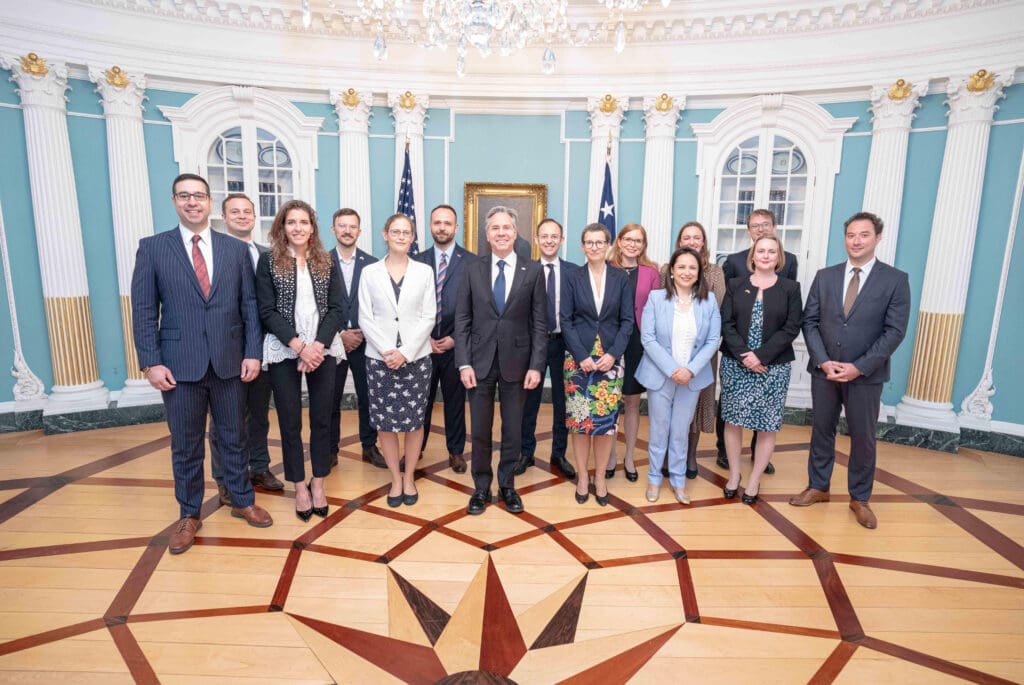
Ildikó Pataki first visited the U.S. as a recent graduate in special needs education, looking for professional challenges. When she married her Hungarian American husband, she decided to stay for life. They raised three children, and she has been actively participating in the community life of the Hungarians in the San Francisco Bay Area for over two decades. When she became a member of the Diaspora Council, a new world opened up to her. As the newly elected president, she works to bring useful information about Hungarian Americans to everyone interested and to encourage broader cooperations in the diaspora. 

***

Why did you leave for America in your twenties?

I was born and raised in Hungary and graduated from the International Pető András Institute. My parents brought me up to love my country. I didn’t come to the U.S. because I wanted to leave Hungary; I was driven by a sense of adventure and professional challenge. Back then, in the summers, a lot of conductors (special needs educators) came to the U.S. to work. At first I came to California for just one summer, but the family I worked for invited me back because the children had improved so much during the time I spent with them. My friend Judit Tóth and I started a small private school for children with disabilities, using a method called conductive pedagogy. It was so successful that we were invited to Michigan to participate in a pilot program assessing how conductive pedagogy could work in public education. Because of its success, we were asked to continue working there as they were planning to start a training program in the U.S. following the Hungarian model. We advised them to contact the Pető Institute in Budapest and start the program with a strong professional background, which they did. I worked there for two years as a visiting professor that I had never dreamed of before. However, what kept me in the U.S. was not my career, but my marriage. Me and my Hungarian American husband, born and raised in America, spent two years flying back and forth between California and Michigan. In 2000 we decided to get married and I moved to San Francisco. I love raising a family here; America gave me a lot, but Hungary still feels like home to me, we travel there very often.

PHOTO: Ildikó Mónika Pataki, Regional President of the Hungarian Diaspora Council for North America PHOTO: Ildikó Mónika Pataki/Facebook

Soon after becoming a mother of three, you started to work again, but in a different field: as a volunteer in the Hungarian community.

I felt it was very important to be at home with my daughters. As I look at them now, I see that every minute invested has paid off in terms of what great people they’ve become. Zsófi is studying art history in Hungary, Noémi is studying to be a vet and Lili is graduating from high school and wants to become a physician. My parents are also special needs teachers; in addition to my father being a pediatrician, my grandparents worked with the deaf and blind—the helping profession is in my blood. I always heard around the dinner table at home how we can heal and help others, and build the community where we belong. I think that’s why I got involved with the Hungarian diaspora. First I taught at my daughters’ weekend Hungarian school, where I am now co-principal, and I was also active in scouting as a parent; I still organize the Scout Balls. My girls have gone through all the steps from Hungarian kindergarten to school and scouting, passed the Hungarian studies exam, became scout leaders, and attended scouting leadership training camps in Fillmore, New York. When someone asks me how I got them to speak Hungarian so well, I reply: I didn’t teach them Hungarian, I spoke Hungarian to them. There was never any question of what language I should speak to them, and they never refused it. They were always proud of their Hungarian identity, which was completely natural for them as they grew up in a completely Hungarian environment, listening to Kaláka (a renowned band playing folk songs and Hungarian poetry), and watching Hungarian folk tale cartoons.

I think the key to this was the positive emotional charge I gave them about everything Hungarian.

One should never forcefully teach a child Hungarian. If they have any negative associations with the language, they won’t want to speak it. If the teacher is kind, not bored with teaching and does not put the children in any unpleasant situation, they will love her and will love Hungarian through their teacher. At home, it is the parents, and maybe a grandmother, who represent the Hungarian language to them.

Your school is the first in the world bearing the poet Sándor Kányádi’s name. Why?

For a long time, we didn’t have a name; we were simply the Hungarian school in San Francisco, even though we’re not even in the city, but a 40-minute drive south of it, and we couldn’t give the name of Portola Valley because no one knows this town beyond the neighborhood. We searched for a long time for the right name, and ended up with Sándor Kányádi. He also wrote poems to children, and being a Hungarian from Transylvania (Romania), he probably had a better understanding of diaspora life. He even mentions San Francisco in his poem ‘Day of the Dead in Vienna’. While he was alive, no one dared to ask him about naming an institution after him, but the year he died, I met the musician Dániel Gryllus, who maintained close ties with him and his family, and told him about our wish. He called the poet’s widow who gave her consent. Our school has proudly borne the poet’s name since; we also became a sibling school of the Kányádi Sándor School in Nagygalambfalva (the Transylvanian village where he was born), and take part in their annual poetry recitation contest.

A meeting of the Hungarian weekend schools in Budapest in April 2024 PHOTO: Ildikó Mónika Pataki/Facebook

The school works very closely with the local Hungarian scout group and the Hungarian church communities, and all of their sessions are on the same day of the week: Sundays.

The school is run by the local Hungarian Reformed and Catholic churches, and its venue is the Woodside Priory School, founded by the Benedictine monks of Pannonhalma who fled Hungary after the fall of the freedom fight in 1956. The Catholic Mission is also based here, with Hungarian mass every Sunday at 11 am, and the Hungarian Reformed Church is just a half an hour’s drive away. The school lasts from 12:30 to 2:30 pm, followed by scouting until 5:30 pm. And all of these activities take place in a beautiful building at a fabulous location. The current number of enrolled children is 69, almost reaching the levels we had before the Covid pandemic, with lots of kindergarteners, 24 this year. Due to the proximity of Silicon Valley, there are many recent immigrants, young intellectuals, thus most of our students speak Hungarian quite well. There are some mixed marriages, too, but mostly Hungarian families, who came to the U.S. over the last few years. Most of our teachers are qualified professionals who have been working with us for many years. They are parents who got involved with teaching and stayed for eight to ten years, some even longer, because their children remained scouts even after finishing the Hungarian school at the age of 14.

Your local Hungarian community seems to work well. What are your joint activities?

The Catholic and the Reformed churches and communities take turns to organize a 15 March program (commemorating the Hungarian revolution and freedom fight of 1848), with the participation of Hungarian school students and local scouts. Since 1957, the Reformed Church has held a so-called ‘cup supper’ to commemorate 1956. The traditional pig slaughter feast dinner is served by the scouts. We have our annual Scout Ball, this year the 49th, of which I have been the main organizer for the last eight years. It’s a lot of work because there are basically only four of us to do it, but it’s always very successful. We always joke about how cool weddings I’m going to organize for my daughters, because I’ve really learned how to make these events successful by now. This year we had nearly two hundred guests and ten pairs of debutantes, which is a nice number. It is one of the most elegant and anticipated events for Hungarians in the area, held in an elegant country club, where Hungarians come together and have fun, knowing that every dollar of the ball supports the Hungarian school and scouting. This year we have raised money specifically for the upcoming ‘Jubilee’ camp, so that we can send as many kids as possible to Fillmore, New York in July. We plan to send 40 scouts there, which is a very large number.

Do you have a folk dance group, or Hungarian house? How big is the Hungarian population?

The Eszterlánc folk dance group always performs on national holidays. They are very active, but it makes a big difference that they have received help in the person of a Kőrösi Csoma Sándor Program (KCSP) scholar. Ilka Dajka is here for the second time, teaching folk dance to the scouts on Sundays and also to the Eszterlánc group during the week. Once every two years we have a big Hungarian festival organized by the local Hungarian Heritage Foundation in a park in Belmont, a nearby town. This year it was held on 11 May, with performances by Eszterlánc, the Los Angeles Carpathian Folk Dance Ensemble and folk dancer István Berecz from Hungary. The scouts prepared lángos, the church communities prepared a variety of Hungarian street food, and various Hungarian vendors offered their products. The festival is typically an event also for Hungarians who may not attend our national celebrations, whose children do not attend Hungarian schools or scouting, but who still want to meet with Hungarians. And many Americans are also drawn to music, folk dancing and gastronomy. We expect around 1500 people to come together. I don’t know what the official number of Hungarians in Northern California is, but it’s certainly tens of thousands. However, as in other states only a fraction attends Hungarian communities. And as mentioned, they are typically more recent immigrants, not so multi-generational as in Ohio, New York or New Jersey. We don’t have a Hungarian house yet, but the Reformed Church has recently bought a new building with the community’s cooperation, with the aim to create a Hungarian community center beyond the church functions. We also have the Orly Museum, founded by two siblings who converted their parents’ house into a museum. It’s a nice little house that can accommodate 40⁠⁠50 people.

Hungarian Heritage Festival in May 2024 PHOTO: Ildikó Mónika Pataki/Facebook

You became the U.S. regional president of the Diaspora Council last fall and the Hungarian government has announced 2024 as the Year of Cooperation. As president, you started to personally visit Hungarians in the diaspora. Why do you think this is important?

Before 2018, Hungarian organizations in the San Francisco area had no representation in the Diaspora Council, so they asked me to join, while Zsolt Jakabffy, a Reformed pastor, was asked to represent the Los Angeles area. As a member, I tried to share all the relevant information with our local community. Over the years, I have written countless letters of recommendation for Rákóczi camps in Hungary and for Diaspora Higher Education Scholarship applicants. When, starting in 2018, I went to the Hungarian Weekend Schools Meeting, the Hungarian American Schools Meeting, and became a member of the Diaspora Council, a new world opened up for me due to which I was able to move from the local to a more global perspective. I started to get to know other Hungarian organizations and their leaders all around the world. By now I am aware of what kind of Hungarian schools operate and who runs them in e.g. Australia; I got to know a lot of teachers and schools also in Europe. It was very important for me to see the whole system and how it works. The Covid pandemic made me realize—not just me of course, but everyone—that nothing can replace personal contacts, because online friendships rarely form or last, so I plan to get to as many places as possible in person. I try to go everywhere where I am invited to.

Where have you been and what are your main experiences?

In my new capacity, I’ve already been to the Kossuth House in Washington, D.C., the Piarist Ball in New York, the Hungarian Gala in Chicago, the theater performance organized by Tímea Antal in Los Angeles, and one of the Hungarian festivals in Phoenix, Arizona. These meetings are about networking, because surprisingly many people don’t even know that this organization exists, or what its aims and means are. I had the opportunity to talk to people who were interested in the various programs of the Hungarian State Secretariat for National Policy. I think it is very important to figure out how to reach out to those who are not aware of these opportunities. We take it for granted, because we have access to the information, but some simply do not, even though they would very much like to participate in these programs. At many places there is not even a clear community leader who can transmit all this information locally. My aim is to improve the flow of information in addition to giving a face to the Diaspora Council across the U.S. I started to regularly collect and post Hungarian organizations and events on my presidential social networking page. I get a lot of feedback expressing that many were not aware of so many Hungarian schools, balls and festivals etc. in the diaspora. For those more deeply involved in this world, this is obvious, but for most ordinary people it isn’t. We need to learn to reach them also.

Through the meetings I can also assess how things are going in each community. My experience so far is that we face more or less the same difficulties, so we can learn a lot from each other. Therefore, I find it very important that communication should work not only locally but also globally.

We should not be concerned with ourselves only.

Since most people work for the Hungarian community voluntarily and have limited time, they tend to focus only on themselves or on their own organization, and lack the energy to look outside their own little circle. Thus, small islands of Hungarian community life are formed, with no cooperation or flow of information between them. My other experience is that no matter how many Hungarians live in a given area, somehow the same handful of dedicated people do everything all the time, and when someone drops out for whatever reason, there is a void that’s difficult to fill…

Taste of Hungary Festival in Phoenix in March 2024 PHOTO: Ildikó Mónika Pataki/Facebook

So we have to think not only about the present, but also about the future. What challenges have you experienced, for example in relation to the preservation of Hungarian language?

When discussing on a diaspora level, we should not just share local reports with each other, but actually try to find real solutions to the problems. For example, nowadays, we talk a lot about how to reach people who no longer speak Hungarian. To paraphrase a Sándor Kányádi poem:

we have only one homeland, and that is the Hungarian language.

If the language is lost, many great things will be lost as well. I see that second, third generation people are less interested in Hungarian culture. For many, being of Hungarian descent is just a ‘checkbox’: my (great) grandmother was from Hungary, I know some Hungarian words, I know some Hungarian dishes or a few geographic/historic facts, which is great, but that’s all. We should always have to define the target group well and deliver the right program for them. Festivals, folk music/dancing and gastronomy, films with Hungarian subtitles are for those who want to get to know and stay closer to Hungarian culture at a certain level without the language. The Balassi Scholarship and the Diaspora Higher Education Scholarship are for those who want to study in Hungary or Europe. For young people who have Hungarian ancestors, there are the Rákóczi Camps and Reconnect Hungary, a fantastic program that should definitely be promoted more. But we have to be aware that they will certainly not search for and be part of Hungarian-language social networking sites, at most they will subscribe to an English-language newsletter of a Hungarian organization. Bilingual programs are good for them, but not at the expense of those who can and want to speak Hungarian. Hungarian schools and scouting are for those who know or want to learn Hungarian. If, for example, an event celebrating a Hungarian national holiday is held on a bilingual basis, how do you explain to a child enrolled in a Hungarian school and scouting to learn Hungarian? Our Scout Ball was opened in English by Father Maurus, but everything else was in Hungarian. If we held it in English, what message would it carry to our Hungarian scouts and parents?

Another difficult question is the issue of mixed marriages. My husband’s parents are Hungarians who immigrated in 1956, and they raised all four of their children in Hungarian. I am the only Hungarian spouse out of the four and, as a result, out of their ten grandchildren, only my three daughters speak Hungarian, go to national holidays, Hungarian schools and scouting. And this is against the backdrop of my in-laws being hard-core Hungarians, supporting all Hungarian causes, living, speaking, cooking, etc. in Hungarian. In mixed marriages, unfortunately, parents often no longer put the energy into preserving their Hungarian identity. Yet, many people still want to acquire Hungarian citizenship, because it is useful to have a Hungarian passport…

Ildikó Antal-Ferencz 

Source: hungarianconservative.com
Reklám
Tas J Nadas, Esq

‘Aspiration for freedom is a value that Hungary and the United States share’

Source: hungarianconservative.com
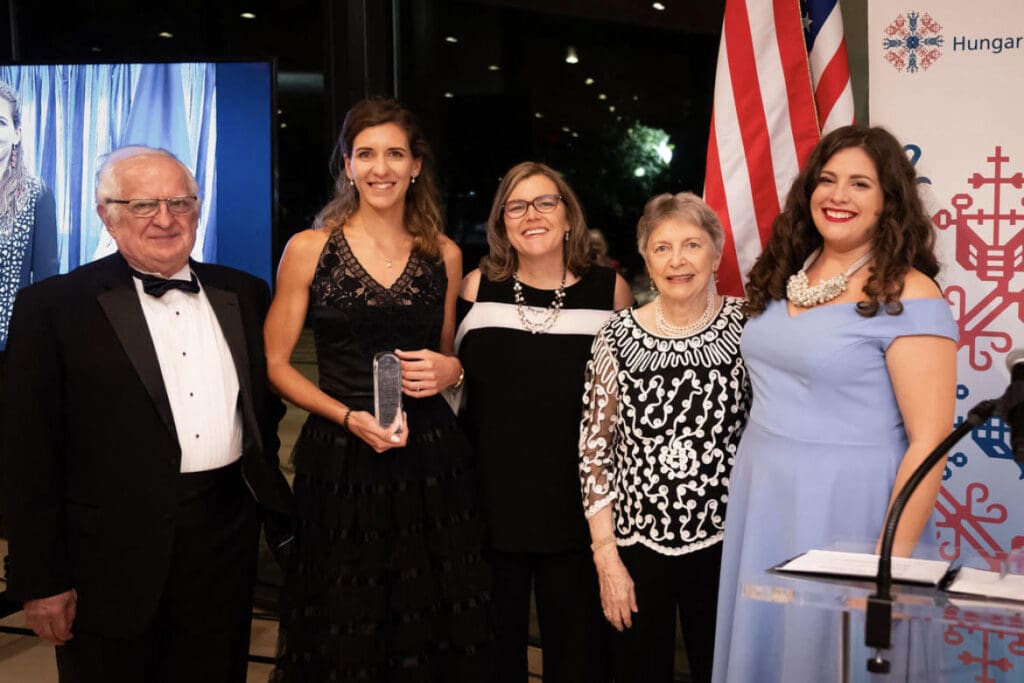
Sándor Végh moved to Washington DC in 1997 for a one-year PhD scholarship but decided to remain there. He noticed the lack of young professionals in the local Hungarian community, so he started organizing cultural and professional events for young adults, mainly for networking reasons, and set up a Hungarian language programme in the Kossuth House. After 13 years, he took a break, but became active again in the Hungarian community after the establishment of the Kossuth Foundation in 2011 and the purchase of its building by the Hungarian government in 2019. Since 2022, he has led the Foundation, working on a new strategy: turning the historical, living-in-the-past image of the Kossuth House into a forward-looking, dynamic organization, aiming to become a multi-functional community centre.

***

How did you first get into contact with the Kossuth House?

When I arrived in Washington DC in 1997, within the first few weeks, I got acquainted with the Kossuth House, owned then by the Hungarian Reformed Federation of America (HRFA), which was a fraternal organization established in 1896; one of the oldest Hungarian organizations in the US. This building was its headquarters purchased in 1985. The previous president of the organization, Rev. Imre Bertalan, who went to school with my grandfather, introduced me to the people in the Kossuth House. This beautiful building in the heart of Washington DC was essentially an office. They organized occasional meetings and celebrated the Hungarian national holidays, but not much more. When I started visiting those events, I immediately realized that those were mostly for the older generation immigrants. It was nice, but something was missing: variety and young people. I realized that we needed to organize different types of events for that generation, too: the newcomers, who did not escape from Hungary, but came by their own initiative to study, work or research.

Which means a very different reason and a quite different view on Hungarian American life, right?

Very much so. Some of them probably came just for a few years, some of them planned to stay for long. The common denominator was that they were my age group, broadly between 20 to 40 years of age. Washington DC is the centre for not only politics; there are many embassies with thousands of diplomats and their families, but also a lot of think tanks, financial and IT organizations, companies of all kinds, as well as the National Institute of Health, medical research centres, a couple of universities, some of them with a quite high profile. So, all kinds of disciplines attracted (and still do) talent here.

In 1998, I started organizing events for young professionals—we called it the Kossuth House Social Club.

We started with film screenings, exhibitions, lectures, etc. We had no funding, so we collected donations. The building itself has a beautiful and cosy conference room, but it is limited in size: maybe 40 people, so we could have a ‘full house’ quickly. Then we realized that we also needed to do more on the networking side. I think this was a change in the mindset. We did not just come together to celebrate that we are Hungarians, but used Hungarian culture that ties us together—whether it is music, folk dance, gastronomy, wine tasting, a movie, a lecture, or a round table discussion—as a vehicle for networking.

Networking with whom?

First with each other, and then with other interested parties. There are people who we call friends of Hungary: spouses, friends and partners, co-workers, and acquaintances. This is one reason why we try to do most of our events in English. Obviously, if the topic is uniquely Hungarian, for example, the commemoration of the 1848 and the 1956 Revolutions and Freedom Fights, we do it in Hungarian. But we try to be inclusive: we never showed a movie without English subtitles. In 1998, we started a Hungarian language programme for adults. We hired teachers, we paid them a modest compensation and asked for a low tuition fee. We started with three levels that quickly grew to five–six levels. And, again, we started building a community around the programme, as most of these people were somehow acquainted with Hungary. It was a beautiful period when the Hungarian community started growing.

You mentioned young professionals. Was there also a professional version of this social club?

PHOTO: Kossuth House

Yes, I eventually established a small, but formal organization called the Hungarian America Foundation (HAF) and launched its ‘Hunex’ initiative. We took advantage of being in Washington DC and worked together with the Hungarian Embassy where delegations were coming on a frequent basis. We tried to be very opportunistic: when a minister or a state secretary came to DC, we invited them to the Kossuth House for an easy, informal event and they were very glad to participate in these roundtable discussions at the end of their official visit, just to relax and connect. It was a fantastic opportunity for the young professionals—who studied and/or worked in the IT, health, or finance industries—to interface directly with the politicians and/or decision-makers in their own field.

One of our biggest series of events was the so-called Homecoming Forum that ran for about ten years.

We invited these young professionals at the embassy as well as the representatives of the Hungarian government, and later those of the European Commission and the US government,

mostly related to the field of education. It was not only a DC-centred event, but people also came from the entire East Coast, especially from the research triangle in North Carolina. The original purpose was to re-connect them with Hungary, so that Hungary could benefit from their study or work experience. However, we soon realized that most of them do not necessarily intend to move back to Hungary, so it turned out to be another networking event, where they had a chance to connect and collaborate here in the US. Nevertheless, it got a lot of attention in Hungary. We had projects which started doing job databases and networking—all kinds of ideas came out of that programme.

Why did it stop if it was so successful?

I got a full-time job at the World Bank and my daughter was born. I believe I shifted out of this at the right time as the membership of the owner organization (the HRFA) was dwindling, and from a financial perspective, it seemed to make sense for them to merge into another organization, GBU, which is an originally German Lutheran fraternal insurance organization based in Pittsburgh, Pennsylvania.

This was unfortunately the end of the long history of the HRFA as such. They did not need the Kossuth House anymore; the ownership was transferred to the newly established Kossuth Foundation in 2011. As I was out of the picture focusing on my career and family at the time, I did not have a lot of insight during those years, but I learned that there was a period of turmoil. The new leadership under the Kossuth Foundation restarted some of the previous initiatives, for example the language programme and some social and cultural events, but there was a lower level of activity in those years.

In 2019, the Hungarian government bought the building and entered a long-term lease with the Kossuth Foundation:

the latter operates the building and pays the bills by renting out a couple of rooms commercially. The government allocated some money for the restoration of the building as well for which we are grateful.

Was this the time when they approached you to come back?

Yes, I guess they remembered those 13 years I put in here. They probably realized that, by working in the World Bank, I might have some comparative advantage, so when I joined the Board, I quickly became the Treasurer. I slowly started taking over responsibility for finances, then communications; and, finally, the events, the language program,e and the library. So, in 2022 the Board voted me to be the Chair. I have been officially leading the Foundation since, having built a small team with a few, but very energetic and motivated people. All of the contributors should be mentioned, but let me single out programme manager Zsuzsanna Seres, a very dynamic organizer. She puts her heart in the Kossuth House. I only work with people in whom I see this level of pride and dedication. None of us works for money, we are volunteers, except for the caretaker, the accountant, and the language programme coordinator. I believe in small teams and want everybody to look in the same direction. I do not want divisions or conflicts. For now, it works well.

You said you dedicated this year to rebranding the entire organization. Could you share more details?

We have a new strategy already reflected in our visual branding.

We look to the future, while we honour our past and keep it in the rear-view mirror,

we strive to be a forward-looking dynamic organization. We are very conscious of what kind of events we organize, for what target groups and in what quality. We want people to see that something is happening here; it is worthwhile to come to our events and contribute. We are very lucky to have a building, a home, which belongs to every Hungarian person and organization. I started to encourage the small communities to participate in our events or use the building for theirs. We aim to become a community centre, a hub for all Hungarians and friends of Hungary.

What about your connections to the Hungarian Embassy?

We work very well together. Ambassador Szabolcs Takács and Community Diplomat for Diaspora Affairs Zsuzsanna Fekete are very supportive. They help us advertise our events, or even host them, if we need more space, as they help other organizations. In my 26 years in Washington DC, I’ve seen governments come and go. We always kept away from domestic politics and did not organize political events at the Kossuth House. Naturally, when the Hungarian government cares about the diaspora, the nation outside the borders of Hungary, that resonates with us. Obviously not with everybody, but that is fine. This is why we focus on culture as it overcomes political divisions in the community and gives a sense of belonging. As János Csák, our Minister of Culture and others said at the commemoration of 1956: ‘We were here in the last 1,100 years, and we will be here for the next 1,100’. We need to think and plan in the long run.

Let’s talk about your current programmes. Which one do you consider as the most important?

Our flagship event is the Hungarian Heritage Festival in late April.

We had two so far successfully, and we are very proud of that achievement. It is a great event for the Hungarians, but this is also a very good showcase of our culture for our American friends. It is a one-day folk culture-centred event: folk music, folk dancing, folk art, handcrafts, food and wine—all the necessary ingredients, including pálinka. We organized it just across the river where we rented a place. On the first occasion, to our very pleasant surprise, 500 people showed up; for the second event earlier this year, over 800. So obviously you can guess what our goal is for next year. This is again mainly organized by Zsuzsanna, who does a fantastic job. My duty is to clean things out of her way, so she can just shine and do it. One of the great ideas she had was to invite Hungarian food trucks, even from New Jersey. At other Hungarian events, organizers and volunteers cook and bake all day. It is a huge load of work in every aspect, and they cannot enjoy the event, because they are locked up in the kitchen for the day. For us, this is not a fundraising event, all we want is breaking even, since we need to pay the performers. Thankfully, a grant from the Bethlen Gábor Fund of the Hungarian government aimed at helping Hungarian organizations outside Hungary also helps.

What about the rest of the programmes, about which short accounts can be read on your website?

The language programme is successful: there are close to 80 students signed up in 11 different groups now. We focus on various aspects of culture from lectures to wine tasting.  For example, we celebrated the 45th anniversary of the return of the Hungarian Holy Crown to Hungary from the US. We also started collaborating with other organizations, for example, the Liszt Institute in New York. It is much easier when we don’t need to bear the full cost of bringing performers from Hungary. We hosted the screening of the Hungarian film Hadik and a subsequent discussion with Lili Bordán, who portrayed Queen Elizabeth of Prussia in it. Our next guest will be Judit Havas, reciting poems of the famous Hungarian poet Sándor Kányádi.

How can families join these typically late-evening programmes?

We focus on families. Being a father, I realized that lots of parents are unable to join evening events. I think our biggest innovation was the ‘double decker’ events. Being lucky to have a library upstairs, we organize something for the children also, while the event for adults is going on downstairs. Having KCSP interns from Hungary every year helps a lot. They are sponsored by the Kőrösi Csoma Sándor Programme funded by the Hungarian government, tasked to help Hungarian diaspora communities around the world.

What about the celebration of the historical Hungarian national holidays?

The Embassy traditionally organizes the commemoration of 23 October, we do 15 March. Traditionally, one of the main Hungarian organizations was in charge of the latter for many years, mainly the American Hungarian Federation (AHF), and when they stopped, we took it over. Another big Hungarian event is the celebration of August 20, but usually, August in Washington DC is ‘dead season’, so it is very difficult to have a big event. However, this year we joined the Bread of Hungarians programme—a great initiative started 13 years ago in Hungary, expressing the unity of the Hungarian nation and having a significant charitable role.

We baked the very first ‘Bread of Hungarian Americans’ that contained wheat from Hungary and the US,

so it was truly symbolic. When we mixed wheat grains from Hungary and the US, and the pastor of the Reformed Church blessed the bread, it was an unexpectedly powerful, moving, and even spiritual event. This has some relation to an artefact in this room, this beautiful flag behind me on the wall.

Please share its story with us.

It is a national ornamental flag made in 1902 in Hungary, as a gift from Hungarians to their brothers and sisters who immigrated to the US at the time in big numbers, so they would never forget their homeland. People put together their little donations, had the flag made and sent to the US. There was a big ceremony in Budapest, when the flag left the country in August 1902. Some 20,000 people celebrated its arrival in New York. Its original mission was to travel around the country from community to community, staying for one year with each of the Hungarian organizations.

There was an ornamental sphere on top of the flagpole containing a handful of soil from various famous parts of historical Hungary. Additionally, more than 200 prominent patriots of Hungary at the time hammered a nail—symbolizing their hearts and thoughts—into the pole. The symbolism was very powerful; its meaning was not taken lightly by either the senders, or the receivers. Unfortunately, the orb and the pole were lost at some point. The HRFA was the second organization that was the guardian of this flag. We do not know too much about its history after 1920. I assume it relates somehow to the deep disappointment and national trauma caused by the Trianon Treaty when the historical Hungarian Kingdom was dismantled at the end of WW I. The flag disappeared at some point, and I was told that it was found in somebody’s basement in the ‘60s, completely ruined. In the ‘80s, it was sent back to the National Museum in Hungary, restored, and returned to the US. However, during the renovations of the Kossuth House, it was mishandled. I found it in one of the offices crumpled up. We have started the preservation project, to make sure people know about its historical message.

PHOTO: Ildikó Antal-Ferencz/Hungarian Conservative

How do you commemorate the eponym of the building?

There is an exhibition commemorating Kossuth’s US tour in 1851–52. This is a visual chronological representation of his trip, with lithographs, paintings, news extracts—everything we could collect about his trip to the US. We recently had the whole exhibition narrated in English, so if somebody walks in here, they can just scan the QR code and listen to the narration on their smart devices. We are also planning a virtual tour of the exhibition and the building itself. I have tons of ideas about what we could do. I want to turn this building into a multi-functional centre of Hungarian culture. This building is in a very central place, thousands of people pass by every day. They look at the Hungarian flag and wonder what this place is. I want to take advantage of this central location and make sure that within ten seconds they will get an idea of what this is, what it represents. We must remember: the whole idea of aspiration for freedom is the same value that Hungary and the US share, which we need to rely on when we strengthen the image of our country and our heritage in the US.

Last question. How many Hungarians live in Washington and how many do you aim to reach?

This is a good question with very different answers; from 1,000 to 5,000. First, who do you define as Hungarian? Those with passports, or people who consider themselves of Hungarian origin. There is a long-standing local Hungarian email list with about 1,100 addresses. That means at least 1,100 families, and, of course, I do not think that every single family member signs up separately. Moreover, Washington DC is greater than the city itself. It is like New York City with its enormous suburbs, so it is very difficult to have exact numbers. We aim to reach out to all kinds of people, young people versus families, artistic-oriented people to more gastronomy-oriented ones, etc. As mentioned, we have limitations in terms of attendance, about 30-40 people can join our events in the Kossuth House in person. But these are not the same people. There are some who come to every event, but not too many; there is only a little overlap. And if we look at our social media pages, during the last six months, our reach is over 10,000 people, with over 1,100 following our Facebook page. We are putting ourselves on the map, which is enough reinforcement for me to continue doing this work in my free time.

Ildikó Antal-Ferencz

Source: hungarianconservative.com
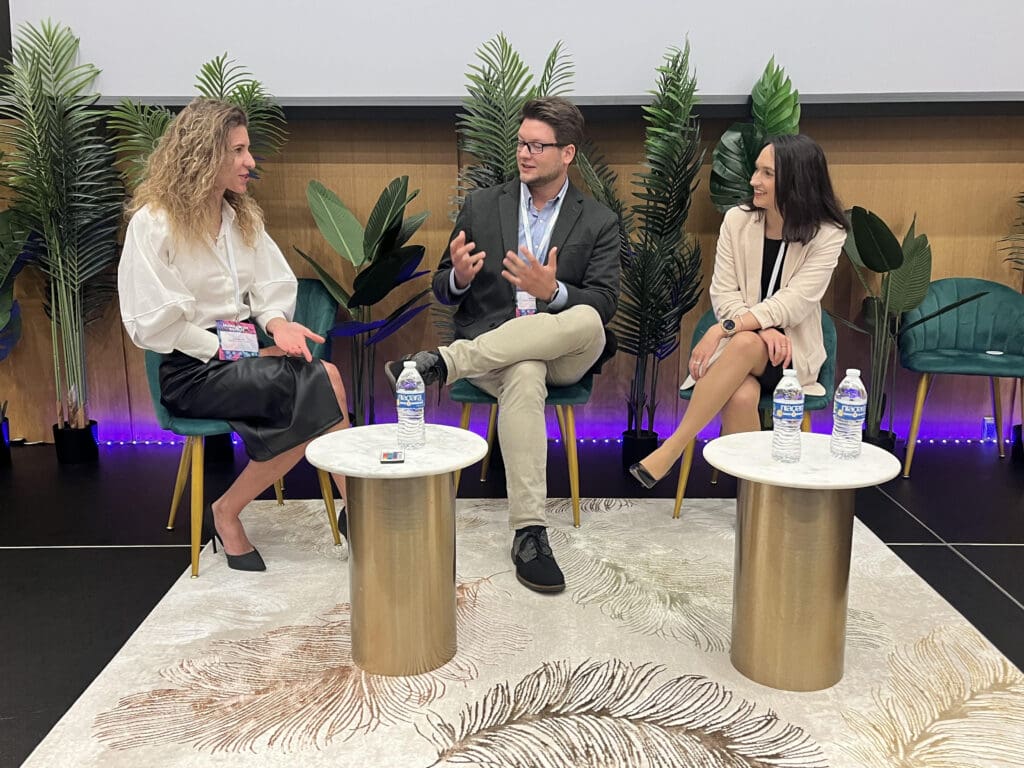
Reklám
Tas J Nadas, Esq

PM Orban: We Won Both Elections + Video

The Hungarian prime minister addressed supporters at the Fidesz-Christian Democrat (KDNP) party alliance post-elections event.

Reklám
Tas J Nadas, Esq

HAC President Andrea Lauer Rice: ‘There are only 1.3 million of us, so we have to work together—across the nation, every generation, and in both languages!’

Source: hungarianconservative.com

Growing up as the daughter of a Hungarian mother, who escaped to the US in 1956, and a successful, self-made American father, Andrea Lauer Rice had a childhood somewhat different from many in her Hungarian American generation. While she was emotionally connected to her Hungarian roots, she lived a mostly American life and spoke only ‘kitchen Hungarian’ until she moved to Hungary at the age of 22. During her six years there, she fully embraced her Hungarian heritage. Since then, she has launched several 1956-related projects to make sure that the memory and true spirit of the Revolution lives on. She also followed in her mother’s footsteps by being elected President of the Hungarian American Coalition (HAC), the largest umbrella organization in the US, with 38,000 members. She is a leader in the Atlanta, Georgia community, established the annual Atlanta Hungarian Festival and had a seminal role in the dedication of the 1956 Freedom Fighter statue in Atlanta. She also served as the US President of the Hungarian Diaspora Council for the past four years. 

***

Your mother, Edith K. Lauer, told us first-hand stories about the revolution of 1956 and the several ways she tried to keep its memory alive in her family and through her work. Tell us about your childhood; how did it feel to be raised by a Hungarian mother and an American father?

I was incredibly lucky to have two supportive parents and a very close-knit family. When I was growing up, we moved every few years due to my father’s work. We also visited Hungary every few years, to learn about our Hungarian heritage, spend time with family members and learn about our family history. I am a tremendously grateful, patriotic American as well as a proud Hungarian! I often say that I have paprika in my veins. I think all of us are richer because we experience two cultural identities at the same time. I feel like being Hungarian American is its own, unique identity — we get the best of both worlds.

The Lauer parents with their daughters and sons-in-law. PHOTO: Courtesy of Andrea Lauer Rice

You mentioned that the very first commemoration of 1956 in Hungary that you witnessed had a huge effect on you. 

I originally moved to Hungary to cover the visit of Pope John Paul II in 1990, which was a fascinating experience for a young journalist like me. I remember the crowds of people, standing for hours on end, to hear from the Pope. It was unforgettable. Around that time, I also remember vividly the first 1956 commemoration in Budapest. The largest revolutionary flag I had ever seen covered the steps of the Parliament. It brought back so many memories of stories I had heard from family members, including when my 14-year-old mother climbed on top of one of the lions by the Parliament’s steps during that huge demonstration on October 23. And there I was, at that same spot, 35+ years later in a free Hungary. I remember a grandfather and grandson sitting on the steps, as he shared his memories of 1956, tears streaming down his face… 1956 was such an incredible and unique moment in history and so few people know about it outside of Hungary. I want to make sure that people continue both commemorating and celebrating it.

Commemorating or celebrating?

This is a moment in history when Hungary did something that no one else in the world dared to do. In some ways, Hungary has never been more respected across the world, than at that moment, when they rose up against Soviet tyranny in 1956. That is why I say it is a cause to both commemorate and celebrate.

Before talking about your 1956-related projects, let us know: how do you try to pass its memory on in your family?

We try to do the same things with our boys that my parents did with my sister Kriszta and me, including traveling to Hungary every few years and teaching our family history, especially 1956. One thing that surprised me in the 90s was to discover how little young Hungarians knew about 1956. Of course, under communism, teachers were forbidden to mention 1956, but I was still shocked since it had been such an important story in my childhood. I created a survey for high school students to find out what they knew about 1956 and discovered that unless a relative had been directly involved, they knew very little. It was depressing, so I tried to come up with new, engaging ways to teach the next generation about the Revolution.

First there was a computer game and a graphic novel, right? Why did you start with these?

When I moved back to the U.S. after six years in Hungary, I founded my own company, Lauer Learning. My first project was to create a historically-accurate, role-playing computer game based on oral histories of 1956ers. FF56! was a new, memorable way to pass on these stories to the next generation. We tried to get kids interested in learning about what 56ers went through and even try to imagine themselves in the same position. We launched the game at the Sziget Festival at the House of Terror Museum exhibit area. It was great fun, but the technology of the game quickly became obsolete, so we repackaged the  graphics and script, developed them into a graphic novel about the Revolution. My boys have had their own copies of Hungarian Freedom Fighters of 1956 from the time they could look at picture books. And, we have donated the graphic novel to every school, church, library, history professor that any of us have ever known!

Your next project was the Memory Project with Réka Pigniczky.

Réka and I met when we both moved to Hungary in the early 90s. Over the years, we became close friends and started the Memory Project (MP) in 2015, in time for the 50th anniversary. Since we had to travel for the in-person interviews, we tried to minimize time spent away from our young kids, by organizing a series of interviews in one community across several days. Everyone has such vivid memories of 1956 that often the interviews became emotional, almost therapeutic. Some interviews took five to six hours. It was such an honor to be invited into people’s homes and to have people share some of their most painful memories with us. We now have 125+ interviews in the archive. Creating the Memory Project was a wonderful way to record and share these recollections with the next generation. Several documentary films have been created from the MP archive, which gives us another great opportunity to highlight these stories. This has given me a new idea, for a series of zoom interviews with Hungarian-American leaders, to collect and pass on their stories to the next generation.

There has been a 1956 statue in Atlanta since 2022. Was it your initiative?

Yes. For years, I dreamt of having a 1956 statue in Atlanta. Three years ago, we raised over $150,000 from the community, private foundations and individuals, many of them freedom fighters and their families. All donors of $1,000 or more, have their name listed on the bronze plaque. It became a wonderful community-wide project, not just in Atlanta or Georgia, but for the national Hungarian American community. The freedom fighter now stands in Millennium Gate Park, along with Martin Luther King, Jr., Jose Marti, a Cuban freedom fighter, and Cyrus the Great, among others; thus, to my delight, it has become part of a much larger peace narrative.

Andrea and members of her family posing with the Hungarian Freedom Fighter statues in 2022. PHOTO: Courtesy of Andrea Lauer Rice

Now let’s talk about the Coalition. When and how did you get involved in it?

I grew up with the Coalition. I was studying journalism at Lehigh University in Pennsylvania. Whenever students’ mothers came to visit, they took their daughters to New York to go shopping or see a play. When my mother invited me to New York, we went to demonstrate at the Romanian Consulate, against the village destruction program. It all started from there. In December 1989, I was sitting in our house, watching the Romanian Revolution on TV, and thinking: I have a journalism degree, why am I watching it on TV from thousands of miles away? So, I moved to Washington DC and worked for several months as the first intern at the HAC office. I also worked at the Hungarian Embassy, where I met Géza Entz, who offered me a job at the Hungarian Diaspora Office (Határontúli Magyarok Hivatala) for which I moved to Hungary. After six years, I moved back to the U.S., and started getting more involved as a member of the Board. I served as Vice President for many years. That was the time I started the oral history website collecting stories about 1956. I have always focused on building the community and strengthening connections. That has been a common theme in most of my work.

HAC’s original mission was to mobilize and coordinate talent and resources promoting the interest of the Hungarian American community, including providing assistance to historical Hungarian minorities in the Carpathian Basin. Has this mission changed since 1991?  

Naturally, thirty-two years later, some things have changed, but other challenges have remained the same. Certainly, the original mission included things like fostering the connection between democratic institutions—that part of the mission statement evolved. Sadly, the human rights advocacy element, which all of us had hoped would be a thing of the past, is still part of our mission. Community strengthening, which is my passion, remains central. We have some significant community challenges, including how we bring in the next generation; a generation that does not have a track record of either volunteerism or making donations. In addition, we have to find ways to reach out to second and third generation Hungarian Americans, the majority of whom do not speak Hungarian. I believe wholeheartedly in the premise of the Coalition, which is that we can accomplish much more when we work together than we ever could on our own. That is why the Coalition was founded in 1991. It was a historic moment in time, and the founders recognized the importance of having an independent, politically neutral group of people ready to roll up their sleeves and get down to work. And that has remained a constant for the Coalition from the beginning.

Andrea Lauer Rice at the 2023 HAC Gala. PHOTO: Hungarian American Coalition

Do you face challenges in this respect?

It is a consistent challenge to be seen as a neutral and independent entity; but HAC’s reputation and our advocacy efforts depend on that. As the largest umbrella organization in our community, we have to be able to work with elected officials on both sides of the Atlantic. So, we rarely make statements unless it is an issue on which there is general agreement, such as Russia’s invasion of Ukraine. We focus on impactful projects such as leadership training and scholarships, and special projects like the 1956 statue and a community-wide fundraising effort to send humanitarian assistance to Ukraine.

What was the objective of the statement you referred to?

The day after Russia invaded Ukraine, the Coalition Executive Committee issued a statement expressing our highly critical opinion of the invasion and urging support for the Hungarian minority in Ukraine. We immediately established a fundraiser, which raised $125,000. That is the power of our community. Our member organizations played an important part of the Coalition’s efforts. Our vice president, Csilla Grauzer in Minnesota, founded an award-winning project called WeCare that collects hospital supplies and sends them to organizations on the ground in Hungary, Transylvania or Ukraine. We were able to help her ship large containers of medical supplies and them where they were urgently needed. We worked with the Hungarian (Magyar) Club of Chicago to help support a member living in Bakonybél, Hungary refurbish housing to host refugee families. We worked with the Carpathian Foundation, to send an ambulance and a mobile ER Unit to Ukraine.

Do you help organizations with planning their future?

Our greatest challenges as a community are the ones that we also face at the Coalition: finding ways to engage the next generation, leadership succession and sustainability. As part of our mission, we want to help strengthen and unify our community. So, we founded a series of 10 HATOG (Hungarian Americans Together) conferences, in different cities across the country. Thanks to social media and our online community calls over the past few years, our community is better connected than ever before, but this was an important way to network ten years ago. Currently, we are working with the Hungarian Hub founded by Piros Pazaurek on the next Hungarian Summit in Daytona Beach, Florida in May 2024. HAC is helping organize the community track to focus on succession planning and how we encourage, motivate, and involve the next generation.

Andrea’s sons wearing Hungarian folk vests, posing with a historical Hungarian flag. In the top right corner of the photo, the Hungarian historical coat of arms is displayed. The caption of the picture reads: ‘For all honourable Hungarian hearts the Homeland is the holiest!’ PHOTO: Courtesy of Andrea Lauer Rice

HAC organizes White House Briefings and Mikulás Dinners each year in early December. What is the relevance of these events?

On the first Friday of December, preceding our annual Mikulás Dinner we host a briefing for our members. In the past, we have also held State Department briefings, and meetings with think tanks in Washington, DC. Over the years, we have had remarkable opportunities to interact with high-level decision makers that led to better understanding of how the U.S. government is thinking about Hungary, Romania or Ukraine, etc. It is our consistent challenge to provide context to U.S. officials to help them understand a thousand years of history that frames the Hungarian human rights issues today. In addition, we have been able to bring Hungarian leaders from Hungary and the surrounding countries to meet U.S. officials. Just a few years ago, we helped coordinate meetings with László Brenzovics, the leader of the Hungarian minority community in Ukraine. This year for our Mikulás Dinner, Hunor Kelemen, the President of the Democratic Federation of Hungarians in Romania (RMDSZ) will be our guest speaker. We are working on this year’s briefing as we speak. As we all know, presently there is a less than ideal relationship between the U.S. and the Hungarian government. Therefore, we have to find areas of agreement. For example, the question of NATO countries following the rule of law when it comes to minority rights is a topic everyone can support. Other issues that enjoy wide support are aid to Israel and humanitarian assistance for Ukraine. Once we establish agreement in some areas, we can focus on other topics.

Let us turn to our last topic: the Hungarian Diaspora Council. What is the main goal of the meetings organized in November each year?

When the Hungarian Diaspora Council was founded in 2011, it was really the first time the Hungarian government reached out in any meaningful way to Hungarian communities around the world. It was very much welcomed and people were thrilled, especially with the idea of obtaining their Hungarian citizenship. I think the original idea was to bring all the Hungarian community leaders from around the world together and give them opportunities to network with each other and to meet Hungarian governmental representatives. This year, the first regional elections were held since 2019. I chose not to run for re-election, and happily passed the baton to a new, elected US Diaspora Council president.

What were the most important achievements during your four years as President?

Connection and community! My major focus was to make sure that everybody was connected, especially during the pandemic as we tried to find our footing. We established monthly community zoom calls to share best practices, coordinate activities and work on particular areas of challenge, like how to include non-Hungarian speakers, which represents more than 1 million of our population.! I held these calls in English so that everyone could attend and can proudly say that over the past four years, we grew much closer as a community and enlarged out tent by inviting many more people into the conversation. This is a key to our success—including representatives from all areas of the Hungarian American community to find solutions to our challenges. There are only 1.3 millions of us, so we have to work together—across the nation, with every generation and in both languages! I look forward to continuing this work on behalf of the community within the framework of the Coalition.

Ildikó Antal-Ferencz

Source: hungarianconservative.com
Reklám
Tas J Nadas, Esq

‘The Hungarian revolution of 1956 became a part of me’ — An Interview with Edith K. Lauer, Chair Emerita of the Hungarian American Coalition

Source: hungarianconservative.com
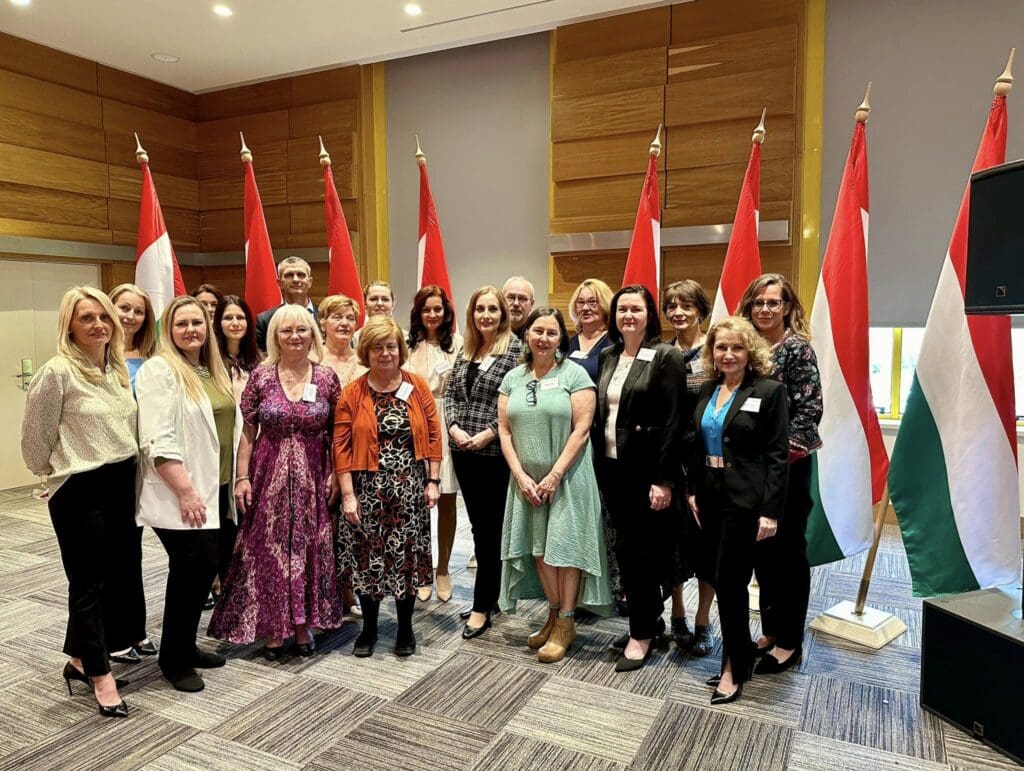
Edith K. Lauer witnessed the tumultuous events of the 1956 revolution and freedom fight as a 14-year-old from the balcony of their family home overlooking the Zsigmond Móricz Circus, one of the prominent locations of the fighting against Soviet tanks. Her entire family was involved: her mother worked at the local pharmacy dispensing medications and helping wounded freedom fighters; her father was a member of the Revolutionary Committee of the Hungarian National Bank; she, her sister Nóra and her grandfather worked side-by-side building barricades in the square as well as gathering supplies from the pharmacy to help classmates prepare Molotov cocktails. They escaped in two waves in November 1956, and after being reunited in Vienna, eventually headed for the United States 1957. In 1963, Edith married John Lauer, an American, and they started their common life in South Texas. In 1991, she was one of the founders and the first president of the Hungarian American Coalition (HAC). She currently serves as Chair Emerita of the largest umbrella organization of Hungarian Americans; at 81, she remains active in the Hungarian American community. 

***

What were your most life-changing memories of the 1956 Hungarian revolution and freedom fight?

The totally unexpected outbreak of the revolution! After leaving school on the morning of 23 October, the first day of the revolution, I never went back to the school or saw my friends and classmates again. Overnight, my entire life—and also my family’s life—changed dramatically. I was only 14, but because I was an eyewitness, I saw and understood what was happening. I spent hours with my sister lying on the balcony and looking down onto the streets, observing trucks carrying injured or dead people. And right around the corner was the pharmacy where my mother worked. She was involved from the very first moments almost around the clock. My 17-year-old sister, Nóra and I were following the events in the company of our grandparents. My father mostly spent those days at his workplace as a member of the Revolutionary Committee of the Hungarian National Bank. My mother was busy in the pharmacy treating injured freedomfighters. The last thing they wanted was to have two teenagers roaming the streets when anything could happen. So, we were strictly forbidden to leave our apartment. Of course, we did not obey.

But you did not get into trouble, did you?

No, we only helped build barricades. This was our most active participation in the events. Somebody entered our apartment building—there were dozens of apartments

in it—and started shouting that people were needed to lift the heavy cobblestones to block the street, where the tanks were expected to enter the square. On 23 October, I also participated in the demonstrations, marching from the Bem statue to the Parliament. And so did Nóra, but we were there separately. Instead of getting home from school at 4 p.m. as usual, we arrived only at 10 p.m. and to our surprise, our parents did not scold us. They were too busy trying to listen to Radio Free Europe, because obviously, the Hungarian communist radio was not disseminating any reliable information about the events of that day.

In the following days, I witnessed the  bravery, desire for freedom, the unity as well as the purity of spirit of the Revolution.

Some examples that I will never forget were the store shelves left untouched in broken shop windows, the boxes put out to collect money for the freedom fighters and the families of the victims, and farmers bringing fresh food from the countryside to Budapest. I also saw corpses of freedom fighters laid out on Móricz Zsigmond Circus and the accidental fall and horrific death of a young man who tried to tear down the red star—the hated symbol of communism—from a government building opposite our home. These images have never left me.

Barricade made from cobblestones in the street in front of the pharmacy where Edit’s mother treated wounded freedom fighters during the 1956 Revolution. PHOTO: Courtesy Edith K. Lauer

You mentioned in your Memory Project interview that the two biggest lessons of the freedom fight were that everything is possible and that it was the Hungarian revolution that revealed for the first time the true face of communism to the world.

Yes, everything seemed to be possible for 13 days. Suddenly, people were brave enough to say exactly what they thought. The free radio reported the release of political prisoners, including of Cardinal Mindszenty; and one day, an old bridge partner of my father’s who had disappeared years before knocked at our door. I remember the crowds on the street singing, and standing in line to take turns to read the free newspapers glued to the wall. Although the revolution was brutally defeated, it was ultimately successful as the first nail in the coffin of communism, because it eventually led to the fall of the communist system in 1989.

As for the second lesson, in countries like France and Italy there were active and popular Communist parties in the ’50s, but

their view of communism was based on Soviet propaganda, until the Hungarian revolution revealed that it was an oppressive dictatorship.

When hundreds of thousands of ecstatic people marched on the streets, sang the same patriotic songs, chanted ‘Russians, go home!’ and loudly expressed their shared hatred for the communist system, even former sympathizers had to believe them. The Hungarian revolution was the fiercest and most violent expression of opposition within the Soviet block. There were so many people deeply affected even outside Hungary. Let me mention just one: an American student in Paris, Lee Edwards, joined the demonstrations organized on behalf of the Hungarian uprising; similar demonstrations were held in other Western capitals as well. He later became the founder of the Victims of Communism Memorial Foundation (VOCMF) in Washington, DC. He is 90 years old now and I have the privilege of calling him a dear friend, and together we serve on the board of VOCMF. That is a motivation I admire: only hearing about the Hungarian revolution led him to a lifelong commitment to helping reveal and fight the evils of communism.

Do you think the world paid any (or enough) attention to the revolution at that time? The United States failed to help the freedom fighters.

I was always curious about that, so once the material became available, I researched that very question in preparation for a 1956 commemorative speech I gave in Cleveland. I think if the revolution had taken place in one of the subsequent decades, maybe the decision would have been different. But at that time President Eisenhower was at the end of his re-election campaign: the presidential election took place that year on 6 November. John Foster Dulles, then Secretary of State, advised Eisenhower that it was simply too costly to intervene. Accordingly, he sent a message to Khrushchev, the Soviet dictator at that time, stating that the US had no intention of intervening in the Soviet sphere of influence, which included Hungary. This meant that the Soviet Union did not need to worry about any US threat if they crushed the Hungarian revolution.

Your parents’ decision to leave Hungary must have been very hard as they loved their homeland very much. Do you have any personal memories related to their decision?

In those days children were to be seen, but not heard! But, at the same time we were aware of the discussions in our own family and saw many relatives who came to our apartment to say goodbye before their own escape to the West. My father’s brother and his family came first. My mother’s half-sister with three small children were next. Ultimately, all of them ended up in the Washington, DC area, where we lived close to each other for many years. At this time, we were living in the same apartment with my grandparents, who said all along that they were too old for such a journey and would never leave. Can you imagine that? Their two daughters and five grandchildren were about to emigrate and they really had no way of knowing if they would ever see them again or if their beloved family members would be successful in their escape to the West.

After getting married and moving to Texas you had a 100 per cent American life. Did you like it?

Yes. I was very excited about living an American life. I was extremely proud when people said they had no idea that I was a foreigner, because I had no discernible accent. What I did not like were the frequent moves—New York, Connecticut, Belgium, Kentucky, Texas, New Jersey, Ohio—as John advanced professionally. The moves required that we pack up the house, move across the country, set up another house, find schools for the girls, make a new set of friends and become active in a new community. It wasn’t easy, but looking back now, I learned so much in the process and grew stronger and more independent.

HAC Gala Honouring Charles Simonyi in 2006: Zsolt Szekeres, Max Teleki, Charles Simonyi, Edith K. Lauer and György Habsburg (L-R). PHOTO: Courtesy Edith K. Lauer

Years later, I heard about a young man, László Hámos, and his organization, the Hungarian Human Rights Foundation (HHRF), whose mission was to call the attention of US policymakers to the plight of Hungarians living as minorities in the region. This was our first involvement in the Hungarian American community. Until that time, I had volunteered for many American organizations and over the years, I learned how to establish and run a non-profit organization, to set up a board of directors, committees, etc. Although I didn’t realize it, that was my training process, which later was put to good use in the Hungarian American community.

You still managed to maintain your dual identity so well that you now feel at home in both countries. You became the first president of HAC and got involved (with your daughter, Andrea) in several other 1956-related projects. What happened in the meantime?

History happened in the meantime: 1989 to be exact, when communism unexpectedly collapsed in Hungary and across the region, and that’s when I became involved in the fundraiser for HHRF. Let me backtrack and talk a little bit about our family. At home we spoke English, but both of our girls knew ‘kitchen Hungarian,’ and we travelled to Hungary every two years or so to get them familiar with their heritage and meet their relatives. In 1990, Andrea graduated from Lehigh University with a degree in journalism, and decided to move to Hungary. This was a heady time: the wall came down and democracy would soon return to Hungary. She lived there for nearly six years, worked hard at learning Hungarian, discovered her love for Hungary and her 56er roots.

While being a proud American, I have always remained very proud of my Hungarian identity.

My family, especially my grandfather, definitely played a big role in this. He was a brilliant man from the famous Kozma family: which included actors, poets, a president of the Hungarian Radio, and others. He was highly educated in history and literature. When we were children, he often told us stories about how Hungarians prevailed even in the worst of times. He regaled us with examples of how talented Hungarians are, how many have won Nobel Prizes. Even after the devastation of WWI, WWII and 40 years of communism, Hungarian accomplishments in the fields of art, science and sports have been remarkable. He also recited Shakespearean poems in Hungarian and of course, lots of Hungarian poems, too. No wonder I ended up majoring in literature; he indirectly pushed me in that direction. Because of his pride in being Hungarian, I never had the feeling of ‘a poor little country, oppressed by the big Soviet Union that could not fight for itself.’

You also said in the interview that in the US you see the world through a Hungarian lens, while in Hungary you see it through an American lens. Can you give us some examples? 

While establishing the Coalition in the early 1990s, I often tried to look at issues through the ‘other lens’. If something works in the US, why not try it in Hungary? And if it works in Hungary, why not try it in the US? There are a few examples of this. One of the first major projects of the Coalition was advocating for NATO expansion to include Hungary. One of the important steps in this process was to hold American-style town hall meetings in several Hungarian cities to acquaint Hungarian voters with the advantages and responsibilities of NATO membership. Afterwards, Hungarian voters overwhelmingly supported NATO membership. We also organized customized programs that brought a group of Hungarian mayors and later, secondary school directors to the US to observe the best practices of their American counterparts and share their own experiences.

NATO Conference in 1997: Foreign Minister Ferenc Somogyi, President Árpád Göncz and Edith K. Lauer (L-R). PHOTO: Courtesy Edith K. Lauer

And thus your dual identity and thinking enriched not only you but also your environment.

Exactly. We always had a large circle of friends in the various places where we lived. And quite often I would take friends to Hungary; Americans who would have never gone there on their own. I tried to show them the Hungary I knew. I took them to the Parliament, not only for a tour, but also for special lectures or programmes. We also took a few of them to Transylvania, which was an unbelievable experience. On one memorable visit, John, Andrea and I inadvertently found ourselves in Kolozsvár (Cluj-Napoca. Romania) when a demonstration broke out protesting the limitation of Hungarian language instruction in Hungarian schools. Of course, Andrea and I wanted to stay, but John, as the president of a large US company, had been urged to travel to Romania only with bodyguards. He had declined. When he mentioned this to the late Bishop Kálmán Csiha who we have became good friends with, his response was: ‘My dear John, you must not worry, you have the best possible bodyguard: God!’

Was this enough for him?

Yes! He was always very supportive and loved our many subsequent trips to Transylvania. He understood and supported another major campaign: when we tried to clarify the ownership of the Kolozsvár Collegium, which was founded 450 years ago, but the Romanian authorities refused to return it to its rightful Hungarian owners. Fortunately, I was able to develop a good relationship with an official in the US Embassy in Bucharest and kept sending him pictures and information about the continued harassment the displaced Hungarian students were having to endure. ‘How is this possible in a supposed democracy? How would you feel if your child faced this situation?’, I asked him. He advised me that this might be a good time to inform Romanian President Iliescu about these legal challenges. I managed to get the President’s direct fax number and in a period of 48 hours, we flooded him with 30-40 letters written by Hungarian Americans demanding the return of the Collegium building to its rightful owner, the Hungarian Reformed Church. To our delight, during the Christmas holiday in 2002, the school head, Árpád Székely, received a notice stating that the Collegium building could be reopened as a Hungarian school in January.

Reformed Church Bishop László Tőkés (L), Edith K. Lauer and Árpád Székely. PHOTO: Edith K. Lauer

Turning to your Coalition, please tell the short story of the foundation to our readers. How did it start?

I often say that the stars were aligned! Just after I had met and worked with so many community leaders, we had a historic opportunity to build important bridges between our two countries. A small group of Washington area Hungarian Americans got together to discuss how best to help Hungary benefit from US programmes and scholarships established to aid post-Communist countries. At that time, there was no viable Hungarian American organization to take on this important role. So, 15 organizations and five individuals, myself included, formed the Hungarian American Coalition, based on the philosophy that we could accomplish more if we all worked together than we ever could on our own. To my surprise, I was elected to be the first president and would go on to serve for the next 12 years.

Andrea is now the President and you are Chair Emerita of HAC. Are you still active?

Andrea has served as President since the end of 2016. She has all the talents she needs: she is a wonderful organizer, speaker, a talented journalist and an unbelievably hard worker. I am extremely proud of her. One big difference between the two of us is that I started my work after our children had grown up, while she is very active while being the mother of two young boys.

I remain active in HAC, but more as an advisor in the background.

I am actively involved on the Boards of the VOCMF and in the Hungary Foundation, a major supporter of Coalition projects. One area where I try to provide guidance to all of these organizations is fundraising. An important rule that I follow is that if you ask someone for money, but you have not given any, it is very easy for the other to say no. When I ask people for support, I first tell them of my own contribution and ask them to follow my example. I think that comes across, which is why I am a pretty successful fundraiser. Since the beginning of HAC, we have had to raise the funds for every project we undertake, but we plan to start an endowment this year that will assist us in our long-term planning.

Ildikó Antal-Ferencz

Source: hungarianconservative.com
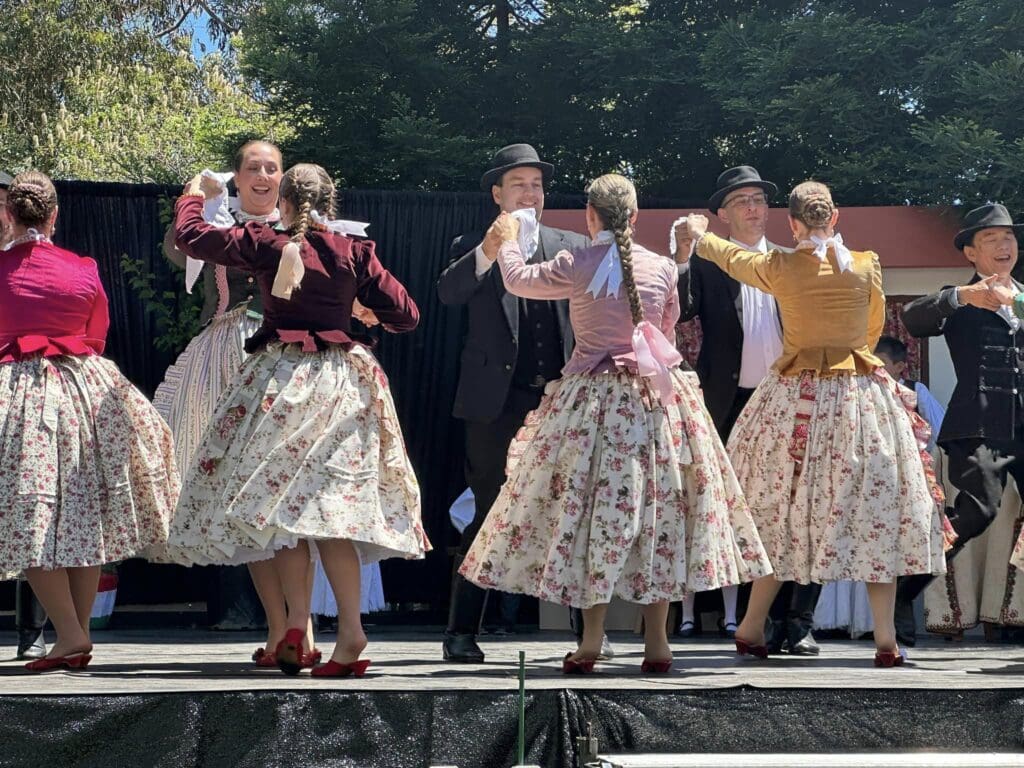
Reklám
Tas J Nadas, Esq

Trump: Viktor Orban Wants to See No Wars, I Don’t Want to See Wars

Palm Beach, 2024. március 8. A Miniszterelnöki Sajtóiroda által közreadott képen Orbán Viktor kormányfõ (b) és Donald Trump korábbi amerikai elnök, republikánus elnökjelölt tárgyalásuk elõtt Trump floridai rezidenciáján, Mar-a-Lagóban 2024. március 8-án. MTI/Miniszterelnöki Sajtóiroda/Fischer Zoltán

“If you look at Viktor Orban, he wants to see no wars, and I don’t want to see wars,” Donald Trump told Timcast in an interview. Miklos Szantho, head of the Center for Fundamental Rights in Budapest, published the interview on Facebook on Tuesday.

Reklám
Tas J Nadas, Esq

Hungary Refuses to Participate in Another European Suicide Attempt

“The time has come to say: Hungary will never again be a victim of the interests of any foreign power, and will not participate in another European suicide attempt, i.e. in a European war,” said the speaker of the National Assembly at a commemoration ceremony held on Thursday in Batonyterenye to mark the anniversary of the Battle of Kisterenye.

Reklám
Tas J Nadas, Esq

President Sulyok To Visit Beijing on Invitation of Chinese President

President of Hungary, Tamas Sulyok (r) receives Chinese President Xi Jinping in the Blue Salon of the presidential Sandor Palace on May 9, 2024 (Photo: MTI/Noemi Bruzak)

“Hungary is the bridge between East and West,” Hungarian President Sulyok said, emphasizing the importance of Hungary-China ties.

Reklám
Tas J Nadas, Esq

Keep an Eye on America — The American Launch of The Genius of America by Hungarian Minister of Culture and Innovation János Csák

Source: hungarianconservative.com
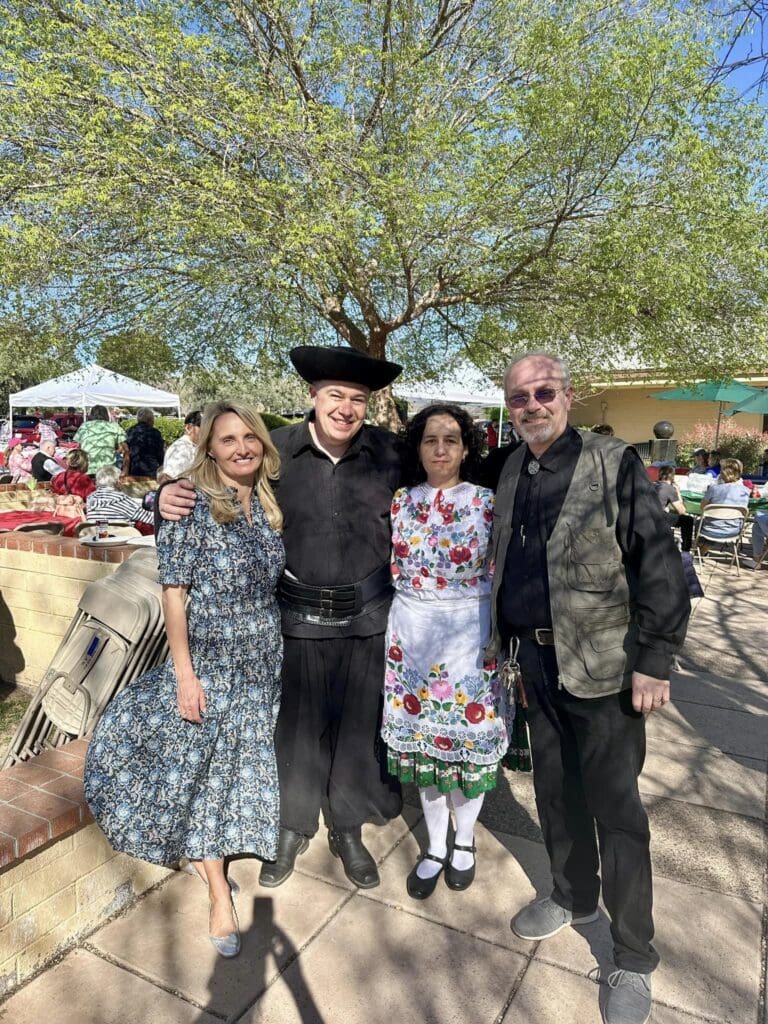
Hungarian Minister of Culture and Innovation János Csák was welcomed in New York for the recent American launch of his book The Genius of America published by Angelico Press. The panel discussion of the event was organized by the New York Liszt Institute and was hosted by the publisher’s director John Riess. Panelists included the author himself, leading U.S. geopolitical analyst George Friedman and economic strategist and deputy editor of Asia Times David P. Goldman.

The director of Angelico Press opened the event by confessing that when he had started Angelico Press twelve years ago, he hadn’t anticipated the myriad directions their publishing activities would take. For example, he had never imagined that they’d publish a worldwide bestseller In Sinu Jesu translated into a dozen languages or works by distinguished theologians as David Bentley Hart and John Milbank; works of short stories, science and religion, Russian philosophy, law and jurisprudence, even new collections of poetry. Thus, he quickly learned ‘to expect the unexpected’ in terms of submissions, which was also the case when he received an email from Gladden Pappin about a book by current Hungarian Minister of Culture and Innovation János Csák. ‘I read through the book and was immediately struck by the fresh articulation of some of the ideas and ideals that comprise our grand experiment in the order of liberty, as Richard John Neuhaus used to like to call it. And I quickly said yes to publication’, he explained.

Mr. Riess continued with praising the author: ‘Working with many, many authors over the past 25 years, I have learned that one can never quite anticipate how things might go in meeting an author, sometimes a strange and unusual breed.

Meeting János, however, felt like meeting an old friend.

What immediately came across to me was an old-world intelligence and integrity, but also, a directness of familiarity and ease, a lack of pretense that seemed to be very American.’ He also illustrated his point by quoting from John Lukács, who emigrated to the U.S. from Hungary at the end of World War II, and who was fond of saying: ‘Hungary is my mother, but America is my wife’. Mr. Riess believes that Mr. Csák ‘also relates a bit to that sentiment as he has deep roots in his own country, but has also a genuine love and admiration for this country as well. And that love and admiration comes across biblically in his book.’

What the publisher seemed to appreciate the most is the author’s complex viewpoint when analyzing America. ‘One of the painful effects of the compartmentalization of our multitude of disciplinary domains is the articulation of single causes to explain events. Scientists too frequently get very partial and narrow monocausal explanations. Similarly, they too often attempt to reduce a country’s history to a single strand drawn from either its successes or its failures, its strengths or its weaknesses. Many times, it takes someone from outside the country to paint a more holistic picture’, he concluded; adding that The Genius of America is now part of that great tradition of the outside observers as diverse as Tocqueville, Frances Trollope, Charles Dickens, G.K. Chesterton, and many others. He stated that the book is much more than an extended political essay; it’s about certain ideas and ideals that found a unique political expression in America, and above all, it’s a reminder that Americans have had and still have their ‘flaws and weaknesses, but unlike what many students have been taught in recent years, the warped and simplistic view of America needs to really be expunged from our thinking once and for all’, since every nation’s history is tightly wound by ‘strands of good and evil’, especially in the ‘dynamo that is America’.

Finally, Mr. Riess expressed his hope that many American readers would find in this book a fresh take on their country. ‘We’re always being exhorted to have an honest conversation about the issues of race or gender or privilege. So, let’s also have one about the country itself, what it meant to our ancestors and what it might still mean to us. Read The Genius of America, comment, argue, discuss, contend, debate. That is, at least I hope, still the American way.’ On behalf of the publishing company, he thanked Mr. Csák and all his colleagues for ‘continuing a lovely relationship between Hungary and America; one that I truly hope will deepen in the years ahead’.

John Riess, János Csák, and director of the New York Liszt Institute Csenge Palotai PHOTO: New York Liszt Institute

Mr. Csák recalled being a young boy dreaming about America, which, during the communist regime, seemed impossible to visit, especially since some of his relatives fled Hungary in 1956, after the revolution and freedom fight was suppressed by the occupying Soviet forces. When he could finally visit the U.S. for the first time, everything he had read about America seemed to be true, and he fell in love with the country. He revealed that the origin of his book dates to 2020, when his friend George Friedman published The Storm Before the Calm. When he read that book, he started to write a foreword to it, continuing in writing his previous verbal discussions with Mr. Friedman, which then grew to become an essay and later a whole book. He explained that when he had started writing, he had gone back to the original ancient questions by Plato: What is a good life? How should we live? He realized that the founding fathers of the U.S. tried to answer that question with ‘independence, life, liberty and pursuit of happiness’, and that ‘they were brave and smart enough to convince the contemporaries that it makes sense to offer a new solution, a new organizational structure, the American experiment of ordered liberty’. He then started digging for the roots of those ideas (stemming from antiquity—Jerusalem, Athens, Rome—and the Enlightenment of the 18th century) and how they could translate into a sustainable organization of a huge country.

While he was told that he should have gone deeper into contemporary issues, he only did that to a certain extent in the epilogue. ‘It’s not a prediction, it’s not strategizing, it’s just thinking about what could happen’, he explained, adding that he is very happy that it was published in English half a year before the upcoming U.S. elections, so people could read it ‘with a peaceful mind before everything gets crazy, controversial, and really aggressive’. He also claimed that what made the Western world successful is the possibility of arguing and accepting disagreement. ‘I would be the happiest if this book would be indeed discussed, debated, argued because no one can claim that he or she knows America. America is an ever-changing entity.’

Leading U.S. geopolitical analyst George Friedman first shared with the audience that his father was a Hungarian fighting in the Hungarian army and from the refugee camp he wanted to go nowhere else but to America, to a country which could not be invaded and could not invade other people. ‘After the war it was a simple dream to go to a place which is safe. Not just, not moral, but safe. And to understand why this is America, we have to understand that it is an invented country, invented literally by men creating a constitution, a political order, a republic out of nothing’, stated Mr. Friedman. He repeatedly pointed out that

the U.S. is an inventive country and Americans are constantly reinventing themselves and their ways.

‘The rest of the world constantly thinks that America will collapse, because we say unsayable things to each other, we distrust each other profoundly and we engage in criminal actions so we clearly are going to collapse, but in each circle, we reinvent ourselves’, he said.

Mr. Friedman believes that the genius of America is reinvention as a norm, and it was built in the Constitution which itself was not intended to be permanent, since there are rules about how to change it. ‘When you consider that the U.S. is mobile, changeable, transformable, you understand why it survives things other countries can’t. We can survive the most delicate racial issues and the most brutal political issues. If you leave and come back after ten years, you do not recognize the U.S.: all arguments are different. Heated in the same way, but never the same. This is the country which doesn’t do the changes peacefully, gently. I do not know of any other nation that has the ability to transform itself. This nation survived the Civil War and became the largest producer of goods.’ He considers that one of the great features of America is to always feel that everything is lost, the world is horrible, the President will destroy the nation next week; but this is not reality; reality is that every time Americans invent something, they invent a solution to something. That’s the American process that most other countries don’t have, he concluded.

George Friedman, John Riess, and János Csák PHOTO: Ildikó Antal-Ferencz

American economic strategist David P. Goldman stated that he had the fortune to review a dozen or so books a year and virtually everything that came into his hands could be summarized on a dozen index cards. He found János Csák’s book exactly the opposite: a short one which takes longer to read than many voluminous books because every sentence must be read carefully and the chain of reasoning must be followed. He believes America is a massive contradiction, and to begin to understand it, one must work through these contradictions. ‘You can’t simply say America’s this, America’s that. We don’t make sense even to ourselves.

To have a distinguished thinker like János Csák explaining this to us is enormously valuable.’

He confessed that he was one of the original signers of the call for the National Conservative movement, which hosted the Hungarian Prime Minister at its most recent conference in Brussels, Belgium. A close friend of his, the editor of the Claremont Review of Books (a publication of the Claremont Institute, of which Mr. Goldman is a fellow), recently attacked him claiming: ‘We are logically inconsistent. We are different from other countries. We have a founding, we have a constitution, we have a philosophy behind it. Why do you have to mix in European nationalism and these other strange phenomena?’ Mr. Goldman felt a bit embarrassed because his friend was completely right in what he said. ‘If János’s book had been out, I would have said: just read this book and it’ll explain it to you.’ But instead, he answered: ‘We have two foundings. We have the religious, spiritual founding vision of the city on the hill and we’ve got the city on the Earth. And these two will never meet. The heavenly city is a point of perspective at the horizon which we look towards, but without its visionwhich we can’t realize in our ordinary practice in the marketplace in the cut and thrust of politics, the invisible hand grows palsied and loses its strength.’

He considers that the brilliance of János Csák’s book is to lay out these contradictions and confront the Americans with them and make clear that although they are ‘unusual, self-invented people, we have an inherent propensity towards not just complacency, but to confuse our interests with the right, the moral, and the good, which are not quite the same’, since there are a lot of things that governments and states have to do which are difficult and not ideal or good. He explained that Mr. Csák compasses this in his discussion of manifest destiny—which is the core of the book—, and contrast that with Abraham Lincoln, who himself is ‘our great contradiction, because nothing in America prior to Lincoln’s presidency would predict that we would have a politician of a character of Lincoln to hold us up to a mirror and demand that we submit ourselves to define judgment and not just the judgment of our own self-interest.’

Mr. Goldman reminded us that the Americans in their own political discourse have an unfortunate tendency to either praise or damn themselves. ‘We have the woke, Hegelian, Neo-Marxist, Frankfurt School left that says everything that came before you was misogynist, homophobic, racist and all other bad things, so we’re now going to create the first perfect clean society stripped of all these terrible things. And there are the defenders of America who never want to apologize for every dumb thing Americans have ever done, including the extermination of (native) Americans—which is a theme of great importance in this book—, and of course, slavery.’

The Genius of America at the New York Liszt Institute PHOTO: New York Liszt Institute

Finally, he called our attention to George Friedman’s epilogue to the book and his citation of the American national anthem. He reminded us that it very unusually ends with a special kind of question which could also be interpreted as: Are we still fit to be Americans? Are we still brave? Are we still free? Mr. Goldman said that János Csák’s work holds us up to the same question that the anthem does, by putting these contradictions ‘in such clear language and so expressively’ and expressed his hope that ‘it will be a great use to us in stepping outside of the way we usually look at ourselves and understand ourselves better and around the world help the world understand us.’

Ildikó Antal-Ferencz

Source: hungarianconservative.com

Reklám
Tas J Nadas, Esq

‘It Would Be a Sin to Do Nothing Even If We Cannot Do Everything’

Source: hungarianconservative.com
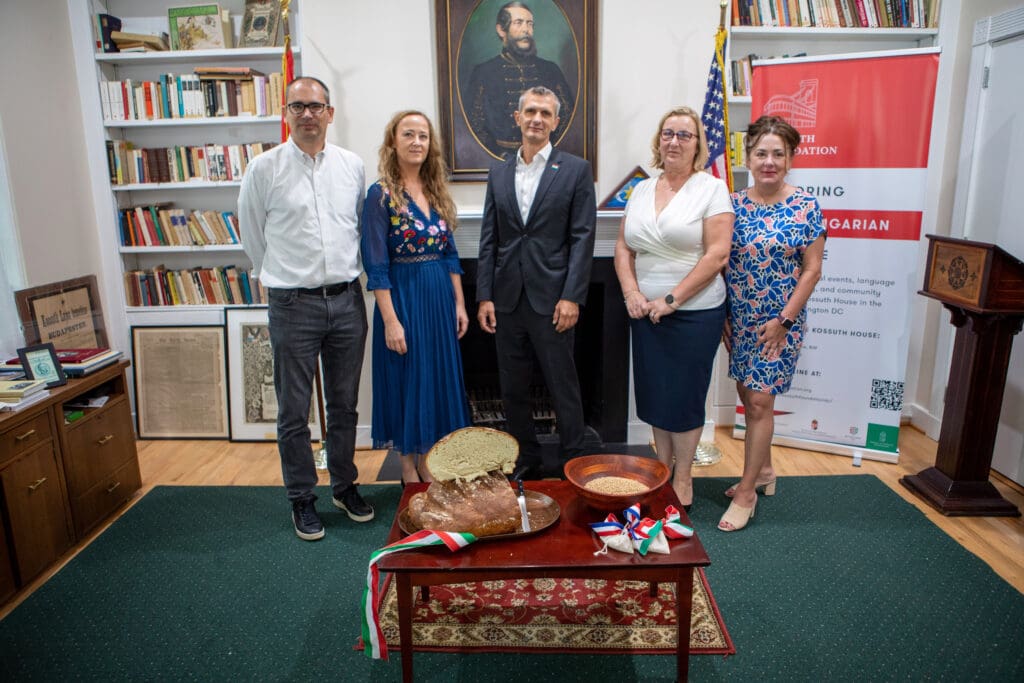
A Snapshot of the Hungarian Diaspora in North America

Our family moved from Budapest to the United States (New Jersey) in the summer of 2022. We immediately enrolled our three children in the Hungarian Scouts in Garfield, as well as the Montclair Hungarian Weekend School, and became involved in the life of the Hungarian St. Stephen Roman Catholic Church in Passaic. Later, we also got to know the Hungarian community in New Brunswick and occasionally attended Hungarian events across New York, Cleveland (Ohio), Washington DC, and some other states, as well as in Canada, so I explored quite a few Hungarian communities. The present article is a summary of the varied and in many ways enlightening picture that I have formed on the basis of a series of interviews with members of the Hungarian diaspora in North America, as well as reports on various Hungarian diaspora events.

In the course of our active family life and my enthusiastic journalistic work, I have had the opportunity to meet many Hungarian Americans during the last year and a half. I have written nearly a hundred articles about their past, particularly in relation to major historical events of the last century (the Second World War and 1956), which often turned out to be as interesting as an adventure novel or a heart-breaking drama. I have also written about the present; about the joys and difficulties of everyday lives, burdened with the additional challenges of diaspora life, as well as about the preservation and transmission of Hungarian spiritual and cultural heritage. I believe that by doing so I managed to develop a comprehensive understanding of current prospects and perhaps the likely future of the Hungarian diaspora in North America—for now, mainly on the East Coast.

My interviewees include former or current leaders and representatives of various Hungarian churches and civic associations, including Hungarian scout troops, weekend schools and school camps, traditional folk dance groups and folk music bands, local clubs, and national associations. These Hungarians are heavily committed to local and national Hungarian community life, and while they are not necessarily well-known or ‘famous’, often being known only locally, they are trying to pass on their faith and their Hungarian language and culture not only to their own children, but also at the community level. Out of these interviews, thirty-seven were selected in the first part of the interview book Magyarnak lenni Amerikában,2 (To Be Hungarian in America), published by Radio Bocskai of Cleveland (Ohio). I have also made several reports on various Hungarian diaspora events (first communions, organizational anniversaries, Hungarian festivals, film screenings, book reviews, etc.), and on various American and/or Hungarian holidays (Christmas, Easter, Mother’s and Father’s Day, Halloween, Thanksgiving, Valentine’s Day, etc.).

‘The most important keystones for the survival of this community are the perseverance and exemplary involvement of the committed Hungarian Americans’

There are one and a half million people of reported Hungarian descent living in North America. Based on my personal experiences and interviews with members of the Hungarian American diaspora, it appears that the most important keystones for the survival of this community are the perseverance and exemplary involvement of the committed Hungarian Americans, the preservation and cultivation of the Hungarian language, culture, and traditions, both at the family and community level, and the close cooperation between Hungarian religious and civic organizations. This may sound straightforward or even simple, but in fact it is very complex and difficult, given that the old ‘Hungarian quarters’—city neighbourhoods inhabited by mostly Hungarians who arrived with various immigration waves at the turn of the nineteenth and twentieth centuries, after the Second World War, and after 1956—have largely disappeared. Only a much smaller number of economic migrants have arrived in recent decades. As such, Hungarians do not currently live in large aggregations, and their attitude towards the preservation and generational transmission of Hungarian identity, language, and culture has significantly changed.

Families

When you move abroad, either of necessity or at your own initiative, the inevitable clash between the host and home cultures raises questions about the future of your mother tongue, culture of origin, and national identity. In a foreign language environment, the use of the mother tongue is not obvious, nor is the development and preservation of the original identity. School-age Hungarian children spend much more time in different educational institutions and with their American friends than with their parents, who typically work long hours.

As Beáta Krasznai3—a psychologist and teacher who has lived in the United States for more than twenty years—explained to me, from a linguistic perspective, the role of the primary caregiver, that is the person who spends the most time with the child (which is usually, but not always, the mother) is of paramount importance. Sometimes the parent speaks good Hungarian, but often switches to English for various reasons (mixed marriage, convenience, conformity, etc.), which is understandable but not useful for language acquisition purposes. Linguistically, of course, one of the biggest challenges is mixed marriage, where English is often used as a compromise. However, there are also many positive examples of parents who do not feel excluded from the family if their partner speaks to their child in his or her mother tongue, and the child thus learns two or three languages at home. At the same time, there are many other (financial, health) pressures on families, which mean that language may not necessarily be the most important factor for them, or which may render Hungarian or multilingual family life unfeasible. In short, a lot depends on the attitude of the parents, the strength of their relationship, and the quality of communication within the family.

Hungarian American children wearing folk costumes pose outside the Hungarian House in New York. PHOTO: Courtesy Arany János Hungarian School, New York

When it comes to language learning, I could go on at length about the misconceptions that still exist today, shared with me by Hungarian school teachers and principals, despite the well-known fact that once in an educational institution and community, every child learns English ‘on their own’ within a few months. So the primary task of Hungarian parents is (or should be) to cultivate and teach the Hungarian language and Hungarian culture at home. Of course, the issue of culture is closely related to language: Hungarian weekend schools try to teach basic Hungarian history, geography, folk songs, and common folk traditions, etc., but they cannot do wonders in the space of two to four hours per week, while American public schools give only minimal grounding in non-American subjects. Therefore, in order for this knowledge (hopefully) established at home and taught in weekend Hungarian schools to be retained and incorporated, the active involvement of parents is key. This is not necessarily easy even in a Hungarian environment back in Hungary, let alone in North America, where parents and children are ‘burdened’ by a multilingual environment, vast physical distances and intensive workload, and typically looser family ties. Also, Hungarian families usually do not have grandparents living anywhere close. They are generally not part of the families’ everyday lives and are therefore replaced by friends and communities, whose role is even more valued in a foreign environment.

‘In a foreign language environment, the use of the mother tongue is not obvious, nor is the development and preservation of the original identity’

Hungarian identity and its defining elements are an even more complex topic. The typical cultural elements that can be kept in a foreign environment are the major religious and calendar holidays and family customs (weddings, baptisms, name days, birthdays, etc.). In mixed families, these are obviously also mixed. Family meals and dishes are also the most enduring expressions of national identity, even if the family no longer speaks Hungarian or cultivates the culture of their ancestors. On this basis, gastronomy is considered by many to be an important means of preserving Hungarian culture, while others see it as only a partial or substitute solution. In any case, the attitude of the various waves of immigrants towards Hungarian language and culture has never been uniform. Those who came to America as adults are more likely to continue to feel one hundred per cent Hungarian. Their American-born children, on the other hand, may be comfortable in both cultures, and therefore feel one hundred per cent Hungarian and one hundred per cent American at the same time. The third generation will most probably be more American than Hungarian. Moreover, these ratios can change not only between generations, but even within a person’s life. For example, in teenage years, peers and the community are the most important aspects for children, and to balance these impacts, parents should constantly try to reaffirm their children’s Hungarian identity, by taking or sending them to Hungary to visit relatives, to study, or to work.

Parents in the diaspora have a lot of extra responsibilities, even at the family level. At the same time, diaspora life may also offer many additional gifts: by passing on Hungarian language and culture to their children, parents not only strengthen their children’s Hungarian identity, but also the parent–child relationship, since children who know their parents’ language and culture understand them better. Moreover, dual identity, when it works well, means double enrichment, both spiritually and culturally.

Communities

In a foreign environment, especially in the absence of grandparents and relatives, the role of the community is enhanced, both in terms of Hungarian language and culture, as well as faith and religion. Without a community, it is difficult or impossible to preserve the Hungarian cultural heritage and faith. This challenge certainly puts an additional burden on parents’ shoulders, not only because of the potentially long driving distances to and from community organizations and events, but also because Hungarian community events (such as mass/church services, school, scouting, folk dancing, etc.) are concentrated on weekends, usually on both Saturdays and Sundays, every weekend. This often creates difficult choices and conflicts between Hungarian friends and community programmes, as well as American sports and American friends. Living and passing on Hungarian language, culture, and identity in diaspora life is therefore always a matter of very conscious parental choices and persistence, which in the case of adolescent children creates new conflicts within the family, in addition to the parental challenges that already exist at that age. This is why Tamás Marshall4—the youth leader of St Stephen’s Roman Catholic Magyar Church in Passaic, New Jersey—says that the fight for faith and Hungarian heritage should not be against, but together with, the children. The big question is: how?

Among Hungarian organizations, churches still play a prominent, albeit steadily decreasing role. Hungarian immigrants arriving at the turn of the nineteenth and twentieth centuries or later often built churches even before they had houses of their own. They usually ran Hungarian weekend schools alongside or as part of their churches and set up community halls and kitchens where they could hold regular community events—and still do today where churches still exist. They remain the driving force behind many Hungarian communities to this day, despite the fact that over the past few decades, several churches have closed and several Hungarian communities have ceased to exist, while the number of churchgoers attending the existing churches fluctuates and typically declines.

It is also a big challenge to secure Hungarian priests/clerics, typically from Hungary, where there is also a shortage. Moreover, in the diaspora there is often a need for priests who can also run cultural institutions. Toronto parish priest Tamás Forrai5 told me that they needed to be not only church leaders, but also cultural directors. Yet despite this, or perhaps because of it, churches still perhaps provide the most effective means of ensuring cohesion between the various civic organizations, encouraging effective cooperation by virtue of their privileged status, and can potentially overcome the many personal and organizational clashes. The issue of bilingualism at churches is seen by some as a threat while others see it as an opportunity. The latter is most characteristic of Reformed (Calvinist) Church communities, where English speakers of Hungarian origin are also active members of their congregations in larger numbers.

Nowadays, the most prominent civic association in the North American Hungarian diaspora is clearly the Hungarian Scout Association in Exteris (KMCSSZ in Hungarian), which currently has about 3,000 active members and twenty-five troops in the US. Their most important mission, in addition to fostering Hungarian identity and faith (and passing on scouting skills), is character education, which, according to its current president, Imre Lendvai-Lintner,6 is the most important challenge they face today. According to some old scouts, today’s Hungarian scouts have become ‘softer’, adopting the American style: their camping equipment is much more comfortable, and their trips present less of a physical challenge than those in the past. It is also harder to foster the Hungarian language than it was fifty or sixty years ago, when Hungarians tended to live in aggregations in city environments. Former New York scoutmaster Viktor Fischer7 states that the secret to the survival of Hungarian scouting, beyond dedicated scout leaders and enthusiastic, supportive parents, is a well-developed, age-appropriate curriculum. And an internet-free environment, I must add, since the biggest change and challenge these days for scout leaders is that they are competing with technology (mobile phones), which makes it much harder for them to organize sufficiently engaging sessions and trips.

‘Living and passing on Hungarian language, culture, and identity in diaspora life is therefore always a matter of very conscious parental choices and persistence’

Across the thirty-five Hungarian weekend schools spread across America, the quality of education varies widely due to the growing number of mixed marriages. Education has to adapt to the new situation, thus children are not only grouped by age, but also by Hungarian language skills. The result is an interesting mix, with older children being able to read at a more serious level, but often in a different language (English), and some of the younger children understanding and speaking Hungarian much better than the older ones within the same class. According to parent-teacher Zsuzsanna Szalai8 from New York, this is a challenge that cannot really be solved, but only overcome, by making school useful and enjoyable for all students. That is why besides Hungarian education, one of the most important aspects of Hungarian schools today is that children should have fun. After all, most of them are unlikely to live their lives in a Hungarian-speaking environment, so the Hungarian school will be a distant childhood memory for them. It is therefore important that they have good experiences to remember because that may encourage them to get involved with the Hungarian communities around them later on, and to pass on the language and culture to their children as well.

The Hungarian folk dance and folk music movement in North America, founded in the 1970s by Kálmán and Judit Magyar,9 seems to have a more secure future because language plays a less prominent role in this respect. Additionally, Hungarian folk music is so catchy and Hungarian folk dancing is so spectacular that it attracts many non-Hungarian Americans; thus, in many places there are dance groups and orchestras with a mixed language background, and some dance groups (such as the one in Washington DC) were founded by non-Hungarians. Folk dance and heritage groups—though significantly reduced in the post-COVID world—are still operating in all cities that have Hungarian community life.

Finally, the fourth ‘leg’ of supporting Hungarian identity comprises Hungarian houses and clubs. Unfortunately, there are only a few of these left in North America, as the former Hungarian cinemas, theatres, bookstores, and literary clubs have all vanished, with a few exceptions. Nevertheless, cultural events still exist, but mainly of a folk or gastronomic nature: Hungarian Days and folk festivals are still popular, but their content has changed and been simplified over time. Instead of higher culture (literary evenings, classical music, etc.), there is now a demand for more popular culture programmes (parties, pop music, etc.), even at the more elegant gala balls. Also popular are events of Hungarian gastronomy—for which, of course, you do not need to know the language.

70th anniversary of the Cicelle Rozgonyi Girl Scout Troop No. 38, Scout House, Garfield, NJ, USA. PHOTO: Emese Kerkay

The importance of intergenerational and inter-organizational cooperation in community life should also be mentioned. Regarding the former, there are many difficult situations where the very active first generation was not able to successfully pass on the baton, often leaving the enthusiastic but less experienced younger generation behind. Different generations not only have different ideas (plans and means) but also quite different motivations. They are no longer refugees, and the connections with the motherland and Hungarian culture are of a varying nature. The generations of 1945 and 1956 have been gradually passing away over the past two decades, and unfortunately, in many places there is no succession plan to take over the institutions. This means that the culture of volunteering must not only be lived and exemplified, but also taught and passed on.

As for the latter, since most local organizations have overlapping members, it is very important to coordinate the various events in advance, otherwise the small group of helpers, as well as the audience, will be even smaller. For this reason, in some places local umbrella organizations are operated with the sole purpose of coordinating local (often jointly organized) events. And there are also traditional and newer national-level organizations that coordinate Hungarian associations and events and try to represent the interests of Hungarians—even at a political level—such as the Hungarian American Federation (HAF), the Hungarian Human Rights Foundation (HHRF), the Hungarian American Coalition (HAC), the American Hungarian Educators Association (AHEA), the American Hungarian Schools Association (AMIT), the Hungarian Association (HA), the Hungarian Communion of Friends (HCF), and the newly established Hungarian Folklife Association (HFA).

Last, but by no means least, the Hungarian government’s multifaceted initiatives, that is the Gábor Bethlen Fund, and the various two-way scholarship programmes, such as the Kőrösi Csoma Program (KCSP) or the Balassi Scholarship, play a huge role in the survival of the diaspora. However, all this would be for nothing if there were no enthusiastic beneficiaries. As Györgyi Papp,10 the widow of the first Hungarian honorary consul, László Bőjtös, has recently put it in a private message to me after reading my diaspora interview book:

‘We see ourselves as an integral part of the global Hungarian community. We consciously accept the fate of the diaspora, and we wish to cultivate this as a positive and active participation. We see all this as a surplus, a value worth preserving. The sense of belonging, the cultivation of our spiritual bond, has been with us since our beginnings. The past, like the roots, is a starting point for the future. Either we assimilate in the melting pot, or we preserve our values and our specialities as parts of a mosaic. We try to look outside the vicious circle of constant looking back, finger-pointing and accusatory judgement. We may not see the end of the road, but it would be a sin to do nothing even if we cannot do everything.’

Ildikó Antal-Ferencz

Source: hungarianconservative.com
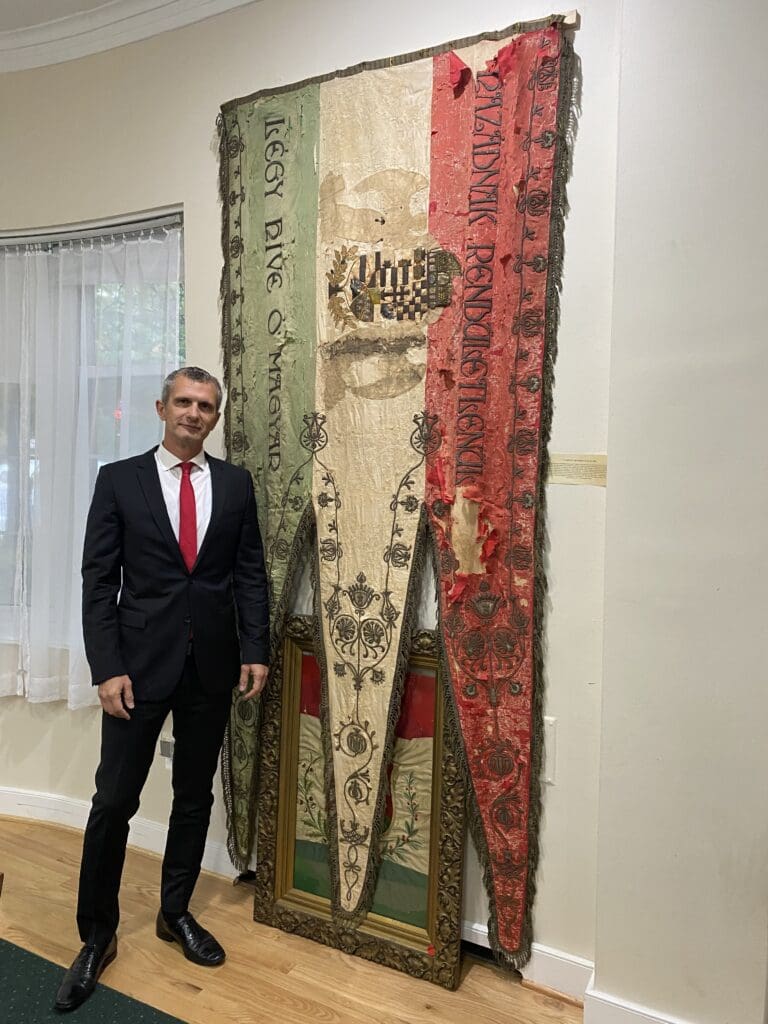
Reklám
Tas J Nadas, Esq

Sándor Petőfi Overseas — A Review of the Movie Now or Never! Screened in New York

Source: hungarianconservative.com

When I was handed an English-language poster about the upcoming screening of the Hungarian movie Now or Never! at a Hungarian American event in Los Angeles, I was a bit surprised, because I had not heard of any American screenings at the time. But by the time we flew back home to the East Coast two days later, a personal invitation was waiting for me from the Liszt Institute New York for the event. I was looking forward to watching this historical adventure movie, which had been at the center of the public discourse over the past month in Hungary, with some glorifying, others hammering it, and was glad I could finally form my own opinion and not just base it on conflicting reviews.

As positive as I was about it at the outset, my overall impression was quite mixed.

Based on the screenplay by Márk Kis-Szabó, Philip Rákay and Vajk Szente and directed by Balázs Lóth, the movie is about one of the most well-known days in Hungarian history, the bloodless revolutionary day of 15 March 1848. The day when the poem ‘National Song’, written upon hearing the news of the outbreak of the revolution in Vienna, first set the hearts of a bunch of young radicals (later referred as the ‘March youth’ by historians) on fire, and then those of the people of Pest. This eventful day of history is interspersed with many fictional elements of action in the movie, such as the repeated attempts of the secret agent Farkasch (Ottó Lajos Horváth) to stop the revolutionaries at all costs. He is trying to carry out the orders of the imperial commander-in-chief Von Lederer (Sándor Lukács), embodying the repressive Austrian power trying to prevent the unrest from escalating into a full-fledged revolution. Since poet Sándor Petőfi (Nándor Berettyán) and novelist Mór Jókai (Balázs Koltai-Nagy) slip through his fingers initially, he focuses his efforts on capturing (or even killing) Petőfi’s wife, Júlia Szendrey (Sára Mosolygó). He pays for the help of his former cronies of a street criminal gang (the head of the gang is played by Gábor Jászberényi), until the latter are also caught up in the spirit of the revolution and ultimately take out Farkasch themselves.

Zsuzsa Máthé, director of the Szent István Institute, referring to screening of the movie for high school students by her institute and her recent public conversation with screenwriter Vajk Szente, stated: ‘Even before the screening, one could read a mass of extreme statements for and against the movie, making it practically impossible for anyone to watch a historical adventure film in the cinema without any preconceptions.’

Unfortunately, as much as I tried to forget the tsunami of criticism and the responses to it, which had been politically biased, I didn’t succeed, and I could not see it simply as an action movie. But I’m not sure I should have, since the creators clearly had bigger goals in sight. Producer Philip Rákay himself said that the film’s mission is to ‘orientate, convey a sense of life of the given age, to appeal to young people, to awaken patriotism, to influence people and uplift them’. He added: ‘If I were a historian, I would rather be happy [than critical] that there are finally patriotic filmmakers who create relatable historical themes and characters in this skewed world, based on which many young people will turn to read about Vasvári, Jókai, Petőfi and the others, in search of reality’.

Ildikó Antal-Ferencz (L), Sára Mosolygó (C) and Ms Antal-Ferencz’s daughter PHOTO: Ildikó Antal-Ferencz

Since my teenage sons were not present and there were no other high schoolers in the New York audience I could have asked (hopefully there will be more screenings in the Tri-state area, even specifically for school audiences, similarly to Hungary), I have no first-hand feedback about the opinion of the target audience. I can only guess: the enthusiasm of the March youth might touch them too, and they might find the characters relatable, even lovable. The fighting scenes, however, might be dubious (also) for them. The greatest virtues of the movie are its authentic scenery and settings: the audience can really feel themselves in 1848, on the muddy, horse manure-covered streets, the chaotic, smelly market of Pest and Buda or in the coffee-scented and smokey Pilvax.

However, sometimes I had the feeling that these fighting scenes bear more resemblance to pubs from Western movies or to 19th century allyes in London

(as depicted by Dickens). In addition, there are way too many fictitious elements added contradicting what’s being taught in schools and held by historians. For example, in the days before March 15, neither demonstrations nor meetings were broken up in Pest; there were no threats of shooting or secret police violence on the day of the revolution; officialization of the Hungarian language had already taken place a few years before the revolution.

It is possible that young people of the 21st century see the March youth like themselves, a group of enthusiastic friends, including a variety of characters: some are hot-headed, some are thoughtful, some are womanizers, while some seek true love, some are loud, while others are quieter. Perhaps even the underlying message may get across: the March youth were able to put aside their individual concerns and personal differences for the sake of a set of noble common goals. Still, we are left wondering as to what extent we can accept that these characters are authentic? The character of Petőfi (who appears as a pale, almost weak and weightless person, especially in contrast to his wife, who comes through as a strong and impactful personality) and his sometimes comically stumbling companions, may serve the purpose of showing how difficult it is for passionate intellectuals to connect with and relate to common people busy with making a living and daily tasks, so perhaps the young audience also realizes how much the success of a mass movement depends on the sonorous, striking slogans of the revolutionary orators (who nowadays are celebrities and influencers). At the same time, no matter how talented the young actors playing the revolutionary characters are, there is little space given to them for showing their actual acting skills. They play one-dimensional roles, focused on one character trait each. They generally don’t offer real drama (except perhaps the Petőfi-Szendrey-Farkasch triple blackmail scene), and we don’t witness real character development either (perhaps with the exception of Jókai, who is initially very timid, but gets more and more self-confident). Thus, we don’t get to know the private Petőfi either which I suspect many high school students would have been interested in.

I agree with those who think that historical authenticity should not be scrutinized in a historical adventure movie, because it should primarily work with exciting characters and a story that simply draws from historical events but does not aspire to document them. I still wonder where the vision of the course of history and its essential moments, mentioned by the producer, are to be found in the movie? After all, even the director, who studied at the New York Film Academy, said in connection with the overseas screening: ‘Our goal was to create a movie for the wider audience, but one that foreigners also understand, because we intended it for them as well.’ However, some more authenticity would have been welcome, for example, showcasing why and how the revolution broke out and how it continued. The two brief closing remarks at the end of the movie about the later life of the two male protagonists simply cannot fill that void. Having said that, I find that the biggest shortcoming of the movie its dramaturgy:

except for the promising, spectacular and humorous first few scenes and a handful of impactful scenes scattered throughout, the story slows down relatively quickly,

becomes weightless and drags on as an average action movie with pretty theatrical and even cliché scenes: lots of marching and fighting; too frequent quotings of Petőfi’s emblematic poem; the soundtrack also reminiscent of Hollywood movies; and an increasingly artificial action-packed, fictitious plot running simultaneously with the historically more authentic series of events.

If I randomly compare this movie to two other recent Hungarian movies, Elk*rtuk and Semmelweis: I have to admit that they were much more exciting and twisty, even though we also knew their outcome in advance. In the former, the action scenes, in the latter, the characters came through as much more convincing. We could have felt more excitement in Now or never!, but for some reason we didn’t. It seems that the extra fictitious plot in itself is not enough to arouse excitement. Just as the performance of talented stage actors alone is not enough for a movie. Ultimately, I came to the conclusion that I don’t regret watching it at all, and I wouldn’t talk anyone out of it. In fact, I specifically recommend that you ‘see it for yourself’, but I am increasingly convinced that the story of 15 March 1848 would also have been much more impactful (and obviously much more cost-effective) if it was created as another piece of Vajk Szente’s large-scale, dynamic historical musical series. It may have not been played for decades, just only for years, but I wonder if this movie will last longer than that.

Ildikó Antal-Ferencz

Source: hungarianconservative.com

Reklám
Tas J Nadas, Esq