
Home Blog Page 41

Romania Re-Confiscates Hungarian Minority School, Persecutes Ethnic Hungarian Official on Fabricated Charges

Ignoring Decades of U.S. Congressional and Administration Appeals for “Equitable, Prompt, and Fair” Restitution Romania Re-Confiscates Hungarian Minority School, Persecutes Ethnic Hungarian Official on Fabricated Charges

In a scandalous disregard for the rule of law, as well as religious and minority rights, on November 26, a Romanian appellate court re-nationalized a Hungarian denominational high school in Sepsiszentgyörgy (Sfântu Gheorghe) built by the Hungarian Reformed Church in 1873 and confiscated in 1948 by the communist regime. Concurrently, the same Ploiesti Court of Appeals upheld three-year, suspended prison sentences for Attila Markó, Tamás Marosán and Silviu Clim for their 2002 lawful decision, in their official capacity as members of the Special Committee on Church Property Restitution, to restore this property to the aforementioned rightful owner.
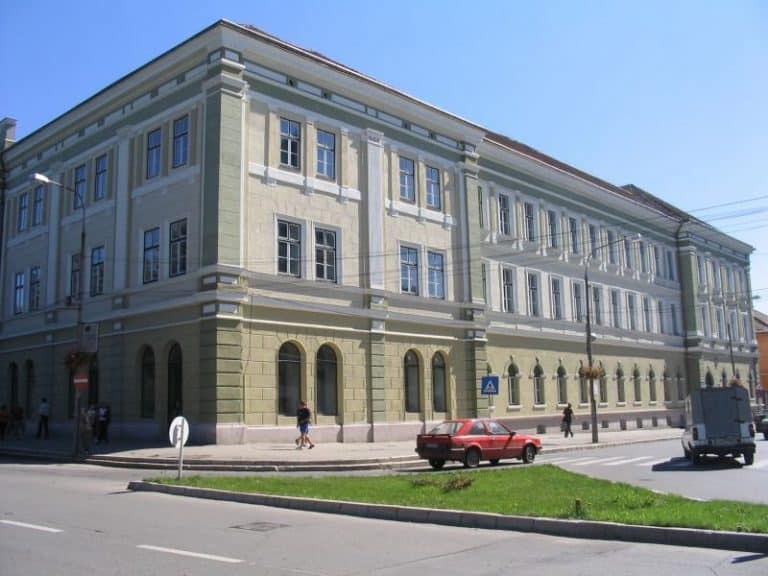
Miko_kollegium

In this last of 25 postponements and show trials begun in 2010, the Romanian court has now imposed the final ruling that the Hungarian Reformed Church — which undisputedly established the school in 1859 — has no legal right to its property, never owned the property, and must hand the building complex — for which it incidentally spent $700,000 on restoration — over to “the people,” i.e., the state. The ruling only suspends the three officials’ prison sentences for their alleged offenses, which remain on their criminal records. At the same time, under the ruling, the state will magnanimously “forgive” the Church a fine of $322,000 for“illegally using the building during the last 12 years since restitution.”

The state actions, occurring on the heels of the Democratic Alliance of Hungarians in Romania resignation from the governing coalition lead by Prime Minister Victor Ponta, have provoked wide-spread protest and universal condemnation by all segments of Romania’s 1.4 million strong Hungarian community. Exhausting all appeals, there is no remaining domestic legal recourse, only international pressure, for the Church and the three individual victims. Bishop Béla Kató of the Hungarian Reformed Church told HHRF that, as “Romania is not governed by the rule of law,” he is ready to take the matter to the European Court of Human Rights, although the outcome is highly dubious.

Four Years of Harassment and Persecution

The latest chapter in the 66 years of miscarriage of justice this school has suffered began on De-cember 22, 2010, when Attila Markó, Tamás Marosán and Silviu Clim were charged by the Romanian Anti-Corruption Prosecutor with “official abuse of power”and “damaging the interests of the Romanian State” for their 2002 decision to restore the property to its rightful owner. Consequently, the Hungarian Reformed Church faced losing the school and was also fined 1.1 million lei in damages.

In deciding to prosecute, and during the subsequent trials, the state deliberately ignored documentary evidence submitted by the defendants and the Church that irrefutably substantiated the rightful owner’s claim of original ownership and should have cleared the Special Committee members of any wrongdoing. The legitimate question arises: Why?

The True Crime: In 25 Years, Less than 1/3 of Church Properties Have Been Restored

By processing, let alone actually returning use of, a mere one-third (2,400 of 7,568) of all religious property claims in the past 25 years, it is the Romanian government that has committed gross negligence and exhibited systemic contempt for private property, the freedom of religion, civil society and, in particular, minority communities. The cost for the entire country has been incalculable as successive Romanian governments have impeded the country’s full democratization by delaying and obstructing the restitution process with impunity, all so that the state could retain these properties as long as possible.

The failure to nominally return to the four historic Hungarian churches (Roman Catholic, Hungarian Reformed, Lutheran and Unitarian) only 1,204 of their 2,140 schools, hospitals, orphanages and other humanitarian institutions confiscated between 1945 and 1989 has directly and irrevocably damaged the 1.4 million-strong minority, the country’s largest. For an entire generation , these Churches have been unable to fully carry out their charitable missions, serve their communities, and provide the traditional pillars of civic society they maintained for centuries.

To deflect attention away from this ongoing travesty of justice, the Romanian state has not refrained from turning the victim into the violator: burdening the innocent with criminal records because they faithfully carried out the law, and branding the Hungarian Reformed Church a liar and thief for submitting “false restitution claims.”

Will the Romanian Authorities File Suit against Each Restitution Decision?

Bishop Béla Kató’s prophetic words back in December 2010 that“the lawsuit may give birth to a dangerous legal precedent, leading to other instances of re-nationalization of already restituted church properties,” is poised to become a reality. A legal precedent has been set by the November 26 ruling which was predicated on the State Prosecutor’s false allegation that the Székely Mikó High School was somehow a separate legal entity because in the 1870s the local Protestant congregation made small donations to its construction, with the significant costs of construction born by Tran-sylvania’s Governor at the time, the Hungarian Imre Mikó. The institution was given legal title under the protectorate of the Hungarian Reformed Church, a centuries-old tradition even at the time. Since the same legal procedures were followed in other localities to establish schools, the state will presumably not stop at attacking only one restitution decision but will seek to renationalize other buildings it has already restored to all the denominations.

This is provided that the restitution process limps forward at all. From 2010 until July 2013, the Special Committee – composed of five newer members – failed to even convene to process claims. Since then, it meets about quarterly, provided a quorum of four is present. As dismal a record as this is, now, with the unjustified criminal sentencing of former members, can they be expected to make any decisions at all without fear of retribution?

Ignoring Decades of U.S. Congressional and Administration Appeals for “Equitable, Prompt, and Fair” Restitution

On May 22, 2014, eight Members of Congress sent a follow-up letter to Secretary of State John Kerry, asking that the State Department continue to “carefully follow developments in the cases regarding ownership of the Székely Mikó Reformed School and the legal proceedings against Attila Markó, Tamás Marosán and Silviu Clim.” In a prior, June 13, 2013 bipartisan letter, 21 Members had requested that, among others, Mr. Kerry “vigorously engage the Romanian government to end the travesty of justice it has perpetuated by fully restituting properties illegally confiscated,” “protest the latest church property restitution law”which was a regression even compared to the flawed 2002 one, and to carefully follow the case of the Székely Mikó High School.

The State Department’s response of July 9, 2013 underscored that property restitution in Romania is a “key priority” for the Administration which it has “long raised with Romania.” U.S. Embassy officials had also met with Attila Markó and attended his June 27, 2013 Romanian Supreme Court hearing as official observers. “We will continue to advocate for a sound judicial decision based on the rule of law,” affirmed the letter.

Though the State Department stated that “Romanian authorities have assured us they are open to our suggestions and those of various stakeholders for amending and improving restitution legislation,” curiously, the Romanian government not only failed to amend or eliminate the retrograde law No. 165 it had adopted on April 17, 2013, but also continued its prosecution of the Hungarian Reformed Church and the three Special Committee members, hiding behind the alleged independence of the judiciary.

Already in 2005 , under the co-sponsorship of Congressmen Tom Lantos and Tom Tancredo the U.S. Congress had sent a strong message to Romania when it unanimously adopted H.Res 191 on the need to accelerate restitution and remedy the gross injustice suffered by the Jewish community, the four historic Hungarian churches, and the Greek Catholic Church. The resolution—wholly ignored to this day—set forth seven specific actions the Romanian authorities needed to urgently take.

* * *

Since all legal recourse has been exhausted in Romania for the Hungarian Reformed Church and the three defendants, their only hope for fair decision rests in the European Court of Human Rights. However, due to the Strasbourg tribunal’s crowded agenda, it might take years until the case is even heard, and justice (further) delayed is justice (continually) denied.
The Romanian authorities are responsible for this injustice. HHRF calls on them to immediately restore legal title of the Székely Mikó High School to the Hungarian Reformed Church by government ordinance and exonerate Attila Markó, Tamás Marosán, and Silviu Clim of all charges. The authorities must further ensure that legal decisions heretofore restoring title and use of properties rightfully belonging to the four historic Hungarian churches are not reversed. The Romanian government must remove all obstacles to fully restoring title to and use of the remaining 5,168 properties, including amending laws as necessary, in consultation with the stakeholders.

Source: hhrf.org

Reklám
Tas J Nadas, Esq

Ted Horvath’s letter to Senator John McCain

December 8, 2014

Senator John McCain
241 Russell Senate Office Building
Washington, DC, 20510

Dear Senator McCain:

I have been a Republican all my life and have been a supporter of you from the time you came upon the political scene.  I have the greatest admiration for the courageous way in which you bore the suffering imposed upon you as a prisoner of the Viet Cong.

It is only fair to you that I introduce myself.  I am the 86- year old son of Hungarian immigrants who worked very hard in their small bakery to raise and educate my sister and me in Cleveland, Ohio.  I was fortunate enough, through hard work, to graduate from Ohio State University and Harvard Law School and become the Principal Corporate Counsel of The Cleveland Electric Illuminating Company.  I retired in 1987.

I am deeply puzzled as to how you could allow yourself to be bamboozled by left wingers at home and abroad that the Hungarian constitution is not based on democratic principles and that the Prime Minister of Hungary behaves like a dictator.  What happened to your ability and responsibility as a Senator to examine the facts for yourself, knowing as you surely do, where the politically motivated accusations against Hungary have been coming from?  I fully endorse what my friends Steve and Susan Szappanos state in their letter to you.  Perhaps your staff has failed to do its homework and has misguided you.

The Hungarian Constitution eloquently spells out the protections of our Bill of Rights for the benefit of Hungarians and establishes a British type of parliamentary government.  Please read it for yourself as the letter below suggests.  Is it perfect?  Not entirely.  The Hungarian Constitution expressly guarantees religious freedom, but the provision allowing registration of religions is a negative .   So far, this authority has not been abused as far as I can tell.  Charges of anti-Semitism by the Hungarian Government, not only by the left, but also by the U.S. State Department, are unfounded.    Of course, there is a minority of Hungarians who have that view, as do a minority of Americans (and a minority of Americans also love to hate Negros and various other ethnic groups).  Words alone do not wipe out prejudice taught by parents to their children.  Surely you recall how many Jews the Hungarian people helped escape the insanity of Hitler before and during World War II while the western world looked the other way.  The Hungarian Constitution also seems to prohibit abortion.  Well, there are a lot of Republicans (with whom I disagree) who would like to see such a provision in our Constitution.

What we see is that Hungarians are committed to the Bill of Rights and democratic government, like Americans and others in the democratic west; and, like we in the democratic west, are wrestling with many of the same issues we struggle to resolve.  It is the duty of Americans, and yours as a member of the American Government, to support the efforts of Hungarians to develop a mature democracy and to fight off politically motivated efforts of left wing socialists and communists to subvert and kill off freedom in Hungary.

Regarding the pipeline issue.  When the U.S. and the European Union decide to get tough enough with Russia, the Hungarians will be right there.  Don’t expect Hungary or any other small European nation dependent on Russian gas and oil to throw itself under the Russian bus.  Also, maybe if the American Government treats the Hungarian Government with a bit more respect for what it has accomplished since the Communists were driven out, there might be better results.

The United States puts up with all kinds of non-democratic countries where it needs their help.  Why pick on democratic Hungary?  The answer is that left wingers want to do in the Hungarian experiment with democracy.  Senator McCain, please just look at the facts and do your homework.

Sincerely yours,
Theodore J. Horvath

TedHorvath
Theodore J. Horvath
Reklám
Tas J Nadas, Esq

The Gift Shop of the Cleveland Hungarian Heritage Society will reopen

The Gift Shop of the Cleveland Hungarian Heritage Society will reopen in its new location Saturday, December 13th. During the holidays, the Gift Shop will be open from 11-3, Monday through Friday between December 15-30th. It will be closed on December 25th and 26th but will be open 11-2 on the 24th.

The new Gift Shop is on the 1st floor in the northeast area of the Galleria. If you come up from the garage by elevator, turn right and walk to the escalators. It is right there to you left.

We have many, many items for Christmas such as “szalon cukor”, pralines with cherry,  Christmas cards and tree ornaments, “csiga” noodles and a book of Hungarian Christmas poetry.

We hope to see many of you.

Kellemes Karácsonyi Ünnepeket és egy Boldog Új Évet Kívánok

Eva Szabo
Hungarian Museum

Reklám
Tas J Nadas, Esq

Hungarian Film Wins First Prize in Italy

Kereszthegy
A Hungarian film won first prize in Bracciano,Italy, on the uniformed filmmakers’ festival. ’Kereszthegy’ gained this acknowledgement in the category of historical films, in the International Defence Film Festival, which had been held from the 10th until the 16th of November.

The programme featured 55 works from 19 countries. The Hungarian film ’Kereszthegy’ tells the story of the 65th Royal Hungarian Székely National defence troop which had held on in World War II. The film was made in cooperation of the HM Zrínyi Nonprofit Inc., the HM Social Connections Inc., the War Reverence Department and the Hungarian Academy of Arts.

’Kereszthegy’ will be screened in Urania Cinema and in several Transylvanian locations. MTV had already included the film in its repertory in this year’s September.

The “Kereszthegy’ (Hungarian language):

YouTube player

Forrás: dailynewshungary.com

Reklám
Tas J Nadas, Esq

John the Valiant in Cleveland

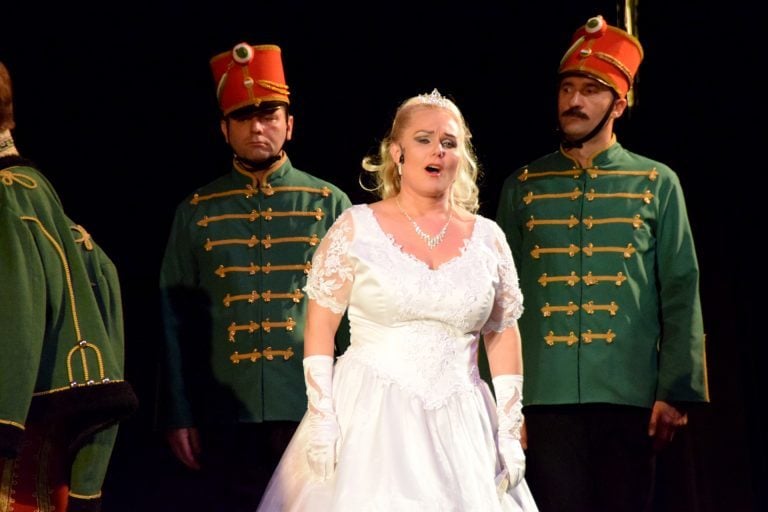
The tenth stop of the Equestrian Theatre of Komárom’s North American tour was in our white, snow-covered city, Cleveland. The organization and preparation of many months prior brought the news of the program to the wider Hungarian community, from which many had already ordered their admittance tickets in advance.

With great interest, we followed the program series organized by Pongrátz Entertainment from their very first performance, and our radio program’s employee, Zsolt Molnár, continually kept in touch with the group. We were able to reach the operetta’s director and group’s head, György Derzsi, between performances via telephone, when Zsolt Molnár also spoke with him. (in Hungarian language)

In light of what has been said, we tried to finalize every little detail surrounding our role in the Cleveland performance with the utmost attention, and we awaited Saturday evening with much excitement. The finishing touches were witnessed by a few spectators who had arrived early and who, together with us, were looking forward to the upcoming performance with impatient curiosity and anticipation.

Behind the stage, the Cleveland Scout Ensemble stood ready together with the performers, who were only waiting for the signal to begin. To the enchantment of one’s eyes and spirit, one could see from behind the curtains rows filled with viewers, which helped us to decide that the time to begin had arrived.

DSC_3375
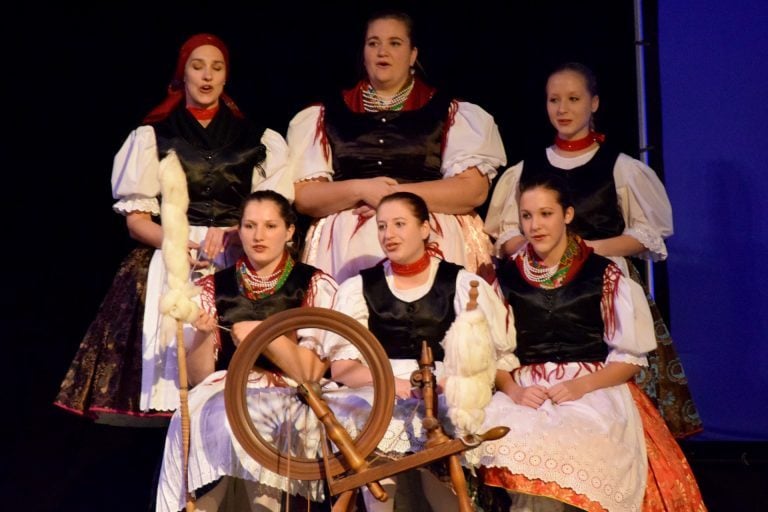
The Cleveland Scout Ensemble’s female participants at the performance of John the Valiant


DSC_3389
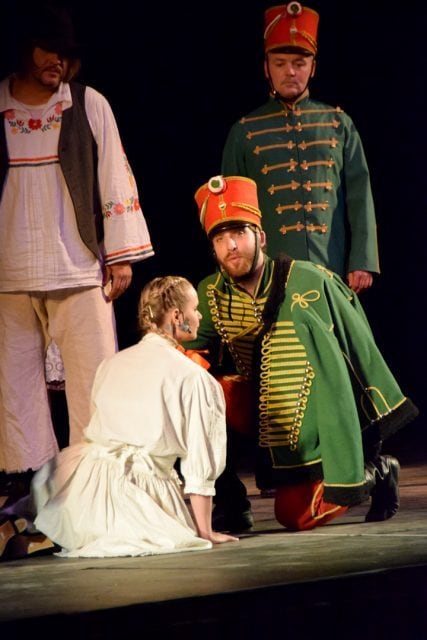
The Cleveland Scout Ensemble’s male participants during the performance of John the Valiant

In the auditorium, the lights dimmed, upon which the clamor in the hall immediately faded and the first voices of the Scout Ensemble arose. Afterwards, the spotlight was centered on John the Valiant. In the hall, all eyes, from those of the little ones to those of the older ones, focused solely on the happenings upon the stage.

DSC_3418
In the center of the stage, Iluska (Zita Prescsák)
DSC_3424
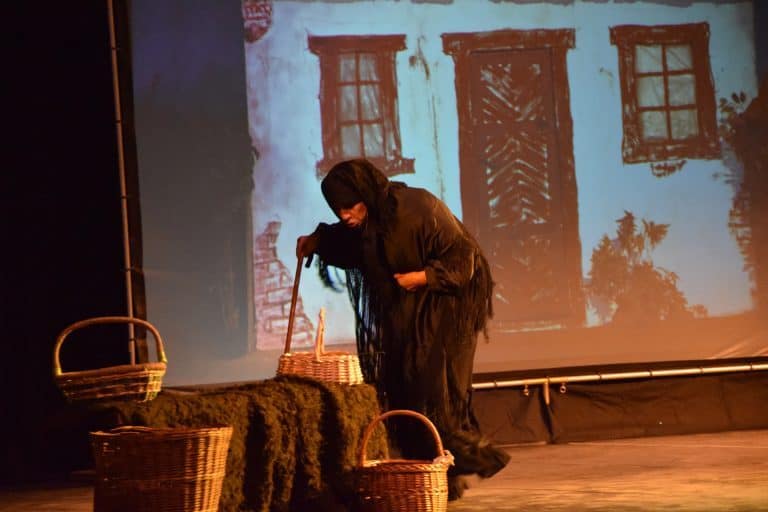
The stepmother (Athina Papadimitiu)
DSC_3462
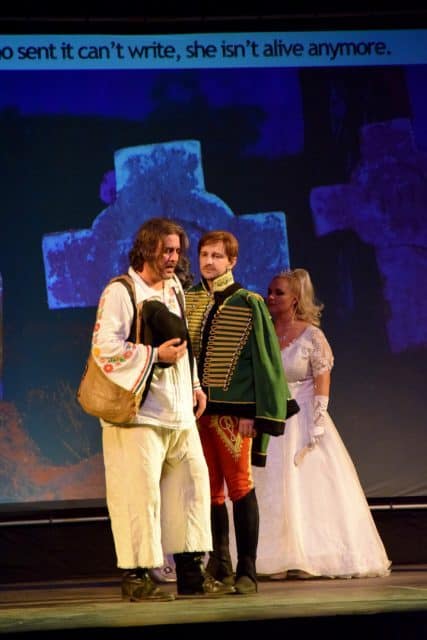
Bagó (Vadkerti Imre) és John the Valiant (Derzsi György)
DSC_3466
The French princess (Mondok Yvette)

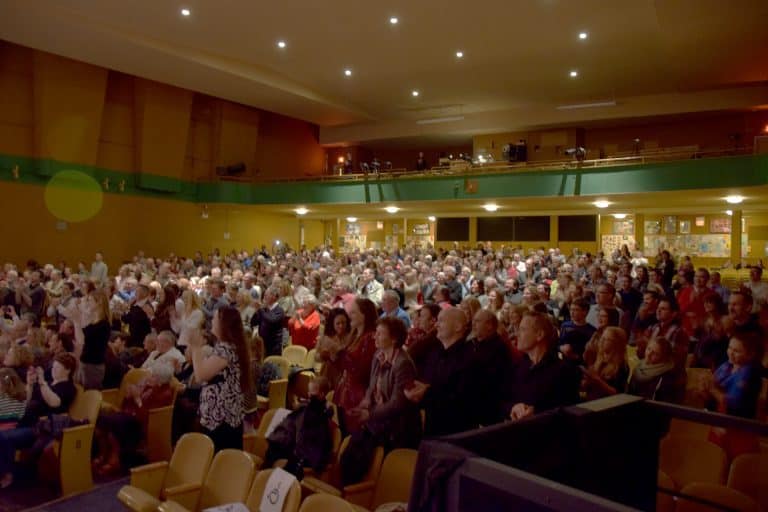
At the end of the last song, five hundred men sprang to their feet at once, cheered, and applauded for several minutes with gratitude and appreciation for this tribute to the perpetual masterpiece of our Hungarian literature that was worthily portrayed by this performance. The actors, in turn, came down from the stage in their authentic costumes, to the great delight of many children, who were able to take pictures with their favorite cast members.

DSC_3485
The jubilant 500+ Cleveland audience after the performance of János Vitéz
DSC_3497
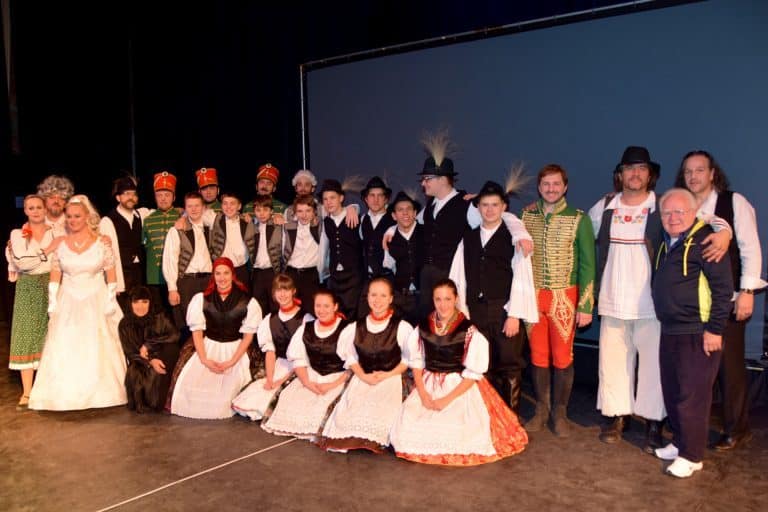
The actors of John the Valiant with the organizers, András Pongrátz and Loránd Csibi (on right)

The audience slowly, very slowly trickled home, with many people forming groups around each of the actors while talking, taking pictures, and inquiring about their lives. Komárom Equestrian Theatre is a very genial, endlessly humble, modest, truly professional group of actors, artists, and singers. We are very thankful to everyone for offering such a memorable experience for both young and old alike.

DSC_3501
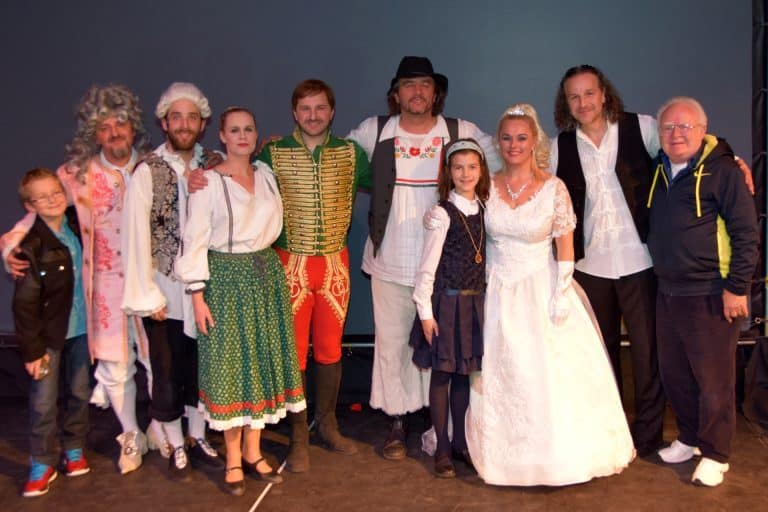
The actors with young fans

More pictures can be viewed on the Bocskai Radio’s Facebook page. The pictures were taken by Zsolt Molnár.

Post translated by Nicholas Boros

Reklám
Tas J Nadas, Esq

The bullying of Hungary – the country that dared to disobey the US and EU

hungary-independent-politics-west.si

25 years ago, Hungary was being toasted in the West for opening its border with Austria to East Germans, in a move which led to the fall of the Berlin Wall. Now the Western elites are not happy with Budapest which they consider far too independent.

The refusal of Prime Minister Viktor Orban and his ruling Fidesz party to join the new US and EU Cold War against Russia, which has seen the Hungarian parliament approving a law to build the South Stream gas pipeline without the approval of the European Union, in addition to the populist economic policies Fidesz has adopted against the largely foreign owned banks and energy companies, has been met with an angry response from Washington and Brussels.

Hungarian officials have been banned from entering the US, while the European Commission has demanded that the Hungarians explain their decision to go ahead with South Stream. That’s on top of the European Commission launching legal action against the Hungarian government for its law restricting the rights of foreigners to buy agricultural land.

The bullying of Hungary hasn’t made many headlines because it’s so-called “democrats” from the West who have been doing the bullying.

Viktor Orban is not a communist, he is a nationally-minded conservative who was an anti-communist activist in the late 1980s, but the attacks on him and his government demonstrate that it doesn’t matter what label you go under – if you don’t do exactly what Uncle Sam and the Euro-elite tell you to do – your country will come under great pressure to conform. And all of course in the name of“freedom” and “democracy.”

Fidesz has been upsetting some powerful people in the West ever since returning to power in 2010. The previous “Socialist”-led administration was hugely popular in the West because it did everything Washington and Brussels and the international banking set wanted. It imposed austerity on ordinary people, it privatized large sections of the economy, and it took out an unnecessary IMF loan. Ironically, the conservative-minded Fidesz party has proved to be much better socialists in power than the big-business and banker friendly “Socialists” they replaced.

One of the first things that Fidesz and its coalition allies, the Christian Democratic People’s Party, (KDNP) did was to introduce an $855m bank tax – the highest such tax in Europe – a measure which had the financial elite foaming at the mouth.

Orban clashed with the IMF too, with his government rejecting new loan terms in 2012, and paying off early a loan taken out by the previous government, to reduce interest payments.

Hungary's Prime Minister Viktor Orban (Reuters / Bernadett Szabo)
Hungary’s Prime Minister Viktor Orban (Reuters / Bernadett Szabo)

In 2013, Orban took on the foreign-owned energy giants with his government imposing cuts of over 20% on bills. Neoliberals expressed their outrage at such “interventionist” policies, but under Orban, the economy has improved. Although it’s true that many still look back nostalgically to the days of“goulash communism” in the 1970s and 80s when there were jobs for all and food on the table for everyone. Unemployment fell to 7.4 percent in the third-quarter of this year; it was around 11 percent when Fidesz took power, while real wages rose by 2.9 percent in the year up to July.

The man his enemies called the “Viktator,” has shown that he will pursue whatever economic policies he believes are in his country’s national interest, regardless of the opinions of the western elite who want the Hungarian economy to be geared to their needs.

His refusal to scrap his country’s bank tax is one example; the closer commercial links with Russia are another. Russia is Hungary’s third biggest trading partner and ties between the two countries have strengthened in the last couple of years, to the consternation of western Russophobes. In April, a deal was struck for Moscow to loan Hungary €10 billion to help upgrade its nuclear plant at Paks.

Orban’s policy of improving trade and business links with Russia, while staying a member of the EU and NATO, has however been put under increasing strain by the new hostile policy towards Moscow from Washington and Brussels.

Orban again, has annoyed the West by sticking up for Hungary’s own interests. In May he faced attack when he had the temerity to speak up for the rights of the 200,000 strong Hungarian community living in Ukraine.”Ukraine can neither be stable, nor democratic, if it does not give its minorities, including Hungarians, their due. That is dual citizenship, collective rights and autonomy.” Hungary’s Ambassador was summoned to the Foreign Ministry in Kiev. Donald Tusk, Prime Minister of Poland, the US’s most obedient lapdog in Eastern Europe, called Orban’s comments “unfortunate and disturbing” as if it was anything to do with him or his country.

In August, Orban accurately described the sanctions policy of the West towards Russia as like “shooting oneself in the foot.”“The EU should not only compensate producers somehow, be they Polish, Slovak, Hungarian or Greek, who now have to suffer losses, but the entire sanctions policy should be reconsidered,” Orban said.

In October, Hungarian Foreign Minister Peter Szijjarto also questioned the sanctions on Russia, revealing that his country is losing 50 million forints a day due to the policy.

Hungary has made its position clear, but for daring to question EU and US policy, and for its rapprochement with Moscow, the country has been punished.

It’s democratically elected civilian government which enjoys high levels of public support, has ludicrously – and obscenely – been likened to military governments which have massacred their opponents. “From Hungary to Egypt, endless regulations and overt intimidation increasingly target civil society,” declared US President Barack Obama in September.

Last month there was another salvo fired at Hungary – it was announced that the US had banned six unnamed Hungarian government officials from entering America, citing concerns over corruption- without the US providing any proof of the corruption.

RIA Novosti / Ramil Sitdikov

“At a certain point, the situation, if it continues this way, will deteriorate to the extent where it is impossible to work together as an ally,” warned the Charge D’Affaires of the US Embassy in Budapest, Andre Goodfriend. The decision and the failure to provide any evidence, understandably caused outrage in Hungary. “The government of Hungary is somewhat baffled at the events that have unfolded because this is not the way friends deal with issues,” said Janos Lazar, Orban‘s chief of staff.

The timing of the ban has to be noted, coming after the Hungarian government had criticized the sanctions on Russia and just before the national Parliament was due to vote on the South Stream pipeline. The pipeline, which would allow gas to be transported from Russia via the Black Sea and the Balkans to south and central Europe without passing through Ukraine, is a project which Russophobes in the West want cancelled.

“I am inclined to think that it is a punishment for the fact that we talk to Russia,” said Gabor Stier, the head foreign policy editor of the leading Hungarian newspaper Magyar Nemzet.

“America thinks that we are corrupt, but we are a sovereign state, and it is our business. Many people in the United States do not like that Viktor Orban is very independent…..Corruption is just an excuse.”

It’s hard to disagree with Stier’s conclusions. Of course, there is corruption in Hungary, as there is in every country, but it pales in comparison with some countries who are faithful US allies and who Washington never criticizes. The 2013 Corruption Perceptions Index compiled by Transparency International, reveals that Latvia, the Czech Republic, Croatia, Romania, Bulgaria and Bosnia-Herzegovina are all below Hungary, as indeed is Italy. Yet it’s Hungarian officials that the US is banning.

True to form, the attacks on Orban and his government in the Western media have chimed with the political attacks. ‘Is Hungary, the EU’s only dictatorship?’ asked Bloomberg View in April. The BBC ran a hostile piece on Orban and Fidesz in October entitled Cracks Emerge in leading party, and which referred to “government corruption” and “the playboy lifestyle of numerous party officials.”

The piece looked forward to the end of Fidesz rule.

While earlier this week, the New York Times published an OpEd by Kati Marton, whose late husband Richard Holbrooke, was a leading US diplomat, entitled Hungary’s Authoritarian Descent. You’d never guess that the Hungarian government wasn’t the flavor of the month in the West would you?

Russian Foreign Minister Sergei Lavrov, left, and Hungarian Prime Minister Viktor Orban at their meeting in Budapest (RIA Novosti / Eduard Pesov)

Russian Foreign Minister Sergei Lavrov, left, and Hungarian Prime Minister Viktor Orban at their meeting in Budapest (RIA Novosti / Eduard Pesov)

The question which has to be asked is: will Hungary be the next country to be the target of a US/EU sponsored regime change?

We all know what happened to the last Viktor who refused to sever links with Russia. Will Orban suffer the same fate as Ukraine’s Yanukovich? There are good reasons for believing that he won’t.

Fidesz did make a mistake by announcing the introduction of a new internet tax last month, which brought thousands onto the streets to protest but they have since dropped the plans and the problem for the US and EU is that Orban and his government remain too popular. In October’s local elections Fidesz won 19 of Hungary’s 21 larger towns and cities, including the capital city Budapest, not bad for a party that‘s been in power since May 2010.

Orban’s brand of economic populism, combined with moderate nationalism, goes down well in a country where people remember just how awful things were when the neoliberal “Socialists” were in power. His style of leadership may be authoritarian, but Hungarians prefer having a leader who has cut fuel bills and reduced unemployment to one who mouths platitudes about “liberal democracy” but who imposed harsh austerity measures and leaves them unable to afford the daily essentials.

Moreover Hungary, is already a member of the EU and NATO unlike Ukraine under Yanukovich and isn’t about to leave either soon. On a recent visit to America Foreign Minister Peter Szijjarto told the US TODAY newspaper “US is our friend, US is our closest ally.” The US clearly wants more from Hungary than just words, but while both Washington and Brussels would like to see a more obedient government in Budapest, the “liberal” and faux-left parties they support simply don’t have enough popular support for the reasons outlined above. And things would be even worse for the West if the radical nationalist party Jobbik, the third largest party in Parliament, and which made gains in October’s local elections, came to power- or if there was a genuine socialist/communist revival in the country. The fact is that Orban is in a very strong position and he knows it. That’s why he feels able to face down the threats from abroad and maintain a level of independence even though total independence is impossible within the EU and NATO.

We can expect the attacks on Orban and his government to intensify but the more the West attacks, the more popular Orban, who is able to present himself as the defender of Hungary’s national interests, becomes.

Hungary gave the West everything it wanted in 1989, and, as I pointed out here, its “reform”communist leadership was richly rewarded. But in 2014 it’s a very different story. In the interests of democracy and small countries standing up to bullying by powerful elites, long may Hungary’s spirited defiance continue.

Hajra, magyarok! Hajra Magyarorszag!

The statements, views and opinions expressed in this column are solely those of the author and do not necessarily represent those of RT.

Source: rt.com

Reklám
Tas J Nadas, Esq

Hungarian Review Publishes Fifth 2014 Issue

Washington, DC – The “Hungarian Review”, the English-language affiliate of the bi-monthly journal Magyar Szemle, edited by Gyula Kodolányi and John O`Sullivan, has published its fifth 2014 issue.

On the cover: Symbolism at the railway station.  Keleti Railway Station, Budapest 2011.  “The Birth of Steam”.  Photo by Alida Kálmán.
On the cover: Symbolism at the railway station. Keleti Railway Station, Budapest 2011. “The Birth of Steam”. Photo by Alida Kálmán.

As the editors write in the editorial note, “there is more than a touch of the political science seminar about this issue.”  The periodical discusses important topics as the nature of human rights in current international relations or the emerging dispute over the character of ‘liberal democracy’ in European politics.  Recently, the interpretation of liberal democracies got relevant in Hungarian politics, especially after Viktor Orbán’s speech in which he proposed the controversial concept of ‘illiberal democracy’ and caused furor, according to O’Sullivan.  In his introductory article, Orbán’s Hungary: Image and Reality – Whose Democracy? Which Liberalism? he explains:

“For the moment, however, all attention has been diverted from other questions to the Prime Minister’s recent speech in which he seemingly repudiated liberal democracy and embraced what he called “illiberal democracy” as his favoured political system.  Those remarks were interpreted, not unreasonably, as a justification for a more authoritarian form of government.  They seemed to confirm the hostile critique of Orbán that is current in the European Left.  And they added weight and force to all the other criticisms of him, his government and Hungary.  My own feeling when I read the speech was slightly different.  I was overcome by a feeling of déjà vu.  For I was an advisor to Margaret Thatcher when she made her famous remark – “There is no such thing as society” – to a women’s magazine.  I recall thinking that she would never escape from that remark or, rather, from a grotesque misunderstanding of that remark.  For that sentence meant the opposite of what it seemingly said when it was wrenched from context.  What she was saying was that society was not a “thing” – an abstract independent entity out there – but that it was composed of the ordinary men and women, and their families, and their various associations from churches to tennis clubs.  If “society” was to take collective action, therefore, it would have to come ultimately from ordinary people, herself included, who would have to provide resources or themselves and for those less fortunate than themselves.  These explanatory thoughts were not the implications of her remark on society.  They were said quite clearly in the few sentences that followed it. But they were never quoted.”

The ‘Current’ section is continued by Christiaan Alting von Geusau’s article, Human Rights, History and Anthropology: Reorienting the Debate, which is raising a similarly serious issue:

“In the history of mankind, by far the most human rights abuses were and are in fact perpetrated by ordinary people in extraordinary circumstances – not by monsters, and despite international treaties.”

Referring to the economic evolution of the last two decades, this Review features Péter Ákos Bod, the economist’s analysis, entitled Why There Was No Marshall Aid after 1990.  Quoting the author:

“Textbooks at the University of Economics in Budapest referred to East Germany (GDR) as one of the ten most powerful industrial nations of the world, on a par with South Korea.  Western analysts generally concurred.  The Soviet Union was considered, right up to its disintegration, as a highly industrialized country; although whether it was termed an advanced nation is another matter.”

Géza Jeszenszky’s discussion on Hungary, NATO and the War in Ukraine completes the first section.

Nicholas T. Parsons’ essay on Populism and the Failures of Democracy is an interesting addition to the previous issues. The ‘Histories’ section comprises the article of Gyula Kodolányi: August-September 1944 – A mosaic selected from diaries, memoirs and histories III.; Attila Balázs: Socks on the Chandelier, Lives by a Thread – (On Tibor Várady’s book by the same title, and a little about myself) and Tibor Várady: Socks on the Chandelier, Lives by a Thread – File No. 12 198.  And finally, this ‘Arts and Letters’ section is written by Clayton Eshleman and Dávid Bán.

September 29, 2014 | Washington, DC

Source: hacusa.org

Reklám
Tas J Nadas, Esq

Hungarian language and culture courses have started at Cleveland State University (CSU)

translated by Nicholas Boros

With the beginning of September, the time has come for students to once again take a seat behind their desks. But without a doubt, the students at CSU were very pleased to return because something new was awaiting them. For those desiring to learn Hungarian, the opportunity to enroll in a course where they can master the language and discover Central European culture has arisen.

The instructor is well-traveled woman, who, after completing her studies in Hungary, acquired a doctorate in France, where she also taught for several years. Rita Gárdosi has vast experience at her disposal. During her research, she concentrated on language acquisition and translation theory, thus developing an effective teaching method. Her teaching areas include Hungarian language (beginner, intermediate, advanced), Central European culture, Hungarian phonetics, and Hungarian linguistics.

dr. Gárdosi Rita
dr. Rita Gárdosi

A welcoming reception in honor of Dr. Rita Gárdosi was held on September 5. Cleveland State University, the Department of Modern Languages, and the United Hungarian Societies invited guests in order to introduce the visiting Fulbright instructor of Hungarian Language and Culture for the 2014-2015 academic year. At the reception, speeches were given by T. Marika Megyimóri, Vice President of the United Hungarian Societies, as well as Dr. Greg Sadlek, Dean of the College of Liberal Arts and Social Sciences at CSU. Furthermore, they thanked the Fulbright recipient for fully overseeing her assignment at the host institution, which includes continuing education and curriculum development in the area of Hungarian studies, as well as Hungarian as a foreign language, Hungarian literature, and cultural education. With her work, she is enriching the image of the department and primarily that of the Hungarian language.

DSC_1839
Dr. Greg Sadlek és Dr. Rita Gárdosi

The audio of the ceremonial speech made at the reception can be heard in English.

T. Marika Megyimóri, Vice President of the United Hungarian Societies, Dr. Rita Gárdosi, and Dr. Greg Sadlek, Dean of the College of Liberal Arts and Social Sciences at CSU.
Marika T. Megyimóri, Vice President of the United Hungarian Societies, Dr. Rita Gárdosi, and Dr. Greg Sadlek, Dean of the College of Liberal Arts and Social Sciences at CSU.
Participants at the welcoming reception for Dr. Rita Gárdosi, visiting Fulbright scholar.

Rita Gárdosi visited Bocskai Rádió’s studio, where she introduced herself to the listeners and the members of staff (in Hungarian language)

Dr. Rita Gárdosi and the staff of Bocskai Rádió

More pictures can be found on  Bocskai Rádió’s Facebook page.

Dr. Rita Gárdosi’s CV as well as more information on the Hungarian courses can be found on CSU’s website.


Reklám
Tas J Nadas, Esq

The Bognár Family Hungarian Scholarship Fund

HAC1Introduction

The scholarship fund, originally named the Hungarian Scholarship Fund (HSF), was established in 1999 by Dr. Béla and April Bognár.

In the spring of 2014, Dr. Béla and April Bognár requested the Hungarian American Coalition to become the administrator of their Hungarian Scholarship Fund as part of the Coalition’s comprehensive training and educational portfolio.  The Coalition has taken over administrative duties for this program, including fundraising, recipient selection and evaluation. With the Bognárs’ agreement, HSF has been renamed The Bognár Family Hungarian Scholarship Fund.

More background informations about The Bognár Family Hungarian Scholarship Fund can be found in here.

The program

The Bognár Family Hungarian Scholarship Fund provides monthly financial assistance to qualified Hungarian university students studying in Hungary, Romania, Ukraine, Slovakia, Serbia, and the United States.  The scholarship awardees will receive a stipend per semester to cover their tuition fee or other expenses related to their studies. The exact amount of the stipend will be determined by the Fund’s Scholarship Committee.

Application process

Applicants should submit the following documentation:

  • An application letter giving information on the applicant’s family circumstances and a statement of financial need,
  • Information on sources of income and required expenditures to cover tuition, travel, books, housing, etc.
  • An up-to-date curriculum vitae including a recent picture,
  • Information on the applicant’s participation in Hungarian community service, cultural, religious, civic or sports related activities,
  • Two letters of recommendation: one from a teacher and one from a religious or community leader,
  • High school and college scholastic records and information on academic standing;


Applications which do not meet the Scholarship Fund’s requirements will not be acknowledged.

Scholarships are awarded by the Fund’s Scholarship Committee.  Successful applicants will be notified and further information given on the transfer of funds.

All scholarship awardees are expected to write thank you letters to donors.  They are also expected to file regular reports on their educational progress, as they are eligible to apply for a scholarship for the following year.  However, their application will be considered along with those of new applicants.

Applications will be evaluated on a rolling basis.


Submission of Applications

Applicants should submit their documentation by mail or electronically to either one of these addresses:

The Bognár Family Hungarian Scholarship Fund
P.O. Box 57135
Washington, D.C. 20037, USA

or

The Bognár Family Hungarian Scholarship Fund
Várfok utca 15/C,
1012 Budapest, Hungary


The email address is: scholarship@hacusa.org.

For further information, please contact János Szekeres at 202-296-9505 in the US or Vivien Geszten-Kovacs at 36-1-214-2933 in Hungary.


July 16, 2014 | Washington, DC


Source: hacusa.org

Reklám
Tas J Nadas, Esq

The Bognár Family Hungarian Scholarship Fund Joins the Hungarian American Coalition Education Programs

HAC1Washington DC –  In the spring of 2014 Dr. Béla and April Bognár requested the Hungarian American Coalition to become the administrator of their Hungarian Scholarship Fund as part of the Coalition’s comprehensive leadership training and educational portfolio.

The Coalition’s leadership gratefully accepted this new opportunity of adding this excellent Fund to its program that already includes the Dr. Elemér and Éva Kiss Scholarship Fund and the Congressional Internship Program.

The Hungarian Scholarship Fund (HSF) was established in 1999 by Dr. Béla and April Bognár to provide assistance to qualified Hungarian university students living and/or studying in Hungary, Romania, Ukraine, Slovakia, Serbia, and the United States.  Since its inception, the founders have raised more than $500,000 from members of the Hungarian American community, churches, organizations and the Sunshine Lady Foundation (SLF), directed by Mrs. Doris Buffett.

Scholarship recipients must have an excellent academic record, outstanding recommendations from teachers or the clergy and proven financial need.

The HSF track record has been remarkable:  as of June, 2013, HSF has awarded scholarships, many of them multi-year, to 152 students.  89 students earned BS degrees, 17 MS degrees, 6 MDs, 7 PhDs and 1 JD degree.

With the Bognárs’ agreement, HSF has been renamed The Bognár Family Hungarian Scholarship Fund as the Coalition takes over administrative duties for this program, including fundraising, scholarship recipient selection and evaluation.

The scholarship application form is available at the Coalition’s website,www.hacusa.org/en/scholarships-internships/TBFHSF or writing to Vivien Geszten-Kovács atvivien@hacusa.org.

August 8, 2014 | Washington, DC

Source: hacusa.org

Reklám
Tas J Nadas, Esq

World’s First Water House Presented in Kecskemet by Hungarian Architect

water-house-hungary

(MTI) – The prototype of the world’s first allwater fluid house was presented to the industry in Kecskemet, central Hungary.

Designed by Hungarian architect Matyas Gutai, the sustainable fluid house uses water insulation in thermal panels on all sides of the building.

Gutai, 33, told MTI on Saturday that the water house is able to provide a balancing capability not unlike that of the Earth, which is covered in 73 percent by water. The balancing effect provides a state-of-the-art comfort zone within a few seconds in the building.

water-house-hungary-2

The prototype presented is a 10 sqm building which was built with European Union support.

Gutai, who attended secondary school in Kecskemet and received his first degree from the Budapest Technical University, is now a researcher at Tokyo University.

Photo: MTI – Sandor Ujvari

Source: mtva.hu

Reklám
Tas J Nadas, Esq

Oscars: Cannes Winner ‘White God’ is Hungary’s Best Foreign Film Entry

Courtesy of Festival de Cannes "White God"
Courtesy of Festival de Cannes
“White God”

Kornel Mundruczo’s film about mongrels dumped on the street won Un Certain Regard at the French festival earlier this year.

A pitiless story of a war between man and dog, Kornel Mundruczo’s Cannes award-winning White God (Feher Isten) is Hungary’s official entry for best foreign film in the this year’s Academy Awards.

The film, which wowed jurors and critics on the Croisette in May when it won sidebar section Un Certain Regard, is, Hungary’s international film promotion body FilmUnio says, “a cautionary tale between a superior species and its disgraced inferior. Outcast and betrayed … man’s ‘best friend’ rebels against its former master.”

The film’s simple but profound idea sets the stage for a gripping story.

When a new law puts a costly tax on mongrels, owners of mixed breed mutts dump their pets on the streets. A pretty, 13-year-old girl, Lili, desperately fights to protect her beloved pet, Hagen, but eventually her father sets the dog free on the streets.

Lili’s desperate search for Hagen ends in failure as the dog, unused to life on the streets, struggles to survive. Eventually Hagen understands that not everyone loves him like Lili does and he joins a pack of strays.

Abandoned, unloved and discarded, the mongrel dogs seek merciless revenge on the masters they had trusted with their lives. And Lili is probably the only one of her race who can stop the war between man and dog.

The film, which had its theatrical release in Hungary in June and is being represented for world sales by The Match Factory, was selected on Wednesday for the Academy Awards by Hungary’s Oscar selection committee, consisting of screenwriter Reka Divinyi, director Krisztina Deak, film fund headAgnes Havas, academic Andras Balint Kovacs, editor Istvan Kiraly, screenwriter Balazs Lovas, cinematographer Tibor Mate, producer Peter Miskolczi and government film commissioner and U.S. producer Andrew G. Vajna.

The 87th Academy Awards take place on February 22, 2015.

Source: hollywoodreporter.com

Reklám
Tas J Nadas, Esq

Hungarian American Coalition’s 10th Annual Gala Dinner

HAC-cities

The Hungarian American Coalition (HAC) hosted its tenth annual Gala Dinner  in Washington DC on May 24th of this year. The honorees of this year’s event were Bishop László Tőkés, The Hungarian Communion of Friends (MBK), and the late Congressman Tom Lantos. On this occasion HAC also celebrated the 25th anniversary of Hungary becoming a democratic republic.

Vice President Andrea Lauer-Rice extended a hearty welcome to the many distinguished guests and VIP’s who attended this year’s gala event.

Vice President Andrea Lauer Rice
Vice President Andrea Lauer-Rice
Master of Ceremony
Photo: Zsolt Molnar (Bocskai Radio)

Max Teleki, the President of the Coalition paid homage to Ms. Alexandra Chalupa for her work with the Coalition on the US-Ukraine Crisis Team as well as for her dedication  to Central European unity. Mr. Teleki felt that the West has a moral duty to stand up for the Ukraine and  admonished The US and EU to take a firmer stand through NATO.

AlexandraChalupa-MaximilianTeleki
Ms. Alexandra Chalupa and Mr. Maximilian Teleki
Photo: Zsolt Molnar (Bocskai Radio)

The Ambassador of Hungary, György Szapáry, applauded the work of the Hungarian American Coalition indicating that he himself would have enlisted in its ranks had he been int the US at the time of its founding. He conveyed  the Hungarian government’s appreciation for Coalition’s  labors in facilitating closer ties between the Hungarian diaspora and the mother country.

GyorgySzapary
The Ambassador of Hungary, Mr. György Szapáry
Photo: Zsolt Molnar (Bocskai Radio)


László Hámos, The President of the Human Rights Foundation, expressed his  genuine admiration for  the late Congressman Tom Lantos who was deeply committed to human rights and to the democratic process in Hungary as well as in other  former satellites of the former Soviet Union.

LaszloHamos
Mr. László Hámos, The President of the Human Rights Foundation
Photo: Zsolt Molnar (Bocskai Radio)

Anette Lantos expressed her thanks to the Coalition and to the Hungarian Community for the honor on behalf of her late husband, Tom Lantos. She indicated that being honored by Hungarians would mean a lot to her husband Tom, and she hoped the he would be present in spirit to see this.

LaszloHamos-AnnetteLantos
Mr. László Hámos and Mrs. Anette Lantos
Photo: Zsolt Molnar (Bocskai Radio)

Dr. Péter Forgách, the Chairman of the Board of  HAC introduced the event’s second honoree, The Hungarian Communion of Friends (MBK) for its contribution to the materialization of democratic rule in Hungary,  for providing a forum over the decades to various opposition forces supporting democratic ideals,  and for supporting minority rights.

PeterForgacs
Dr. Péter Forgách
Photo: Zsolt Molnar (Bocskai Radio)
MaximilianTeleki-PeterKovalszki-PeterForgacs
Mr. Maximilian Teleki, Dr. Peter Kovalszki, and Dr. Peter Forgach
Photo: Zsolt Molnar (Bocskai Radio)

Péter Kovalszki thanked the Coalition for the award  which was highlighted by the presence of  distinguished guests and other honorees. He also acknowledged the names of  other MBK leaders who could not attend the event, such as Lajos Éltető,  András Ludányi, László Fülöp, Balázs Somogyi, and Hajnal Minger.

EdithLauer
Chair Emerita of the Hungarian American Coalition Edith K. Lauer
Photo: Zsolt Molnar (Bocskai Radio)

Chair Emerita of the Hungarian American Coalition Edith K. Lauer introduced the third honoree. Bishop László Tőkés who was given the award for his courageous promotion of Hungarian minority rights within the Carpathian Basin. Mr. Tőkés came to the US on several occasions to testify before Congress to bring to the world’s awareness the plight of Hungarians in his homeland.  In 2009 the Victims of Communism Memorial Foundation awarded him the Truman-Reagan Medal of Freedom for his life-long commitment to promoting freedom and democracy and opposing Communism and tyranny.

LaszloTokes
Bishop László Tőkés
Photo: Zsolt Molnar (Bocskai Radio)

In his acceptance speech, Bishop Tőkés expressed how pleased he was that his first trip following the latest European Parliamentary elections has brought him to the US where he is being honored by the Hungarian American Coalition.  He then expressed his gratitude to Hungarian Americans and Americans in general.  He recalled that during  the darkest days of the Communist  oppression and nationalistic tyranny, Hungary and the ethnic Hungarian communities outside her  borders knew that they could count on American Hungarians to stand up and speak up for them.

Reklám
Tas J Nadas, Esq

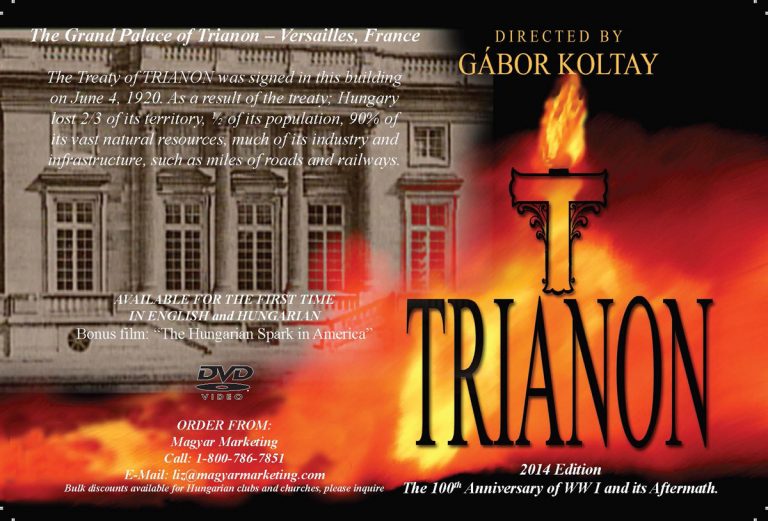
The Crucifixion of the Nation of Hungary – TRIANON [DVD]

The Aftermath of the 100th Anniversary of WW I (1914 -1918)

A bi-lingual (Hungarian/English) DVD with Professors, Historians, Intellectuals, and Poets that review the various national interests leading to the Treaty of Trianon, signed at the Grand Palace in Versailles, France on June 4, 1920.

Also, bonus part of the DVD – ‘The Hungarian Spark in America’; a previously released video of the many accomplishments of those of Hungarian descent in the field of art, music, theater, sports, science, medicine, etc

The DVD Menu allows the selection of Hungarian or English version, as well as, ‘The Hungarian Spark in America’.

Included with the DVD is a 22 page manual of the complete English dialog and maps contained in the video.

The TRIANON DVD is reproduced, released, and financed by The American Foundation For Hungarian Youth And Culture, Inc. at the request of the Kazinczy Ferenc Society of Hungary. Copyright with the US Copyright Office/Library of Congress.

Order From: Magyar Marketing – Phone #1-800-786-7851.

E-mail: liz@magyarmarketing.com

Bulk discounts available for Hungarian organizations, clubs, and churches.

TrianonPostcard_Page_1

Reklám
Tas J Nadas, Esq