
Home Blog Page 8

‘Correcting misleading assertions about Hungarians and defending Hungarian minority rights are our priority’ — An Interview with Ákos L. Nagy, President of the American Hungarian Federation

Ákos L. Nagy was born in an Austrian refugee camp in 1947. The family emigrated to the US in December1951 and settled in Passaic, New Jersey (NJ). After graduating from college, he was drafted into the US Army and served for two years. He then obtained an MBA in Finance and worked for 30 years for a New York-based multinational company. He got involved with the American Hungarian Federation (AHF, Amerikai Magyar Szövetség, AMSZ in Hungarian) in 1980 and was recently elected for the third time as the president of this umbrella organization, the largest and oldest of its kind in the United States, established in 1906 in Cleveland, Ohio as an association of Hungarian cultural and civic institutions and churches to protect their interests in the United States. Over the past 117 years, their mission has broadened to include the protection of the rights of Hungarian minorities in the Carpathian Basin.

***

What were the circumstances of your family’s arrival to the US?

My mother (Emerencia Timcsák) was a teacher, and my father (Dr. Sándor Nagy) was a school superintendent for the Szeged school system. The school administration stayed in place until the Red Army was at the outskirts of the city in October 1944. Fortunately, my mother and my four siblings (two brothers and two sisters) were sent previously to one of my uncles’ in Vác, north of Budapest. My family had to flee with nothing and the train containing their belongings was bombed by the Allies, so we do not even have a family photo from those times. From Vác the family went to my other uncle, Gyuri bácsi’s place in Szombathely, close to the Austrian border. My father was one of nine siblings; two died fighting the Russians in World War I. My father also fought in WWI on the Italian front when Italy turned on its allies.

What were the significant experiences and challenges faced by your family during their journey as refugees from Hungary, to Austria?

The family owned 250 acres of land in Szentes, a town close to Szeged, which was lost after the war along with other real estate they owned. By the time they got to the Austrian border, they could only buy an ox and a cart. They were fleeing with a group of a dozen or so other refugee families. Many times they became scared as they could hear loud gun and machine gun fire behind them as the German and Red Army units were fighting, and it sounded like the battle was only a mile or so behind them. At some point the German army commandeered all the oxen and horses from their refugee group, and put everybody on a train, in which they travelled around Austria for about two months, without any provision of food. The only way to survive was to find some food whenever the train stopped. My brother—who was always worried that the train would leave without him while he was scavenging for something to eat for the family—said the Austrians were often very compassionate and gave them food. All the refugees had to get off the train in the city of Braunau, Austria around April 1945, before Germany’s surrender on May 7, while the German and Red Army were still fighting near the city.

What were your family’s experiences and living conditions as refugees? 

My older sister almost died in Braunau as the US Army strafed the refugees from low flying aircraft. Later, they went to a refugee camp set up for Polish soldiers, who treated them well, recalling how Hungary welcomed them during WWII after the Nazis and the Red Army destroyed the Polish Army in a coordinated manner. Then they went to an American refugee camp, and finally moved to a British camp where the refuges were treated much better. The camp was located in Trefling, at the foothills of the Alps near Spital an Drau, Austria. There were about 5,000 refugees, of which about 500 Hungarian, while the rest were Belarusians, Russians, Volk Deutsch, and Croatians. The camp had public kitchens and my siblings told me that the menu would invariably consist of bean soup (without meat) for lunch and dinner. I was born in Seeboden by the way (where the closest hospital was located) in 1947, as an unplanned child: my father was 60, and my mother was 47 at the time.

When did it begin to become evident that the final destination was going to be the United States?

We had to wait in Seeboden, Austria for about six years, because the US wanted single young people and not big families like ours. While we could have gone to other countries, my father was determined to go to the United States, nowhere else. Finally, my parents’ friends from the refugee camp, Lajos and Júlia Kovács, who by that time lived in Passaic, NJ, became our sponsors.

What were your first experiences in the US?

I went to St Stephens School in Passaic, where the nuns were of Hungarian origin, and became a Hungarian scout.

We spoke Hungarian at home and my mother organized the Hungarian Saturday School at the church.

As a teenager, I attended bi-monthly classes in New York City, which was ten miles away from Passaic, where we were taught Hungarian history, geography and culture by Hungarian university professors. There were many other organizations and Hungarian social clubs where I and my friends were active. As a college student I regularly escorted debutantes at the many Gala Debutante Balls in NYC, which despite the meagre circumstances of most of the DP refugee families (‘Displaced Persons’ was a reference to the refugees from WWII and it was not an endearing term), were held at top venues such as the Waldorf Astoria, the Plaza Hotel, and son on. These families were willing to sacrifice financially to uphold these traditions. The fact is that the ‘DP’ families were not welcomed with open arms by many Americans. They were often viewed as somehow complicit in the horrors of WWII, even the Hungarians who came to America in early 1900s often felt this way.  Fortunately, the 1956 freedom fighters were treated much better.
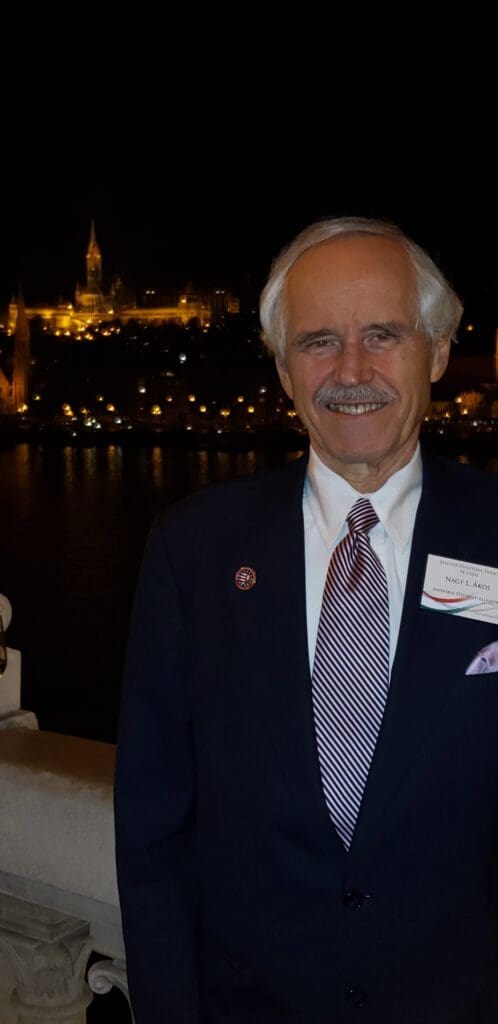
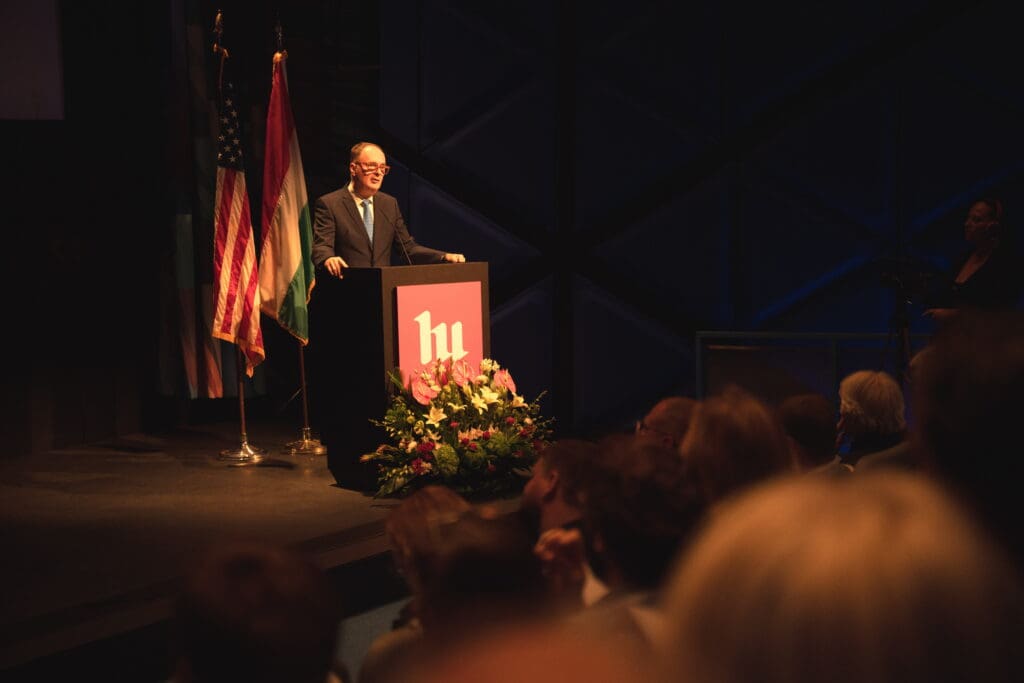
Ákos Nagy in Budapest, with the illuminated Castle Hill in the background. PHOTO: Courtesy Ákos Nagy

You were and you are a member of the still existing Hungarian Scout Association in Exteris (Külföldi Magyar Cserkészszövetség, KMCSSZ in Hungarian). What about the Lövészek riflery group?

Lövészek was founded around 1959 by Zoltán Vasvári, an armoured division captain in WWII who was the Hungarian scout troop commander at the time in NYC. Young men, many 1956 freedom fighters in their early 20s, joined, who felt too old to join the scouts, and did not want to run around in scout shorts. (Back then, American men did not wear shorts, except on the beach, but Hungarian Scouts did. There was a pop tune #1 on the Hit Parade ‘Short Shorts’ sung by The Royal Teens in 1957). Sometimes I had to wear scout shorts when walking two miles to the scout home in Clifton, NJ, and I recall a couple of times that fisticuffs broke out as the kids would make fun of the shorts. I was not a member of the Lövészek though but many friends of mine were: Frank Kapitány, Camille Szabó, Gábor Imrányi, Pista Csorna and Andrew Ludányi who climbed up a 50-feet pole and tore down the Soviet flag from the UN HQ in NYC in one of the demonstrations against the Soviet re-invasion of Hungary in 1956.

Many Hungarians felt that the United States was complicit in the crushing of the revolution,

as promises were made to encourage rebellion against the Communist regime in Hungary, but the revolutionaries were let down. The NYC mounted police occasionally charged into the demonstrators against the Russkies.

There is an excellent documentary film titled Lővészek / Cold Warriors that Réka Pigniczky and Andrea Rice Lauer (President of the Hungarian American Coalition, HAC) filmed in 2017. Could you please share some ‘behind the scenes’ stories related to that?

It was filmed at the Vasvári Farm in Rummerfield, PA. Zoltán Vasvári, whom we called Uncle Zoli or ‘Zoli bá’ bought the farm when he was still a scout commander in NYC. The farm was adjacent to the scout farm that Gábor Bodnár, Tibor Szadai, Lajos Bán and Frank Bodó purchased a couple of years earlier. Later, the Garfield scouts would camp at the Bodnár Farm and the Lövészek would hone their shooting and other paramilitary skills at the Vasvári Farm. I seem to recall that older NYC scouts camped at Zoli bá’s farm even after the Lövészek was formed as there was no animosity between them (several lövészek also remained active scouts, like the Ludányi boys). Around 1958, the NYC scout boys who were five or so years older than me, were camping at the Vasvári Farm, raided our scout camp at the Bodó farm at night, and while us younger scouts were sleeping, sewed our pants legs together and then started shouting ‘Alarm!’ As we jumped out of the sleeping bags, we were totally perplexed, because we couldn’t put on our pants and ‘repel’ the attack!

Were these men actual ‘Cold War warriors’ in some sense?

Up to late 60’s, organizations such as the Lövészek were common among refugees from the Iron Curtain countries, not just among the Hungarians. Their motto was ‘Death to Bolshevism’. I believe, but do not know for a fact, that these were encouraged in the context of the Cold War, in the event of a possible Eastern-Western conflict in Europe. It ended in the late ’80s, when Zoli bá died, who, unfortunately, did not live to see the liberation of Hungary from under the Soviet boot.

You did not have to use a gun in action, though you served in the army and were supposed to go to Vietnam. How would you have felt about going if you had to? Did you ever thought about it as a way to express your gratitude to the United States, as I heard from some Hungarian immigrants?

After graduating from Farleigh Dickinson University with a BA in Mathematics, I was drafted into the US Army and served two years. I, however, don’t know how to address your question about ‘feeling gratitude to the US from some immigrants’ and consequently desiring to go to potentially die or get permanently maimed in Vietnam. America has not been attacked. About 90 per cent of US college students were opposed to the war and only ten per cent understood the geopolitical situation of containing communist terror. I understood it, and was on my way to Vietnam, but do not regret ultimately not being sent there. Actually, I wanted to be a fighter pilot and was accepted into the US Air Force, but because I wore glasses, not as a pilot, but as a navigator. I was willing to enlist for six years but while the papers were being processed, I was drafted into the Army. Sometimes I wonder about it: who knows, it could have been an adventure, even though a close friend and many acquaintances of mine died there! To directly answer your question, the ‘gratitude’ aspect was not a consideration.

I was a patriotic American who answered the call and that’s it!

(Unlike a draft dodging US President who was elected twice despite that.) All three Nagy boys served in the Army: my oldest brother fought in the Korean War.

What happened in your private life after the Army?

I obtained an MBA in Finance from Rutgers University and started working for W. R. Grace in 1973. I worked 28 years at their corporate headquarters, with a two-year stint at Marriott Corp HQ in Bethesda, MD. During last 20 years I managed Grace’s worldwide real estate portfolio. I am still 100 per cent active, involved in land development in Swedesboro, NJ.  Last, but not least, I have a daughter, Ramona, who speaks fluent Hungarian and lives in Florida with my two little granddaughters, the apples of my eye! Our whole family is close knit maintains its heritage; my niece’s (Csilla Bányai) nine grandkids speak Hungarian and are scouts, as well as my nephew’s (Csaba Kertész) six grandkids.
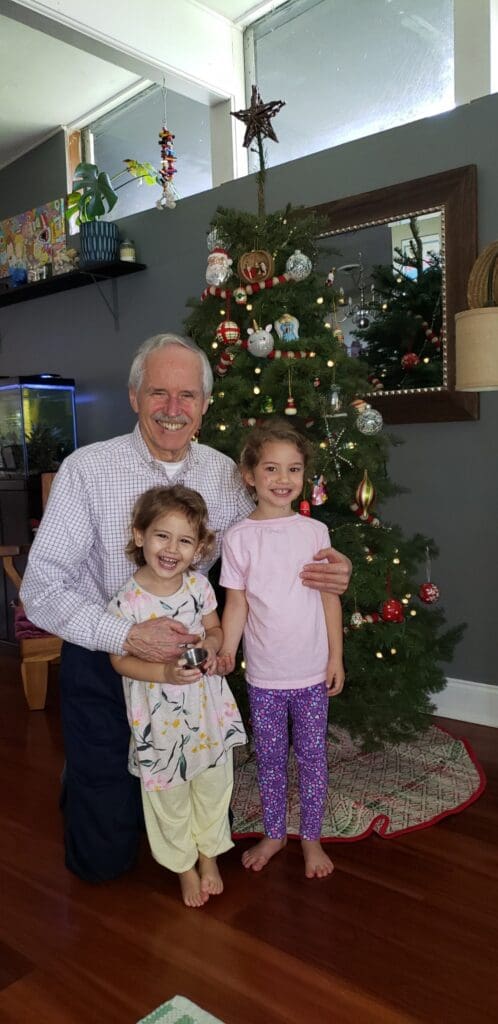
President Nagy with his granddaughters. PHOTO: Courtesy Ákos Nagy

And now let us turn to the American Hungarian Federation. You mentioned at a conference held in 2019 in the Hungarian Parliament that AHF’s mission includes correcting misleading assertions about Hungarians and their history. I also read on its website that one of AHF’s original missions was ‘to defend the good name and reputation of Hungary against attacks and defamations’. Is this then an ongoing mission? What are the other goals the organization is still pursuing?

AHF’s original mission was to help Hungarian immigrants to integrate into the American way of life.  An expansive explanation can be found in the book entitled Emlékkönyv az Amerikai Magyar Szövetség 80. Évfordulójára edited by Dr Elemér Bakó, published in 1988. With the tragic events unfolding in Europe in WWI, WWII, and in 1956, AHF’s mission evolved. In the 1920s and 30s, much of the AHF advocacy was directed at reversing to the extent possible the evil perpetuated by the unjust and forced Treaty of Trianon, which dismembered an 1,100-year-old nation in the heart of Europe. Consequently, a new mission was added to advocate for the Hungarians living in minority status in the Carpathian basin. The third objective is to support Hungarian institutions in America so that Hungarian culture and education can flourish. These latter two are still critical goals. The AHF stands up for the rights of Hungarians living in the successor countries, and has done so for 50 years, regardless of the Hungarian governments’ positions.

We have a friendly relationship with the current government, which also advocates for the Hungarian minorities.

However, the AHF is not a lobby group; the Hungarian government has its own lobbyists in the US. AHF advocates for issues that American Hungarians feel are important. There are many articles in this regard on AHF’s website; for instance, Louis S. Segesvary, PhD, a retired American Foreign Service officer, recently wrote an article about the treatment of Hungarians in Ukraine.

Who are the members of AHF? Institutions or private individuals or both?

Currently both. The need for individuals is due to the fact that many individuals who want to work for AHF’s goals are not members in any organization. But at the outset, AHF was set up as an umbrella organization and the members were Hungarian institutions. I understand that in the heyday of Hungarian immigration to America there were 5,000 active organizations plus innumerable business ventures catering to them. My recollection is that when I joined in 1980, there were still at least 1,000 active Hungarian organizations in the US, and over 100 of them were AHF members. Since that time most of the churches and social clubs have closed, the Hungarian Reformed Federation (a fraternal insurance company) no longer exists, and overall, there are maybe 200 organizations left that have some activity.
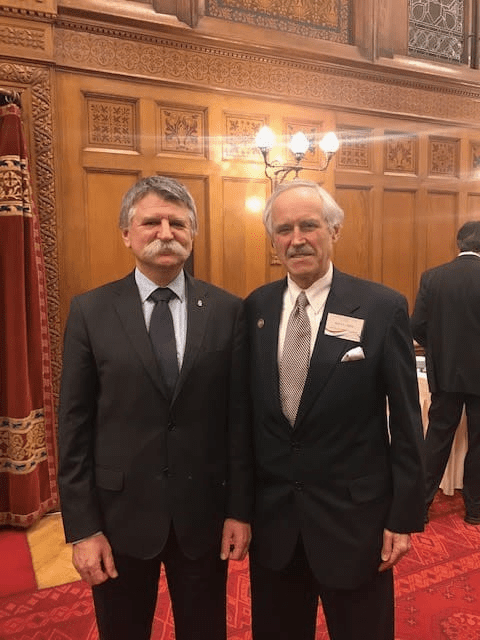
President Nagy with Hungarian House Speaker László Kövér in the Hungarian Parliament in 2019. PHOTO: Courtesy Ákos Nagy

What are the changing needs and challenges faced by the American Hungarian community today, as you’ve gathered from discussions with leaders of prominent organizations?

My understanding from speaking with the leaders of some of the large organizations is that the needs of American Hungarians have changed. This reflects the composition of the American Hungarians. Immigration from Hungary is at a trickle; most of those who come are here temporarily working for multi-national companies, and there are also many others who have overstayed their visas and live in a half-illegal status.

As a result of Hungary’s European Union membership and the eroding US economy, there is less of an incentive to immigrate here.

The net result is that the new ‘immigrants’ don’t have the same needs as the ones who arrived before 1989. If a church or club closes, it is not viewed as a tragedy any more and most of the new immigrants have family and friends to go back to in Hungary.

How are you addressing the challenge of engaging younger individuals? Could you share your strategies and successes in recruiting?

We still consider organization as key, and are actively recruiting, and forming new chapters of the AHF. We are also working on recruiting individual members. As the stalwarts who were the ‘backbones’ of these institutions are growing older, we cannot find enough younger people who are interested to get involved and sacrifice the time and effort to keep the work going. The children of the old guard often do not speak Hungarian; they may come to the large Hungarian Day in Brunswick held every year on the first Saturday of June, eat a ‘goulash’ or ‘chicken paprikash’, watch a folk dance, but that’s all, that is the extent of their Hungarian heritage. It takes up a lot of time to engage in advocacy, and people are changing, they are busy with their own lives with (non-Hungarian) social events, sports. The need to be part of Hungarian associations is not there, especially since they do not speak the language any more. Consequently, we are also discussing how to reach out to those who do not speak Hungarian but still consider their heritage important. Despite all this, we are having same success recruiting younger people: about ten are involved now as officers and directors of AHF.

AHF ‘strives to unite the American Hungarian community through work that supports common goals’. Has this also changed over the past years? What were the main issues that united them?

Supporting common goals has never been easy, as different personal, political, and ideological views needed to be put aside for the sake of a higher common goal. It worked mostly in case of bigger issues or tragedies, such as Trianon or the demolition of 300 Hungarian villages in Transylvania back in the middle of the ‘70s as part of Ceaușescu’s anti-Hungarian programmes. At that time, I was one of the founders along with Imre Beke, László Hámos and others of the Hungarian Youth Organization (Fiatal Magyar Munkaközösség or FMM). We were involved and organized protests in NYC and in Washington, DC when Ceaușescu visited. In 1976, about 2,000 people showed up at a Hungarian rally in Washington, DC to stop this attack on civilization and culture.

Even Charles, the Prince of Wales, currently the King of England spoke out against it,

stating that one of the cemeteries of an affected village contained the grave of his great-great-grandmother, Countess Klaudia Rhédey. I was a young guy and along with my friends was very resolved to stop this travesty.

In your opinion, did these protests help stop the destruction of those Hungarian villages in Transylvania?

Yes, but there’s more: these demonstrations definitely united the Hungarians not only in the US at the time. In the mid ‘80s, AHF had a lot to do with the revocation of the Most Favourite Nation bilateral trade status between Romania and the US. They destroyed Hungarian Bibles, made toilet paper out of them—those news also united American Hungarians. We received a lot of support from the Baptists, other Protestant denominations and the budding evangelicals. Reverend Sándor Haraszti was instrumental in getting the US Baptists involved as the head of the American Hungarian Baptists and later Chairman of AHF’s Board. David Funderburke, the US Ambassador to Romania in 1981, also played an important role in this effort.

Impressive… Can you please provide additional examples or actions?

Another issue that united us was the fall of the Berlin wall in 1989, when all American Hungarians celebrated together the end of the communist era and Soviet occupation. AHF organized a banquet with about 500 people from all over the US in Montclair, NJ. We hosted Mátyás Szűrös, then interim president of Hungary, and after the banquet was over, Imre Beke (then Chair of the AHF Executive Committee) suggested that he should lay a wreath at the 1956 statue in Passaic Park (Clifton, NJ) which he did, along with the entire delegation from the Hungarian government. I believe this was the first wreath-laying to commemorate the 1956 freedom fighters by the Hungarian government in the world.

The latest example was the placement of the Kossuth statue in the US Capitol in 1990. Bishop Tibor Dömötör, then Chairman

of AHF, was instrumental in raising the money for the bronze bust of Kossuth, which was placed in the Statuary Hall of the Capitol in 1990. Congressman Tom Lantos was a big help getting the approval of US Congress to make this happen. Reverend László Tőkés from Romania, many congressmen and a couple of senators, and Hungarians from every part of America attended this event. There were only two non-Americans who had statues there: General Lafayette and General Pulaski (both heroes of the American Revolutionary War), and now the third and most recent is Lajos Kossuth.

Does any remnant of that gritty self-assertion still exist today?

An example of a positive resolution of an issue was the State Department’s attempt in 2017 with holdovers from the previous Obama-administration who proposed (through the Bureau of Democracy, Human Rights, and Labour) to allocate $700,000 to fund media groups in Hungary that are opposing the current Hungarian government. AHF’s efforts—including a letter to Assistant Secretary of State Wess Mitchell, followed by a meeting with Congressman Andy Harris (with whom other topics were also discussed including Ukraine’s education law curtailing Hungarian and other ethnic minorities to be educated in their mother tongue) and an AHF letter to then-Secretary of State Rex Tillerson, and later on a meeting with State Department officials, Matthew Palmer, Deputy Assistant Secretary of State for European and Eurasian Affairs, and Ivan S. Weinstein, the Hungary Desk Officer—

were successful in blocking the State Department grant. Most American Hungarians found it insulting that the State Department even considered this initiative.

The reasoning is simple. In the US, out of the ten or so major television channels nine are far-left liberal. Americans would not appreciate it if Hungary or some other country told the US what to do in this regard or tried to fund opposition media.

Hungary might have dodged a bullet, thanks to your work. Hungary’s negative political framing is no novelty. Some say that it has its roots in the beginning of the 20th century. Is this the reason why you are dealing with issues like antisemitism?

In November 2019, we co-hosted a conference, titled The Fate of Rescuers in Dictatorships, which honoured Colonel Ferenc Koszorús, whose military intervention in the summer of 1944 prevented the deportation of close to 300,000 Jews living in Budapest at the time, who were about to be deported to Auschwitz. At the conference we also introduced Dr Zsuzsa Hantó’s latest book, Páncélosokkal az életért – Koszorús Ferenc, a holokauszt hőse (With Tanks for Life – Ferenc Koszorús, a Hero of the Holocaust). The book recounts the history of the 13 Hungarians who worked to save the Jews in 1944 and it was prepared from the materials presented at the above conference. AHF is working on getting it translated into English. This is the type of critical issue advocacy AHF does to set the historical record straight. There are critics who

accuse all Hungarians of having been Nazi collaborators by inaccurately presenting facts and the political situation Hungary faced during WWII.

They refuse to acknowledge any fact, including these acts of heroism, that refutes their efforts to ‘tar brush’ all Hungarians. There is no other country under Nazi occupation which did anything heroic of this magnitude to save Jews. These same critics ignore the vicious forces supporting the Nazis in Norway, France, Spain, Slovakia, Romania, Ukraine and multiple other countries, who committed horrible acts of violence against Jews, but they do not talk or write about them, because they were ultimately ‘on the winning side’. In the late 19th and early 20th centuries, Hungary was the unofficial ‘capital’ of the Jews living in Europe. The biggest European synagogue is in Budapest: I guess because Hungarians have always been more tolerant than other European countries. Many Jews fled from other countries to Hungary, for example from Romania to survive during the first two years of WWII. There were no death camps in Hungary even during the German Nazi occupation in 1944. We want to translate the book and distribute it to universities and think tanks.

What about Trianon?

Similarly, Trianon must be on our agenda because the neighbouring countries still mistreat Hungarian minorities, and not just from a basic human rights’ perspective, but also in terms of collective rights. Romania has not returned many of the confiscated church, school and other civic Hungarian properties. These battles still need to be fought and it is not easy. In 2020, on the 100th anniversary of the Treaty of Trianon, AHF organized an international symposium in Washington DC, which, due to the Covid pandemic, was held as an online event. There were experts and authors attending from the US, UK, and Hungary. AHF was successful in having its statement on Trianon published as a full-page article in the Washington Times.

Ildikó Antal-Ferencz

Source: hungarianconservative.com

Reklám
Tas J Nadas, Esq

An Interview with Rev. Zoltán Vass, Minister of the Reformed Church in Toronto

Source: hungarianconservative.com

This is an abridged version of the interview first published on reformatus.hu.

Zoltán Vass was born in 1954 into a Transylvanian minister’s family. In the 1980s he left Transylvania for Western Europe but returned home to be with his newborn son. In due course, he set out again to America, initially to New York, then Hollywood, ultimately settling in Toronto 29 years ago as the minister of the First Hungarian Reformed Church, which will be 95 years old next year. He also serves on the Board of the Hungarian Diaspora Council.

***

Was it a family expectation to follow your father’s vocation?

I was born in the village of Hegyközcsatár near Nagyvárad (Oradea, Romania). The church was my home, I grew up in it, I helped my father with everything from ringing the bell to posting the hymn numbers. Given my academic results, my parents considered a variety of careers to choose from but ultimately, I chose to become a minister. The choice came to me simply and naturally as one born into God’s family where I grew up and felt at home, never doubting my choice over these many years. Not long after my birth, my father became a minister at Apátkeresztúr (Crestur) in Bihar County. We lived there until I was five or six years old. Then my father was invited to Tenke, a small spa town that was purely Hungarian until Romanians from the surrounding area started to move in. I went to a bilingual school and high school, then to study theology at the university in Kolozsvár (Cluj). We received such a solid foundation there that when I later studied theology at Princeton, New Jersey, I struggled more with learning the general language than the professional language. Being well grounded in all aspects of theology, I could discuss any topics with confidence, albeit initially with broken English.

After completing the four years in Kolozsvár, my professors encouraged me to continue my studies in Szeben (Sibiu) in German. I graduated in theology in 1979 and I was ordained in 1982. First, I was an assistant minister in Nagyvárad for nine months. Then for three months in Bélzerind (Zerindu Mic), a village along the Fehér–Körös River, where people got along well as a tight community without outside interference. I became very fond of them during my short stay. Pusztaújlak (also known as Körösújlak; Uileacu de Cris), a Hungarian village 20 kilometers from Nagyvárad, inhabited mainly by members of the Reformed Church, followed for eight years.

How and when did you come to America?

When my mother-in-law remarried in the U.S., I applied for a passport to visit her. Since I had already returned from a trip to Algeria (and Western Europe), where I had visited my sister’s family, and my wife had also returned earlier from visiting her mother, the communist authorities chanced that I wouldn’t defect while my family remained hostage. Even so, I had to wait for almost a year since my bishop was reluctant to give his consent. I was afraid that the Securitate—the secret service in Ceaușescu’s communist dictatorship—could at the last minute take me off any plane for any reason. Even in Frankfurt, Germany when I transferred from the Romanian flight to Lufthansa, I was worried whether they would detain me having second thoughts about my trustworthiness as a Hungarian minister. Because of this, I didn’t dare talk with anybody about my plans. Nevertheless, as I boarded the Bucharest-bound flight in Nagyvárad, my father said to my mother: ‘He won’t come back.’

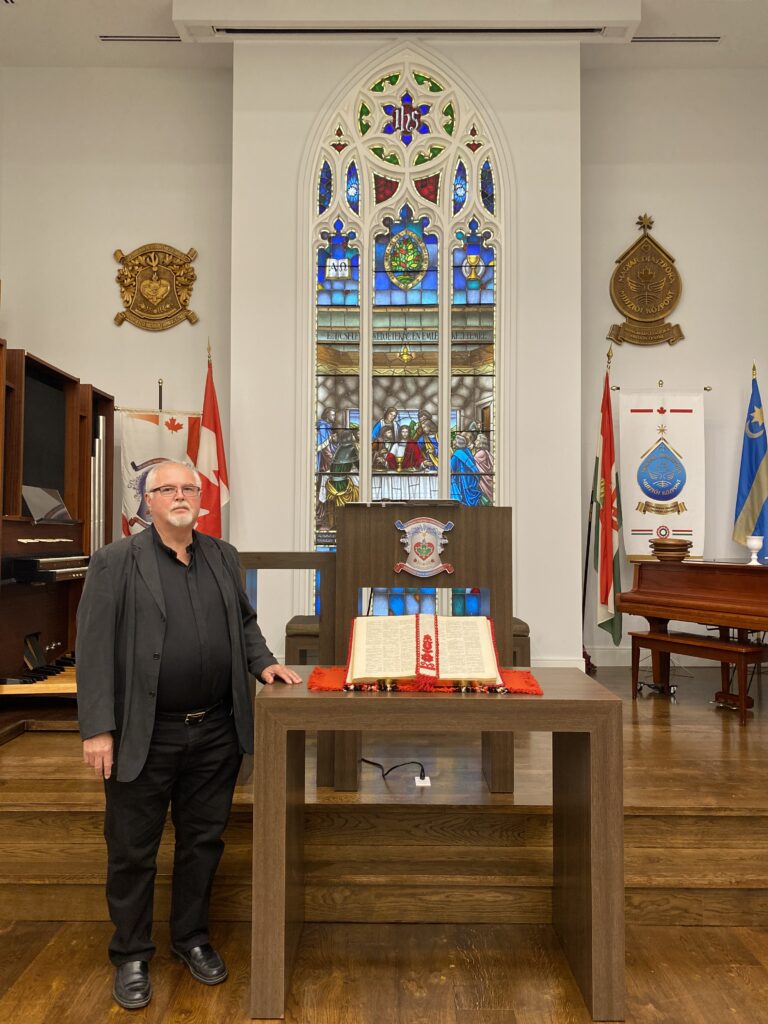
Reverend Zoltán Vass in September 2023 PHOTO: courtesy of Ildikó Antal-Ferencz

What were your first impressions of America?

My first trip to New York was to the 82nd Street Hungarian Reformed Church. I preached there on Palm Sunday, then I served there as an associate minister for almost two years. In the meantime, I studied at Princeton Theological Seminary and earned my master’s degree. Then I was accepted to the doctoral program, where I spent a couple of years, and continued my studies in Toronto. The years at Princeton were very beneficial as I got to know the local scientific community during the course of my immersion in theological studies.

What prompted your next steps?

The agreement with the aging minister in New York was that he would retire, and I would take over the congregation, but he changed his mind. I moved to the First Hungarian Reformed Church on 69th Street. Being good friends with the minister there, we signed up together for a three-year course preparing for hospital chaplaincy. The knowledge I gained there proved invaluable, especially in building relationships. A hospital chaplain establishes rapport with strangers, making it difficult to come to terms with it when one dies. I had an interesting conversation with a Lutheran pastor who said to me that he was taking the course because he could never close his parish door. Thinking this through, I concluded that this approach gave rise to the maxim that the minister is invisible during the week and incomprehensible on Sunday. In contrast, my door will always be open. I have a single phone number where I am always reachable, and I take special care to participate in the life of the congregation. This approach has time and again proven itself very rewarding.

From New York you went to Hollywood, California and then to Toronto, Canada. Why?

While in New York, the minister’s position in Hollywood became vacant. There was a minister there for 29 years, who was very ill during his last ten years. I found a very strange group of church elders there, who took over the authority from the sick minister and ran the church on their own will. They did not like the fact that their reign came to an end with my arrival, but that’s how it usually happens when we take control and clean the house. Those three years were the most productive period of my entire career as minister. The Hollywood congregation with 70–80 people regularly attending services in the renovated church was quite happy with me and they did not want to let me go. But when the minister’s position in Toronto became vacant, I announced my departure. Toronto’s church was comparatively huge and beautiful, housing the largest Hungarian speaking congregation in North America with 120–150 people regularly attending each service—which is a huge number in the diaspora. I introduced myself in December 1993 by speaking at a social event on Saturday night and preaching on Sunday. I was invited to preach for a call in February 1994 as an official candidate for the position. Elections followed with 16 candidates as I recall, that was reduced to a shortlist of three with one dropping out before the final ballot. We Protestants are competitive to the bitter end…

Having won the position, you have been in Toronto for 29 years. How do you see this long period of time?

Yes, I will be marking 30 years next year and I am pleased the years have passed without significant conflicts. Of course there were disagreements, but they were all surmountable. As soon as I came here, I started to work vigorously: there was a youth group, starting with Sunday school and all kinds of musical and other events. This is a more conservative congregation, initially unsupportive to cultural content, but after a while they opened up and well-known artists, actors, and musicians visited us here as well. I was younger and came up with all kinds of new ideas. We held modern services, including one Christmas service featuring rock music. In 2004, we celebrated our 75th anniversary in a beautiful venue, where Bishop László Tőkés was our guest of honor, and Miklós Varga—a famous Hungarian singer—performed. We commemorate every major anniversary, especially of our founding in 1929 usually at the Hungarian Cultural Center. Next year, we will be celebrating the 95th anniversary of the founding of the church. I will be 70 years old and slowly getting ready for retirement.

Zoltán’s wife, Jozefina and their son, Gergely PHOTO: courtesy of Zoltán Vass

Before we talk about the future, let me ask: when did your family join you from Transylvania? How did your wife fare with life in immigration?

I kept in close contact with my family. They followed me to New York in March 1990 (shortly after the Ceaucescu regime had collapsed). Our son Gergely was born in February 1982 and was five years old when I left, so we missed a few years. Our daughter, Viktória, was born in Los Angeles in 1993. Jozefina stayed home with the children for a long time. She started working in Toronto, first as an administrator at a Montessori school for twenty years, then at another education center for ten years. She is now retired but she won’t be resting for long, because we’ll soon be launching the Kodály Method Music School and she’ll be the director there. It will function as an after-school program, with teachers from the Royal Conservatory, and a KCSP (Sándor Kőrösi Csoma Program) scholar/teacher who has taught this method in Beijing for eight years. I want to build this before I retire, and I want to pass on a well-functioning school to my successor.

Who is expected at the school and who will maintain it?

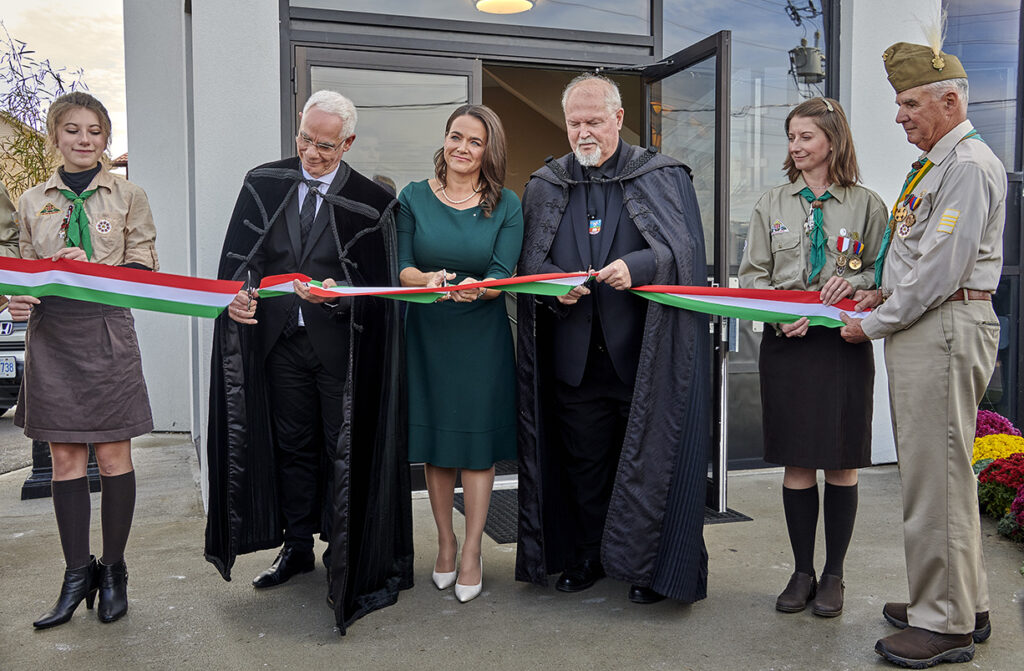
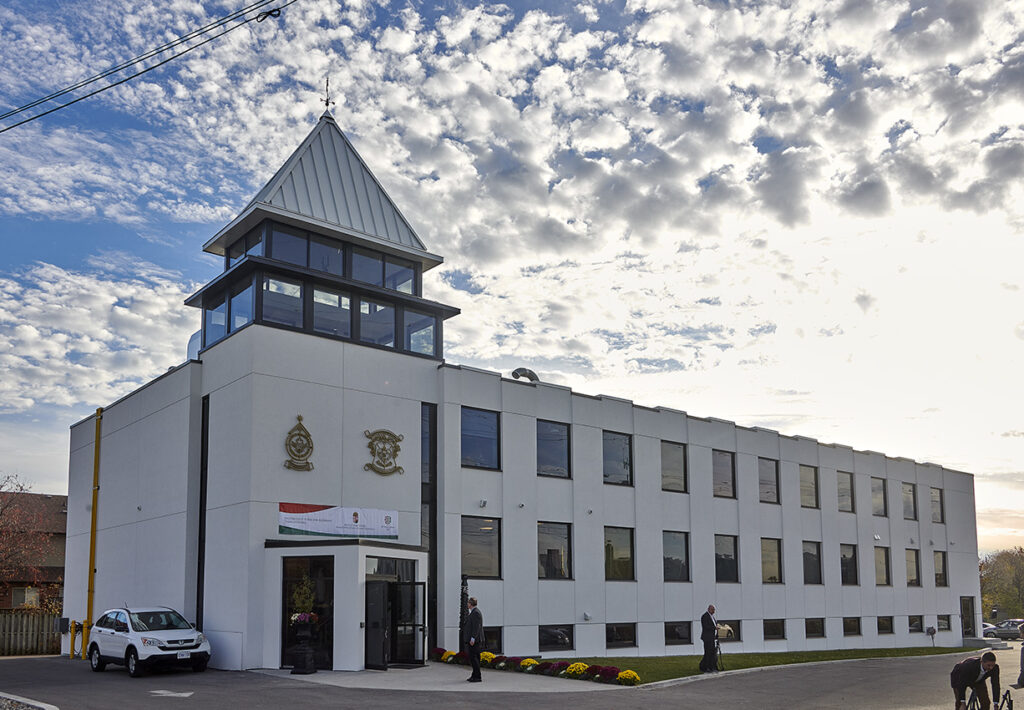
Given that the Kodály method is well known in Chinese and Japanese cultures, apart from Hungarians we will mainly target Canadians of Chinese and Japanese descent, and it’s likely that they’ll make up the majority of the students. The school will belong to the Hungarian Diaspora Mission Center, which, in addition to the church, will house several different organizations: the music school is only one of them, but there will be a sports center too. The locker rooms have already been built and there is a soccer field close to us, which is suitable for us to start an athletic program. However, this requires more time and special organization, as we have moved here only recently having sold our previous church building in 2018 to buy an old school building, which had to be fully remodeled. We applied to the Hungarian government and duly received a grant to carry out the remodeling of the building, which incorporates the relocated church, an important bastion of the Hungarian Diaspora, completed in October of 2022. Of the many people who supported our cause, I would like to highlight the support of former President Katalin Novák, who presided at the inauguration of the Hungarian Diaspora Mission Center and Bishop Zoltán Balog, who dedicated the relocated church incorporated in the building.

At the inauguration of the Hungarian Diaspora Mission Center with Bishop Zoltán Balog (second from left), former President of Hungary Katalin Novák (third from left), and Zoltán Vass (third from right) on 31 October 2023 PHOTO: courtesy of Zoltán Vass

Why was all this necessary?

I foresaw problems 15 years ago as the generation that has maintained that big and beautiful church started to dwindle, and the new generation will not fill the growing void. I announced my concerns to the congregation, repeatedly explaining to them the urgency to relocate while we still had the strength to act. I encountered a lot of resistance, especially from older people whose lives were indelibly vested in the old church building, with an immense nostalgia and I couldn’t fault them for that, but with all the respect the maintenance and upkeep were becoming unsustainable. There was a very stormy assembly meeting where they accused me of giving up the old building for a new one that was merely a vague concept. In the end, the congregation voted to relocate with a majority of more than two-thirds, but I still had to pacify the elderly. This was in 2016 and we were able to present the new location at another meeting in 2017. It took almost a year to complete the sale and purchase.  Finally, in 2021, we opened the new church to the community.

How big is this community? Is it Hungarian or rather bilingual? In the U.S., the Reformed congregations are mostly bilingual.

On our community list, there are approximately 150 of us, which is always changing in such a big city. After the Covid pandemic, our numbers shrank to approximately 100. Toronto is a big city; sometimes newcomers show up, which is always encouraging. The stable congregation ranges between 70–100 souls. In regard to language, let’s not forget that French is the other official language here, and this is a huge help for ethnic groups to keep their own language. Bilingualism is not a problem here. The U.S. is different, much more of a melting pot. We mainly have Hungarian services here, with very few bilingual services; only if a family requests it specifically for a baptism, wedding, or funeral. On larger holidays, if I see English-speaking family members, I turn to them in English, so they also feel included in the worship.

The Hungarian Diaspora Mission Center PHOTO: courtesy of Zoltán Vass

You said, ‘We are unified by our disagreements.’ What did you mean?

I was a board member of the local Hungarian Culture Center for a long time. There were serious disagreements between different generations and factions. We worked together a lot, but many of us argued about everything. However, in crucial situations, we were able to get together. Also, although leadership was often second guessed or undermined just to showcase independent thinking, a well explained good cause garnered solid support. We Hungarians can be very distant from each other, but our hearts keep us together.

Does the generational conflict mean that the older people don’t want to let things slip out of their hands? How did you handle that?

Yes, in such a community we have to cooperate with many people of different abilities. Conflicts often arise from misunderstanding and lack of information, but when they slowly understand what the actual situation is, it is possible to work together with the elderly. As leaders, our task is to ensure that they also see the path that we see ahead. But this must be done patiently and in such a way that they feel that it is theirs. Because otherwise they would say: the minister goes ahead, he doesn’t even ask us. Often this is the reason for misunderstandings, but we, the ministers, must solve this, and if necessary, examine the issues back and forth several times. We have to share, discuss, and debate. It is tiring, there are difficult periods, but we also have to go through the paths that we don’t like. It’s the result of patience that my almost thirty years of service here has been largely conflict-free. At the beginning, we had 18 elders in the Session, who said no to all my suggestions. After a few occasions, I told them: ‘It doesn’t work this way, we should move forward somehow. My next proposal can only be voted down if an alternative is offered. If it is better than mine, then we will go with it, but if not, then we stick to my original proposal.’ It broke the ice. I was able to be patient also regarding the relocation of the church—I knew it was the right decision.

How did you become a member of the board of the Hungarian Diaspora Council and a member of the Hungarian Permanent Conference (Magyar Állandó Értekezlet, abbreviated as MÁÉRT)?

Before the possibility of a simplified acquisition of Hungarian citizenship was announced, I applied twice unsuccessfully. On 2 January, 2011, on the first day when this possibility became available, I took my family to the Hungarian embassy in Ottawa to hand in our papers. I was proud to be the first Hungarian in North America to become a Hungarian citizen in the framework of the new simplified procedure, but I knew that others wouldn’t drive 500 kilometers for it. Anyone who has a Canadian passport in their pocket, even if they are good Hungarians, will not spend a day or two making the effort. That’s why I invited the embassy to us as a ‘mobile consulate’ for which I’d provide the venue and equipment. At first, they refused so I also asked the authorities in Hungary to investigate whether there is such a possibility, because if we really want to have new Hungarian citizens in Canada, they must do something about it. With their help, I finally succeeded. I started the process, collected the names, organized the visits; they just had to come and seal the documents. That’s when I became part of the Diaspora Council, perhaps because they appreciated what I had done. The board members of the Hungarian Diaspora Council are automatically members of MÁÉRT. In my first speech there, I confessed: I have four passports, but the most valuable is the one I received last: the Hungarian one, which means more to me than anything else because I had to fight for it, whereas I received the others automatically. This touched the audience very much, just as it did when I added: the church will be the last place where the lights will be turned off for the Hungarians in the diaspora.

Ildikó Antal-Ferencz

Source: hungarianconservative.com

Reklám
Tas J Nadas, Esq

‘We need a substitute for the Old Country’ — A Conversation with the Lengyel Family at the Magyar Tanya* in Philadelphia

‘We have come together to celebrate the 60th anniversary of the Magyar Tanya, a club founded by Hungarian Americans, to remember and pay tribute to the founders who created everything we enjoy and appreciate today. To this day, we need a place to come together, to cherish our nationality, our traditions, and our customs. We need a place that is truly ours, that is a substitute for the Old Country, and that welcomes all our fellow citizens who approach us with goodwill. Today we still believe in the principles on which this organization was built, and to which we must continue to adhere if we are to survive. Its members should look at what it can give to the Magyar Tanya, not how it can be used.’ This is how László Lengyel began his speech at the event commemorating the 60th anniversary of the Magyar Tanya club. A conversation with László Lengyel, his wife Marika, and their daughter Emília.

***

In your speech, you described the history of the association that founded the club. What was the beginning like?

László Lengyel: The club was founded on 4 November 1961 in Philadelphia, with 67 refugees of 1956 attending the event, marking the fifth anniversary of the [Hungarian] Revolution’s defeat. By that time, most of the refugees had families or were starting families. The founders set up a non-profit organization and subscribed for shares to buy the land, but they had little idea of how to maintain it, so they used the proceeds, which should have been the capital stock, to run it. They charged a token $2 membership fee, regardless of expenses, and to some extent, this is still the case today: membership fees cover less than a third of annual expenses. Although the bylaws require the board to share annual expenses equally among the membership, the board has never once in over 60 years done so, as the priority was not whether money came in from the shares, but whether those who were shareholders felt true ownership of the place. Our first President was Dr Tibor Bódi for two years, followed by Tibor Machán for one year, and then József Szodfridt, who held the post for almost 40 years until his death at the age of 80. After that came Alajos Remetei, then me for two seven-year terms, then Erzsébet Veres for four years, and now my brother is President, and I am Vice-President. This year the directorate consists of twenty members: President, Vice-President, Secretary, Treasurer, Hungarian Notary, English Notary, and fourteen Directors, representing ten per cent of the membership respectively. This number originally kept growing nicely, but has now, unfortunately, decreased, because many of the founders are no longer with us. I became a director in ‘71, at the age of just 21.

So young? Or was that common at the time? And what is the situation now?

L.L.: According to the basic rules, you can vote and hold office from the age of 18. At the time, other young people were involved in the board as well, and although not all of them stayed, I have been on the board ever since. Over the past 52 years, I have been a Director, Secretary, Vice-President, and President—I’ve been everything but Treasurer. There were times when it wasn’t so easy to be on the board, like when I was away in Houston for two years, but when I had to be here, I was always here. When I was working and living in Pittsburgh for ten years, I was President at the time, so I would fly in or drive to meetings; I spent quite a bit of time travelling. Every year we have a general meeting and an election. Apart from that, we have four to five board meetings a year, depending on what is happening and what decisions need to be made, including amendments to the statutes. In 2012, I retired at the age of 62, and we moved to a house a few minutes from the Tanya—but not because of the Tanya, as it’s not always so good to live too close because you can be called in at any time. We had known the area for a long time; I used to come here with my parents at the beginning.

I was 11 when Magyar Tanya was founded, and I’ve been here ever since.

So, we would have moved here even without the existence of the Magyar Tanya. When Marika and I got married, we lived further away, but we were still often coming here.

Members are not difficult to get, there are many applicants, but there are fewer who feel ownership of the place and treat it as such. Right now, we have 110–120 members, but one member is one family, so we’re over 200 if you count adults only.

There used to be a Hungarian school and scouting here as well, despite the fact that there were never any Hungarians living here in large numbers…

L.L.: Yes, Katalin Vörös and the Pigniczky family could tell you a lot about this, as they were the leaders of the scouting here at the time, but unfortunately, it was discontinued in the 90s. The Hungarian Scout Association in Exteris (Külföldi Magyar Cserkészszövetség, KMCsSz) is very clever in demanding that you don’t become a scout just because you wear a tie, but that you must also know Hungarian. The Hungarian school ran parallel to the scouting and ceased to exist at the same time, as the same children went to both.

Marika Lengyel: I was a kindergarten teacher in the Hungarian kindergarten on the premises, and at that time there were 12 children there; they all spoke enough Hungarian to understand everything. They came to us for two years until they were of school age, but by then many of them had so many other things to do that they didn’t have time to come to the Hungarian school.

Emília Lengyel: I grew up here, this is my home. I was a scout here, and I went to the Hungarian school here. We were here every weekend, especially in the summer. I grew up together with Eszti and Réka Pigniczky** as if we were sisters. They are still active now. At the Sík Sándor Scout Park in Fillmore (New York State), I am a trainer at the annual leadership camp for the assistant scout subcamp, and I also give lectures at the little scoutmaster training. However, this year I didn’t go there—I attended the Dobó subcamp of the VK camp in Germany instead. Before that, I had a holiday in Europe and visited relatives in Hungary—something I do every year.

Before we delve into the history of the estate’s buildings, tell us a little bit about your own life.

M. L.: My parents came to America in 1948. At the end of the war in Germany, my father, an army officer, was captured by the Americans. They tried to get me out in ‘53, too, when they became American citizens, but the Hungarian government wouldn’t let me out. So, in ‘56, my aunt helped me get to my parents when I was 13. When my parents fled Budapest to the West, the windows were shot out on the train. I was 15 months old and had pneumonia. When on their way they passed the place where my great-grandmother lived, they dropped me off at her house and continued without me. When my aunt and I came out here later, she lived with my parents for a year, then she went to Philadelphia, managed to make a living on her own, and when I got married, she moved in with us again and lived with us for thirty years. What was it like to come out here at 13? Terrible. I missed everyone from home. My parents lived on a farm—my father was an engineer, but he liked to live on the farm, doing outdoor things; they raised cattle, for example. But I was lonely, and because I was in my teens, we never really got on well. So, I went to a private school in Kentucky, finished secondary school there, and then came to live with my aunt in Philadelphia.

My meeting with Laci is a funny story. There was a butcher nearby who raised pigs, and a lot of people used to go there from the club to buy meat and stuff. I met Laci when I was hired to help process the meat and fat. It was five hundred metres from where we live now; that’s why it was so important for me to come back here. I started coming to the Magyar Tanya after we got married, and I’ve been coming home here ever since.

So, you finally found a home here and then. And how did you, Laci, end up in America?

L. L.: My father was involved in the Revolution and the neighbour told him that he the communist authorities wanted to arrest him. We ended up in Pottstown, in the end, not far from here; my father’s aunt lived there and sponsored us, and I went to the second grade at the Catholic school there. I didn’t speak English at all, but I picked it up quickly and easily. In 1961, the first scout camp was held at the Magyar Tanya, and I took part in it.

Emília, as you said, you grew up here, among the scouts. What does scouting mean to you and what else do you do?

E. L.: Scouting is a way of life, full of joy. My basic nature is to always be cheerful and to love people and children. Of course, there are negative things in life and in scouting as well, but I always try to look at the bright side. Otherwise, I have been a teacher for 35 years. I taught fourth graders for 16 years, then worked for two years as a professor at the university. I worked in a secondary school for 16 years, and now I’ve been working for two years in a middle school with kids who have reading problems. I love teaching. Besides, I started taking pictures at a scout camp a few years ago, and then I put them on social media, and everyone liked them. That’s how it started and since then I’ve been taking photos at almost every major scout camp. I know everyone, everyone knows me, and I always have my camera around my neck. The kids smile when they see me as they know: photography is coming. The parents also like to see that everything is going well with their children at the camps and that they are having a good time.

You mentioned that you go to Hungary every year. Is that like going home, too?

E. L.: Yes! I was brought up as a Hungarian by my parents. That’s what scouting and the Hungarian school were for.

I feel Hungarian, and when I go to Hungary, I go home.

Even in the American school where I teach, everyone knows that I am Hungarian and a scout. I have both in my heart. I was six or seven years old when my Aunt Ida took me to Hungary for the first time, for three weeks. Since then, I have gone every year with my parents and my brother Lackó; since I grew up, alone or with my mother.

What did this area originally look like?

L. L.: It was originally a dilapidated house and barn with leaky roofs. There were no toilets, no water, no heating, no stove, just very poor electricity supply. The house had no foundation, its walls leaned outwards, and the middle was sunken. There were no roads, and the site of the present lake was a swamp. The women cooked in primitive, almost ancient conditions, on an outdoor stove, for which they had to fetch water from the spring, of which there are several on the estate. The building was eventually raised and excavated underneath; the kitchen and dining room are now there. The old house has been enlarged with a dance hall, eight guest rooms, parking spaces, and a garage. The pool was completed in 1972 because families needed a place to bathe. First, a lake was established, with a sandy area on the shore, which became the beach. [One of the members,] Jóska, dug the pond by converting an old tank into a bulldozer. The shape of the lake was reminiscent of Greater Hungary. But as time went by, more and more farmers used chemicals, which leached into the groundwater and turned up in the pond as well. Therefore, when the water quality was no longer good enough, we built the pool.

M. L.: The people worked by day and danced by night. A band called Falbontó (Wall-Breaker) played music for them—when it got dark the women prepared dinner and then danced until dawn. This was the case every Saturday, and on Sunday they continued working. In the meantime, they went home because there was nowhere to sleep here. The building was originally planned as a hotel, but it’s not very suitable for use in the winter as it’s far from the main road, so at the end of November, before the harsher winter sets in, we close this building and the pool and move to the other clubhouse. And then around April–May, we move back here. Because of that, we needed a dance hall here as well, the Katalin Hall, which we opened with our first Katalin Ball.

E. L.: The many flowers around the building and in the park are all the work of Mum’s hands. Especially in spring, summer, and autumn, everyone enjoys the beauty of the flower gardens. At the same time, I have been planning, organizing, and leading the national celebrations and commemorations for 15 years, which are really appreciated by the Hungarians living in the area.

M. L.: The construction of the swimming pool coincided with the construction of the campsite. First, they camped here, on the second meadow. Some people put up a small house; others made a wooden foundation and pitched their tents on it. In the evenings, they built a big campfire, where they drank wine, sang songs, and talked—thus, they felt at home. Later they also set up camping sites on the mountainside. The fishing lodge was built because some enthusiastic fishermen really wanted one. This was before the newer edifice was built. They needed a covered meeting place when camping, so they built it. There is a big fireplace, too, where sometimes we roast a whole pig.

L. L.: The yurt came to be here because the Smithsonian Institute has held the Folklife Festival in Washington DC every year since ‘67, with Hungary being the guest of honour in 2013. At that time, several wooden buildings were sent to the exhibition and donated to the KMCsSz at the end of the festival, so almost all of them were brought to Fillmore and set up there, except for this yurt. It lay on the ground for a couple of years, eaten by moths and ants. We went by truck to fetch it and arranged with the locals to help load it up in the heavy snow. Then, we sorted it out here and reassembled it based on a photo.

It looks like a sacred place; are there masses here?

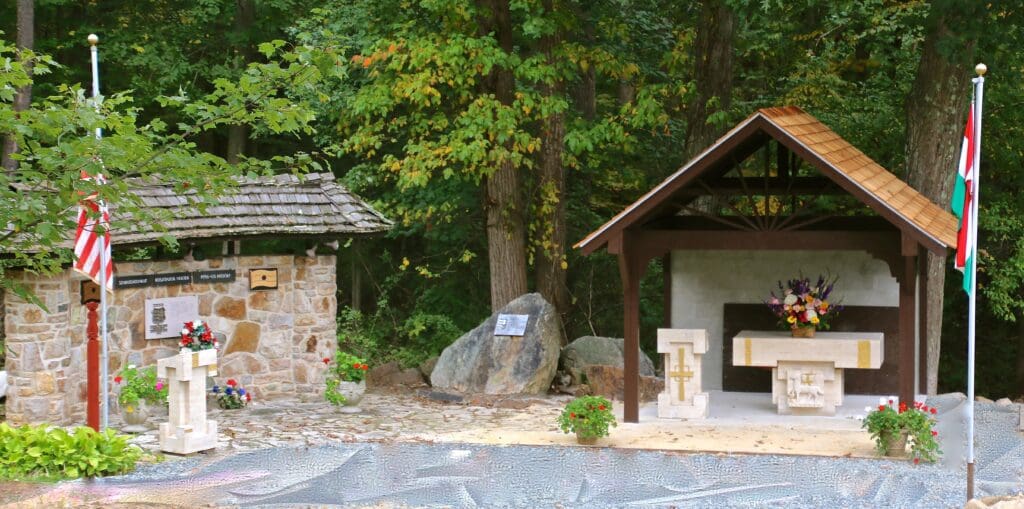
L. L.: No; there’s an altar at the memorial by the lake, which was moved here four or five years ago from the St Stephen of Hungary Church in Allentown, not far from here. In Pennsylvania, there were big iron factories around Bethlehem, and in the early 20th century, a lot of Hungarians worked and lived there, and they built several churches. Unfortunately, along with the big wave of church closures eight years ago, the St Stephen of Hungary Church in Allentown was also closed, and the Italian marble altar was put out in the parking lot to be buried. The local Hungarian community of believers told me about this, asking me to try to save it. The diocesan bishop gave us permission to bring it here and celebrate mass here, and the club’s board also agreed to bring it and put it up in a worthy place. We brought it, built a small roof over it, a chapel, and placed the altar next to the ‘56 memorial.

How many people have come here and are coming here now, and from where?

L. L.: The larger events can have up to a hundred people, the smaller ones up to 30 or 40, but in the past, we sometimes had as many as 300–400. At the Hungarian Day, which we have held every year since ‘83, we had had up to a thousand participants at times. The age group is mixed; although it’s mainly the elderly who have more connection to this land, younger people also come, albeit with new ideas: some of them think that money grows on trees and that anything can be done without money. Just to give you some figures: the pool, built for 30,000 dollars, was renovated for 90,000 dollars.

E. L.: The speakers for the national celebrations were Dr Réka Szemerkényi, former Hungarian Ambassador to the United States, and Dr Imre Szakács and Dr Ferenc Kumin, former Consul Generals, from the Embassy in Washington DC. Dr Réka Szemerkényi initiated the honouring of my father, which I accepted at the Honorary Dinner on 4 May 2018 with the following words:

I would like to thank the President of the Republic of Hungary, János Áder, for this award of the Hungarian Cross of Merit and all those who nominated, supported, and presented this honour to my father. I pay tribute to those who founded the Magyar Tanya, my parents, and my family, because they gave me the example, the foundation, and the encouragement to take this association into the future.’

M. L.: In the olden days there were also very valuable literary evenings here. Almost all the writers and artists who lived in emigration or came here after ‘56 visited us here, such as Lajos Fürj, Albert WassÁron Tamási, Claire Kennett, Éva Szörényi, and many others. Poet Tibor Tollas was always a very popular guest of ours. Such events are unfortunately no longer held, but instead, we often have artists and folk dancers from Hungary. Folk dance groups from the nearby areas are also frequent guests. Besides, we host winter and summer scout camps as well. We also have many weekend guests who love the Tanya. The children are free to move around—they can go for walks, play games, football, volleyball, and go swimming. So, they are safe here.

Finally, a word about the future. Are there any replacements?

L. L.: When I was in my eighth year as President, I didn’t know how many years I had left. I was doing it as long as I could, but I tried to pass it on. Succession planning was mandatory at my workplace before, so it was instilled in me at the company, and I brought the same mindset to the board here as well. I’m thinking long term: the reason I didn’t take on the board again after seven years was so that others could learn how things work and how to run this association—and so that they could learn that way and not without anyone to pass on the knowledge.

If no one else takes over, it’s only a matter of time before we must close our doors.

We may not be there yet, only in five years, but we may be there at some point. This is how Erzsébet Veres took over the Presidency from me in 2017, and from her, my brother, who is eight years younger than me, almost another generation. And then there are even younger people, aged 30–40; in recent years we have managed to bring the average age down steadily from 65 to around 50, which is a much more encouraging figure.

Ildikó Antal-Ferencz

translated by huconedit

Source: hungarianconservative.com

*The Hungarian word ‘tanya’ has a dual meaning: it denotes a particular type of homestead that used to be typical of the Hungarian Great Plain, but also a hideout or gathering place of a group of people.

**Réka Pigniczky is a renowned Hungarian American documentary filmmaker and visual artist, whose work focuses on the fate of the Hungarian community in the United States and their ties to the motherland.

All the photos in this article are courtesy of the Lengyel family.

Click here to read the original article.

Reklám
Tas J Nadas, Esq

Semmelweis — The World Premiere of the Hungarian Biopic in New York

A production still of the film. Attila Szvacsek/Intercom/National Film Institute

Source: hungarianconservative.com

On the anniversary of the 1956 revolution and freedom fight of Hungary, the world premiere of the film telling the life of Ignác Semmelweis, a 19th century Hungarian physician and scientist, an early pioneer of antiseptic procedures was held on Monday, 23 October in New York. At the event, organized by the National Film Institute (NFI) and the Liszt Institute in New York, Minister of Culture and Innovation János Csák, Csaba Káel, the government commissioner responsible for the development of the Hungarian film industry and President of the NFI, director Lajos Koltai, producer Tamás Lajos, leading actor Miklós H. Vecsei, and Director of the Liszt Institute Csenge Palotai were all present.

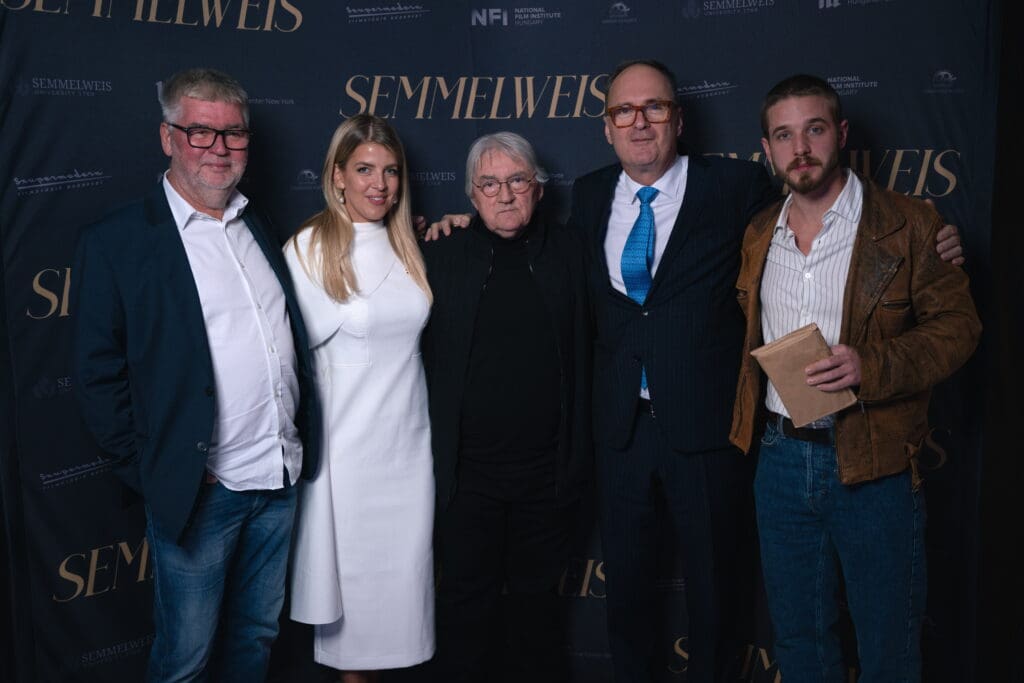
Tamás Lajos, Csenge Palotai, Lajos Koltai, Csaba Káel and Miklós H. Vecsei at the screening in New York on 24 October 2023 (L-R). PHOTO: NFI/MTI

The premiere was attended by ambassadors of more than twenty countries. Special guests of the evening were Courtenay Rattray, Chief of Staff of UN Secretary-General António Guterres and Stewart Simonson, Deputy Director-General of the World Health Organization (WHO).

The romantic period biopic created with the support of the NFI and produced by Szupermodern Filmstúdió explores the life and work of Ignác Semmelweis, a devoted Hungarian physician and scientist, who, defying traditional theories, strove to overcome one of the most devastating diseases of the 19th century, puerperal fever. The film shows him in 1847 and evokes the atmosphere of mid-19th-century Vienna, the life-or-death tragedies of the hospital at the time, the irreconcilable, entrenched conflicts between Austrian and Hungarian doctors, and the agonizing desire for love between a doctor and a nurse, a relationship socially unacceptable in those times.

Before the screening, János Csák explained that Hungarians currently celebrate several heroes: not only the 56ers, but also the famous poet Sándor Petőfi who was born 200 years ago, as well as the the well-known writer Imre Madách, whose main drama, The Tragedy of Man was selected by The Economist as the best ever written parabole on human progress, matching Goethe’s Faust, Milton’s Paradise Lost and Dante’s Divina Commedia. John von Neuman, the Hungarian father of the computer, was also born 120 years ago. ‘Culture in my understanding is not only pictures and music, but our way of life, our way of thinking, therefore it includes art, science and also sports. Talking about science, this year we celebrated two Hungarian Nobel Prize winners, too: one in medicine and one physics,’ the minister stated, who emphasized that Ignác Semmelweis’s journey is an example to follow, since—despite the malice and attacks from his Austrian superiors and colleagues—he carried out his vision and became the ‘saviour of mothers’.

He saved the lives of millions of people, just as Nobel laureate Katalin Karikó did, János Csák stressed.

The minister then reminded: ‘100 years later, in Szeged, a city in the south of Hungary, there lived a gentlemen called Albert Szentgyörgyi, who got the Noble prize in 1937 for discovering Vitamin C. I see a direct connection from Semmelweis through Szentgyörgyi to Karikó, who researched in the very same institution where Szentgyörgyi used to work’. Hungary is a small country and nation, we are about ten million within the country’s borders and 15 million around the globe, but we punch above our weight; and what is common in all great Hungarians is that they always work to preserve culture and safe lives. Hungarians are proud of that and this is the reason why the government invests a lot in the education system, Mr Csák concluded his speech.

Csaba Káel first referred to the fact that the Motion Picture Museum, which hosts the premiere, is located next to the legendary Kaufmann Studios, built by Adolf Zukor, founder of Paramount Pictures, who was born and raised in Hungary. He would be very proud if he saw that there is a Hungarian film screening in New York, the commissioner said. ‘Films, music and arts are very much rooted in the Hungarian DNA, as they are in that of the Americans.’ Mr Káel recalled that many famous Hungarians became household names in the US, through hard work and artistic talent. The talent, the secret ingredient has an origin in a creative, inventive nation: Hungary.’ In Káél’s opinion Budapest, often referred to as a regional cultural metropolis, and New York, ‘its twin city, an undoubtedly true metropolis, share more in common than we may think: both cities are vibrant, dynamic, and are hubs for creativity. In the heart of Europe,

Budapest is shaped by a blend of influences, especially in its architecture which filmmakers from around the globe find irresistible’.

Csaba Káel delivering his remarks at the world premiere of Semmelweis in New York on 24 October 2023. PHOTO: NFI/MTI

He also emphasized that in recent years, Hungary has hosted landmark productions that have established Budapest as the second biggest film hub in Europe after London. The list of international blockbusters and critically acclaimed films shot in Hungary continues to grow and Hungary has shown itself as a versatile, captivating background for cinematic storytelling, Káel stated. Reflecting on the strategic vision of the NFI, he explained that it is dedicated not only to supporting creative talent of Hungarian films and preserving film heritage, but also to properly investing into a promising future. ‘We are committed in supporting and nurturing local talent and fostering impact for international collaborations. A nation’s rich heritage provides filmmakers with a wealth of storytelling and possibilities ready to be turned into screenplays.’

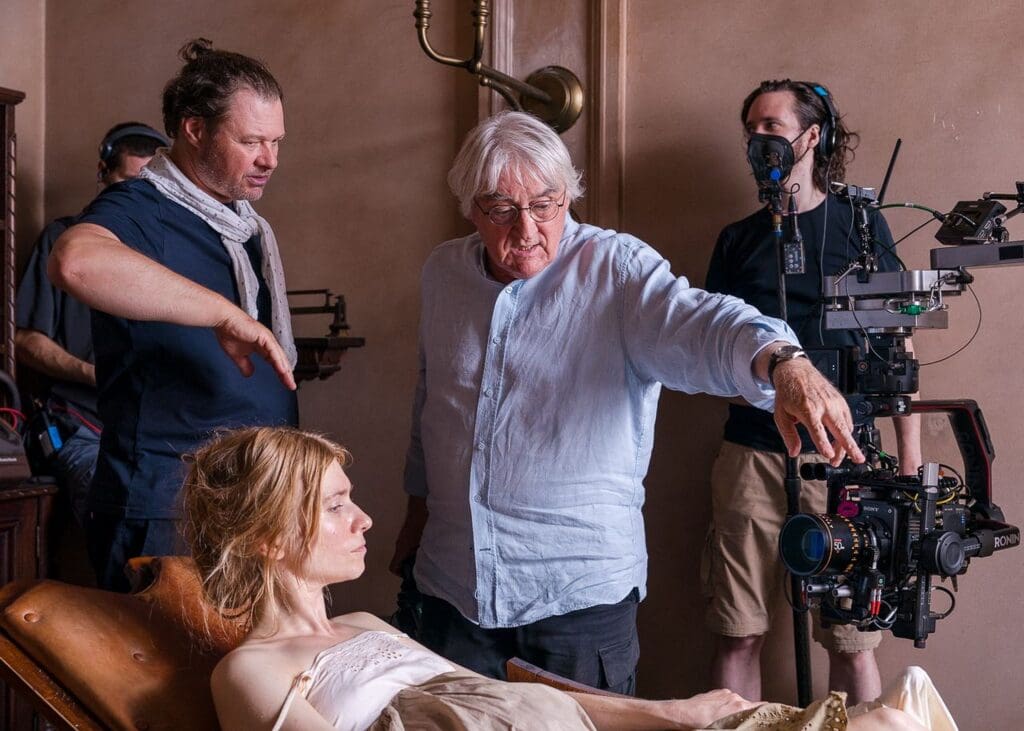
A werk photo of Semmelweis, with Lajos Koltai (center) instructing the cast and the crew. PHOTO: Attila Szvacsek/NFI

He emphasized that Semmelweis is but one example of these talent stories, an excellent opportunity to present a Hungarian talent worldwide and tell his story; and there is a great deal of international interest in the film, which is further enhanced by the fact that in recent weeks Hungary could celebrate two Hungarian Nobel Prizes. ‘If you think about it,

Semmelweis’s discovery was of such importance at his own time that it would have been worth of a Nobel Prize if this recognition had already existed then,’

Csaba Káel concluded his speech.

As Csenge Palotai mentioned, the film was shown on 23 October, a Hungarian national holiday, as it commemorates Ignác Semmelweis’s unbroken faith and life of struggle, who was a hero like the Hungarian freedom fighters in 1956. His story is of great importance not only in Hungary, but throughout the world and it is a great opportunity that it can be shown overseas, Lajos Tamás stated. The representative of WHO called the film an important opportunity to bring the figure closer to a wider audience and to explain how fundamental his work was in holistic medicine. As Miklós H. Vecsei previously emphasized, in the case of historical films, it is important that not only the positive character traits of the heroes be illustrated. Semmelweis was not a saint but a fallible human in search for his truth, who believed that his profession was more important than his personal life.

Ignác Semmelweis was the very first doctor who realized that the deadly childbed fever was caused actually by the doctors themselves, who also made autopsies while helping women to deliver their babies in the same institution and were totally unaware of themselves spreading the infection they got from the corpses. In the film version of his life, the doctors, who desperately try to realize what they are doing wrong, have to fight against the leadership of the Austrian hospital, who do everything to protect their authority from the consequences of the discoveries of the ‘obsessed Hungarian doctor’. The Austrian colleagues consider Semmelweis unbearably violent, interested only in the ‘saint cause’ of the health of the mothers’. Dr Kein, the director of the hospital—for whom Semmelweis is the unpleasant, living conscience: if his theory is right, all the doctors were murderers—even tries to set the Hungarian physicians by the ears. He suspends them collectively when they stand up for their colleague who had been suspended because of insisting that before entering the department all doctors should wash their hands with chlorinated water—the only chemical that makes the smell of corpses (and thus infection) disappear.

Although even his Hungarian colleagues do not really understand Semmelweis and consider him crazy (or at least weird, not enjoying the joys of Vienna life, but living only for his work), they at least try to support him by protecting him from the consequences of his hot-tempered behaviour and occasional violations. However, the only one who truly believes in him is a young nurse, Emma Hoffman, who helps him in his devoted work, desperate overnight research, while reciprocating the doctor’s tender emotions. However, she is blackmailed by a careerist Austrian doctor who aims to be the next director of the hospital and therefore tries to put mean obstacles in Semmelweis’s way even by putting mothers’ (and babies’) lives in danger. After three weeks of experiments qualified unsuccessful by the leadership, Semmelweis finds himself before a professional court, being accused of several instances of professional misconduct and called a charlatan. However, with Emma’s help, the truth finally transpires, his reputation is restored, and he ultimately becomes known as the ‘saviour of mothers’. After the trial, he is even offered the leadership of the obstetrics department in Vienna which he refuses, and moves back to Hungary.

Semmelweis is the story of a professional freedom fight and a socially unacceptable love, beautifully photographed by András Nagy. Miklós H. Vecsei’s performance is extremely convincing: he renders the figure of the ‘obsessed Hungarian doctor’ masterfully. The only surprise is the female protagonist, played by Katica Nagy, who wins not only the doctor’s but also the viewers’ hearts—and not through her beauty, but her braveness and devotion to her profession. Most of the minor characters are played by actors who are ‘big names’ in the Hungarian theatrical scence, such as László Gálffi, Kornél Simon and Nelli Szűcs.

The dramaturge of the film is Krisztina Goda, acclaimed Hungarian screenwriter, dramaturge and director, most well-known for her film dedicated to the 1956 revolution Szabadság, szerelem (Children of Glory). Semmelweis is also being screened today, 27 October, at the Hungarian Film Festival in Los Angeles and will be released in cinemas across Hungary on 30 November, distributed by InterCom.

Source: hungarianconservative.com
Reklám
Tas J Nadas, Esq

PM Orban: We don’t dance to their tune

Today, too, we were the first to protect Europe from migration and the first to propose peace instead of war. Today we are still the first and only ones who want to hold back the peoples of Europe from marching blindly into another war, Hungary’ prime minister said in his ceremonial speech delivered on October 23, in Veszprém, one of the most important rural locations of the 1956 revolution.

Reklám
Tas J Nadas, Esq

PM Orban holds talks in “China’s Silicon Valley”

Sencsen, 2023. október 19. A Miniszterelnöki Sajtóiroda által közreadott képen Orbán Viktor miniszterelnök érkezik a Meng Fanlival, a Sencsen Városi Pártbizottság titkárával tartott megbeszélésre a dél-kínai Sencsenben 2023. október 19-én. MTI/Miniszterelnöki Sajtóiroda/Fischer Zoltán

Hungarian Prime Minister Viktor Orban traveled from Beijing to Shenzhen in southern China, where he held talks with Meng Fanli, secretary of the Shenzhen Municipal Party Committee, and visited the exhibition titled “40th Anniversary of the Reform and Development of Guangdong Province” at the Museum of Contemporary Art and Urban Planning, Bertalan Havasi, the prime minister’s press chief, told Hungary’s state news agency MTI on Thursday.

Reklám
Tas J Nadas, Esq

Two Hungarian Air Force planes evacuate 215 people from Israel

As part of a joint rescue operation by the Ministry of Foreign Affairs and Trade and the Ministry of Defense, two Hungarian Air Force aircraft with 215 people on board have left Israeli airspace and are now flying safely towards Hungary, Peter Szijjarto posted on Facebook on Sunday evening.

Reklám
Tas J Nadas, Esq

Hungary is open to take part in any peace initiative

New York, 2023. szeptember 20. A Sándor-palota által közreadott képen Novák Katalin köztársasági elnök felszólal az ENSZ Közgyûlése 78. ülésszakának általános vitájában a világszervezet New York-i székházában 2023. szeptember 19-én. MTI/Sándor-palota

Hungary supports and is open to take part in any peace initiative that creates a feasible environment for a lasting ceasefire in Ukraine and creates a roadmap towards a sustainable and just peace,

Katalin Novak, Hungary’s president, said in her speech at the UN Security Council in New York on Wednesday. She is the first Hungarian head of state in decades to have addressed the forum.

Hungary welcomes the Ukrainian peace initiative and is open to join the process, Hungary’s head of state affirmed.

She stressed that Ukrainian President Volodymyr Zelensky’s personal presence at the meeting is an indication that the moment has come to be serious about peace.

Hungary’s president spoke out for the Hungarian community living in Ukraine. She counts on President Zelensky to take action and facilitate the restoration of the minority rights of ethnic Hungarians in Ukraine, delivering on his promise made both in Kyiv and in New York, said Katalin Novak in her address to the UN Security Council, where US State Secretary Anthony Blinken and Russian Foreign Minister Sergei Lavrov also delivered speeches on Wednesday.

Katalin Novak stressed that the war in Ukraine poses a direct threat to Hungary as a neighbor, and that Hungarians are also losing their lives on the battlefield. The war is also a direct threat to Europe’s security architecture, she said.

Hungary’s president called for cooperation in promoting peace and security in Ukraine, pointing out that this requires organizations, strong nations and personalities that can invite the warring parties to a peace negotiation. The UN and the UN Security Council are essential actors in this process, she noted.  She highlighted the United States, China and Turkiye as examples of strong nations that are capable to set the table for a possible solution, are capable or ready to engage in dialogue with both sides and have the potential to influence the continuation further.

Katalin Novak said she is convinced that Pope Francis is someone who can facilitate peace in Ukraine.

Our history gives us so many examples that a small group of people or even a single person can have an effect or turn the flow of history,

said Katalin Novak, who is the first Hungarian president in decades to have addressed the UN Security Council.

In her speech at the UN Security Council, Katalin Novak, who attended the working lunch of women leaders on Wednesday, also highlighted the role women leaders in promoting the resolution of conflicts. Women leaders who join their forces to contribute the peacemaking can have a substantial contribution in this process, she pointed out.

On Wednesday, Hungary’s president held talks with Moldovan President Maia Sandu, South Korean President Yoon Suk Yeol, Namibian President Hage Geingob and Peruvian President Dina Baluarte on bilateral relations, education and demographic issues on the sidelines of the 78th session of the UN General Assembly’s High-level Week.

On Monday, Hungary’s head of state co-chaired the leaders’ dialogue meeting that reviewed the mid-term implementation of sustainable development goals set by the UN for the 2015-2030 period. On Tuesday, she addressed the UN General Assembly as the head of Hungary’s delegation.

Katalin Novak’s official visit to the United States continues on Thursday in Texas, where she will hold talks with Governor Greg Abbott, among others.

(Magyar Nemzet)

Cover photo: Hungarian President Katalin Novak addresses the General Debate of the 78th UN General Assembly at the UN headquarters in New York on September 19, 2023. (Photo: MTI/Sandor Palace)

Reklám
Tas J Nadas, Esq

‘We have to shake people up to make them feel Hungarian’ — An Interview with Eszter Pigniczky

Source: hungarianconservative.com
This is an abridged version of the interview originally published on 777.hu.

The Pigniczky–Szentkirályi couple from Cleveland, Eszter and Endre, are known by many in North America; even by those who are not scouts or folk dancers. Eszter’s sister, Réka, has made several documentaries about Hungarian Americans—that is where the name Pigniczky may be familiar to many. A conversation about family, languages, scouting, folk dancing, and where and who needs to preserve Hungarianness and faith more.

***

Your sister has made quite a few films about your parents’ arrival in America (Memory Project , Megmaradni (Surviving), Hazatérés (Homecoming), Inkubátor (Incubator), etc.), but I have not seen their written story yet…

My father, László Pigniczky, was born in 1930, and as a freedom fighter in [the Hungarian Revolution of] 1956, he was sent to a refugee camp in Italy through Yugoslavia in January of the following year. He was sponsored by his godfather András Kószó, who brought him to Lansdale, Pennsylvania. My father immediately sought out the Hungarians there and went to all kinds of events, and that’s how he met my mother, who had been expatriated in a different way. My mother and her family lived on the Austrian border; my maternal grandfather was a cantor and very anti-establishment, so he was thrown out of his job and put to work in a metalworking factory; thus, they couldn’t stay either. In the autumn of ‘56, my grandparents, with their daughters, that is, my mother, Katalin, my aunt Zsóka, and their nephew Pityu, went over to Austria. For them, it was uplifting to arrive there because the locals were very well prepared to receive and care for refugees. From there, they were quickly sent on to Switzerland, and the three children were sent to Munich, where my mother graduated.

When my parents met, it soon became clear that they were both scout leaders. My mother and her family became scouts in Kastl, Germany, while my father was involved in the so-called ‘undercurrent’ Hungarian scouting after it was banned in Communist Hungary. Soon after the founding, my parents became troop leaders and did the work together. I was born in May and was already with them at the scout camp in the summer. We, the children were also a wonderful recruiting tool for my parents because they were looking for childminders for us, who, at the same time, attended the scout camps as well and when they saw how much fun it was to be there, they already came to camp as scouts the next time.

What was the inner drive of your parents, and why was scouting so important to them? Or to you, because you are a lot like your parents…

I never asked them that question, as it was completely natural to me in my whole life that they were scouts and I was one too. And it was the same with our children. But anyway, every scout has an inner drive, they just need the right conditions to be able and willing to work as scouts and for their Hungarian identity. Often it comes naturally who will be a leader. I cannot say exactly what fuelled the flame in my parents, but I do know that remaining Hungarian in the big Unites States was vital then, and still is, for my mother, who supports many Hungarian organizations through her work to this day. And what is the most effective way to preserve Hungarianness? By educating young people to do so.

And the best way to educate young people is through positive experiences, and that’s where scouting comes in, which strives to raise people of character and loyal Hungarian citizens.

Scout Day 2022

Scouting is just one of the many youth programmes in Hungary, but in America, it is one of just two, if I consider folk dancing as a separate activity, so the stakes are much higher here.

The stakes are as high in Hungary as they are in the diaspora.

There, Hungarianness may be given, but it may not have value.

It usually happens in other Hungarian scout associations that they use international framework stories on excursions and camps instead of bringing our own Hungarian stories, and sometimes they don’t even understand why it is so valuable and important.

I strongly believe that we have to shake people up to make them feel Hungarian; for example, they should not be ashamed to sing the National Anthem out loud, which I have often experienced in Hungary. That is why the stakes are as high in Hungary as they are here in America. Here, in the great prosperity, we also have to shake people up, to make them want to do something, want to participate in the community, and maintain it as well. But we don’t really need to invent anything new because our predecessors have already pretty much invented everything. The various waves of immigrants and refugees before the First World War, after the Second World War, and then the ‘56ers all paved the way.

In Hungary, preserving the Hungarian identity is a long-term issue, but here it is a short-term, even existential issue.

What is short-term and what is long-term? Short term is a human lifetime. So, if you don’t involve a child between 8 and 14, you can forget about that one in terms of scouting and being Hungarian. After that age, it is almost impossible to convince him why both are so important. Maybe, when he becomes a parent and sees the point of scouting because he wants to make a man out of his child, he might try it. But this is a short-term issue in Hungary, too. Just look at how quickly villages and communities are being disbanded. We have to build the future around children.

How did you meet your husband?

I have known Endre since I was nine. In the annual leadership training camps for the children of leaders like Réka and me, the so-called model subcamps were created, so that the children of the leaders could be somewhere, and so that the scoutmasters and assistant scoutmasters could not train on each other but on living (smaller) children, i.e., ‘on a sample’. That’s where we met with Endre. He is a bit younger than me, so he was always in the same subcamp with my sister. At that time, there were so many of us that each year belonged to a separate patrol, a separate age group; nowadays we have children in scouting in three-, four- and five-year age groups. So, we were never together with Endre later, in any camp except the first one, but we always knew about each other.

In ‘93, at the leadership training camp, we met by chance in Nagyrét. I briefly told him I lived in California and invited him to come, but I knew he would never come. Why would someone from Cleveland go to California? Yet, in April ‘94 Endre called me and said he was in California, and I should show him San Francisco. We had a mutual acquaintance, also a scout leader from San Francisco, and he called him first to show him the city, but Jenci Rácz was busy at the time and referred Endre to me. We spent a day together and then got married in August the following year. I moved to Cleveland in November and have lived here ever since. Our first son, Keve arrived in ‘96, then Bendegúz in ‘97, Vajk in 2000, and our only daughter, Emese three years later.

The Pigniczky family: Eszti and Endre with their four children

Besides scouting, another very important part of your life is folk dancing. The members of the Cleveland Hungarian Scout Folk Ensemble (Clevelandi Magyar Cserkész Regös Csoport), well known in North America, are scouts and can be seen performing at all major folk dance events. Nevertheless, I’ve been told by many people: it is either scouting or folk dancing, you cannot have both…

On the Hungarian Farm (Magyar Tanya) they were not called ‘regös’ folk ensemble—we danced within the scout patrols. My parents were amateur dancers, so they took dancing to the same level as it was taught abroad at the time. In any case, when I was seven years old and first visited Hungary, I noticed the old ladies who sang folk songs, and I learned the songs from them. At the age of nine, when we were in Hungary again, I received Hungarian folk recordings, listened to them, and made notes, knowing only half the words, but I learned them all. But the most important thing was that our parents always sang to us, my father, my mother, and my grandmother, too. So, the singing heritage comes from them. And the dancing comes from the fact that I danced all the time as a scout; it was as natural as scouting itself. When I was 13, I told my mother that I wanted to be an ethnographer, and she said no way. But wherever I lived, I was always scouting and in tune with folk dancing as well, because there were dance groups everywhere at the time.

Regös folk dance and scouting are close to my heart, and I believe that

scouting and folk dancing should not be separated—in fact, they strengthen each other.

Every scout should learn folk dance. After all, it is also a way of practising movement improvement and getting to know Hungarian traditions better, which is much more enjoyable than just learning dry texts about ceramics, pottery, and carpentry, for example.

What is the history and present of the 50-year-old Cleveland Hungarian Scout Folk Ensemble?

Scouting together with the regös folk dance was not invented in the diaspora. As early as the mid-1900s, there were already regös patrols going out into the villages to do research. The legacy of [Hungarian politician and Prime Minister of the Kingdom of Hungary] Pál Teleki is that Hungarian scouting is based on two pillars: the Bible and Hungarian culture. Thus, in Hungarian scouting, one cannot be separated from the other. Here in Cleveland, we have weekly activities on Tuesday evenings, just like we water at Easter, put up a Maypole in May, and play nativity scenes and sing carols at Christmas. Regös folk dancers do not only dance: when we are not preparing for a show, we do crafts, tell folk tales and ballads, or play folk music—in other words, we deal with the entire Hungarian folk tradition. And we, like the old ones, go to the villages to do research as well—our trips to the small village of Kazár in Hungary are all about that, too. And we are present at all the folk dance festivals, such as the Pontozó and the Hungarian Day in New Brunswick. Right now, we have the Scout Day going on and I’m so proud of the scouts because they performed a dance that they learned on our last trip to Kazár.

Small children folk dancing on the 2022 Scout Day

How big is the dance group and where did you get your beautiful garments?

We have only one folk dance group, the Scout Folk Ensemble, which has fluctuating numbers, now with 24 children aged 14–18 and two leaders. We don’t have our own orchestra or any more children’s groups, but the younger scouts are learning enough that we could prepare them for performance for Scout Day in just two sessions. Most of our costumes are designed, embroidered, and sewn by the regös folk dancers, together with their parents and grandparents. Later, we bought the pieces that we could not produce. In addition, we also have kind donors who have donated some garments to us. Our costume collection now includes 30 different costumes, of which we have 6–20 [kinds of traditional Hungarian] sets: palóc (Paloc), matyó (Matyo), székely (Szekler), csángó (Csango), as well as traditional costumes of the Szatmár, Kalotaszeg, Szilágyság, Küküllő, Mezőség, the Southern Great Plain, Sárköz, Kalocsa, Tápé, Somogy, and Kapuvár areas.

Back to the family: what do you do when you are not scouting?

When the children were small, I went to the ‘adult world’ once a week. First, I worked in a programme where we helped girls who hadn’t finished secondary school yet but already had babies: we took care of the children while the mothers went to class to finish school. I was an administrator in this US government programme for two years until it expired. After that I started working for Gyuri Kovács’ Smartronix company as a marketer, then I was a baker at Lajos Mezősi’s bakery and managed his finances in between. I went to different festivals to sell things and organized the stalls—it was a busy period. In the meantime, I started working in the school secretariat, and then, at the school where my husband is an English and German teacher, I have been the administrative assistant to the headmaster for six or seven years now.

Our children attended not only weekend Hungarian schools, but also weekend German schools in addition to the regular American school. It’s worth noting that the German government pays the teachers to teach German to the locals in evening classes. Endre spoke to the children in German, and they responded to him in German for a long time. Fortunately, I understood enough German to be able to chime in when I needed to. But the family language was always Hungarian. So, they had Hungarian school on Mondays, Bible class on Tuesdays, if I remember correctly, then from the age of 14 onwards, regös folk dance classes, German school on Wednesdays, some kind of sport on Thursdays, scouting on Fridays, and excursions on the weekends…

Why did Endre speak German to his Hungarian children in America? Was it some kind of family expectation?

No. After World War II, many of the Hungarian refugees of ‘56 usually spoke German as well, so they typically learned English as a third language. Therefore, their children were all taught German in school, not Spanish, which more people in this country would have understood. I also studied German in secondary school, but it was not at the expense of Hungarian at home—it was just an optional language at school. However, it is a bit different in our family. Endre continued to study German at university as well—it just stayed with him. He wanted to be an English teacher, but he was so good at German that he got a degree in it, too. He got both his jobs because he could teach German, and only then was he asked to teach English as well.

We wanted to pass on this knowledge of languages to our children because we believe that the more languages you know, the more you are.

I understand you are a devout Catholic. How important is religion and its practice to you?

Yes, I am a Catholic. My father was a Catholic and my mother was a Lutheran. When my parents divorced, my mother, being a Lutheran, still went to Catholic church with us because when they got married, she made a vow to raise us as Catholics. I respect that about her. I like to go to Catholic Mass because I know it and therefore it is comforting. The homilies make me think and I look forward to the time at Mass to reflect on what happened that week and evaluate what I did well, what I did wrong, what I should improve, and what I can be thankful for. It’s a kind of refreshment. I especially like it when the sermon is well constructed and delivered, and when the cantor and choir sing beautifully. Mass is only a part of my spiritual life, but a significant part.

But this was not always the case. I’m not saying I was ever an atheist, but there were times when it was particularly difficult to go to church and pray. In fact, there were times when I was even angry with God when things happened in my life that I couldn’t see the meaning of or the reason for. Almost everyone has a process when it comes to spirituality, everyone is a seeker somewhere. I want to get to my best self through my faith in God, which is also my scout self, but I know that’s not everyone’s path. In scouting, we have a duty to say that there is such a path.

Mass on the 2022 Scout Day

The Scout House is in the courtyard of the Saint Emeric Roman Catholic Church, yet few scouts go there. Why is that?

Our scouts go to church, just usually not to Hungarian churches. This is also because, for example, there are many of them who go to religious schools, and they are expected to go to church where they go to school. Besides, many Hungarian churches don’t have Bible classes, so the students go to the local American churches to attend them. Hungarian scouting is ecumenical, so the patrols in Cleveland are not only Catholic. For example, today on Scout Day, there was not only a mass but also a church service, which the scouts attended. By my estimate, one-third to one-half of the current active scout families are Protestant. On major holidays we support the local Hungarian churches in larger numbers, but especially our headquarters, the St Emeric Church. When we go there, the regös folk dancers also dress up in regös costumes to make the occasion more festive. There are eight Christian Hungarian churches in Cleveland, all of which are very important to us and to the Hungarian people living here.

We try to provide Hungarian-language masses and services at camps and on excursions as well. Unfortunately, sometimes we have to listen to them in English because we can only find an American pastor, but sometimes we cannot find anyone at all who can come to say mass or hold a service. This can give quite a headache for the organizers, both locally and federally. The scout leaders are aware that at all levels the main focus is on character building, and they are up to the task. Personally, I try to work with everyone at the level they are at and help them develop their spirituality, their Hungarian identity, as well as their scouting skills.

All the photos in this article are courtesy of the Pigniczky family.

Source: hungarianconservative.com

Reklám
Tas J Nadas, Esq

PM Orban: We will extend income tax exemption to mothers with three children

Family-friendly, conservative forces must come to power in the governments of as many European countries as possible, Viktor Orban said in his speech at the Budapest Demographic Summit. The prime minister contended that Hungary was the most vocal advocate of families and demographic issues in international politics.

Reklám
Tas J Nadas, Esq

Carlson’s interview with PM Orban receives over 100M

It’s no exaggeration to say that the internet exploded after American right-wing media personality Tucker Carlson published his interview with Hungarian Prime Minister Viktor Orban. The 30-minute video was posted on the journalist’s site at midnight Hungarian time on Wednesday and has since been viewed by more than a hundred million people.

Reklám
Tas J Nadas, Esq

‘Assimilation is inherent in the diaspora’ — A Conversation with Jesuit Father Tamás Forrai

This is an abridged version of the original interview first published on 777.hu.

Father Tamás Forrai was born and raised in Budapest, and first became a teacher, then a Jesuit priest. He was a high school principal in Miskolc, a provincial in Budapest and most recently a parish priest in Toronto, Canada for six years. He became a scout in Hungary and was a regular participant in the scout leadership training camps of Fillmore in upstate New York, where we met. I asked him about the situation of the Hungarian communities and Hungarian Jesuits in Canada as well as about the challenges and opportunities of his own service. One year after the interview, he returned home and has just started his new ministry in Pécs.

Reklám
Tas J Nadas, Esq

‘I believe the devil wants priests to fail in their calling’ — A Conversation with Fr. Richárd Bóna

This is an abridged version of the original interview first published on 777.hu on 4 August 2023.

Richárd Bóna was a final year seminarian in Pozsony (Bratislava, Slovakia) when his distant relative Fr. László Roskó, Pastor of St. Margaret of Hungary Parish in Cleveland, Ohio asked him to consider coming to America to serve the Hungarian community there. After finishing seminary in Cleveland and becoming an ordained priest, he served in English-speaking parishes for eight years, followed by his assignment in Washington, DC for further studies. In 2020 he finally became the Pastor of St. Emeric and St. Elizabeth Parishes. The latter is about to become a shrine.

Reklám
Tas J Nadas, Esq

The Library of Congress preserves WJCU’s Bocskai Rádió

On Aug. 1, 2023, The Library of Congress informed WJCU’s Hungarian-American community genre show, “Bocskai Rádió,” via email that the Hungarian website was selected for preservation in the Voices of Eastern and Central European Americans Web Archive.

In this collection, The Library of Congress digitally stores publications such as newspapers, web pages, printed material and photos from Eastern and Central European voices living in America.

Since 1984, “Bocskai Rádió, The Voice of Hungary,” has been on the air, serving Greater Cleveland’s Hungarian-American community. The program was first organized by a Hungarian student at JCU and remains one of WJCU’s longest community genre shows as well as the longest Hungarian language show in the nation’s diaspora.

“Bocskai Rádió” is supported by nationally-recognized Hungarian organizations such as American Hungarian Friends of Scouting, The Hungarian Scout Association in Exteris and The American Hungarian Federation from Washington DC. WJCU currently airs the show on Sundays from 2-5 pm.

Zsolt Molnar, director of Bocskai Rádió and chief editor of the corresponding website since 2019, illustrates the show’s ecstasy towards the news.“I was asked to give permission to the Library to archive the contents of the Bocskai Rádió’s website for current and future researchers.”

At first, he bypassed the email, interpreting the notification as a scam. After careful authentication, Molnar confirmed the email domain as the Library of Congress and celebrated the outstanding achievement.

“For the editors of the Bocskai Rádió, this achievement means that the work we do is important and valuable not only for us, but also for the world’s largest library.”

According to Molnar, the mission of the website and broadcast is to provide “a bridge between Hungarians living in the US diaspora and the Carpathian basin,” emphasizing that this reward would not be possible without the listeners of the show.

“This achievement is also a confirmation to our listeners that their financial support has been put to good use and led to the preservation of Hungarian heritage in the American diaspora.”

Bocskai Rádió’s web page is preserved in the Voices of Eastern and Central European Americans collection of the Library of Congress. (Bocskai Rádió)
On behalf of the Hungarian-American community, Molnar accepts not only the honor but also the duty that he believes is bestowed upon “Bocskai Rádió” following this milestone.

“In the database of the US Library of Congress, there are only three other websites archived about Hungarians. Unfortunately, all three websites are inactive (online) as of today. So, the Bocskai Rádió’s website has a big task to keep being active as long as it can.”

After receiving the news, Molnar anticipates the future of the Hungarian show, having the show’s 40th anniversary on his radar. “Our plan is to engage more students and volunteers from the community. We also hope to increase the number of our supporters and sponsors to cover the expenses related to website maintenance and security.”

Most of all, he expresses his gratitude towards WJCU for accommodating a channel to reach the Hungarian community. “We are grateful for the air-time, the various opportunities and support WJCU provides to the Hungarian community living in greater Cleveland and people around the world, through its online reach.”

Source: carrollnews.org

Reklám
Tas J Nadas, Esq