

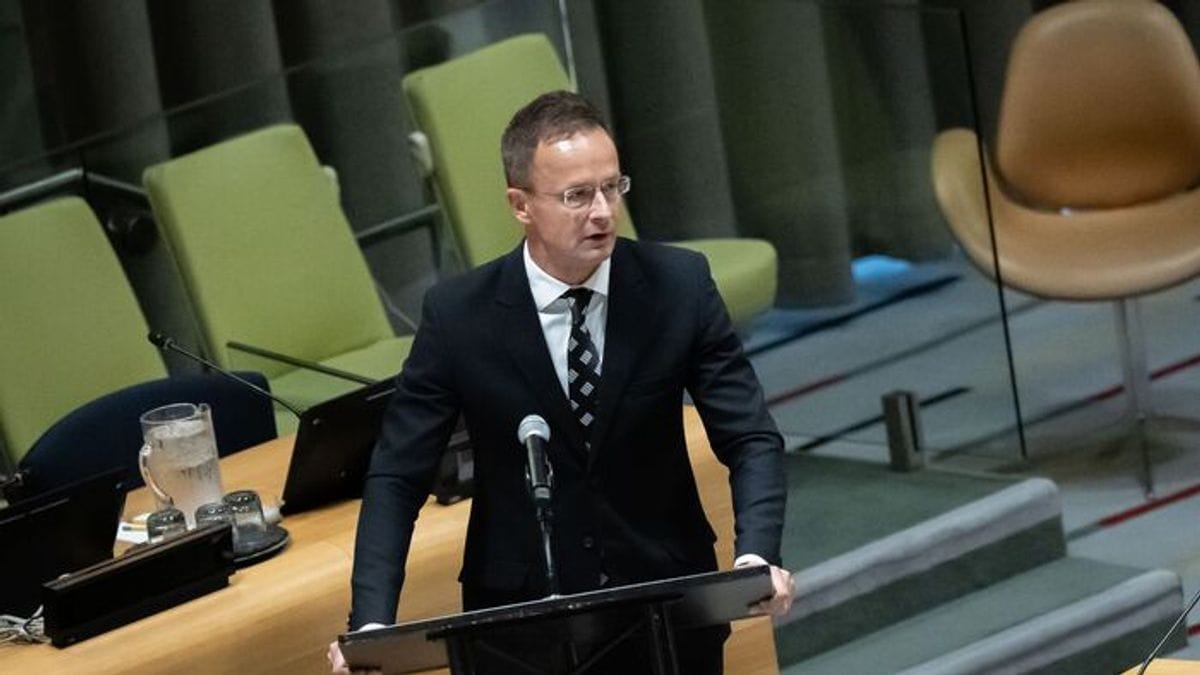
Minister of Foreign Affairs and Trade Peter Szijjarto was once again a guest on Fighters’ Hour, where he and host Balazs Nemeth exposed another round of fake news. During the discussion, the minister stressed that without Donald Trump, there would be no peace in Israel. At the same time, he said Ukraine’s president has completely lost touch with reality.
The first topic discussed on Fighters’ Hour was the Israel–Hamas agreement, Minister of Foreign Affairs and Trade Peter Szijjarto called “fantastic news”.
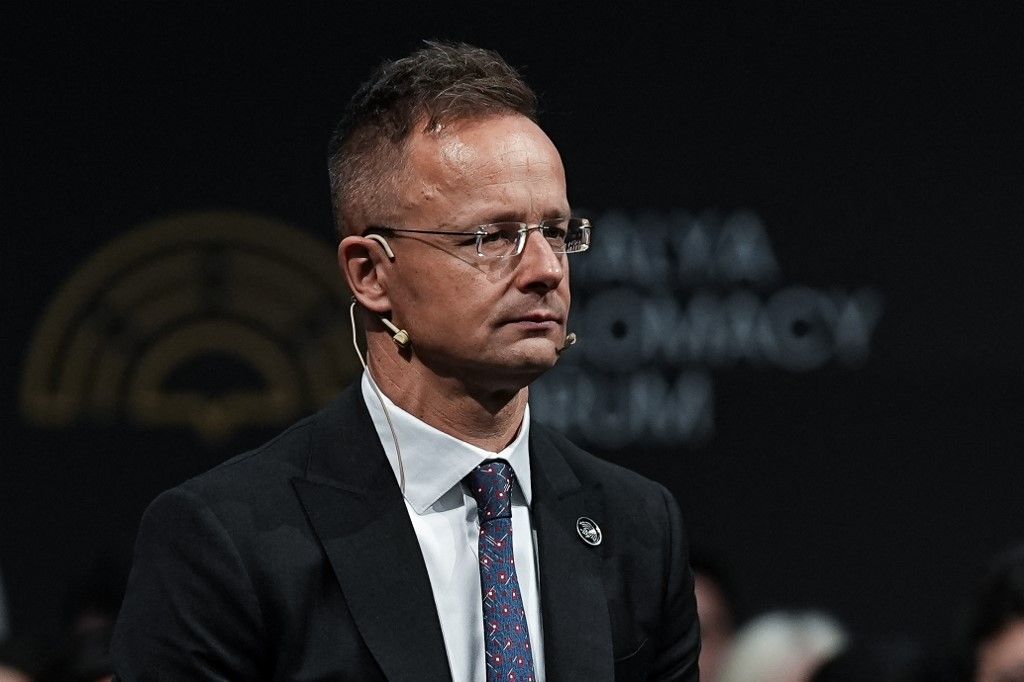

The minister highlighted:
This is further proof that US President Donald Trump is a true president of peace. Once again, he has played a crucial role in resolving a major security conflict, achieving a real breakthrough.
Donald Trump has proven himself to be the single most important guarantor of peace in the Middle East. In fact, the only real hope for peace in the Middle East.
“History and the facts speak for themselves. For decades, countless attempts have been made to build peaceful coexistence among the peoples of the Middle East. All of them failed except one: the Abraham Accords of 2020, when Israel normalized relations with Bahrain and the United Arab Emirates. That agreement was signed under Donald Trump’s ‘guardianship’ in the White House garden, and I was the only foreign minister in the world who attended in person,” said Peter Szijjarto.
After decades of failure, Donald Trump’s approach turned out to be the only realistic way to give the people of the Middle East their right to live in peace
— free from rocket attacks and terrorism. His success deserves another check mark on the list of his peace achievements. Trump played an absolutely indispensable role in resolving yet another serious security crisis. And here in Central Europe, we hope he can be just as successful in addressing the other major conflict that threatens our own security — the war in Ukraine.
Peter Szijjarto said many were working on thwarting Trump’s plans in both regions. There was now a hope of success in the Middle East, “and we sincerely hope that Donald Trump will be successful in creating peace in Ukraine, too, despite all attempts to trip up, hinder or undermine him,” he said.
The foreign minister then mentioned that one Hungarian citizen is still being held hostage by Hamas.
The signs suggest that he is still alive. We pray to God to protect him and his family, and according to the latest reports, he could be released as early as Monday together with the other hostages. He’s been in captivity for more than two years, and his family has lived all that time in uncertainty, not knowing if they would ever see him again. If everything goes well, that reunion could finally happen on Monday.
The minister expressed his gratitude not only to Donald Trump but also to those who played a mediating role. “Egypt and Qatar were also crucial,” he said. “This is a huge accomplishment. Every time we manage to resolve a serious security conflict somewhere in the world, it significantly reduces the likelihood of a third world war.”
Host Balazs Nemeth turned the conversation to the no-confidence motion against Ursula von der Leyen. As he noted, “Yesterday was Von der Leyen’s birthday, and the Patriots for Europe EP group, which includes Fidesz–KDNP MEPs, celebrated the occasion by saying that it is time for Von der Leyen to go, because we believe that it would be better for the future of Europe if Von der Leyen were no longer European Commission President.”
Peter Szijjarto responded:
First of all, of course, we wish the Commission President a happy birthday and good health. But the truth is, Ursula von der Leyen has done enormous damage to the European Union, to European nations, and to the people of Europe. She has done more damage than almost anyone in the past two decades. Under her leadership, Europe has lost its peace, the continent has lost its global weight,
the EU has lost its economic competitiveness, and an extreme liberal madness has taken over, with gender propaganda and all that comes with it.
The minister went on to say that Von der Leyen has played an astonishingly big role in ruining the EU. “Remember, Europe used to be the continent of peace. Then a war broke out three and a half years ago. Instead of isolating that conflict, the European Commission, with Ursula von der Leyen taking a leading role, helped globalize it. Today, leaders outside Europe simply cannot understand how Europe has become incapable of managing a conflict within the continent.
Ursula von der Leyen managed to ‘achieve’ that the EU now holds a smaller share of global economic output than the US or China. Von der Leyen’s policies have weakened Europe’s global position and isolated it from the world’s main political and economic players. She signed a trade deal with Washington that’s fantastic — for the Americans. Even our favorite liberal media outlets here were embarrassed to celebrate it and portray it as a success. European exporters now pay 15 percent tariffs instead of 2.5, while US tariffs dropped from ten to zero, he said.
Peter Szijjarto continued by pointing out that “we’ve isolated ourselves from China too. Instead of focusing on economic cooperation, we call them a systemic rival. It’s like an elephant and a mouse walking across a bridge, with the mouse saying, ‘Hey Dumbo, hear us stomp!’ That’s how ridiculous it is.
The tariffs on Chinese electric vehicles hurt Europe more than China, and sanctions against Russia have effectively destroyed the foundation of Europe’s economic model, the mix of eastern energy and western technology that would rive Europe’s economic growth.
And we’ve cut ourselves off from Africa, the continent of the future, by making insane gender and ideological conditions the entry ticket for any trade deal. Those are demands African nations simply cannot and will not accept,
he said.
“It really is time for Von der Leyen to go. That would give Europe a glimmer of hope, a chance for the EU to start improving. But let’s be honest: in the European Parliament, the Hungarian opposition parties, the Tisza Party and the Democratic Coalition, the European People’s Party they belong to, and the Socialists all care about one thing and that is power. It’s bizarre that year after year, or decade after decade, we see coalitions of the European People’s Party, the Socialists, the Liberals, and the Greens coming together. These majorities only exist because power is all that matters to them, not the principles or goals they were elected to represent. Because really, what business does a center-right party have in coalition with liberals, socialists, and greens?”
Host Balazs Nemeth turned to the Czech elections and the major victory of Andrej Babis.
Ever since I became foreign minister, I’ve been hearing that Hungarian foreign policy is isolated. Just take a look around. If today you try to find a European leader who can speak, on equal footing, with the leaders of the world’s biggest and strongest countries in every direction, then there’s exactly one. His name is Viktor Orban. So talking about isolation is, frankly, a bit much. PM Orban is the founder of the third largest political group in the European Parliament. Our sister parties across Europe are in government, they’ve won elections, or they’re leading in the polls. This isolation narrative is pure nonsense and it has been for more than a decade.
It is not Hungary that is isolated, but the European Union,
Peter Szijjarto stated.
Turning to the political climate in other European countries, Szijjarto said:
In one country after another, we’ve seen the same pattern: a patriotic party wins decisively, yet they’re pushed out of power. Take the Netherlands: a patriotic party won, then was forced into a coalition where party politicians couldn’t even become ministers, and the prime minister couldn’t come from their ranks. Everyone had to dissolve their political identity, and what the result was is new elections and so on. In France, the leader of the patriotic party is stripped by a court of the right to even run in the European elections — in the name of democracy. A French government resigns hours after being installed, or doesn’t resign, no one knows what’s going on, while the president appoints what — his fifth government in twenty months? It’s absurd.
“In Slovakia, they tried to assassinate the patriotic prime minister.But the dam burst here in the Czech Republic because despite every international effort, a patriotic party won the election with a majority. There’s nothing President Petr Pavel can do now but give Andrej Babis the mandate to form a government. And we saw even before the vote how they tried to interfere — summoning Babis for a lecture, setting expectations for his future government, and preaching about how to preserve the country’s credibility.
People decided they want something different. They want a different kind of politics, a different approach.
And then the president starts lecturing about what the country’s credibility requires? I’ll tell you what gives a country credibility: a government that does what its people want, the minister emphasized.
Balazs Nemeth remarked that Weber is sending messages from Brussels and the liberal press are releasing articles claiming that “they opened the champagne too soon at the Carmelite Monastery,” since Babis’s coalition wasn’t yet finalized. In response Peter Szijjarto said:
I know Andrej Babis well. I couldn’t even count how many times we’ve met over the years. And I know people in the other two parties, too. So let me just say to those still hoping otherwise: don’t waste your time writing those little articles. They’ll only look more and more ridiculous. A massive dam has broken. Europe is in a new political era.
For the first time since Hungary’s example, a patriotic party not only won but it’s going to govern.
The fact is that soon there will be three Central European patriotic prime ministers sitting at the European Council table and that changes everything in all existing debates,
Peter Szijjarto emphasized, adding that “I’m really looking forward to the formation of the new Czech government. Let’s finally have a patriotic foreign minister there too, so I can sit side by side with my Slovak colleague Juraj Blanar and the new Czech colleague. I can’t wait to see the faces in Brussels when that happens. I remember the looks when the Slovak foreign minister first spoke, I think it was at a NATO meeting. Let’s just say, it was quite a moment.
Balazs Nemet went on to point out that 70 percent of the French say Macron should go and shouldn’t even finish his second term because the country’s falling apart. “But really, in which democracy have we ever seen liberal leaders actually act according to the will of the people?” He also noted that President Zelensky recently declared it irrelevant what Hungarians or Viktor Orban say, because Ukraine’s EU membership is now an irreversible process.Peter Szijjarto responded firmly:
In my view, the president of Ukraine has completely lost his sense of reality — entirely disconnected from the real world. That’s probably the only explanation for why he says things that, in a normal situation, would make the ceiling crack. So he says ‘Ukraine will be an EU member, period.’ Dear Mr. President, you are the least qualified person to decide that. Who becomes a member of the European Union is not decided by those who want to join, but by those who are already members. And it has to be a unanimous decision.
Until every single EU member agrees, there will be no membership. This isn’t rocket science
— everyone knows it. We understand that he believes the Ukrainian people have decided they’ll be members, but that’s simply not how it works.
He went on to add: “This decision will be made by the people of the European Union — including the Hungarian people. And the Hungarian people have already spoken: we do not want to be in a strategic integration with Ukraine. We do not want Ukraine to join the EU or NATO. And let me add — they won’t.”
Host Balazs Nemeth then recalled how, before the Copenhagen summit, Viktor Orban and European Affairs Minister Janos Boka warned that Brussels was looking for ways to “trick” or bypass the right of veto. “But in Copenhagen,” he said, “they quietly backed off, because they realized there are other member states that don’t want to give up their veto power either. Maybe not because of Ukraine, but on EU issues in general.”
In response Peter Szijjarto gave an example:
There’s this so-called European Peace Facility. Funny name, really, because it’s the EU’s financial instrument that gives money to member states but only when they send weapons to Ukraine. We vetoed those payments — six billion euros in total — so they can’t be made,
Peter Szijjarto said, and recalled how EU foreign policy chief Josep Borrell once announced a ‘breakthrough deal’ to make those payments voluntary. “Borrell was overjoyed. He’d been publicly blaming me at every meeting for blocking the payouts. He said: ‘Finally, we’ve reached an agreement with Peter’ and called it a huge success. Payments could go ahead on a voluntary basis! And then, right at this point, some countries said, ‘Well, actually, we don’t agree with that.’”
That’s how it often goes. And in the corridors, when we talk one-on-one, they say: ‘Please, hold your ground today — we’re counting on you.’ Because they can’t say it publicly. Now that unanimity is being questioned, it’s dawning on everyone what it really means. Today they want to bypass Hungary over Ukraine. But what if tomorrow they want to bypass you on something vital to your own country? Every nation has its specific interests. A coastal country cares about the fishing industry, for instance, he said.
“So every country has their specific interests, and at least 1-2-5-10 issues where they need unanimity. And it’s starting to sink in for everyone now that if bureaucrats from Brussels, and politicians in the capitals of one or two major European countries, can decide things over our heads from time to time, that won’t be good, he emphasized.
Read the full article on the link below:
Cover photo: Peter Szijjarto, Minister of Foreign Affairs and Trade (Photo: MTI)