Home Blog Page 23

Dorka Juhász Named Big Ten Freshman of the Week

COLUMBUS, Ohio – Behind a pair of double-doubles and helping lead the Buckeyes to two wins, Dorka Juhász has been named the Big Ten Freshman of the Week.

For the week, the Pecs, Hungary native averaged 17.5 points and 14.5 rebounds with three steals and a pair of blocks. That led the Buckeyes to wins over North Carolina and Cincinnati and they are now 3-2 on the season.

Juhász notched season-highs of 18 points and 16 rebounds and also added a block in the Buckeyes ACC/Big Ten Challenge win over North Carolina. Her performance helped the Buckeyes snap a six-game losing streak in the challenge.

Against Cincinnati, Juhász again notched game-highs of 17 points and 13 rebounds to go along with three steals.

Juhász is the first Buckeye to earn B1G Freshman of the Week honors since Tori McCoy on Dec. 12, 2016.

Source: ohiostatebuckeyes.com

Reklám
Tas J Nadas, Esq

Disappointment, Mixed Feelings and Conflicts Followed the Events of the Romanian Centenary

Not every event in celebration of the Romanian Centenary has gone smoothly. The Orthodox Cathedral meant to represent the unity of Romania has yet to be finished. External scandals have overshadowed the celebration and opinion polls show that Romanian citizens display consistently low interest in the Centenary.

The conflict escalated when Jean-Claude Juncker gave a controversial speech at the European Parliament. The President of the European Commission told Romanian President Klaus Iohannis that he considers the Romanian national holiday commemorating the unification with Transylvania to be a European celebration. The Commissioner did not seem to realize that his words would infuriate Hungarians.

The fact that Romania chose to organize its 100th anniversary in 2018 leaves some room for interpretation. Romanian authorities desired to tie the anniversary of the “unification” to 1918, the date of Gyulafehérvár (Alba Iulia). However, the Romanian administration only occupied Transylvanian territories following the Treaty of Trianon in 1920. By celebrating earlier, Romania wishes to demonstrate that the “unification” of Transylvania was the result of the will of the Romanian people (represented by the assembly of Gyulafehérvár) and has nothing to do with the peace treaties in Paris or the geopolitical logic of the Allied powers.

Yet, aside from tedious preparations, the Romanian public has shown little excitement about the national holiday. A 2017 study about Romanian culture consumption revealed that more than half of Romanians are not interested in the Centenary. In fact, a further 48 percent had nothing to say about the event and eight percent declined to even answer. Researches believe these results prove that the Centenary isn’t of nationwide interest.

In another study testing public interest, 30 percent of the population reported they believe Romania should foster positive relations with Hungary. In reality, the two countries have had many conflicts due to minority issues.

The majority of Hungarians living in Romania didn’t feel included in the celebration. The Transylvanian Hungarian press described what appeared to be a bitter, one-sided celebration. In an editorial, Háromszék, a Hungarian newspaper based in Szekerland, claimed that the Romanian state didn’t even attempt to build something long-lasting. The author referenced the unfinished highways and how commutes take the same amount of time as they did 100 years ago as a result: “Such a great celebration is sufficient for glorifying the past, but not for building the future. As long as hostility persists against us Hungarians who hold Romania together, there is no hope that the country can become a better place to live by its 101st year.” Háromszék also pointed out that merely a few questionable monuments and a half-built Cathedral stand to remind the Romanians of the unification.

The Romanian Orthodox Church began constructing a Mega-Cathedral for the anniversary, but it remains unfinished. According to the Romanian Patriarchy and Mediafax, the construction of the cathedral is 95 percent complete and has cost 110 million euros ($125 million) thus far. Out of that sum, 25 percent came from donations and the rest was provided by local and national authorities. The patriarch said it couldn’t estimate the project’s total cost, which is expected to be completed by 2024. At 120 meters (393 feet) high, the building is the tallest Orthodox cathedral in the world and is expected to hold up to 5,000 people.

Hungarians merely expect Romania to uphold the promises it made 100 years ago at Gyulafehérvár. Géza JeszenszkyLászló Tőkés and other Hungarian Members of the European Parliament called attention to the fact that the organizers of the event, the Gyulafehérvár (Alba Iulia) National Assembly, previously promised “Full national freedom for all the co-inhabiting peoples. Each people will study, manage and judge in its own language by individual of its own stock and each people will get the right to be represented in the law bodies and to govern the country in accordance with the number of its people.”

The events of the Centenary closed with international debates. Manfred  Weber, the EPP spitzenkandidat supported by Fidesz, also congratulated Romania. Though the move has not sparked as much outrage as Juncker’s speech, the Hungarian press has still dealt deeply with the topic. Romania also expressed its anger at German outlet ZDF for referring to the 1918 event in Transylvania as an annexation instead of a unification.

Meanwhile, RMDSZ announced on Monday that it had drafted a bill to be submitted to the Romanian Parliament about the implementation of the rights promised 100 years ago. The legislation would require the Romanian state to provide proportional representation for minorities in elected institutions (including self-government at the local and county level), the Romanian and European Parliaments, courts and tribunals. The bill also would give local governments greater authority over educational and cultural matters.

Image: EuroNews

Written by Gábor Sarnyai

Source: hungarytoday.hu

Reklám
Tas J Nadas, Esq

Hungarian szaloncukor: Who sneaks the candy from its wrapping?

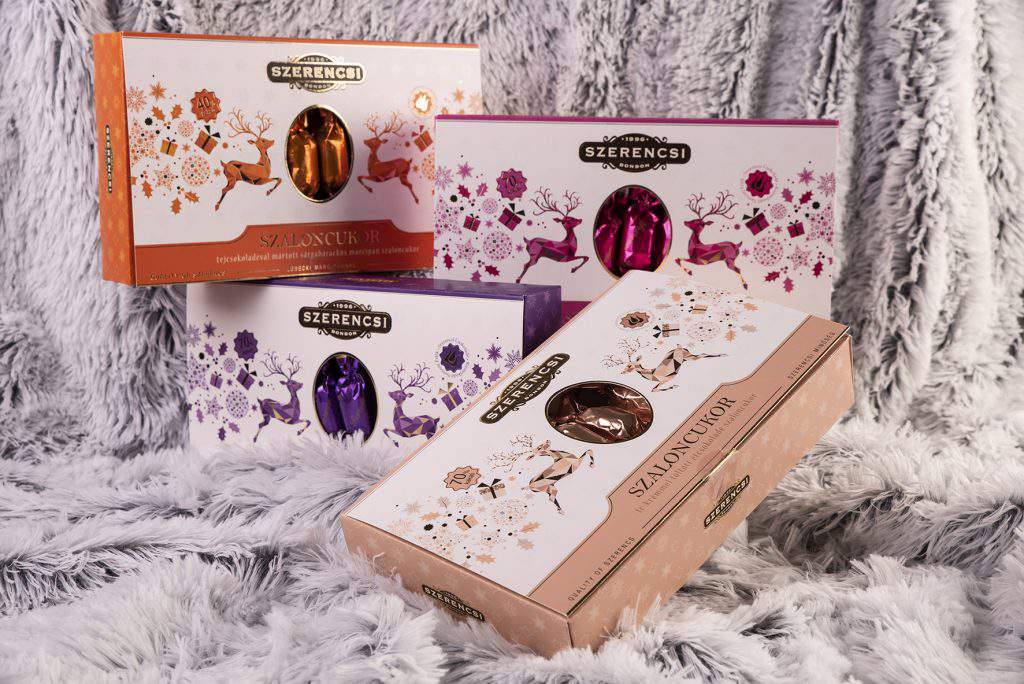
For centuries, Hungarians have decorated their Christmas trees by hanging so-called szaloncukor (‘salon candy’), a traditionally fondant-based candy coated in chocolate that is wrapped in shiny, colourful foil, on their trees. While the flavours and wrappings of the festive candy have changed and followed certain trends over the years, it remains to be a staple and important accessory of Christmas in Hungarian households.

Sándor Sánta, president of HUNBISCO, the Association of Hungarian Confectionary Manufacturers said,

The sales of this festive candy skyrocket before Christmas and according to the survey 86% of Hungarian consumers plan to purchase salon candies this year”.

In the flavour contest the classic citrus jelly is the absolute favourite with two thirds of consumers choosing it as their preferred variety. Runners-up include coconut and caramel, but many people also like the more refined, and expensive, marzipan and hazelnut cream fillings. In the past few decades the supreme reign of the classic sugar fondant szaloncukor has slipped and it has gradually become one of the least popular varieties while the products made using high quality chocolate and fillings have become increasingly widespread.

New-Year


Despite the Christmas candy not being a Hungarian invention, it was Hungarian confectioners who first started making them in the first third of the 1800’s, and it has been exclusively produced by Hungarians ever since. True, the ancestor of all festive candies, the fondant sugar originates from France and the tradition of erecting Christmas trees has German roots.

However this unique marriage of the German Christmas tree and the French sugar dessert, via the decoration of the tree with candy only evolved in Hungary.

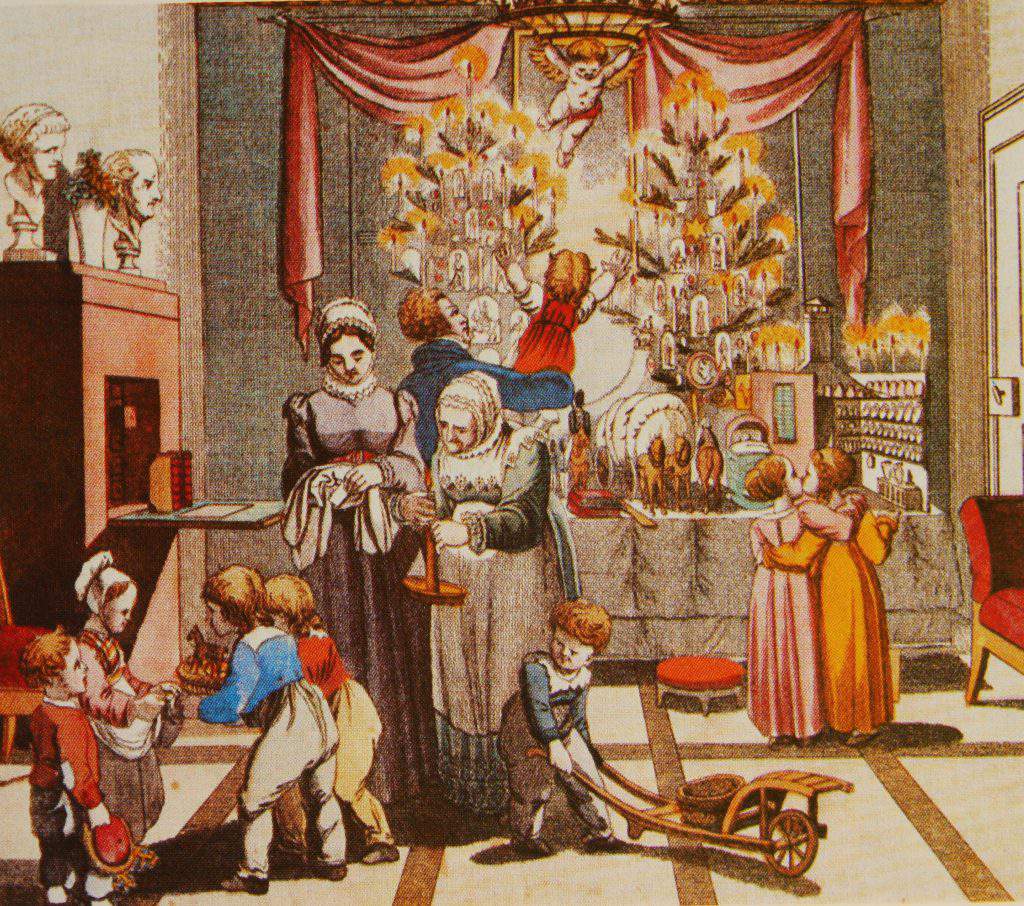
Initially only the wealthy families could afford to erect Christmas trees and buy sweets. The noble families placed the trees in the salons of their apartments or houses, hence the szaloncukor or ‘salon candy’ name.

Today, this festive candy is much more widespread and accessible.

On average consumers spend around HUF 2,000 on the sweets. They first decide the flavour and the second consideration is the price. Since the price is important, 50% of consumers will shop around after Christmas for special deals and pick up discounted candy too.


Finally the survey also answered a major debate that keeps families excited during the festive season. Some people have the habit of sneaking the candy from the wrapping and leaving the shiny but empty foil hanging on the tree, thus leaving the next candy hunter to grab nothing but the empty wrapping. So how many people do this? As it turns out: almost everyone! The survey revealed that almost three-quarters of families have faced this mischief. Therefore, it is hardly worth trying to find sinners, because almost everyone has committed this ‘sweet offense’.

And if they haven’t yet, there’s a good chance they will, sooner or later.

Members of the Association of Hungarian Confectionery Manufacturers who produce the festive candy:

  • Choccogarden Kft.
  • Haribo Hungária Kft.
  • Lissé Kft.
  • Mondeléz Hungária Kft.
  • Nestlé Hungária Kft.
  • Szerencsi Bonbon Kft.
Founded in 1992, the Association of Hungarian Confectionery Manufacturers currently has 24 members and is the ambassador of the producers of quality confectionery to be consumed with pleasure and moderation. The Association engages in dialogue with the public and decision-makers and represents the interests of the sector in Hungary and in the Union. Its aim is to provide a support and an environment promoting competitiveness for the Hungarian confectionery market. It stands for fair taxation, correct regulation, skilled workforce and high quality education.

Featured image: Szerencs szaloncukor via Association of Hungarian Confectionery Manufacturers 

Source: Association of Hungarian Confectionery Manufacturers

Source: dailynewshungary.com

Reklám
Tas J Nadas, Esq

Government Steps Back Following Debates and Public Outcry

Following tedious debates and heated public outcry, the government has stepped back from its proposed “slave law.” Officials now insist that an increase in overtime would be voluntary and the one-year compensation period would not be extended.

On Wednesday afternoon, having met with the representatives of certain trade unions, the bill’s presenter, Lajos Kósa, announced that even though it would raise the upper threshold for annual overtime to 400 hours, an amendment to the original bill would make it clear that more overtime would only be possible with the employee’s consent.

Kósa thinks the planned modification of the regulation of the rest days of those working uneven hours is in the employees’ best interest. In addition, from now on, employees may initiate modifications to their schedules, he argued.

Furthermore, Kósa insisted that the government’s original goal was to dismantle administrative barriers in the labor code and allow employees to earn more by increasing their work hours on a voluntary basis. He also promised further consultations and talks with the representatives of the workers.

Minutes after Kósa’s announcement, PMO chief Gergely Gulyás claimed that the government—after having discussed Kósa’s individual motion—would not support the extension of the compensation period to three years. He confirmed that additional overtime would only be possible with the worker’s consent.

Reportedly, trade unions have favorably received the new announcements. However, they still oppose the potential extension of the overtime hours to 400. It is also still unclear how workers would go about declining an employer’s request for additional overtime. As a result, the trade unions have yet to call off their December 8 demonstration.

featured image: PMO chief Gergely Gulyás at his regular press briefing on Wednesday; via Zoltán Balogh/ MTI

Source: hungarytoday.hu

Reklám
Tas J Nadas, Esq

Hungarian Film Eternal Winter Awarded Best Drama in Florida

Attila Szász’s new film Eternal Winter, based on Norbert Köbli’s script, bagged another prestigious honor last week when it took home the award for Best Drama at the 33rd Fort Lauderdale International Film Festival (FLIFF). The film previously won the award for Best European Movie of the Year in Berlin and Szász was chosen to receive the award for Best Director at the 42nd Montreal World Film Festival.

Following the Soviet occupation of Hungary in 1944, local, Ethnic German women are taken from their small village, loaded into cattle wagons and forced to work in coal mines under inhuman conditions at a Ukrainian labor camp. Here, Irén meets fellow prisoner Rajmund who decides to teach her how to survive. While she is determined to return home to her daughter and family, history and fate have a different plan: Irén and Rajmund fall in love. Eternal Winter is based on true events and is the first Hungarian feature film about the 700,000 Hungarian victims of the Soviet labor camps whose stories have remained untold for over 70 years.

This is Attila Szász’s first feature film for cinematic release, but he previously directed two TV movies (Félvilág/Demimonde and A Berni Követ/The Ambassador to Bern) with Köbli, as well as TV commercials and a short film. Eternal Winter was released in Hungary on 25 February 2018.

Celebrating its 33rd annual festival in 2018, the Fort Lauderdale International Film Festival presents American indies and studio films, international films, student films, special tributes, seminars and introduces filmmakers to audiences in Southern Florida. The festival—considered one of the most important regional film festivals in the U.S.—was held between 2 and 18 November and screened 200 films.

via index.hu, fliff.hu

Source: hungarytoday.hu

Reklám
Tas J Nadas, Esq

More and More Countries Are Rejecting UN’s Migration Package

The United States and Hungary were the first countries to reject the UN’s migration pact. However, many countries have since followed in their footsteps. The pact is primarily criticized because it doesn’t differentiate between legal and illegal migration.  Hungarian officials claim it harms sovereignty and legitimizes illegal migration. 

Hungarian Foreign Minister Péter Szíjjártó thinks that the global migration compact will only worsen Europe’s situation as it will encourage millions of people to set out, risk their lives and pay millions of dollars to human smugglers.

Szíjjártó insists the package would pose a “serious danger” to Europe as it is “aimed at legalizing illegal migration as a fundamental human right.” He warned that Hungary would vote against the proposal at next year’s UN general assembly session.

Austria is the first country to follow Hungary’s example.  Concerning the UN package, Vice-Chancellor Heinz-Christian Strache said that Austria disagreed with 17 out of the 23 points. Austria would vote against the package to prevent “bad development,” he said, adding that the line between legal and illegal migration must not be removed.

On November 14, The Czech Republic joined the growing ranks of European Union countries rejecting the UN pact. Prague also criticized the decision because of the lack of clear differentiation concerning migration.

This week, Poland, another V4 country, joined the list. The right-wing Law and Justice (PiS) government said in a statement that it would not approve “the agreement which does not guarantee security for Poland and can also be an incentive to undertake illegal migration.” It also added that the pact had failed to give “strong guarantees regarding the sovereign right of countries to decide who they accept on their territory and to distinguish between legal and illegal migration.”

In a statement, Bulgaria revealed it would be not be siding with the United Nations on the matter.

Slovakian Prime Minister Peter Pellegrini said he was concerned his country might be required to receive more migrants than it wishes to. “Our red lines are obligations that would limit our sovereignty to decide about accepting migrants,” he told reporters after a government meeting.

The pact became a major domestic political issue when left-wing politician and former UN official Miroslav Lajcak declared it would not impose anything on Member States. Lajcak argued that the issue was “being hijacked by populists, xenophobes and nationalists.” He stated that if Pellegrini’s left-leaning Smer party did not trust him, then “[he wouldn’t] be the minister of foreign affairs.”

On a global scale, America was the first major player to say no to the pact. The Trump administration is leading the international opposition against the compact, claiming it harms sovereignty and legitimizes illegal migration. On Wednesday, Australia’s conservative government also said it would not sign the pact because the agreement would undermine its existing immigration policies. Australia is widely known for its hard stance towards migration.

The Israeli government appeared to not be in favor of the pact. When asked about the issue this week, Prime Minister Benjamin Netanyahu said Israel is coordinating with the Trump administration and will act accordingly: “We are not in favor of the Global Compact on Migration in principal and probably will not be part of it.”

Via: Mti, Reuters, Origo.hu

Image: ispionline.it

Source: hungarytoday.hu

Reklám
Tas J Nadas, Esq

Traditional Blueprint Dyeing Technique Added to UNESCO World Heritage List

Blueprint dyeing, a traditional Hungarian cloth dyeing technique, has been admitted to the UNESCO intangible world heritage list, the UN educational, scientific and cultural body’s committee said at its Wednesday meeting in Port Louis, Mauritius.

The technique, which was nominated jointly by Hungary, Austria, the Czech Republic and Slovakia, spread in central Europe in the 18th and 19th century. A pattern was traced on cotton or silk with a water resistant material and then the fabric dipped into indigo dye, giving it a characteristic and often intricate beauty.

UNESCO countries signed an agreement on preserving intangible world heritage in 2003. Of Hungarian achievements, the Kodály music education method, the Mohács Busó festival, the “dance house” method to preserve Hungarian folk dances, Matyó folk art and traditional falconry have been admitted to the list.

via MTI
featured photo: Ildikó Tóth, Hungarian blueprint dyeing artist

Source: hungarytoday.hu

Reklám
Tas J Nadas, Esq

It is with deep sadness that we announce the passing of Luca Katalin Gerő

Luca Katalin Gerő
(December 13, 2001 – November 18, 2018)

Luca Katalin Gerő was born December 13, 2001, at St. Luke’s Roosevelt Hospital in New York, overlooking the smoldering rubble of Ground Zero—the aftermath of the terrorist attacks of 9-11. She was born a survivor: her mother, Réka Pigniczky, was six months pregnant with Luca as she covered the attacks for the Associated Press. Dodging the crashing WTC towers, it was a miracle that Luca and her mother survived.

That rough beginning and the war-like aftermath of living in New York did nothing to dim the light Luca emanated from the day she was born. Her very name: Luca, an archaic Hungarian version of Lucia, means light. And her light shone from the day she blessed this world to the day it was extinguished all too soon in a horrendous fire that destroyed her family’s home on November 18, 2018.

Luca was the beloved first child of Barnabás Gerő and Réka Pigniczky. When Luca was six months old, the family moved to Budapest, Hungary (her father’s childhood home and her mother’s ancestral home). For her doting grandparents there, Luca was the first of 11 grandchildren, including Luca’s siblings Jolán and Lukács.

The Gerő household was always bursting with children and activity, with Luca the ringleader. She was an impetuous and joyful child who met the world head-on. Even as a toddler, Luca befriended everyone she met and climbed every tree she saw. Together with her sister Jolán, Luca attended the Zoltán Kodály Music School and sang in the Hungarian Radio Children’s Choir. She also sang in the children’s choir of the Church of St. Anthony of Padua, where she received her First Holy Communion.

In 2012, Luca moved with her family to Orinda, CA (her mother’s childhood home). Within months, Luca had made herself comfortable in a brand new circle of friends at Del Rey Elementary School. Before she even spoke English properly, she captivated the school talent show with a song about Hungary and the friends she’d left behind.

Luca enjoyed rock climbing, read voraciously in both English and Hungarian, and liked to write. She played volleyball competitively until her sophomore year. She loved to travel, hike, and ski with her family; she was planning a trip to Bhutan with her mother as a high school graduation gift in 2020.

As she became a teenager, her childhood chattiness sharpened into a sophisticated verbal ability that she deployed to defend her opinion on any issue at hand. Her mother’s suggestion that she join the Debate Team at Miramonte High School was inspired. Debate was not an academic exercise for Luca; it was how she made sense of the chaotic post-terror world into which she was born. She learned to use analysis and criticism to take a stand and defend it, with eloquence and wit. She planned to become a lawyer.

She had an incredible sense of humor, empathy toward those in trouble, and fierce loyalty to her friends. Even in her teenage years, she was open and honest with her parents, much more likely to spill the beans than to tell a lie.

Since childhood, Luca was an enthusiastic member of the Hungarian Scout Troop of the San Francisco Bay Area. She was a natural leader of the younger scouts in her charge. Among her scout peers, it was often Luca who set the tone, came up with the skits, wrote the songs, and rattled off zany ideas in her signature mile-a-minute chatter.

Luca’s natural magnetism drew many friends from her many communities, but she knew her essential home was her family. Only a few weeks ago, Luca defied her parents’ wishes and got herself a small tattoo. Just four discreet letters on the inside of one finger: rblj—representing her mother, father, brother and sister, whom she loved indelibly and permanently.

Luca’s lived life as it was meant to be lived, full of love and inquiry and the yearning for justice. But love is what drove her and gave her the ability to not fall prey to pettiness, insecurity, or hatred. Even as she argued and sought the truth, she remained respectful and tolerant.

Now, that powerful love is all we have left of Luca. Though her loss and our grief are infinite, we can still cling to that love. As we return to our everyday lives in a world marked by brutality, intolerance, and injustice, we honor Luca best by following her example, by radiating love and forgiveness to our families and communities.

__

Those left to cherish Luca’s memory include: parents Réka Pigniczky and Barnabás Gerő; sister Jolán; brother Lukács; grandparents Katalin Vörös (Wayne Phillips), Dr. László Gerő and Dr. Eszter Jánossy; great-aunt Elizabeth Vörös; aunt Eszti Pigniczky (Endre Szentkirályi); cousins Keve, Bendegúz, Vajk, and Enese; uncle Andrew Udvarnoki; aunt Villő Gerő (Zsolt Andrasek) and cousins Sára, Samu, Emma; aunt Borbála Gerő (Ákos Pogány) and cousins Áron, Emese, and Vera; uncle Dr. Domokos Gerő (Dr. Eszter Simon) and cousins Anna and Blanka; and numerous loving relatives, friends, classmates, scouts, and their parents and teachers in the U.S. and in Hungary.

Luca is preceded in death by her grandfather, László Pigniczky.

Arrangements for a memorial service are pending.

Please donate anything you can to help this wonderful family we love so dearly.

YouTube player
Reklám
Tas J Nadas, Esq

Hungarophile French Writer Refused Entry to Romania

The Romanian Ministry of Internal Affairs has banned French linguist and writer, Raoul Weiss, from entering the country for national security reasons. Weiss is also an enthusiastic member of the Transylvanian-Hungarian folk dance-movement and has publically supported cases related to ethnic-Hungarians in Romania.

In an interview with MTI, Weiss revealed that upon landing in Kolozsvár (Cluj-Napoca), he was denied entry to the country.

Documents presented to him at the airport stated he “poses a serious threat to the Romanian legal, social, economic and political stability which is the basis for the existence and development of a sovereign, unified, independent and indivisible Romanian nation-state.” He is banned from entering Romania for 5 years.

Weiss finds it ridiculous that the Romanians consider his artistic activity a threat to their national security and is considering filing a court case against the decision. “How could I have threatened Romania’s security? With my Poems? With linguistic analysis?”

He insists his art has not been the cause of his entrance into Romania being denied. According to Weiss, the real reason could be that his writings about the Romanian civil demonstrations that enjoyed world-wide readership angered some at the „Romanian deep state”, as he puts it. Among the sensitive topics he has touched upon he mentioned voicing his opinion about street movements being organized by NGOs representing foreign interests, and by the anti-democratic maneuvering of the internal services. (Note: this part has been corrected along Mr Weiss’ observations and comments.)

Raoul Weiss explained that he holds French citizenship only, previously ran a café in Kolozsvár (Cluj-Napoca) and is currently a Ph.D. student at Babes-Bolyai University (BBTE). He is planning to defend his doctoral dissertation in comparative linguistics next year. Weiss has published novels in Romanian, authored poems in Hungarian and written several French opinion pieces and philosophical essays.

MTI/Magyar Idők/Hungary Today
Image: alexandrupetria.wordpress.com

Source: hungarytoday.hu

Reklám
Tas J Nadas, Esq

Varga: Witch-Hunt Against Hungary Continues

In an opinion piece released on Euronews, Minister of State for EU relations, Judit Varga, defends the govt and insists that the Article 7 procedure against Hungary was triggered because of its anti-migration policy.

First, she states that, according to the government, the EU breached the Lisbon Treaty with the approbation of the report, as taking into account the abstentions would have altered the result of the vote. Accordingly, Hungary has turned to the Court of Justice of the European Union for an annulment.

She claims that “the battle rages over legal issues while its motivations are clearly ideological and political.” The government views the Article 7 procedure as a punishment for not abandoning its migration policy.

According to Varga, the EU often overreaches in the domestic affairs of sovereign states and interferes in ongoing legal disputes that are confidential. Certain actions, such as Sargentini’s behavior ahead of the vote, indicate political motives. “Most of the official EP procedure happened behind closed doors and deliberately ignored the calls for open discussion. In comparison, the Hungarian Government showed openness numerous times, for example in the case of our Media Law or the constitutional reform,” she added.

The Minister of State also insists that according to Fundamental Law, Hungary’s commitment to the EU is “above any question,” therefore, “we are still ready and willing to engage in a constructive and mutually open dialogue with anyone criticizing us today.”

(You can read our exclusive interview with Judit Varga here)

featured image via Tamás Kovács/MTI

Source: hungarytoday.hu

Reklám
Tas J Nadas, Esq

Hungarian president Áder held talks in The Hague

President János Áder, in The Hague on Friday for a two-day working visit, met Dutch King Willem-Alexander for talks on climate change and measures to prevent a water crisis.

The heads of state reviewed ways to make changes in energy production and to reduce greenhouse gas emissions.

Flood protection is crucial for the low-lying Netherlands, and the country is seeking effective measures to ensure its safety in the long run. The Dutch government is also paying attention to the connection between climate change and global security, especially when it comes to raising public awareness of these issues.

President visits Dutch site with Hungarian biological waste water treatment plant

The Hungarian president observed the operation of a Hungarian developed biological waste water treatment plant at the abbey in Koningshoeven on Friday, wrapping up his visit to the Netherlands.

Using plants and algae in an alternative technology, the facility has the capacity to filter the waste water of a community of 20,000 residents, Áder told journalists at the site.

It can also be used for filtering out residues of drugs and chemicals in industrial waste water in a process faster and more effective than conventional ones, the president said.

Áder hailed that Biopolus, the Hungarian project company, has entered with its innovation the market of a country that had amassed hundreds of years of experience in water purifying technologies.

THE GREAT PLANS OF THE DUTCH MAN WHO BOUGHT A HUNGARIAN VILLAGE

Elroy Thümmler fell in love with Hungary a long time ago, and although he has been a Sziget Festival promoter his true affection is for the countryside. By now Elroy bought almost an entire village, Bedepuszta, and wishes to make the Hungarian countryside more popular, read more HERE.

Source: MTI / dailynewshungary.com

Reklám
Tas J Nadas, Esq

The Evolution of the Transylvanian Economy over the Last One Hundred Years

Transylvania was annexed to the Romanian Kingdom in 1920. Studying its last 100 years, we can conclude that despite all of the various changes the region has undergone, somehow it has preserved its peculiar and magical atmosphere. On the other hand, there are many good reasons to doubt that its huge natural, economic and human potential have been sufficiently exploited.

Unfortunately, it seems that the Romanian majority and political elite have concentrated primarily on how to use political ideology and excessive shows of power instead of implementing regional development plans and policies. Transylvania differs geographically, historically and culturally from the other parts of the Southeastern European country. It isn’t surprising considering the fact that Transylvania belonged to the Hungarian Kingdom for one thousand years and then to the Habsburg Monarchy from 1526 until 1918. After the Austro-Hungarian Compromise in 1967, Transylvania experienced a very rapid development. Its cities, especially in Partium (Temesvár, Arad, Nagyvárad), made colossal progress even by western standards. A dense railway network was built, higher educational institutions were utilized, public hospitals appeared, the streets were given modern public lighting, industrialization and urbanization advanced and the middle-class grew stronger. Transylvania stepped into the 20th century with well-established hopes for its economic prospects. After the Romanian annexation, however, the Romanian state was in constant fear that Hungary would recapture Transylvania and therefore it made great efforts to make the area Romanian ethnically. Transylvania lost economic momentum and the regions beyond the Carpathians didn’t make much progress either. The only exception was Bucharest, which enjoyed a great construction boom and a flourishing cultural life. As a result, it became known as the Paris of the East.

After World War II and the brutal consequences of the communist takeover (nationalizations, putting the previous economic elite out of business, deportations and imprisonments of people etc.), Transylvania was even further behind. Although there were signs of modernization – electrified households and an expanding housing stock – several other fields were poorly developed, like the railway network and the roads, and conditions worsened when Ceausescu came to power in 1965. Similarly to other socialist countries, Romania pursued the policy of forced industrialization. As a result, efficiency in industry improved slowly, whereas pollution increased dramatically. At the end of the eighties, a village destruction program was launched and first demolished the Hungarian village of Bözödújfalu. The settlement on the Maros had been inhabited by a multicultural community including Catholics, Calvinists, Unitarians and Jews. The houses were pulled down and a reservoir was built in their place, but the hydroelectric power station installed on the dammed brook hardly produced any electricity. Due to this, a prosperous community was destroyed by a totally unnecessary, barbaric and loss-inducing project. Sadly enough, such pointless and extreme measures were typical in communist Romania at the time. As most of the ethnic German population was persecuted and sold to Western Germany, a number of advanced cities and villages were depopulated. The once thriving Saxony still hasn’t reached the standard it used to enjoy, though lately some measures have been taken to revitalize the area.

The Complicated Relationship Between Romania and Its Ethnic Minorities over the Last 100 Years

The 1989 Romanian Revolution was followed by a rather turbulent and often chaotic transition period, not uncommon in other post-communist countries. The establishment of a market economy and democratic institutions proved to be slow and controversial. Many jobs were lost and when Romania joined the EU in 2007; emigration to Western and Southern European countries increased and the population rapidly declined as a consequence. Infrastructure hasn’t developed as required, and though the highways of Transylvania are of excellent quality already, the motorway network is sparse and its extension is happening very slowly. The railway is not efficient and a modern network is in high demand so that major cities can be reached easily and quickly. This is also true for the capital because it isn’t centrally located and is difficult to access by public transport.
From the beginning of the 2000s, the Romanian economy grew swiftly and a considerable improvement occurred which could be felt in some regions of Transylvania (Kolozsvár, Temesvár etc.). However, due to poor infrastructure, even today a number of multinational companies are still not present in Transylvania. It is well illustrated by the BMW story: the Bavarian car manufacturing giant originally wanted to go to Romania but, because of the lack of motorways and underdeveloped railways, they finally decided to build their new Central European factory in Debrecen, Hungary.

After the lack of progress Transylvania has had the past one hundred years, it certainly deserves a more dynamic and fruitful future.

By Dénes Sályi

featured photo by szabadsag.ro

Source: hungarytoday.hu

Reklám
Tas J Nadas, Esq

Members of Friends of Hungary Awarded by Bethlen Foundation

Each year, the Bethlen Foundation awards outstanding contributors to Hungarian society. This year, two members of the Friends of Hungary Foundation, publisher of Hungary Today, were among the recipients.

The foundation’s most prestigious prize, the Bethlen award, was given to József Komlóssy who emigrated from Sopron to Canada during the 1956 revolution. In Canada and later Switzerland, he worked and made a fortune as a forest engineer. At the same time, he worked tirelessly to protect the rights of Hungarian minorities living in the Carpathian Basin. He gave multiple speeches on minority rights at the UN, OSCE and other international organizations and was present for a number of delegations to Transylvania and Vojvodina. In his laudation speech, former Deputy Speaker of the National Assembly Sándor Lezsák highlighted Komlóssy’s role in helping to open a pedestrian border crossing in Szelmenc in 2005. In 1946, the village was surrealistically cut in two by the new Soviet-Czechoslovakian border. Later, in recognition of his merits, the village’s main street was named after him.

József Komlóssy
Éva Zabolai Csekme

Éva Zabolai Csekme was awarded the Teleki Pál memorial medal for her efforts in helping Hungarian minorities. As an immigrant, Zabolai Csekme settled down in Geneva, Switzerland, and took an active part in building the Hungarian community. She worked for the World Federation of Hungarians and spent 20 years in the UN. She founded multiple groups intended to protect the rights of Hungarians living beyond the borders. She played an indispensable role in convincing the UN to officially condemn Romanian dictator Nicolae Ceaușescu’s notorious village destruction projects which harshly affected ethnic Hungarians.

In addition, the Márton Áron memorial medal was awarded to Monk Balázs Barsi OFM, chemist Dr. György Heltai and his family from Gödöllő and teacher László Pék, President of the Hungarian Teachers’ Association in Slovakia. The Tamási Áron prize was awarded to literary historian Endre Papp, the editor-in-chief of “Hitel” journal. “For the future of Szeklerland” scholarships were awarded to students Máté Boér from Sepsiszentgyörgy (Sfântu Gheorghe) and Attila Medgyesi from Barót (Baraolt).

The Bethlen Foundation was founded in 1980 by writer Gyula Illyés, poet Sándor Csoóri and widows of writer László Németh and composer Zoltán Kodály. The foundation—through material, intellectual and spiritual support, prizes and scholarships—takes a pioneering role in serving national unity, Central European intellectual cooperation, presenting and promoting the values and renowned representatives of Hungarians living beyond the borders and in the maintenance and nurture of Hungarian relations and solidarity.

images: Friends of Hungary

Source: hungarytoday.hu

Reklám
Tas J Nadas, Esq

92-Year-Old Kurtág’s First Opera Debuts in Scala with Orbán in Attendance

Hungarian contemporary composer György Kurtág’s long-awaited, first-ever opera Fin de Partie made its world debut at the La Scala opera house in Milan with Prime Minister Viktor Orbán reportedly in attendance.

Kurtág spent more than eight years writing Fin de Partie—based on Samuel Beckett’s play Endgame, premiered in 1957. The audience celebrated the performance with eight minutes of applause and Prime Minister Orbán remarked that the opera was “astonishing.”

According to AP, La Scala Common Manager Alexander Pereira has wanted to bring the opera to the stage for years, saying “it’s a masterpiece.” Pereira believes it’s the most important opera of the last 30 years.

The Kossuth Prize-winning composer couldn’t participate in the event due to health reasons, but the Hungarian Prime Minister posted a picture on his Facebook page from La Scala, declaring:

This is the first time that a Hungarian opera is being premiered at the Scala. This is where we need to be. This is the most important event for Hungarians today.

He also told news channel M5 prior to the premiere that although our unique language “separates us from the rest of the world to some extent,” with the help of music, Hungarians can tell who they are and what they think about the world. He added that “events such as tonight’s fill us Hungarians with pride.”

Először tartják magyar opera ősbemutatóját a Scalában. Nekünk itt a helyünk. Ma itt történik a legfontosabb dolog a…

Posted by Orbán Viktor on Thursday, November 15, 2018

Forrás: hungarytoday.hu

Reklám
Tas J Nadas, Esq