Home Blog Page 24

Catholic pilgrims, the fear of Romania

Legend has it that when Turkish and Tatar troops broke into Transylvania in 1661 – one of many such incursions – a Tatar unit raided the Franciscan church in the small village of Csíksomlyó (Şumuleu Ciuc). Their commanding officer, having had recognized the value of a devotional statue of the Virgin Mary, ordered his troops to take it with them. But the statue resisted: it became so heavy that eight pairs oxen couldn’t even budge it.

The officer then unsheathed his sword and went on to hit the statue several times in blind rage – the wounds are still said to be visible. The government of modern Romania seems to display the same irrational fear. At least we cannot think of any rational explanation for them blocking the admission of the Whitsunday pilgrimage of Csíksomlyó in the UNESCO intangible world heritage list back in 2016.
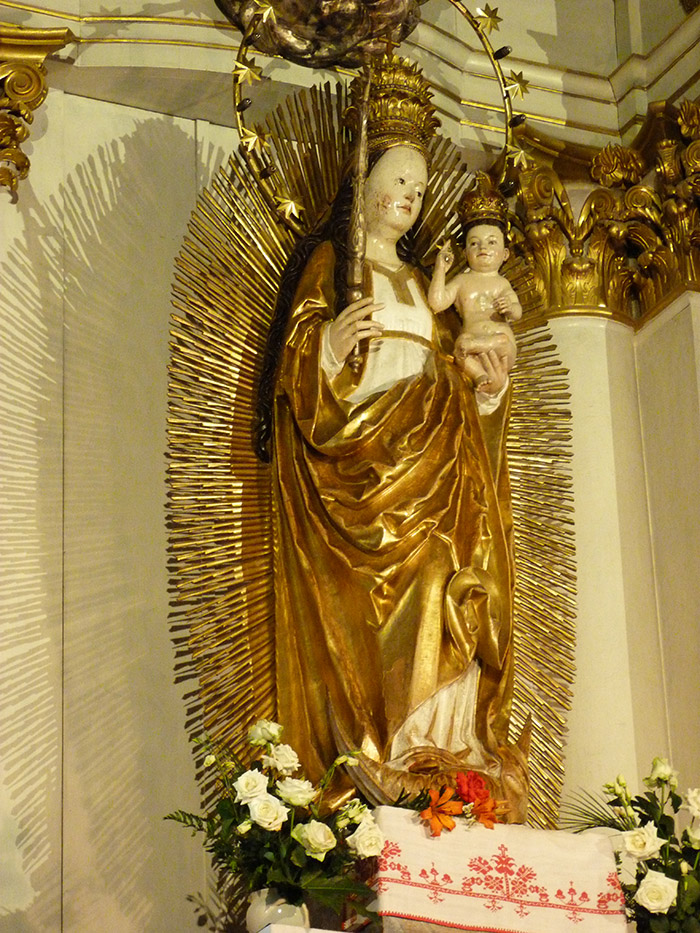
Holy Mother of Csíksomlyó (image: Andor Derzsi Elekes, Wikimedia Commons)

The Whitsunday Pilgrimage of Csíksomlyó is the largest religious and ritual event of Catholics in the Carpathian Basin, attested in the area around the Franciscan monastic settlement of Somlyó since 1442, both by ecclesiastic documents and oral tradition.

The central element of the pilgrimage is the veneration of the Virgin Mary. Hundreds of thousand participants express their gratitude with donations and commemorative plates, showing their devotion through prayers and religious folk practices.

Pilgrims come from Transylvania and Moldova, from rural and urban settlements of Romania, Hungary, Slovakia, Germany, Brazil and Australia – just to name some of them.

In 2011,  Romanian Minister of Culture Hunor Kelemen and his team launched the procedure to include the Pilgrimage into the Representative List of the Intangible Cultural Heritage of Humanity.

The nomination file was carefully compiled with the involvement of professional organizations, the Franciscan order, local cultural institutions, all levels of municipal and state authorities, researchers, heritage specialists and national museums. It included a thorough description of the site and its religious significance, plans for safeguarding the values, as well as for promotional and awareness-raising activities.

Representatives of the Roman-Catholic community, the local administration authorities, cultural institutions, non-governmental organisations and professional associations gave their agreement for nominating the Pilgrimage of Csíksomlyó on the Representative List of the Intangible Cultural Heritage.

In 2012 the nomination file was submitted to UNESCO. That was also the time when Romanian authorities began to display cold feet: they simply did not reply to Unesco’s questions related to the application, thus the file was not evaluated further.

But the team involved in the original bid never gave up: in 2014, when Kelemen was again appointed Minister of Culture, the file was re-submitted with the clarifications requested by UNESCO. The file was evaluated by Unesco and submitted for final approval to the Intergovernmental Committee for Safeguarding of Intangible Cultural Heritage. The meeting of the Committee took place in Addis Abeba, Ethiopia, from 28 November to 2 December 2016.

At the meeting, the representative of the Romanian government, a state secretary from the Ministry of Culture did not support the inscription of the Pilgrimage of Csiksomlyó in the UNESCO list. When asked to make a single verbal clarification he refused to do so, but later gave exhaustive answers during the debate about another file submitted by Romania. He actually asked UNESCO to return the Csíksomlyó file to Romania.

This unprecedented approach caused a major uproar both in the Hungarian community in Romania and throughout the world. It was a clear indication that the Romanian government, lead by Dacian Cioloș had no respect at all for the cultural heritage of the Hungarian community from Transylvania. The Washington Post published an AP report about the discrimination against the largest Catholic pilgrimage in the region.

This is also the first time in Romanian history that a so-called technocrat government perceived Hungarian pilgrims and their devotion as a threat. Despite all this, hundreds of thousands of pilgrims go each year to Csíksomlyó, to pray for the souls of everyone.

Neither the Turks, nor the Tatars, not even Ceausescu, Romania’s feared dictator managed to harm the pilgrims in their adoration of Virgin Mary. So goverments might come and go, but the Csíksomlyói Szűzanya (the Holy Mother of Şumuleu) will still stand there and shine peace and wisdom upon all those souls that pray to her.

Source: transylvanianow.com

Reklám
Tas J Nadas, Esq

Romanian parliament amends controversial bill on language tuition

The Chamber of Deputies (Camera Deputaților), the lower house of the Romanian Parliament has amended on Wednesday the education bill, restoring ethnic Hungarian elementary schoolteachers’ rights to teach Romanian language and literature.

At the end of August, the Romanian government passed a regulation that teaching the Romanian state language in minority schools can only be performed by native Romanian teachers – contrary to previous practice that permitted ethnic minority teachers to also teach Romanian.

The conflict came to a head at the end of September, when Hunor Kelemen, Chairman of the Democratic Alliance of Hungarians in Romania (RMDSZ) suspended cooperation with the ruling Social Democrats (PSD). Although RMDSZ only holds 6.4 percent of seats in the lower house, the Chamber of Deputies, their support is crucial to the PSD.

The conflict was swiftly settled on September 27 by PSD President Liviu Dragnea, who many say is the real power pulling the strings behind Romanian Prime Minister Viorica Dăncilă. Following a meeting with Dragnea, Minister of Education Valentin Popa announced his resignation, and at a cabinet meeting held shortly thereafter, the government withdrew the regulation.

Source: transylvanianow.com

Reklám
Tas J Nadas, Esq

Orbán: Nation to Benefit from ‘Even Stronger’ Family Policy

The government’s enhanced support for families will “benefit the whole nation, including young people” in the long run, Prime Minister Viktor Orbán told public Kossuth Radio on Friday.

“Young people often plan a family … and then face financial difficulties,” Orbán said, adding that he wanted to build a Hungary in which young people are not forced to change their plans due to money worries. Compared with other European Union members, Hungary has the highest family support in relation to GDP, the prime minister said, noting government efforts to reverse negative population trends.

“Hungary’s population is steadily decreasing,” Orbán said, adding that measures must be geared towards ensuring an adequate replacement rate. Enhanced family support will promote child birth and lower the average age, which will make Hungary a “merry and happy” country, Orbán said.

Concerning the government’s latest public consultation survey, Orbán said that the economy was strong enough to allow for more assistance to families. The government is looking to voters for “guidelines” for its next measures, Orbán said, and encouraged residents to “spend half an hour” and fill in the questionnaires.

Viktor Orbán with interviewer Katalin Nagy. Photo by Zsolt Szigetváry/MTI

On the subject of the European People’s Party’s congress in Helsinki, Orbán said “it had not been difficult” to decide whom to support of the two candidates. He called Alexander Stubb an “extremely liberal, pro-migration politician” while he said Manfred Weber was a Christian Democrat.

In his interview, Orbán referred to the United Nations’ migration pact, calling for it to be ditched because “governments should side with the people and protect them from illegal migration, terrorism, crime, and economic difficulties”. He insisted that the plan would “go against the will of the vast majority of Europeans”. “This is a bad pact”, Orbán said, arguing the plan was aimed at driving international support for “principles that are in conflict with the interests of Hungarian people” such as acknowledging migration as a human right. “We won’t accommodate migrants and cannot accept a document which presents it as a noble and globally shared purpose,” Orbán said.

Photo by Zsolt Szigetváry/MTI

Referring to his recent trip to China, he said Hungary’s political stability within the region was especially prized. He said that experts in China converged on the view that central Europe will be the engine of growth in Europe in the next 5 to 10 years. Budapest, he added, is the centre of cooperation between 16 central and eastern European countries, the Balkans and China. Orbán said Hungarian quality manufacture in China is competitive and his visit had resulted in a deal to resume exports of Hungarian poultry halted due to bird flu. Further, hundreds of millions of dollars of Hungarian business opportunities have opened up, too, he added.

Asked about the Central European University (CEU), Orbán said “hysteria” had been generated around the “Soros university” for as long as the CEU had been present in the country. “However much hysteria is whipped up around the university, I’m not inclined to allow anyone to operate outside of the law.” At the same time, the prime minister said the prospect of the CEU leaving Hungary was “a bluff” since Hungarian law provided for the possibility of the universities operations and “the legal requirements for their operation in Hungary are guaranteed.” “I’d place a large bet that we’ll still see them in Budapest,” he added.

via MTI
featured photo by Szilárd Koszticsák/MTI

Forrás: hungarytoday.hu

Reklám
Tas J Nadas, Esq

Ignorant Juncker Angers Hungarians with Romania Speech

Jean-Claude Juncker already wasn’t a popular politician among Hungarians and his recent speech definitely didn’t improve that reputation.

Jean-Claude Juncker, President of the European Commission, told Romanian President Klaus Iohannis that he considers the Romanian national holiday commemorating the unification with Transylvania to also be a European celebration.

During a speech given to the European Parliament Juncker said:

Romania will celebrate on December 1 of the current year its centenary, the centenary of the great union, as our Romanian friends say. I wanted to say to the President that it is a Romanian feast, but also a European feast, because all that concerns Romania concerns Europe. All that is peculiar to Romania is not foreign to the European Union. That day we will celebrate together a great moment in Romanian history and a great moment in European history.

His worlds caused a public outcry in Hungary. Due to the consequences of World War I, Hungary lost two-thirds of its territory including Transylvania. Romania annexed the region despite the fact that Romanians made up just 53 percent of the population. The Hungarian public still remembers the anniversary as a historic tragedy.

This isn’t the first time the Commissioner has ignored the historical grievances of Eastern Europeans. He delivered a speech at an event in Trier, Germany, at which a statue of the left-wing revolutionary donated by the Chinese government was unveiled. Jean-Claude Juncker received criticism from across the globe, but the heaviest attacks came from Eastern Europe.

Government spokesperson Zoltán Kovács stated that Juncker had “spoken in line with his state” and that “his lack of historical facts confirms his being unfit for his position.”

Via: Mandiner / hungarytoday.hu

Reklám
Tas J Nadas, Esq

István Mody Awarded the Prestigious Hungarian Order of Merit, Commander’s Cross on October 23

István Mody, one of the founders of the Friends of Hungary Foundation, has been awarded the Hungarian Order of Merit, Commander’s Cross.

The 62nd anniversary of the 1956 Hungarian Revolution was celebrated in Los Angeles and organized by the Los Angeles Scouts, the Hungarian Reformed Church of Hollywood and the Consulate General of Hungary Los Angeles.

At the end of the ceremony, Tamás Széles, the Consul General in Los Angeles, awarded state honors to István Mody for his work aiding Hungarian-American scientific and public relations and improving Hungary’s reputation in America.

István Mody was born in Marosvásárhely (Târgu Mureș), currently teaches at the University of California in Los Angeles and has been a member of the Hungarian National Academy of Sciences since 2001.

Source: hungarytoday.hu

Reklám
Tas J Nadas, Esq

Ukrainian Nationalist Group Claims They Stole Identification Documents of Hungarian Citizens from Russian Intelligence

An Ukrainian nationalist group claims they stole confidential identification documents listing the passport information of hundreds of Hungarian citizens from Russian intelligence.

Diplomatic tension has been building between the Hungarian and Ukrainian governments for weeks due to a list sharing the information of 300 ethnic Hungarians. The controversial document was published by Ukrainian website Myrotvorets.

The database contains knowledge obtainable only by the government or secret service. Hungary has accused the Ukrainian security service of conducting operations against the Hungarian minority.

For instance, Foreign Minister Péter Szijjártó said earlier that Ukraine “went further than ever before when it violated every existing written and unwritten rule of international law and diplomacy” by conducting an intelligence operation at a Hungarian consulate in Ukraine (referring to the illegal recording of an oath-taking ceremony).

Myrotvorets claims they didn’t receive the information from the Ukrainian security service, but instead stole it from Russian intelligence. The extremist group says they were in possession of Hungarian passport data through to 2015, therefore Russian intelligence must have been very active during this period. They revealed that they invented a special method of filtering out Hungarians who have Ukrainian citizenship.

The story is suspicious as the Ukrainian Nationalist group could have gotten the data from other sources with less effort. Index.hu revealed that many violations occurred in Ukraine in the early stages of the Naturalization process when people with Hungarian origins could obtain Hungarian Citizenship. The newspaper gathered information proving that with the help of corrupt officials and lawyers, members of Russian and Ukrainian crime syndicates could take advantages of legal loopholes.

On Wednesday, Myrotvorets added more than 300 individuals to the list. According to MTI (Hungarian wire service), people on the list noticed that the database displays their expired passport numbers from prior Hungarian documents next to their names.

Via: Index.hu / hungarytoday.hu

Reklám
Tas J Nadas, Esq

Szijjártó on CNN: ‘We Have Been a Christian Country for a Millennium and We Don’t Want to Change That

Christiane Amanpour, one of the most well-known faces of CNN, uploaded a 4-minute long video to her official Facebook page from her interview with Péter Szijjártó, Minister of Foreign Affairs and Trade. She tries to find the answer to what exactly Prime Minister Viktor Orbán means when he says he’s trying to preserve a “Christian Hungary.”

Amanpour asked the foreign minister whether the government was insinuating that anyone “other than white Christians” would not be accepted in the country. Szijjártó responded, claiming that no one said this and explained Orbán’s statements:

We have been a Christian country for a millennium and I don’t really understand why is it bad news that we don’t want to change that. And I don’t understand why is it bad or why is it unacceptable that we would like to stick to our history, to our culture, to our heritage, to our religion. We never judged other countries that have different kinds of policies. We never judged countries, who said that multiculturalism is more valuable than a homogeneous society, for example. Please, let’s leave it to the certain countries. Let’s leave it to us to make a decision, whether we think multiculturalism is more valuable than a homogeneous society. I understand we don’t agree on that, but I respect that you have a different position and I’m not going to judge you on that (…) but I expect the same.

Amanpour pointed out that Hungary also “claims to have an immigration problem” and that Hungary doesn’t want these – as Prime Minister Orbán called them – “invaders” in the country; Szijjártó quickly corrected the term to “illegal migrants.” Amanpour continued, pointing out that the country doesn’t have an actual immigration or asylum problem, as the population is “10 million or so with less than four thousand refugees or people seeking to migrate.” She added that Hungary hasn’t declared crime or terrorism a problem either.

Szijjártó said that Hungary would have an immigration problem if the country didn’t protect its borders. He added that Hungary still complies with its obligations as part of the Schengen zone. Amanpour called attention to the fact that the European Union thinks Hungary is in violation of other rules and, as a result, is currently proceeding with Article 7.

You can watch the 4-minute excerpt from the interview below:

What exactly does the Hungarian prime minister mean when he says he’s trying to preserve a “Christian Hungary?” I asked Foreign Minister Peter Szijjarto. Full interview: https://cnn.it/2IE5DQy

Posted by Christiane Amanpour on Wednesday, October 3, 2018


Source: hungarytoday.hu

Reklám
Tas J Nadas, Esq

Hundreds of Szeklers singing in the Vatican

Hargitanépe reports that a choir representing the Upper Ciuc region of Transylvania sang on Monday at the Saint Peter’s Basilica in the Vatican. The choir numbering over 405 people arrived in the Vatican to promote the beautification of bishop Áron.

The pilgrims attended the Sunday Holy Mass on the 7th of October at the Saint Ignatius church, while on the next day, on the Feast of Our Lady of Hungary, the group attended another Holy Mass (this time in Hungarian) where they even performed several songs. Since the large group could not fit into the Our Lady of Hungary Chapel, the mass had to be performed at the cathedral altar of the St. Peter’s Basilica. The Hungarian Deputy Prime Minister, Zsolt Semjén, the Hungarian ambassador to the Holy See, Eduárd Habsburg-Lotharingiai and the Hungarian ambassador to Rome, Ádám Zoltán Kovács, were also present at the latter mass.

The choir prepared mostly with Mary-songs for this Mary Indulgence, but they performed the Hungarian and Szekler anthems, too.

Bishop Ferenc Palánki emphasised that Hungarians everywhere are trying to maintain peace in Europe, representing Christian values, honouring Saint Stephen, who offered Hungary to the Virgin Mary, hoping that she will protect the nation in the coming centuries. A thousand years have passed, as Palánki argues, and yet Hungarians have never forgotten their faith which was given to them by their ancestors and which they will have to pass on to the coming generations.

The pilgrims, respecting tradition, wore Szekler and Csángó folk costumes which, as Vatican News writes, captivated tourists and believers alike.

The choir had an audience with the pope himself, for which they prepared fifteen liturgical songs, among them several are dedicated to Virgin Mary, and even a hymn about bishop Áron Márton, as this pilgrimage is to commemorate the 80th anniversary of Áron Márton’s appointment as a bishop. The pilgrims’ ultimate goal is to have bishop Áron beatified.

The 405-member choir is made up of 14 smaller Szekler choirs, namely from Balánbánya, Csíkszentdomokos, Dánfalva, Madaras, Csicsó, Madéfalva, Delne, Szépvíz, Szentmiklós, Borzsova, Taploca, Gyimesfelsőlok, Gyimesközéplok, and the choir of the Millenium Church from Csíkszereda.

YouTube player

Photo: vaticannews.va Source: hargitanepe.eu, vaticannews.va

Source: dailynewshungary.com

Reklám
Tas J Nadas, Esq

Hungary Wins 2018 Men’s Water Polo World Cup

After 19 years, the Hungarian men’s water polo team won the gold medal at the FINA Men’s Water Polo World Cup held in Berlin, Germany between 11-16 September, after beating Australia 10-4 in the final yesterday.

Monday got off to a bumpy start with Head Coach Tamás Märcz’s squad losing their first match against the Germans (12-10) following a 3 point lead. However, the Hungarian team marched through their remaining games.

Overcoming this summer’s disappointing performance at the LEN European Championships where they came in eighth – their worst result since 1989 – the Hungarian team beat Serbia, the current Olympic champion and winner of the last three World Cups, in the semifinals and will face Australia in the final.

Head Coach Tamás Märcz said:

I’m glad that the squad was successful and could win. It’s a great thing to get into the final, but to win is a different thing, it is even harder – but we did it, and managed to pocket an important tournament victory after the summer.

The 2017 FINA World Championship silver medalists took an important advantage of 4-2 over the Australians at the halftime. In the third quarter, the team scored an essential 4-0, and, despite a tie (2-2) in the last, it was too late for the Australian team to beat the Hungarians. The top scorer of the final was Krisztián Manhercz with a total of four goals, while goalie Gergely Kardos became the match’s MVP.

1. MAGYARORSZÁG

Rég hallottuk így, ebben a formában…A 2018-as Világkupa végeredménye:1. MAGYARORSZÁG, 2. Ausztrália, 3. Szerbia

Posted by VLV – magyar férfi vízilabda-válogatott on Sunday, September 16, 2018

Märcz added:

It’s only the first step towards demonstrating something from this new Hungary, it does not mean Hungary will return to the top and never fall down. But we can win if we believe.

This was the fourth success for the Hungarian team in the World Cup competition after previous victories in 1979, 1995 and 1999.  Serbia played the bronze medal match and had no difficulties in overcoming the match’s host, Germany, by 15-9.

The top scorer of the competition was Serbian Gavril Subotic, who secured 17 goals throughout the six-day event, while Australian Aaron Younger was nominated as the best player of the tournament.

Hazaérkezett Berlinből a Világkupa-győztes magyar válogatott.

Posted by VLV – magyar férfi vízilabda-válogatott on Monday, September 17, 2018

The final ranking of the 2018 FINA Men’s Water Polo World Cup:

  1. Hungary
  2. Australia
  3. Serbia
  4. Germany
  5. Croatia
  6. United States
  7. Japan
  8. South Africa

Hungary’s World-Cup winning squad:
Goalkeepers: Gergely Kardos, Soma Vogel
Outfield players: Bence Bátori, Dávid Jansik,  Szilárd Jansik, Gergő Kovács, Krisztián Manhercz, Tamás Mezei, Ádám Nagy, Toni Német, Mátyás Pásztor, Zoltán Pohl, Gergő Zalánki 

via fina.org, waterpolo.hu, swimmingworldmagazine.com

Source: hungarytoday.hu

Reklám
Tas J Nadas, Esq

Hungarian foreign minister slams Ukraine government over dual citizens list

Claiming no link between the Ukrainian state and a list containing the names of Hungarian-Ukrainian dual citizens equals to lying, Foreign Minister Péter Szijjártó told public Kossuth Radio on Thursday.

Szijjártó insisted that the list of some 300 ethnic Hungarian state or municipal officials published by Ukrainian website Myrotvorets contained information which could only be obtained from the government or the secret services.

Szijjártó added that a leader of the civil group running the portal used to work for the Ukrainian secret services, while a founder of the group was still a government employee.

The foreign minister blamed the Ukrainian state for its “obvious failure to protect its own citizens” and argued that Ukraine had so far done nothing to resolve the matter.

Ukraine has launched a “state-assisted hate campaign against the Hungarian community”, Szijjártó said, adding that Ukrainian President Petro Poroshenko had “probably granted approval to that campaign to increase his popularity”.

On Wednesday, Hungary’s foreign ministry summoned Ukraine’s ambassador to Budapest over the existence of the “death list” of Transcarpathian Hungarians in Ukraine, read details HERE.

Source: MTI / dailynewshungary.com


Reklám
Tas J Nadas, Esq

Németh: Turkey Introducing the Presidential System a Success

urkey is a key factor for security in the Middle East, Zsolt Németh, head of parliament’s foreign affairs committee, said in Strasbourg on Monday.

Turkey’s April 2017 referendum on introducing the presidential system was a success given its smooth transition, Németh told MTI by phone on the first day of a meeting of the Parliamentary Assembly of the Council of Europe.

He said the vote itself was “undoubtedly” a democratic success even if he would “not put in parenthesis” his reservations concerning the rule of law surrounding the plebiscite.

From the point of view of Turkish stability, the manner and mode in which the CoE helps the country’s democratisation process is of key importance, he said, adding that the CoE had “a broad and sophisticated” array of means for promoting democracy, including respecting linguistic and minority rights and fighting corruption.

Meanwhile, on the topic of Macedonia, he said notwithstanding low participation in the popular vote on the country’s change of name, there was a strong political commitment in the country to make the necessary constitutional changes. “It’s now Europe’s turn to speed up the country’s integration,” he said, adding that failure to do so would have negative consequences for stability in the Western Balkans.

via MTI
featured photo by gunaz.tv

Source: hungarytoday.hu

Reklám
Tas J Nadas, Esq

A report from the Art Museum Atrium International Day Sunday, October 7th

Bandi and I spent the day there under the United Hungarian Societies name representing everyone.  The main takeaway from being there yesterday is that the Hungarian Community in Cleveland is something to be very proud of!

The consensus from the other ethnic groups that were represented was that none of them have anything like what we do, not in the combination of longevity, quantity and the quality of the organizations and the events and programs they hold and nurture, nor the sharing of and education about our heritage now and its preservation for the future.  Not that we talked to each and every one of them, but we ended the day with a woman who did just that, who is a community organizer and she went around and talked to them and collected information she will share, and she said that with us, she hit the mother load!

Many of them have primarily the Garden and no other or few formally organized groups, even though some have populations in the Greater Cleveland area much larger than ours.

Just a few examples: Someone from the Italian Garden asked about the Museum as they are thinking that possibly they may be able to have one, also.  A Ukranian woman asked how we are doing at the Galleria – I thought there is already a Ukranian Museum, so this may have been another group inquiring and they may not be working together. So when we tell them our Museum goes back more than 30 years, they realized what they may have already lost by not cooperating or by just starting now.

That the Hungarian Community is represented at the Art Museum and we are accessible to the public on this day always turns out to be worth the effort.  We talked to people from many backgrounds, from Eastern European to Turkish, couples with mixed family ethnicities, and so just plain Americans.  The conversation with one lovely couple went from the Garden to the Organ Concert at the Blackstone Home which was to be held in less than two hours, and after I showed them photos in my phone of how remarkable it is, and a quick phone call to Carolyn, they actually went! And per Carolyn Balogh, they loved it, and most likely we will be seeing them again, though neither is Hungarian.

We talked about the Regös and their upcoming performance with a lot of people and how they are such a gem in the city of Cleveland, not just among us.  A Turkish man whose hobby is linguistics talked at length with Bandi about the Hungarian language – he was super knowledgeable – and they used the “A Bölcsötöl a Sírig” as the basis for a discussion about sentence structure, pronouns, prefix and suffix, etc.  And although he has heard the advertising of the Hungarian State Ensemble coming to perform (I should have asked where he heard that), he was actually more intrigued and interested in the folk focused performance of the Regös than a theatrical production and will definitely be back in town to attend the Regös, and maybe both, if he can.  A lot of people took the Regös flyers!

That’s just a few of the positive and lovely interactions we had with all kinds of people.  We gave out the handouts and told people about the Museum in the Galleria, the exhibits and lectures, the Paprika held by the Development Panel, the Thanksgiving weekend of lectures by the Magyar Társaság, the beauty of the Hungarian Garden not that far away, and the Genealogy Society (though we had no handout); the picture of the Szekely kapu on the Hungarian Cultural Center’s flyer got a lot of attention and questions, as did the flyer for the Scouts as well as the Regös and all that they do for our Hungarian youth.  My apologies if I missed anyone here, but we honestly covered so much it was pretty amazing.

We got accolades from the Art Museum’s people, as well.  And to further emphasize how important this outreach really is, of all the people we talked to all day, besides the members of the Regös and their family, the number of them who were Hungarian was 4 – László Böjtös and his daughter Anita, and 2 other people!

And on another positive note, Dan Hanson was there doing his usual thorough reporting and picture taking and I thanked him for all he does for all of us.  Many people told us they look at People.com to find out about our events – so we definitely should all continue to keep Dan informed of all that our many organizations are doing.

So, to everyone who runs these organizations, who year after year make things happen, to those who are members and who dedicate so much personal time so that we can share our love for our heritage and also to reach out to people outside of our close-knit group to teach them about what it means to be Hungarian –  BRAVO!

Ari/Andrea and Bandi Lázár

Source: email

Reklám
Tas J Nadas, Esq

Brexit: Jean-Claude Juncker says chance of deal has increased

Top EU officials have expressed optimism that a Brexit deal can be struck by the end of the year.

Jean-Claude Juncker, the head of the European Commission, said the chance of the UK and the EU reaching a deal has increased in the last few days and could be agreed by November.

Meanwhile, European Council President Donald Tusk said an agreement was possible by the end of 2018.

But Irish PM Leo Varadkar said there is still “a fair bit of work to be done”.

The UK is due to leave the EU on 29 March 2019.

However, there is still no agreement on some issues, including how to avoid new checks on the Irish border.

Both sides had hoped to finalise the so-called divorce agreement and agree a statement on their future economic co-operation by an EU summit in 11 days’ time.

Speaking to the Austrian press on Friday and asked whether an agreement could be reached at the next meeting of European leaders on 17 October, Mr Juncker said: “We are not that far yet. But our will is unbroken to reach agreement with the British government.”

He said a deal could be agreed by November.

“I have reason to think that the rapprochement potential between both sides has increased in recent days,” Mr Juncker added.

He also reiterated his position that a no-deal scenario “would not be good” for either the UK or the EU.

‘End of the year’

Speaking on Saturday, European Council President Mr Tusk said: “We will try for it [agreeing a deal] in October… and I think there is a chance to have an accord by the end of the year.”

Foreign Office minister Sir Alan Duncan also expressed optimism that a deal could be reached before December.

There were also reports from EU officials of a better atmosphere in talks over the Irish border.

The upbeat assessment of progress in negotiations prompted sterling to rise against the Euro and the US dollar.

But Mr Varadkar warned that the two sides had not crossed the finish line yet and the October summit was “a time to take stock”.

He told reporters: “I would be hopeful at that point that there would be decisive progress allowing us to conclude an agreement by November.

“That remains to be seen yet. I think there is a fair bit of work to be done.”

He added: “It’s increasingly important that we conclude a deal sooner rather than later.”

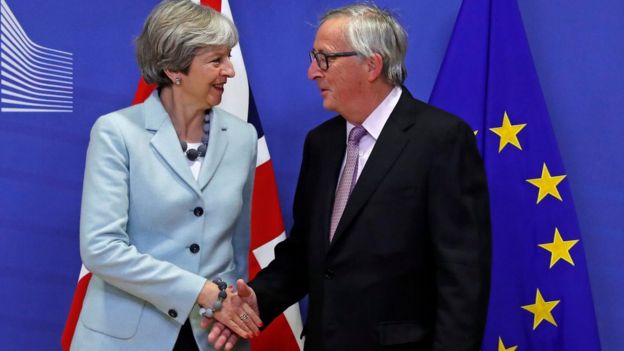
Theresa May and Jean-Claude JunckerImage copyrightREUTERS
Image captionTheresa May meets Jean-Claude Juncker at the summit of the European Council in December last year

The BBC’s Brussels correspondent Adam Fleming said officials still “seem to be pushing for the whole withdrawal agreement to basically be done” by the EU summit.

“Although, if we have learned anything from Brexit it’s that the timetable is incredibly flexible, to use diplomatic language,” he told BBC Radio 4’s Today programme.

Downing Street distanced itself from suggestions – reported in the Daily Mail newspaper – that they were concerned Mr Juncker was trying to “bounce” the UK into agreeing a Brexit deal by mid-October.

Courting Labour votes

Meanwhile, the Guardian reported senior Conservatives had been in private contact with a number of Labour MPs to persuade them to back Theresa May’s Brexit deal.

Some Labour MPs who were mentioned in the article took to Twitter to refute the claims. Rachel Reeves tweeted: “All the Labour MPs listed work hard and fight Tories locally and nationally every day.”

It comes weeks after the head of the European Council Donald Tusk said Theresa May’s Brexit plans were unworkable.

Both sides had hoped to finalise the so-called divorce agreement and agree a statement on their future economic co-operation by the October summit.

But last month, the EU’s chief negotiator Michel Barnier said that if both sides were “realistic” there could be an agreement by November, when a special one-off summit has been arranged.

The European Commission is also considering whether to publish an analysis of where the two sides agree on elements of their future relationship.

It could appear alongside the EU’s latest contingency plans for a no-deal scenario, which will be released next week.

Speaking on BBC Radio 4’s Any Questions, Sir Alan Duncan was also optimistic about the prospects of a deal.

“We are in the art of the possible here, and from what I see in government, I think that we will get a deal, be it in October or November at the two consecutive summits,” he said.


What is the Irish border problem?

Currently, thousands of people cross the border between Northern Ireland and the Republic of Ireland every day. Goods and services pass between the two areas easily without any restrictions.

As the UK and Ireland are currently part of the EU single market and customs union, products do not need to be inspected for customs and standards, but after Brexit, all that could change. The UK wants to leave both the single market and customs union.

Both the UK and EU have agreed they do not, in all circumstances, want a “hard border” – which means physical checks or installing infrastructure such as cameras or customs posts.

Both sides signed up to that promise in December 2017.

They hope they can achieve that anyway in a future agreement on a new trading relationship after Brexit.

But if there were to be a delay or a failure in reaching such an agreement, they have agreed there needs to be a “backstop” solution – which means a last resort plan – that would keep the Irish border open.

The trouble is the two sides can’t agree on what the backstop text should say.

The EU’s proposed backstop solution would see Northern Ireland stick to those rules of the customs union and single market that are required for cross-border co-operation to continue.

But the UK government is against this idea, saying it would effectively separate Northern Ireland from the rest of the UK and create a border in the Irish Sea.

Instead, it would like to see the UK as a whole remaining aligned with the EU customs union for a limited time. But the UK has now signalled that it is “open to looking at some of the options on regulatory checks”.

Negotiators are yet to find a solution that is acceptable to both sides.

Source: bbc.com

Reklám
Tas J Nadas, Esq

László Brenzovics: Human Rights Defenders Simply Don’t Care About the Violations Against Hungarians

Origo.hu interviewed László Brenzovics, President of the Cultural Alliance of Hungarians in Zakarpattia, about current events in Ukraine.

The Ukrainian state has been putting more and more pressure on its Hungarian community in the Zakarpattia region. The multicultural region suffers from many vexations, including secret service operations, military training near the Hungarian border, the expulsion of the Hungarian consul and harassments at border points.

Ukrainian border police have made many attempts at intimidating the Hungarian minority from crossing the border. As Brenzovics told Origo, on several occasions, the border guards have made travelers wait for hours without any official reasons. Sometimes, they are questioned by the Ukrainian secret service solely due to using the border crossing, and authorities don’t distribute records following the procedure. He suspects that these measures strictly aim to threaten Hungarians living in Ukraine.

Hungarian-Ukrainian Relations: How Much Worse Can It Get?

When addressing the recent scandal of a policeman recording footage of the Hungarian consul conducting Hungarian naturalization ceremonies for Ukrainian citizens, Brenzovics claims that the Hungarian consulate in Beregszász (Berehove) did not violate any of Ukraine’s laws. Ukrainian law doesn’t ban Ukrainians from holding multiple citizenships, but Ukrainian rules clearly state that public servants can only hold one citizenship. Therefore, the policeman violated the rules when making the video.

Brenzovics also recalled that the Ukrainian consulate creates citizenship procedures, for instance, in Nyiregyháza. He also said many top politicians and state functionaries, like police officers, hold at least two citizenships.

While the Ukrainians are in the national development process, they don’t seem to care if they harm other communities. Without civil society, the church, and the support of the Hungarian state, the community would just disappear, Brenzovics claims.

There is no other support besides Hungary

The president claims the representatives of the Hungarian community personally informed EU officials about the violations of rights by the Ukrainian state. Therefore, he thinks the international community of human rights defenders and organizations are very aware of the physical attacks against the community, but simply don’t care.

Extremists attacked the headquarters of the Hungarian Party twice, burning it down. Paramilitary forces have been marching in the streets of the ethnic towns, and Hungarian related memorials were destroyed.

Until recently, the communities have banded together in the region, and Brenzovics said that authorities were helpful with the incidents in the past. The community doesn’t want to put a guard at every monument and they insist their “office is not a barrack.” They simply want the Ukrainian state to respect the values of the European community.

Via: Origo.hu

Featured Image: 444.hu

Source: hungarytoday.hu

Reklám
Tas J Nadas, Esq