Budapest’s Hungexpo Fair Center was buzzing for three days last week as this year’s European Championship of young professionals was held in the Hungarian capital with much success.
HT was able to take a closer look at the restaurant service section of the competition. Participating waiters had to perform three stations in total, one per day: fine dining, bistro and bar/lounge+coffee. They had to manage each step within, from napkin folding to recognizing wines and preparing starters. In fine-dining, for example, besides providing a five-star experience, they had to prepare the starter fish-plate or, in the bistro, the steak tartare. At least eight of the ten members on the jury were circulating around the room checking every minute detail and movement of the competitors. The competition is not only a prestigious contest with a festival-like milieu, but also a foot in the door to the highest levels of a given field. The former 2014 winner of the restaurant section can attest, having had no problem finding a job at a three-star restaurant following the competition.
Waiting for the “guests”. Image: Hungary Today
The EuroSkills competition is held every two years for young professionals from 28 countries. The skill competition includes the fields of information and communication; manufacturing and engineering; construction and building; transportation and logistics; social and personal services and creative arts and fashion. In total, 525 competitors and 500 experts took part in the championship, attracting more than 100,000 visitors to the Hungexpo. This year, Hungarian professionals won three gold, three silver and three bronze medals, finishing fourth behind Russia, Austria and France, wire service MTI reported.
Image: Balogh Zoltán/ MTI
In a speech given at the closing gala, President Áder declared that “there is a need for exacting precise and conscientious work everywhere in the world.” President of the Hungarian Chamber of Commerce and Industry, László Parragh, announced that the excellent performance of Hungarians shows that the country possesses the right professionals in both traditional and modern professions.
The next EuroSkills will be held in Graz, Austria, and Kazan, Russia will host next year’s WorldSkills.
featured image: the opening ceremony in László Papp Sports Arena on Tuesday; via Koszticsák Szilárd/ MTI
Romania, which occupied large territories in 1918, has since pursued a controversial nationality policy. Ethnically, the country has become far more homogenous over the past one hundred years. As a result, it has lost much of its exciting, diverse character.
After World War I, the population of the state doubled, amounting to 18 million. Nevertheless, only two-thirds of its people were Romanian, one-third being Hungarian, German, Jewish, Bulgarian, South Slavic, Ukranian and Roma. Following the French model, a highly centralized and Bucharest-centered state organization was created; the Romanian elite had to face the challenge of governing a culturally and economically heterogeneous, fragmented country. After the Treaty of Trianon peace agreement, approximately 200 000 Hungarians emigrated to Hungary. Despite this, the majority of the inhabitants and elite in major Transylvanian cities were still Hungarian, German and Jewish. (While under Hungarian rule after 1867, Jews speaking Hungarian were regarded as Hungarian.) The Romanian government began forced assimilation, but only the communist regime proved to be successful in that effort after World War II.
Bucharest was an ally of Nazi Germany in World War II until 1944. In this period the state lost Northern Transylvania as it was given back to Hungary in 1940 along with one million Romanian residents. Following the attack of the Soviet Union in 1941, Romania regained Bessarabia from its eastern neighbor, whose inhabitants were mostly Romanian. In August 1944, Romania, realizing the forthcoming defeat of Germany, switched sides to join the Allies. As a result, the country regained the whole of Transylvania, losing Bessarabia to Soviet rule in the process. During the cataclysm of the war, the majority of Romanian Jews were killed and most of the Jewish survivors emigrated to Israel at the end of the forties.
Communist power didn’t put an and to discrimination against Romanian ethnic minorities; for Hungarians, the situation became far worse. An autonomous Hungarian region was established in the Székely Land due to Stalin’s pressure, but its area was later reduced and minority rights were not too widespread before it’s abolishment in 1968. The Hungarian political, cultural and religious elite were meant to be intimidated by a number of show trials, but many of those persecuted behaved courageously and remained steadfast. Catholic Bishop Áron Márton’s spirit couldn’t be broken even after enduring long years in prison where he was beaten and tortured. The castles, manor houses and lands of Transylvanian Hungarian aristocrats were confiscated and many were deported to labor camps in the Danube Delta.
Conditions deteriorated after Ceausescu came to power in 1965 and built a severely totalitarian dictatorship founded on a harshly nationalistic policy. The dictator didn’t spare his own nation; his megalomania and paranoia led to the imprisonment of many dissident, intellectual and working class Romanians. His economic policy gave rise to austerity measures and poverty increased, stimulating growing dissatisfaction within the whole society. However, the majority of insults were inflicted upon ethnic minorities. Germans in Transylvania were sold to West Germany, so when communism fell in the region less than a quarter of a million ethnic Germans could be found in Romania, as opposed to half a million in the sixties. Huge housing estates were built in big Transylvanian cities and deliberately filled with Romanians so that the towns would lose their original Hungarian character. The stifling nationalistic atmosphere drove tens of thousands of Hungarians to Hungary in the eighties. Most came legally, but a considerable number did not.
As a consequence of the 1989 revolution in Romania and the dramatic changes in Central and Eastern Europe, the country went through a democratization process with free elections and the introduction of a market economy. Similarly to other post-Soviet satellite states, the transition wasn’t without difficulties and hasn’t been completed as far as deep structures are concerned. The ethnic minorities’ circumstances have improved a lot, but unfortunately, an open-minded minority policy comparable to West European practices (cp. South Tirol or Finland) has not yet been developed. Young and middle-aged ethnic Germans emigrated to Germany and the number of Hungarians dropped from 1,8 million in 1992 to 1,5 million in 2002 and sank to 1,3 million by 2011. In elementary education minorities are guaranteed the use of their mother tongue, however, in secondary education, this isn’t always the case. In higher education, a nationalistic approach is utilized as exemplified by the case of the Medical University of Marosvásárhely. Originally the trainings were presented in Hungarian, but from 1962, the courses became bilingual. The use of Hungarian was continually made difficult and this practice didn’t improve with political change. Bucharest is still actively hampering the day to day operation of medical training in Hungarian. Székely Land – the largest Hungarian regional block in Transylvania – is fighting for autonomy in vain due to the unanimous refusal of the Romanian elite.
At the moment it can’t be predicted how these issues will develop in Romania in the 21st century, where a twin phenomenon – intensive ageing of the population and massive emigration to the West – has already reduced the number of inhabitants to 18 million from 23 million in 1992. Although positive steps have been taken, further efforts are necessary to make sure that the Hungarian and Romanian people in Transylvania can live together in peace. Broadening minority rights has to be the first priority, followed by a significant economic development project launched to improve the living conditions in Székely Land. Of course, the increased well-being and prosperity of the whole country is the ultimate aim.
Gergő Balázs Gecse has died in a road accident as a result of being struck by a 90-year-old driver in France.
According to the French press, the driver claimed to be blinded by the sun and unable to see Gecse in the road. The accident occurred Sunday morning in the south-east of France, near Villard-Bonn. Prior to the accident, the 32-year old had been living a nomadic lifestyle traveling around Europe with his ox-wagon, dog, cows and two goats since 2004.
A French couple – both former friends of Gecse’s and fellow nomads – revealed that his animals are temporarily being taken care of. Gecse’s lifestyle was documented in the short film below:
Alex Borstein – best known for being the voice behind Lois Griffin and a number of other characters on Family Guy – won an Emmy yesterday for Best Supporting Actress in a comedy series for her role in The Marvelous Ms. Maisel. In her acceptance speech, some might have recognized a few Hungarian words as she thanked her mother in the language.
Both of Borstein’s parents are mental health professionals. Borstein’s mother Judy was raised in Budapest, Hungary, but she later moved to the United States because of the Hungarian Revolution of 1956. Watch the acceptance speech below to hear Borstein thank her family and pay tribute to her mother by saying “Anyukám, nagyon szeretlek.”
Over the course of her career, Borstein has performed in a wide range of roles, mainly as a voice actress. She previously received another Emmy award for her role as Lois Griffin inFamily Guy.
Other nominees of the category included Zazie Beetz for Atlanta; Aidy Bryant, Kate McKinnon and Leslie Jones for Saturday Night Live; Betty Gilpin for GLOW; Laurie Metcalf for Roseanne and Megan Mullally for Will & Grace. The 70th annual Primetime Emmy Awards aired live on NBC from the Microsoft Theater in Los Angeles. Saturday Night Live‘s Michael Che and Colin Jost co-hosted the event.
Legendary fencer and trainer, sportsman of the nation, and four-time Olympic champion, Győző Kulcsár has died at the age of 77. As Index notes, for more than 50 years he managed to stay at the forefront of the fencing world. Kulcsár was not only one of the most successful Hungarian athletes, but also a celebrated trainer.
Győző Kulcsár was born on 18 October 1940 in Budapest. During WW2, he lived in Germany and Sweden with his family. He started fencing at the age of 15. He was part of the gold medal-winning Hungarian team épée during the 1964, 1968 and 1972 Olympic games. Individually, he earned gold in 1968 and later took two bronze medals as well. Aside from his many other triumphs internationally, Kulcsár is also a three-time world champion.
Despite having earned a degree in engineering in 1968, Kulcsár only worked in the profession for a short time. After retiring from the competitions ahead of the 1980 Olympics, he became the head coach of the Hungarian national fencing team. In 1986, he moved to Italy to work with Pro Vercelli. His trainees included Olympic gold medalist Maurizio Randazzo and silver medalist, Elisa Uga.
In 2001, he returned to Hungary and initially became the head coach of Budapest Honvéd’s fencing department. Ahead of the 2004 Olympic Games, he prepared the then-defending champion Tímea Nagy for her second Olympic title. He was the head coach of the Hungarian National épée team from 2006 to 2012. He achieved his last major international success with Emese Szász when she triumphed and was named the 2016 Olympic champion. His nephew and legendary fencer, Krisztián Kulcsár, is currently the president of the Hungarian Olympic Committee (MOB).
Kulcsár with Emese Szász in Rio de Janeiro. Image: István Huszti/ Index.
Besides the number of merits and awards he already had to his name, Kulcsár was also elected to join the Association of Immortal Hungarian Athletes, a very illustrious company which consists of 21 sportsmen, in 2000. In 2004, he was elected among the sportsmen of the nation, while in 2010, he was awarded the Hungarian Order of Merit, Commander’s Cross.
As the Hungarian Olympic Committee told wire service MTI, Kulcsár passed away on Wednesday evening.
Hungary has become very popular with the Hollywood film industry, and in the past few months, it seems there’s always at least one American movie star in the capital. Following in the footsteps of Ryan Gosling, Mila Kunis, John Malkovich and Will Smith, Arnold Schwarzenegger is currently filming the sixth Terminator movie in Budapest.
In the new Terminator film, Linda Hamilton reprises her role as Sarah Connor alongside new stars Natalia Reyes and Blade Runner 2049’s Mackenzie Davis. Arnold Schwarzenegger also returns to play his android character a fifth time. Schwarzenegger acted as a villain in the first movie, but enjoys a more positive role in the later installments. Reportedly, the movie is a direct sequel to Terminator 2 (1991) and will ignore the three movies in-between.
The 71-year-old Austria-born actor reportedly walks a lot in the city and his fans can meet him in local gyms, restaurants and in front of the Parliament. We have collected some of Arnie’s best moments in Budapest.
Biking around Budapest with the Parliament in the background:
Three steps to waking up after shooting all night:1. Beautiful bike ride(Steps 2 and 3 in comments)
Pumping up to get ready for one of you to visit me on the Terminator set. Enter here and let’s #terminategerrymandering: https://www.crowdpac.com/campaigns/386151/meet-arnold-on-the-terminator-set-in-budapest-to-terminate-gerrymandering
The Hungarian government condemns in the strongest terms the Ukrainian leadership’s attempt to “intimidate” the ethnic Hungarian community in Transcarpathia, Hungary’s foreign minister said on Thursday.
Addressing a press conference on a different subject, Péter Szijjártó reacted to his Ukrainian counterpart Pavlo Klimkin’s remark that he is not ruling out expelling the Hungarian consul serving in Beregszász (Berehove) from the country after hidden camera footage showing Ukrainian citizens taking Hungarian citizenship oaths at the consulate appeared on YouTube.
Szijjártó said the oath-taking ceremony in question had been conducted lawfully, insisting that Klimkin’s objection to it had more to do with Ukraine’s upcoming election.
He called it a “particularly unfriendly move” to use hidden camera footage in the election campaign which he said served only to mobilise “the anti-Hungarian vote”. The minister insisted that the footage had been leaked on purpose and recorded as part of an organised campaign.
Dual citizenship is common in the European Union, Szijjártó said, adding that the Ukrainian leadership’s objection to the oath-taking raised questions over whether Kiev was serious about its Euro-Atlantic aspirations. Ukraine must honour its international obligations and accept that Transcarpathia Hungarians are still entitled to their rights “even if Ukraine is working on curbing them”, he said.
Referring to the issue of whether abstentions were counted or disregarded under European parliamentary rules in the vote to open the Article 7 procedure against Hungary, the head of the Prime Minister’s Office said on Thursday that the government’s assessment was that the Sargentini report did not receive the required two-thirds majority.
Under the EU’s Lisbon Treaty, a vote by two-thirds of MEPs would have been required for the report’s approval, and abstentions should have also been taken into account in the vote tally, Gergely Gulyás told a press conference. With the abstentions counted, the report would have failed to secure a two-thirds majority, he said.
Gulyás said he did not believe that the EP’s house rules contained any provisions saying that abstentions should not be counted in a vote.
The procedure cannot move forward until Hungary settles the legal dispute over the matter, Gulyás added. The cabinet will meet to discuss EU-related matters on Monday and it will decide on steps to take in connection with the report on the rule of law in Hungary drafted by Green MEP Judith Sargentini.
The minister underlined the government’s view that the report was not really about the rule of law. Instead, the issue of migration was the factor that determined its adoption, he said.
He said the government had refuted every single critical remark in the report.
The government considers it “unacceptable” that the report includes issues which Hungary had already settled with the European Commission, he said. If these cases can later reappear as “charges” in another EU document, then the commission’s role of “guardian of the Treaties” loses its meaning, Gulyás argued.
He said “pro-migration” politicians were currently the majority in the EP, and this was why next year’s European parliamentary elections — where voters will get to have their say on migration — would be crucial.
“We hope that the forces opposed to migration will make up the majority in the European Parliament formed n 2019, or that at least they can make up ground on the pro-migration forces,” Gulyás said.
Asked about the legal steps the government planned to take over the report, Gulyás said the “most likely” step would be to request the European court to declare the vote invalid.
Asked to comment on a plan by Hungary’s leftist parties to organise a demonstration over the approval of the Sargentini report for Sunday, Gulyás said everyone in Hungary has the right to take part in demonstrations, “unlike when these parties were in power”.
Asked about whether Fidesz would still support Manfred Weber in his quest to become president of the European Commission, Gulyás said no formal decision had yet been made to support him. “But clearly we can’t act as if Manfred Weber, in serving his own personal ambitions, had not voted against his own party for a report he knew to be a lie.”
He said it was doubtful the Sargentini report would have any kind of impact outside of Europe. Regarding a closed meeting of the European People’s Party group, he said even Fidesz’s staunchest critics did not deny that the report was weak and “teeming with lies”.
Asked about German Chancellor Angela Merkel’s comment that protection of the EU’s external borders should be strengthened in order to combat illegal migration, and furthermore, some national competences should be transferred to the EU’s Frontex, Gulyás said he disagreed, adding that the Hungarian government insisted the Schengen rules should be upheld.
He said that if a member of the Schengen zone is incapable of protecting the external border, then either it should turn to other Schengen countries with a request for help or, if it fails to do so, their membership of the convention should be suspended.
On the subject of a recent report compiled by the United Nations denouncing reprisals against human rights activists in 38 countries, including Hungary, Gulyás said the report was the UN’s way of “exacting revenge on Hungary”.
There are currently 70 NGOs in Hungary, he said, adding that there were no practices or laws in place hindering their operations.
Attila Farkas, master of Hungarian pastry, influential soccer coach and possessor of seemingly unlimited gusto, died Aug. 31 after a long illness. He was 83. His family held a private ceremony on Tuesday at St. Colman Catholic church in Cleveland. An informal public memorial service is planned for 5 p.m. Saturday, Sept. 22, at the Ohio City bakery that still bears his name.
A native of Budapest, Hungary, Farkas leaves behind his wife, Ilona, daughter Katherine Berente Laraway of Cleveland, son Nicholas Berente of South Bend, Ind., their spouses and five grandchildren. To that last group he was chauffeur, Hungarian language teacher and sports coach.
Within a day of announcing his passing, the bakery’s Facebook page received more than 100 expressions of condolence
Attila in 2001 with son Nicholas, daughter Katherine and wife Ilona. Believing he was denied admission to college by the Communist government in Hungary, he encouraged his children to get their degrees. (Photo courtesy Ilona Farkas)
“I remember going to his shop around the corner when I was a girl with my parents,” wrote Marge Williams. “We all spoke in Hungarian. He was so nice and charismatic. Lovely man. If I tell Mom, she will cry.” Said fan April Baer: “One of the happiest times of my life was living a few blocks away from Farkas and dropping in on Saturday mornings for nut rolls, walnut squares, pork crackling biscuits, and, oh, dear God, those Napoleons [layered custard and whipped cream puff pastry squares]. “To have fed so many people, and warming us all with his conversation, Attila, a glass of Tokay [Hungarian wine] in your honor this weekend. You gave us so much.”
Farkas, around 1981. He sailed with a club out of Cleveland, despite his lack of experience. “But who wouldn’t want Atti on their crew,” said family friend George Muhoray. (Photo by John Szilagyi from “To Market, To Market” by Joanne Lewis, permission courtesy Steve Szylagyi.)
Mike Harrison, who currently runs Farkas Pastry Shop at 2700 Lorain Ave., a short walk from West Side Market, said he sought a blessing from Farkas before taking over his shop several years ago. He got more than that.
“He became something of a father figure for me, besides teaching me all his recipes. He agreed to come in and work Tuesdays and Saturdays. Then it was just Saturdays, which became the highlight of my week.
“So many people loved him,” Harrison added. “Old ladies would come in with hearts in their eyes. Attila could be abrasive, but he just melted into a sweetheart when a customer was there. He was so much larger than life . . . He made people feel good about themselves. What more can you say about a person
St. Ignatius 1989 soccer team, Farkas at top left. (Photo courtesy Mike McLaughlin)
Farkas also had impact in the sports arena, serving as assistant soccer coach for more than a decade at St. Ignatius High School and, later, John Carroll University. The St. Ignatius relationship evolved in a singular way, said family friend George Muhoray.
“He had his big stainless steel table in front of window when the shop was on West 28th Street,” he said. “It looked onto the [St. Ignatius] soccer field. One day he just showed up at practice, and then he kept coming. Dr. Greg Knittel [the head soccer coach] never told him to stop coming, so it was a little more like a metamorphosis into the job.” Sometimes, Farkas, a former club soccer player, would coach in his baker’s apron. School staff and players gathered regularly at his shop to eat and talk.
“Find any Ignatius soccer player from the 1980s, and you’ll get a big smile on face if you mention Attila Farkas,” added Muhoray. “He was tough, funny, smart, had wit, and the Hungarian accent made it all that much better. He wasn’t our parent, our teacher. He could give it to you straight.
“He made you want to work really hard.”
Coaching team at St. Ignatius: From left, Tom Healey, Dr. Greg Knittel, Mike McLaughlin, Attila Farkas. (Photo courtesy Mike McLaughlin)
“Attila had a fiery passion in the way he approached everything,” said Mike McLaughlin, a Farkas team member and now head soccer coach at the school. “He would say things like, ‘Are you gonna be a ballerina or a boxer?’ He preferred you were boxer.
“Right now, our soccer program is one of the top in the country, and he really laid the foundation for what we’re doing today.”
Sandor Farkas, emigre with his son, Attila, from Hungary’s 1956 anti-Communist revolution. (Photo courtesy Mike Harrison)
Farkas was the son of Sandor Farkas, a Budapest baker who ran a 15-member staff at his own pastry café. When Russia’s Communist government appropriated the shop, father and son immigrated to the United States. Their first American store, in Maryland, tried to mimic American pastries, and failed. They moved to Cleveland to be part of the city’s bustling Hungarian refugee population. Many fled their home country after the failed anti-Communism revolution in 1956. Sandor took a job with Kaase Bakery. But when his wife, Klara, arrived in town she pointed husband and son toward their own business.
“Word spread quickly,” Farkas wrote in Joanne Lewis’ 1981 book on the West Side Market, “To Market, To Market.” “Hungarians love good food and when our pastries first came out, I mean, it went like wildfire and it just burned on and on.”
People know, he added, “the difference between vegetable oil and sweet butter.”
Farkas served in the U.S. Army between the Korean and Vietnamese wars. (Photo courtesy Ilona Farkas)
Ilona, Attila’s wife, lost her first husband soon after she had two children, Nicholas and Katherine. She later dated the bachelor Farkas. Nicholas remembers thinking he talked Farkas into marrying his mother.
“I remember going to a restroom with him one day when I was about 7,” he said. “I told him, ‘Hey, if you want be my dad, all you have to do is marry my mom, you know?’ And he started laughing. Next thing you know, they’re married.
“He was a wonderful father to us,” Nicholas said.
“I just remember way he always talked in superlatives,” he added. “Everything was ‘the best’ or ‘the worst.’ I was always the strongest and my sister was the most beautiful. There was never a middle of the road. It was fun, part of his charm.”
Nicholas remembered that his father read the entire dictionary to sharpen his English.
Farkas worked on pastries most of the week, then sold at the shop on Fridays and Saturdays. (Photo courtesy Mike Harrison)
Kathy recalls that he gave sports reports on Hungarian radio shows, broadcast on the now defunct WXEN.
“He was such an avid sportsman,” she said. “You could find him lying in bed, watching a game on television, wearing headphones to listen to sportscasts on radio and reading the sport pages, all at the same time. That’s not an exaggeration.”
Sought-after kremes, or stacked puff pastry Napoleons. Family friend George Muhorey says he’s made comparisons across Europe, and still thinks this one is the best. (Photo by Allison Carey/The Plain Dealer)
When the family held its memorial, they celebrated in style.
“We had kremes [KREM-ess],” Kathy said of the Hungarian name for the Napoleons. “I don’t remember the last time I ate a whole one. They were just always around. We took them for granted.
Christmas, 2015 with, top row from left, Mathias Doherty, Mat Adcox, Danny Sherry and Mike Harrison. Front row, from left, Brandon Pfeiffer, Attila Farkas. (Photo courtesy Mike Harrison)
“It’s so neat that they’re still making them in his name,” she said. “It speaks to a longstanding tradition in Cleveland. We want it to continue.”
Farkas and his kremes, before slicing. (Photo by Lynn Ischay/The Plain Dealer)
Muhoray said a friend of his has a standing joke about Farkas and his gift for conversation.
“He’d say, ‘I was in Attila’s shop the other day and I said that magic word that got him going.’ ‘Oh, yeah,’ someone would reply. ‘What was the word?’
David B. Cornstein, the US ambassador to Hungary described the country’s workforce as “exceptional” and “highly intelligent” at a business forum organised by the American Chamber of Commerce in Hungary (AmCham) on Tuesday.
Cornstein highlighted Hungary’s low corporate tax rate and said the government’s measures encourage business activity.
Lászlo Szabó, Hungary’s ambassador to the US, said many aspects of the two countries’ relations have changed over the past year.
He noted that US President Donald Trump and Hungarian Prime Minister Viktor Orbán spoke on the phone for the second time shortly before Cornstein had taken up his post in Budapest this past summer and thanked the ambassador for his support. Szabó said the two countries’ trade relations have “never been better”. Hungarian exports to the US increased by more than 6 percent, while imports rose by 4 percent in Q2 of this year, he said.
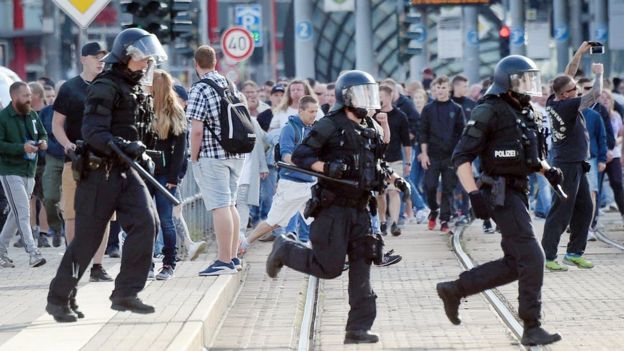
Rival protests over a murder in the east German city of Chemnitz have ended with several people injured as objects were hurled by both sides, police say.
Far-right activists had gathered in the centre for a second day as a Syrian and an Iraqi remained under arrest on suspicion of Sunday’s deadly stabbing.
Anti-Nazi activists rallied just metres away, accusing the far right of using the death for political ends.
Injuries were caused when protesters on both sides threw objects, police say.
German Chancellor Angela Merkel had warned that “vigilante justice” would not be tolerated.
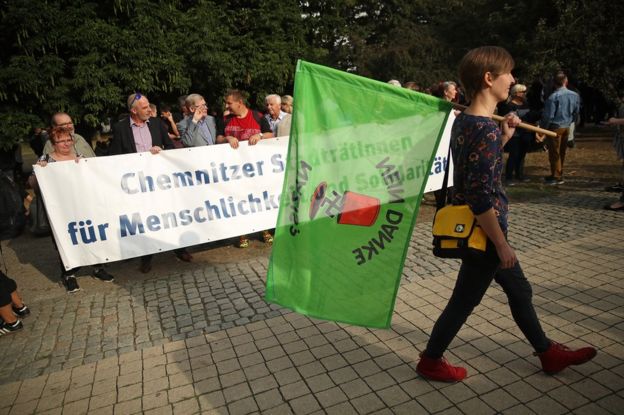
Image copyrightGETTY IMAGESImage caption“Nazis, no thanks” reads a flag carried by a counter-demonstrator in Chemnitz
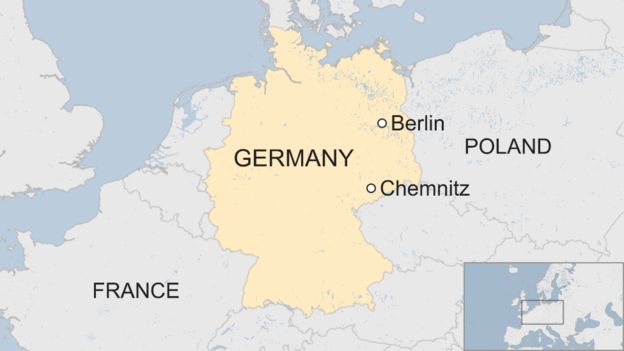
Police warned masked demonstrators who were picking up stones in the city, about 200km (120 miles) south of Berlin, that their actions were being filmed.
Earlier, authorities said police were investigating alleged assaults on an Afghan, a Syrian and a Bulgarian during the unrest that broke out on Sunday.
Reports have included mentions of protesters chasing foreigners, though there are few details.
Chemnitz police, quoted by the local broadcaster MDR, said: “We did not anticipate such a total of participants [on Sunday]”.
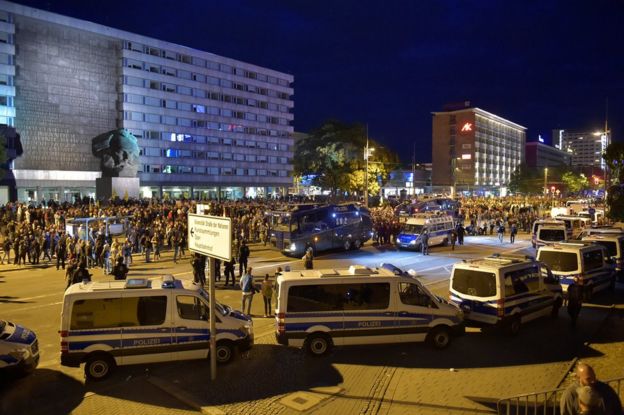
Bigger crowds thronged the city centre on Monday. MDR estimated the far-right turnout to be 5,000, with some 1,000 leftists opposed to them.
What happened on Sunday?
It is unclear what triggered a fight which reportedly preceded the stabbing, at about 03:15 (01:15 GMT) on Sunday, on the sidelines of a street festival.
The far-right demonstration in the city centre on Sunday caused the festival to be cancelled abruptly.
The stabbing victim, a carpenter aged 35, was critically wounded and died in hospital. He has been named as Daniel H, who had a German mother and a Cuban father.
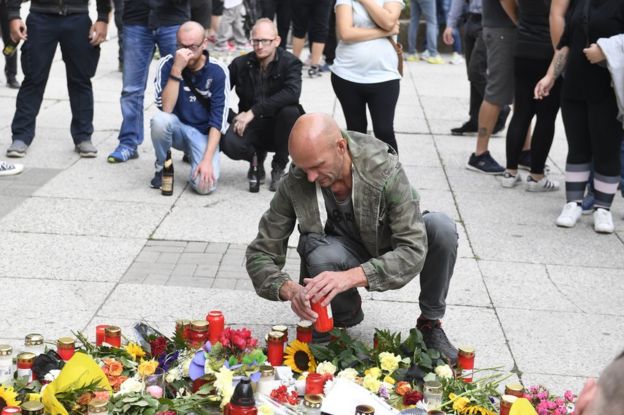
Image copyrightEPAImage captionTributes to the dead man continued to be paid on Monday
Two other German men with him, aged 33 and 38, were seriously hurt, police say.
The Syrian detainee is 23 and the Iraqi 22.
Police have denied rumours on social media that the fight was linked to the sexual harassment of a woman.
A half-Cuban woman who grew up with Daniel H, Nancy Larssen, told Deutsche Welle news that media misreporting had helped fuel the “horrible” far-right protest.
“It’s sad that in the media they’re just saying that a German has died, and that’s why all the neo-Nazis and hooligans are out, but the media should describe who died, and what skin colour he had, because I don’t think they’d be doing all this if they knew,” she said.
Another friend of Daniel H, quoted by the Chemnitz news site Freie Presse, described him as left-wing, with a seven-year-old son.
How did protests spread?
Initially, about 100 people gathered on Sunday for a rally which passed off without incident, AFP news agency reports.
However, some 800 people later gathered at the Karl Marx monument, a focal point in the centre of Chemnitz.
The monument is a throwback to the city’s days as a model socialist city in the former German Democratic Republic, when it was renamed Karl-Marx-Stadt.
Image copyrightAFPImage captionRiot police were deployed in Chemnitz on Sunday
Pegida, the far-right street movement, called for a new demonstration on Monday afternoon, while an MP from the far-right political party AfD, Markus Frohnmaier, tweeted: “If the state is no longer to protect citizens then people take to the streets and protect themselves. It’s as simple as that!”
“Today it’s a citizen’s duty to stop the lethal ‘knife migration’!” he wrote, alluding to the influx of migrants in recent years. “It could have targeted your father, son or brother!”
As the heap of wreaths and candles at the spot where the murder occurred grew larger on Monday evening, right-wing demonstrators massed at the Marx monument, and counter-demonstrators gathered close by.
Police reported some Hitler salutes among the far-right crowd, who held anti-immigration placards with messages like “Stop the asylum flood”.
What did Merkel’s office say exactly?
“We don’t tolerate such unlawful assemblies and the hounding of people who look different or have different origins and attempts to spread hatred on the streets,” Mrs Merkel’s spokesman, Steffen Seibert, told journalists.
Image copyrightREUTERSImage captionPolice ringed the demonstrations in the city centre on Monday evening
“That has no place in our cities and we, as the German government, condemn it in the strongest terms. Our basic message for Chemnitz and beyond is that there is no place in Germany for vigilante justice, for groups that want to spread hatred on the streets, for intolerance and for extremism.”
Martina Renner, an MP for the radical Left party, accused the far right of seeking to exploit the murder for political ends.
“A terrible murder, the background to which is still unclear, is being instrumentalised in the most repugnant way for racist riots in Chemnitz,” she said in a tweet.
Why is the migrant issue so thorny?
In 2015, Chancellor Merkel decided to let in a record 890,000 asylum seekers. Syrians fleeing the civil war comprised the biggest group – a 403% rise on Syrian arrivals the previous year, the German migration office reported.
She and her allies were punished by voters at last year’s general election, when the anti-immigrant Alternative for Germany (AfD) entered parliament for the first time, winning 12.6% of the vote and more than 90 seats.
Chemnitz is in Saxony, a region where AfD and Pegida are particularly strong.
The 20th of August might as well be the most significant national holiday of Hungary with festivals, celebrations and fireworks everywhere. But what is it really about? Read a quick recap of the must-know facts about the background of and traditions connected to St. Stephen’s day.
WHAT DO WE CELEBRATE EXACTLY?
A little history lesson may be necessary when it comes to the 20th of August, but do not worry, we will keep to the essentials. On the other hand, should you be interested in the details, read this previous post about the historical background of Hungary’s foundation.
On the 20th of August, which happens to be the earliest national holiday of Hungary, we celebrate the Christian foundation of the state, king St. Stephen, as well as the new bread.
Stephen’s father, Géza, Grand Prince of the Hungarians was the one who started to steer the country towards Christianity. He avoided wars with the religious neighbours and invited priests to the country. He also raised his son, Vajk in this spirit: Vajk was christened and took up the name Stephen, how we know him today. A struggle for the throne followed the death of Géza, but in the end, Stephen managed to beat Koppány who was supporting pagandom in Hungary. Afterwards, to enhance the country’s independence from the Holy Roman Empire, he asked and received the Hungarian Crown directly from the Pope.
Stephen I was crowned king of Hungary in 1000, which marks the foundation of our state.
Among his acts to spread Christianity was the declaring of the 15th of August, the Assumption of Mary, a holiday. Later, in 1018 he also died on this day, so for a long time, he was commemorated on the 15th.
The date changed when King Ladislaus I of Hungary (King László in Hungarian) initiated his canonisation. Ever since then Saint Stephen’s holiday has been on the 20th of August, although it became a national holiday only much later, during Queen Maria Theresa.
TRADITIONS
The most prominent and well-known traditions are connected to the capital city. Every year it begins at Kossuth Square when the flag of Hungary is hoisted accompanied by the military courtesy. It is followed by the graduation of the honvéd officers, the officers of the Hungarian army. Later the great vaulted hall of the Parliament is opened for the public where you can admire the Holy Hungarian Crown.
At Buda the celebration continues with concerts and family programs, the Festival of Folk Arts and the Street of Hungarian Flavours are also organised here, where you can taste the Cake of Hungary for the first time.
In the afternoon there is a reaper march followed by the blessing of the new bread. And it is still not over! There is a celebratory mass in the Saint Stephen Basilica, preceding the Procession of the Holy Right Hand of Saint Stephen. This latter occasion is partially a state event; however, it is also a religious celebration.
OUTSIDE THE CAPITAL
On the 20th of August the whole country celebrates so do not worry if you are not at Budapest, there are plenty of other programs.
The celebration starts early in Székesfehérvár, as they hold a two-week-long festival here.
It is the Royal Days of Székesfehérvár, complemented by the Coronation Games. The latter changes annually, celebrating the coronation and life of a different Hungarian king every year. Also, there is a traditional festival as well, and it all finishes with a classical concert.
Esztergom and Veszprém organise music festivals for St. Stephen’s day, while Debrecen has the remarkable Flower Parade.
In Siófok you can attend the celebration of wine and bread, and if you are looking for something more historical or authentic, then the tournaments at Hollókő Castle are just right for you.
St. Stephen’s Day is not only celebrated within the Hungarian borders, but there are also masses, bread blessing, concerts and so on in Upper Hungary (Felvidék, now part of Slovakia) as well as cultural programs and ecumenical pilgrimages in Transylvania. The holiday is celebrated among Hungarians living in the USA, too.
FIREWORKS St.
Stephen’s Day would not be complete without the fireworks, of course. It is the grand finale in all the celebrating cities. According to origo.hu this year there are 358 officially announced firework shows. Out of these 27 will take place around Lake Balaton, but of course the greatest and most spectacular is always the one on the Danube.
It is always broadcasted on television if you wish to watch it while sitting in your own chair at home – but in that case make sure to watch István, a király (Stephen, the King), the Hungarian rock-opera about Stephen’s life, as well.
And if you are planning to spend the holiday in the capital, then do not forget to check out this guide. Not only will you get a great overview of the programs but you can also learn about the changes in traffic.
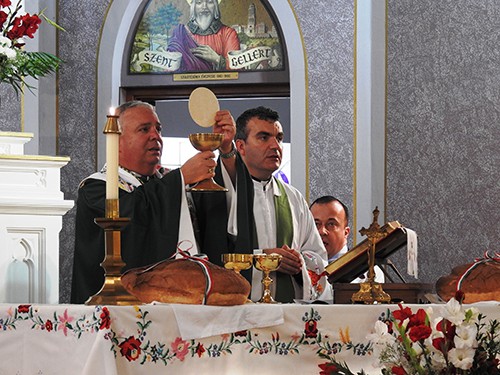
St. Emeric Parish on Cleveland’s West Side, which sits in the shadow of the West Side Market, had a double celebration on Aug. 19. Bishop Nelson Perez celebrated the 11 a.m. Mass that day to observe the feasts of St. Stephen and St. Emeric of Hungary.
St. Stephen, a much-loved king of Hungary, was born a pagan but baptized at about age 10 with his father, Geza, who was chief of the Magyars. After succeeding his father, St. Stephen adopted a policy of Christianization of the country, establishing a system of tithes to support churches and pastors and to help the poor. He also encouraged the building of churches throughout the kingdom. His son, Emeric, died in 1031, seven years before St. Stephen. Both were canonized together in 1083. The veneration of both saints was decreed in 1092 throughout Hungary.
During the Mass, Bishop Perez wore a brightly colored stole that bore Hungarian symbols. Instead of his crosier, he entered the church using a carved wooden Hungarian walking stick. Leading the entrance procession behind the cross-bearer were representatives of the Hungarian Scouts in uniform and others wearing traditional Hungarian dress.
Two parishioners carried large, round loaves of bread that were placed on the altar. Bishop Perez blessed the bread after Mass, cut a slice from each loaf and tasted it.
He told the congregation that faith and culture are inseparable. “Jesus was a Jew, a man of culture.” The bishop said that food is important, recalling how he and others spent many Sundays gathered around the table. “The Eucharist is the food that nourished St. Stephen and St. Emeric. This bread of life gave them strength and courage. Whoever eats this bread will live forever,” he said, linking the thought to the day’s Gospel, which focused on Jesus as the bread of life.
“The bread of life brings us all together in the universal Church as our source of solace and strength. Our hands, mouths and hearts are touched by the Eucharist,” he said.
The bishop congratulated the parish on the double feast of its namesake, St. Emeric, and his father, St. Stephen.
After Mass, the bishop was presented with a bouquet of white flowers and a gift basket. A parishioner displayed a relic of St. Stephen that he said his family received about 40 years ago. The cross and crown of St. Stephen were displayed in the front of the church.
Father Andras Mezei, administrator of St. Emeric and St. Elizabeth of Hungary parishes, and Father Andras Antal, who retired in July as administrator of St. Elizabeth of Hungary Parish, concelebrated the Mass. Father Mezei thanked St. Elizabeth parishioners who joined those from St. Emeric for the special liturgy.
The parish hosted a traditional Hungarian dinner in the church hall after Mass.
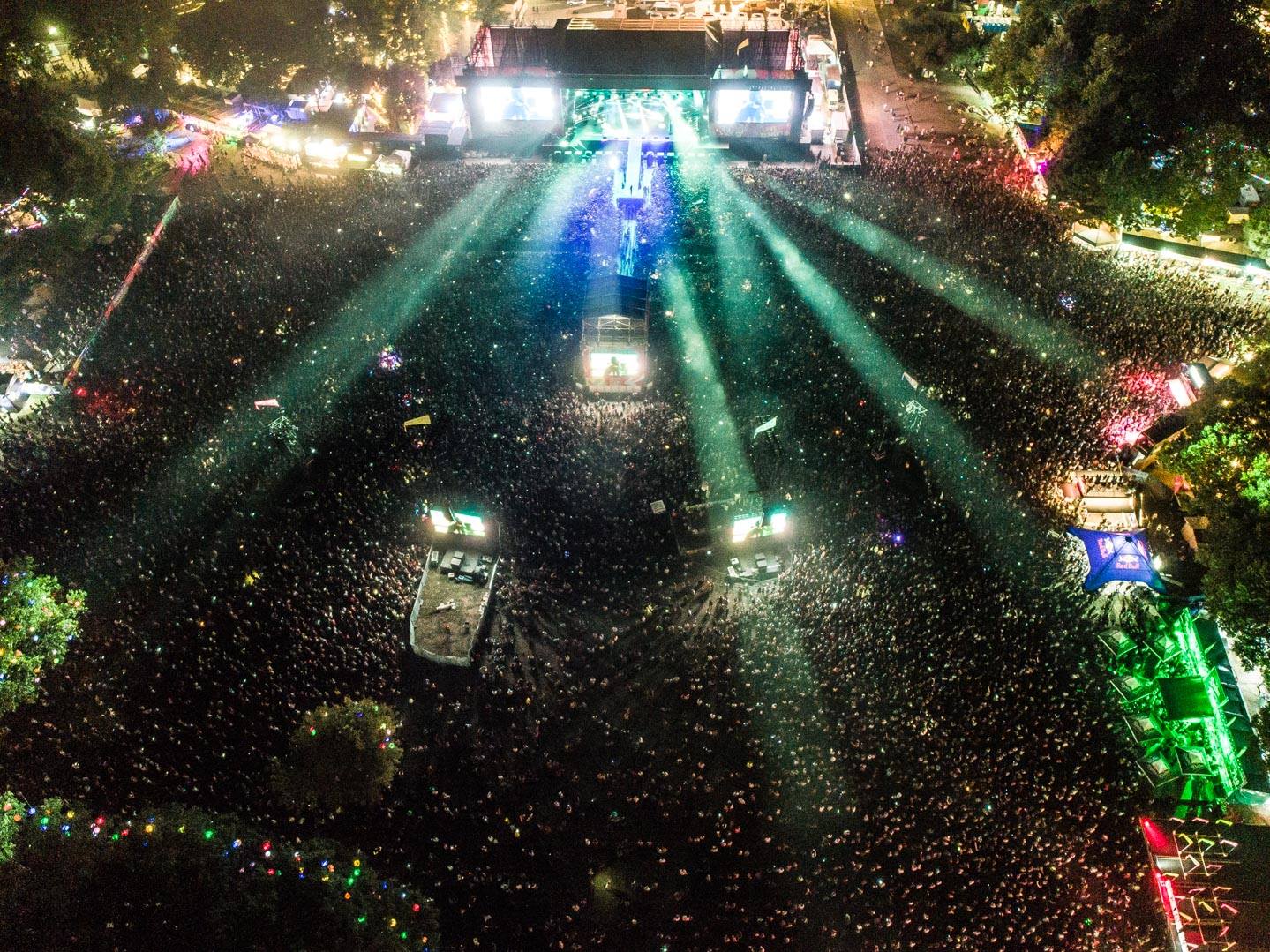
The world-famous Sziget Festival kicked off yesterday in Budapest, and tens of thousands of visitors arrived at the Island of Freedom to listen to Clean Bandit, Stormzy, Lykke Li and Kendrick Lamar on the first day of the festival.
The 26th Sziget Festival is held between August 8 and 15 on Hajógyári Island. With last year’s record number of 496,000 visitors, organizers are expecting to attract around 500,000 people throughout the seven days of the festival.
photo: Sziget Festival Official Facebook
About 20,000 of the visitors will be UK citizens, outnumbering the Dutch for the first time in several years. In an interview with Index, Virág Csiszár, the booking manager of Sziget Festival, stated that most of the visitors are from the UK this year – possibly because Glastonbury, the biggest festival in the country, took a ‘fallow year’ and hasn’t returned this summer. In fact, most of the professionals from Britain compare Sziget with its famous British counterpart.
photo: Sándor Csudai / Sziget Festival Official Facebook
Csiszár also talked about the performers as well; she remarked that they have noticed the increase in prices every year. In some cases, it is well above 10 percent – which she believes is understandable as many performers aim to get the most out of their careers while still considered popular. She also talked about the booking process: every year, organizers ask visitors which bands they want to see perform next year, then compare with statistics, take into account their popularity at western festivals, measure the expected audiences and later compile a short list of potential performers.
She went on to say that they have to make sure to have a strong headliner every day, as they have to sell 20-25 thousand daily tickets. If one day is sold out then it’s often not a problem if one or two other days are less popular. For example, Shawn Mendes is expected to sell out given he only has three concerts scheduled in Europe.
A few of the staff members at Hungary Today have the opportunity to spend the week at the Island of Freedom and will be able to provide you with a taste of Sziget. From the music world’s biggest names, festival foods, incredible dance performances, acts, cultural programs to Brits covered in glitter and dressed as minions or unicorns, we will be reporting it all. Don’t miss out on all the fun; make sure to check in every day to enjoy spectacular photos and descriptions from one of Europe’s biggest festivals.
Máté Bodorkós – Rockstar Photographers / Sziget Festival Official Facebook
Yesterday’s headliner, Grammy-winning rapper Kendrick Lamar, was a bit disappointing because he started his performance 40 minutes late due to technical difficulties – according to Sziget organizers, it was the rapper’s audio system that caused the delay. Performing before Lamar, Lykke Li’s show ended sooner than expected, leaving one and a half hours between the two performances. As concerts on the main stage have to be over by 11 pm, the show only lasted around 50 minutes.
However, the festival continues until the 14th of August with headliners such as Lana Del Rey, queen of melancholic songs; British indie rock band Arctic Monkeys; five-time Brit Awards nominee Dua Lipa; British virtual band Gorillaz; Norwegian DJ Kygo and the London based folk-rock band Mumford and Sons.
via MTI, index.hu
featured photo: Máté Bodorkós – Rockstar Photographers







 Emeric, died in 1031, seven years before St. Stephen. Both were canonized together in 1083. The veneration of both saints was decreed in 1092 throughout Hungary.
 Two parishioners carried large, round loaves of bread that were placed on the altar. Bishop Perez blessed the bread after Mass, cut a slice from each loaf and tasted it.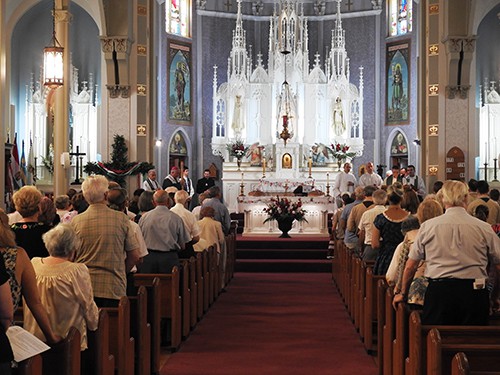
 the bread of life.