Home Blog Page 26

Hungarian Politics: Shifting to the Right in Terms of Symbols and National Issues

After the two-thirds victory of FIDESZ-KDNP in 2010, the right-wing government not only generated major changes in legislation, state organization and the constitution but also shifted public discourse into a direction more in line with the political philosophy of the traditional Right. This is well demonstrated by the fact that being patriotic has become trendy among opposition parties. This cautious approach to the national issue has been a distinguished feature of the Hungarian Left, unlike most of their western or eastern brother parties. Clearly, patriotic slogans have become politically saleable products in Hungary; after the 2008 global crisis, the demand for liberal messages decreased, while the popularity of traditional and local values continued to rise.

Right-wing Jobbik, the biggest opposition party, has built up an image of itself as a patriotic (or nationalist) party representing anti-globalist and Eurosceptical ideas. As of late, Jobbik has tried to appear less radical in an attempt to become a mainstream party. Jobbik supported giving citizenship to ethnic Hungarians living in neighboring countries. They called for protecting the traditional values gained from Hungarian history and levying taxes on multinational companies.

The Socialist Party has had the most interesting change in position, traditionally being internationalist, but critical of national rhetoric in political communication when in government. In the 2004 referendum, they, including Prime Minister Ferenc Gyurcsány, opposed giving citizenship to ethnic Hungarians living in neighboring countries.  After the disastrous fall of the party at the national election in 2010, they defined themselves as leftist patriots – but this official line didn’t get the full support of the party, and has remained the same today. In 2013, Mesterházy visited the Transylvanian city of Kolozsvár – which has around 20% Hungarian residents and a lot of cultural and historical memories – where he and the Socialist Presidium apologized for their previous policy, saying they had offended Hungarians living in neighboring countries. This summer, several Socialist politicians took part in the Transylvanian Festival of Tusnád – a major and symbolic political gathering organized by FIDESZ for about a quarter of a century. The great question of the future is whether MSZP will be able to consolidate their patriotic policy, getting rid of a serious political handicap from their past and establishing an authentic patriotic and anti-globalist agenda focusing on the matters of the Left. Particularly social welfare and justice, which could preserve a pro-European Union stance. Or they could choose to remain a modernist, globalist, capital-friendly ‘third-way’ party.

The smallest party of the parliament, Lehet Más a Politika (Politics Can Be Different), is an anti-globalist green party. Since their establishment, they have stood for indigenous ethnic minorities and regionalism. In this, they differ from several Western European green parties. However, at the previous election, they got just 7 percent and appeared to be on the verge of falling apart. So it’s unsure whether a markedly green, leftist and patriotic party will remain in the Hungarian political arena.

A further question is to what degree this ’new patriotism’  influences the political scene in Europe. The phenomenon – wrongly interpreted as populism with a pejorative overtone by the mainstream –  is a reaction to a haphazardly elaborated federalist scenario in the direction of a United States of Europe. They don’t seem to understand that the project’s success is dependent on the acceptance of the societies of the member states. If rejected by the ‘people of Europe’, a new scenario has to be launched in order to keep the European project alive.

by Dénes Sályi       

featured photo: MTI

Reklám
Tas J Nadas, Esq

Eurostat: Hungary leader in fighting poverty

The number of poor declined to an all-time low in Hungary from 2012 to 2016, a labour market expert told public news channel M1 on Saturday.

In the period under survey, Hungary witnessed the biggest decline in this respect from among all European Union member states, Piroska Szalai said, citing data from Eurostat, the EU’s statistics office.

The number of severely materially deprived people fell from 2.2 million in 2004 to 1.7 million by 2007, but then rebounded to 2.7 million by 2012.

In the subsequent four years, however, it decreased by about half, she said.

Hungary’s economy started to perceivably decline in 2006, two years before the outbreak of the global economic crisis, with shrinking employment, decreasing real wages and growing unemployment. The decline, however, came to a halt in 2010, and real wages started to increase again in 2012, Szalai said.

Reklám
Tas J Nadas, Esq

SUCCESS: FOUR HUNGARIAN HEALTHCARE INNOVATORS AMONG EUROPE’S BESTS – VIDEO

Clavicont, DiabTrend, HepC and Spicy Analytics got into the finals of a startup competition organized by the European Institution and Innovation &Technology (EIT). The first three teams will be awarded 25, 20 and 15 thousand EUR to develop a prototype of their product. The finals will take place in Budapest, in November.

Helping to cure Parkinson Disease, diabetes, and Hepatitis

To start with, Clavicont is a tool supporting neurological and psychological diagnostics able to

detect Parkinson Disease accurately

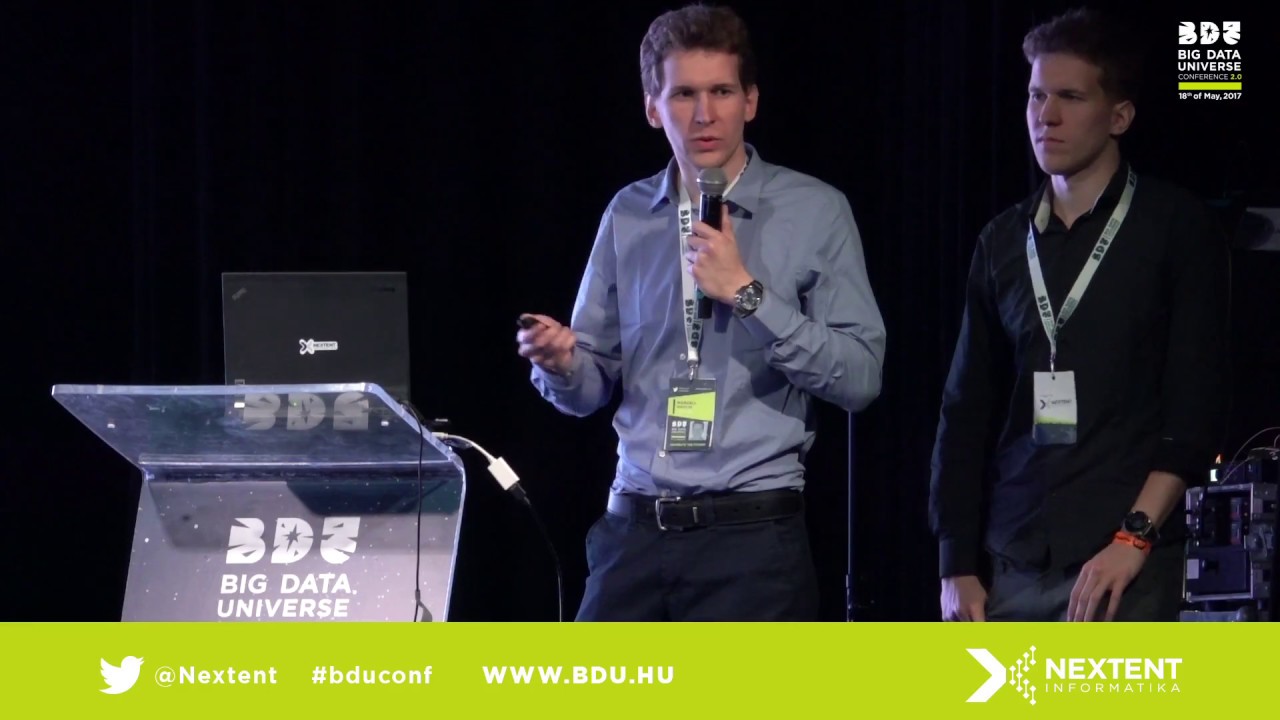
even during its incubation period. This would be extremely important since, without early detection, the patient has no chance of getting treatments or lifestyle advice. Secondly, DiabTrend is an application that supervises your blood glucose level and warns of its dangerous changes, by making a continuous analysis based on your data. For those interested deeper in what DiabTrend does, here is a presentation by Marcell and Tamás Havlik, the two co-founders of the startup:

YouTube player

Furthermore, HepC is aiming to struggle against viral infections like Hepatitis B and C. Finally, Spicy Analytics’ activities include

healthcare data collection,

data analysis and modeling based on complex data with sophisticated methodologies, market research, application development and clinical trials support services.

According to the organizer EIT Health, the four Hungarian teams are competing with 21 additional European startups. The ‘Innostars’ Awards program is suitable for start-ups, spin-offs, early-stage companies and SMEs that already have a prototype or a minimum viable product (MVP) on the field of healthcare and information technology.

Perfect possibility to break into the market

Successful applicants can take part in mentor programs and other training. Moreover,

they can get 8,000 EUR funding

as smart money for business development, business plan writing, and product validation. Besides, they can even consult with experts about their product.

In the first stage of the competition, each team had the chance to take part in a boot camp in the Instituto Pedro Nunes Incubator (IPN), Coimbra, Portugal. There they could prepare for the second stage with the help of trainers and experts which is presenting the business plan to an international jury consisting of healthcare professionals, representatives of EIT Health core industrial partners and market experts. This year’s finals are taking place in Budapest on November 30. The first three teams will be awarded

25, 20 and 15 thousand EUR to develop a prototype of their product.

As we already reported, Hungarian startups are becoming more and more successful lately in many areas.

Photos: facebook.com/EITHealthInnoStars

Source: hvg.hu

Reklám
Tas J Nadas, Esq

It is with deep sadness that we announce the passing of Professor Emeritus and McAnulty Distinguished Professor of History Dr. Steven Béla Várdy

It is with deep sadness that we announce the passing of Professor Emeritus and McAnulty Distinguished Professor of History Dr. Steven Béla Várdy.  Dr. Várdy received his doctoral degree from Indiana University and taught at Duquesne University for fifty years – from 1964 to 2014.  As one of Duquesne’s most prolific faculty members, Dr. Várdy wrote and edited more than 22 books, 175 scholarly articles, 87 book reviews, 83 encyclopedia entries, 60 essays, and 350 newspaper articles.  He was considered one of the world’s leading experts in Hungarian history and presented more than 100 conference papers in Europe and the United States.  He received numerous awards for his scholarly achievements, including Hungary’s Berzsenyi Prize, Hungary’s Officers’ Cross of the Order of Merit, Árpád Academy’s Gold Medal, Canada’s Pro Libertate Diploma and Pro Patria in Exteris Diploma, along with Duquesne University’s Excellence in Scholarship Award.  Dr. Várdy was elected to the Hungarian Writer’s Federation and the Hungarian Academy of Science; he received two honorary doctorates from Hungarian universities and had two festschrifts written in his honor by some of his former students.  Dr. Várdy served on a number of editorial boards and held administrative positions on numerous external academic associations and committees – some of which he founded.

Dr. Várdy is survived by his wife of 56 years, Dr. Agnes Huszár Várdy – who co-wrote and co-edited some of his scholarly work – as well as his three children Nicholas, Zoltán, and Laura, and four grandchildren.  In 2015, Drs. Agnes and Steven Várdy endowed the Várdy International Research and Study Grant at Duquesne University to support overseas research by graduate history students or study abroad by undergraduate history majors. Dr. Várdy passed away in his native Hungary and further information pertaining to any services or gifts will be forthcoming.

Steve was a caring individual who will be terribly missed. Please keep his family in your thoughts and prayers during this difficult time.

John J. Dwyer, PhD
Chair
Department of History
Duquesne University
603 College Hall
Pittsburgh, PA 15282
Email: dwyer@duq.edu

Reklám
Tas J Nadas, Esq

Leaving the periphery – Orban and the Zeitgeist

Festival-goers and politicians of the 29th Balvanyos Summer Open University and Student Camp (also known as Tusvanyos) listened to a very confident Viktor Orban on Saturday. Hungary’s prime minister has launched a counter-attack against his opponents and made it clear that he wants Hungary to be in the power center of the European Union.

According to Orban’s speech, both his government and Central Europe has the legitimacy to make brave decisions. First, he reminded that in the April general election it received a two-thirds majority and with it “authorisation to build a new era” – not just a new political system. He described Central Europe as an “alliance of free nations”, whose impressive economic growth and ability to establish a migration policy which now serves as a model creates a legitimacy to have a louder voice in the EU.

Even though the word “illiberalism” has been mentioned in connection with Orban in almost every foreign article about him, the prime minister hasn’t used this word since he did at this camp in 2014. This time he came back to this expression by the end of his speech, declaring that Christian democracy does indeed have some important illiberal/non-liberal principles.

At the Q and A, Orban said loyalty was important and Fidesz wanted to contest the European parliamentary elections as part of the European People’s Party. He noted, however, that the EPP contained parties with views that were far apart and bridging them would be “extremely hard”to do. Political forces and NGOs critical of Fidesz has been demanding the EPP to expel Fidesz for years. As polls predict a weaker EPP group after the elections in 2019, the ruling Hungarian party’s positions have become significantly stronger. Orban has a good reason to think that today he is strong enough to influence the EPP instead of giving in to its small but loud liberal wing.

In his speech, the prime minister provided a rather thorough assessment of the global situation. He pointed out that China’s march hasn’t stopped, Donald Trump is rewriting the rules of international trade and Russia is also doing everything to protect its interests. Orban’s approach to Hungary’s position in the international status quo is based on pragmatism. Focusing on the interest of Hungary and the region, he complained that the EU is pursuing a crude policy on Russia, which should be replaced with “an articulate Russia policy”. He added that the security of Hungary, of the whole of the Carpathian Basin and of Europe depends on whether Turkey, Israel and Egypt are stable enough to halt the Muslim influx. Orban was the only incumbent EU head of government who attended Recep Tayyip Erdogan’s inauguration, and he didn’t slam his widely criticised ally in this speech either. According to Orban, one can like or dislike Erdogan, but Europe needs a stable Turkey. Another pragmatic opinion which receives much criticism both internationally and in Hungary.

The main idea behind Orban’s confidence is not only his party’s majority and Central Europe’s economic success. The prime minister believes that the Zeitgeist is on his side. He blasted the European Commission as the symbol of the EU’s failure and declared that the time of liberal democracy and the elite of ’68 is over.

The inability of the EU elites to handle the migration crisis and protect Europeans was indeed a sign that once the people of the EU have the opportunity to vote about their “leaders” in Brussels, the status quo will significantly change.

Photo: Facebook/Orbán Viktor

Mariann Őry, head of the foreign desk at Hungarian conservative daily Magyar Hírlap

Reklám
Tas J Nadas, Esq

HIGHER EDUCATION AGREEMENT SIGNED WITH STATE OF INDIANA

The Hungarian government and the State of Indiana have signed a higher education agreement, based on which another US university may launch training programmes in Budapest, Minister of Foreign Affairs and Trade Péter Szijjártó told the Hungarian news agency by telephone.

The Minister said Hungary is required to stand its ground amidst the dramatic changes of the world economy in a tough struggle, and therefore the quality of higher education and the quality of experts that Hungarian higher education is able to train fundamentally affects the country’s competitiveness.

It is, in consequence, in Hungary’s best interest that Hungarian higher education institutions develop cooperation with foreign universities which represent the highest standards, he pointed out.

He said that the University of Notre Dame operating in the State of Indiana is one of the most prestigious higher education institutions in the United States which has a history of 176 years and is ranked 150th in the world in 2018.

Mr Szijjártó highlighted that there is a long-standing educational cooperation scheme dating back to two decades between the University of Notre Dame and the Pázmány Péter Catholic University which was previously limited to the launch of minor common programmes and professor exchanges.

“Now, however, we have managed to conclude an agreement pursuant to which the University of Notre Dame will launch three of its world-class training programmes in Budapest from September 2019”, namely chemical engineering, civil engineering and mechatronics programmes will start in cooperation with the Pázmány Péter Catholic University, he explained.

The Foreign Minister highlighted that in exchange the Pázmány Péter Catholic University will launch a programme related to sustainable development which was accredited by the Holy See.

He pointed out that in order for the cooperation of the universities to be elevated to a higher level and to allow the University of Notre Dame to start training programmes in Budapest, in accordance with the new higher education legislation, an inter-state agreement had to be concluded which was signed by Governor of Indiana Eric Holcomb.

The Minister took the view that the agreement “has significance pointing beyond itself” as it also strengthens the whole of the Hungarian higher education system.

With these world-class technical training programmes the Hungarian investment environment will also gain in strength as students graduating from technical programmes are always in great demand, he said. He added that it will be a letter of recommendation for the community of foreign investors that the University of Notre Dame conducts training programmes in Budapest.

According to Mr Szijjártó, this may lead to the enhancement of the country’s competitiveness and a further improvement in the view the investor community holds regarding Hungary.

He also said that “the development of Hungarian-Indiana relations speaks for itself”: last year the volume of trade increased by 96 per cent, several companies from Indiana are preparing further investments in Hungary, and with this higher education cooperation they managed to bring to Budapest three world-class training programmes.

“We achieved all this against the background that this cooperation was only formalised through the signing of an agreement last year”, the Foreign Minister said.


Reklám
Tas J Nadas, Esq

HUNGARY OFFICIAL CALLS EU MIGRATION PROPOSAL “POLITICAL BLACKMAIL”


Prime Minister Viktor Orban has completed “a record-breaking diplomatic schedule” in the past month and met some of the most important world leaders, the state secretary for communications said on Wednesday.

Orban’s recent meeting partners included the German chancellor, the prime ministers of China and Israel, the presidents of Russia and Turkey and he had a telephone conversation with US President Donald Trump, with whom he also exchanged a few words personally during a NATO summit, Tamas Menczer told a press conference.

All of which means that world leaders pay attention to the Hungarian prime minister and consider him a central European premier whose opinion is important and worth listening to,” he said.

Political opponents have criticised the government for isolating Hungary in terms of diplomacy, yet these meetings showed that the opposite is true, he added.

Menczer said people were paying attention because the Orban government had broken with the opposition’s diplomatic stance of “we dare to be small”. “We are respectful but we also have reciprocal expectations,” he said. The government, he continued, had always acted to defend Hungarian interests. “It doesn’t seek out conflicts, neither does it shrink from them.”

Furthermore, Orban’s government has responded well to international challenges, he said, insisting that Orban had been the first European leader to recognize the dangers of illegal immigration and to act swiftly to protect the country.

Orban “has been working for the Hungarian people for 30 years,” Menczer said, noting the PM had not departed from political life even after election defeats. “This continuity and consistency is clearly appreciated internationally.”

The direction of Hungarian foreign policy will not change in the future, he said, adding that everything would be done to protect Hungarian security and economic interests.
Commenting on Europe, the state secretary said: “We are interested in a European Union based on strong nation-states while we also maintain pragmatic ties with our eastern and southern partners based on respect.”

On the topic of migration and a European Commission proposal to pay member states 6,000 euros per migrant taken in, Menczer said the government firmly rejects such payments. The EU should instead spend its budget on border protection and the well-being and security of European people, he added.

Asked about the possibility that Brussels may plough less money into cohesion funds, Menczer said Hungary had pursued an “exemplary economic policy” in recent years and that it was strange that money would be taken away from a country that complies with EU standards while other countries that fail to comply are rewarded. “The government will not accept political blackmail,” the state secretary said. “It would be appalling were Brussels decision-makers to punish the Hungarian people for the government’s policy on migration.”

YouTube player

Also:

YouTube player
Reklám
Tas J Nadas, Esq

Hungary’s New Budget Aims for Stable Economic Growth

Hungary’s 2019 budget approved by parliament last Friday increases wages and will boost economic growth, the head of the Prime Minister’s Office told a regular press briefing on Tuesday. Stable economic growth is of key importance in ensuring Hungary’s successful performance in the long term, Gergely Gulyás said.

The aim of the budget, which Gulyas called “a budget of stable growth”, is to contribute to the Visegrad Group’s fast paced economic growth which is rising twice as fast as the EU average.

“The 2019 budget rests on solid foundations,” he said, noting an unprecedented increase of budget reserves by 50 percent, to some 360 billion forints (EUR 110m), to accommodate “international risks”.

The government will tap these reserves only if doing so does not upset the planned budget balance, he said. In terms of tax measures, he noted a reduction to the social contribution tax from 19.5 percent to 17.5 percent and an increase to the tax benefit for families raising two children. In the long run, Hungary’s fiscal policy should remain balanced, stable, conservative and comply with the Maastricht criteria, he said.

Gulyás said the government is yet to decide on wage hikes in the public service sector, adding that he “hoped” that the wages could be raised from January 1, 2019. Managers should be given more freedom in assigning individual wages to avoid the present practice of using “legal loopholes” to pay highly qualified workforce, he said. The minister expressed condolences to the victims of wildfires in Greece, where at least 50 have been killed since Monday afternoon. The Hungarian government is looking into providing swift aid, he said.

Regarding reports that the one-time ally of Prime Minister Viktor Orbán , businessman Lajos Simicska, is to sell all his business holdings in the construction, farming, media and outdoor advertising and asset management sectors to Zsolt Nyerges, a long-time co-manager, Gulyás said that “he was unaware of Nyerges’s plans” but was enraged by “the state [commercial television] HirTv and Magyar Nemzet are in”.

Commenting on articles questioning programme choices of Gergely Prohle, the director of Budapest’s Petofi Literary Museum, Gulyás said that Prohle was “an excellent director” and that “quality is the only measure of cultural expansion”.
Gergely Gulyás revealed new details regarding Orbán’s visit to Israel and the demonstrations against him. Having ridden in the same vehicle, Gulyás claims the PM was dissatisfied with the number of protesters organized by Amnesty International, allegedly saying, “It would have been respectable had they sent more than just seventeen people.”
Reklám
Tas J Nadas, Esq

PM Orbán Visits the Strongest Man in Montenegro, Promises 25 km Border Fence

In the first official visit since the country joined NATO, Hungarian Prime Minister Viktor Orbán arrived in Montenegro on Monday afternoon to discuss plans to help build a 25 Kilometer long fence on the country’s border.

After the ceremony, which was held at the National Airport in Podgorica, members of Dusko Markovic’s government and PM Viktor Orbán spoke privately. Orbán’s visit fosters excellent bilateral relations, aids Montenegro’s European integration, and provides an opportunity to exchange views on the many political and security issues currently facing the region and Europe.

Following talks with Markovic in Podgorica on Tuesday, Orbán stated that by protecting its borders, Montenegro also protects Hungary and the whole of the European Union. Orbán announced that Hungary would gladly participate in modernizing Montenegro’s economy. The whole point of an economy is to enable people’s well being, and a modern economy only works if it’s market-based, he added.

Markovic thanked Orbán for his help in protecting Montenegro, adding that a metal fence might be built on the country’s border in the future. Markovic also noted that a large number of migrants have been arriving at the border from Albania.

Hungary-Montenegro ties are at a high point according to Markovic; he pointed out that both countries are NATO members and their economic cooperation is continually developing, and, as a result, Montenegro would gladly welcome Hungarian investors.

Predsjednik Đukanović na radnoj večeri sa predsjednikom Orbanom

Predsjednik Crne Gore Milo Đukanović priredio radnu večeru za predsjednika Vlade Mađarske Viktora Orbana #PredsjednikCG

Posted by Milo Đukanović on Monday, July 23, 2018

Markovic thanked Hungary for supporting Podgorica on its road to NATO integration and membership within the European Union. “The EU is our top priority,” he said, pledging that Montenegro would continue to acquire European values and strengthen democratization.

Péter Szijjarto announced that Hungary plans to build a 25-kilometer long border fence at the Albanian-Montenegrin border due to the increased migratory pressure in the area.

The country’s NATO membership has already caused international uproar due to its traditionally good relations and economic ties with Russia. Moscow officials have expressed concern about the tiny Balkan country’s increasingly western approach for years. In 2014, Russia threatened Montenegro with retaliation if the country joined NATO; they also enacted economic sanctions, thus dramatically decreasing Russian FDI to the Balkan country.

During a Fox News interview with Donald Trump concerning NATO’s common defense policy, Tucker Carlson asked the president why his son should defend Montenegro from an attack. Trump’s head-scratching response was as follows: “I understand what you’re saying. I’ve asked the same question. Montenegro is a tiny country with very strong people. They’re very aggressive people. They may get aggressive, and congratulations, you’re in World War Three.”

Via: MTI, RTCG.

Reklám
Tas J Nadas, Esq

Interview with Levente Szorenyi: Member of the Iconic Illes and Fonograf Bands, Composer of the Rockopera, Istvan, a Kiraly (“Stephen, the King”)

We asked Szorenyi, creator of multiple hit albums and plays, about the following: his roots in Hungarian folk music, the role of his play “Stephen, the King” in 2018, the challenges facing younger generations of performers, and his opinion on the global phenomenon of talent competition television shows (especially when considering he was a Ki mit Tud participant in 1962).

***

Are you familiar with the joke that has Zoltan Kodaly approaching John Lennon, asking him, “What exactly is the meaning of Obladi oblada?”. To which Lennon responds: “Well Mr. Kodaly, the same as talibe-tutaliba-malibe”.

Of course I know this joke, it’s very old. It already existed while Kodaly was alive.

Based on this observation, have these two artists had a serious impact on your work?

Naturally, every person is influenced in many ways, especially when one starts out as simply a casual fan of music–until things take a much more serious turn. I was 16 years old when I wrote the music for the song “Az Utcan” (“On the Street”) for the Illes band, for which Janos Brody later wrote the lyrics. Folk music is the basis for this song, though that was not at all a mindful decision given that this type of creation subconsciously flows from a person. Within the world of folklore, music first caught my attention, not dance. Learning to play violin from my godmother and consistently learning folk songs throughout preschool and grade school, provided the base for my musical knowledge. I am not entirely sure how this happens these days, though I don’t hear many good things about it. Other musical influences of mine are early swing, beat music, and the folk music of the Carpathian basin, including southern-slavic melodies as well.

Despite you and your brothers’ rigorous musical training, you were called the crazy Szorenyis. Why?

That was already the beginning of the rock and roll age, during which we preformed, among other songs, the Italian hit “Con Venti Quattro Mille Baci” at the Vac high school dormitory. The director of the dormitories was definitely not used to our style of uproarious yelling and singing. Later we discovered that the director didn’t necessarily have a problem with the music, but rather the way we moved to it. We came quite close to being banned when he told us, “do not move” while singing.
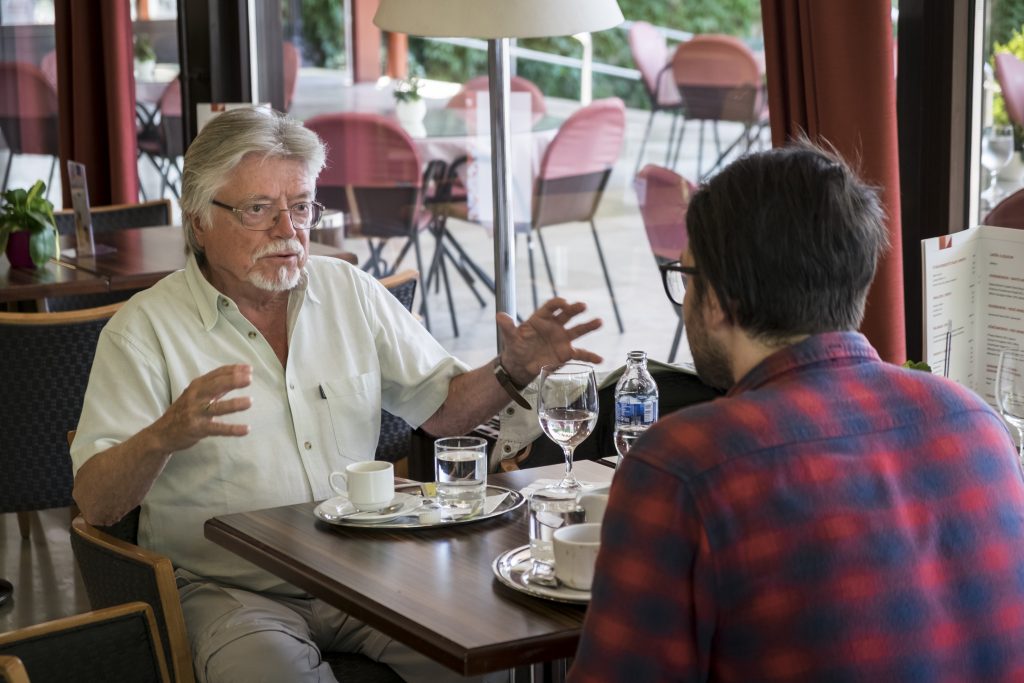
“The director of the dormitories was definitely not used to our style of uproarious yelling and singing.” (Photo by Tamas Komporday)

Today in Hungary, if a young, unknown artist who lacks connections in the industry writes music, he or she has only a very small chance of achieving widespread popularity. The radio only plays mass hits, the number of music tv channel viewers has plummeted, and no widely circulated professional music critic newspaper or magazine exists. 

In my opinion, new musicians can still slip into performances; for example, this morning, only singers unknown to me performed–though this was also my mistake. Personally, I do pity the youth because no matter how talented they may be, they won’t be discovered because there is no need for them. These days you can’t explode onto the music scene anymore because the expectations and trends are different.

How could a band like Illes become popular today?

They couldn’t. I see the worst era of music beginning with the rise of ABBA -then still not irreversible- which worsened the demanded music designed for entertainment. I resent the fact that newer generations of musicians assume that just because they may appear on television or radio, they are already stars.

You have participated in talent-competition shows like Ki mit Tud? and Tancdalfesztivalas well as competitions on the radio. How closely do you follow both the criticisms offered and the Hungarian and foreign talent scouting shows of today?

Well, this is even worse. Even though the whole country may be sitting in front of the TV watching Megasztar and X-factor, how can I take it seriously? Why even have a show for this in the first place when the majority consists of Pici Presser and other judges laughing at ridiculous contestants who shouldn’t even be there. This ruins the morale. Talent shows have turned into parodies of themselves.

If asked, would you be a judge?

I’ve been asked multiple times, but I’ve never accepted. In my opinion, it is entirely frivolous. The only TV show of this kind that I ardently follow is the live second season of Virtuosos. That is a serious competition: narrowing down, evaluating, and assessing competitors to generate valuable results.

These types of pop-music talent shows assert that there is a demand in Hungary for the entertainment they provide.

This is simply untrue- it’s just an excuse. Have a beauty pageant instead. At least that has a demand and is nice to watch.
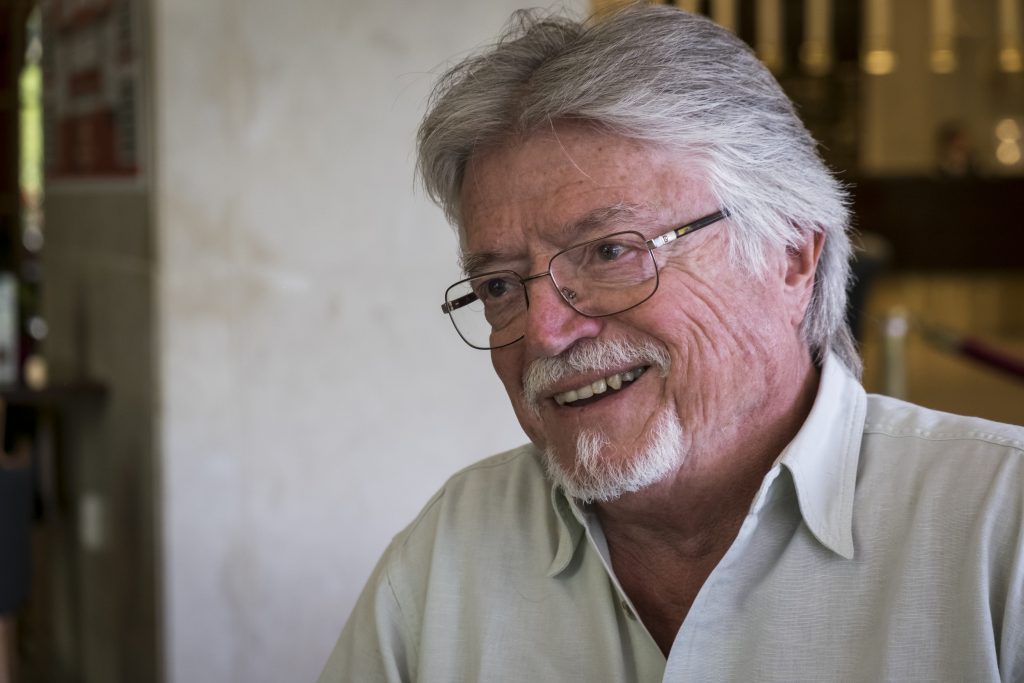
“For this exact reason I was nervous for my Fonograf concert- after a while, you can feel that you are fading.” (Photo by Tamas Komporday)

What role does music play in your life currently?

Music is my inspiration day in and day out, however, I no longer compose or direct. In February we played with the Fonograf band in the Sportarena; preparing for it was quite extensive given the challenges of performing at my age. In addition to this, I still regularly play with the Vujicsics band throughout the country, preforming around five of my southern-slavic inspired songs–but that is all. This is just enough to satisfy my need. For this exact reason I was nervous for my Fonograf concert; after a while, you can feel that you are fading. If I cannot properly play and sing the notes, and, moreover, I do not enjoy the experience, then I should not be performing–I should be leaving a pleasant memory.

Since the 1983 introduction of Istvan a Kiraly, critics have been voicing their commentary. Do you agree with what Janos Brody had to say back then: “The value of Istvan a Kiraly lies in its display of these historical contradictions and conflicts as well as providing diversified perspectives. In my opinion, if this play does indeed have something to say, it is that certain conflicts are better off avoided”.

This is an intelligent train of thought, but he and I know that these types of conflicts will always inevitably surface.  For instance, these stem from clashing interests. We can find them in today’s world: in America, a businessman of Hungarian origin decided he would transform the Earth’s population.  This could present a pretty enormous problem.

In this case, what message does Istvan, a Kiraly send in 2018?

That we can perform it. Not only that it can still be performed, but also that such an incredibly large numbers still attend today. Most recently it played at the Opera festival in Miskolc; I was very excited for this because finally we were able to perform without playback or half-playback, considering the fact we presented the original music live. I do not mean to be conceited, but, if the play’s music was bad, it would be of interest to no one–despite its powerful message. Therefore, in practice, the music essentially carries the production. In this manner the two components together go through the viewers’ mind and soul; the two together are essential! Of course, with this statement, I am not demeaning Brody’s role. Besides Istvan, a Kiraly, he wrote Attila, Isten Kardja, Veled, Uram!,and Arpad Nepe; though Istvan, a Kiraly is uncontestably the most popular.

In Hungary both the left and the right accept this play…

It would be quite idiotic if they didn’t.

But considering both unified and diversified perspectives, how do you view our path politically? Along St Stephen’s or Koppany’s?

I have already expressed my opinion on this question and caused quite an outcry with it. I was totally ripped apart for it. I see Stephen as a model, like Brody said too. Based off of this model, I said there are Hungarians aligned with Stephen, Koppany, and then the “foreign-hearted”. The “foreign-hearted” are those who, despite living their entire lives in Hungary, refuse to admit where they belong. These consist of the individuals who are never pleased and constantly say they want to leave the country, yet never actually do. This is what’s written in Istvan, a Kiraly. Specifically in the play, the Teutonic conquerors arriving with the priests represent these “foreign-hearted”.
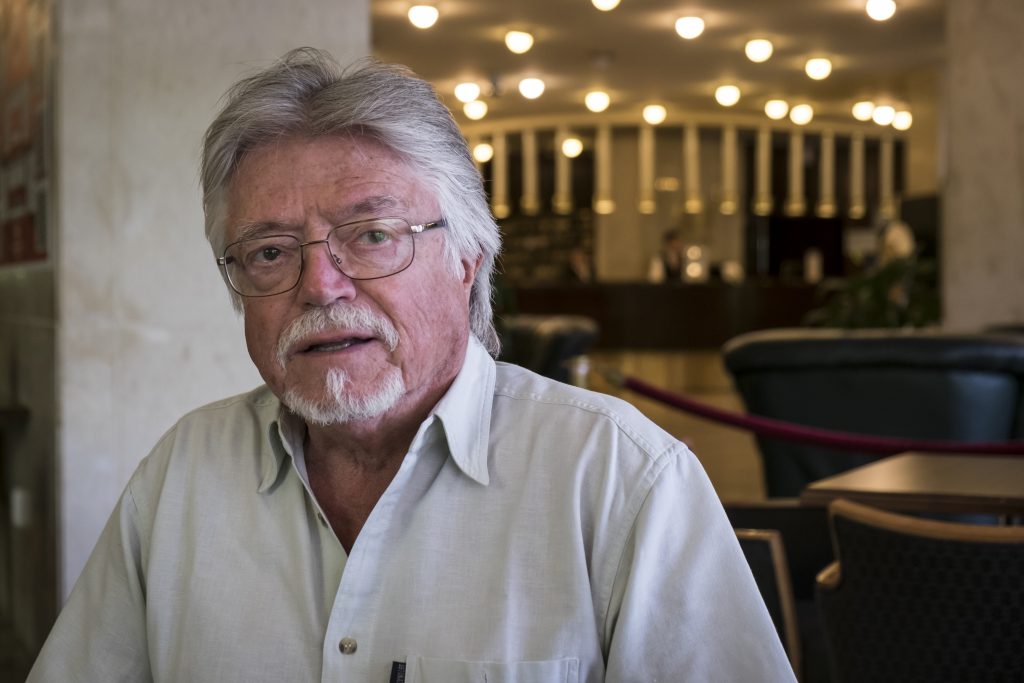
„Hungarians have suffered during many historical eras, it is a miracle we still stick with each other.” (Photo by Tamas Komporday)

Neurosurgeon, Dr Andras Csokay, who regularly holds lectures on the connections between science and religion, expressed the following to us: Europe has abandoned and thrown out Christianity, viewing God with indifference; meanwhile Hungary is continuously characterized with no empathy, betrayed by neighbours and friends when we deny all forms of migration.  Who speaks the truth?

I see the latter as a lie–or an exaggeration if I want to be polite. Hungarians have suffered during many historical eras; it is a miracle we still stick with each other. Hungarians are a friendly people. Yet there are the moments when “foreign-hearted” politicians do not view Transylvanian Hungarians as true Hungarians.  Let us remember December 2005. Where are we now compared to the battle of 907 in Bratislava when Hungarians lead by Arpad pushed back an army of nearly 100 thousand soldiers representing a “united EU”.

***

Reported by Balazs Horvath

Translated by Katalin Hier

featured images via Tamás Komporday

Reklám
Tas J Nadas, Esq

Németh: Băile Tușnad Summer University to Be Held ‘at Key Time’

This year’s Bálványos Summer University in Băile Tușnad (Tusnádfürdő) is being organised “at a key time of political stability” in Hungary following the spring general election, the head of parliament’s foreign affairs committee said.

With its internal political situation stable, Hungary has been able to expand its room for manoeuvre internationally, and preparations are also under way for next year’s European parliamentary election, Zsolt Németh told a press conference.

The motto of the 29th summer university to be held between July 24 and 29 is “Our Passion: Tusványos”, Németh said. This shows that open speech, national cohesion and the vision of a Europe built on traditional values have become part of the identities of the university’s organisers and participants, he said.

As regards the theme of this year’s summer university, Németh said a competition of differing visions on the future of Europe was under way. Hungary and its ruling Fidesz party want to make their mark in this race by forming an alliance for the Europe of nations, he added.

In response to a question, Németh confirmed that, as has become tradition, Prime Minister Viktor Orbán will again be addressing the event.

via hungarymatters.hu

featured image: Zsolt Németh in Tusványos last year; via MTI

Reklám
Tas J Nadas, Esq

Hungary and the state of Indiana signed a higher education agreement

YouTube player

On July 25th, 2018, the nation of Hungary and the state of Indiana signed a higher education agreement. Hungary’s Minister of Foreign Affairs and Trade, Péter Szijjártó, stated to Bocskai Rádio that this will be the basis for a new American university that will offer a study abroad program in Budapest.

This higher education agreement solidifies the rapport that was established last year by a previous economic agreement between the two states. Over the course of one year, commerce between Indiana and Hungary increased by 96%, meaning that both sides are taking the collaboration very seriously.

The minister further explained the importance of educational agreements for Hungary to maintain its competitive capacity by keeping up with universities that represent international standards through creating relationships in higher education.

Péter Szijjártó praised Notre Dame College of Indiana, which has 176-year-long history and ranks at 150th place internationally. Notre Dame College is opening technical branches in Budapest, which are especially important departments for the Hungarian economy and its strategic planning accuracy. Simultaneously, Pázmány Péter Catholic University is opening a department of environmental sustainability in Indiana that is accredited by the Vatican.

The minister answered us by saying that it was no accident that one of Hungary’s Catholic universities would like to emphasize and highlight Christian traditions arm-in-arm with a Catholic university of Indiana, since Christianity is so widely criticized today.

The minister told us in an interview that the legal, as well as political conditions exist that will enable the establishment of new relationships with other universities through similar agreements.

Péter Szijjártó also praised the significance of the Chicago Consulate’s work, since they played an important role in negotiating Indiana’s economic and higher education agreement, as well as in cultivating a good relationship with local Hungarians. This also encouraged the decision to open two more Hungarian consulate offices in Florida and Texas, following the success of the Consulate General in Chicago.

To answer our question, the minister said that they are quite fortunate since the American president sent an excellent ambassador to Budapest, David B. Cornstein. He is interested in developing mutually beneficial relationships and “does not want to lecture” the Hungarians. He simultaneously mentioned that Hungarian-American relations have been reborn after a six-year-long hiatus, high-level political discussions have resumed, and if necessary, a rendezvous could be arranged between the American president and the Hungarian prime minister.

At the end of the interview, Péter Szijjártó thanked the American Hungarian communities for their interest in the developments within the mother country and he asked that they continue to preserve their Hungarian roots and to participate in decisions regarding Hungary’s future.


Translated by Eva Orszag

YouTube player

Reklám
Tas J Nadas, Esq

Religious American University to Offer Degree Courses in Hungary

Indiana’s University of Notre Dame has signed a deal with Pazmany Peter Catholic University to launch degree courses in Hungary starting September 2019, Hungary’s foreign minister said in New York on Friday.

Under the agreement, Pazmany University will launch its own programme — also accredited in the Vatican — at the University of Notre Dame, Peter Szijjarto told MTI.

The two institutions are still in the process of finalising their deal, the minister said. Szijjarto noted that under Hungary’s amended higher education law, the Hungarian government and the state of Indiana will have to sign an interstate agreement allowing the University of Notre Dame to provide educational activities in Hungary. He added that he will discuss the matter with Indiana’s commerce secretary later on Friday.

The interstate deal will be incorporated into an economic and trade cooperation pact signed between Hungary and Indiana last year, Szijjarto said.

He said that since the Hungarian government and Indiana’s leadership were “on the same page” regarding the agreement, talks were expected to proceed quickly and it was unlikely that anything would get in the way of the University of Notre Dame starting its programmes next year.

Reklám
Tas J Nadas, Esq

Beyond the 2 Percent Budget: Are There Other Ways to Measure NATO’s Defense Spending?

Stefan Kornelius, the international section head of Germany’s Süddeutsche Zeitung newspaper, analyzes the budget of the North Atlantic Alliance. Debating military expenses has become popular as of late, but Kornelius manages to bring a new perspective to the table. He claims that the 2 percent GDP normative can be misleading, but that there are other ways to measure how the nation states contribute to the allied defense expenses. 

According to the article, NATO has disagreed about the allocation of its general expenditures since the early 2000’s. After the peace dividend faded out at the end of the Cold War, the Alliance generated shortages in equipment and dysfunction in the military deployment and budgeting systems. This has since led to many significant arguments about finances.

At the 2012 NATO summit, every member state agreed that 2 percent of the GDP should be spent on defense, and the participating countries have until 2024 to accomplish it. NATO members have made great strides towards meeting the two percent goal, but have yet to reach it.

Kornelius outlines four different approaches to counting the military expenses, with regard to the complexity of the allied defense policy. He also draws attention to the misleading simplicity of the 2 percent regulation and how there are no set limitations dictating how the money should be spent. He argues that, instead of financing the development of military material, the member states could use the money to improve employment statistics, cover personnel expenditures, or pay for foreign missions.

He explains the stances of four experts on this topic:

    • The first group is the biggest. They say equipment and military potential should be the main elements of the calculation.
    • Group two measures loyalty in operations and deployments. How many soldiers are abroad? How long did the mission last? How committed is the country?
    • Group three strives to quantify the risks: is a country keeping its soldiers at headquarters, or are the troops out taking risks? This categorization is especially popular in Afghanistan. There are even statistics providing rankings of the number of killed or wounded, measured by the size of the population of each country.
    • The fourth category is new and close to the German government’s heart: Defending Europe should come first, no matter the cost. This approach focuses on European strength and emancipation from the USA.

      Participation of troops in NATO missions by countries (Afghanistan-Kosovo) by Gábor Sarnyai

      As he pointed out, it’s difficult to measure one nation’s contribution to the joint defense system. For instance, Hungary spends (comparing to its size and population) just 0.7 of its GDPto cover military expenses, yet the country has the second largest share in foreign NATO missions.

      Kornelius also noted that Germany would suffer from the budget debate due to its low military spending rates, but there is a chance the country will rectify this by 2024.


Reklám
Tas J Nadas, Esq