Hypocrisy may be the only consistent guiding principle of US foreign policy. Here’s a prime example of the “do as we say, not as we do” that is the core of how Washington does business overseas: In the same week that the the US Justice Department demanded that the Russian-backed RT America network register as a foreign propaganda entity or face arrest, the US State Department’s Bureau of Democracy, Human Rights and Labor (DNL) has announced that it is launching a program to massively interfere in NATO-partner Hungary’s internal media.
So the US Justice Department is cracking down on RT America for what it says is manipulation of US domestic affairs while the US State Department announces a new program to manipulate Hungary’s domestic affairs.
The State Department’s new program would send three-quarters of a million dollars to Washington-selected Hungarian media outlets to “increase citizens’ access to objective information about domestic and global issues in Hungary.” On what authority does the United States pick winners and losers in Hungary’s diverse media environment? Since when does one government have the right to determine what news is “objective” in another country? Hungary is not a country to be “regime-changed” — it is a full democracy where the will of the people is regularly expressed at the ballot box and where the media competes freely in the marketplace of ideas.
Washington’s Hungarian media project is clearly meant to interfere in that country’s domestic political environment. Here are the stated objectives of the US government’s Hungary program:
The program should improve the quality of local traditional and online media and increase the public’s access to reliable and unbiased information. … Projects should aim to have impact that leads to democratic reforms, and should have the potential for sustainability beyond DRL resources. (emphasis added)
The State Department’s Bureau of Democracy, Human Rights, and Labor identifies its mission in this call for grantees as “promoting democracy and protecting human rights globally.” So what is it doing in Hungary? Hungary has had nearly three decades of democracy since 1989 and hardly needs the United States to tell it what kind of media is allowed (subsidized) and which kind should be suppressed.
In reality this is a US government program to ensure that the Hungarian media follows Washington’s policy line. Hungarians are all too familiar with this kind of toxic interference from an outside superpower: it was called the Soviet Union. Does Washington really seek to take on that role?
Stab in the back
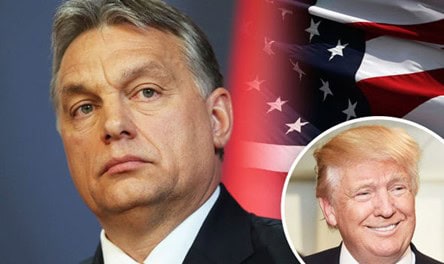
This US government intervention in Hungary’s internal affairs must feel like a stab in the back to Orban and his government. Orban was an early — and rare — supporter of candidate Donald Trump among his European colleagues. Indeed, where Brusssels saw Trump as a gauche loudmouth, Orban openly admired the soon-to-be-president’s position on immigration and particularly on the mass immigration of mostly Muslim “refugees” that has proven to be disastrous for so many European countries. Likewise, Viktor Orban’s Fidesz party has managed to retain a high level of popularity through two election cycles by embracing and promoting the kind of nationalism that characterized Trump’s successful campaign.
Orban’s early support for Trump appeared to have paid off. Where Fidesz had struggled to make any headway at all under GW Bush or Obama’s State Departments, both of which were openly hostile, one of President-elect Trump’s first moves was to invite Orban to the White House. Orban, for his part, hailed Trump on inauguration day, welcoming in an era where national interest takes precedent over multilateralism.
As recently as last month, President Trump praised Viktor Orban, saying that the “strong and brave” Hungarian Prime Minister is “on my guest list.”
Then Trump’s State Department launched a program to undermine Hungary’s national sovereignty by interfering in the Hungarian media market. It seems national sovereignty is a one-way street for Washington no matter who occupies the Oval Office.
Hypocrisy…or policy consistency?
But perhaps it’s inaccurate to accuse the US government of hypocrisy in this case. After all, pressuring RT America with the intent of silencing the news network and spending our tax dollars propping up US-friendly media outlets in the Hungarian countryside are actually two sides of the same coin: the US government will tell you what kind of media you are allowed to consume. If you are a media network in the United States that allows voices who oppose Washington’s neocon-dominated foreign policy they will shut you down. If you are a news outlet in the Hungarian countryside that spews the US party line, they will prop you up. Both cases are the same: your media will toe the US government official line or else.
Note to Washington: This is not 1950. Hungary has been a fully free and democratic country with plenty of free elections under its belt. It does not need you to come in and attempt to manipulate its newspapers and broadcast media. What would you do if China sent in a few million dollars to prop up US publications who agreed to push the Beijing line? What about if Tehran sent some money to publications pushing the Ayatollah party line? You cannot even tolerate RT America — which is largely staffed by Americans but dares to feature prominent Americans who challenge the neocon foreign policy line. Hands off Hungary!
Note to Viktor Orban: You risked arrest — and worse — in June, 1989 when you directly confronted the communists who were occupying your country. Now that Hungary’s freedom has been won — in no small way due to your efforts — do not allow Washington’s neocons to take it away from you! If you do not confront this violation of Hungarian sovereignty, the neocons will continue to increase the pressure. The neocons want you out! Just this week, neocon commentator Anne Applebaum wrote that you are a “neo-Bolshevik” who has “little to do with the right that has been part of Western politics since World War II, and…no connection to existing conservative parties.” Do a little research and you will notice that Applebaum is a member of the International Advisory Council of the Center for European Policy Analysis — the organization your own government funded for a big conference this summer! Neocon knives are out for you. You’d be smart to make a better assessment of who are your friends and enemies in the United States…before it’s too late.
Budapest, 2017. október 23.
Orbán Viktor miniszterelnök az 1956-os forradalom és szabadságharc emléknapján tartott állami ünnepségen a Terror Háza Múzeum elõtt 2017. október 23-án.
MTI Fotó: Kovács Tamás
Below, we are sharing the full text of Hungarian Prime Minister’s speech delivered at House of Terror Museum in Budapest on 23 October 2017. In his national holiday speech, Viktor Orbán not only remembered the heroes of Hungary’s anti-Soviet uprising in 1956 but also drew parallel between the times of the revolution and today’s political tensions in Europe. The summary of the speech can be found here.
photo: Tamás Kovács – MTI
“I greet Hungarians bowing their heads in honour of the heroes of the 1956 Revolution and Freedom Fight. I greet you all, wherever you are in the world, from Toronto to Paris to Dunaszerdahely, from Munkács to Szabadka, and all the way to Szeklerland. I greet those celebrating in the nation’s capital, and also those who join us in front of their screens at home. I greet those who appreciate that we Hungarians, the people of freedom, are a special nation of freedom. Whatever may come – rain, biting winds, tear gas or mounted police charges – we gather nonetheless. Because, wherever in the world we live, we want to remember: worthily and justly. We want to remember that wonderful day in October when an entire people said “Enough!”, and the pillars supporting the communist regime started to shake. We want to remember a moment which will always live in the memory of the free nations of the world.
Ladies and Gentlemen,
A motherland is a natural and spiritual reality. Soviet rule, however, pushed us into a space without history, and sought to destroy both our past and our culture. The strongest weapon against physical and mental terror is national remembrance. This is why today we came here, of all places. The building we see here was the headquarters of the Arrow Cross, and later the centre for communist party state terror. This building was a nest first for national socialists, and then for international socialists. This is where they imprisoned and tortured those who they feared the most, and who they therefore hated the most. In 2002 we cut it out of space and time with a blade-like wall, elevated it to a memorial, and created a museum here, in the heart of Budapest, of Hungary and of Europe. Let it remind the world that the Hungarians’ thirst for freedom cannot be denied. We created it in this place to also remind us that if freedom is lost, if national independence is lost, we ourselves will also be lost. It warns us that freedom is never given to us for free: we must always fight for it. We must always defend our freedom, whether from Austrians, Russians, Germans or Soviets, from those wearing the garb of the Arrow Cross or of communism. No one else will ever do this for us. This is what we are used to: here “liberation” has often meant the beginning of a new occupation. A nation which at the right moment, in the hour of reckoning, has sons and daughters who are ready to defend the motherland is a lucky nation. Because in this corner of Europe there regularly come times when it is not enough to talk about one’s love for the motherland: one must defend the motherland.
Today we remember those who one day woke up to find that everything had been taken away from them: everything which was not only worth living for, but worth dying for. What was taken from them was not only that which they had, but also that which they could have had. They were struck by the fear that if things continued in that way, they would lose Hungary forever. And then when they reached the edge of the precipice – about to see the crumbling of the thousand-year-old motherland and the Hungarian world – they rebelled. In 1956, from the half-light of oppression, there emerged the truly wonderful country which we had always desired. Before us flashed the realisation that there can be a Hungary which is built by the better angels of our nature. The Revolution was a national revolution. All of a sudden it turned out that those working in the factories here were not members of an international proletariat, but Hungarian workers. And we shall remember this moment for as long as a single Hungarian lives on this Earth. Let us digress a little, and admit that we not only remember: we also do not forget. We do not forget those who were on the other side. We are regularly accused of lacking the capacity to forgive. But in fact it is they who are unable to forgive us for all the sins they committed against us for almost half a century.
Ladies and Gentlemen,
Though Westerners may have admired the Hungarian Revolution, they did not understand it. They didn’t understand the force that animated us. They didn’t understand why, so heavily outnumbered, we fought against a force that, according to human logic, we had virtually no chance of defeating. They did not understand that we fought because we insisted on our own culture and way of life to the end, and refused to be dissolved in anyone’s melting pot. We want to be respected for who we are and what we are. We have guarded Europe’s borders for a thousand years, and have fought for our national independence. We are a brave and combative nation which realises that those who are not respected are despised. We are not understood in Brussels today, just as we were not understood back then either.
Ladies and Gentlemen,
The place we stand today is not only in front of the House of Terror Museum, but also on one of the world’s most beautiful boulevards. The beauty and grandeur that our nation is capable of are visible to us here in their true colours. Here we have the palatial villas of Andrássy út, Heroes’ Square is over there, and the Opera House and the Chain Bridge are further in the other direction. This is a heritage – a stunning heritage – that imposes an obligation on us all. Our time-honoured squares are not mere stage sets to idly marvel at: these are benchmarks, signals and warning signs. A nation that reached the heights that we did – and more than once – must not be content with less. Today, also, we must not be content with any less. There were periods when we needed to control an empire. There were times – more than once – when we needed to rebuild and restructure a ravaged motherland after its devastation by the enemy. We did not shy away from either responsibility, hard work or the will of God: we did what we had to do. Some of us stood their ground on the battlefield, while others won a place for us among the nations through their intellectual achievements. Today we celebrate a day when once again millions of Hungarians came to the simultaneous realisation that, though each of us lives our own life, we all belong to the same nation. We remember the moment when the cardinal and the lathe operator, philosophers and the “lads of Pest”, the archduke and the Soviet partisan turned defence minister all wanted the same thing. Today we remember the impact which broke through the walls dividing the severed parts of the nation, and reached the student gatherings of Transylvania and the cells of Szamosújvár Prison. Péter Mansfeld, Mária Wittner, László Dózsa, János Szabó, Gergely Pongrátz, Imre Nagy, József Mindszenty: we look at them, but we see a nation.
Ladies and Gentlemen,
Remembering also helps us to hold the truth of our life today in a steadfast gaze. The truth is that, thirty years after communism, there is once again a world power which seeks to turn the European nations into a monochrome, homogeneous mass. Like all cultured European nations, we Hungarians have always had our own notion of our country: a vision of freedom and civilisation; a vision of how to be human and how to live as human beings. This is how, throughout history, we’ve always rebuilt Hungary, once we’ve rid ourselves of our oppressors. This is how it was after we tore down communism and sent the Soviets packing. The truth is that now, three decades down the line, everything that we think about Hungary and the order of life in Hungary is once again under threat. The truth is that after we regained our freedom in 1990, we have once again arrived at a crossroads in our history. We wanted to believe that the old troubles could no longer return. We wanted to believe that the deranged dream that the communists had of turning us Hungarians into Homo sovieticus could never return, ever again. And now here we are, astonished to see that the forces of globalism are trying to force our doors open, and are working on turning us Hungarians into Homo brusselius. We wanted to believe that never again would we have to deal with political, economic and intellectual forces seeking to sever our national roots. We also wanted to believe that in Europe there was no room for terrorism and violence.
That is not how things have turned out. Europe has been blinded by its former achievements, and, without even noticing, has found itself forced to the back of the world stage. It once dreamt of taking on a leading role in the world, but now even its own neighbours hardly bother with it, and it can barely put its own house in order. Instead of realising this, they started campaigns of revenge against those who warned them of the threats of intellectual and spiritual self-immolation and of nihilism. People who believe that Europe needs external borders that can be physically protected have been branded as closed-minded. Those who believe that immigration poses a threat to our culture have been branded as racists, and those who have spoken up for the protection of Christianity have been branded as exclusionists. Those who have stood up for the protection of families have been branded as homophobes. Those who believe that Europe is an alliance of nations have been branded as Nazis. And finally, those who have stepped off the Brussels economic policy path, that leads to a quagmire, have been branded as fantasists. Few have survived these campaigns of retribution. It was this arrogance that has led Europe into the economic, political and intellectual chaos that every country is now seeking to escape. This is the truth we must face today. A short digression: it seems that over there they’re not familiar with our king, Saint Stephen of Hungary’s most important admonition: “naught elevates, save humility; and nothing casts down, save pride and envy”.
Ladies and Gentlemen,
The European people – including us – have had enough of being made to accept globalisation as an irresistible force. We have had enough of being told day and night that there’s nothing we can do, we must accept our lot, adapt and bow down. We wanted and continue to want the European Union to be a guarantee and a vehicle with which the European nations protect their shared ideas of civilisation. In reality, however, we have made ourselves more vulnerable than we used to be. In every crisis situation they cry “Europe!”, as if it were a magic word which on its own is capable of turning around our fate. Europe has found itself in a dead-end. We Hungarians know why, and we see this most clearly at times like this, on the twenty-third of October. In the twentieth century the trouble was caused by military empires, but now, in the slipstream of globalisation, it is financial empires which have risen up. They have no borders, but they have global media, and they have bought tens of thousands of people. They have no fixed structure, but they have extensive networks. They are fast, strong and brutal. It is this empire of financial speculation that has captured Brussels and several Member States. Until it regains its sovereignty, it will be impossible to turn Europe in the right direction. It is this empire that saddled us with modern-day mass population movement, with millions of migrants, and with a new migrant invasion. They developed a plan with which they now seek to turn Europe into a continent with a mixed population. We alone resist them now. We have reached the point at which Central Europe is the last migrant-free region in Europe. This is why the struggle for the future of Europe is being concentrated here.
Ladies and Gentlemen,
We Hungarians were the ones who broke the ice of silence. We are the ones who identified the forces which seek to sever Europe from its national roots. We brought them into light, and to combat them urged united national – and later international – solidarity. We could do no other. Our world is not that of half-light and covert warfare: we can never win with that approach. In darkness our enemies outnumber us. We only stand a chance of defending our borders, stopping the mass population movement and preserving our national identity in a battle fought with our helmets’ visors up, and with clear, straightforward talk. If we want a Hungarian Hungary and a European Europe, we must talk about it in a straightforward manner. And it is not enough to talk: we must also fight – as we have always done when our freedom and independence have been at stake.
Ladies and Gentlemen,
Nowadays all elections in Europe are crucial. This is true of the recent elections in Austria, Germany and the Czech Republic, and this will be the case in Italy and Hungary next year. Now it is being decided whether the peoples of Europe take control back over their own national lives, whether they take control back from the European bureaucrats acting in cahoots with the economic elites. We must achieve far-reaching changes in every field: in politics, in the economy, in our intellectual life, and above all, in culture. Now it is being decided whether we can bring back our great old Europe: the Europe that existed in the days before multiculturalism. We want a Europe that is safe, just, civic, Christian and free.
Many people still believe that this is impossible. But let’s just think of 1956. On the morning of 23 October 1956, how many people sitting on the tram on the way to work would have thought that come the evening all that would remain of the statue of Stalin would be his boots? How many people believed that, if needed, even children would take up arms? István Örkény wrote about a little boy knocking on the door of a middle-class apartment in Budapest: “If I wipe my feet like a good boy, Lady, will you let me shoot out of your window?” And in 1988, how many people believed that within a year we would knock communism down, count it out, carry it from the ring, and send the Soviet troops from the country? And before 2010, how many people believed that we would soon have a new constitution based on national foundations, Christian in culture and capable of protecting our families? They said it would be impossible. They said it would be impossible to send the IMF packing. They said it would be impossible to hold the banks to account, it would be impossible to impose taxes on multinational companies, and it would be impossible to reduce household utility bills. They said it would be impossible to provide jobs for everyone, it would be impossible to resist mass population movement, and that it would be impossible to stop the migrant invasion with a fence on our borders.
Not once could I tell you with absolute certainty that we would succeed. In life there are no such guarantees. One thing has always been certain, however: if we don’t even try, we definitely cannot succeed. There is always some chance. In 1956 we salvaged the honour of the nation. In 1990 we regained our freedom. And in 2010 we embarked on the path of national unification. No one can tell us that something is impossible. We know that mass population movement can be stopped, that globalisation can be restrained, that Brussels can be reined in, that the financial speculator’s plan can be torpedoed, and that a straitjacket can be forced onto the insane idea of a United States of Europe. All it takes is for us here in Central Europe – Poles, Czechs, Slovaks, Romanians and Hungarians – to unite our efforts. All it takes is for us to discover the strength in our hands, in our heads and in our hearts, and to behave in a way that befits proud nations.
Ladies and Gentlemen,
The stakes are high, and we must not treat anything casually. Our strength today must not lead us into complacency or inactivity. We must never underestimate the power of the dark side. We are strong favourites to win the next election, but we have yet to earn it, and we have yet to complete the fight for victory. We will need everyone. We will therefore make our preparations in the months ahead. In March we will start anew, and then in April we will win again.
Go for it Hungary! Go for it Hungarians!”
***
via miniszterelnok.hu; featured photo: Szilárd Koszticsák – MTI
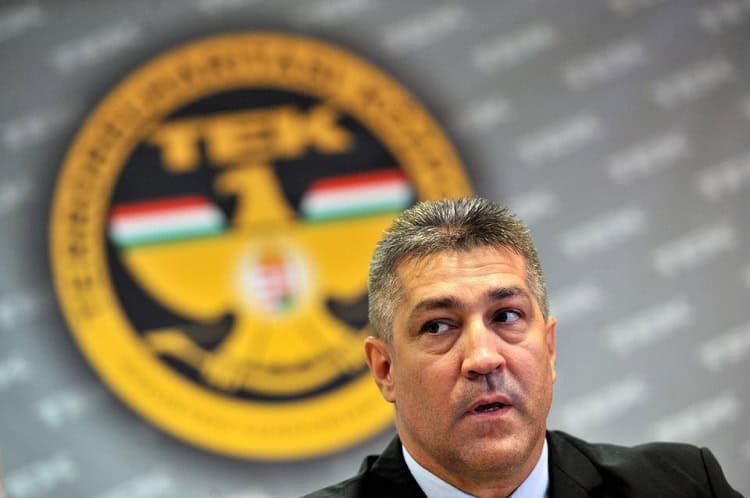
The Hungarian national who has recently been reported kidnapped by pirates off the coasts of Nigeria is alive and well, the head of Hungary’s counter-terrorism force TEK told public television on Thursday night.
János Hajdu (pictured) said his information had been confirmed and TEK was working to rescue the captive. Answering a question as to how long it would take TEK to bring him back to Hungary, Hajdu said one or two months were “realistic”.
Reuters reported on Tuesday that six people had been kidnapped from a German container. Peter Doehle Schiffahrts KG said the ship had been attacked on Saturday. According to Reuters information, the kidnapped persons were from the Philippines, Ukraine and Hungary. The shipping company said the boat and the remaining 12 crew members had left the Nigerian coastline.
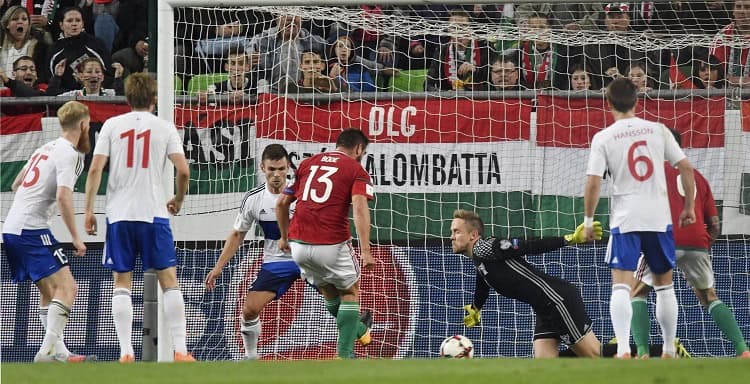
A late goal from corner by substitute striker Dániel Böde gave Hungary a narrow 1-0 home victory against the Faroe Islands in the final fixture of the FIFA 2018 World Cup qualifying campaign in the Groupama Arena in Budapest last night and ensured a third-place finish for his country in the final group standings. However, the Hungarian fans remained more than frustrated with the national team’s poor performances in recent games that broke the country’s World Cup dreams.
Ferencváros striker Dániel Böde (13) made the difference against Faroe Islands (photo: Tibor Illyés – MTI)
A tepid first half never really sparked into life, despite home-team efforts on goal from Eppel, Patkai, Ugrai and Dzsudzsák, only the first of which from the host’s captain troubling Faroes goalkeeper Gunnar Nielsen at all, but even that curling 20-metre free-kick was punched clear without serious difficulty. At the other end of the pitch, the Faroes created one moment of real danger when Gilli Sorensen plucked a long ball out of the air, cut inside and fired low towards goal from the edge of the area, only for Péter Gulácsi to get down well to his left and gather the ball cleanly at the first attempt. There was little else for either keeper to though in an opening period which remained goalless.
Bernd Storck shuffled his pack for the first time at half-time, bringing on Dániel Böde for Márton Eppel but the pattern on the match didn’t change, Hungary on the front foot far more but unable to break down a stubborn, stoic Faroes defence. In came attacking midfielder Dániel Nagy from the bench as efforts to break the deadlock stepped up a gear and finally the clear opportunity which Hungary had craved came to pass, a right-wing corner earned by Roland Ugrai and curled in by Dzudzsák landing at Böde’s feet just five metres from goal. Faroes goalkeeper Nielsen did extremely well to block the Ferencváros striker’s intial low, first-time shot but he couldn’t do anything about Böde’s second effort on the rebound which found its way past him and nestled in the net to give Hungary a precious lead they never relinquished, despite late pressure from the visitors
Bernd Storck, the under-fire German head coach of the Hungarian team said he was surprised by the negative atmosphere in the stadium. He said: “It is not easy to play football when our own fans support the opponent. I’ve never experienced such atmosphere before, I’m glad it did not have a negative impact on the team and we could win the game. I’m also disappointed with our recent results .We’ve finished third-placed, but we should have collected much more points. However, we’ve started reforms that need more time and players with international experience. The fans need to be more patient.”
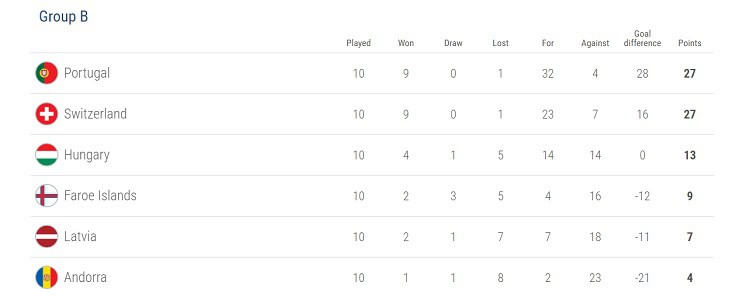
Yesterday’s result means that Hungary secure third place in FIFA 2018 World Cup qualifying group B, well behind higher-ranked teams Portugal, who have qualified for the World Cup in first spot, and Switzerland, who enter the play-off stage as one of the eight best group runners-up. Hungary’s recent results also mean, that the national team will be involved in the C league of the UEFA Nations League, a new international football competition in Europe to be launched in September 2018. Hungary will compete against Romania, Scotland, Slovenia, Greece, Serbia, Albania, Norway, Montenegro, Israel, Bulgaria, Finland, Cyprus, Estonia and Lithuania.
source: uefa.com
World Cup 2018, European Qualifiers, Group B, Round 10
HUNGARY–FAROE ISLANDS 1–0 (0–0) Budapest, Groupama Aréna, attendance: 20 000; referee: Reinsreiber (ISR) Hungary: Gulácsi – Fiola, Guzmics, Kádár, J. Szabó – Stieber (D. Nagy, 66.), Á. Nagy, Pátkai, Dzsudzsák – Eppel (Böde, HT), Ugrai (Sallai, 89.). Coach: Bernd Storck Faroe Islands: G. Nielsen – Naes, Gregersen, Baldvinsson, Jónsson – Vatnhamar, Sörensen (Bartalsstovu, 72.), Benjaminsen (Hansson, 65.), Edmundsson – Joensen, Faerö (K. Olsen, 88.). Coach: Lars Olsen Goal: Böde (81.)
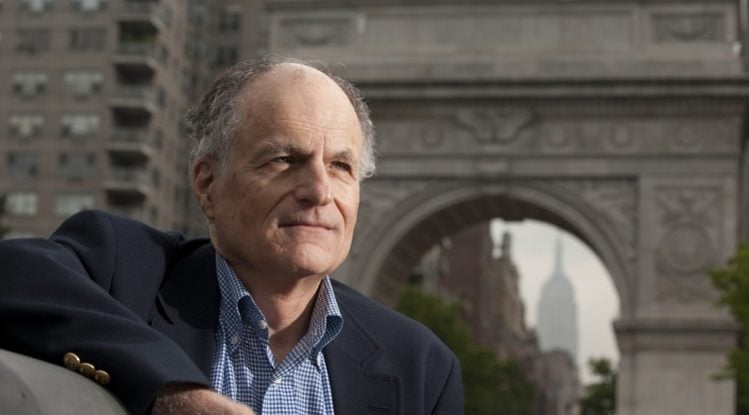
“This is the first time I pay a visit to Hungary and I clearly see the impacts of the EU process on the country’s culture, institutions, ideas and education. At the same time I’m also feeling a fantastic intellectual buzz around here”, said Nobel laureate economist Thomas J. Sargent in a recent interview with Hungarian economy and finance news portal portfolio.hu.
The 74-year old US economist, who was awarded with the Nobel prize in 2011 for his “empirical research on cause and effect in the macroeconomy”, and who is currently the W.R. Berkley Professor of Economics and Business at New York University, said that although the United States was a big country but he still felt that the region of Central Europe (Germany, Austria and Hungary in particular) represents the top of the world in terms of science. “I have met several Hungarian researchers and scientists in America, we worked together. Many of them had a great impact on my work, they inspired me intellectually”, Sargent said.
Answering a question about the future of the EU and the eurozone, Sargent cited former German Chancellor Gerhard Schröder, who once said that the EU project was to be on the United States of Europe and it was a political project motivated by 20th century and earlier European history. The future of the EU is primarily a political question, therefore it should not be answered by economist but political analysts, Sargent said. “This is a matter for voters. You are asking me to forecast what voters are going to decide. I couldn’t forecast the U.S., I was completely surprised by U.S. voters in various ways”, he said.
Click to read the full Hungarian interview here and the English version here.
via portfolio.hu; featured photo: economics.rice.edu
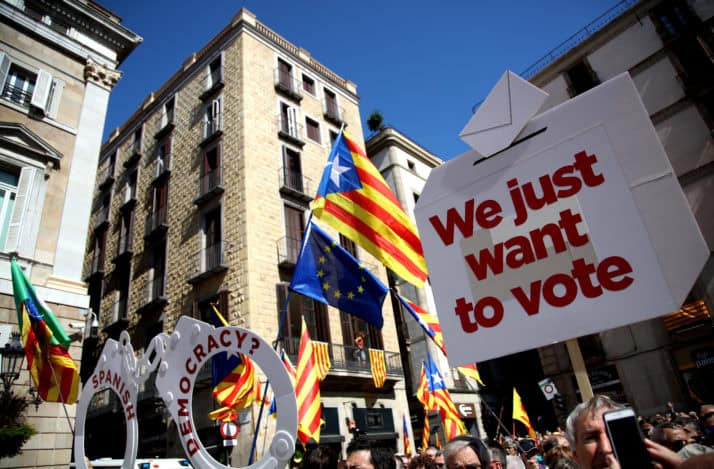
Government spokesman Zoltán Kovács declined to say whether Hungary would recognize Catalan independence if the breakaway referendum were successful (Photo by Sandra Montanez/Getty Images)
‘This is called democracy,’ Prime Minister Viktor Orbán’s spokesman says.
Government spokesman Zoltán Kovács declined to say whether Hungary would recognize Catalan independence if the breakaway referendum were successful (Photo by Sandra Montanez/Getty Images)
Hungary will “respect the will of the people” if Catalonia goes ahead with a referendum on independence on October 1, the Hungarian government said on Monday.
“The will of the people is always what matters, that’s the position,” Zoltán Kovács, spokesman for Prime Minister Viktor Orbán’s administration, told a press conference in Brussels when asked if Hungary had a position on Catalonia.
“That’s the internal issue for the Spanish and Catalonian people and it should be their decision, we all have to respect the will of the people, this is called democracy,” he added.
Pro-independence leaders in Catalonia are pressing ahead with their plan for a referendum even though the Spanish government, with the backing of the Constitutional Court, says that the vote is illegal.
Kovács did not say whether Hungary would recognize Catalan independence if the disputed referendum produced a result in favor of breaking away from Spain.
Spanish Prime Minister Mariano Rajoy has vowed to do everything necessary to stop the referendum going ahead. Last week, Spain’s public prosecutor ordered an investigation into 712 Catalan mayors who have vowed to provide logistical support for the vote in defiance of a ban by the Constitutional Court.
In recent days, armed police have raided print works and newspaper offices in Catalonia to search for voting papers, ballot boxes and leaflets.
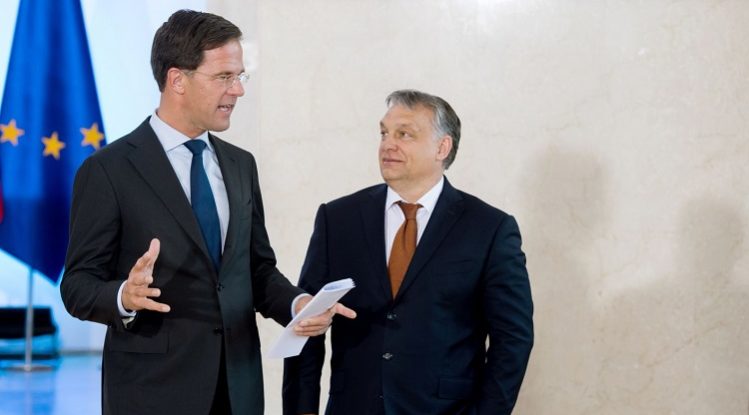
Hungary has settled its conflict with the Netherlands and the Hungarian ambassador will soon resume his post in the country, Prime Minister Viktor Orbán said in Tallinn on Friday.
Hungary recalled its ambassador to the Netherlands last month after Gajus Scheltema, the outgoing Dutch ambassador to Hungary, compared the principles of Islamic extremism to those of the Hungarian government. In an interview with political weekly 168 Óra last month, Scheltema said that Islamic extremism “applies the same principles to create an enemy as the Hungarian government”. In reaction, the Hungarian government decided to suspend ambassadorial-level communication between the two countries for an indefinite period.
Speaking to reporters ahead of the European Union’s Digital Summit in the Estonian capital, Hungarian Prime Minister Viktor Orbán said he had discussed the matter with his Dutch counterpart Mark Rutte. “We settled the conflict between the two countries; in fact we like each other and we agree on many issues,” Orbán said. Hungary’s Ambassador to the Netherlands can resume his post in The Hague, he added.
On the subject of recent proposals to reform the EU, the Hungarian Premiers said: “We are still far from being able to talk about reform proposals.” “Right now, all we have is an intent to make Europe competitive again and there are a number of ideas on how to go about it,” he added.
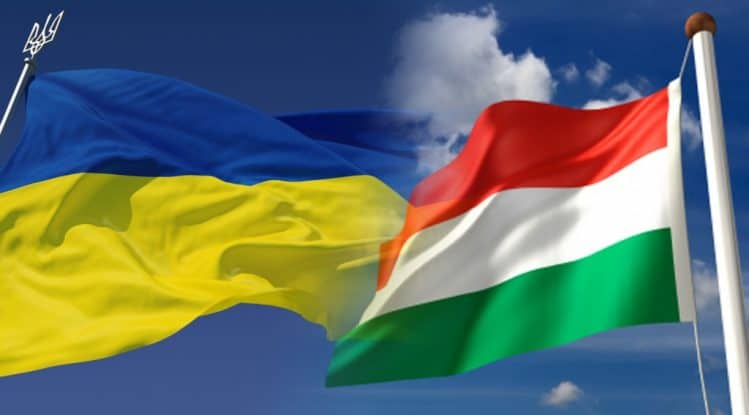
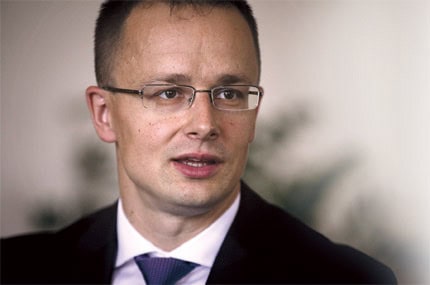
Hungary is fighting to get Ukraine’s new education law repealed and its language and citizenship bills withdrawn, Foreign Minister Péter Szijjártó said.
Ukraine’s new rules on education banning post-primary-level education in minority languages were signed into law by the president earlier this week. Ukrainian lawmakers have yet to vote on two other “dangerous” bills, Szijjártó said.
The country’s controversial education law, passed by its parliament on September 5th, states that its aim is to “modernize education”, through reforms to be introduced from September 2018. Concerning the language of education, the 7th paragraph of the law states that Ukraine’s official language in education is Ukrainian and the use of minority languages is allowed only in the first four grades of primary education.
One is a language bill that would seriously restrict the general use of minority languages and the other is a bill that would place strict sanctions on dual citizens, he said. The Foreign Minister added that, over the past year, Hungary has been pressing Ukraine to withdraw these three bills,
In a letter of response to the European Commission (EC) President Jean-Claude Juncker, Hungary’s Prime Minister Viktor Orbán has insisted that the EC President’s “interpretation of solidarity conforms neither to EU law nor the historical traditions of Hungary”.
“Unlike some other major EU member states, Hungary does not have a colonial past,” the PM said, adding that immigrant countries had obligations arising from their colonial past. “Hungary is not an immigrant country and does not want to become one.”
Viktor Orbán wrote to Jean-Claude Juncker that he was pleased that the Commission President, in his recent letter to Orbán, had recognised Hungary’s efforts to protect the European Union’s external border. “Over the past two years, Hungary has been protecting the common borders by mobilising Hungarian resources, with a heavy budgetary burden, by building a fence and deploying thousands of border guards,” the letter said.
Addressing Juncker’s point that Hungary had refused some EU funds, Viktor Orbán wrote: “Hungary must always behave like a Schengen-border country, but for geographical reasons, migrants cross the borders of the EU of other EU member states, especially Greece. It is for this reason that Hungary has not participated in projects that do not make this issue clear, and it does not want to do so in future either.”
Prime Minister Viktor Orbán said in his letter to the European Commission president Hungary could not accept being forced to change. He wrote in the English-language letter:
The interpretation of the principle of solidarity described in your letter is essentially nothing other than the demand that Hungary transform itself into an immigrant country against the will of Hungarian citizens. This is not solidarity in my view but force.
The Hungarian PM said he was baffled by passages in Jean-Claude Juncker’s letter that drew a connection between the issue of migration and cohesion funding. “Such a connection does not exist; neither is it allowed by European law.”
“The Hungarian government’s view is that much of the cohesion funding lands with the companies of countries paying into the fund, so the economies of large EU member states have profited greatly from cohesion spending. This is also true of the opening of the markets of new member states.”
Viktor Orbán also expressed his “astonishment and incomprehension” at reading that the commission was disinclined to accede to Hungary’s request for border control funding. “It is my conviction that whoever refuses to support the fence, cannot and does not want to protect the citizens of the European Union.”
“Wherever there are mass attempts to cross borders illegally, without physical obstacles it is impossible to defend them,” the letter said. “If instead of defending the borders the European Commission only willingly finances measures and institutions for receiving migrants, instead of halting migration, we would give new incentives to hundreds of thousands of planning to migrate to Europe.”
“This is why I’d like to repeat the Hungarian government’s request that the European Union pay half the cost of Hungarian measures, including the fence, aimed at protecting the common Schengen borders,” Orbán wrote, adding that the costs to the Hungarian taxpayer had amounted to 270 billion forints (EUR 883m) over the past two years. “The fence and Hungarian border hunters protect not only Hungarian citizens but Austrian, German and other EU citizens, too,” the letter concluded.
via hungarymatters.hu and kormany.hu; photo: Gergely Botár – kormany.hu
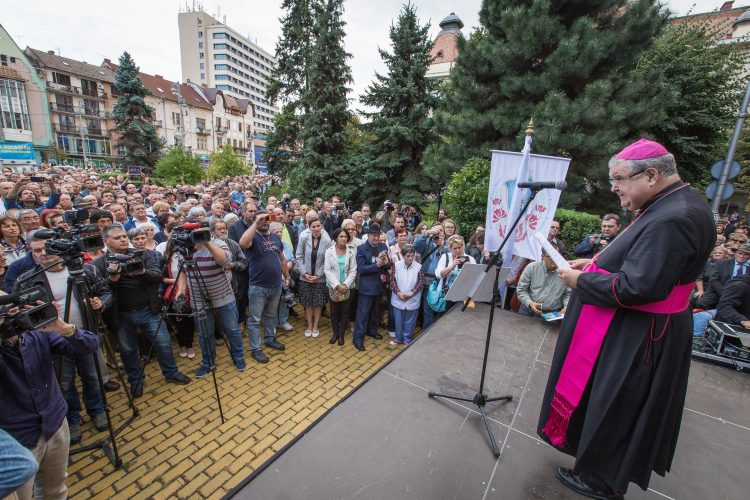
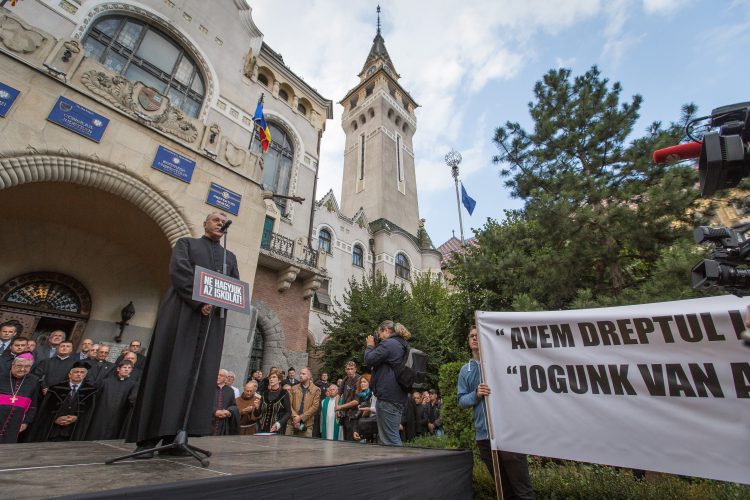
On Wednesday, thousands gathered in the Transylvanian city of Targu Mures (Marosvásárhely) at a protest held in support of the local Roman Catholic High School, which was set to be closed by Romanian authorities.
As Romania’s Roman Catholics are overwhelmingly ethnic Hungarians, the move was seen by many in the Hungarian community as an ethnically- and religiously-based attack on the part of the government.
The move to close the Hungarian school began due to Romanian government claims (whose lengthy background you can read about in Hungarian here) that the school lacked proper documentation. This subsequently led to a case being launched last year against the school’s principal and the school itself.
The protest was organized by the Roman Catholic Status Foundation, and included leaders of both the Roman Catholic and Protestant churches of Transylvania, all of which have majority-Hungarian membership.
Major speakers at the event included György Jakubinyi, Archbishop of Alba Iulia (Gyulafehérvár) as well as Béla Kató, Reformed Bishop of Transylvania, and Barna Kapás, head of the Status Foundation.
Alba Iulia Archbishop György Jakubinyi speaking at the protest in Targu Mures (Photo: MTI – L. Gergely Boda)
Protest leaders called on the Romanian government, and on the Ministry of Education in particular, to issue a governmental or ministerial decree guaranteeing the continued operation of the Catholic Theological High School.
In his speech, Archbishop Jakubinyi said that this was a protest “in defense of our rights.” Quoting famed Transylvanian bishop Áron Márton, Jakubinyi added that
This is not politics; this is our life.
Hungarian Diplomatic Response
In response to the Romanian government’s planned closure of the school, the Hungarian Foreign Ministry summoned Romania’s ambassador for discussions.
State secretary Levente Magyar voiced the Hungarian government’s shock and told a press conference that the move was equal to
an attack against the Catholic Church, the Hungarian minority, children, families, and the restitution process in Romania.
Magyar also claimed that the Hungarian government would suspend its support for Romania’s aspirations to join various international organizations such as the OECD. At the same time, he said Hungary continues to consider Romania a strategic partner and an important ally.
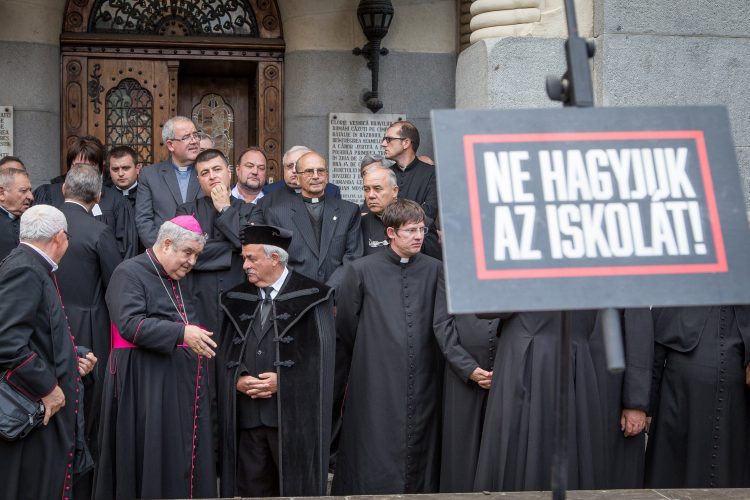
Ethnic Hungarian religious leaders gathered on the steps of the Targu Mures prefect’s office, as part of a protest against the closure of the city’s Roman Catholic High School. In the foreground, a poster can be seen emblazoned with the message “Don’t Abandon the School!” (Photo: MTI – L. Gergely Boda)
He called on Romania to resolve the issue of Hungarian education in Targu Mures as soon as possible.
Magyar further claimed that, while Romania has repeatedly promised to resolve the problem, instead several hundred children and their parents have been misled. The Romanian side has rejected numerous proposals made by Hungarians and parents have been “intimidated”, he added.
Zsolt Nemeth, the head parliament’s foreign affairs committee, told a press conference held on the issue of the Catholic secondary school in Targu Mures that the ruling Fidesz party objects to “the Romanian authorities’ persecution of Christians”. Nemeth, of Fidesz, welcomed a demonstration held in Targu Mures and praised parents’ and students’ perseverance in protecting their basic rights. He also noted that the historic churches, interest representation bodies, political organisations and ethnic Hungarians in Romania have joined forces in their protest.
Nemeth said it is important that Romania should respect the right to church education, the restitution of church property and the freedom of religion.
Romanian Response
Initially, Romania’s foreign ministry responded by saying that Romania does not violate the education rights of either Hungarian minorities or Catholics, and by dismissing the Hungarian government’s stance on the case of the Targu Mures secondary school as election campaign posturing.
The ministry said Romanian authorities “regret” that the case of the school “has become a topic of the Hungarian election campaign” and that children’s rights to quality education are “being sacrificed for political interests”.
Arch-Dean Father Dénes Oláh speaking at the protest, organized by the Roman Catholic Status Foundation (Photo: MTI – L. Gergely Boda)
The ministry added that authorities were in constant dialogue with the parties involved to find a lawful solution to the school’s situation, warning that all educational institutions in Romania have to comply with the country’s laws, regardless of religious affiliation or ethnic makeup.
The statement said Hungary’s decision to tie the issue of the Targu Mures school to matters such as its support for Romania’s aspirations to join international organizations like the OECD was a “wrong and unfriendly” one.
A Successful Protest: Romanian Prime Minister, Education Minister Weigh In
On Thursday, the Romanian government’s stance softened significantly, with Prime Minister Mihai Tudose himself saying that his Foreign Ministry had issued an “excessively harsh” response to Hungary.
Speaking to Romania’s Digi24 TV network, Tudose said that he did not believe that Hungary truly wanted to prevent Romania from entering the OECD, and that if such would be the case, it would not be announced by a state secretary.
Referring to the school closure controversy, Tudose insisted that Romania would never close a school for ethnic or religious reasons, and described the entire affair as a “bureaucratic mistake” at the local level.
Criticizing his own foreign ministry, Tudose said that
While supposedly the cream of the diplomatic crop is there, there response was more reminiscent to that of a sports ministry. They treated it like a boxing match: if you hit me, I’ll hit you!
Following these comments, Liviu Pop, Romania’s Minister of Education, announced that Targu Mures’ Catholic School would not be closed after all, but rather would be officially placed under the rubric of the Hungarian-language Farkas Bolyai High School.
In a statement, the minister announced that children would be signed up for classes, and that classes should begin on Monday. The students and teachers would officially be assigned to the Farkas Bolyai High School while the ongoing legal case is still underway, but that neither the school’s location nor its teachers would change. In addition, once the case comes to a conclusion, Pop said,
everything will go back to normal.
Via MTI, origo.hu, transindex.ro, szekelyhon.ro, and magyarkurir.hu
Hungarian Prime Minister Viktor Orbán with Russian President Vladimir Putin at the World Judo Championships, held in Budapest’s László Papp Sport Arena (Photo: MTI/PMO Press Office: Balázs Szecsődi)
While Putin was officially in Budapest for the 2017 World Judo Championships (as he is honorary head of the International Judo Federation), he also spent his time at the sporting event meeting with Hungarian Prime Minister Viktor Orbán, discussing areas of cooperation between Russia and Hungary.
In addition to visiting the Judo tournament, while in Budapest the Russian President also accepted the “civis honoris causa” (honorary citizen) award from the University of Debrecen in recognition of “the major role the Russian Federation and Hungary assign to the Debrecen University in the upgrade of the Paks nuclear plant.”
Meeting Between Orbán and Putin
Hungarian Prime Minister Viktor Orbán with Russian President Vladimir Putin at the World Judo Championships, held in Budapest’s László Papp Sport Arena (Photo: MTI/PMO Press Office: Balázs Szecsődi)
While at the Judo championships, Putin was seated in a box next to Viktor Orbán. There, during the competition, the two discussed the Russian-financed Paks II nuclear power plant upgrade project, as well as other points of bilateral cooperation.
Following the Russian President’s departure, Hungarian Foreign Minister Péter Szijjártó spoke about the topics discussed between the two leaders.
First and foremost, the Foreign Minister announced that “the real construction work” on the Paks II upgrade will start in January, adding that “nothing will stop the investment from now on.”
While Orbán and Putin forged no new arrangements, they reportedly reviewed their earlier agreements. According to Szijjártó, the two agreed that “their joint decisions made earlier have started to bear fruit.”
The two confirmed that the Paks upgrade project, overseen by Hungarian minister János Süli, will begin in January of 2018 following lengthy delays.
Szijjártó said that the project will cost a total of $12 billion USD, $5 billion of which will be paid for by Hungary.
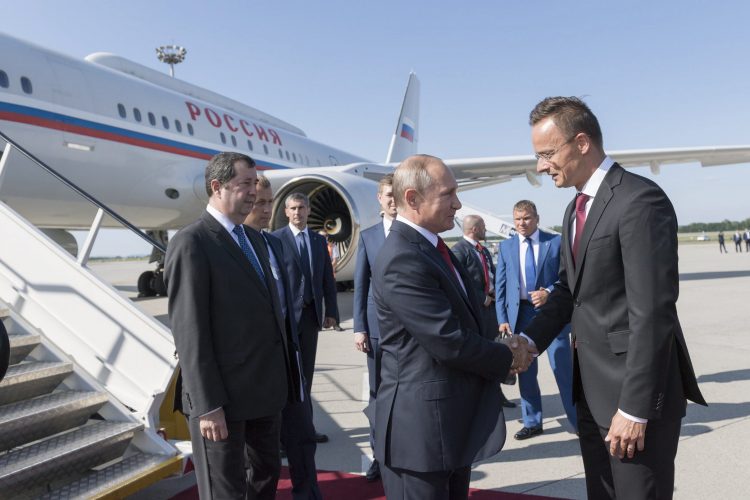
Hungarian Foreign Minister Péter Szijjártó welcoming Russian President Vladimir Putin at Budapest’s Ferenc Liszt International Airport (Photo: MTI/KKM – Márton Kovács)
In other Russia-related topics, the Foreign Minister ‘welcomed’ a growth in bilateral trade between Hungary and Russia. In addition, he noted the launch of a new direct flight between Budapest and Saint Petersburg, as well as an increase in Hungarian students receiving Russian scholarships.
Putin also confirmed that Russia was making efforts to supply natural gas via Turkey, Bulgaria and Serbia to Hungary and Austria.
The Hungarian Foreign Minister said that Bulgaria, Serbia and Hungary would upgrade parts of their natural gas pipelines to allow the transport of up to 10 billion cubic metres of Russian gas by the end of 2019.
Speaking to Russian media outlet Ria Novostyi about his visit to Budapest, Putin expressed his satisfaction with the state of bilateral relations between his country and Hungary, saying that “I am happy, that I can discuss bilateral relations at a sporting event. Despite difficulties, economic ties are progressing well.” He also reinforced Russia’s commitment to financing the Paks II Nuclear Plant’s upgrade, and guaranteed $12 million USD of Russian financing for the project.
In addition, while in Budapest, Putin held an open discussion with Orbán, in which the two joked about their respective passions for judo and football, respectively. In addition, the Russian leader promised support to Hungarian economic initiatives in his country, saying that
We see our Hungarian friends and partners’ interest in working on the Russian market and we will do everything possible to support them and help them to promote their business interests in Russia.
Reactions and Protests
Protesters at the Momentum Movement’s demonstration against Vladimir Putin’s visit to Budapest, gathered atop Budapest’s Gellért (Photo: Momentum Mozgalom Facebook Page)
In response to Putin’s second visit to Budapest since this past February, various left-wing groups made use of the Russian leader’s arrival to voice their opposition to the Orbán government’s attacks on the EU and its perceived embrace of dictators and authoritarian strongmen worldwide (in addition to his meetings with Putin, earlier this year Orbán met with Turkish President Recep Tayyip Erdoğan and Belorussian President Alexander Lukashenko, two leaders who, like Putin, have been accused of a variety of violations of human rights, freedom of speech, and freedom of the press in their respective countries. Erdoğan has also been invited to visit Budapest).
By far the most vocal and effective, however, was the recently-formed Momentum Movement.
Momentum, which officially became a political party this past March, came into the political spotlight earlier this year with its successful signature-collection drive for a referendum on Budapest’s bid to host the 2024 Olympic Games. The signature drive was a massive success, with around 266,000 signatures collected; shortly thereafter, the Hungarian government and the Budapest City Council decided to officially withdraw Budapest’s bid.
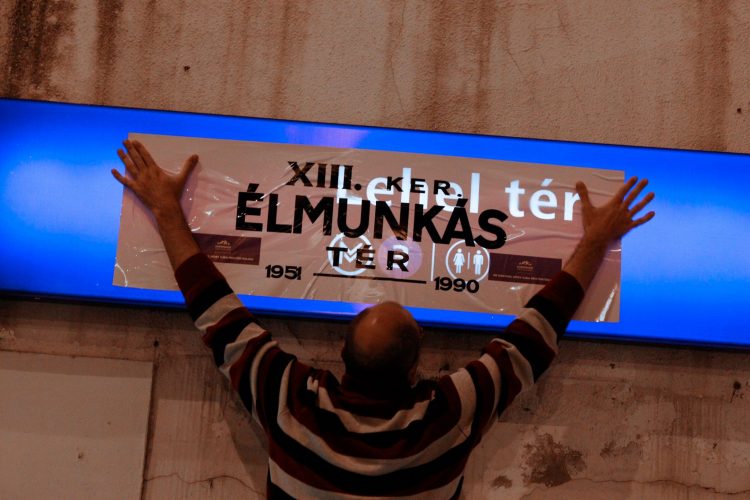
As part of its protests against the Russian strongman’s visit, Momentum posted Communist-era, “Moscow approved” street names around Budapest, a reference to the decades Hungary spent behind the Iron Curtain. The ‘new’ street signs were accompanied by stickers urging Hungarians to “not let this happen again.”
A sticker with a Budapest square’s Communist-era name, placed by the Momentum Movement in protest of Putin’s visit to Hungary (Photo: Momentum Mozgalom Facebook Page)
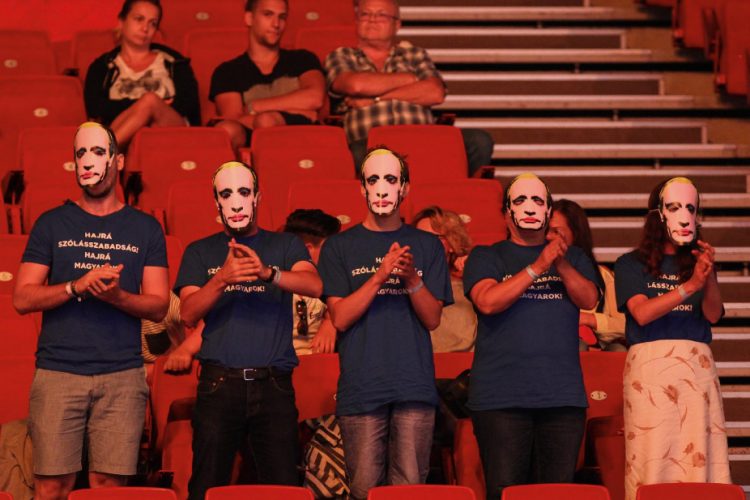
In addition, some Momentum protesters were in attendance at the World Judo Championships. There, they demonstrated against the Russian President’s visit by wearing shirts emblazoned with the slogan “Go Hungarians! Go Freedom!” as well as Putin masks of the style that have been used to protest against the strongman’s crackdown on his country’s LGBT community, before being removed by event security.
Protesters at Budapest’s László Papp Sport Arena (Photo: Magyar Nemzet – Dávid Balogh)
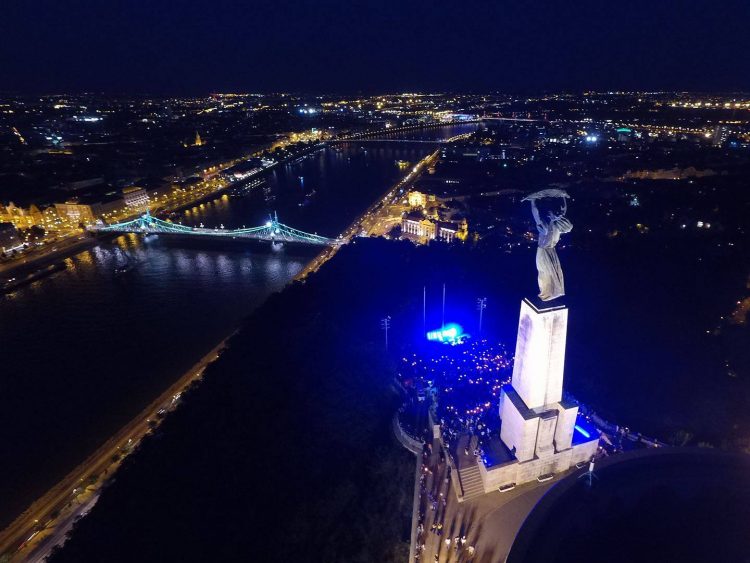
And on Monday evening, party leader András Fekete-Győr held a rally on top of Budapest’s Gellért Hill. In front of the city’s Statue of Freedom, which was lit up with a projection of the EU flag, the Momentum leader said that Hungarians were “tired of Hungary laying down with a KGB agent.” He further argued that Putin was no true friend of Hungary, but rather
a dictator, and a dictator is not a friend to anyone for whom peace, freedom, and Europe are important.
Fekete-Győr also expressed his party’s opposition to the Paks II nuclear upgrade. In addition, he claimed that
the reason Viktor Orbán is moving closer to Moscow, is that he wants to build up a regime of fear on the model of Putin.
Via MTI, Index, Magyar Nemzet, ria.ru, euronews.com, and kremlin.ru
Images via MTI, Magyar Nemzet, and the Momentum Facebook Page
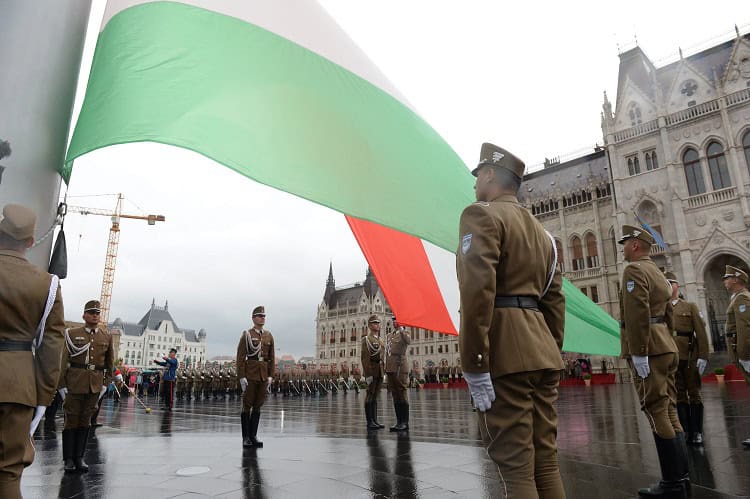
Budapest, 2017. augusztus 20.
Felvonják a nemzeti lobogót az augusztus 20-i nemzeti ünnepen a budapesti Kossuth téren 2017. augusztus 20-án.
MTI Fotó: Kovács Tamás
20th of August, the day King Saint Stephen of Hungary, was celebrated with weekend-long festivities throughout Hungary. The national holiday commemorates the foundation of the medieval Kingdom of Hungary by the legendary king, who was canonized on 20th of August, 1083 by Pope Gregory VII. Festivities started in the morning with the raising of the Hungarian flag and continue on all day long, culminating in a spectacular fireworks display over the Danube in the evening.
Budapest, 2017. augusztus 20. Felvonják a nemzeti lobogót az augusztus 20-i nemzeti ünnepen a budapesti Kossuth téren 2017. augusztus 20-án. MTI Fotó: Kovács Tamás
BUDAPEST – In a time when most of Europe is in the grips of atheism, there is a nation where Christianity seems to not only be holding its own but some say is thriving.
Imagine a government that is unabashedly Christian, that thinks Christian values are worth defending, that wants to protect and even nourish the family.
Welcome to Hungary.
A Christian Nation
Hungary’s constitution is explicitly Christian and says that marriage is between one man and one woman and that life begins at conception. It even includes the phrase, “God bless the Hungarians.”
Hungary’s Faith Church, with 300 branches, is one of the largest Pentecostal churches in Europe, with 70,000 attendees.
Help for Persecuted Christians
And the Hungarian government has taken on the role of protecting Christianity. It’s even set up an office to help persecuted Christians worldwide.
When CBN News revealed the story of Sweden’s threat to deport Iranian actress Aideen Strandsson back to certain prison and torture in Islamic Iran, only one nation stepped up and offered her asylum: Hungary.
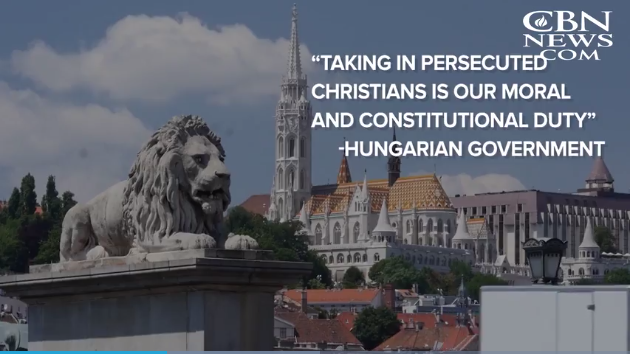
The Hungarian government says, “Taking in persecuted Christians is our moral and constitutional duty.”
Returning to Its Christian Roots
Hungarian policy analyst István Pócza says Hungary has only returned to its roots as a historic bastion of Christianity, dating back over a thousand years.
“Hungary wants to protect the European values, European Christian Jewish values,” he told CBN News.
Christianity in Hungary has survived almost 200 years of Muslim Ottoman rule and Soviet Communist domination.
Secretary of State Zoltán Kovács told us, “You have to stick to your traditions and legacies. Europe’s legacy is a Christian legacy, not necessarily in a religious form but most definitely in a cultural form.”
Resisting Islamization
And it’s this belief that has Hungary locked in a battle with the European Union over migrants.
Hungarian Prime Minister Viktor Mihály Orbán has accused the European Union of trying to Islamize Europe, and Hungary has infuriated Brussels by building a fence to keep illegal migrants out.
Orbán has essentially told the European Union to ‘take a hike’ when it comes to open borders. Hungary has seen the terrorism and chaos caused by migration in Western Europe and has said, “not here.”
The European Union has even gone to court to force Hungary, Poland and the Czech Republic to take in migrants. Mr. Oban has accused Brussels of “blackmail.”
“Securing the borders to stop illegal migration is indeed a solution, and this is actually the only way to reinstate law and order at the borders of the European union and not the other way around,” Kovács told CBN News.
Islam Matters
Kovács says it matters that most of the migrants trying to enter Hungary are Muslim. And he says Western European nations are paying a heavy price by pretending that Islam doesn’t matter.
“We’ve been living with and close to Islam for centuries in the past and we know about it. So, that’s why it does matter who has come in and in what manner people are coming,” Kovács told CBN News.
Orbán Is No Putin – Or Is He?
Orbán is often portrayed in the western media as a version of Vladimir Putin, an undemocratic strongman. In fact, at an EU summit in 2015, the European Commission President Jean-Claude Juncker reportedly greeted Orbán with the words, “Hello, dictator.”
Hungary is most certainly not a dictatorship. But Orbán’s critics accuse him of corruption and using the instruments of government against his political opponents, including the recent billboard campaign against billionaire George Soros.
Tamás Lattmann of the Institute of International Relations told us, “What we see in Hungary today is the shameless use of public money, of tax money to formulate pro-government messages.”
Bulcsú Hunyadi of the Political Capital Policy Research and Consulting Institute said, “Since 2008 the Hungarian government headed by Prime Minister Viktor Orbán has been continuously weakening the system of checks and balances and weakening democratic institutions.”
But Orbán, a man who even his critics concede is a skilled politician, doesn’t seem to have a serious political rival, and he will probably remain in power, meaning Hungary’s standoff with the European Union over migrants is likely to escalate.
Is also means that Hungary will continue to have a government that thinks Christianity is worth protecting.
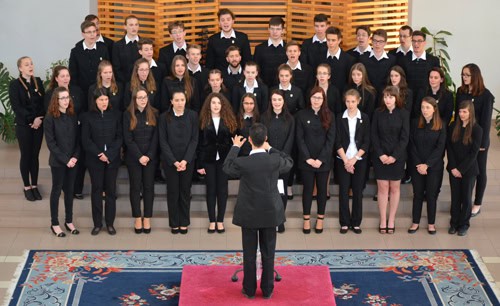
The Reformed School Choir of Pecs, Hungary travels in various parts of Hungary and to Hungarians living in the diaspora throughout the year. This is the first time that they will perform in North America. The choir is dedicating this performance to commemorating and celebrating the 500th Anniversary of the Reformation. Currently, the choir is comprised of forty teenaged members and six adult teachers.
Reformed School Choir of Pecs, Hungary
NOTE: All the images below with a white arrow in the middle are videos. (The other images are just photos) You can click on the white arrow to watch the video of whatever is described. Make sure your speakers are on and you can make the video full screen once it begins by clicking the icon in the lower right corner.
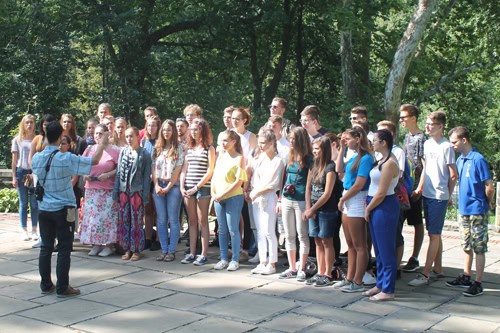
The Choir gave a beautiful performance with selections in Hungarian and English at the First Hungarian Reformed Church in Walton Hills in the evening. In the morning they toured the Hungarian Cultural Garden.