Home Blog Page 36

Trump Invites Anti-Migrant Hungarian PM Orban to Washington: Report

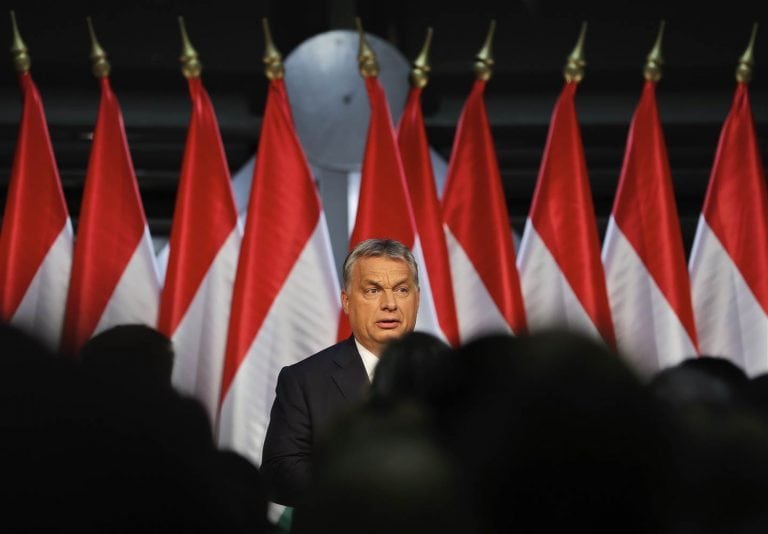
LONDON — The controversial leader of Hungary who erected a fence along his country’s border to keep migrants out says Donald Trump has invited him to visit Washington.

Prime Minister Viktor Orban said in an interview published online by business daily Vilaggazdasag that Trump made it clear to him that “he thinks highly of Hungary.”

161003-orban-0620_2f4c5d79764b558438dc36ce61bcfa75-nbcnews-ux-2880-1000

Orban, who tried but failed to win a referendum to ban Hungary taking a EU quota of refugees in October, said in July that Trump’s migration policies were better for Europe and Hungary.

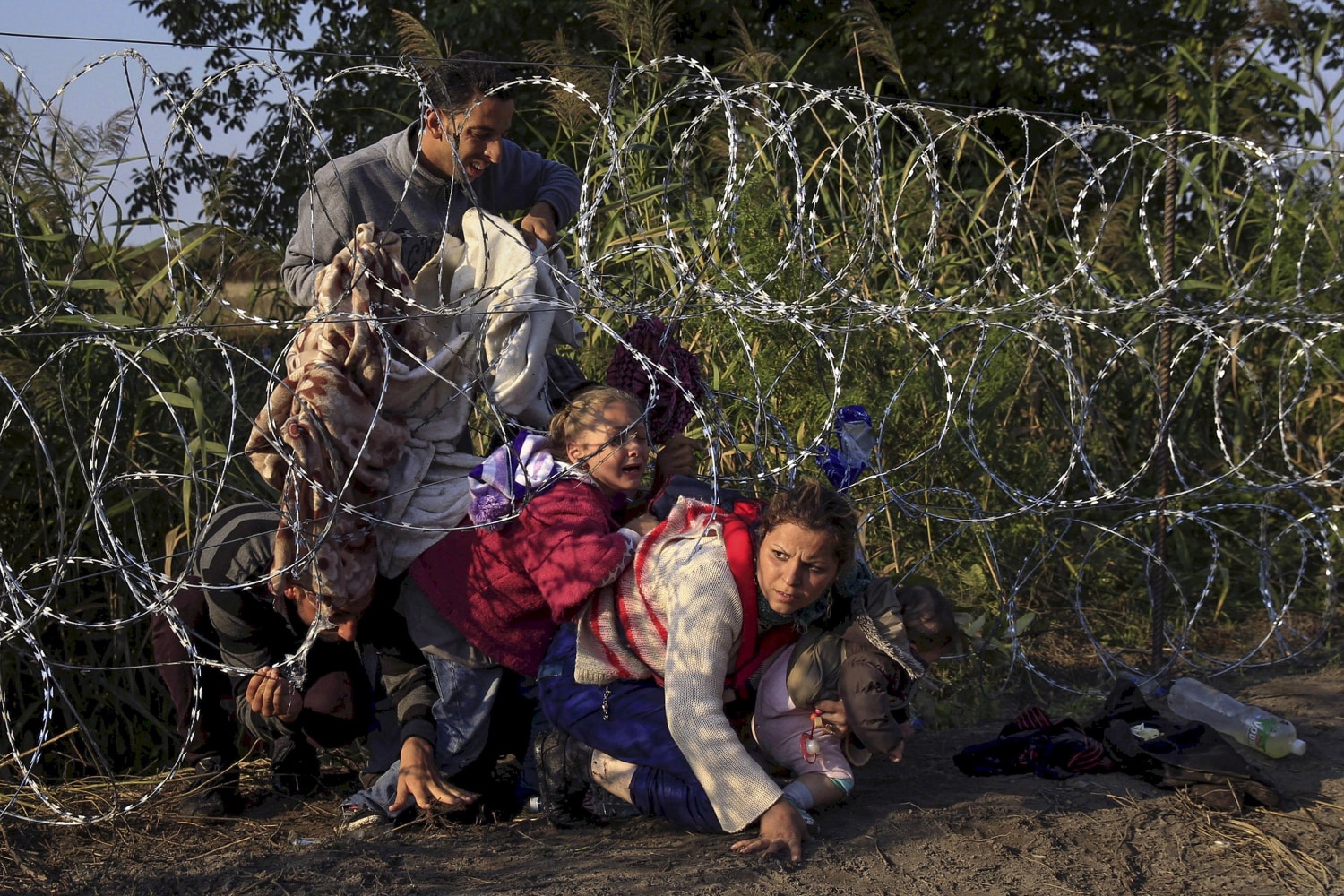
The right-wing leader has strong anti-Islamic views. Last year, he had fences built on Hungary’s southern borders to stop the flow of migrants trying to reach Western Europe.

Image: Syrian migrants cross under a fence as they enter Hungary at the border with Serbia
Syrian migrants cross a fence as they enter Hungary at the border with Serbia on Aug. 27, 2015. BERNADETT SZABO / Reuters

Orban was quoted as saying he felt that Hungary’s position had “improved greatly” with Trump bound for the White House.

Orban said: “He invited me to Washington, I told him that I hadn’t been there for a long time as I had been treated as a ‘black sheep’, to which he replied, laughing: ‘Me too’.”

“I think America will now have a president who is not ideologically limited,” Orban added. “He is an open person who is much more interested in success, efficiency and results than in political theories.”

Orban earlier hailed Trump’s victory as “great news,” which would allow Western civilization to return to “true democracy and straight, honest talk,” freed from the “paralyzing constraint of political correctness.”

Source: nbcnews.com

Reklám
Tas J Nadas, Esq

Toronto’s Country Style Hungarian reopens doors with traditional menu intact

When Country Style Hungarian Restaurant, a venerable schnitzel house on Bloor Street West, shut its doors earlier this summer, rumours quickly began circulating in Toronto’s food-o-sphere about its demise.

country-stylemain

Which wouldn’t have been such a surprise. After all, the 54-year-old Annex institution is the last survivor in a stretch once known as the goulash archipelago, with eateries such as The Coffee Mill, Marika’s, Csarda House, The Blue Danube Room, Continental and Korona. The owners have mostly retired or died.

This particular closure turned out to be not only temporary, but a kind of reboot. The interlude allowed owner Katalin Koltai to do a stem-to-stern renovation, the first real overhaul since 1975. The restaurant reopened late last month.

Still, as Ms. Koltai said after the lunch-hour rush one day this week, all the speculation was a concern: “We were afraid we would not be getting people back.”

But the city’s greatly relieved schnitzel aficionados have returned, in droves.

The facelift cost her more than $150,000 and is meant to secure the business so that Ms. Koltai’s daughter, also named Katalin, can take over when she retires. The work included new kitchen equipment, counters, chairs, bathroom fixtures and even a digital cash register to replace the restaurant’s antiquarian push-button version.

Most conspicuously, the bulky refrigerated dessert display case that dominated the front has been replaced with large and inviting picture windows, as well as a couple of street-facing tables.

What hasn’t been updated: the kitschy Communist-era tourist posters of Budapest that adorn the walls, and, crucially, the menu, which features Magyar staples such as cabbage rolls, goulash, palascinta and the “wooden plate” – a veritable steppe of fried meat, potatoes and pickled beets.

“We didn’t change anything,” Ms. Koltai stressed, noting that Country Style Hungarian serves about 400 Frisbee-sized schnitzels each week, as well as 20 wooden plate specials on a typical weekend. “The food is the same as 30 or 40 years ago.”

The restaurant dates back to the early 1960s, a time when many of the thousands of Hungarian refugees who came to Toronto after the 1956 revolution were living in and around the Annex. The second owner, Alex Pataki, expanded the eating area, which included a row of counter stools at the front that were habitually occupied by his most regular customers.

Ms. Koltai, who came to Canada in 1971, worked in a bank for five years before opening the Hungarian Rhapsody in Yorkville. She sold it a few years later and went to work for Mr. Pataki in 1981. After leaving for a brief period in the mid-1980s, she returned in the late 1990s and bought the business outright in 2001.

Country Style Hungarian, which has sustained generations of hungry university students, has also been a favourite of visiting food writers looking for Toronto’s authentic ethnic fare. “Everything comes in two portions,” a Chicago Sun-Times scribe noted admiringly in 1991. “Large, and very large.”

Toronto’s restaurant scene, of course, has changed utterly since Country’s Style Hungarian’s early years, when its menu was considered exotic but also emblematic of the city’s emerging multiculturalism.

Ms. Koltai, however, has no intention of modernizing the menu or incorporating whatever might pass as nouvelle Hungarian cuisine. Asked where she fits into the city’s food scene, Ms. Koltai offered a shrug and a smile. “I have no idea,” she replied. “Some people say the homemade cooking. We start to work early in the morning every day to put fresh food on the table for our customers.”

John Lorinc, a freelance writer, has been eating at Country Style Hungarian for over 40 years.

Source: theglobeandmail.com

Reklám
Tas J Nadas, Esq

AMAZON STARTS SHIPPING TO HUNGARY FOR FREE

Christmas is almost around the corner, so Amazon already gave a gift to its customers and made shipping free of charge to several countries, including Hungary, writes index.hu.

amazon

Amazon, one of the world’s most popular online retailers decided to give an early Christmas gift to its customers and announced that no shipping fee shall be paid when products are ordered to some European countries, including Hungary, Slovakia, the Czech Republic, Denmark and Finland.

However, there are some important conditions to keep in mind in order to get free delivery. Firstly, orders should be made on the website of the German Amazon (amazon.de) instead of the American online store (amazon.com). It’s probably because the German store is a market within the EU, which makes delivery duty-free, unlike deliveries from the US.

Secondly, your purchase shall exceed the minimum limit of 39 EUR to get free shipping. But by doing so, the system automatically offers free delivery. Furthermore, Amazon will add the Hungarian VAT to your purchase, so, to see the final price of the order you’ll need to log in and set your Hungary-based address in the German platform.

The news was shared by Amazon via emails to its customers, and was made available to read at the official website of the company. Should you need more information about this new opportunity to receive free delivery, make sure to click here.

Photo: facebook.com/amazon.de

Copy editor: bm

Source: dailynewshungary.com

Reklám
Tas J Nadas, Esq

HUNGARIAN CHOCOLATE IS THE BEST IN THE WORLD

hungarian-chocolate-is-the-best-in-the-world

For the little amount of chocolate we eat, we are almost a major world power in the field of chocolates and sweets, as Origo reports. Yet another gold medal!

Although the Hungarians are not famous for their affection for quality sweets, Hungarian chocolate manufacturers are fairly active and pretty successful.

ChocoMe was awarded with its second gold medal at the world-championship final of the most prestigious professional competition, at International Chocolate Awards. Therefore, the best nut and milk chocolate sweet is officially Hungarian. As always, the world-championship final and the announcement of the results were held in London as part of The Chocolate Show.

raffinee-piemonte

The exact product is the Raffinée Piemonte hazelnut, covered in ground Ethiopian Harrar coffee and hazelnut flavoured milk chocolate.

“The Raffinée product was awarded as the best at the Eastern-European regional semi-final a few weeks before the finals, so it could be seen that we were going to be in the top three, but I did not expect to get the gold again after winning last year.” says Gábor Mészáros, owner of chocoMe.

The committee consists of the most reputed foreign chocolate manufacturers, gastronomical experts, sommeliers and chefs. The chair of this committee is Martin Christy, founder of the award and editor of the chocolate degustation site Seventy % – one of the greatest chocolate experts today.

Photo: chocome.hu

Source: dailynewshungary.com

Reklám
Tas J Nadas, Esq

DEPUTY PRIME MINISTER SEMJÉN EXPRESSES SUPPORT FOR PERSECUTED HUNGARIAN LEADERS IN SZELKERLAND

Csíkszererda (Miercurea Ciuc), Romania, November 11 (MTI) – Hungarian Deputy Prime Minister Zsolt Semjén has declared support for leaders of any Hungarian community abroad who are “persecuted unjustly” for representing their community’s interests.

d_mti20161110005-1280x640

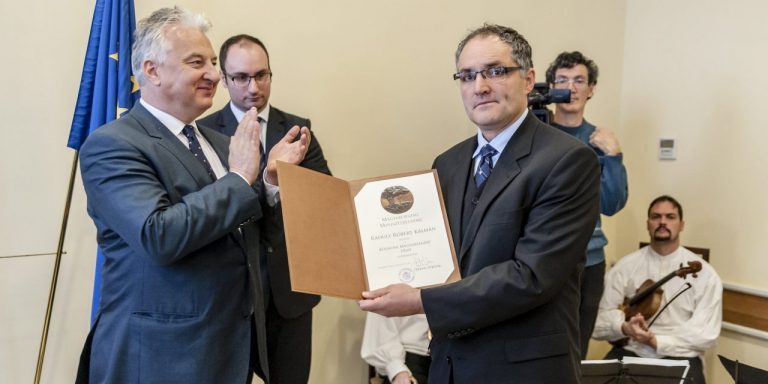
Semjén presented the For Hungarians Beyond Borders award to four politicians serving in three central Romanian cities inhabited mostly by ethnic Hungarians.

The awards were granted to Arpad Antal, the mayor of Sfantu Gheorghe (Sepsiszentgyörgy), János Mezei, the former mayor of Gheorgheni (Gyergyószentmiklós), and Róbert Raduly and Domokos Szőke, the mayor and deputy mayor of Miercurea Ciuc (Csíkszereda), at Hungary’s consulate-general on Friday.

Romanian authorities have launched criminal procedures against the four politicians for alleged corruption. “What is going on is an intimidation of Hungarians under the pretext of fighting against corruption,” Semjén said.

The legal procedures were obviously launched against influential Hungarian leaders who play a crucial role in holding their community together and pressing for their interests and survival, he said “Hungary will never let these people down, they can always rely on Hungary’s support,” Semjén said, adding that Hungary would seek to solicit support for them in every international forum.

Photo: MTI

Source: MTI / dailynewshungary.com

Reklám
Tas J Nadas, Esq

ORBÁN EXPECTS ‘TURNAROUND’ IN HUNGARY-US TIES

Budapest, November 11 (MTI) – Donald Trump’s winning the United States presidential race is expected to bring a “complete change” in bilateral relations, Prime Minister Viktor Orbán told public Kossuth Radio on Friday morning.

k__ap20161110144-1280x640

Hungary has had strong economic and security ties with the US, but political cooperation “tended to run aground” with the Democrat administration, Orbán said. He insisted that the Democrat government lived in a “Liberal pseudo-world” and sought to “export democracy in its own interpretation”, and supported migration tendencies in the world.

Answering a question if he expected a change in the US government’s critical attitude towards Hungary, Orbán said that he expected a “180 degree” turnaround.

“There is a fair chance” that the world will be a better place with the new US president, the prime minister said. Concerning Trump’s future policies, Orbán said that “campaign and government are two different things” and added that Hungary was interested in a “reasonable, calm and well-considered” US foreign policy.

Answering a question about Trump’s campaign remarks that he would not support his country’s free trade talks under the current conditions, Orbán said “neither do we”.

On another subject, Orbán said that in light of Trump’s making it clear that “the US will no longer foot the same bill” Europe will have to do more for its own security. “It will do us good if we take security more seriously, and do not take it for granted by a huge US army from outside the continent”, he argued.

Concerning US-Russia ties, Orban said there were ways to ease the tension and it was in Hungary’s interest that the two powers should “return from a warlike mood to the culture of peace and cooperation”. He added, however that “it won’t happen overnight”.

Referring to his recent talks with British Prime Minister Theresa May, Orbán said agreement had been reached that the situation of Hungarians working in the UK should not become worse, on condition that the Hungarian government does not take measures impacting Brits in Hungary, either. Orbán noted that his government was not planning to take any such moves. The focus of talks in the future will be conditions for Hungarians wishing to seek employment in the UK from now on, Orbán added.

Orbán noted that Hungarians working abroad send home an annual 1 trillion forints (EUR 3.3bn), “taking a serious role in keeping the Hungarian economy going”. He added, however, that the government was working to make Hungary “a place ensuring an attractive life and predictable careers” also for people wishing to return.


Photo: MTI/AP/Pablo Martinez Monsivais

Source: dailynewshungary.com / MTI

Reklám
Tas J Nadas, Esq

FIRST HUNGARIAN TO BE ELECTED TO INTERPOL EXECUTIVE COMMITTEE

interpol

Budapest (MTI) – Interpol elected Mátyás Hegyaljai, interior ministry deputy state secretary for EU and international affairs, to the executive committee of European members of the organisation on Thursday. The ministry wrote in a statement that the election represented a great success for Hungarian law-enforcement diplomacy. It added that this is the first time a Hungarian professional has been elected to the 13-member body of the organisation comprising 190 member states. Before his appointment, Hegyaljai served in leading positions in Interpol’s Hungarian office, the Hungarian Permanent Representation in Brussels and in the International Law Enforcement Cooperation Centre.

Source: MTI / dailynewshungary.com

Reklám
Tas J Nadas, Esq

A Student’s Memories of the Hungarian Revolution – Budapest 1956

by Agnes Sylvester Fulop


It was a regular school day with regular class schedule for Tuesday. As I did at the beginning of every school day, I wrote the date in my note book. It was October 23.

In the morning my mother talked about my upcoming birthday party. So, going home from school in the afternoon I was thinking about inviting my girlfriends to the celebration. In school I belonged to a study group that stayed there after the regular class hours; it was 4 pm when I left for home. My school was on Isabella Street on the Pest side and I lived on the Buda side of the city close to the Southern Train Station. Traveling home on the ring boulevard everything seemed to be the same, as was every day. The streetcar – everybody called it “the #6” – was crowded as usual, although there seemed to be more pedestrians walking on the sidewalks.

When the streetcar reached the Western Train Station the traffic came to a halt.  Here people were walking toward the Danube and the Margaret Bridge not only on the sidewalks, but on the traffic lanes as well. Excitement filled the air. I got off the streetcar and walked with the crowd. When we arrived to the corner of the famous Budapest-theater, the “Vigszinház”, it became obvious that it was impossible to get across the Margaret Bridge to Buda. Thousands of people marched from rail to rail on the bridge toward us. They were singing Kossuth songs, from the 1848 Hungarian Revolution and Freedom Fight. Hungarian flags were floating in the wind, above the crowd. “We are coming from the memorial statue of Bem”- they shouted. Jozef Bem was a famed and well-respected Polish general, who volunteered to fight on the Hungarian side in the 1848-49 uprising.

The huge crowd moved slowly on St. Stephen Boulevard, sometimes stopping and waiting patiently to join other waves of people coming from Buda. Windows opened on adjacent buildings; they were filled with waiving hands, singing and smiling faces. On one of the balconies little kids and their kindergarten teachers waved their small Hungarian paper flags to the crowd. “Vivat, Vivat” people shouted back to them. They laughed happily, sang, clapped and all faces were lit up by smile.

Oh God, what is happening? I totally forgot my birthday plans.

As a 15-year old, I was not interested in politics. I just couldn’t understand the many strange and unfair turns of the communist rules and regulations in our daily lives. My parents’ grave warnings to be very careful what we talk about outside of our home became ingrained in us kids. In these years people were jailed by the government if they were accused by anyone as enemy of the communist party and the government.

But here it was something absolutely different happening: great and surprising event and the air of free expression after many terrifying years of terror. Something unbelievably beautiful…! And I witnessed this fantastic day!

The shoulder-to-shoulder crowd simply absorbed and carried me into the side streets, toward the State Capitol (Parliament Building). I marched along with them we talked, sang and shared the happy moments and liberated feelings.

Sunset painted the Fisher Bastion and the Matthias Church to a magical, glittering red color. The streetlights lit up as a series of pearls on the sidewalks. The huge five point red star dominated the top of the Parliament Building. Finally the many thousands of demonstrators stopped on the Kossuth Plaza at the Parliament. I was relatively close to one of the lion statutes guarding the entrance. The excited, singing and peaceful crowd was just growing, filling up the entire plaza and extended into the adjacent streets everywhere.  Someone cried out and began chanting:” Turn off the light of the red star, energy waste won’t be so high!” The crowd picked up the slogan and loudly repeated it. More and more slogan came up that everybody shouted in rhymes. Another voice emerged: “Confiscated Church-properties should be given back to all Churches!” People turned back right away with disagreement: “This is not the time for this, first we want freedom! Russians go home!” There were several speeches given from the balcony of the Parliament by well known politicians and student leaders of the demonstration. Actors recited the National Anthem written by Ferenc Kolcsey as a poem and other rousing, beautiful poems about freedom by Sandor Petofi.

A young college man touched my arm gently: “You don’t have a rosette (kokarda) yet”- said and he pinned a tiny tricolor ribbon to my coat collar. He smiled and stepped to the next person.  My heart was filled with faith and enthusiasm.

I still have this little piece of red-white-green ribbon that I cherish as one of my great treasures. It has reminded me over the years that I was there in a historic time when Hungarians bravely stood up for their freedom.

When Imre Nagy a respected politician stepped out on the balcony of the Parliament to give a speech I couldn’t stay any longer. It was late in the evening and I feared my parents would be very worried about me. Slowly, step by step I managed to wiggle out of the thrilled and excited crowd of demonstrators. At this time the simple pontoon bridge named Kossuth Bridge was a functional connection between Buda and Pest. I chose to take this short cut my way home, running through narrow little streets up the Castle Hill and down on the other side. My heart was pounding, filled with never experienced impressions and emotions and I could hardly wait to share them with my family.

My parents were relieved to hug me because many hours passed after I’d left school and I finally showed up. As I learned later, my father was also on the Kossuth Plaza, but, of course, it was impossible to meet each other on the huge space filled with hundreds of thousands of people shoulder to shoulder. I told them everything I saw in the afternoon. My parents, my brother and little sister, my 92 years old great grandmother and my grandmother were listening to my stories. My “grannies” had lived with us after they had been bombed out of their home and lost everything they owned in a carpet bombing of WWII. My great granny who was completely alert mentally beamed from happiness when said: “Oh Lord, thank you for giving me the chance to see freedom again. Maybe I’ll live to see my great grandchildren learning the truth in school, not ridiculous and distorted statements about almost everything, like they called my favorite poet and freedom fighter, Sandor Petofi a communist! Communism did not even exist at his time.”

Late in the evening we were “hanging on” the radio’s news. We heard the speech of Erno Gero (first Secretary of the Communist Central Committee) filled with repulsive and outrageous statements. My father’s eyes were flashing in anger and in a choked voice he whispered his thoughts to my mom. A little later loud noise and shouting was heard from the streets and drew us to the windows facing the Vermezo Park and the Moscow Square.  On the street we saw a big truck packed with young people holding up a soaring Hungarian flag with a hole in the middle heading in our direction. The despised communist seal was cut out of the flag. The voices got lauder finally it became comprehendible: “The Stalin statue was toppled! The Stalin Statue has been destroyed!”

Oh my God! It is unbelievable! We were thrilled …

They were, of course, referring to the humongous statute of Stalin erected in place of a church in the Pest City Park.

New and new information spread, everything happened so fast. Like a sharp knife piercing hope the news was relayed that serious shootings happened at the Radio Station.

There had been so much unimaginable happenings that day it was hard to go to sleep.

It was still dark, when we awoke in the early dawn hours to a chilling, roaring, rumbling noise. That spring there had been an earthquake of 5.6 on the Richter scale in Budapest and vicinity. It was very scary. The trembling of the apartment building was similar to that. What is happening this time? We ran to the windows. The roaring, earsplitting noise was increasing. It was shaking up our stomach and froze our heart. In less than a minute we saw: from behind the corner of our building suddenly emerged the first Russian tank followed by the next and a never ending cue of others. These monsters were creaking and rattling on the cobblestone road as they proceeded passing our building moving toward the Moscow Square. The top door of each tank was opened and a dark figure rose out of each machine. Fear started flowing into my heart. The peaceful demonstration yesterday, the cheerful mood, songs and hopes of the multitude and our belief in miracle… seemed to have faded far away in this early hour of threatening, gloomy daybreak. Our fearful eyes couldn’t see the end of the line of those thundering tanks.

Next day on the 24th schools were closed. Everybody in my family hurried to stand in line to buy food. Just in case, because everything became uncertain and we wanted to store some groceries. My alert mom was able to get salami, that wasn’t easy to buy in these days. In fact, this was the first time I ate salami in my life.

Tension was vacillating in the air all day. Everyone sensed that something would happen soon. The news spread about fighting and shootings in different parts of Budapest, especially at the building of the Radio Station.

Early afternoon the freedom fighters pushed railroad cars from the Southern Railway Station to the street intersection and tore up cobblestones of the road to build a barricade that would stop a new column of tanks. It happened very close, just a short block from our building. My uncle who’d heard about the barricade building came over and stayed with us to see if we needed help. Later that evening my father sent us, the children, to a safe room in our apartment away from the bedroom that faced the street. It was getting dark. Suddenly, we heard the threatening noise of a tank coming toward our building. The tension was increasing to a stretching point. A series of gunshots came from the barricade. The tank responded and enormous detonation shocked our flat because the shot hit our building. Then another firing came. Our windows broke and the panes shattered on the floor in million little peaces. “Everybody hurry, run to the shelter!”-cried my dad. My uncle hugged my great grandmother, lifted up her frail body on his shoulder and ran out of our apartment down the stairs to the underground area. There was panic on the staircase; yelling and crying residents were running down from seven floors. A family with two little children was crawling on their knees out of a huge cloud of dust. Oh God! The memories of WWII just came back! Huddling in the cellar we could hear the fight above us. Shootings, detonations filled the air. Some people carried a wounded man down to our shelter. It was a Russian soldier who was shot in his lung. He was laid down on a blanket and a couple people ran for doctor. The soldier cried out for his mother. This detested, wounded enemy was the beloved son of someone… somewhere… We the youngsters were sent away from this site. My heart sank. I never found out if they could save him.

Next day, on the 25th my father left for work as usual. He was a lawyer at the Ministry of Agriculture. During the early fifties he lost his job as a “class-alien” because of his background and because he declined to become a member of the communist party. In the spring of 1956 he was asked by the Department to come back to work in the same position because his knowledge and the high quality work he had done was much needed.

The 25th of October is remembered as “Bloody Thursday”. Again thousands of people marched to the Parliament and on the plaza they were caught between the crossfire of Soviet tanks and the Hungarian secret police. As the building of the Agriculture Ministry was facing the Kossuth Plaza and the Parliament Building he and his colleagues witnessed what happened on the square. We had already heard about the horror and the slaughtering of hundreds of innocents on the plaza. I would never forget the scream my mom gave out as she flew into the arms of my father very late evening on that day, when he finally arrived home exhausted, but alive and safe. My father told us how he and many of his colleges in the department tried to save panicking people, who were desperately running for their lives, pulling them through the first floor windows into the building. He also told us about the communist party secretary of the Department, who was yelling furiously, ordering the Ministry staff to close all windows and doors to keep the rebellious men, women and children out of the building. That would have meant to simply let them be shot to death on the street. Father wept as he told us, how the secret (AVO) police men hunted people down one by one, under the arcades of the building. He described how horrible was seeing the piled up bodies of the dead around the Rakoczi statue on the plaza. No word was fit to express our feelings…

Days passed and the fights got more serious. We heard reports about additional divisions of the Russian army entering Hungary at our Eastern border and advancing upon Budapest. Apparently, the Russian troops that had stationed for years at Szekesfehervar, at Gyor, on the Szentendre Island and elsewhere were not enough to crush the revolution.

By November 4 the advancement was complete and they attacked Budapest at dawn. It was a tragic day.

At this time I was allowed to go out only as far as the nearby grocery store. Although I was not involved in fighting I learned the names of Pal Maleter, Gergely Pongracz and Szabo bacsi. People were talking about serious fights on the Pest side at the Corvin Passage and at the Kilian Army Post Building on the Ulloi Avenue. Also there was serious street fighting on the Buda side at the Szena Square, at the Viennese Gate that was an entrance to the historic Castle District. In the following days the Soviets bombed the Kilian Army Post and the Moricz Zsigmond Plaza. One night when we heard the explosions of bombs and ran to our windows that faced the Vermezo Park and the Castle Hill district too, we watched in horror the burning roof of the National Archives. The blazes colored the entire horizon red and the flames were spreading fast. This horrifying scenery showed me the nonsensical and mindless waste a war can inflict.

The fights had grown worse and merciless. We, the three kids moved to my other grandmother’s place, because her home was safer in the back hills of Budapest. Even there we experienced gunfire over our heads because two fighting groups, freedom fighters on one and Russians on the opposite hill had set up their lines and they were shooting at each other. Later most of us got used to standing in line for bread while the adjacent street was under gunfire. One day I was in cue for milk, when a Russian tank showed up at the corner. The tank slowly moved closer with a rattling noise, stopped and lowered its cannon aiming what seemed like the people standing on the street. Everybody ran in all directions. A smaller group tried to hide in the store. They pushed me in, too. I was stuck and scared. What would happen if the tank just fired into the store?  After a few breathtaking minutes that seemed like hours to me, the monster moved on. The fear remained in my mind for a long time.

What happened to the faith in freedom that filled the people’s heart just a few days ago? What happened to the powerful will that bonded Hungarians together, from the capitol city to little villages with the great dream of freedom?

Many escaped to avoid the Soviet reoccupation. More than 200,000 men, women, children left the homeland because of fear and to find a better future in the West.

We listened to Radio Free Europe and Voice of America constantly. Hungarians were wishing for help desperately that would come from the West. Many families hoped to get radio messages from loved ones or friends who made it to the “free world”. Often it was hard to understand reports in the radio from the West, because of the jamming noises. Our apartment was still in the dark; all front windows were covered by plywood after we lost the glass of the windows. People in Budapest stayed home in the evenings for it wasn’t safe to go outside. Rumors spread fast about robberies, attacks, assaults. Who was doing this to us? One late evening a spine-chilling scream of a woman broke up the quiet hours. It came from the street. We became numbed with fear. What is happening? Who is in danger? After a while the prolonged, desperate screaming died down leaving us in a feeling of helplessness and a sense of terror.

In mid-December my great grandmother became ill. She lost her dreams to see Hungary free from communist and Soviet domination. The first euphoric feelings faded out fast and disappeared when it became obvious that the Russian army crushed our revolution. The fight for Hungary’s freedom seemed over. My great granny had been born 1864, three years before the Hungarians made the compromise agreement with the Habsburgs following a heroic 1848-49 freedom fight that Austria crushed with the help of the Russian Czar’s army. Granny survived WWI, the 1919 short-lived Communist take over in Hungary. She lost everything during WW II, when her home was bombed to the ground. Now she lost her will to live. Now, she refused to eat, just laid in bed with her prayer book in her hands. She left this world just two days before her 92 birthday. There was a rattle of firearms in a distance when we buried her in the cemetery.

When school started again many of my classmates were missing. They fled the country with their parents or family. We were sad to learn the fate of our favorite gym teacher who was a famous athlete competing in pentathlon. His athletic figure became part of the design on the backside of the 20 Forint paper money.  He was shot on the street when he went to his mother’s house to bring food for her. For us he was an exceptional coach and teacher, and so young… as young as many boys and girls, the fearless, bravest of the braves who also perished.

The regular classes started again at the end of January. Strange silence surrounded the turbulence of the preceding few months. But that year instead of the required Russian language we started studying German. That stopped again with the school year and we resumed studying the Russian language next September. People talked about revenges of the government, arrests, prisons and concentration camps, even executions of young rebels. We were gripped by an insecure and fearful feeling for years. But then life slowly started changing for the better. I never found out, whether I was on a list of monitored people, because my cousin sent letters and postcards to me from Germany and later from California…

“A nation cried out. But the only echo was silence.”

(Quotation from Sandor Marai’s “Angel from Heaven…” New York, 1956)

Agnes Sylvester Fulop -2006, January

Reklám
Tas J Nadas, Esq

Thank you, Cleveland!

images

As the Hungarian community in greater Cleveland gathers this Sunday afternoon to commemorate the 60th anniversary of the Revolution in Hungary in 1956 against Soviet Bolshevik rule, it is a befitting opportunity for us 56-ers to formally express our heartfelt thank you to the citizens of this wonderful city.

Soon, it will be sixty years that my family and I arrived in this city sometime at the end of January 1957. From that fateful day of October 23, 1956   in Hungary to the time of our arrival in Cleveland, I felt that I went through a time-warp, an acceleration in time and space, which exposed me to those human experiences that transformed me into a much older individual than I really was at the age of twelve when our train pulled into the station under Cleveland’s Terminal Tower. We felt dislocated; we were anxious, restless, fearful, and uncertain. From the perspective of a twelve year old, we were in need of a warm home, not merely a place to live but a place where we could feel safe, a place where people were kind, gracious, and responsive to our needs. And this was the exact time when the American people, the clevelanders stepped in welcoming us with open arms.

Over the many decades as a Cleveland resident, fond memories of kindheartedness and compassion keep coming back to me, and over the years I find myself telling the same stories that depict how wonderful the people of this city were to us. I am not referring to social organizations, church groups, and city officials, but to our very neighbors who responded according to the golden rule. Over the many years people on both sides of the ocean would ask me how I was treated by the American public. So I tell them about those heartening episodes that touched us, those episodes that inspired me in my adult life to give back to the very community that treated us like family.

A favorite story that I tell is about the mom and pop shoe shop on Lorain avenue. My father took my brother Peter and I shoe shopping, as we were growing ever so fast. The shop owner, who himself spoke with a heavy German accent, inquired where are we from, detecting a foreign language conversation among us. So we told him that we are Hungarians, Hungarian refugees fleeing from communism. As the old man that my brother and I nicknamed Mr. Wasisdas started to wrap up the merchandise, my father reached for his wallet asking how much do we owe for the two pairs.  The old proprietor’s answer was, “No, you do not pay anything this time, but please come back next time and then you can pay. Auf wiedersehen, he waved us good-bye with a wide smile.

At another time, we went to purchase scout uniforms and camping supplies at May Company; they had a dedicated Boy Scout shop on one of the floors. Not really knowing the value of money, American dollars that is, my brother and I really went on a shopping spree buying everything from uniforms to canteens and bowie knives. The tally, of course, came to a hefty sum.  Again came the same question, “What language do you speak?”  We are Hungarians came the answer and we told the clerk that we need all this because we joined the Hungarian Scouts. Mulling things over, the clerk signaled over to the manager and after whispering a few words between themselves, the clerk announced that this purchase is on the house, courtesy of May Company.

Then my mother would tell the story of how a neighbor came over after finding out that my mom needed a heavier coat. The lady said that she has this old winter coat that she was just about to take over to Goodwill or a second-hand store, but if it fits my mom, she’d rather give it to her. So my mother thanked her and gladly accepted the coat. It was almost a year after this incident that my mother discovered that the coat was brand new when she found its exact replica at Fries & Schuele’s. As it turned out my mom and this lady became life-long friends.

Now, I am sure all of you can imagine how bad our English was in school and how bewildered we behaved in class. The teachers were gracious enough to pass us at the end of the first year. In subsequent years , however, we struggled and worked very hard. It’s noteworthy that I never felt that I was made fun of; no one ever ridiculed me or used a derogatory word, at least not one that I would have understood. Yes, Clevelanders treated us as if we were one of them. They displayed a genuine interest in our homeland and our customs.  I found them to be truly compassionate and gracious.  It was at that time that I realized that true graciousness is the aroma of friendliness which emanates from a love-saturated soul.

Over the continuing years and decades as I became actively involved in philanthropic organizations, I came to realize that there is in fact no enmity between peoples, but only between political and dogmatic religious groups of different peoples! It is the political groups and tribal altruists who, without consideration for loss, incite people against each other, only in order to reach their goals in terms of power-politics. People and their governments are not one and the same.

So our hats off to you, Clevelanders! Over the years we became one of you. We have taught our offspring the example you set before us. Since we have received so abundantly from you so should they be also inspired to assist people in need.

I would like to close this note of thanks with a quote from the founder of the Department of Sociology at Harvard University, the great Pitirim A. Sorokin: “When every human being is actually treated by every other human being as an end value; when no truly harmful action is committed by anybody against anybody; when one’s joy and sorrow become everybody’s joy and sorrow; when everyone is responsible for everyone; when everybody is spontaneously prompted to help, within his capacity; when everyone who needs help, in brief, when everyone behaves as dear brother or sister to everybody: then, and only then, altruistic love is extended over the whole of  humanity.”

dsc_0363

Reklám
Tas J Nadas, Esq

THIS YOUNG HUNGARIAN WOMAN WAS ALREADY DEAD WHEN HER PHOTO BECAME SYMBOL OF THE REVOLUTION

Danish journal Billed Bladet published a very special cover page on 13th of November 1956. It depicted a red-hair freckled girl in cotton-wool coat, holding a Russian-made sub-machine gun in her hands on the streets of Budapest. The picture, that soon became a symbol of the Hungarian revolution, had spread quickly in international media, however, foreigner readers could not possibly know that the young Hungarian girl was already dead by that time.

erika_small

The name of the girl was Erika Szeles. She was born in 1941. She lived in the 13th district of Budapest with her mother, who raised her daughter by her own after her husband died in the Second World War. Erika studied to become a cook, she worked at hotel “Béke szálló” when the revolution broke out. She was inspired by her boyfriend to join a group of Hungarian freedom-fighters and worked as a Red Cross nurse to help the injured. Erika was shot in her neck by a Soviet soldier on 7th of November 1956, when the revolution was already suppressed.

via szeretlekmagyarorszag.hu / hungarytoday.hu

Reklám
Tas J Nadas, Esq

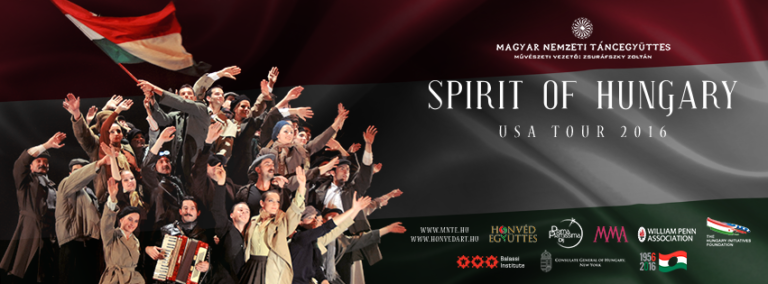
SPIRIT OF HUNGARY – North American Tour – Cleveland proximity shows

Dear Friends in the Cleveland Area – the SPIRIT OF HUNGARY will not visit Cleveland on the 2016 Tour, but for enthusiast of Hungarian folkdance may decide to travel 2 or 3 hour to see the show. If you are one of those, here is the information.
Visit: www.facebook.com/thespiritofhungary

thespiritofhungary

Presented by the Hungarian organizations of Buffalo, Rochester and Niagara Falls
Saturday, October 15, 2016 at 7 PM
Riverside Institute of Technology
51 Ontario Str. Buffalo, NY 14207
Tickets: $ 25 [General Seating], children under 12 – $ 10
Purchase tickets online: www.ticketcentral.com or call: 1-212-279-4200
Tickets info locally: 716-837-1942 or 716-648-7228
Info: magyar@magyar.org or spiritofhungary@gmail.com

&&&&&&&&&&&&&&&&&&

Presented by the Hungarian Club of Toledo
Tuesday, October 18, 2016 at 7 PM

Ohio Theatre and Event Center
3114 Lagrange Street, Toledo, OH, 43608
Tickets: $ 25 advanced or $ 30 at the door [General Seating]
Purchase tickets at: www.ticketcentral.com or 1-212-279-4200
At the Hungarian Club: 224 Paine Ave. Toledo – T: 419-698-5195
Info: magyar@magyar.org or spiritofhungary@gmail.com
The performance is sponsored by The Hungary Initiatives Foundation of Washington DC

&&&&&&&&&&&&&&

Presented by William Penn Association and Bethlen Communities
Friday, October 21, 2016 at 7 PM
West Mifflin Area Middle School Auditorium
81 Commonwealth Ave. West Mifflin, PA 15122
Tickets: $25 + service fee [Reserved Seating], Children under 12 – $10 + service fee
To purchase tickets please visit: https://www.talentshadows.events/p/ensembles
For information call: 724-238-2235 or 800-848-7366 ext: 149
Email: magyar@magyar.org or spiritofhungary@gmail.com
The performance is sponsored by The Hungary Initiatives Foundation of Washington DC

Visit: https://www.facebook.com/thespiritofhungary/

qnhmtod

Reklám
Tas J Nadas, Esq

MEMORIAL EXHIBIT: 60th ANNIVERSARY OF THE HUNGARIAN REVOLUTION

JCU will once again be the site for a Memorial Exhibit of Images for the 60th Anniversary of the Hungarian Revolution. JCU hosted a similar exhibit in 2006 for the 50th anniversary as well. The exhibit will be held in the atrium of Grasselli Library from Sunday, October 16 through Saturday, October 30, 2016. The exhibit is hosted by Grasselli Library and the Hungarian Association, which is an international cultural and literary organization based in Cleveland, Ohio, and with the generous financial support of the Hungarian Initiatives Foundation based in Washington, DC. On Sunday, October 16, starting at 2 pm everyone is cordially invited to attend the opening reception, followed by film viewings in the Mackin Room.  This event and exhibit will celebrate the courage of the Hungarian people and in remembrance of this nation which dared to take on the huge Soviet Empire in search of freedom and human dignity.

The Sunday October 16 exhibit opening will be followed by a viewing of the film, “PLAY YOUR OWN GAME.” The events of the 1956 Hungarian Revolution intertwined with the life of the reigning soccer star Ferenc Puskás give new meaning to the bloody revolt that cracked the myth of communist ideology. Through archival footage, director Ferenc Török portrays the power of the human spirit that ignited the uprising of the Hungarian people against the evil and hugely oppressive communist Soviet empire. It will be followed by the 2007 award winning film, “FREEDOM DANCE” (animated documentary, intercutting original character driven animation w/ recorded interviews and photos). FREEDOM DANCE is the story of a young artist and his newly wedded wife, Edward and Judy Hilbert, literally running for their lives – on foot, by truck, by bus, by train and by boat – on a gutsy and determined quest for personal independence. The film chronicles the four months they spent escaping the ruthless control of Communist Hungary during and post 1956 Hungarian Revolution.

The Hungarian Revolution of 1956

The twentieth century was filled with tragedies but the Hungarian Revolution of 1956 stands out as one of the most poignant. It was a nationwide revolt against the government of its Soviet-imposed policies, lasting from 23 October until 10 November 1956. What had led up to it was that after the end of World War II, Russian troops occupied Hungary and they had no plans of ever leaving. Shortly thereafter, Hungarians had been coerced into signing a mutual assistance treaty with the Soviet Union. Thus after Germany’s defeat in WW II, the Soviet Union imposed a communist dictatorship on Hungary (and other Eastern block countries as well).

The Hungarian Revolution actually began as a student demonstration, which attracted thousands as they marched through central Budapest to the Parliament building, calling out on the streets using a van with loudspeakers via Radio Free Europe. A student delegation, entering the radio building to try to broadcast the students’ demands, but was detained. When the delegation’s release was demanded by the demonstrators outside, they were fired upon by the State’s Secret Security Police from within the building. One student died and was wrapped in a flag and held above the crowd.

The revolt spread quickly across Hungary and the government collapsed. A new government formally disbanded the Secret Police, declared its intention to withdraw from the Warsaw Pact (= a treaty among the Soviet Union and seven other Soviet satellite states in Central and Eastern Europe in existence during the Cold War), and pledged to re-establish free elections. By the end of October 1956, fighting had almost stopped and a sense of normality began to return.

But the defeat of the Hungarian revolution was one of the darkest moments of the Cold War. At certain points since its outbreak on October 23, the revolution had looked like it was on the verge of an amazing triumph. The entire nation had appeared to have taken up arms against the regime. Rebels, often armed with nothing more than kitchen implements and gasoline, were disabling Soviet tanks and achieving other — sometimes small but meaningful — victories throughout the country.

After announcing a willingness to negotiate a withdrawal of Soviet forces, the Soviet Union, tragically, and unbeknownst to anyone outside the Kremlin, completely reversed itself and decided to put a final, violent end to the rebellion and moved to crush the revolution. On November 4, 1956, a large Soviet force invaded Budapest and other regions of the country. The Hungarian resistance continued until 10 November 1956. Over 2,500 Hungarians and 700 Soviet troops were killed in the conflict, and 200,000 Hungarians fled as refugees. Mass arrests and denunciations continued for months thereafter. By January 1957, the new Soviet-installed government had suppressed all public opposition.

Public discussion about this revolution was suppressed in Hungary for more than 30 years. Since the thaw of the 1980s, it has been a subject of intense study and debate. At the inauguration of the Third Hungarian Republic in 1989, 23 October was declared a national holiday.

Source: Carroll News / Dr. Martha Pereszlenyi-Pinter, CMLC chairperson

1956-memorial-exhibit-sepia-4

Reklám

Tas J Nadas, Esq

Hungary records historic first ever international win

    In only its third international game ever, Team Hungary pulled off the upset of the year by beating a Polish squad which had pushed two of Europe’s best – Sweden and Denmark – to the limits in the last month. The game, played in Szekesfehrvar, Hungary, at the first American football specific stadium in the country, attracted a crowd of 2,600 delighted Hungarian fans.

    For much of the game, Poland held the advantage due to its experience. Team Poland has played six games over the last 12 months while this was the third game ever for the Hungariannational team.

    But Team Hungary finally made their intentions known when it counted late in the contest.

    Poland scored in the first half on a touchdowns by Jacek Wroblewski and Karol Zak. Adam Nelipa kicked a field goal as well. Hungary’s Ferenc Baksa added a 51-yard field goal for the host team.

    Down 16-3 early in the fourth quarter, Hungarian receiver Márton Czirók and quarterback Márk Bencsics began to connect. Bencsics found Czirók two times giving Hungarya 17-16 lead midway through the period.

    hungary-hungary-poland-2016-8

    Then, after Polish quarterback Bartosz Dziedzic found Tomasz Zubryckiego for a 26 yard touchdown, restoring the Polish lead, 22-17, Hungary struck again.

    This time Bencsics threw a 31 yard touchdown strike to Balazs Szabolcska, with little time remaining, shocking Poland and giving Hungary its first ever international victory.

    Hungarian national team head coach Vilmos Gratz:

    The key to success was to let everyone work. The match also proved that I am surrounded by very good professionals, coordinators and players. The improved performance in the second half is due to our offensive and defensive coordinators. This was truly a team victory. We have begun to believe in ourselves and I am very proud of this team.?

    Hungary’s next game will be against Belgium on October 29. Meanwhile, Team Poland will faceHolland’s Dutch Lions October 8 in Poland.


    Source: americanfootballinternational.com

    Reklám
    Tas J Nadas, Esq

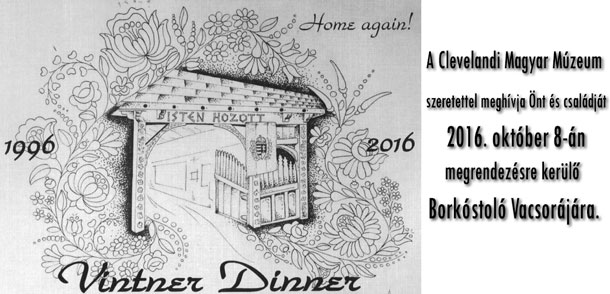
    Vintner Dinner 2016

    muzeummeghivo

    Reklám
    Tas J Nadas, Esq