
Home Blog Page 37

The First Country to Officially Defend Christians Persecuted by ISIS

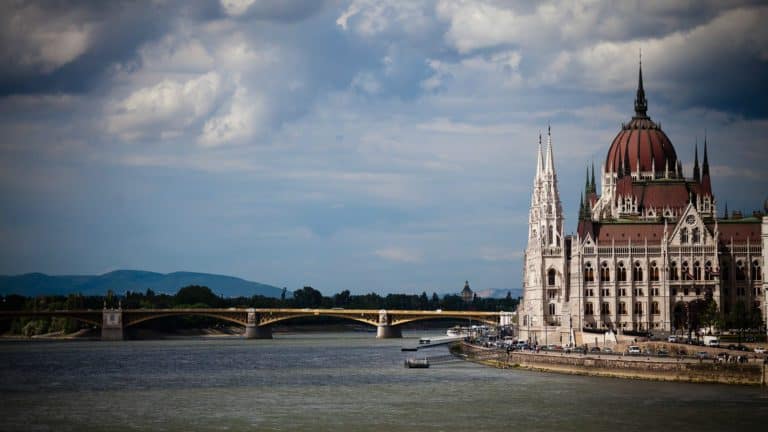
hun_parlament

This week, Hungary, which has during the past year come under pressure for its handling of Europe’s mass migration crisis, has become the first government to open an office specifically to address the persecution of Christians in the Middle East and Europe.

“Today, Christianity has become the most persecuted religion, where out of five people killed [for] religious reasons, four of them are Christians,” Catholic News Agency (CNA) quoted Hungary’s Minister for Human Resources, Zoltan Balog, as saying. “In 81 countries around the world, Christians are persecuted, and 200 million Christians live in areas where they are discriminated against. Millions of Christian lives are threatened by followers of radical religious ideologies.”

[Editor’s note: Canada’s attempt at an office of international religious freedom, modeled on the American version, shut down after only three years.]

The move sets a precedent on the international stage. It comes after Hungary’s right-wing prime minister, Victor Orban, drew criticism in the EU by saying Europe should focus on helping Christians before helping millions of Muslims coming into Europe.

“If we really want to help, we should help where the real problem is. … We should first help the Christian people before Islamic people,” Orban said.

Orban’s government has campaigned against an EU plan to spread some of the burden of the influx of migrants and refugees by requiring member states to accept quotas. Orban has called for a referendum on October 2 at which voters are expected to back the government and reject any future quotas.

He said that Europe is divided between an “EU elite” and those, like him, who want to hold on to Europe’s Christian roots.

“The political war based on the topic of migration is a great opportunity for both parties,” Orban said. “[The elite] know that Muslims will never vote for a party with Christian roots, so with the huge volume of Muslims, the conservative parties will be crowded out of power. But this war is also a great opportunity for the supporters of the nation-states with Christian roots.”

Many of the 1.5 million refugees who have fled to Germany since the country announced its “open door” policy in 2015 traveled through “the Balkan route,” though Hungary has now erected a fence on its southern borders with Serbia and Croatia.

Hungary’s new office will have a starting budget of $3.35 million with which to help persecuted Christians, to raise international awareness of their “untenable situation,” and to coordinate humanitarian efforts, Balog said. (Canada’s office had $5 million.)

In Iraq, a Christian population estimated at more than a million before the 2003 war—and considerably more prior to that—today stands at less than 300,000. Many displaced from Iraq’s Nineveh Plains after the 2014 ISIS offensive currently seek a permanent home in the West.

In Syria, a similar situation has developed since the country’s civil war started five years ago. Other countries in the region have seen a hemorrhaging of indigenous Christianity with the resurgence of Islam as a political ideology since the last century.

Iraq ranks second and Syria is fifth on Open Doors’ 2016 World Watch List, a list of 50 countries where Christians come under the most pressure. Almost 40 of the 50 countries are majority Muslim or have Islamist non-state actors (e.g. militias) at work.

The Hungarian government will spend the coming weeks working out the exact duties of the new department, though it will have a primarily humanitarian focus, said Eduard von Habsburg, the Hungarian ambassador to the Holy See.

The decision to launch the new department came after Orban and Balog traveled to Rome in August to meet Pope Francis. Orban and Balog, respectively a Protestant layman and a Calvinist pastor, were the only non-Catholic members of the group whom Pope Francis received in a private audience in August.

Von Habsburg said that government officials’ interactions with leading European churchmen and with the patriarchs of the Middle East contributed to the decision to form the agency.

Part of the reason for going public with the initiative now is to set an example for other European nations.

“Somehow the idea of defending Christians has acquired a bad taste in Europe, as if it means excluding other people,” von Habsburg said. The Hungarian initiative is intended to show it doesn’t have to be that way, Catholic news sources reported.

“Our interest not only lies in the Middle East but in forms of discrimination and persecution of Christians all over the world,” Balog said. “It is therefore to be expected that we will keep a vigilant eye on the more subtle forms of persecutions within European borders.”

Source: christianitytoday.com / Support our work. Subscribe to CT and get one year free.

Reklám
Tas J Nadas, Esq

Dear Friends of the Cleveland Hungarian Museum,


meghivo

This year, we are returning to the Galleria, the home of our Museum with our Vintner Dinner, for its twentieth anniversary. The date is October 8, 2016, per our Invitation, that we hope you have received. As you know, this traditional event is the occasion where all of our friends can meet in a friendly atmosphere and enjoy each other’s company. Every year we try to do our best to please our guests, primarily with our special wine selections. What is special this year is our dinner menu.  We were invited to taste the three entrees offered, and all of them were exceptionally great.

No more salmon!  But, the Crab-Stuffed Lemon Sole is exquisite!  The Chicken Wellington is not just chicken, it is a culinary experience! The slow-roasted rib-eye melts in your mouth, incredibly seasoned!  No kidding! I am constantly changing my mind, which of the three to choose. Oh, and all this is topped with a great selection of old recipe Hungarian desserts.

Add the five carefully chosen Hungarian wines – the first one  served at the cocktail hour to tingle your palate – and four more complementing our dinner,  your dining pleasure will be completely satisfied.

All this, while the well known Harmonia is entertaining us with music and a short after dinner concert.

This event is also an occasion where you can show your support, that is so necessary for our future. Half of your ticket price and all of your donations – in case you cannot attend – serves that future. That future is important, because we are now the only remaining Hungarian museum open to the public in the entire United States.

If you already sent in your reservation for the 2016 Vintner Dinner, consider yourself lucky as space is limited at Sausalito! With two weeks left we are already past the half way mark. So please do not delay any longer, mail in your reservations today.

By now you have received the invitation, so you know we are honoring two young people for their super accomplishments, Andrea Rice Lauer and Réka Pigniczky. We are also honored that Hungary’s Consul General in Chicago, Hon. Ferenc Szebényi accepted our invitation.

All of this promising to be one of your best dinner parties of the year! We will be talking on the Hungarian radio programs, Kapossi and Bocskai this Sunday afternoon. Be sure to listen in. Hope to see you at the Vintner Dinner!

Susan Szappanos
Chair of the Dinner Committee

P.S. We have mailed formal invitations to all recipients of this email. If you have not received one, please let us know by return email. Your address may not be up-to-date on our list.

vitner

Reklám
Tas J Nadas, Esq

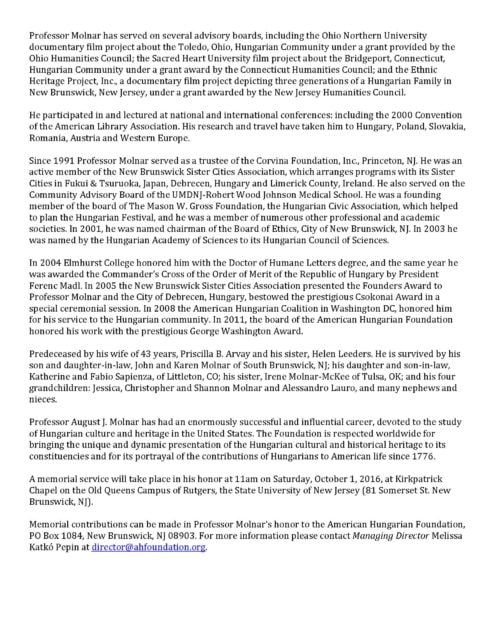
In Memoriam: August J. Molnar

AJM press release_Page_1

AJM press release_Page_2


Reklám
Tas J Nadas, Esq

Hungary Letter: Steppe festival celebrates mysterious origins

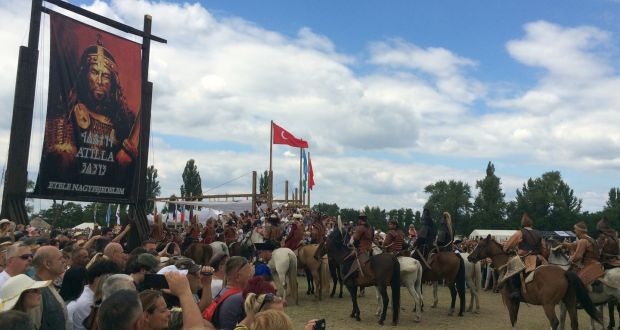
A portrait of Attila the Hun watches over Hungary’s Kurultaj festival of ancient Turkic cultures and traditions. Photograph: Daniel McLaughlin

Every second summer, the outskirts of the village of Bugac resound to beating drums, whipcracks, traditional Turkic music and the rumble of galloping hooves as people and horses gather in the dusty steppe of central Hungary.

Many come clad as if ready for medieval battle, in leather and metal armour and wielding swords and shields, while others carry banners and strike resonant metal “singing” bowls that bear strange runic symbols.

They are here for Kurultaj, billed as “a tribal assembly of the Hun-Turkic nations, a celebration of the preservation of (their) ancient traditions”, which last weekend drew more than 250,000 people from as far apart as the Balkans, the Caucasus and central Asia.

Groups representing some 27 nations re-enacted battles and performed displays of everything from horsemanship, hand-to-hand combat and archery, to folk singing, dancing and shamanic fire and drumming rituals.

A bare earth arena, where the mock fights and high-speed horseback shows took place, was flanked by the bright flags of all nations present and yurts, stages and stalls, all presided over by huge portraits of a glowering Attila the Hun.

“We’ve been here several times and it’s a great event,” said Petar Vladov, a Bulgarian in a purple, red and gold tunic, whose sword-carrying friend wore an animal skin draped over his head and bare torso.

Reihan and Fazana, two ethnic Uzbeks from Germany, wandered through the throng with their three young children, who wore leather jerkins trimmed with fur and carried small bows slung over their shoulders.

“We’ve been to Kurultaj before as well,” said Reihan. “Our husbands are demonstrating how ancient Turkic tribes used to fight.”

The vast majority of visitors were Hungarians however, and Kurultaj is inspired by a theory that their ancestors – the Magyar – originated in central Asia and have deep historical, cultural or even genetic links to other nations from that region.

The Magyar settled in Europe in the late ninth century, more than 400 years after Attila’s death had triggered the collapse of Hun control over a swathe of central and eastern Europe.

In Hungarian myth and folklore, however, the idea persisted that the Magyars were descendants of the Huns, a theory that helped explain a language and some cultural traits that share little with those of their Slavic neighbours.

This movement, known as Turanism, gained popularity in the 19th century as Hungarians sought to break from the Germanic Habsburg empire and resist rising pan-Slavism across central Europe and the Balkans.

Turanism implied Hungary had a host of ancient and “natural” eastern allies in the Turkic world, and linked its people to the epic figure of Attila, whose feats vastly outshone those of the obscure Siberian tribes that the rival “Finno-Ugric” theory held to be the Hungarians’ ancestors.

Turanism also highlighted how parts of Hungarian society had long fared better with the Muslim Ottomans than the Catholic Austrians.

Stark contrast

In the 16th and 17th centuries, Hungarian protestants living under Ottoman rule in Transylvania enjoyed great religious freedom, in stark contrast to the persecution suffered by their co-believers in Habsburg lands.

After Hungary fought for independence from the Habsburgs in 1848-9, several senior revolutionaries and their soldiers found refuge in the Ottoman empire; during the 1912-13 Balkan wars some Ottoman troops fled to Hungary, and in the subsequent first World War the Ottomans and Austria-Hungary were allies.

Belief in a lost but glorious eastern past – and hostility to Israel and to liberal US and European powers which it sees as Hungary’s perpetual oppressors – even wove a surprising pro-Muslim thread through Hungary’s far-right Jobbik party.

That thread snapped with Europe’s refugee crisis last year, which saw Jobbik follow the hardline anti-immigration policy of Hungary’s populist prime minister Viktor Orban.

While calling refugees and migrants from the Islamic world a threat to Europe’s security and identity, however, Orban is still pursuing an economic “eastern opening” to boost Hungary’s trade with the Middle East and other regions.

And while sponsoring lurid billboards and radio announcements warning of the dangers posed by the mostly Muslim asylum seekers, Orban’s government also funds Kurultaj alongside Muslim states like Turkey and Azerbaijan.

“Kurultaj is about a time before Christianity and Islam, when the Huns and the Turkic peoples were pagan brothers,” said Szabolcs Molnar from near Budapest, who wore a traditional Hungarian embroidered shirt, baggy black trousers and a fur-trimmed felt hat.

“Now, in this time of trouble, it’s good to remember where we all come from, and the ancient things we have in common.”

Source: irishtimes.com

Reklám
Tas J Nadas, Esq

Feature film about Márton Áron

Marton_Aron


Dear Hungarian Americans!

The leadership of the Magyar Club of Dayton, Ohio, accepted the request of Reverend Laszlo Papp, Pastor of the Roman Catholic Parish in Marosvásárhely (Targu-Mures) to conduct a  fundraising to contribute to the cost of the feature film of the life of Bishop Marton Aron. (See details on www.martonaronfilm.ro)

The President of the Magyar Club, Michele La Flame has formed a four member committee to target Hungarian organizations, churches and individuals for donations. The Marton Aron Fund Committee is authorized to raise funds until December 31, 2016 and then to transfer the collection to Transylvania (See www.mustarmag.info). The Film was originally proposed by college students, who are members of the Mustarmag Association. Kindly make checks payable to the Magyar Club of Dayton with a memo indicating Marton Aron Fund and mail it to Magyar Club of Dayton c/o Thecla Batin, Treasurer, 7130 Cotton Wood Road, Celina, Ohio 45822.

The Committee thanks you for your donation,

Reklám
Tas J Nadas, Esq

THE HUNGARIAN PUMI ACKNOWLEDGED IN THE USA

pumik-600x400

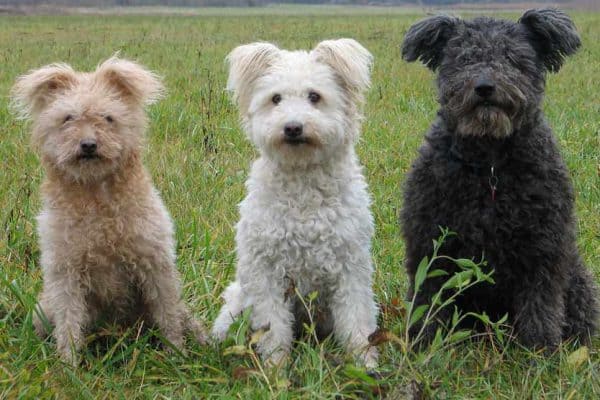
According to 24.hu, the indigenous Hungarian herding dog got into the oldest American breed register in the 190th place. After this decision, Pumis can compete at the most famous American dog-show, at the event Westminster Kennel Club.

The short, curly furred, floppy eared Pumi is very docile, alert and cobby. The dogs, weighing around 9-13 kilos, were used for the herding of cattle, sheep flocks and swine herds for centuries in Hungary. It’s the cousin of the Puli, which has been acknowledged by the American Kennel Club previously.

The president of the Hungarian Pumi Cub in America thinks that this dog is not for those “who sit around all day and watch the television”. Chris Levy has been working on the spread of the breed in the US for many years. He said that Pumis are doing great at skill tests, dog sports and even guard rabbits, chickens, goats and cats in America.

A breed needs to have at least 300 individuals and needs to live up to the requirements of AKC in order to get listed in its register. Two other breeds, the American Hairless Terrier and the Arabian Greyhound were registered in January, so they will also be present at the dog-show in February.

A few days ago the Hungaricum Committee decided to add the Hungarian herder and hunter dog breeds, thus the Pumi, as well, to the list of the Hungarian Valuables.

Photo: www.kutyafajtak.hu,

Copy editor: bm

Source: dailynewshungary.com

Reklám
Tas J Nadas, Esq

Brexit strips world’s 400 richest people of $127bn – Bloomberg

Brexit-caused losses of the world’s 400 richest people amounted to an eye- watering $USD127.4 billion in a single day, Bloomberg estimates. Rich Britons have lost a “mere” $5.5 billion, according to reports.

576e5b52c3618880178b4579
© Russell Boyce / Reuters

The British voters’ decision to leave the European Union caused profound ripples in all major global equity markets.

The Brexit vote has sent European markets into the steepest decline since 2008. The pound plummeted to a record low, not seen since Margaret Thatcher was prime minister some 30 years ago.

The Bloomberg Billionaires Index says billionaires lost 3.2 percent of their total net worth, now estimated at $3.9 trillion.

The worst losses among European billionaires were suffered by Amancio Ortega, Europe’s richest person, who hemorrhaged $6 billion. Many other mega rich individuals took a massive hit, including Bill Gates and Amazon magnate Jeff Bezos, who lost over $1 billion each.

Britain’s wealthiest person Gerald Cavendish Grosvenor dropped more than $1 billion. However, for the UK’s wealthiest Brexit was surprisingly less devastating than for others in the billionaire class. Altogether, Britain’s 15 richest people lost “only” $5.5 billion.

British co-founder of stockbroker Hargreaves Lansdown, Peter Hargreaves, lost the most, seeing his fortune shrink by 19 percent to US$2.9 billion.

In a major irony, Hargreaves was the largest donor to the Leave campaign, donating £3.2 million, according to the UK’s Electoral Commission.

Hargreaves has shown no regret, and says he is ready to work with the British government to shape the nation’s economic future once the country stops being an EU member state.

“I have enormous experience of business, enormous experience of negotiation, enormous experience of economics, and I’m one of Britain’s most successful businessmen,” Hargreaves said. “If they don’t involve me, they’re crazy.”

Richard Branson, a vocal advocate of the UK staying with the EU, has made peace with the decision of the majority, stressing that the British people’s“determination, resolve and sense of what is right” would be necessary “over the testing months and years to come.”

The richest person in South Africa, Christo Wiese, who has vast investments in the UK economy, believes the current crisis doesn’t mean the end of the EU.

“I think it’s the end of [the] EU as it’s currently structured,” the Stuff cited Wiese as saying. “It’s always had unattractive features alongside its attractive features. This will make people sit up and say how can we make it better,” Wiese said.

Source: rt.com

Reklám
Tas J Nadas, Esq

Objects of Freedom

ObjectofFreedomflyer 56

Reklám
Tas J Nadas, Esq

We are together, we are one

KiralyFranciska

Here’s my synopsis from our recent trip… I left out so many details but this sums up my general feelings:

Those who were sitting, scrambled to their feet. Everyone stood up straight, hands crossed or at their side. Flags and banners waved in the breeze and the murmur of the crowd hushed as the music began.

I turned around slowly, trying to take in the moment. A sea of people extending over the hill in every direction – from parents with infants to the very old; from various countries, backgrounds and life events – all so different, yet all united here. Here, in this moment, as we began to sing “Isten aldd meg a Magyart,” our Hungarian national anthem, we were one.

The shared pride was almost tangible, the words floated with the breeze, connecting those on the altar with those on the hillside and reaching those up between the trees far atop the hill.

My voice quivered while tears ran down my cheek, as I realized “I am here.” Here, where so many Hungarians have come to express their faith in God, their trust in the Virgin Mary and the pride in their Hungarian heritage. Just as a picture cannot take in the full experience, neither can the words I use. All I can say is – if you have the chance to go – Go!

Fr. Andras did an amazing job of organizing our trip and filling it with so many historical sites, experiences, delicious foods, and great hospitality that it would take a book to tell you everything we experienced.

We all met up on the Wednesday before the pilgrimage day in Budapest and got aboard our bus and headed east to see the Balaton lake, making a stop at the picturesque Tihany, then Keszthely and the Festetics palace with a final destination of Veszprem. Although I can’t describe each destination in detail, let me just say that warm hospitality awaited us everywhere – palinka and homemade baked goods to nibble on were offered at every spot along the trip.

The next day we headed across Hungary into Romania, and over two days we saw the former Hungarian cities of Nagyvarad, Kolozsvar, Marosvasarhely, Gyergyoszentmiklos and Ditro all before the Csiksomlyoi Bucsu. There is so much history in each of these cities. Also, Fr. Andras was able to celebrate mass almost daily in the historic churches of the cities in which we stayed. We saw many beautiful churches and met many welcoming priests who educated us on their churches and towns and we had the opportunity to meet multiple bishops along the way. We wrapped up the second leg of the trip with visits to the cities of Korond, Szekelyudvarhely, Segesvar, Brasso, Nagyszeben, Gyulafehervar, Vajdahunyad Castle, Temesvar, Arad and ended up in Szeged for a final delicious meal together – halászlé and túrós csúsza – before heading back to Budapest and ready for a nap!

So what is this “Csiksomlyoi Bucsu?” It’s a pilgrimage that has been important especially to Hungarian Catholics but has recently expanded to all Hungarians who use this as an opportunity to show their solidarity, especially with those Hungarians living outside of the formal Hungarian border. Csiksomlyo has been a Catholic pilgrimage site since the 1500s dedicated to the Virgin Mary. With the fall of communism in the 90s, hundreds of thousands of Hungarians make their way to the site every year. It is held on the weekend of Pentecost, with the main pilgrimage day being Saturday.

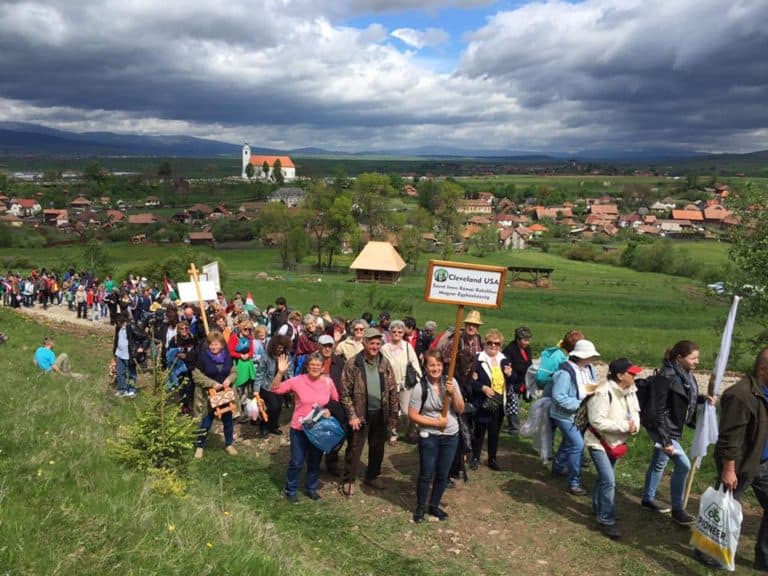
On the day of the pilgrimage, we boarded the bus and hit the road early in the morning knowing that foot traffic would be plentiful. As we neared the town, we noticed more and more pedestrians walking alongside the road, horse drawn wagons filled with people often dressed in traditional Szekely clothing, groups walking with banners and signs detailing the city of their origin and how far they walked – all with smiles on their faces, singing songs and waving as we drove past. There were Hungarian flags on the gates of homes in the villages and a general feeling of openness and welcoming from the town’s people who stood at their doors or waved from their windows.

We had to park the bus at a distance and everyone walked a few miles to get to the church. The church bells rang, welcoming all and calling us in, as long lines of people continued to pour into the town. Making our way through the town we then followed the streams of people up over the steep hill taking a break to catch our breath and look at the crowds in front of us and those who kept coming from behind. We made our way to the top of the hill and positioned ourselves within site of the altar and here we stayed for mass. To be surrounded by so many others who were all happy and smiling was a beautiful feeling. I was proud to carry our banner “St. Emeric Catholic Church, Cleveland USA” and in a way, say “yes, I know I’m not from here but I still feel like I belong.” And this was especially true when we sang the national anthems and a few other traditional songs before dispersing.

Once we were back out of town, we waited for the bus along the roadside and other groups continued to stroll by on their way home. A middle-age man stopped, peered up at the sign I was holding and asked “America? “I replied, “Yes.” In Hungarian he said, “I’m glad you came to be with us.” I replied in Hungarian, “We are together, we are one.” Looking back it may sound cheesy but I can’t explain the feeling I have in my heart now for my Hungarian brothers and sisters. There’s something about that place and that event – I don’t want it to sound superficial but the experience does change you if you let it.

The Hungarians living in Romania/ Transylvania call themselves “Szekelyek” or Szeklers and a significant portion of them live in the area we visited. It was strange, but as we ventured deeper into Romania going east (further from Hungary) – instead of diminishing, the Hungarian community and pride grew. One would think the opposite would happen, yet these people have held tight to their Hungarian history and culture. When we arrived in Ditro it was the most evident. I can’t even describe it – although I had never been there before, it felt like we were home. After the Csiksomlyoi Bucsu, we came back to Ditro for a community meal – we were greeted with children singing, lively young folk dancers, a delicious meal with live music and we danced the evening away. Though we were exhausted from walking all day, it was hard to leave the festivities that night.

Pentecost Sunday gave us another great opportunity to feel the outpouring of friendship from the Ditro community. Ditro is Fr. Andras’ home town and it was beautiful to watch him celebrate mass at home in a church filled with his family, friends and neighbors. Many ladies dressed in traditional folk costumes as well. After mass we were surprised and treated to a group of men and women in traditional costumes who danced and sang for us before our delicious lunch. We then went over to Fr. Andras’ childhood home – and again were treated to a band playing in the street and more traditional dancing which stopped the traffic while we watched in amazement at the quick footwork. His wonderful, sweet mom and siblings were waiting with dessert and beverages and again, welcomed us with open arms!

It was hard to leave so soon but the afternoon was filled with sights to see. We went to the Gyilkos lake – another place filled with history and myth, and we had the chance to walk through the Bekas Szoros – a beautiful narrow gorge excised by the Bekas river. Again, too beautiful for a picture or to put in words.

Going on this pilgrimage is something I have wanted to do since 2009 when I first learned of it. I am so thankful that I’ve had the opportunity to go – and as they say – once you’ve been there, you long to return. And I plan on it! I hope you’ll consider going as well.

Franciska Kiraly

Source: Facebook

Reklám
Tas J Nadas, Esq

A Pilgrimage in Harghita’s Csíksomlyó (Sumuleu Ciuc, Romania).

I’ve been stuck and working in Brasov for almost 3 weeks in miserable weather with little to no time to explore and photograph the area.  But it wasn’t for naught as I was gathering information from locals in places that might fly under the radar as a tourist destination (at least for Americans).  Monica, a soft-spoken receptionist at the hostel I’m staying at (Kismet Dao) suggested I contact her friend who knows places, Cornelius.  So when I got a message from Cornelius that there’s a massive Catholic Pilgrimage in Sumuleu Ciuc in Harghita County, I couldn’t resist but jump on a train and have the opportunity to witness and discover a pilgrimage in a place I’ve never heard of.

The train ride from Brasov Miercurea-Ciuc took approximately 1 hour and 45 minutes.  I was invited to stay Cornelius’ apartment which was a communist-era building from the eighties.  Walking around town, you can’t help but notice the stark contrast of the architecture.  You’ll see  old buildings mixed in with soviet era apartments.
Franciscan Monastery

Franciscan Monastery

After a quick tour of the town square, we met with Cornelius’ friend Eva, a beautiful woman with striking blue eyes, for dinner at San Gennaro Pizzeria.  Right off the bat, she proudly proclaimed that she’s Hungarian.  The pride in her voice echoes a connotation that deserves mention.

San Gennaro Pizzeria

San Gennaro Pizzeria

Harghita County sits in what used to be the extent of the Austro-Hungarian Empire in Transylvania.  After WWI, the empire started to disintegrate and the nationalities within wanted to proclaim their independence.  The Treaty of Versailles placed Transylvania under the sovereignty of Romania.  However during Nazi era, on August 1940, the second Vienna Award granted the northern half of Transylvania to Hungary but at the end of WWII, the territory was again returned to Romania.

Hungarian Flag

Hungarian Flag

The history here is deep and full of intrigue and probably enough to spin your head around in circles 6 times if you’re not into history.   It seems like a place ripe for conflict but that’s not what I’ve observed.  Inter-cultural tolerance seems to be what’s prevalent and I can sense this with my interactions with everyone I met in town.

Csíksomlyó Village

Csíksomlyó Village (Șumuleu Ciuc) is a neighborhood of Miercurea Ciuc, Harghita County, Romania. The Franciscan monastery of Csíksomlyó was founded 1442.

Csíksomlyó became a pilgrimage site in 1567 when a Hungarian King wanted to convert the Székely population to Protestantism, the Székelys resisted.  A battle took place in a field nearby on Saturday prior to Pentecost 1567 and the Székelys came out victorious.  The monks saw this as a sign of a blessing from the Virgin Mary and ever since then became a pilgrimage site.

Throughout the years, thousands of people from around the world, coming as far the United States and Australia, started to join the Harghita locals to pray for miracles and blessings from the Virgin Mary.  Even the president of Hungary, János Áder, was there to make an appearance (2016).

Masses In Sumuleu Ciuc

Masses In Sumuleu Ciuc

The masses of people ascending up the hill and gathering in droves is amazing to behold.  I estimated somewhere between 100,000 – 150,000 pilgrims making their way up the hill.  Cornelius told me that at one point, it was recorded that over 250,000 people showed up.

Pilgrims In Village

Pilgrims In Village

Pilgrims start their journey from villages far as 55km away waving banners and flags that represent their villages as they continue their march towards a steep hill, called the “Way of the Cross”, to gather pray at a wooden statue of the Virgin Mary.  The statue is purported to have caused hundreds of miracles and fulfilled wishes.   Besides its religious significance, the pilgrimage is communal event illustrating the spiritual unity of Hungarians living in Transylvania.

Masses Of Pilgrims

Masses Of Pilgrims


Pilgrims Ascending Up The Hill

Pilgrims Ascending Up The Hill

The area is lush with rolling green hills where old villages can be seen over the horizon.  It’s also well known for its mineral springs and spas.  There’s a natural running mineral water source deep from within the earth that you can drink and purported to have health benefits. It tastes quite unique, like carbonated mineral water only with more iron.

Pilgrims Marching

Pilgrims Marching

The pilgrimage is more or less a festival with various craftsmen and artisans selling Hungarian wares on the way. Several vendors are selling Hungarian dishes such as Kürtőskalács, Goulash, Langos, and various cured and barbecued meats.  Some hardcore pilgrims extend their stay by spending a night in the Church and some make their way to the former border of the Austro-Hungarian Empire in Transylvania. In fact, there’s a special train, carrying pilgrims, that departs from Hungary to the last train station in Ghimeș, built by the Austro-Hungarian empire.   Upon arrival, the pilgrims continue their walk towards the border for more celebration.

Source: alwayswanderlust.com

Reklám
Tas J Nadas, Esq

We make a traditional Hungarian dish!

We’re hungry for Hungarian food! Krisztina Ponti from Balaton Restaurant stopped by our kitchen to make a traditional Hungarian Beef Goulash. Take a look at our video clips for her recipe!

You can find Balaton Restaurant on Shaker Square in Cleveland.

www.balaton-restaurant.com

Source: fox8.com

Reklám
Tas J Nadas, Esq

Annual Gala Dinner Honors Dr. János Martonyi

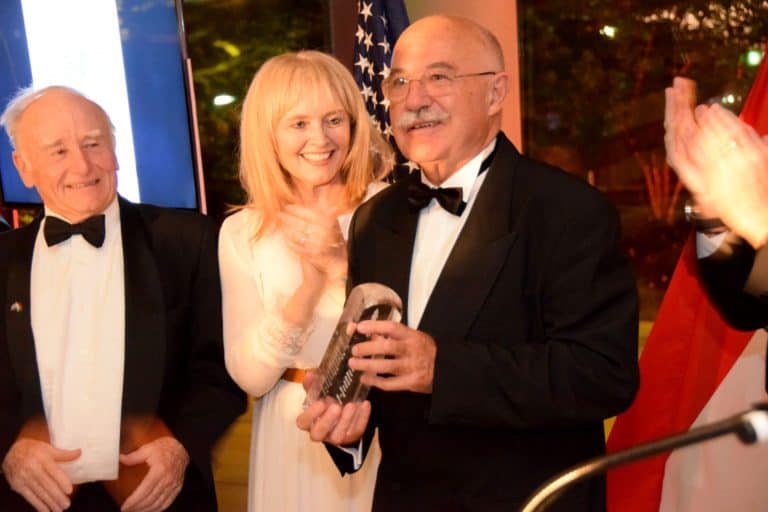
Washington, DC – On May 3, 2016, the Hungarian American Coalition (Coalition) honored Dr. János Martonyi, Hungary’s former Minister of Foreign Affairs, at its 12th annual Gala Dinner. This year’s Gala also marked the 25th anniversary of the Coalition, which was founded in 1991 to provide advocacy and community leadership.

His Excellency János Áder, President of Hungary, was Honorary Chairman of the event, held at the House of Sweden in Washington.

Coalition Vice President Andrea Lauer Rice welcomed the distinguished guests, including Dr. János Martonyi, and his wife Dr. Rozália Rábai; Governor George Pataki, Gala Co-Chair; Co-Chairs Ambassador Richard Swett and Dr. Katrina Lantos Swett, Chairman of the Lantos Foundation for Human Rights and Justice; Ambassador George Herbert Walker and Mrs. Carol Walker; Ambassador Réka Szemerkényi, Hungary’s Ambassador to the United States; Mr. Sunil Sabwarhal, Alternate U.S. Executive Director, IMF and Mrs. Gabrielle Tabori Sabwarhal; Ambassador Thomas Robertson and Mrs. Antoinette Robertson; Mrs. Annette Lantos Tillemann-Dick and her daughter Mercina Tillemann-Dick; Mr. David Kostelancik, the incoming DCM of the US Embassy in Hungary; Ms. Karyn Posner-Mullen, former Counselor for Public Affairs at the US Embassy in Hungary; and Dr. Lee Edwards, Chairman of the Victims of Communism Memorial Foundation.

Other prominent guests included: Mrs. Edith Lauer, Chair Emerita of the Coalition, and Mr. John Lauer; Mr. Stefan and Mrs. Erika Fedor, founders of the Washington Hungarian Heritage House; Mr. and Mrs. Blaise Pasztory; Mrs. Enikő Basa Molnár, Executive Director of the American Hungarian Educators Association and the Coalition interns’ guardian angel.  Also in attendance were Coalition board members Zsolt Szekeres, Treasurer; Mrs. Anne Bader; Mr. László Böjtös, Honorary Consul of Cleveland and Mrs. Georgianna Böjtös; Mr. László Hámos, President of the US Section of the Diaspora Council and the Hungarian Human Rights Foundation; Mr. Leslie Megyeri; Mr. George Pogan, Coalition Secretary and Mrs. Sandy Pogan; Mr. Tibor Purger, the Coalition’s Head of Communications; Mr. Gabe Rozsa, Chairman of the Kossuth Foundation; and Mr. Julius Varallyay.

Many Embassy of Hungary staff were also in attendance: Ms. Krisztina Osvát, Counselor in charge of outreach to the Hungarian American community; Ms. Dorottya Mártonffy-Nagy, Commercial and Economic Attaché; Mr. Ferenc Kalmár, Third Secretary, Political-Military Affairs; Ms. Anita Demeter, Consul; Brigadier General Zsolt Sándor, Defense, Military and Air Attaché; and Mr. Péter Rada, Third Secretary, Congressional Liaison Officer.

DSC_5136

In her welcoming remarks, Mrs. Lauer Rice emphasized that 2016 marks not only the Coalition’s 25th anniversary, but is also the 60th anniversary of the 1956 Hungarian Revolution, which shaped the lives, passion and contributions of so many Coalition founders.  After presenting a capsule history of the Coalition in statistics, Mrs. Lauer Rice thanked everyone who has worked with and supported the Coalition in its efforts to strengthen the US-Hungary relationship.

Mrs. Lauer Rice reported on the latest developments of the Coalition’s Memory Project initiative, launched earlier this year by Mrs. Lauer Rice and Réka Pigniczky, Coalition member and award-winning documentary filmmaker. The Memory Project commemorates and celebrates the spirit of 1956 through video interviews with Hungarian-Americans who were witnesses and participants in the 1956 events. The Memory Project, with its latest work in the D.C. area, has just completed its 66th interview.

Following Mrs. Lauer Rice’s remarks, Ambassador Réka Szemerkényi highlighted the major achievements of the Coalition, including its role in Hungary’s NATO accession; the successful negotiation of the Visa Waiver Program; and its ongoing educational programs.  The Coalition, Ambassador Szemerkényi said, “has been a major strategic asset for successive Ambassadors, that is, to have friends like you helping to advance Hungary’s national interests here in Washington.  This has taken many forms over the years, but one thing has remained constant: we could always count on the support of the Coalition.”

Ambassador Szemerkényi praised Dr. János Martonyi, the Coalition’s honoree, as a true European and an Atlanticist whose leadership and policy decisions have always exuded a confident certainty of Hungary’s place in the world as a member of the democratic European family of nations in a strong alliance with the United States.

In his remarks following dinner, Coalition President Max Teleki introduced Dr. Martonyi, highlighting his commitment to Hungary’s accession to the European Union, NATO and other Western democratic institutions.  A short video interview with Dr. Martonyi was shown (the video is available on the Coalition’s home page).

In accepting the award, Dr. Martonyi said that among the many recognitions he has received in his career as civil servant, this award was the most meaningful, because it comes from those who share his commitment to ensure that all Hungarians dispersed throughout the world are part of a free and sovereign Hungarian nation.

Source: www.hacusa.org

Reklám
Tas J Nadas, Esq

Gusztáv J. Veres Obituary


Gus1Gus2

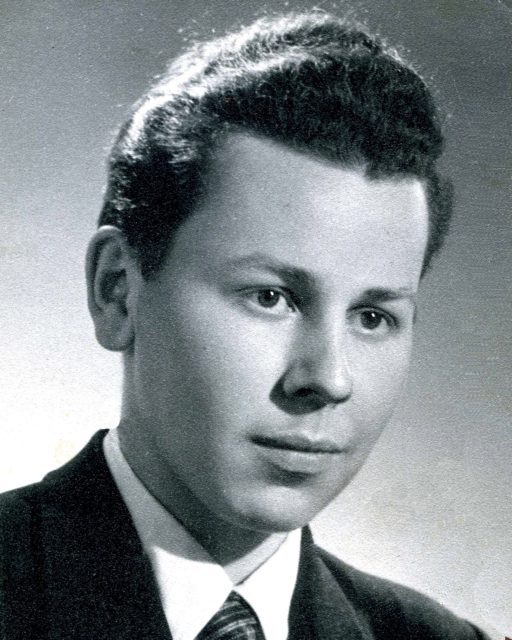
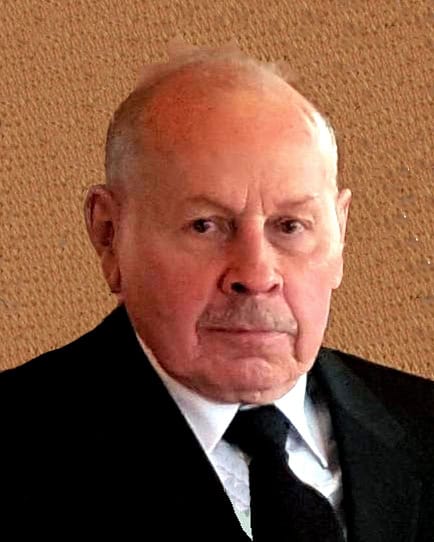
Gustáv passed away unexpectedly in his sleep on April 21, 2016. He is the brother of the late Ilona Kreeger Veres (1954 – 2016),  and is survived by his brothers László (Baltimore, MD) and Joseph P. (Anita) (Middleburg Heights, OH); his nephew Eric A. Veres; and his nieces Lili O. and Júlia A. Veres.

The funeral services for Gusztáv will be held on May 7, 2016 at Bodnar – Mahoney Funeral Home on 3929 Lorain Rd, Cleveland, OH, and interment at Sunset Memorial Park, on Columbia Rd., 6265 Columbia Rd., North Olmsted, OH.

Biography

As an 18 year old student at the Budapest Academy of Fine Arts in 1956, Gusztáv took part in the peaceful demonstrations against the oppressive Communist Hungarian government, which ultimately led to the Hungarian Revolution against the Soviet terror and the military occupation of Hungary. After the Soviet army brutally crushed the popular uprising, Gusztáv with his parents and family of three younger siblings emigrated to Austria, where they lived for 2½ years. In 1959, the Catholic Charities sponsored his family to emigrate to Buffalo, New York, where he continued his higher education in fine arts at the University of Buffalo. After receiving a Bachelor of Fine Arts degree in 1962, Gusztáv launched his career in Buffalo, where he was an artist illustrator at several manufacturing and medical companies, as well as the Buffalo & Erie County Public Library until 1965.

In 1965 Gusztáv was appointed as an Artist – Illustrator and Visual Information Specialist in the Printed Material Department, at the United States Government Printing Office (GPO), in Washington, D. C. Throughout most of his 20+ years of working for the GPO, he was promoted to the highest level in the Printed Material Department, where he was the chief graphics designer of numerous U.S. government issued books, signs, charts, U.S. stamps, and Congressional certificates. He utilized his academic background in fine arts and  his artistic skills to produce  camera-ready proofs, often with custom elaborate hand painted caligraphic lettering, which became one of his numerous graphic design specialties. Some of his noteable achievements include the graphic design of the seal on the reverse side of the U.S. Bicentennial Passport. Gusztáv also produced the graphic design for the commemorative book that President Richard Nixon gave to Chairman Mao Tse Tung, during his historic trip to China.

In 1981 Gusztáv retired from the GPO due to an injury caused by an unfortunate accident, and later moved to Cleveland, Ohio in 1992. Gusztáv was a member of Saint Emeric Hungarian Church for over 24 years, and was an active supporter in the effort to reverse Bishop Lennon’s highly unpopular decision to permanently close the church. While the church was in limbo with its doors locked to its members, Gusztáv with about 20 other members refused to accept the Bishop’s decision to close St. Emeric. For 2½ years Gusztáv and the other members faithfully held impromptu church services outside the shuttered doors every Sunday, until 2012, when the decision was made by the Pope to reverse Bishop Lennon’s decision, and St. Emeric was open once again to serve its members.

Reklám
Tas J Nadas, Esq

Open the Gates! NASA Glenn Invites the Public for a Weekend Visit

Glenn’s 75th anniversary logo. Credits: NASA
Glenn’s 75th anniversary logo.
Credits: NASA

Have you ever wondered what lies beyond the gate of the NASA Glenn Research Center in Cleveland?  Well, here is your chance to see the facilities where we have contributed to some of the nation’s greatest innovations over the last 75 years.

Join us May 21 and 22 from 10 a.m. to 6 p.m. at the Lewis Field Campus for an exciting Open House celebrating NASA Glenn’s 75th anniversary.  Our staff will guide you through world-class facilities and show you the technologies that contribute to the future of NASA in aeronautics and our journey to Mars.

Each day will feature special presentations by NASA Glenn’s technologists and researchers and hands-on activities for kids including making a handheld jet engine, straw rockets and solar energy bracelets as well as demonstration carts on lunar robotics, soda bottle rockets, alternative energy and more.

And it’s all free!

Directions, Parking and Security Policies

Facilities Tours

Enjoy a free walking tour of our research campus at your own pace.  The men and women who work in each facility will host tours.

Spread your Wings at the NASA Hangar

You’ve seen our iconic hangar many times from Brookpark Road, but what’s exactly inside that big building with the NASA meatball on it?  The hangar houses our aircraft fleet, which conducts flight research such as mapping the algal blooms on Lake Erie each spring and summer. There will also be displays of some of Glenn’s groundbreaking research in support of NASA’s missions.

What’s Under the Dome?

NASA Glenn researchers are investigating noise reduction concepts for subsonic and supersonic aircraft of the future at the Aero-Acoustic Propulsion Laboratory.  New innovative models are developed and tested here as we move toward more advanced aircraft.

Our Wind Tunnel will Blow your Mind

The Low Speed Wind Tunnel is the only facility in the nation that can simulate aircraft takeoff, approach and landing.  With airspeeds up to 175 mph, this wind tunnel helps us conduct aerodynamic and acoustic testing of airplane models and parts.

Chill Out in the Icing Research Tunnel

The Icing Research Tunnel may be an historic landmark, but it’s on the cutting-edge of research to understand the effects of in-flight icing on full-size aircraft components. Creating safer aircraft has always been our goal because NASA is with you when you fly.

Drop by the Zero-G

How do you create weightlessness on Earth?  The Zero-Gravity facility, the largest drop tower of its kind, does it everyday to test the effects of microgravity on experiments and hardware. Peer into the deep hole that goes down 467 feet.

Roll Over to SLOPE

You’ve never seen wheels like this.  Researchers at the SLOPE (Simulated Lunar Operations) facility develop innovative wheels that can navigate lunar and Martian terrain so NASA can continue to explore the solar system and beyond.

Get into the Gruve

GRUVE and GVIS designers create 3-D and virtual reality products based on science and engineering specifications.  The GRUVE Lab is an advanced CAVETM like display environment for science and engineering. Its three large, moveable projection modules can create a 24-foot display wall, a panoramic 3D theater or a fully immersive virtual reality room.

Imagine Conditions at 90,000 Feet

The Propulsion System Lab is the nation’s premier altitude flight simulation facility for full-scale gas turbine engine and propulsion system research.  It creates flight conditions from near sea level up to 90,000 feet, subsonic to Mach speeds, and weather conditions that help us understand how ice crystal clouds can affect aircraft engines.

Enter the Portal to the Space Station

Do you ever wonder how experiments are conducted on the International Space Station? Sometimes the astronauts do the research and sometimes it’s done remotely back here on Earth.  At the Telescience Support Center operators can send commands and receive science data from their payload hardware operating on board the ISS.

Journey to Deep Space

The Electric Propulsion Laboratory has many vacuum chambers that simulate the unique conditions of deep space.  This is where we test hardware and solar-electric propulsion systems that will help NASA achieve its future missions on the journey to Mars.

Start your Engines

When it comes to engines, we’ve got you covered.  The Engine Research Building is filled to the brim with test cells that support research on every aspect of engine development—turbomachinery, aerodynamics, flow physics, aeropropulsion, heat transfer, mechanics and combustion.

Take It to the Limits

Talk about extreme! The Glenn Extreme Environment Rig (GEER) can simulate the most hostile conditions in space. Take Venus for example, which has surface atmosphere high-pressure up to 90 times that on Earth and surface temperatures up to 872˚ F. GEER tests whether spacecraft will survive those conditions before they launch.

Power for a New Generation of Space Missions

Take a look at the next generation of solar arrays at the Photovoltaic Lab that will power future spacecraft going to Jupiter and Saturn.  You’ll even see a demonstration on how water can be split into H2 and O2 to be used in fuel cells and see the batteries of the future.  All these are powerful sources of energy for the space missions of tomorrow.

Source: nasa.gov / Kelly Heidman

Reklám
Tas J Nadas, Esq