




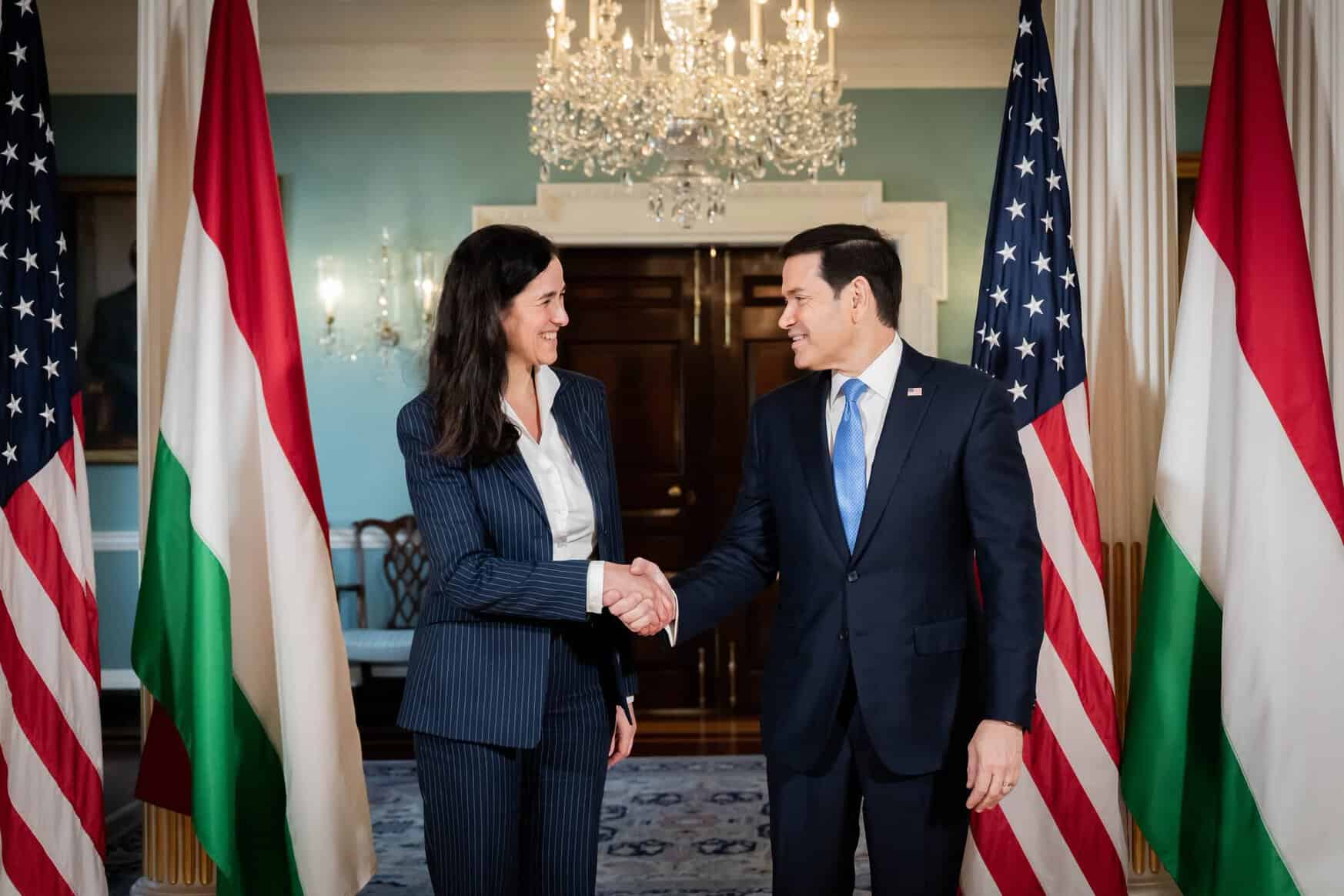
Foreign Minister Anita Orbán met U.S. Secretary of State Marco Rubio in Washington on Thursday, after an initially scheduled meeting on Tuesday failed to materialize. The awkward delay raises questions about how the Trump administration views Hungary’s new government. Meanwhile, the TISZA government appears to be continuing their predecessors’ energy policy that Péter Magyar himself criticized just a year ago.
Following the talks, Anita Orbán announced that two important agreements had been signed with the U.S. Secretary of State. The first concerns closer cooperation on regional natural gas and oil infrastructure under the Trump Peace Pipelines Framework. The initiative aims to increase U.S. liquefied natural gas (LNG) exports while developing gas infrastructure across Central and Eastern Europe and the Western Balkans. The framework was established by the U.S. Department of Energy. The American and Canadian LNG would come at a considerably higher price than current supplies through Russian pipelines, yet the new government is running out of option since their earlier confrontative communications directed against Moscow.
Today we signed two key agreements with @SecRubio. One strengthening the Hungarian-American cooperation on regional energy infrastructure under the Trump Peace Pipelines Framework, the other aims to enhance law enforcement cooperation and the exchange of information concerning criminal activities perpetrated by radical organizations. Looking forward to continuing the dialogue on key national matters. — Anita Orban (@_OrbanAnita) October 29, 2026

However, the agreement also highlights a striking continuity between the policies of the previous Orbán government and those of its successor.
As political analyst Dániel Deák pointed out on social media, much of the groundwork for the current Hungarian-American energy partnership was laid under Viktor Orbán’s government. In November 2025, Viktor Orbán met Donald Trump in Washington. In February 2026, Hungary’s then Foreign Minister Péter Szijjártó and Marco Rubio signed a civilian nuclear cooperation agreement in Budapest.
By April, the White House had announced plans involving $500 million in American oil purchases, an assessment of the possibility of extending the operating life of the Paks I nuclear power plant, and a potential investment opportunity worth up to $20 billion in small modular reactors. The latter was not a finalized purchase order but an investment possibility still under preparation.
At the time, Péter Magyar took a decidedly different position.
Following the Trump-Orbán meeting in November 2025, he accused the former prime minister of surrendering Hungary’s interests to foreign powers.
“Orbán previously bowed to China with the battery factories, and now he is bowing to America with the nuclear power plants,” Magyar wrote, linking the Washington agreements to indebtedness and political theater.

Now, however, the TISZA government is not only signing a new energy memorandum of understanding but, according to Reuters, has also submitted the February nuclear agreement, originally concluded under the Orbán administration, to Parliament for approval, with the aim of making it legally binding.
The second agreement signed in Washington focuses on strengthening law enforcement cooperation and intelligence sharing concerning crimes committed by radical organisations. According to MTI, the agreement will further deepen cooperation between the two countries in internal security and law enforcement.
The press statements, particularly Anita Orbán’s own remarks, made clear that the cooperation also concerns crimes linked to far-left extremist organisations such as Antifa Ost.
This specific reference was largely obscured in Orbán’s Facebook announcement and the
report, although she spoke about it explicitly in her video statement.
The issue is politically sensitive in Hungary, particularly because of the 2023 Antifa attacks in Budapest.
The United States has designated Antifa Ost, a far-left extremist network linked to the attacks, as a terrorist organization.
The Hungarian authorities accused activists who travelled to Budapest in an organized manner of carrying out coordinated, politically motivated assaults against people on the streets of the capital. The case has also become entangled in European politics through Ilaria Salis, an Italian member of the European Parliament who was among the defendants in the proceedings related to the attacks.
The European Parliament recently voted by a margin of just one vote not to lift Salis’s parliamentary immunity, preventing criminal proceedings against her from continuing in Hungary. This has prompted serious criticism from Hungary’s previous governing camp, particularly regarding the conduct of Péter Magyar and his TISZA Party delegation.
In a post on X, Balázs Orbán, the former political director of Viktor Orbán, accused the prime minister of deliberately avoiding the decisive vote.
Magyar had acknowledged that he did not participate, while reportedly asking fellow Tisza MEPs to abstain or stay away as well.
🚨 A stunning display of political hypocrisy!
Did Anita Orbán lie to the US Secretary of State?
The Hungarian Foreign Minister smiled as she signed an agreement in Washington, negotiated by Viktor Orbán and the Trump administration, aimed at strengthening joint efforts against far-left extremist violence.
The problem is that the European Parliament decided by a margin of just one vote not to lift Ilaria Salis’s parliamentary immunity. Péter Magyar, by his own admission, did not participate in the vote. In fact, he even asked the other MEPs from his Tisza Party to abstain or not vote at all. In other words, when a single vote could have made all the difference, Péter Magyar deliberately chose to stay away.
Salis is one of the defendants in the case concerning the 2023 Antifa attacks in Budapest. The attacks have been linked to Antifa Ost, a far-left extremist network designated as a terrorist organisation by the United States. The activists who travelled to Hungary in an organised manner were accused of carrying out coordinated, politically motivated assaults against people on the streets of Budapest. Criminal proceedings against Salis in Hungary cannot continue because the European Parliament upheld her immunity. As a result, she remains a Member of the European Parliament and continues her political activities.
The case of Maja T. raises similarly serious questions. Convicted in Hungary in connection with the same attacks, Maja T. had the prison sentence reduced on appeal after the change of government, and preparations have begun for a transfer to Germany. The obvious question is what guarantees exist to ensure that the sentence will actually be served, and whether the transfer could lead to an early release.
How shameless do you have to be to look the US Secretary of State in the eye, smile, and sign an agreement on combating far-left terrorism, while your own Prime Minister deliberately stayed away from a vote in which a single ballot made the difference between lifting and preserving Ilaria Salis’s immunity?
What did they tell the Americans? Did they also disclose that Péter Magyar refused to vote to lift Salis’s immunity? Or did they conveniently leave out that embarrassing detail?
Smiles in Washington and ceremonial signatures are no substitute for straight answers. The US Secretary of State has every right to know what Hungary’s government leaders actually do when it comes to taking action against far-left extremist violence.
— Balázs Orbán (@BalazsOrban_HU) October 29, 2026
Balázs Orbán argued that this was particularly contradictory given that Anita Orbán was now signing an agreement with Rubio aimed at combating far-left extremist violence.
What did they tell the Americans? Did they also disclose that Péter Magyar refused to vote to lift Salis’s immunity? Or did they conveniently leave out that embarrassing detail?”
he asked.
The Washington meeting itself had already become a source of embarrassment before it even took place. On Monday, Anita Orbán announced that she would meet Marco Rubio the following day. However, the meeting did not happen on Tuesday, despite initially appearing on the official American schedule. The explanation eventually emerged: Rubio had accompanied President Donald Trump on his campaign tour ahead of the following Tuesday’s congressional elections.
The meeting eventually happened, and the agreements were signed. But the sequence of events, the apparent continuity in energy policy and the political contradictions surrounding the fight against extremism leave uncomfortable questions for the TISZA government.
Via MTI, Reuters, Magyar Nemzet
Featured image: Facebook/Orbán Anita