Home Blog Page 35

HUNGARIAN NATIONAL SECURITY EXPERT EXPECTED TO JOIN TRUMP’S WHITE HOUSE STAFF

According to news site Business Insider, Sebastian Gorka, a national security expert who has served as a Fox News contributor and national security editor for far-right news site Breitbart, is “expected to join President Donald Trump’s White House.” He was also charged with a weapons offense last year for attempting to bring a gun onto an airplane. 
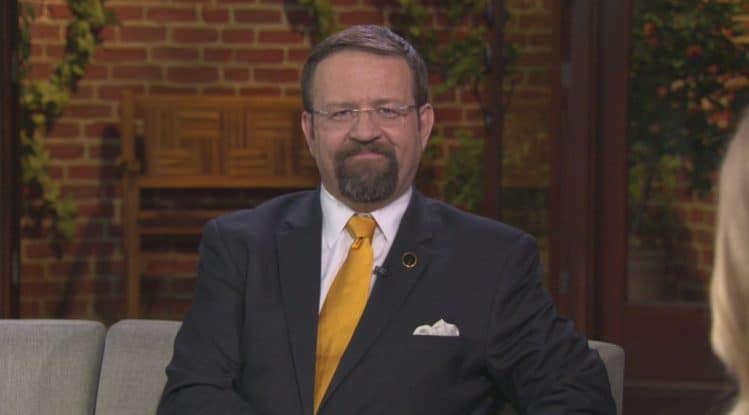
The news came from an unknown source, who also claims that Gorka will likely receive a position in Trump’s National Security Council.

Gorka, who was born in London to parents who had fled the Hungarian Revolution of 1956, has also in the past served as an advisor to Hungarian Prime Minister Viktor Orbán. He also worked at the Hungarian Ministry of Defense during the Prime Ministry of József Antall, Hungary’s first PM following the end of Communism.

Mr. Gorka entered Hungarian public life following the 9/11 terror attacks in 2001, when he appeared multiple times on Hungarian television as a security expert.

Following a break with Orbán and Fidesz in 2006, Gorka briefly attempted to establish his own alternative right-wing party in Hungary, called the New Democratic Coalition (Új Demokratikus Koalíció), but without much success. In an interview with Hungarian newspaper Magyar Nemzet, Gorka said that he currently has no political relationships or consulting roles in Hungary, “only personal relationships.”

Speaking of Hungarian and the Orbán government, Gorka has said that, after years of dancing between Russia and NATO, Hungary has to decide “if it will follow the Western and Western European system of values, or not,” and added that “this cannot be put off forever.”

In addition to his activities in Hungary, Gorka, who holds a PhD in political science, has taught at Georgetown University, and has served as an advisor to the US Military and the Department of Defense.

Gorka has written for Breitbart since early 2014, and in addition wrote for the Hungarian weekly magazine Heti Válasz in 2005. He is the author of a New York Times best-selling book, entitled Defeating Jihad. He has also written policy papers for Trump and was paid by Trump’s campaign for ‘policy consulting.’

Gorka, whose official relationship with Fox News was reportedly ended “when he informed executives of his new position,” is far from the first Breitbart face to join Trump’s administration. Stephen Bannon, Breitbart’s chairman, had served as the campaign’s CEO and currently holds the title of White House Chief Strategist; in addition, Julia Hahn, a “hardline immigration writer for Breitbart,” is also expected to join Trump’s White House as a special assistant.

According to the Washington Post, in early 2016 Gorka was charged with a weapons offense after attempting to bring a 9mm handgun onto an airplane at DC’s Reagan National Airport. Transportation Security Administration (TSA) officials said that the gun was detected and confiscated.

Via Business Insider, valasz.hu, 444.hu, Magyar Nemzet, and the Washington Post

Image via foxla.com

Source: hungarytoday.hu

Reklám
Tas J Nadas, Esq

WHAT CAUSES EARTHQUAKES IN HUNGARY?

According to origo.hu, compared to other regions of the Earth, the Carpathian Basin counts as a relatively peaceful place from a seismic view. But the truth is that it is not peaceful at all. Due to the very deep plate tectonic processes, more than one million quakes bust the crust every year.

The majority of these quakes can only be detected by special instruments, the number of moderately strong (at least magnitude 6 on the Richer scale) earthquakes is only around 200, while there’s only 2-3 truly destructive (magnitude 8 or more) earthquake every year.

Hot upwelling from the depths of the Earth

Earthquakes are globally caused by the drift of substances – the thermal motion of the cape’s hot, melted detritus – in the core of our planet. The plates of the firm crust, the lithosphere, are “floating” on the viscose asthenosphere due to thermal motions that are coming from the deep. The lithospheric plates are in constant, slow movement.

The plate motions can happen affront each other, which signifies percussive or convergent plate borders, but the lithospheric plates can also move away from each other, which creates divergent plate borders. Also, the plates can slide by each other.

High energy tensions pile up in the crust in all three cases, and, when they bust, we can talk about seismic activity or earthquakes. 90% of the earthquakes can be detected at the plate borders.

Unpeaceful microplate at the depth of the Adriatic Sea

Hungarian earthquakes are caused by the collision of the African and Eurasian plate. This process has been going on for a very long time on a human scale. India joined Asia about 37-35 million years ago, at the end of the Eocene period. This, the coalescence of Africa and the Arabian plate, and then its collision with Eurasia triggered the Alpine orogenesis, and the upthrust of the Eurasian Mountain Range, including the Pyrenees, the Alps, the Carpathians, the Dinarides and the Himalaya. The African-European plate border is still active.

The upthurst of the Eurasian Mountain Range

However, the plate border doesn’t fall in place with Africa’s geographic northern border, in other words, the southern coastline of the Mediterranean Sea. It actually deeply streches under the Mediterranean basin instead. The microplate lying under the Adriatic Sea, called the Adriatic thorn, belongs to this plate border. The Adriatic microplate moves in a northern-north eastern direction, while turning counter clockwise. The complicated movement of the Adriatic thorn determines the tectonic and seismic conditions of the Apennines, the Alps, the Dinarides and the Carpathians.

Due to the rotating movement of the Adriatic microplate, significant tensile stress piles up in the crust, which’s burst causes the Italian earthquakes for instance.

The northern movement of the Adriatic thorn has a pressurizing effect on the Carpathian Basin, which is the cause of earthquakes in Hungary.

The biggest Hungarian earthquake

Origo.hu writes that there are approximately 100-120 earthquakes registered by experts every year in Hungary. The majority of them is less than the strength of 2.5, so most of them can’t even be sensed.

Strong, destructive earthquakes of 5.5-6 strength can only be expected in every 40-50 years. The most serious Hungarian earthquake happened on the 28th of July, 1763. The epicentre of the quake was in the vicinity of Komárom, and it had a strength of 6.3 according to the Richter scale.

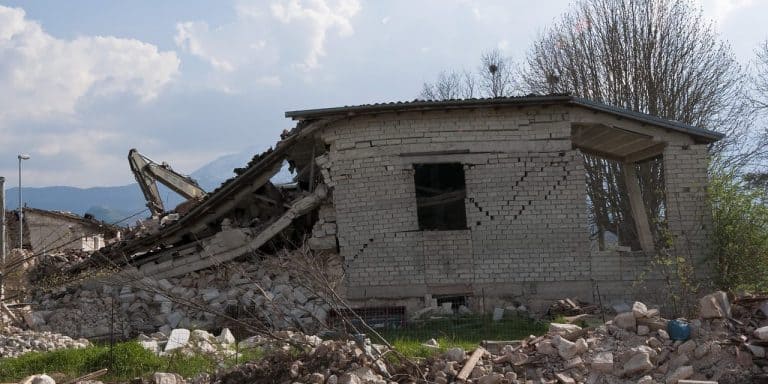
The Zsámbék Premontre monastery church

The natural disaster took a toll on the nneighbourhood, causing many casualties: 63 deaths and more than 120 injuries. Seven churches – including the famous church of Zsámbék, the 13th century Prémontré abbey church – and 279 buildings were completely demolished, and 353 buildings suffered serious damages. The quake was accompanied by a strong sound effect.

The last big earthquake happened on the 12th of January, 1956, when the epicentre of the seismic occurrence was in Dunaharaszti. It was caused by the dislocation of a deep dolomite ball of earth. It caused two deaths, injured 38 people and damaged 3144 buildings (out of 3500).

Photo: www.eurekalert.com

Copy editor: bm

Source: origo.hu / dailynewshungary.com

Reklám
Tas J Nadas, Esq

NATIONAL GEOGRAPHIC LISTS BUDAPEST AS AN UNEXPECTED CITY FOR FOOD LOVERS

National Geographic recently collected six places where you can unexpectedly meet tastes of each corner of the world. Welovebudapest.com reports that Europe is represented by Budapest in the article from three aspects. It seems like they were captivated by our food scene

The article recommends gastronomic adventures in different places by three aspects: they list the best neighbourhoods for food frenzy, getting fancy and DIY-s.

Regarding the best neighbourhood for food frenzy, they suggest that – especially if you only have a few days to spend in the capital – one should definitely spend it in the 7th district. There’s no reason to wander anywhere else since there are plenty of restaurants specialised for international cuisine in the Jewish Quarter. Furthermore, after your abundant meal, you can finish the gastro experience in a buoyant pub.

Are you interested in the 10 best Hungarian restaurants?

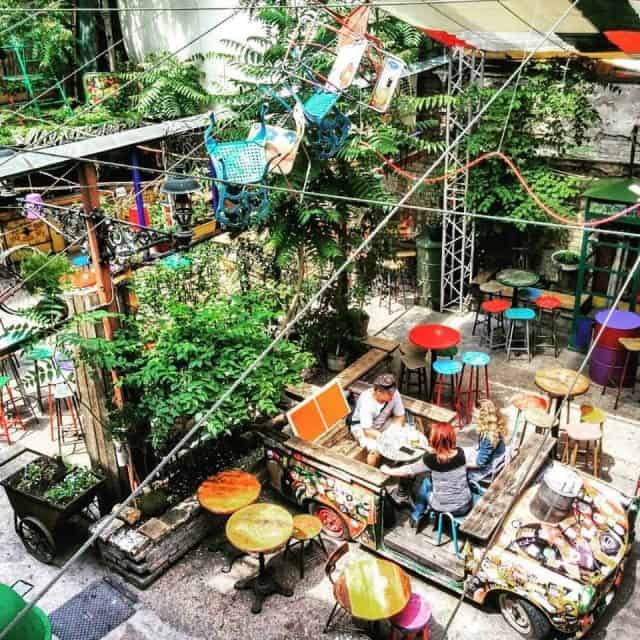
Karaván is a paradise for food lovers with its yard full of street food trucks and delicacies. “Don’t leave without trying lángos, that is fried flatbread, usually topped with grated cheese and sour cream.” The writer also recommends visiting the New York Café, one of the world’s most beautiful coffeehouses. “The food holds its own against the ornate interior (think marble, gold leaf, and red velvet).” Naturally, the leading ruin pub, Szimpla Kert can’t be missing from the list. “This unique spot is one of Budapest’s “ruin pubs,” eateries housed in old and derelict buildings.”

Szimpla

Next up is the best neighbourhood to get fancy. The Castle District is one of the oldest parts of Budapest, where you can find amazing restaurants along the cobbled streets and cosy buildings. The writer highlights Alabárdos, founded in 1964, which is a perfect spot to try authentic Hungarian meals. “Ask for the secret chef’s-choice menu.” And if you’re a fan of caviar, then you should visit Arany Kaviár, an opulent restaurant specialised in Russian food.

Arany Kaviár

Lastly, when it comes to the best neighbourhood for Do It Yourself, Budapest markets and especially the Great Market Hall is recommended. The endless stands offer a wide variety of ingredients. “Make a pilgrimage here for local meats, cheeses, and produce, as well as spices (smoked paprika is a must), pastries, and souvenirs.”

Great Market Hall

Well, we couldn’t agree more: Budapest is a unique gastro destination which dazzles tourists with peculiar flavours.

Photos: www.facebook.com/AranyKaviárÉtterem, SzimplaKert, KardosIldikóPhotography

Copy editor: bm

Source: nationalgeographic.com.au / dailynewshungary.com

Reklám
Tas J Nadas, Esq

INTERVIEW – ORBÁN: CLASHES WITH BRUSSELS EXPECTED ON MIGRATION AND ECONOMIC ISSUES

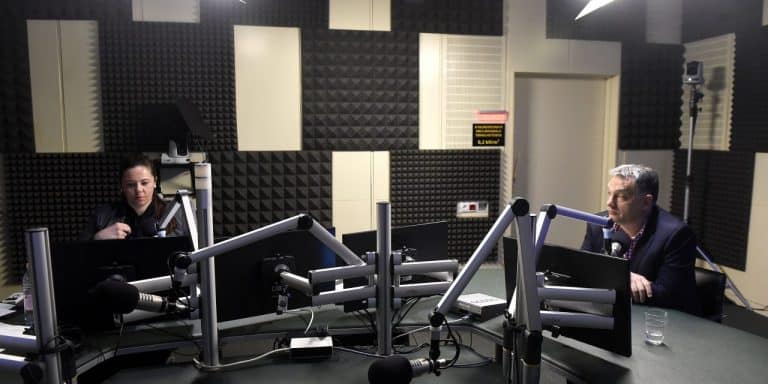
Budapest, January 13 (MTI) – Further clashes with Brussels are expected this year on issues concerning migration and economic management, Prime Minister Viktor Orbán said in an interview to public radio on Friday. Hungarians should have access to information about all public personalities and their sources of financing, he said.

“We’ll have to defend the country’s sovereignty,” the prime minister said.

Attempts by Brussels to curb national competencies on migration issues should be stopped, Orbán said.

Hungary has reinstated the detention of asylum seekers, a step which clearly conflicts with EU policy but necessary due to heightened terror threat in Europe, he said. Laws that make terrorism easier to carry out should be changed for reasons of self defense, he added.

Of the second “battle”, Orbán said Brussels was increasingly interfering in economic management. Citing matters such as energy prices, taxes and wages, he insisted this tendency must be stopped.

Orbán highlighted measures to cut household utility fees, saying the scheme must be protected in light of EU plans to harmonise energy fees, thereby taking price-setting out of the hands of national governments. This would put an end to Hungary’s centralised measures to cut utility fees, he warned.

Orbán dubbed 2017 the “year of revolt”. EU member states will openly and unrelentingly oppose EU policies which “covertly or overtly” deprive them of their competencies, Orbán said. French presidential candidate Francois Fillon’s programme is “revolutionary” and opposed to EU immigration policies, among others, Orbán said.

This year will bring serious strain between policies aiming to protect national policymaking and the EU tendency to curb it, he said.

“Western reasoning is defined by frustration,” Orbán added. The West has been used to setting norms for eastern European countries in terms of modernising and democracy. “And now, they are failing: their indices are bad and ours are good because we do not do things their way. They do not want to admit our way works better”, he said. Instead of facing reality, western countries “keep on playing the same old record”, he added.

Commenting on Visegrad Four cooperation, he said that during the Hungarian presidency starting in July he would attempt to further deepen cooperation within the group. Referring to Hungarian-Polish relations, he said “solidarity is working well”, citing Hungary’s stand in the European Union on the issue of coal mining in Poland’s favour and Warsaw’s backing for Hungary in efforts to have the VAT on internet services reduced to 5 percent.

Orbán said government economic policies were bearing fruit and “a change is slowly happening in people’s lives resulting from the work-based economy”. Everybody has the opportunity to work, unemployment is rapidly falling, wages are growing and taxes and contribution payments are being cut, Orbán said. Commenting on the shortage of labour, he said this showed that investment in Hungary was continually expanding.

Referring to the extreme cold weather currently experienced in Hungary, he asked homeless people to use the available shelters. He added that more places are available than the number of homeless.

The prime minister said Hungary’s energy reserves were sufficient to guarantee the country’s operation, adding that the scheme to cut household utility fees meant that energy bills were now “tolerable”.

Orbán: Sources of financing for public personalities should be made transparent

In response to a question about NGOs, Orbán said in an interview to public radio Kossuth that “we live in a world today” where attempts to influence are frequent in all countries and by almost all countries.

He cited the example of the US during the presidency of Barack Obama which had developed many varied methods for trying to exert influence around the world.

“I could tell you about it in length … we have seen it all in the recent period, including the most primitive methods to exert influence,” Orbán said. He added that since the US was an ally he would not focus on the past. Orbán said he trusted that such attempts by the US would not be made in the future.

The opportunity should be given to all Hungarian citizens to find out where public personalities receive funding from, whether from Hungary or abroad, the prime minister said. In the case of foreigners, it is also important to know whether they are subject to certain expectations.

“We want transparency,” Orbán said, adding that Hungarians have the right to understand “the system of manipulation that attempts to exert influence on our everyday political life.”

Commenting on President-elect Donald Trump, he said a new style of US leadership is about to start. While the outgoing Obama administration has been “globalist”, the next one would not prevaricate or overcomplicate, Orbán said. The Europeans will need to readjust to the new attitude and new system of relations, he added.

In response to a question about a future US visit, Orbán said no concrete details are as yet publicly available.

Photo: MTI

Source: MTI

Reklám
Tas J Nadas, Esq

HUNGARIAN PÁLINKA MANUFACTURE CONQUERS IN AFRICA

Sándor Balogh had an unusual idea: we should not export our national beverage, pálinka, but produce it locally. Furthermore, the location should be Africa. The businessman – who has excellent local knowledge being the president of the African Hungarian Union – chose Uganda as the location of the first pálinka project, reports Lokál.

Because of the tropical conditions, the quality drink is not made of the well-known peach and plum, but banana, pineapple and jackfruit, at a mini farm built by the Hungarian people of Kapeke. The first bottles containing exotic but still Hungarian pálinka get in stores in the next months.

Sándor Balogh said to Lokál Extra: “We have already started the building of a larger distillation factory, which I hope to help to put a bigger amount of pálinka onto the market.”

The president of the African Hungarian Union also noted that, after Uganda, the next location of the pálinka project will be Morocco, where there might be a chance to make pálinka out of pomegranate and pineapple.

The Hungarian pálinka types, which also count as a Hungaricum, can be exported specialties in the next years – said the Ministry of Foreign Affairs and Trade. Moreover, the image of the country could be built with its help, which, otherwise, costs a lot of money.

The man behind the idea said that no name has been chosen for the pálinka yet, so they are happy to receive any ideas on their Facebook and Instagram profiles.

Copy editor: bm

Source: Lokál / dailynewshungary.com

Reklám
Tas J Nadas, Esq

JOBBIK REPEATS CALL FOR STAND-ALONE BORDER GUARD FORCE

Budapest, January 13 (MTI) – Opposition Jobbik welcomes the recent inauguration of 500 border guards but repeatedly calls for reinstating a separate border guard force, the party’s spokesman said on Friday.

Hungary is the only EU country without a force like that, Adam Mirkoczki told a press conference, noting that Hungary’s Border Guard had been eliminated in 2008.

The Border Guard should consist of at least 8,000 members and patrol Hungary’s EU Schengen border sections, he said.

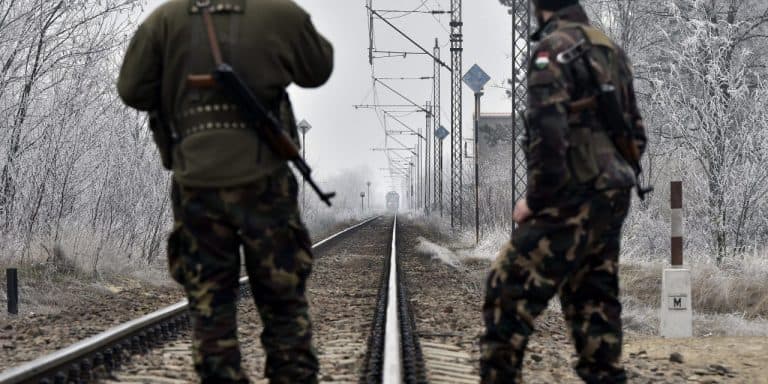
The first “border hunting” officers took their oath on Thursday at a ceremony addressed by Prime Minister Viktor Orbán.

In response, ruling Fidesz said that Jobbik only “preaches” border protection while it prevented “together with the Socialists and [Democratic Coalition leader Ferenc] Gyurcsány” the passage of a constitutional amendment aimed at banning the forced settlement of migrants in Hungary.

Fidesz noted that the Hungarian government had been the first in Europe to defend the country’s borders, the party said in a statement. Source: MTI

MTI / dailynewshungary.com

Reklám
Tas J Nadas, Esq

Bishop Richard Lennon resigns from Cleveland Catholic Diocese citing health reasons

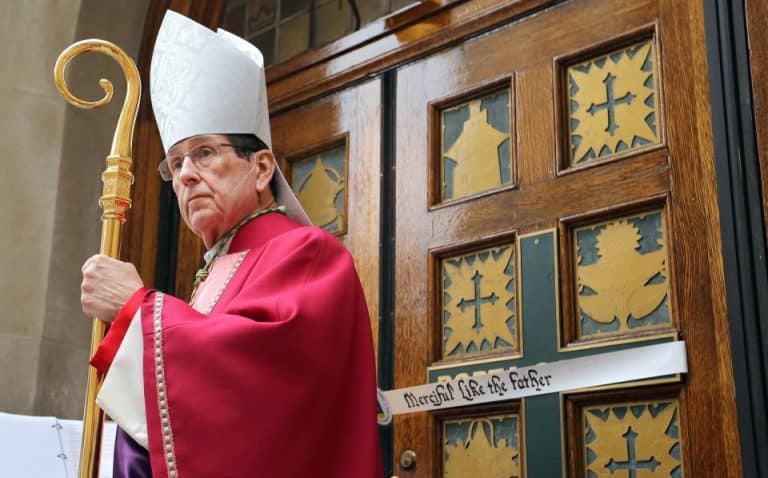
Cleveland Bishop Richard Lennon addresses the crowd before he unlocks the chained Holy Door of Mercy at the Cathedral of Saint John the Evangelist in downtown Cleveland on Sunday, Dec. 13, 2015. (Lisa DeJong/The Plain Dealer)

CLEVELAND, Ohio – The Diocese of Cleveland released a statement early Wednesday announcing the retirement of Bishop Richard Lennon.

The release cited ongoing health issues as the reason Lennon is retiring. At a Wednesday morning news conference, the diocese disclosed that Lennon suffers from vascular dementia, a cognitive impairment caused by reduced blood flow to the brain.

As of now, Lennon’s duties will be performed by Bishop Daniel Edward Thomas from Toledo.

Lennon, who was installed in May of 2006 as the 10th bishop to lead the Cleveland diocese, was hospitalized in February, 2016, for chest pains and underwent an emergency heart procedure.

Cleveland Bishop Richard Lennon addresses the crowd before he unlocks the chained Holy Door of Mercy at the Cathedral of Saint John the Evangelist in downtown Cleveland on Sunday, Dec. 13, 2015. (Lisa DeJong/The Plain Dealer)

The Cleveland diocese encompasses eight counties. Lennon is best known here for shuttering 30-some churches in Northeast Ohio in 2009 and 2010, a decision that sparked fervent backlash from some of the 700,000 parishioners in the diocese.

More recently, Lennon’s career in Cleveland was marked by much-needed and successful fundraising campaigns.

A Boston native, Lennon was appointed interim administrator of the Boston Archdiocese in 2002, when longtime Cardinal Bernard Law resigned amidst the sex-abuse scandal involving priests.

Lennon went on to serve as a bishop in the Archdiocese of Boston for five years before being sent to Cleveland to replace retiring Bishop Anthony Pilla.

During his tenure in Cleveland, Lennon displayed a progressive bent at times, choosing for instance to stop charging $450 for marriage annulments two years before the Vatican ordered all Catholic churches to do so.

But he could also draw a hard line. He prevented students at Catholic schools in the diocese from participating in the social media phenomenon known as the ALS ice bucket challenges that raised money to fight Lou Gehrig’s Disease because that research includes the destruction of embryonic stem cells.

Lennon also required teachers at diocese-run schools to sign a morality clause.

Local Catholics will always remember Lennon for his decision to close dozens of churches because of declining membership. His actions were met with protest and in the case of 11 churches, the Vatican reversed Lennon’s decision to close them claiming he did not follow proper procedures.

Reporter Sara Dorn contributed to this post.

By Peter Krouse, cleveland.com


Reklám
Tas J Nadas, Esq

ONE OF THE LAST SAMURAIS IN THE WORLD LIVES IN HUNGARY

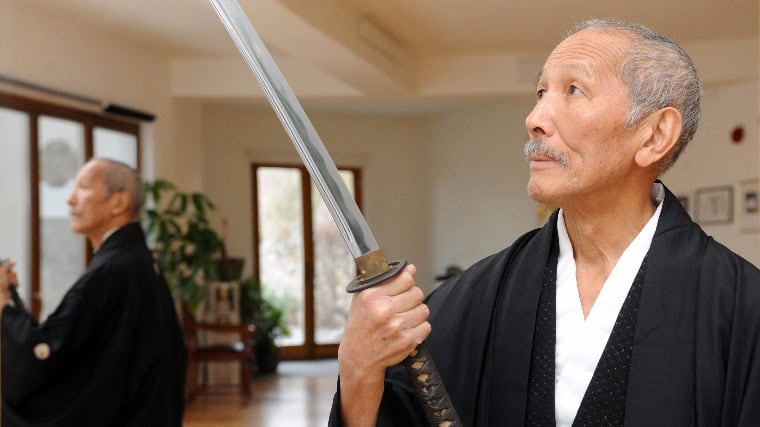
The “samurai of Pécs”, Suzuki Kimiyoshi lives in the Mecsek with his wife. The 82-year-old martial artist was born in Tokyo and moved to Hungary 24 years ago. He no longer misses Japan, and when he does go back, it is to learn new martial art techniques, which he then imparts to his students in schools and in the training hall of his house, hirado.hu writes.

After their rebellion was defeated, the age of samurais in Japan officially ended in 1877. However, their traditions lived on and continued to define the image of the country. Today there are only a few samurais left who were trained in the traditional ways. The grandfather of Suzuki Kimiyoshi was one of the samurais of the old days; to commemorate him, an obelisk was built in Japan, on the island of Hokkaido.

Starting in ‘80s, Suzuki Kimiyoshi visited Hungary many times, and, after making some friends and meeting his current wife, he settled down in Pécs, in the south of the country, in 1992. His wife is Hungarian, and he speaks the language, as well.

In the beginning, the Hungarian mentality felt strange to him. He said in the Kossuth Radio programme Közelről: “Hungarians seemed rough and violent at first, but I’ve got used to it over time, and now, whenever I visit Japan, I feel like everyone is overly nice,” he said.

According to hirado.hu, the 6-dan master, who was initially trained by one of his grandfather’s students, now teaches karate and kenjutsu, that is, Japanese swordsmanship. He has more than a dozen students in Pécs, and over a hundred in Budapest, but he is frequently visited from abroad, as well.

Out of his three katana, one is a 300-year-old original Japanese sword. The sharp katana is not used for practice; instead he uses a blunt sword, forged by a Hungarian blacksmith. “If anything happens to this, it can be fixed, which would be very difficult in the case of an original katana,” he said.

Swordsmanship used to be a deadly technique, but now it is practised with a different purpose, the building of the body and the spirit, he said.

Suzuki Kimiyoshi began training in kenjutsu when he was 6, and he is still learning. He travels to Japan once a year for this purpose. “I know almost everything, but it’s not over. It is over only when I stop,” he said.

Photo: MTI

Copy editor: bm

Source: hirado.hu / dailynewshungary.com

Reklám
Tas J Nadas, Esq

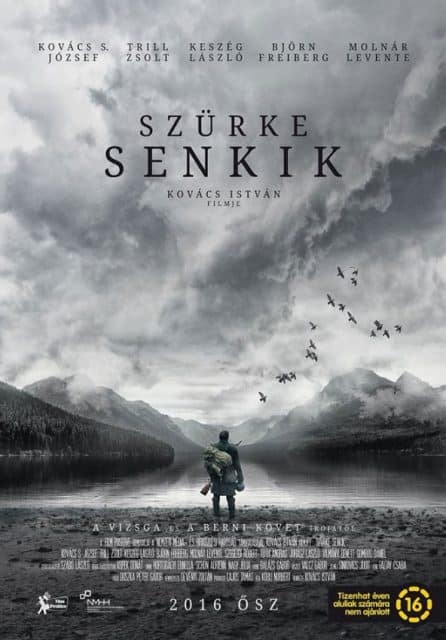
WATCH THE TRAILER OF PROBABLY THE BEST HUNGARIAN WORLD WAR MOVIE EVER

There are not many movies about the First World War, at least not Hungarian ones. Few films were made during the 30’s but no one remembers or has ever seen them. During the socialist era just a few scenes about the First World War got into the movies.

And usually the Hungarian film-making industry is not famous for its combat scenes and action movies. But now a film called Szürke senkik (Grey Nobodies) is probably going to pioneer in this field.

The movie tells the story of five Hungarian soldiers who are fighting on the Italian front, behind the enemy lines. This core of the story could make the movie interesting. Everything can happen in the enemies’ territory, and trouble always follows the soldiers. Additionally, the battles are intense and realistic in the movie.

Among the characters is a professional soldier called sergeant Fodor who is interested in the outcome of the war. The others just want to get back home in one piece. The soldiers are Hungarians, Austrians and Romanians. All of them speak Hungarian and German and this is the only connection between them to feel some fellowship with each other.

YouTube player

(The Grey Nobodies is going to be shown on 16th December 16 PM, and 17thDecember 2:50 AM on Duna Television or streaming will be available on the website of Médiaklikk.hu)

via index.hu / hungarytoday.hu

Reklám
Tas J Nadas, Esq

ReConnect Hungary – Hungarian Birthright Program – Deadline: December 31, 2016

Hungarian Birthright Program a unique cultural immersion experience!

Proud of your Hungarian heritage and want to experience it in a meaningful, unique and fresh way? Explore your heritage and discover the Hungary of today with a scholarship that connects you to other young Americans and Hungarians!

Summer  2017

Join other young Americans and Canadians for a fun-filled and eye-opening experience of your culture, traditions and history while exploring the country. See first-hand the trends, innovations and ingenuity driving Hungary today. 

What you need to know:

  • any degree of Hungarian heritage
  • for ages 18 – 28
  • trip dates: June 17 – July 3, 2017
  • application deadline: December 31, 2016
  • scholarship limits your expenses to $1,500

Your heritage, for a lifetime.

reconnecthungary.org

facebook.com

[gview file=”https://www.bocskairadio.org/wp-content/uploads/2016/12/RH2017-Flyer-small.pdf”]

Reklám
Tas J Nadas, Esq

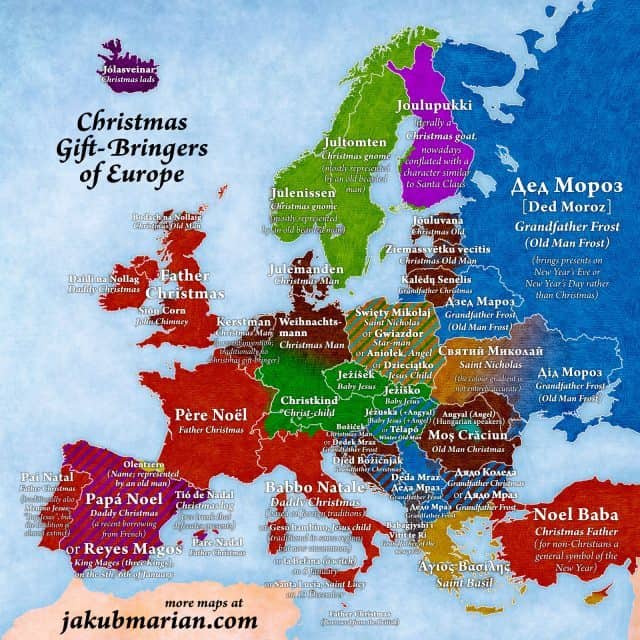
Christmas gift-bringers of Europe

Santa Claus is relentlessly trying to enter our European households (mostly through our mailboxes rather than chimneys), but Father Christmas, Baby Jesus, Grandfather Frost, and other traditional gift-bringers have managed to fend him off so far (well, sort of).

Each country (or region) has its own traditional Christmas gift-bringer. Some of them are quite nice, such as the British Father Christmas, others are outright weird, such as the Catalan “defecating log”, but all of them are equally interesting. The following map shows the gift-bringers’ names with translations, coloured by relatedness of the concepts themselves (that is, not by etymological relatedness of the names).

Please note that some of the stripes and gradients may not represent the actual geographical distribution completely accurately; they just show general geographical trends. For example, Weinachtsmann is more common in the north of Germany, Christkind (or Christkindl) in the south, but the border is not entirely clear. The situation in Ukraine is even more unclear.

In Poland, the four variants are mostly regional (only one of them is typically common within a certain region). However, since there is not enough space in the map to show the regional variations, Poland is simply shown with stripes. There is also another variant, Gwiazdka (meaning “little star”), which is related to Gwiazdor and which did not fit in the map.

In Spain, the traditional Christmas gift-bringers are the Three Kings who give Children presents on the night of the 5th of January or the morning of the 6th of January, but the tradition is slowly becoming replaced or supplemented by Papá Noel (influenced by Santa Claus, name imported from France), who brings gifts on Christmas Eve.

In Russia and several other members of the former Eastern Bloc, Ded Moroz gives presents to Children on New Year’s Eve rather than Christmas Day. Although he was originally a pagan character, in the 19th century he became a Christmas figure, akin to Father Christmas and other Western European traditions. During the Soviet era, when celebration of Christmas was discouraged (and in some countries even completely forbidden), he became the symbol of New Year’s celebrations.

Here’s the same information as above in the form of an alphabetical list:

Albania: Babagjyshi i Vitit te Ri, Grandfather of the new year
Austria: Christkind, Christ-Child
Belarus: Дзед Маро́з, Grandfather Frost (or the Russian version)
Belgium:

In Dutch: Kerstman, Christmas Man
In French: Père Noël, Father Christmas

Bosnia: Djed Božićnjak, Grandfather Christmas or Djeda Mraz, Grandfather Frost
Bulgaria: Дядо Коледа, Grandfather Christmas or Дядо Мраз, Grandfather Frost
Croatia: Djed Božićnjak, Grandfather Christmas
Cyprus:

Turkish: Noel Baba, Christmas Father
Greek: Άγιος Βασίλης, Saint Basil

Czech Republic: Ježíšek, Baby Jesus
Denmark: Julemanden, The Christmas Man
Finland: Joulupukki, literally Christmas Goat
France: Père Noël, Father Christmas
Germany: Weihnachtsmann, Christmas Man or Christkind, Christ-Child
Greece: Άγιος Βασίλης, Saint Basil
Hungary: Jézuska, Baby Jesus or Télapó, Winter Old Man
Iceland: Jólasveinar, Christmas lads
Ireland: Father Christmas

In Irish: Daidí na Nollag, Father Christmas

Italy: Babbo Natale, Daddy Christmas
Lithuania: Kalėdų Senelis, Grandfather Christmas
Latvia: Ziemassvētku vecītis, Christmas Old Man
Estonia: Jõuluvana, Christmas Old
Macedonia: Дедо Мраз, Grandfather Frost
Montenegro: Деда Мраз, Grandfather Frost
Netherlands: Kerstman, Christmas Man
Norway: Julenissen, literally Christmas gnome
Poland: Święty Mikołaj, Saint Nicholas; Gwiazdor, Star-man; Gwiazdka, Little Star; Aniołek, Angel; or Dzieciątko, Jesus Child (depending on region)
Portugal: Pai Natal, Father Christmas
Romania: Moş Crăciun, Old Man Christmas

Transylvania (Hungarian): Angyal, Angel

Russia: Дед Мороз, Grandfather Frost
Serbia: Деда Мраз, Grandfather Frost
Slovakia: Ježiško, Baby Jesus
Slovenia: Božiček, Christmas Man or Dedek Mraz, Grandfather Frost
Spain: Papá Noel, Daddy Christmas or Reyes Magos, Three Kings

In Catalonia: Tió de Nadal, Christmas log
In Basque: Olentzero (proper name, represented by an old man)

Sweden: Jultomten, literally Christmas gnome
Switzerland:

In German: Christkind, Christ-child
In French: Père Noël, Father Christmas
In Italian: Babbo Natale, Daddy Christmas

Turkey: Noel Baba, Christmas Father
Ukraine: Святий Миколай, Saint Nicholas or Дід Мороз, Grandfather Frost
United Kingdom: Father Christmas

In Welsh: Siôn Corn, John Chimney
In Scottish Gaelic: Bodach na Nollaig, Christmas Old Man

By the way, I have written several educational ebooks. If you get a copy, you can learn new things and support this website at the same time—why don’t you check them out?

Source: jakubmarian.com

Reklám
Tas J Nadas, Esq

WHO OPENS CENTRE IN BUDAPEST

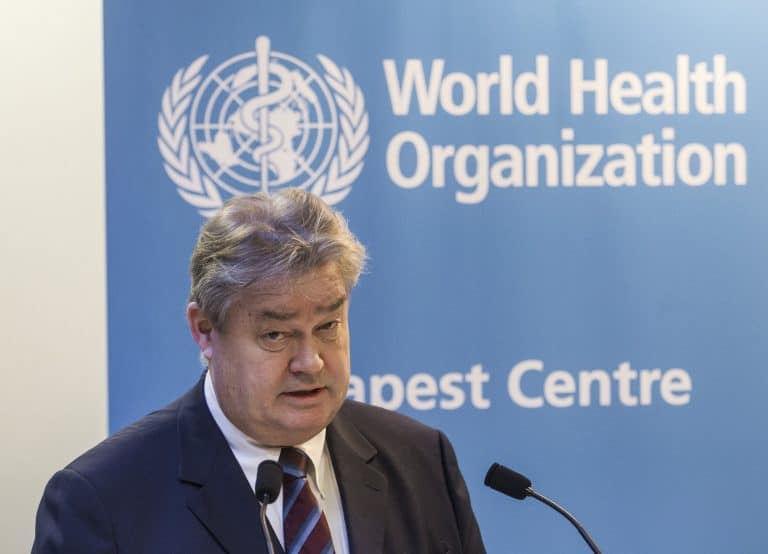
Budapest, 2016. december 13. Hans Troedsson, az Egészségügyi Világszervezet (World Health Organization, WHO) fõigazgató-helyettese beszédet mond a világszervezet budapesti központjának megnyitóján a Business Center 30 Irodaházban 2016. december 13-án. MTI Fotó: Szigetváry Zsolt

Budapest, December 13 (MTI) – The World Health Organisation’s Budapest centre was officially opened on Tuesday.

The WHO has moved some of its Geneva-based operations to Budapest, including its Collaborating Centre on Human Resources for Health Development. Its Budapest centre initially will be staffed by 20 people and it is possible that further operations could be transferred to Budapest at a later point.

István Mikola, state secretary at the foreign ministry, said at the opening ceremony that the organisation would help coordinate action to handle the big challenges currently facing the world. He said that Hungary had always closely cooperated with the WHO but “now we are much closer to each other”.

Dr Hans Troedsson, assistant director-general of the organisation, said the entire project perfectly demonstrated the effectiveness of recent months of cooperation between the WHO and the Hungarian government.

Budapest, 2016. december 13.
MTI Fotó: Szigetváry Zsolt

Read more at: dailynewshungary.com

Reklám
Tas J Nadas, Esq