Home Blog Page 38

Ambassador Szemerkényi Announces Launch of Commemorative Events in Honor of the 1956 Revolution

Ambassador Dr. Réka Szermerkényi reaches out to the Hungarian-American community as the 60th anniversary of the 1956 Revolution and Freedom Fight approaches to announce commemortative events the Hungarian embassy will be organizing in honor of this year’s celebrations.

YouTube player

To read Ambassador Dr. Réka Szermerkényi’s letter in its entirety and to find out more about the events planned by the Hungarian Embassy in commemoration of the 1956 Revolution CLICK HERE.

The Hungarian Embassy is also announcing the launch of an all new collaborative online map, accessible to all, that will shows the various commemorative events planned by Hungarian communities throughout the country. Get on our common map and share with us and the rest of the Hungarian-American community your planned events! The map can be found HERE.

Source: washington.kormany.hu

Reklám
Tas J Nadas, Esq

Turul, the Mystical Hungarian Mythological Bird

Turul_emlekmu-600x400

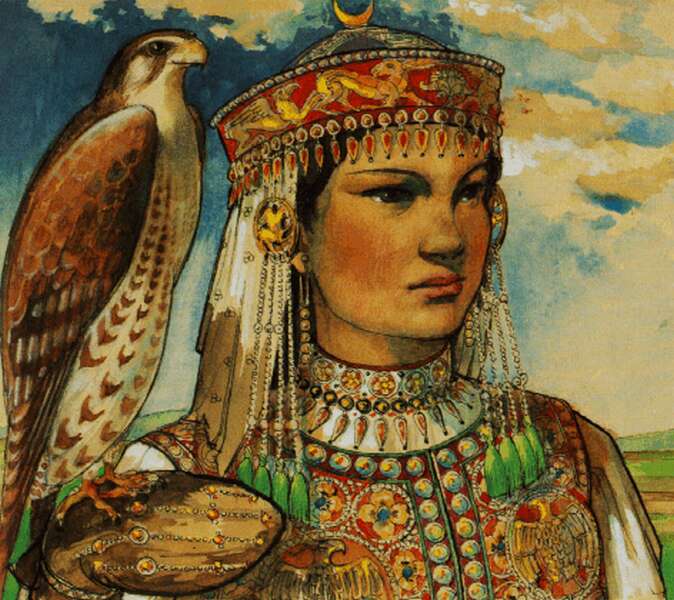
One of the most beautiful and mystical symbols in the Hungarian legendry is the turul bird. The origins of the turul legendry go way back to prehistoric Hungarian past. It is the relic of the ancient Hungarian faith, the embodier of the powers above and the monarchic sovereignty, the national symbol of the providence and guidelines. It is the ancient symbol of national identity and togetherness. Legendry originates the Turul clan from the bird (the dynasty was later wrongly called Árpád clan) thus emphasizing the divine origin of the monarchs and kings of the dynasty. This mystical bird is still very close to the Hungarian hearts; however, we don’t know for sure which animal it was exactly. The turul bird has both a mythological existence and a real one. Both were the symbols, guards of the Holy Spirit for the ancient Hungarians. Turul.info is a website that tries to collect all the information about the turul and the early Hungarian history. Some people believe in these while others don’t. Nevertheless, we all have some knowledge about the Settlements of the Magyars in Hungary and the following century, but this era is somehow not really part of today’s historic public consciousness. They go into the beautiful details of the turul legend, and we also wanted to present a short overview. So getting back to the mystical Hungarian mythological bird, the foundation of the Turul dynasty is gloomy. The legends, ancient chronicles and oral tradition originate the dynasty from Nimród, the first king after the flood. Álmos and his offspring were very proud to originate their family from Attila and the Turul clan. Their origin myth was preserved by chroniclers for the after-ages.

turul-emese-álma

Emese’s dream or, in other words, the Turul myth is one of the oldest Hungarian myths, its formation is estimated to be around 860-870. As the origin myth of the Turul dynasty (Árpád dynasty), it was believed to be unconditionally authentic some centuries later, thus it was put into the Illustrated Chronicle. The date when the first written text is born is unclear; however it is clear that the text noted by Anonymus, and the one that appears in the Illustrated Chronicle, are based on an older source. What’s interesting is that probably all Hungarians have heard about one of the titles, but the word ‘turul’ doesn’t appear in either of the stories. And this is just one mystery surrounding the legend.

According to the myth, Emese was the wife of Ögyek (Ügek) and the mother of Chief Álmos (he was the first Hungarian monarch and one of the seven chiefs who led the Settlement of the Magyars into present Hungary). The turul bird sent her a dream in which there was a river flowing from Emese’s uterus that expanded in a foreign land. Dream-readers believed that it meant that she was going to give birth to a boy, who would lead his nation from their homeland, Levédia, and that his offspring would become glorious kings.

But what kind of bird was the turul? Turul.info writes that historians still can’t settle on one opinion. Naturally, the bird’s saint origin doesn’t exclude the chance that it has/had an existent, real version. All historians agree that it was a predatory bird, but the exact type has been argued about for centuries. There were many predatory birds in the region where our antecedents lived, but despite the many tries to draw its nature study, nobody has entirely succeeded.

As much of disagreement girdles the appearance of the turul, as steady is the opinion of linguists about the origin of the word ‘turul’. According to them, the word has Turkish origins and comes from the ‘togrul/ tugrul’ word, which means ‘gerfalcon’ and ‘the favourite predatory bird with excellent characteristics’.

No matter how times change, a nation needs legends, myths to believe in.

“Long live the Hungarians, never let them fall!
The turul bird guards its nation and defends them from all.”

Source: Daily News Hungary

Reklám
Tas J Nadas, Esq

Dr. Balázs Somogyi Receives Hungarian Government Award

Dr. Balázs Somogyi, Coalition board member and founder of the Hungarian Cultural Society of Connecticut, was honored with the Middle Cross of the Order of Merit (Magyar Érdemrend Középkeresztje) on March 15, 2016.  The award was presented by János Áder, President of Hungary, at an award ceremony in the Dome Hall of the Hungarian Parliament.

IMG_1137

Balázs Somogyi was honored in recognition of his outstanding service in the Hungarian American community – for his dedication to support and preserve Hungarian cultural heritage.

Balázs Somogyi was born in 1938 in Győr, Hungary.  After completing Ferenc Kölcsey High School in 1956, he attended Semmelweis University in Budapest until the outbreak of the Hungarian Revolution.  Along with his parents, sister and brother, he left Hungary in December, 1956.  After a nearly two-year stay in Vancouver, BC, the family settled in the United States in 1958. He completed his education in the State University of New York, and became a medical doctor in 1965. He served in the United States Air Force for two years.  He became board-certified in Orthopedic Surgery in 1974.  He is married to Csilla Makay, and is a father of three daughters.  The family lives in Cheshire, Connecticut.

Between 1963 and 1978, Dr. Somogyi was the director of the New York Hungarian Folkdance Ensemble. He has been director of the Hungarian Cultural Society of Connecticut since the mid 1970-s. He joined MBK (Hungarian Communion of Friends) in 1975 and served as its president for two terms. In 1991 he represented MBK as a founding member of the Coalition and served as Chairman of the Board for one year. He is a member of the Diaspora Council. He serves as executive council member of the Széchenyi István Society of New York and is vice-president of the New York based Memorial (Emlékmű) Committee.  He is member of the executive council of the Wallingford Hungarian Club, and serves on the Consistory of the Hungarian E. & R Reformed Church of Wallingford.

Source: hacusa.org

Reklám
Tas J Nadas, Esq

THE SYMBOLS AND TRADITIONS OF EASTER

Since the First Council of Nicaea in AD 325, the Easter has been dedicated as a moving Day. It means that the celebration is not on the same day of the Julian-calendar, annually. The date of Easter depends on the moving of the Sun and the Moon similarly to the way of the Hebrew-calendar. Etymologically the name of Easter Day, the celebration day of the resurrection of Jesus Christ called Passover although the Easter is a more common expression. The Easter comes from the German Oster word, but according to an other theory it originates from the word East and to that; the sun rises on the East. In the Hungarian language it is called “Húsvét” what means “getting meat”; the world connected to and signs the end of the 40 days long tassel period.

The most common symbols of Easter are uniformed all over the world. Who could imagine the Monday of Easter without a lamb, a chocolate rabbit, or crafted and painted eggs, but there are national and cultural differences also. Well, let’s have a read-trough of the main common symbols.

3462_barany

The Lamb:

We can find the origin of the lamb as a symbol in the Bible. It is one of the most ancient Easter symbol. In the Old Testament we can read the Hebrew people sacrificed one year old lambs to avoid the anger of the Lord. In the New Testament and in the Christianity the lamb symbolize Jesus Christs; “Christ, our Passover Lamb, has been sacrificed for us”. In the Hungarian Easter meals the lamb is the main dish.

Kaninchen mit Ostereiern

The Rabbit:

Find the answers for the origin of the Easter Rabbit, is much more difficult. It might be connected to the fruitiness of the feast. This is the time when the winter passes and the spring comes, the nature starts renewing and the rabbits are very prolific animals. The connection of the rabbit and the eggs exists in an old German legend also. However, the carrier of the Easter rabbit might be a misunderstanding because in Germany it was a tradition to gifting guinea hens at Easter time, and in the German language it is called Hasel, and the rabbit is called Hase. Anyway the rabbit became the star of the Easter, in every culture. In the Hungarian culture also the rabbit brings the eggs, and the chocolate for the children to Easter morning.

30605_orig

The painted eggs:

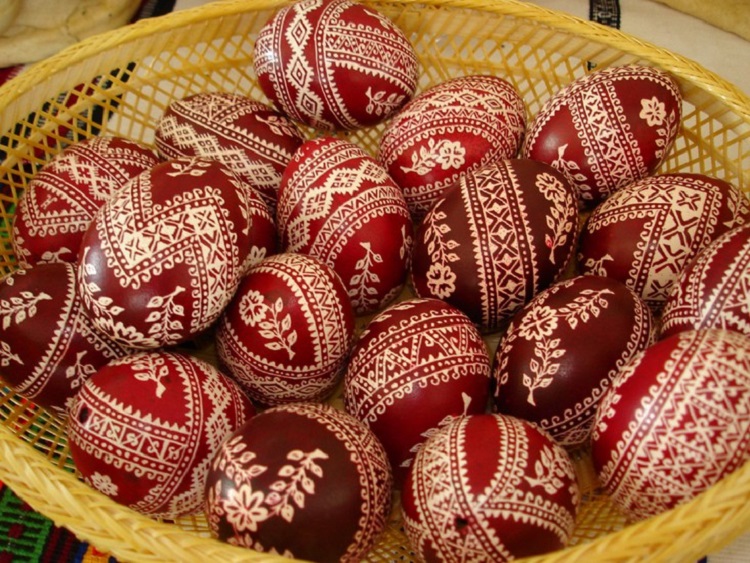
The eggs are symbolizing the rebirth, and the renewing of the life in heathen cultures. The tradition of the egg painting mainly preserved in the Eastern-European cultures. Originally the painted eggs were red, and they made them with natural materials for example with the peel of onion. Later writing became popular on the painted eggs, they used wax for it. In the Hungarian traditions the eggs are very common and important at Eastertime. The guys get eggs for the watering…but what about the most important Hungarian tradition, the watering?

00r1es0e1

The watering:

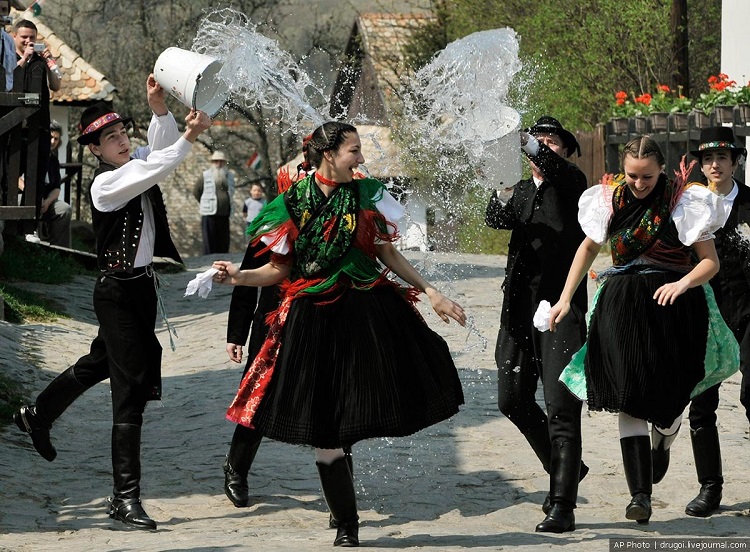
The watering is a fertility rite but it has Christian meaning also. The symbol of watering is connected to the baptizing too. In the Hungarian traditions the boys visiting the girls of the village and ask for the watering in a very kind way. They have to tell a sprinkling poem what sounds like this:

 “I was walking in a green forest
A saw a blue violet
it had started to wilt
my a sprinkle it?”

 After they finished the poem they can watering the girls of the house for what they get painted eggs and the invitation to the table. After a short talking and pálinka tasting they say goodbye and goes to the next nice girl’s house of the village or of the company. This tradition is still works in the Hungarian countryside and between friends in the cities also. To tell the truth it has got a very good socializing effect. So don’t hesitate today morning; grab a pencil write your poem and fill a bucket of water, don’t let wilting your female friends…

via: sulinet.hu; mek.oszk.hu / hungarytoday.hu

Reklám
Tas J Nadas, Esq

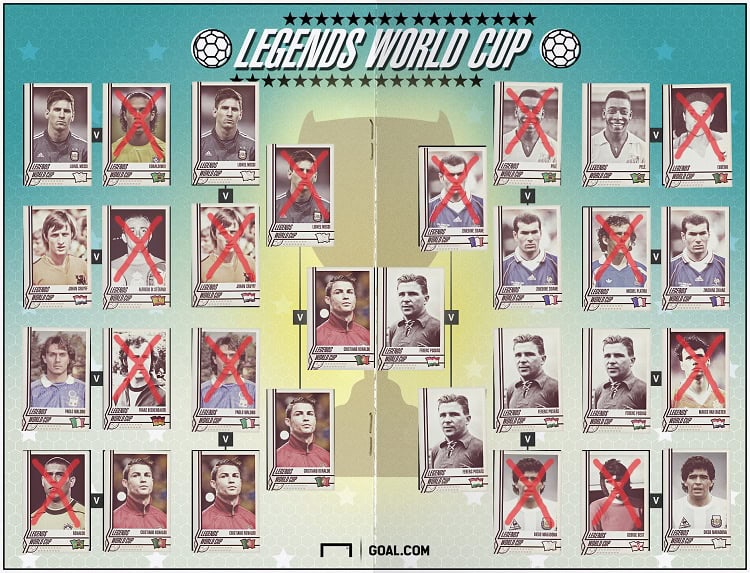
GOAL.COM: PUSKÁS KNOCKS OUT RONALDO TO BECOME WORLD CUPS’ BEST FOOTBALL PLAYER EVER

Hungary’s legend Ferenc Puskás has been named the best player in football world cups’ history after the legendary Budapest Honvéd and Real Madrid striker of the 1950s defeated fellow Real Madrid icon and Portugal ace Cristiano Ronaldo in the final of a voting competition made by popular football portal goal.com.

2929002

The knock-out voting competition called “Legends World Cup” saw Ferenc Puskás eliminating Marco van Basten, Diego Maradona and Zinedine Zidane on his impressive run to the final. Despite his worldwide popularity, Cristiano Ronaldo was relatively easily beaten by Ferenc Puskás as the Hungarian received 69% of the votes, including about 97000 votes from his homeland”, the London-based portal said. All in all, over  1,000,000 votes were cast in goal.com’s 16-player tournament.

YouTube player

Ferenc Puskás (1927-2006), also called the Galloping Major, scored 83 goals in 84 games with the Hungarian national team and was a member of three European Cup-winning teams (1959, 1960, 1966) with the Spanish club Real Madrid. He became Olympic champion in 1952 and led his nation to the final of the 1954 World Cup where he was named the tournament’s best player. In 2006 he was buried under the dome of the St Stephen’s Basilica in Budapest as millions of Hungarians went to the streets to mourn him.

 via goal.com and origo.hu / hungarytoday.hu

Reklám
Tas J Nadas, Esq

Hungarian Cultural Garden Association, a Bit of History

Garden


To weld the various nationalities of the cosmopolitan city of Cleveland into a close fellowship and to acquaint their cultural background with the native citizens,  a chain of cultural gardens was proposed to be designed and built by the various nationality groups each to symbolize something of that cultural background of which they were most proud of and best known.

The United Hungarian Societies of Cleveland delegated Albert A. Tudja and Stephen Gombozy to keep in touch with the movement and from time to time to report about its progress. In 1933 a committee was appointed under the auspices of the United Hungarian Societies to secure the plot of land and prepare plans for the Hungarian Garden. The committee selected a strip of land between the Shakespeare Garden in the German cultural Garden resembling the general contours of the Great Hungarian Plains and its surrounding and plans for the garden were drawn up by the landscape artists in Hungary.

In the fall of 1936 the United Hungarian Societies appointed a committee composed of the officers of the organization and several outside individuals. This committee was authorized to organize itself into the Hungarian Cultural Garden Association and to conduct the Affairs of the Garden. In the spring of 1939 a beautiful wrought iron gate — a Székely Kapu– was built and donated by the Verhovay Fraternal Insurance Association of Pittsburgh Pennsylvania and on the 11th of July of the same year the garden was dedicated with fitting ceremony.  A procession of about 5000 Hungarian Americans in native costumes opened the occasion that was attended by over 25,000 people. A choir of over 200 sang, noted speakers came from many parts of the country and the festival is remembered as one of the most impressive occasions of the city during the last few years.

In the spring of 1941 by authority of the United Hungarian Societies of Cleveland the Association was the organized with paying members. In December of the same year the garden was presented by the Magyar Club of Cleveland with a 40 foot flagpole and the American flag was dedicated with proper ceremony in the month of September. The Hungarian Cultural Garden Association expressed hope that the organization as well as the large Hungarian community of Cleveland Ohio will make donations from time to time to perpetuate the great work of our rich Hungarian tradition.


Source: Hungarians in America, Az Amerikai Magyarság Aranykönyve, published by Szabadság in 1941.

Reklám
Tas J Nadas, Esq

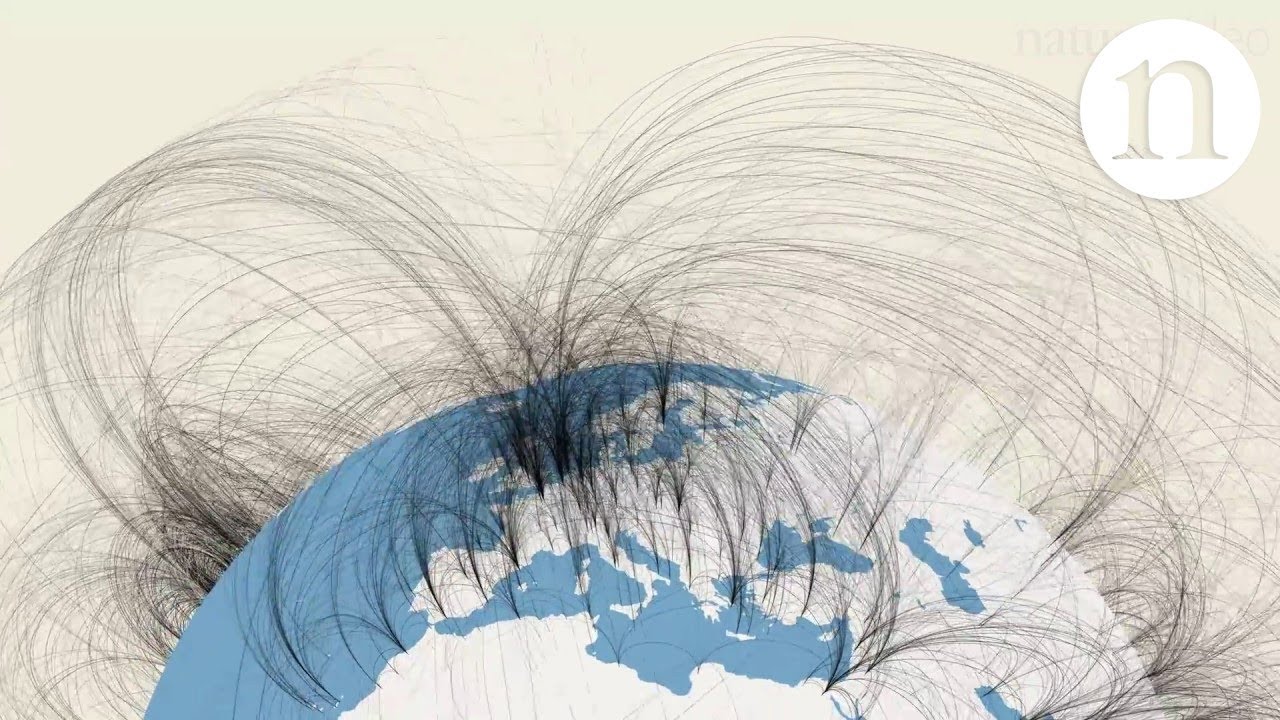
Researchers find the tipping point between resilience and collapse in complex systems

Using statistical physics, network scientist Albert-László Barabási and his colleagues have developed the first-ever tool to identify whether systems—be they technological, ecological, or biological—are in danger of failing. Photo by Matthew Moodono, Northeastern University

Hon­ey­bees have been dying in record num­bers, threat­ening the con­tinued pro­duc­tion of nutri­tious foods such as apples, nuts, blue­ber­ries, broc­coli, and onions. Without bees to pol­li­nate these crops, the envi­ron­mental ecosystem—and our health—stands in the bal­ance. Have we reached the tip­ping point, where the plant-​​pollinator system is due to collapse?
There was no way to cal­cu­late that—until now.

Using sta­tis­tical physics, North­eastern net­work sci­en­tist Albert-​​László Barabási and his col­leagues Jianxi Gao and Baruch Barzel have devel­oped a tool to iden­tify that tip­ping point—for every­thing from eco­log­ical sys­tems such as bees and plants to tech­no­log­ical sys­tems such as power grids. It opens the door to plan­ning and imple­menting pre­ven­tive mea­sures before it’s too late, as well as preparing for recovery after a disaster.

The tool, described in a new paper pub­lished on Wednesday in the pres­ti­gious journal Nature, fills a long­standing gap in sci­en­tists’ under­standing of what deter­mines “resilience”—that is, a system’s ability to adjust to dis­tur­bances, both internal and external, in order to remain functional.

The failure of a system can lead to serious con­se­quences, whether to the envi­ron­ment, economy, human health, or tech­nology,” said Barabási, Robert Gray Dodge Pro­fessor of Net­work Sci­ence and Uni­ver­sity Dis­tin­guished Pro­fessor in the Depart­ment of Physics. “But there was no theory that con­sid­ered the com­plexity of the net­works under­lying those systems—that is, their many para­me­ters and com­po­nents. That made it very dif­fi­cult, if not impos­sible, to pre­dict the sys­tems’ resilience in the face of dis­tur­bances to those para­me­ters and components.”

Our tool, for the first time, enables those pre­dic­tions,” said Barabási, who is also a leader in Northeastern’s Net­work Sci­ence Institute.

YouTube player

Taking a system’s temperature

Barzel, a post­doc­toral fellow in Barabasi’s lab who col­lab­o­rated on the research and is now at Bar-​​Ilan Uni­ver­sity, draws an ele­gant analogy between the role of tem­per­a­ture in iden­ti­fying that tip­ping point in a pot of water and the single parameter—a tem­per­a­ture equiv­a­lent, as it were—that their tool can uncover to iden­tify the tip­ping point in any com­plex system.

July 12, 2013 - Baruch Barzel, a Postdoctoral Research Associate in the Barabasi Lab, created a new mathematical method for finding the links between protein interactions in cells.
Baruch Barzel col­lab­o­rated on the research as a post­doc­toral fellow in Barabási’s lab.Photo by Brooks Canaday/​Northeastern University

Con­sider: 100 degrees Cel­sius is the tip­ping point for water changing from liquid to vapor. Think of liquid as the desir­able state for the system and vapor as the unde­sir­able one, sig­ni­fying col­lapse. Mil­lions of para­me­ters and com­po­nents quan­tify what is going on within that pot of water, from the rela­tion­ship of the water mol­e­cules to one another to their speed and the chem­ical bonds linking their elements.

As the water heats up, those para­me­ters and com­po­nents con­tin­u­ally change. Mea­suring those mul­ti­tudi­nous changes over time—a micro­scopic approach to assessing the water’s state—would be impos­sible. How, then, are we to know when the water is reaching the threshold that divides the desir­able (liquid) state from the unde­sir­able (vapor) state?

Simple: Using a single parameter—temperature. As the water in the pot reaches, say, 99 degrees Cel­sius, alarms go off and we know to remove it from the heat.

Sta­tis­tical physics has found that you can crunch down all of these mil­lions of para­me­ters and com­po­nents into one number—the tem­per­a­ture,” said Barzel. “We take it for granted now, but that was a tremen­dous sci­en­tific achievement.”

The researchers’ tool sim­i­larly crunches down all the para­me­ters and com­po­nents of any com­plex system into a single cru­cial number. It enables us, essen­tially, to take the system’s “tem­per­a­ture” to deter­mine its health and respond accordingly.

02/09/16 - BOSTON, MA. - Jianxi Gao poses for a portrait in the Network Science Institute on Feb. 09, 2016. Photo by Adam Glanzman/Northeastern University
Jianxi Gao, who col­lab­o­rated on the research, is a post­doc­toral fellow in Barabási’s lab. Photo by Adam Glanzman/​Northeastern University

We col­lect all the data and map it to one number, a uni­versal resilience curve,” said Gao, a postdoc in Barabási’s lab. “That’s the only number we need in order to quan­tify whether the system is on the desir­able or unde­sir­able side of the threshold, or even approaching the danger zone.”

From theory to application

Of course, the inter­ac­tion between, say, bees and plants in an eco­log­ical system is not the same as the inter­ac­tion between water mol­e­cules in a pot, noted Barzel. “But the way of thought and the math­e­mat­ical tools that we use—statistical physics—are very similar.”

A big dif­fer­ence, how­ever, is that we know how to pre­vent the water system from col­lapsing: Turn off the heat before the tem­per­a­ture reaches 100 degrees Cel­sius. Indeed, the water system on its own pro­vides a vis­ible clue as it approaches the tip­ping point: bub­bles. You can’t say the same for the dying bees. The problem leads nat­u­rally to the researchers’ next steps: Using sta­tis­tical physics both to detect trouble in a system early on and to bring about its recovery if it has crossed the threshold.

Once you iden­tify the rel­e­vant para­meter that con­trols the system’s resilience, you can begin to tackle how to manip­u­late that resilience—how to enhance resilience or restore resilience,” said Gao. “These are not easy ques­tions, but our theory, by giving us a pic­ture of the entire system, paves the way to the answers.”

Source: northeastern.edu

Reklám
Tas J Nadas, Esq

48 Hours in Cleveland: The Essential Guide to Doing a Weekend in Cleveland Right

wsmTime was when asking someone to spend 48 hours in Cleveland was like asking them to have a root canal sans Novocain. These days, things are quite different: There’s so much going on in Cleveland, two days isn’t nearly enough time to take in all of the city’s sights, sounds, restaurants and entertainment options. While below you’ll find one suggested itinerary for a 48-hour visit, we just as easily could’ve included catching a show at Playhouse Square, taking a stroll along the lakefront near the Rock Hall or in the Metroparks, checking out the resurgence of the Flats or browsing some of the city’s antique shops. But for the weekend visitor, we boiled down the city’s many splendid treasures into a manageable tour de force meant to capture as much of the glorious Forest City as possible. Of course, we recommend spending far longer than 48 hours here — Cleveland’s a bustling urban hotspot ripe for a weeklong sojourn — but if you’re here for a short stay, we have you covered. And we know you’ll want to come back.

Friday

5 p.m.: Hang out at Prosperity Social Club’s happy hour (1109 Starkweather Ave., prosperitysocialclub.com). It doesn’t get much more Cleveland than Tremont’s Prosperity Social Club. The inviting bar and restaurant, which stands in the former home of the legendary circa-1938 bar Dempsey’s Oasis, serves up classic Cleveland comfort food like pierogi, beer-battered fish and stuffed cabbage alongside a rotating craft beer list. Their happy hour is one of the city’s best deals, between the $2 domestic bottles and $4 microbrews, as well as food specials.

6 p.m.: Sip a cocktail at the Spotted Owl (710 Jefferson Ave.,spottedowlbar.com) Mixology is a big deal in Cleveland, thanks to places such as Tremont’s Spotted Owl, located in a former religious publications press built in the mid-1800s. The dark, cozy bar pairs a small selection of wines and beers with artisanal drinks such as Whiskey Fix of the Painproof Man, a fanciful libation containing bourbon, lime, broiled pineapple, artichoke and bitter chocolate.

8 p.m.: Catch a show at Cleveland Public Theatre (6415 Detroit Ave.,cptonline.org) The thriving local theater scene includes independent stalwarts such as Cleveland Public Theatre, which produces thought-provoking plays and actively helps promising local playwrights develop their craft. Highlights of their current season include Mr. Burns: A Post-Electric Play (subtitled “a post-apocalyptic tale of survival, passion and … the enduring power of Bart Simpson”) and Wrestling Jerusalem, which explores the nuances of the Israeli-Palestinian conflict.

Alternate selection: Check out the world-famous Cleveland Orchestra (11001 Euclid Ave., clevelandorchestra.com/plan-your-visit/severance-hall)

The phrase “cultural institution” is thrown around liberally, but in the case of the Cleveland Orchestra, it fits like a glove. When the renowned, respected musicians aren’t wowing audiences all around the world, they perform at their home base: gorgeous Severance Hall in University Circle.

11 p.m.: Grab a nightcap at Happy Dog (5801 Detroit Ave.,happydogcleveland.com). Quench your late-night hunger with a loaded hot dog (we’re partial to the bourbon pork ‘n’ beans to start) and a heaping helping of tater tots. Chances are, you’ll do so while enjoying live music: The Happy Dog books local and national touring bands on weekends.

Saturday

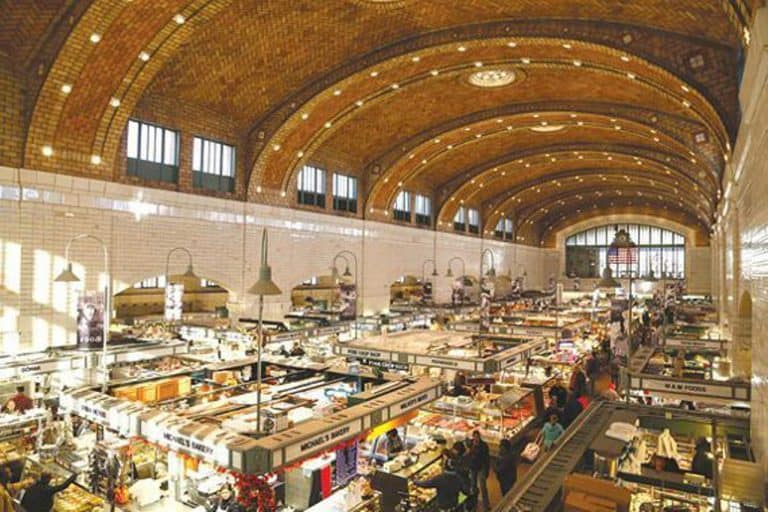
9:30 a.m.: Brave the crowds at the West Side Market (1979 West 25th St., westsidemarket.org) Saturdays are always hopping at the West Side Market, so head down early, grab some coffee and take a stroll through one of the city’s most eclectic destinations. Bonus: There are plenty of portable treats like local maple syrup, spices, olive oil, popcorn, and delicious baked goods to make the trip worthwhile.

11:30 a.m.: Linger over brunch at the Beachland Ballroom (15711 Waterloo Rd., beachlandballroom.com) Not only does the former Croatian Hall book plenty of must-see touring and local bands, but it also has one of the most well-curated, delicious weekend brunch/lunch menus in town. Try the fried chicken and waffles, an egg sandwich on a homemade buttermilk biscuit or a bloody mary garnished with bacon. (The mimosa pitchers are strong, too: Be warned.)

Alternate Choice: Ohio City’s Bon Bon Pastry & Cafe (2549 Lorain Ave.,bonboncleveland.com) is another excellent choice for morning munchies: Their all-day brunch menu features everything from breakfast tacos to vanilla bean french toast, as well as generous vegan/vegetarian options. (Tofu hash with plenty of veggies, anyone?)

1 p.m.: Buy some records at Music Saves (15801 Waterloo Rd.,musicsaves.com) and/or Blue Arrow (16001 Waterloo Rd.,bluearrowrecords.com) Cleveland is a music town through and through. Exhibit A: the sheer number of thriving independent record stores in operation. Two of the best are just down the street from the Beachland on Waterloo Road. The (mostly) vinyl Blue Arrow is a haven for casual fans and crate-diggers alike, while Music Saves is a must-visit if you’re looking for new tunes.

2:15 p.m.: Get a mid-day java jolt at Rising Star Coffee Roasters (1455 West 29th St., risingstarcoffee.com) The Hingetown neighborhood is a thriving haven for entrepreneurs such as Rising Star, whose tiny retail store and coffee shop (located in a firehouse, no less) is a little slice of caffeinated heaven.

3 p.m.: Take a tour of the Great Lakes Brewing Co. (meet at 1951 West 26th St., Suite 100; book in advance greatlakesbrewing.com/brewery-tours) On Fridays and Saturdays, local craft beer behemoth Great Lakes Brewing Co. gives tours of its Ohio City facilities for just $5. As an added bonus: Admission includes four 5-ounce tastings, so you’re guaranteed to leave the place in an, er, spirited mood.

Alternate activity: Visit the Transformer Station (1460 West 29th St.,transformerstation.org) This Cleveland Museum of Art satellite is a hidden gem, with rotating exhibits that tend toward the modern and experimental.

Alternate activity: If the weather’s nice, head over to Lakeview Cemetery, a wondrous treasure on the near-eastside that’s home to the final resting place of President James A. Garfield and hosts of other dignitaries and notables, including John D. Rockefeller, Eliot Ness, Carl B. Stokes and more. The grounds are pristine, the funerary sculpture remarkable, the view of the city unparalleled, and the history unmatched.

5 p.m.: Grab an early dinner at Crop Bistro & Bar (2537 Lorain Ave, Cleveland) Chef Steve Schimoler has opened three new restaurants on the burgeoning Flats East Bank, and another one in University Circle, but his anchor operation is still Ohio City’s Crop Bistro & Bar. The upscale contemporary American restaurant offers a nice selection of artisanal cheeses as a prelude to a generous menu of inventive meat, pasta and seafood entrees.

7 p.m.: Indulge your sweet tooth at Mitchell’s Ice Cream (1867 West 25th St., mitchellshomemade.com) Despite cold temperatures, ice cream is big business here in the C-L-E. Hometown favorite Mitchell’s Ice Cream recently opened a store on Ohio City’s main drag —making it easier than ever to get your chocolate (fudge) on.

Alternate suggestion: Drop by Jukebox (1404 West 29th St.,jukeboxcle.com) Not hungry for dessert? Spend some time perusing the ever-changing, always-interesting selections on the old-school jukebox at this Hingetown bar.

8 p.m.: Bowl at Mahall’s Lanes (13200 Madison Ave., Lakewood,mahalls20lanes.com) Founded in 1924, Mahall’s Lanes is a Cleveland institution with a small (but mighty) selection of beers and 10 charming, old-school bowling lanes. The alley also hosts concerts from up-and-coming indie, punk and rock bands.

9:30 p.m.: Sample a pint or two at Griffin Cider House (12401 Madison Ave., Lakewood, griffinciderworks.com) Griffin Cider is a locally produced, authentic English cider made with plenty of TLC. The company’s recently opened pub offers eight cider and four craft beer taps, an experience which will make you feel like you’re actually drinking in London.

11 p.m.: Scarf down some late-night tacos at Barrio (15527 Madison Ave., Lakewood, barrio-tacos.com) Tacos are the unofficial late-night food — okay, anytime food — of Cleveland. One of the most popular joints is Barrio, which offers customized, build-your-own tacos and a dizzying (pun intended) array of tequila, whiskey and cocktails.

Sunday

9:30 a.m.: Fuel up with breakfast at Lucky’s Cafe (777 Starkweather Ave., luckyscafe.com) Lucky’s Cafe is a go-to brunch/breakfast spot in Cleveland, mainly due to the quality of the food. The charming cafe’s weekend brunch menu is a reliable standby featuring filling sandwiches and morning faves such as biscuits and gravy, a breakfast burrito and homemade granola.

11:30 a.m.: Tour the Rock & Roll Hall of Fame and Museum (1100 East Ninth St., rockhall.com) No trip to Cleveland is complete without a swing through the Rock Hall, which offers a multi-sensory experience with a deep reverence for history and something for all music fans — whether obsessed with Elvis or beholden to Bowie.

1:30 p.m.: Have a decadent snack at Coquette Patisserie (11607 Euclid Ave., coquettepatisserie.com) Two words about Coquette Patisserie: French pastries. Need we go on? How about this: This quaint uptown bakery and wine bar offers a mouthwatering array of decadent desserts and sweet trifles, including (of course) macarons, marzipan and cream puffs.

Alternate selection: Stroll down Mayfield Road

Pop into any number of bakeries and storefronts in Cleveland’s historic Little Italy neighborhood. Grab a latte, grab some fresh pastries, and enjoy the scenery.

2:30 p.m.: Soak up some culture at the Cleveland Museum of Art(11150 East Blvd., clevelandart.org) Cleveland’s art scene has many underrated, understated galleries and museums to explore; indeed, you could spend the better part of your week exploring those alone. If you only have a few hours, however, a trip to the Cleveland Museum of Art is a must. You won’t be able to see all of the museum’s 30,000 art pieces, but it’s difficult to quibble with only seeing Picasso, Matisse and Warhol on display. Best part? Admission to this world-class museum is free.

5 p.m.: Have an early dinner at the Greenhouse Tavern (2038 East Fourth St., thegreenhousetavern.com) End your weekend in Cleveland with a meal at the Greenhouse Tavern, the beloved restaurant helmed by James Beard Award-winning chef Jonathon Sawyer. While you can go whole hog — one of the establishment’s most notorious dishes is a roasted pig’s head — the menu also offers plenty of other inventive spins on hearty American cuisine. Plus you get a chance to check out East Fourth Street in all its glory.

Source: clevescene.com / by

Reklám
Tas J Nadas, Esq

WHAT DO HUNGARIANS CELEBRATE ON MARCH 15?

1848-hungary-600x400

More than 160 years passed, but the Hungarian Revolution of 1848 associated with Petőfi’s name is still commemorated by the Hungarian people. Multiple elements of the 12 points composed by the Pilvax Circle are still a relevant topic in the present, utisugo.hu reports. A long time under pressure eventually led to a revolution on March 15, 1848. The same monarch ruled over the Kingdom of Hungary and the Austrian Empire, and the National Assembly of Hungary could only hold sessions in Latin or German language. Hungary couldn’t gain autonomy and the lowered taxes alone were not enough for the positive perception of the social opinion climate. Although the French Revolution of 1789 ended decades ago, it had an enormous influence on the intellectual class. Moreover, the French declared war against the Habsburg Monarchy, which reached the territory of Hungary in 1805. Napoleon then ordered Hungarian nobilities to separate from the Habsburg dynasty, however, he lost the war in 1815. The demand for home products then decreased rapidly and the inflation hit.

Lajos Kossuth informed his nation about the controversy behind the curtain in his periodical called ´Országgyűlési Tudósítások´, which launched in 1832. Consequently, reform movements began to play a bigger role in the country. Count Lajos Batthyány became the leader of the opposition, in which Ferenc Deák also took part. Meanwhile in February 1848, a revolution started in France, then another in Vienna, March 13. The news spreaded quickly and made an impact on Pilvax Circle members like Sándor Petőfi, Mór Jókai and Pál Vasvári. Only a few people headed to the press of Lajos Landerer and Gusztáv Heckenast to print József Irinyi‘s 12 points and Petőfi‘s National Poem, without censure. Despite the small number of participants at the press, more, than 10 000 people joined the congress on March 15 in front of the Hungarian National Museum. The congress then entered the Castle, where the Governor’s Council approved their demands. Mihály Táncsics was set free, and the revolution succeeded without spilling blood. Unfortunately, the celebration and freedom couldn’t last long. The Hungarian Revolution of 1848 will be celebrated in Budapest: 9.00 – Hoisting of the national flag.

10.30 – Viktor Orbán’s speech in Múzeumkert.

10.00 – 17.00 Family activities in Buda Castle.


Source: https://www.utisugo.hu/

Reklám
Tas J Nadas, Esq

St. Elizabeth of Hungary

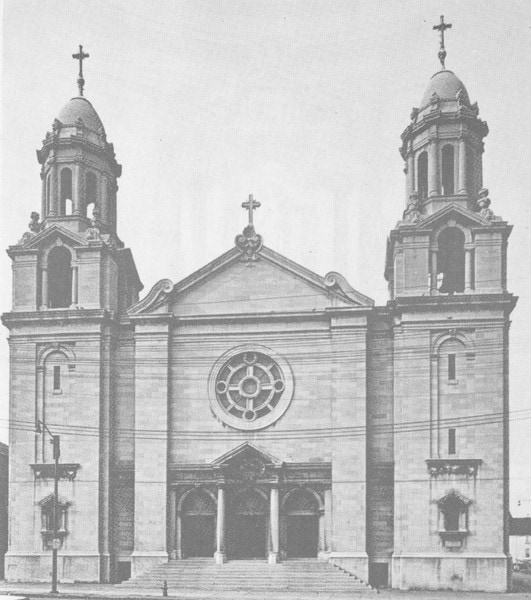
St. Elizabeth of Hungary Roman Catholic Church sits on the corner of Buckeye Road and East 90th Street in Cleveland’s Lower Buckeye neighborhood. In the late nineteenth century, the neighborhood became home to thousands of Hungarians immigrants who were drawn to the area by nearby factories and mills, especially the Cleveland Malleable Iron Company and the Eberhard Manufacturing Company, which were known to these immigrants as, respectively, the “old” factory and the “new” factory.

Hungarian immigrants initially worshiped alongside Slovak immigrants at St. Ladislas Church, located on the corner of Holton Avenue and East 92nd Street. However, when a dispute broke out between Hungarian and Slovak parishioners as to which mass should be said in which ethnic group’s native language, the Hungarians were induced to leave St. Ladislas and form a parish of their own. That new parish became St. Elizabeth of Hungary parish, the first Roman Catholic Hungarian parish in the United States.

The first parish church was built in large part as a result of the efforts of Father Karolyn Boehm. Arriving in America in 1892, Fr. Boehm temporarily held masses for the parish in a nearby hall and led the efforts of the parish in constructing a small wood-framed church on the corner of Buckeye Road (then called South Woodland Avenue) and East 90th Street (then called Bismark Street).

On June 4, 1893, the cornerstone of the first St. Elizabeth’s Roman Catholic Church was laid. This first church provided seating for up to 800 Hungarian immigrants at a single mass. Within a decade, however, it was too small to accommodate the thousands of Roman Catholic Hungarian immigrants arriving in Lower Buckeye. As early as 1907, Father Szepessy, the second pastor of St. Elizabeth began to petition the Bishop of Cleveland for permission to raise money to build a new church that would hold up to 1300 parishioners. Permission was finally granted by the bishop and, in 1918, construction of the new church was begun.

The new church, designed by French-born architect Emile Uhlrich, was completed in 1922. The church is a large rectangular building with a gable roof and exterior masonry walls composed of large smooth grey blocks of stone. A prominent feature of the Church are its twin bell towers which flank the front of the building, each topped with a brass dome and an internally illuminated cross. The two exterior side walls of the Church are each graced with six large stained glass windows with semicircular arches. The Church has a front entrance way consisting of ten wide and deep stone steps that lead up to three large metal front double doors with semicircular arches above them. Each doorway is flanked by stone columns, and above the doors, arches and columns is a decorative triangular pediment. The facade of the building also features a large ornate circular window with carved stone decoration directly above the front doors.

De-industrialization and suburbanization induced the Hungarian population to begin leaving the Buckeye neighborhood in the 1960s. Today, few Hungarian-Americans live in the Buckeye neighborhood. A small group of Hungarian-Americans–most of whom live in Cleveland’s suburbs, however, continue to worship at St. Elizabeth of Hungary. The church now serves as a symbol and reminder of the once thriving and bustling Hungarian-American population that resided in Cleveland’s Buckeye neighborhood for nearly 100 years.

The present St. Elizabeth Roman Catholic Church was constructed between 1918 and 1922. The imposing structure was built at a cost of $350,000, a huge sum in that era. The church is a neoclassical structure that displays Renaissance and Baroque elements.  Photograph courtesy of Cleveland State University Library, Special Collections
The present St. Elizabeth Roman Catholic Church was constructed between 1918 and 1922. The imposing structure was built at a cost of $350,000, a huge sum in that era. The church is a neoclassical structure that displays Renaissance and Baroque elements.
Photograph courtesy of Cleveland State University Library, Special Collections

Source: clevelandhistorical.org / By Jim Lanese & Jim Dubelko

Reklám
Tas J Nadas, Esq

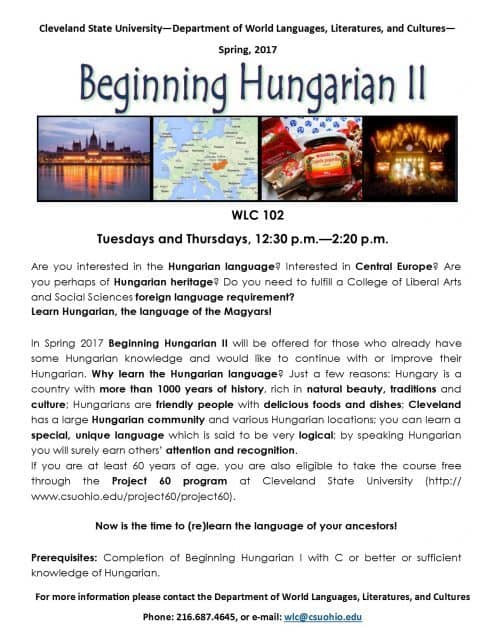
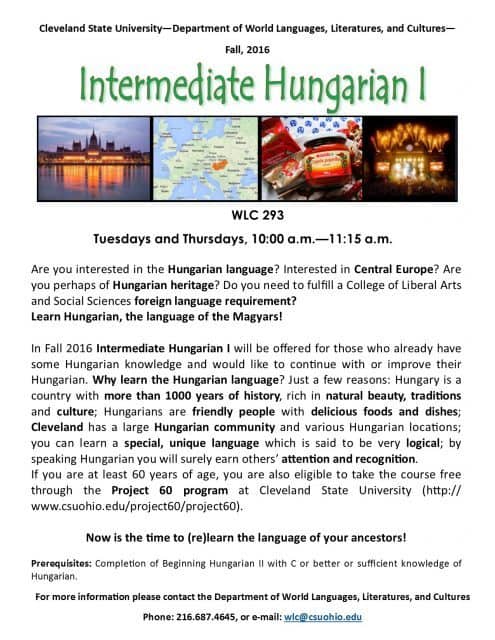
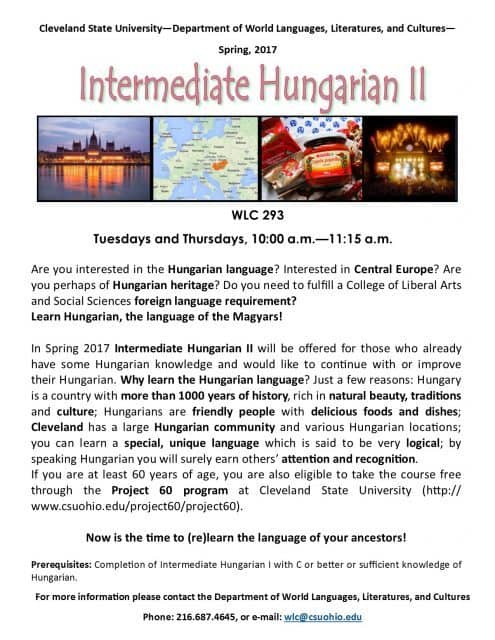
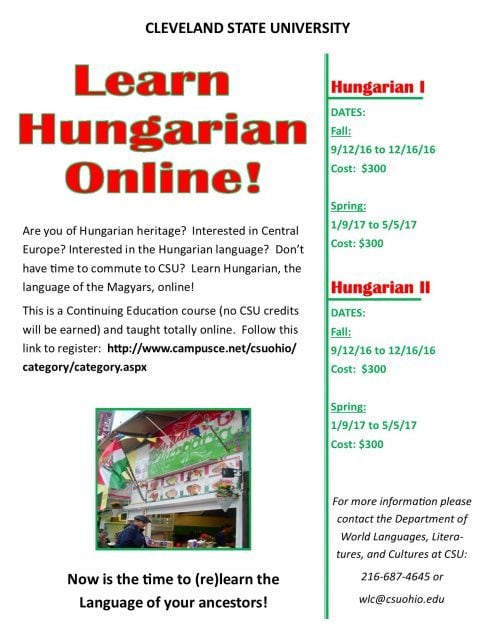
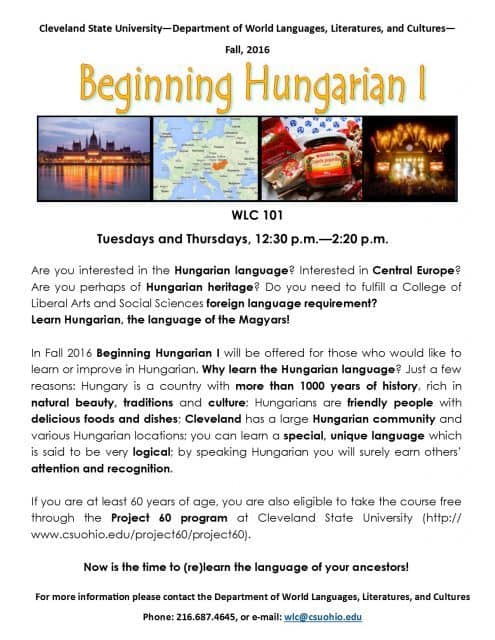
Hungarian courses at Cleveland State University in the academic year 2016-2017

In the Fall term of the academic year 2016-2017 the following courses in Hungarian language are to start at Cleveland State University, Department of World Languages, Literatures, and Cultures:

WLC 101 – Beginning Hungarian 1
(August 29, 2016 through December 17, 2016, Tuesdays and Thursdays, 12:30-2:20 pm)

WLC 293 – Intermediate Hungarian 1
(August 29, 2016 through December 17, 2016, Tuesdays and Thursdays, 10:00-11:15 am)

Online Magyar 1 (September 12, 2016 through December 16, 2016)

Online Magyar 2 (September 12, 2016 through December 16, 2016)

In the Spring term of the academic year 2016-2017 the following courses in Hungarian language are offered:

WLC 102 – Beginning Hungarian 2
(January 17, 2017 through May 12, 2017, Tuesdays and Thursdays, 12:30-2:20 pm)

WLC 293 – Intermediate Hungarian 2
(January 17, 2017 through May 12, 2017, Tuesdays and Thursdays, 10:00-11:15 am)

Online Magyar 1 (January 9, 2017 through May 5, 2017)

Online Magyar 2 (January 9, 2017 through May 5, 2017)

Enrollment to the courses opens in the beginning of March, 2016, and CSU is happy to welcome everyone interested in the courses.

Further information: Dénes Mátyás, d.matyas@csuohio.edu, 216 413 88 69, or see the flyers attached.

Hungarian Continuing Education Fall 2016 Spring 2017WLC 101 Beginnning Hungarian I_Fall_2016WLC 102 Beginnning Hungarian II_Spring_2017WLC 293 Intermediate Hungarian I_Fall_2016WLC 293 Intermediate Hungarian II_Spring_2017

Reklám
Tas J Nadas, Esq

Study and Scholarship Opportunities in Hungarian Language and Culture in Hungary

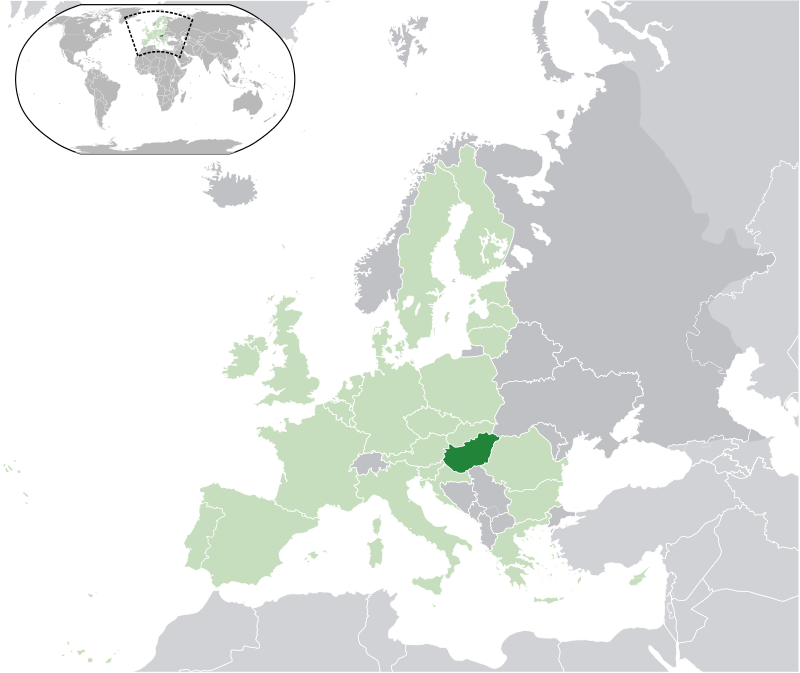
Hungary is within easy reach! Hungarian institutions offer study and scholarship opportunities in Hungarian language and culture in Hungary – not for students only. Each institution has long-term experience in teaching Hungarian language and culture, organizes excellent programs (summer universities, semester studies etc.) at all levels (Beginning, Intermediate, Advanced, and so on), with lots of personal enrichment, fun, excursions etc., and each city has its own particular beauty.
Please visit the following websites to learn about the study and scholarship opportunities, discounts, application requirements and deadlines, as well as the organizing institutions themselves.

Tempus Public Foundation: 
Call for application for Hungarian State Scholarships (application deadline March 18, 2016):
https://tpf.hu/docs/palyazatok/call_for_applications_2016_2017_en.pdf
https://tka.hu/international-programmes/4133/information-for-applicants

Balassi Institute (Budapest):
Call for application for Balassi Summer University 2016 (application deadline March 9, 2016):
https://www.balassiintezet.hu/en/call-for-applications/1574-call-for-scholarship-applications-balassi-summer-university-2016/

University of Debrecen (Debrecen): 
Information about Debrecen Summer Course (application deadline: June 30, 2016), other study programs, discounts etc.:

Kezdőlap


https://www.nyariegyetem.hu/hasznosinfo.php

Eötvös Loránd University (Budapest):
Information about Summer University of Hungarian Language and Culture (early bird registration deadline: April 30, 2016, continuous registration deadline: July 15, 2016), other study programs, discounts etc.:
https://www.elte.hu/en/summer_university_hungarian
https://www.elte.hu/en/language_courses

University of Pécs (Pécs): 
Information about Hungarian Language and Culture Summer University (early bird registration deadline: March 15, 2016, registration deadline: July 1, 2016), other study programs, discounts etc.:
https://www.isc.pte.hu/hirek/95
https://international.pte.hu/

University of Szeged (Szeged):
Information about Summer Course in Hungarian Studies and Hungarian Language (application deadline: July 1, 2016), other study programs, discounts etc.:
https://www2.arts.u-szeged.hu/hungarianstudies/index.htm
https://www2.arts.u-szeged.hu/hungarianstudies/summer.htm

Take this opportunity, have a unique experience, study in Hungary!


Hungary

Reklám
Tas J Nadas, Esq

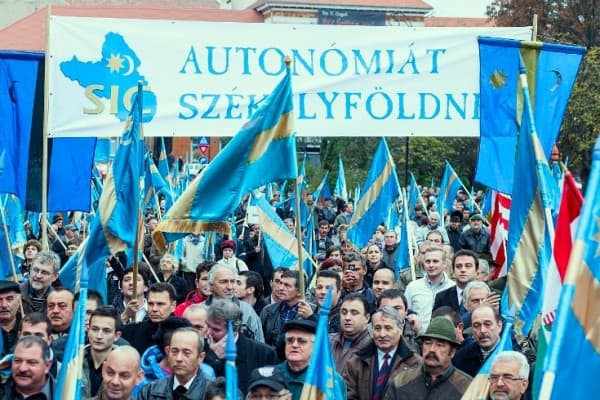
This is How the Romanian Secret Service Works in Szeklerland

174_bigger

Secret service agents, state officials fulfilling orders, full-time challengers are trying to intimidate Hungarians and provoke them into things that the power in Bucharest can refer to when acting. Mno.hu presents some of them.

Romanian journalist Dan Tanasa happily announced on February 6 that his professional Facebook page received 10 thousand likes. Four days earlier he wrote that his blog was visited by 372 thousand people last year. The Romanian internet analyzing service says that he is one of the most popular authors in Romania.

Ethnic cleansing

Who is this 34-year-old man who brought dozens of Hungarian local governments in Szeklerland to the court? According to people who know his family, he is the son of simple Romanian workers. He was born in Sepsiszentgyörgy, Szeklerland, he went to school there, he graduated at the Transilvania University of Brasov, the Faculty of Education and Psychology, and he earned a master’s degree of communication and PR in 2011.

During the national-communist dictatorship a truly distorted picture was developed of Hungarians. They were told to be an alien and hostile population recently settled in the Romanian land with excessive and unjustified claims. They were told to be following hidden aims always moving against Romanians, mno.hu reported.

Dan Tanasa, by his own confession, has been writing since 2008 on the “massive abuses of local governments controlled by RMDSZ and the Hungarian Civic Party” that are committed against the Romanian residents of Hargita and Kovászna county. He also writes accusations to stop “ethnic cleansing” to which the Romanians are exposed. Sepsiszentgyörgy mayor, Árpád Antal, said that they have one or two people who always have to deal with the answering of Dan Tanasa’s questions. Fomer Social Democrat Senator, current mayor of Craiova, Lia Olguta Vasilescu said: “if Dan Tanasa did not exist, we would have to have invented him”.

He reports in the name of the Civil Association for the Pride in Europe (ADEC), which is chaired by the blogger. The other three founders cannot be found on the social sites. The association has objectives, like the promotion of the Romanian nation-state, the protection of fundamental human rights, at least in the exclusive cases of the Romanian-speaking Romanian citizens.

Agent or messenger?

Mno.hu asked several people, including colleagues, about the Dan Tanasa phenomenon in Transylvania. Most people only talk anonymously, because they are afraid that the notorious blogger would harass them and immediately cite them to the court. Almost everyone thinks that he has relations with the secret services. He spent years in Spain and now he lives in Germany, so he is likely to work for the Romanian foreign intelligence. Otherwise, he could not have been informed about the fact that the mayor of a small Székely Land settlement put up the Székely flag. The blogger reported that with photos within days.

László Szőke, Transylvanian journalist, wrote on szekelyhon.ro that Tanasa gets a lot of awards. Voiculescu Family Foundation awarded him a 3 and a half million HUF (11,290 EUR) for his courage with which he protects the Romanians of Hargita-Kovászna counties. Voiculescu himself was sentenced to 10 years by the national anticorruption prosecutor’s office (DNA). Mno.hu knows that the blogger already received a scholarship from the foundation during his university studies. He is also a frequent guest at Antena 3 TV that is owned by Voiculescu.

Mno.hu asked Dan Tanasa about his reports, complaints and observations, but he has not responded so far.

Relationship network, or the network is alive and well

If you search through the Facebook profiles of some people it becomes revealed that Dan Tanasa is in a daily contact with former and current Romanian Prefects of Hungarian-populated counties, with Székelyföld Romanian Orthodox bishop Ioan Selejan and with various organizations of Székelyföld Romanians.

While he wins several lawsuits sometimes he also takes a knock. In 2014, he complained about the Nyírő József commemorative ceremony, because he believes that the organization popularized Fascist, anti-Romanian and anti-Semitic views. The Gyegyószentmiklós prosecution rejected it.

State employee Mircea Diacon – who was sent to Háromszék – is the enthusiastic supporter of the blogger. He is the head of the Kovászna County Consumer Protection Office and he strikes down on every perceived or real illegitimacy, mno.hu said.

Székely flavor

Diacon has led the office since 2013. When he punished the Háromszék butchery for the use of the phrase “Székely flavor” he explained it by how there is no such thing as a “Székely flavor”. However, he did not respond to the question asked about the phrase “traditional Romanian flavors” which can be found in several Romanian stores.

According to mno.hu, his zeal becomes tragicomic at times: since he insists on the Romanian labeling for every product, he made the name Rigó Jancsi sweets of Rigó Jancsi pastry shop change into “Mierla Ionica” with the Hungarian name below.

Photo: MTI Copy editor:

bm Source: mno.hu / dailynewshungary.com

Reklám
Tas J Nadas, Esq

9 Amazing Facts About the Hungarian Language that Most People Don’t Know

hungarian-lang

The szabadonebredok.com is collected 9 interesting things about the Hungarian language:

1. Did you know that one of the earliest remaining fragments of the Hungarian language was found in Nova Scotia, Newfoundland? Yarmouth County Museum in Nova Scotia keeps a unique artifact – Runic Stone, which proves that at least one Hungarian was in America before Columbus. Tyrkir, who accompanied Vikings on the voyage of the great discoveries around the year 1000, was Hungarian. Samuel Laing has first disclosed this information about Tyrkir back in 1844, in London. Tyrkir carved in stone a 13-character inscription. Many theories and centuries later linguists denied the Norse Rune theory. The text on the stone was not written with a Runic alphabet, but in the Old Hungarian. In 1984 Szilva Lajosné has translated the infamous inscription – Ericson járt e hejen is sok társával.

2. Did you know that one of the most valuable incunabulum in the Library of the British Museum in London has a following opening sentence –“Az Ephesom helyeknek yrth Zent Pál levelének elsew capitoliuma”. The text, which is written in Hungarian, is a part of the book that was published in 1533.

3. Did you know that a group of linguists from the Department of Linguistics and Phonetics of Sorbonne University decided to conduct an antiquity exam of the several languages? With a help of modern technologies and necessary tools scientists decided to establish which languages has preserved the most ancient elements of literacy and has the most etymons (the linguistic form from which another form is historically derived). According to the results: modern English contains 4% of etymons, Latin 5%, Hebrew 5%, the Pacific languages 7%, Indian languages 9%, Tibetan Sanskrit 12%, ancient Turkish and Turkmen 26%; however the language that contains the most of etymons is modern Hungarian – 68%!

4. Did you know that linguists put a huge emphasis on the question of antiquity of modern languages? They conduct scientific research analyzing ancient ancestors and range of evidences from the tests. The Hungarian linguists, historians, professors have been working on that matter for over than 200 years. Everyone from Kerestesi József, Horváth István, Kőrösi Csoma Sándor, Táncsis Mihály, Varga Zsigmond, Pass László and many other inspiring Hungarian professionals have shown impressive dedication in conducting the antiquity examinations of the Euroasiatic languages. KeményFerenc is a linguist (he understands 40 languages and speaks 15) claims that the oldest of the Euroasiatic languages is the Hungarian language.

5. Did you know that Hungarian family names have been used as the geographical names in many places all over the world? Dr. Vámos- TóthBátor, who lives on Hawaii Islands, and his colleagues have done a great job collecting examples of the Hungarian names and words used in the countries on all across the globe. They have established that over 6000 locations have Hungarian names. There are many examples of the Hungarian names given to geographic locations, cities, smaller towns, rivers, and hills in India, Iraq, Malta, Tunisia, Burkina Faso, Philippines, and Caucasus region, alongside Udmurtia. The most common names are: Almás, Káldi, Kocsis, and Vajas.

6. Did you know that Sir John Bowring, who was an English political economist, traveller, polyglot and a 4th Governor of Hong Kong, spoke fluent Hungarian? He translated many Hungarian poems into English -the book title was “Poetry of Magyar”. As a foreword of the book he wrote the following :” The Magyar language stands afar off and alone. The study of other tongues will be found of exceedingly little use towards its right understanding. It is molded in a form essentially its own, and its construction and composition may be safely referred to an epoch when most of the living tongues of Europe either had no existence, or no influence on the Hungarian region.”

7. Did you know that the Hungarian language is one of a kind in term of Effects of Compression on language? There is no denial about this language being a truly unique linguistic phenomenon. The Hungarian language is very rich, and has absolutely unique phonetics of the consonants. Alongside 19 noun cases, numerous suffixes, prefixes, and verb conjugation.

8. Did you know that in the Western countries alphabet usually contains around 7 vowels? For example, in Italy there are only 5.Whereas the Hungarian language recognizes and uses 14 vowels: a-á, e-é, i-I, o-ó, ö-ő, u-ú, ü-ű.

9. Did you know that in the list of the most melodic languages first comes the Italian language, followed by the Greek and the third most melodic language is the Hungarian? Giuseppe Mezzofanti, who was an Italian cardinal and famous linguist and hyper polyglot (he could write in 58 languages and could speak 103 languages), once said to the Czech linguist, Ludwig August Frankl: “Do you know which language is equal to Latin and Greek in its structure and rhythmic harmony? It is the Hungarian language. I am familiar with the new Hungarian poets, whose verses are completely mesmerizing. Let us watch the future, for the poetic genius will have a sudden upswing, which will prove my statement to be true. It seem as if the Hungarians themselves do not realize what a treasure is hidden in their language.”

based on article of szabadonebredok.hu

translated by Ekaterina

Egorova Photo: szabadonebredok.hu

Source: www.szabadonebredok.hu

Reklám
Tas J Nadas, Esq