

Home Blog Page 6

‘It Would Be a Sin to Do Nothing Even If We Cannot Do Everything’

Source: hungarianconservative.com

A Snapshot of the Hungarian Diaspora in North America

Our family moved from Budapest to the United States (New Jersey) in the summer of 2022. We immediately enrolled our three children in the Hungarian Scouts in Garfield, as well as the Montclair Hungarian Weekend School, and became involved in the life of the Hungarian St. Stephen Roman Catholic Church in Passaic. Later, we also got to know the Hungarian community in New Brunswick and occasionally attended Hungarian events across New York, Cleveland (Ohio), Washington DC, and some other states, as well as in Canada, so I explored quite a few Hungarian communities. The present article is a summary of the varied and in many ways enlightening picture that I have formed on the basis of a series of interviews with members of the Hungarian diaspora in North America, as well as reports on various Hungarian diaspora events.

In the course of our active family life and my enthusiastic journalistic work, I have had the opportunity to meet many Hungarian Americans during the last year and a half. I have written nearly a hundred articles about their past, particularly in relation to major historical events of the last century (the Second World War and 1956), which often turned out to be as interesting as an adventure novel or a heart-breaking drama. I have also written about the present; about the joys and difficulties of everyday lives, burdened with the additional challenges of diaspora life, as well as about the preservation and transmission of Hungarian spiritual and cultural heritage. I believe that by doing so I managed to develop a comprehensive understanding of current prospects and perhaps the likely future of the Hungarian diaspora in North America—for now, mainly on the East Coast.

My interviewees include former or current leaders and representatives of various Hungarian churches and civic associations, including Hungarian scout troops, weekend schools and school camps, traditional folk dance groups and folk music bands, local clubs, and national associations. These Hungarians are heavily committed to local and national Hungarian community life, and while they are not necessarily well-known or ‘famous’, often being known only locally, they are trying to pass on their faith and their Hungarian language and culture not only to their own children, but also at the community level. Out of these interviews, thirty-seven were selected in the first part of the interview book Magyarnak lenni Amerikában,2 (To Be Hungarian in America), published by Radio Bocskai of Cleveland (Ohio). I have also made several reports on various Hungarian diaspora events (first communions, organizational anniversaries, Hungarian festivals, film screenings, book reviews, etc.), and on various American and/or Hungarian holidays (Christmas, Easter, Mother’s and Father’s Day, Halloween, Thanksgiving, Valentine’s Day, etc.).

‘The most important keystones for the survival of this community are the perseverance and exemplary involvement of the committed Hungarian Americans’

There are one and a half million people of reported Hungarian descent living in North America. Based on my personal experiences and interviews with members of the Hungarian American diaspora, it appears that the most important keystones for the survival of this community are the perseverance and exemplary involvement of the committed Hungarian Americans, the preservation and cultivation of the Hungarian language, culture, and traditions, both at the family and community level, and the close cooperation between Hungarian religious and civic organizations. This may sound straightforward or even simple, but in fact it is very complex and difficult, given that the old ‘Hungarian quarters’—city neighbourhoods inhabited by mostly Hungarians who arrived with various immigration waves at the turn of the nineteenth and twentieth centuries, after the Second World War, and after 1956—have largely disappeared. Only a much smaller number of economic migrants have arrived in recent decades. As such, Hungarians do not currently live in large aggregations, and their attitude towards the preservation and generational transmission of Hungarian identity, language, and culture has significantly changed.

Families

When you move abroad, either of necessity or at your own initiative, the inevitable clash between the host and home cultures raises questions about the future of your mother tongue, culture of origin, and national identity. In a foreign language environment, the use of the mother tongue is not obvious, nor is the development and preservation of the original identity. School-age Hungarian children spend much more time in different educational institutions and with their American friends than with their parents, who typically work long hours.

As Beáta Krasznai3—a psychologist and teacher who has lived in the United States for more than twenty years—explained to me, from a linguistic perspective, the role of the primary caregiver, that is the person who spends the most time with the child (which is usually, but not always, the mother) is of paramount importance. Sometimes the parent speaks good Hungarian, but often switches to English for various reasons (mixed marriage, convenience, conformity, etc.), which is understandable but not useful for language acquisition purposes. Linguistically, of course, one of the biggest challenges is mixed marriage, where English is often used as a compromise. However, there are also many positive examples of parents who do not feel excluded from the family if their partner speaks to their child in his or her mother tongue, and the child thus learns two or three languages at home. At the same time, there are many other (financial, health) pressures on families, which mean that language may not necessarily be the most important factor for them, or which may render Hungarian or multilingual family life unfeasible. In short, a lot depends on the attitude of the parents, the strength of their relationship, and the quality of communication within the family.
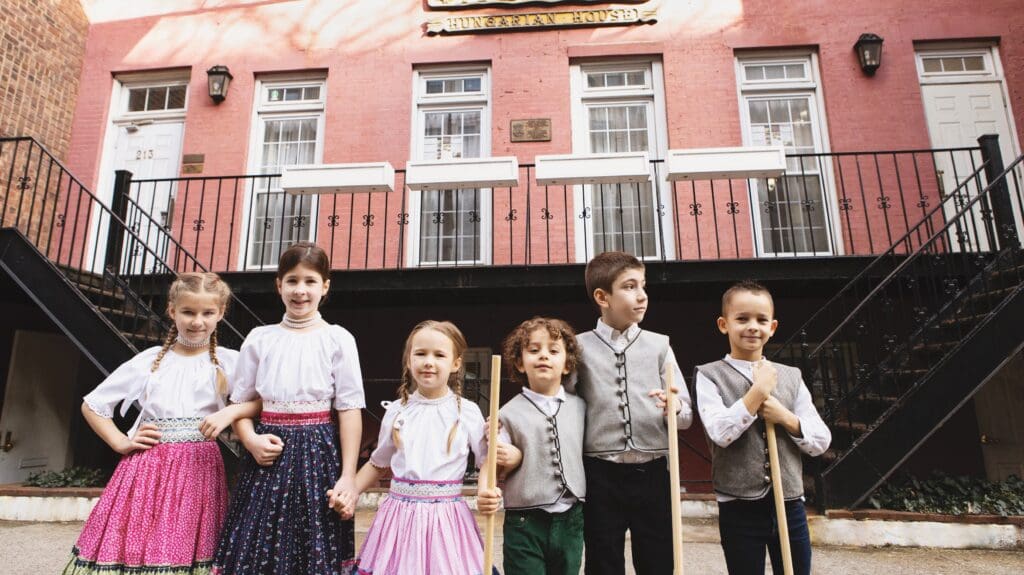
Hungarian American children wearing folk costumes pose outside the Hungarian House in New York. PHOTO: Courtesy Arany János Hungarian School, New York

When it comes to language learning, I could go on at length about the misconceptions that still exist today, shared with me by Hungarian school teachers and principals, despite the well-known fact that once in an educational institution and community, every child learns English ‘on their own’ within a few months. So the primary task of Hungarian parents is (or should be) to cultivate and teach the Hungarian language and Hungarian culture at home. Of course, the issue of culture is closely related to language: Hungarian weekend schools try to teach basic Hungarian history, geography, folk songs, and common folk traditions, etc., but they cannot do wonders in the space of two to four hours per week, while American public schools give only minimal grounding in non-American subjects. Therefore, in order for this knowledge (hopefully) established at home and taught in weekend Hungarian schools to be retained and incorporated, the active involvement of parents is key. This is not necessarily easy even in a Hungarian environment back in Hungary, let alone in North America, where parents and children are ‘burdened’ by a multilingual environment, vast physical distances and intensive workload, and typically looser family ties. Also, Hungarian families usually do not have grandparents living anywhere close. They are generally not part of the families’ everyday lives and are therefore replaced by friends and communities, whose role is even more valued in a foreign environment.

‘In a foreign language environment, the use of the mother tongue is not obvious, nor is the development and preservation of the original identity’

Hungarian identity and its defining elements are an even more complex topic. The typical cultural elements that can be kept in a foreign environment are the major religious and calendar holidays and family customs (weddings, baptisms, name days, birthdays, etc.). In mixed families, these are obviously also mixed. Family meals and dishes are also the most enduring expressions of national identity, even if the family no longer speaks Hungarian or cultivates the culture of their ancestors. On this basis, gastronomy is considered by many to be an important means of preserving Hungarian culture, while others see it as only a partial or substitute solution. In any case, the attitude of the various waves of immigrants towards Hungarian language and culture has never been uniform. Those who came to America as adults are more likely to continue to feel one hundred per cent Hungarian. Their American-born children, on the other hand, may be comfortable in both cultures, and therefore feel one hundred per cent Hungarian and one hundred per cent American at the same time. The third generation will most probably be more American than Hungarian. Moreover, these ratios can change not only between generations, but even within a person’s life. For example, in teenage years, peers and the community are the most important aspects for children, and to balance these impacts, parents should constantly try to reaffirm their children’s Hungarian identity, by taking or sending them to Hungary to visit relatives, to study, or to work.

Parents in the diaspora have a lot of extra responsibilities, even at the family level. At the same time, diaspora life may also offer many additional gifts: by passing on Hungarian language and culture to their children, parents not only strengthen their children’s Hungarian identity, but also the parent–child relationship, since children who know their parents’ language and culture understand them better. Moreover, dual identity, when it works well, means double enrichment, both spiritually and culturally.

Communities

In a foreign environment, especially in the absence of grandparents and relatives, the role of the community is enhanced, both in terms of Hungarian language and culture, as well as faith and religion. Without a community, it is difficult or impossible to preserve the Hungarian cultural heritage and faith. This challenge certainly puts an additional burden on parents’ shoulders, not only because of the potentially long driving distances to and from community organizations and events, but also because Hungarian community events (such as mass/church services, school, scouting, folk dancing, etc.) are concentrated on weekends, usually on both Saturdays and Sundays, every weekend. This often creates difficult choices and conflicts between Hungarian friends and community programmes, as well as American sports and American friends. Living and passing on Hungarian language, culture, and identity in diaspora life is therefore always a matter of very conscious parental choices and persistence, which in the case of adolescent children creates new conflicts within the family, in addition to the parental challenges that already exist at that age. This is why Tamás Marshall4—the youth leader of St Stephen’s Roman Catholic Magyar Church in Passaic, New Jersey—says that the fight for faith and Hungarian heritage should not be against, but together with, the children. The big question is: how?

Among Hungarian organizations, churches still play a prominent, albeit steadily decreasing role. Hungarian immigrants arriving at the turn of the nineteenth and twentieth centuries or later often built churches even before they had houses of their own. They usually ran Hungarian weekend schools alongside or as part of their churches and set up community halls and kitchens where they could hold regular community events—and still do today where churches still exist. They remain the driving force behind many Hungarian communities to this day, despite the fact that over the past few decades, several churches have closed and several Hungarian communities have ceased to exist, while the number of churchgoers attending the existing churches fluctuates and typically declines.

It is also a big challenge to secure Hungarian priests/clerics, typically from Hungary, where there is also a shortage. Moreover, in the diaspora there is often a need for priests who can also run cultural institutions. Toronto parish priest Tamás Forrai5 told me that they needed to be not only church leaders, but also cultural directors. Yet despite this, or perhaps because of it, churches still perhaps provide the most effective means of ensuring cohesion between the various civic organizations, encouraging effective cooperation by virtue of their privileged status, and can potentially overcome the many personal and organizational clashes. The issue of bilingualism at churches is seen by some as a threat while others see it as an opportunity. The latter is most characteristic of Reformed (Calvinist) Church communities, where English speakers of Hungarian origin are also active members of their congregations in larger numbers.

Nowadays, the most prominent civic association in the North American Hungarian diaspora is clearly the Hungarian Scout Association in Exteris (KMCSSZ in Hungarian), which currently has about 3,000 active members and twenty-five troops in the US. Their most important mission, in addition to fostering Hungarian identity and faith (and passing on scouting skills), is character education, which, according to its current president, Imre Lendvai-Lintner,6 is the most important challenge they face today. According to some old scouts, today’s Hungarian scouts have become ‘softer’, adopting the American style: their camping equipment is much more comfortable, and their trips present less of a physical challenge than those in the past. It is also harder to foster the Hungarian language than it was fifty or sixty years ago, when Hungarians tended to live in aggregations in city environments. Former New York scoutmaster Viktor Fischer7 states that the secret to the survival of Hungarian scouting, beyond dedicated scout leaders and enthusiastic, supportive parents, is a well-developed, age-appropriate curriculum. And an internet-free environment, I must add, since the biggest change and challenge these days for scout leaders is that they are competing with technology (mobile phones), which makes it much harder for them to organize sufficiently engaging sessions and trips.

‘Living and passing on Hungarian language, culture, and identity in diaspora life is therefore always a matter of very conscious parental choices and persistence’

Across the thirty-five Hungarian weekend schools spread across America, the quality of education varies widely due to the growing number of mixed marriages. Education has to adapt to the new situation, thus children are not only grouped by age, but also by Hungarian language skills. The result is an interesting mix, with older children being able to read at a more serious level, but often in a different language (English), and some of the younger children understanding and speaking Hungarian much better than the older ones within the same class. According to parent-teacher Zsuzsanna Szalai8 from New York, this is a challenge that cannot really be solved, but only overcome, by making school useful and enjoyable for all students. That is why besides Hungarian education, one of the most important aspects of Hungarian schools today is that children should have fun. After all, most of them are unlikely to live their lives in a Hungarian-speaking environment, so the Hungarian school will be a distant childhood memory for them. It is therefore important that they have good experiences to remember because that may encourage them to get involved with the Hungarian communities around them later on, and to pass on the language and culture to their children as well.
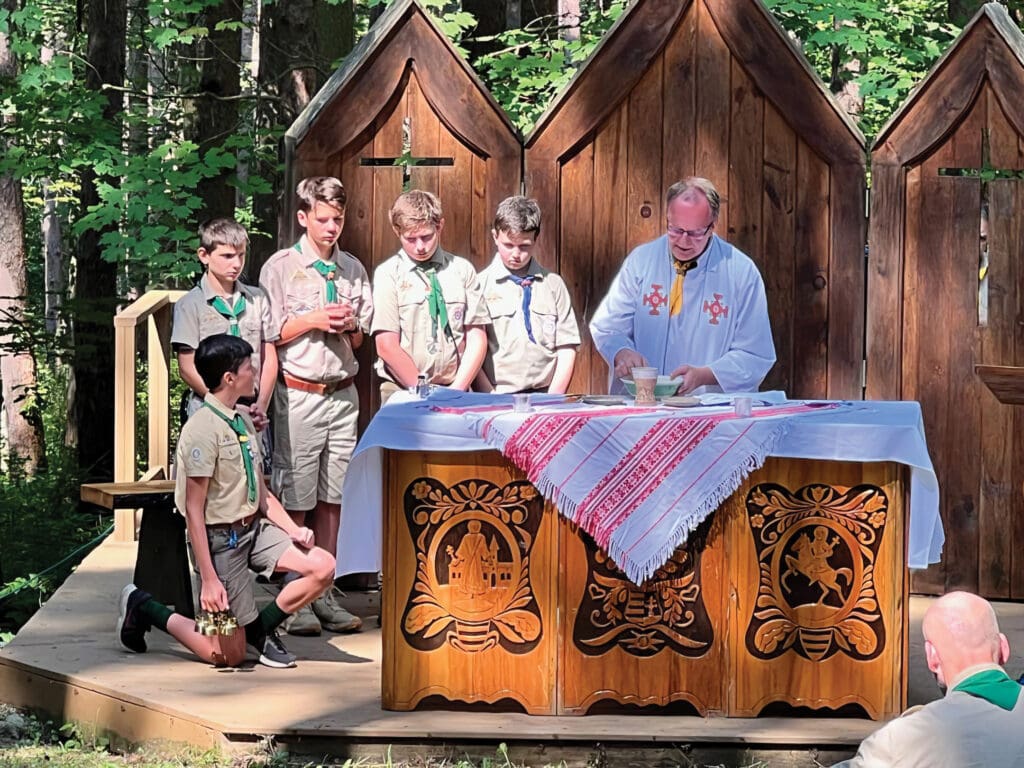
The Hungarian folk dance and folk music movement in North America, founded in the 1970s by Kálmán and Judit Magyar,9 seems to have a more secure future because language plays a less prominent role in this respect. Additionally, Hungarian folk music is so catchy and Hungarian folk dancing is so spectacular that it attracts many non-Hungarian Americans; thus, in many places there are dance groups and orchestras with a mixed language background, and some dance groups (such as the one in Washington DC) were founded by non-Hungarians. Folk dance and heritage groups—though significantly reduced in the post-COVID world—are still operating in all cities that have Hungarian community life.

Finally, the fourth ‘leg’ of supporting Hungarian identity comprises Hungarian houses and clubs. Unfortunately, there are only a few of these left in North America, as the former Hungarian cinemas, theatres, bookstores, and literary clubs have all vanished, with a few exceptions. Nevertheless, cultural events still exist, but mainly of a folk or gastronomic nature: Hungarian Days and folk festivals are still popular, but their content has changed and been simplified over time. Instead of higher culture (literary evenings, classical music, etc.), there is now a demand for more popular culture programmes (parties, pop music, etc.), even at the more elegant gala balls. Also popular are events of Hungarian gastronomy—for which, of course, you do not need to know the language.
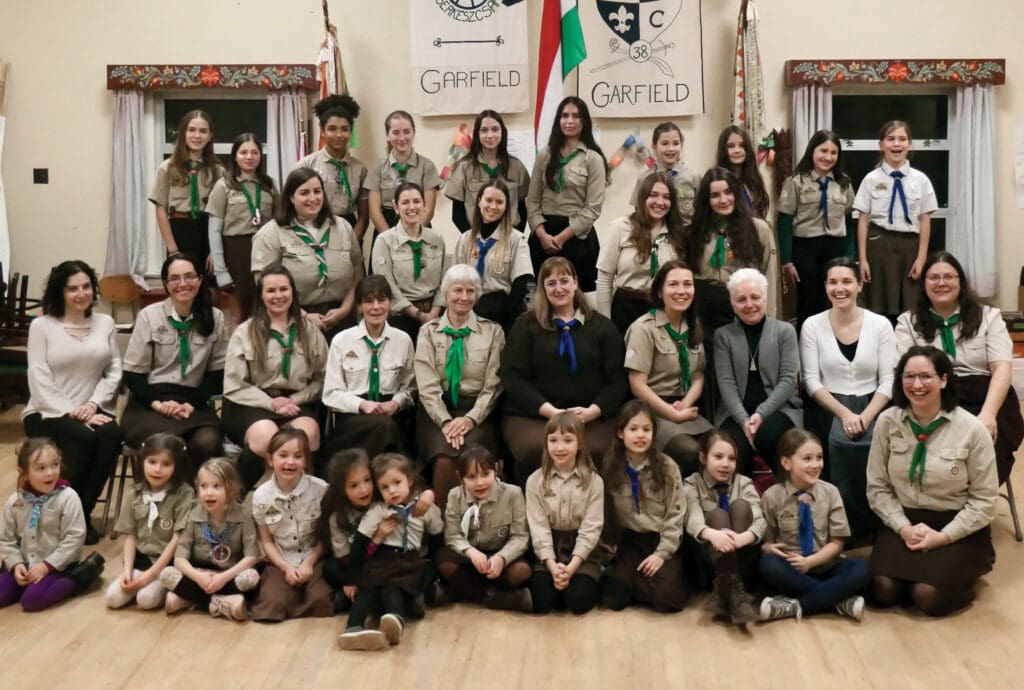
70th anniversary of the Cicelle Rozgonyi Girl Scout Troop No. 38, Scout House, Garfield, NJ, USA. PHOTO: Emese Kerkay

The importance of intergenerational and inter-organizational cooperation in community life should also be mentioned. Regarding the former, there are many difficult situations where the very active first generation was not able to successfully pass on the baton, often leaving the enthusiastic but less experienced younger generation behind. Different generations not only have different ideas (plans and means) but also quite different motivations. They are no longer refugees, and the connections with the motherland and Hungarian culture are of a varying nature. The generations of 1945 and 1956 have been gradually passing away over the past two decades, and unfortunately, in many places there is no succession plan to take over the institutions. This means that the culture of volunteering must not only be lived and exemplified, but also taught and passed on.

As for the latter, since most local organizations have overlapping members, it is very important to coordinate the various events in advance, otherwise the small group of helpers, as well as the audience, will be even smaller. For this reason, in some places local umbrella organizations are operated with the sole purpose of coordinating local (often jointly organized) events. And there are also traditional and newer national-level organizations that coordinate Hungarian associations and events and try to represent the interests of Hungarians—even at a political level—such as the Hungarian American Federation (HAF), the Hungarian Human Rights Foundation (HHRF), the Hungarian American Coalition (HAC), the American Hungarian Educators Association (AHEA), the American Hungarian Schools Association (AMIT), the Hungarian Association (HA), the Hungarian Communion of Friends (HCF), and the newly established Hungarian Folklife Association (HFA).

Last, but by no means least, the Hungarian government’s multifaceted initiatives, that is the Gábor Bethlen Fund, and the various two-way scholarship programmes, such as the Kőrösi Csoma Program (KCSP) or the Balassi Scholarship, play a huge role in the survival of the diaspora. However, all this would be for nothing if there were no enthusiastic beneficiaries. As Györgyi Papp,10 the widow of the first Hungarian honorary consul, László Bőjtös, has recently put it in a private message to me after reading my diaspora interview book:

‘We see ourselves as an integral part of the global Hungarian community. We consciously accept the fate of the diaspora, and we wish to cultivate this as a positive and active participation. We see all this as a surplus, a value worth preserving. The sense of belonging, the cultivation of our spiritual bond, has been with us since our beginnings. The past, like the roots, is a starting point for the future. Either we assimilate in the melting pot, or we preserve our values and our specialities as parts of a mosaic. We try to look outside the vicious circle of constant looking back, finger-pointing and accusatory judgement. We may not see the end of the road, but it would be a sin to do nothing even if we cannot do everything.’

Ildikó Antal-Ferencz

Source: hungarianconservative.com

Reklám
Tas J Nadas, Esq

Sándor Petőfi Overseas — A Review of the Movie Now or Never! Screened in New York

Source: hungarianconservative.com

When I was handed an English-language poster about the upcoming screening of the Hungarian movie Now or Never! at a Hungarian American event in Los Angeles, I was a bit surprised, because I had not heard of any American screenings at the time. But by the time we flew back home to the East Coast two days later, a personal invitation was waiting for me from the Liszt Institute New York for the event. I was looking forward to watching this historical adventure movie, which had been at the center of the public discourse over the past month in Hungary, with some glorifying, others hammering it, and was glad I could finally form my own opinion and not just base it on conflicting reviews.

As positive as I was about it at the outset, my overall impression was quite mixed.

Based on the screenplay by Márk Kis-Szabó, Philip Rákay and Vajk Szente and directed by Balázs Lóth, the movie is about one of the most well-known days in Hungarian history, the bloodless revolutionary day of 15 March 1848. The day when the poem ‘National Song’, written upon hearing the news of the outbreak of the revolution in Vienna, first set the hearts of a bunch of young radicals (later referred as the ‘March youth’ by historians) on fire, and then those of the people of Pest. This eventful day of history is interspersed with many fictional elements of action in the movie, such as the repeated attempts of the secret agent Farkasch (Ottó Lajos Horváth) to stop the revolutionaries at all costs. He is trying to carry out the orders of the imperial commander-in-chief Von Lederer (Sándor Lukács), embodying the repressive Austrian power trying to prevent the unrest from escalating into a full-fledged revolution. Since poet Sándor Petőfi (Nándor Berettyán) and novelist Mór Jókai (Balázs Koltai-Nagy) slip through his fingers initially, he focuses his efforts on capturing (or even killing) Petőfi’s wife, Júlia Szendrey (Sára Mosolygó). He pays for the help of his former cronies of a street criminal gang (the head of the gang is played by Gábor Jászberényi), until the latter are also caught up in the spirit of the revolution and ultimately take out Farkasch themselves.

Zsuzsa Máthé, director of the Szent István Institute, referring to screening of the movie for high school students by her institute and her recent public conversation with screenwriter Vajk Szente, stated: ‘Even before the screening, one could read a mass of extreme statements for and against the movie, making it practically impossible for anyone to watch a historical adventure film in the cinema without any preconceptions.’

Unfortunately, as much as I tried to forget the tsunami of criticism and the responses to it, which had been politically biased, I didn’t succeed, and I could not see it simply as an action movie. But I’m not sure I should have, since the creators clearly had bigger goals in sight. Producer Philip Rákay himself said that the film’s mission is to ‘orientate, convey a sense of life of the given age, to appeal to young people, to awaken patriotism, to influence people and uplift them’. He added: ‘If I were a historian, I would rather be happy [than critical] that there are finally patriotic filmmakers who create relatable historical themes and characters in this skewed world, based on which many young people will turn to read about Vasvári, Jókai, Petőfi and the others, in search of reality’.

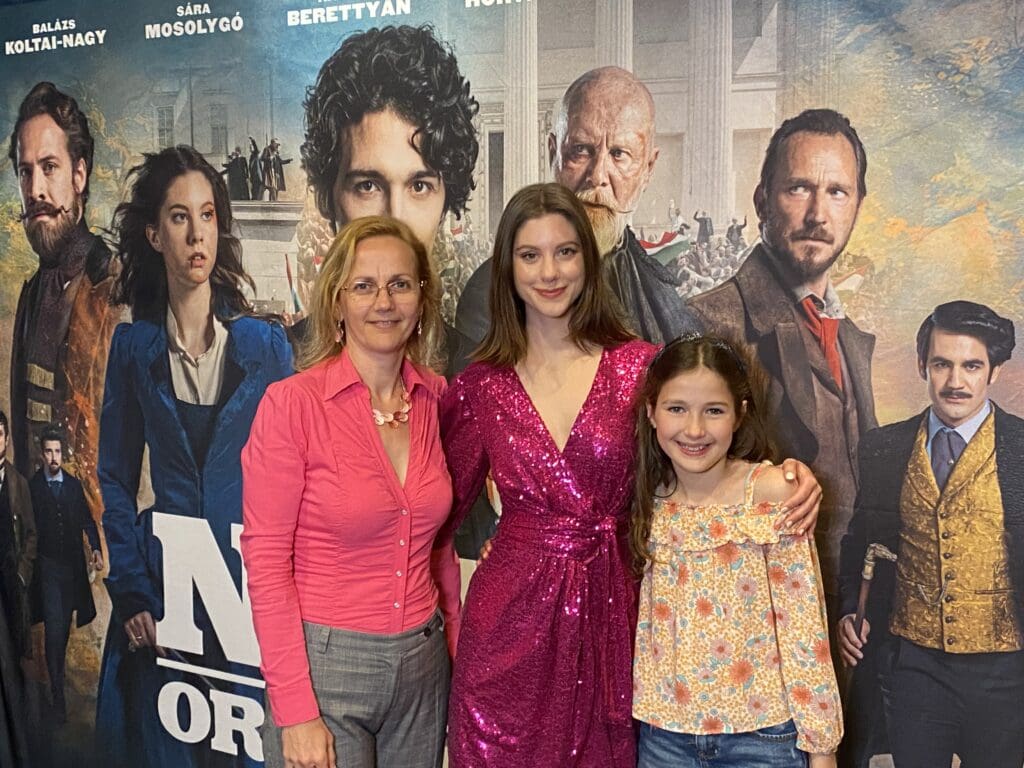
Ildikó Antal-Ferencz (L), Sára Mosolygó (C) and Ms Antal-Ferencz’s daughter PHOTO: Ildikó Antal-Ferencz

Since my teenage sons were not present and there were no other high schoolers in the New York audience I could have asked (hopefully there will be more screenings in the Tri-state area, even specifically for school audiences, similarly to Hungary), I have no first-hand feedback about the opinion of the target audience. I can only guess: the enthusiasm of the March youth might touch them too, and they might find the characters relatable, even lovable. The fighting scenes, however, might be dubious (also) for them. The greatest virtues of the movie are its authentic scenery and settings: the audience can really feel themselves in 1848, on the muddy, horse manure-covered streets, the chaotic, smelly market of Pest and Buda or in the coffee-scented and smokey Pilvax.

However, sometimes I had the feeling that these fighting scenes bear more resemblance to pubs from Western movies or to 19th century allyes in London

(as depicted by Dickens). In addition, there are way too many fictitious elements added contradicting what’s being taught in schools and held by historians. For example, in the days before March 15, neither demonstrations nor meetings were broken up in Pest; there were no threats of shooting or secret police violence on the day of the revolution; officialization of the Hungarian language had already taken place a few years before the revolution.

It is possible that young people of the 21st century see the March youth like themselves, a group of enthusiastic friends, including a variety of characters: some are hot-headed, some are thoughtful, some are womanizers, while some seek true love, some are loud, while others are quieter. Perhaps even the underlying message may get across: the March youth were able to put aside their individual concerns and personal differences for the sake of a set of noble common goals. Still, we are left wondering as to what extent we can accept that these characters are authentic? The character of Petőfi (who appears as a pale, almost weak and weightless person, especially in contrast to his wife, who comes through as a strong and impactful personality) and his sometimes comically stumbling companions, may serve the purpose of showing how difficult it is for passionate intellectuals to connect with and relate to common people busy with making a living and daily tasks, so perhaps the young audience also realizes how much the success of a mass movement depends on the sonorous, striking slogans of the revolutionary orators (who nowadays are celebrities and influencers). At the same time, no matter how talented the young actors playing the revolutionary characters are, there is little space given to them for showing their actual acting skills. They play one-dimensional roles, focused on one character trait each. They generally don’t offer real drama (except perhaps the Petőfi-Szendrey-Farkasch triple blackmail scene), and we don’t witness real character development either (perhaps with the exception of Jókai, who is initially very timid, but gets more and more self-confident). Thus, we don’t get to know the private Petőfi either which I suspect many high school students would have been interested in.

I agree with those who think that historical authenticity should not be scrutinized in a historical adventure movie, because it should primarily work with exciting characters and a story that simply draws from historical events but does not aspire to document them. I still wonder where the vision of the course of history and its essential moments, mentioned by the producer, are to be found in the movie? After all, even the director, who studied at the New York Film Academy, said in connection with the overseas screening: ‘Our goal was to create a movie for the wider audience, but one that foreigners also understand, because we intended it for them as well.’ However, some more authenticity would have been welcome, for example, showcasing why and how the revolution broke out and how it continued. The two brief closing remarks at the end of the movie about the later life of the two male protagonists simply cannot fill that void. Having said that, I find that the biggest shortcoming of the movie its dramaturgy:

except for the promising, spectacular and humorous first few scenes and a handful of impactful scenes scattered throughout, the story slows down relatively quickly,

becomes weightless and drags on as an average action movie with pretty theatrical and even cliché scenes: lots of marching and fighting; too frequent quotings of Petőfi’s emblematic poem; the soundtrack also reminiscent of Hollywood movies; and an increasingly artificial action-packed, fictitious plot running simultaneously with the historically more authentic series of events.

If I randomly compare this movie to two other recent Hungarian movies, Elk*rtuk and Semmelweis: I have to admit that they were much more exciting and twisty, even though we also knew their outcome in advance. In the former, the action scenes, in the latter, the characters came through as much more convincing. We could have felt more excitement in Now or never!, but for some reason we didn’t. It seems that the extra fictitious plot in itself is not enough to arouse excitement. Just as the performance of talented stage actors alone is not enough for a movie. Ultimately, I came to the conclusion that I don’t regret watching it at all, and I wouldn’t talk anyone out of it. In fact, I specifically recommend that you ‘see it for yourself’, but I am increasingly convinced that the story of 15 March 1848 would also have been much more impactful (and obviously much more cost-effective) if it was created as another piece of Vajk Szente’s large-scale, dynamic historical musical series. It may have not been played for decades, just only for years, but I wonder if this movie will last longer than that.

Ildikó Antal-Ferencz

Source: hungarianconservative.com

Reklám
Tas J Nadas, Esq

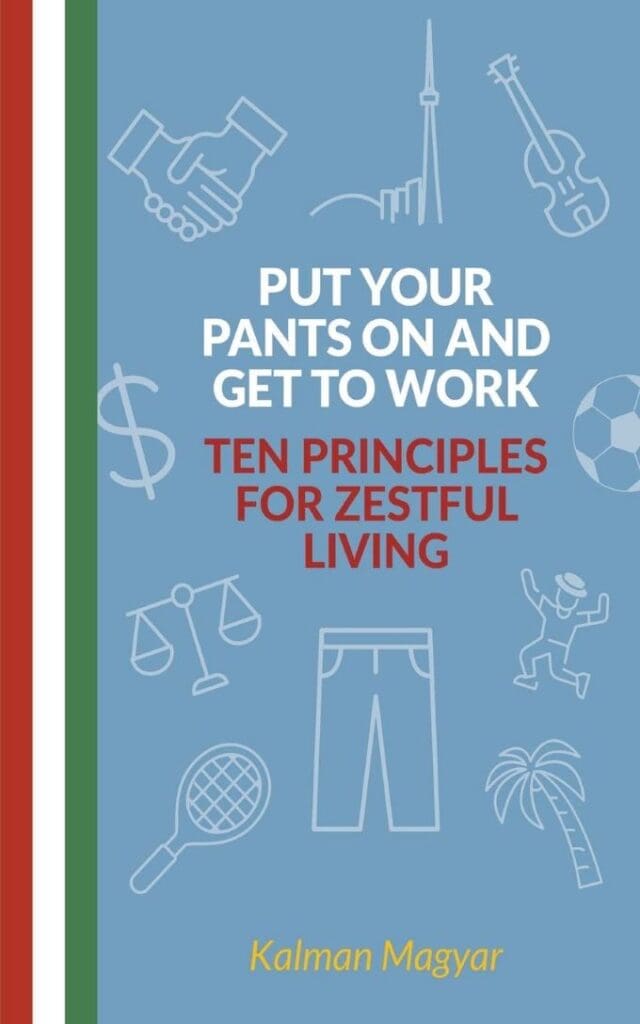
Put Your Pants on and Get to Work: Ten Principles for Zestful Living — A Review of Kálmán Magyar Jr.’s Book

Source: hungarianconservative.com

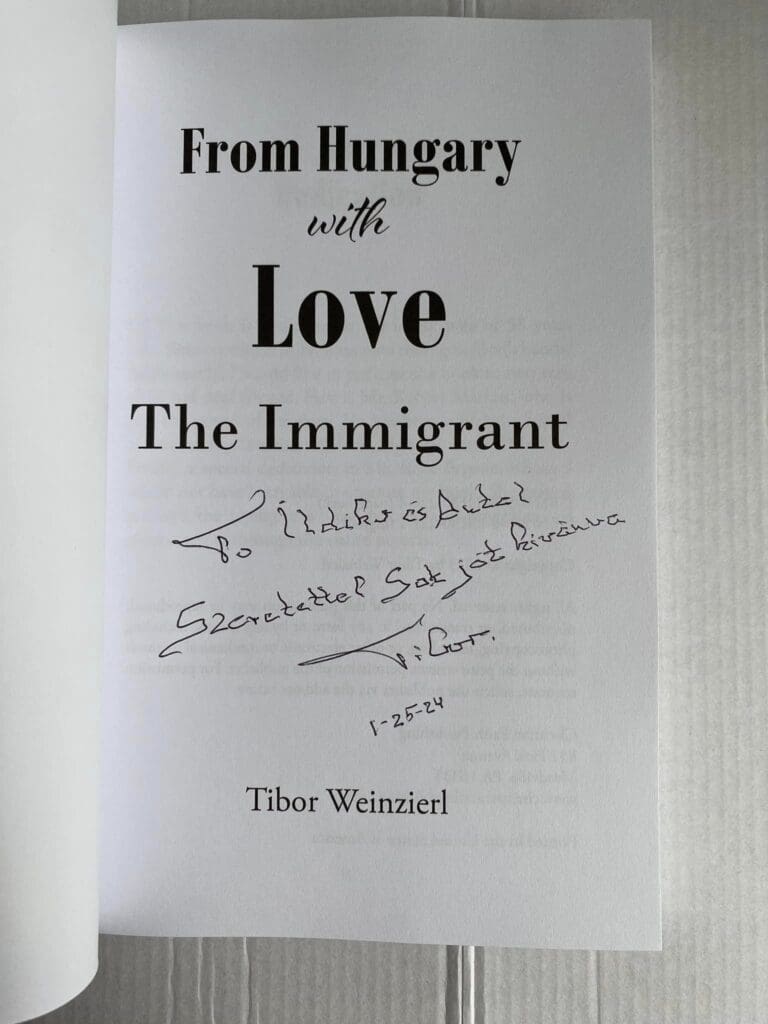
I met Kálmán (Kalman) Magyar Jr. last year at a Hungarian folk dance Camp in Michigan called Csipketábor. Prior to that, I interviewed his father, the ‘founding father’ of the Hungarian folk-dance movement in North America, so I heard of his son, but it was only at that folk dance camp when I got to see in person his enthusiasm for teaching the violin and his passion for folk dance. I only heard about his legal career later, when I interviewed him as well, but these two seemingly different interests blended together nicely upon reading his biographical book. Solely based on its title, I was somewhat reluctant to start reading, because I sensed typically American self-help material, but since I read this book, I’m all in and happy to recommend reading it.

Kálmán Magyar (Öcsi) Jr. is a second-generation Hungarian American, a father of three, a successful international lawyer and teacher with more than two decades of extensive business experience in US and Canadian boardrooms and courtrooms. At the same time, he is a well-known Hungarian folk musician who has carried on his parents’ legacy and performed at the world’s most prominent concert venues as well as in tiny community halls at faraway places. In his book, he takes us on an extraordinary journey through his family and professional life, where we can learn as much from the mistakes and failures that he candidly shares with his readers as from his multiple wins and successes. In the introduction, he already surprises us by stating that, although he is honored to have built up a respectable international legal practice and is privileged to have contributed in ‘his small way’ to the continuing revival and spread of Hungarian folk music around the world,

his greatest source of pride is that people find him authentically ‘zestful’,

that is, ‘happy, enthusiastic and energetic’. Knowing him personally, that’s how I see him, too.

What ‘zestful life’ means and how it can be achieved are answered in the book, starting from the premise that it requires ‘no special effort, skills, education or money’. All it takes is following ten principles that are based on his family history, his respect for Hungarian music and culture as well as his practical life and working principles drawn from his private life and legal experience. Although these ten principles are ‘universally valid regardless of age, background, location, political affiliation, religious beliefs or social status’ and were compiled by the author himself, he stresses that they have been ‘established and honed over generations, resiliently surviving turbulent and jubilant times alike’. Öcsi shares with us not only how these principles guide him every day, but also their source and how they might be incorporated into the lives of us, his readers.

PHOTO: Kalman Magyar’s webpage

Let’s take, for example, the first principle: ‘Put your pants on and get to work’, from which all the other principles stem from. He identifies Conor McCourt and his wife Marguerite Ethier, a couple who are ‘super lawyers and super personalities’, as the source of this principle. The former says that the greatest secret of his success as a lawyer is that he ‘got up every morning and went to work’, where the emphasis is put on the regularity and the work itself, not about any work-related ability or workplace. As with all principles, the author associates several family stories with this one, including a brief history of Hungary in the first chapter. We learn that his great-grandfather, Zygmund Piatek, was an officer in the Austro⁠–⁠Hungarian army who met his Hungarian wife, Melania Redle, a schoolteacher, in Magyaróvár, Hungary, a small town on the northwestern border of the country. After her parents’ divorce, their daughter Olga moved to Budapest, where she met her husband, and in 1963 emigrated to the US with her daughter Judit. Unfortunately, Öcsi never got to meet Olga, his maternal grandmother, because she passed away in the year before he himself was born. His paternal great-grandfather, Dusán Jovanovits, was a Serbian from Vojvodina, but he was fluent in Hungarian as well and, as a stationmaster in the Austro⁠–⁠Hungarian monarchy’s railway system, met his wife Julianna in Szeged, a large town in southeast Hungary. Soon after their wedding he was conscripted and most probably died in a prisoner-of-war camp in World War I. Growing up without a father, Sarolta became tougher than her peers: she worked as a hairdresser and wigmaker for renowned theatres in Budapest, enrolled her twin daughters and—despite his protests—her son, Öcsi’s father in the National Ballet Institute, and fled to America with her daughters when the revolution broke out in 1956. Her husband and son were only able to follow her several years later, after their great-grandmother’s death. A strong, confident, and cheerful grandmother, she was one of Öcsi’s early supporters, making him feel that he could be anything he wanted to be. In this first chapter, we also get some more thoughts and stories about the size of work trousers (i.e. about healthy lifestyles) and about the basic level of proficiency and toughness needed to work.

The other chapters are structured in a similar way, with

work experiences and lessons learned alongside the family stories.

One of my favorites is the third principle: ‘Find your vocation’. As the author emphasizes, a vocation is not necessarily a full-time occupation (i.e. a job that earns your income) or a passion (e.g. watching football), but ‘something that ignites your inner fire, consumes your free time, and gives something to the world. It is the reason you exist.’ As a family example, he cites his father, born amidst the worst bombing during World War II, and expelled from the ballet school in 1956 after the freedom fight was crushed, because his mother and twin sisters fled the country. He became ‘a class clown and a rebellious prankster’, who would be diagnosed as hyperactive today, but back then was only ‘often put in a corner and sometimes spanked’. Kálmán Magyar Sr. came to America at the age of seventeen, with no English skills, but in school he met another Hungarian student who invited him to join the Hungária Folk Dance Ensemble. They immediately took him on with his excellent dancing skills and experience as a big stage performer—gained from the ballet school years—, and he soon became the leader of the group and later an iconic figure in the Hungarian folk-dance movement in North America. He has been promoting Hungarian folk culture in the US and Canada for over fifty years. He’s been living in Hungary again for over ten years by now, where his company is one of the country’s largest packaging distributors. His vocation, however, will forever remain performing: over five decades he has organized hundreds of tours, performances and exhibitions of Hungarian artists, musicians and dancers in the US and Canada, entertaining and ‘infecting’ hundreds of thousands of people and future generations with the joy of Hungarian folk culture.

Additionally, through the example of her mother, the author shows that a vocation can also be a way of nurturing family and cultural roots. Somewhat similarly to Öcsi’s father’s case, Judit emigrated with her mother to America in 1963 to reunite her family, following her father’s and brother’s footsteps who fled after the revolution of 1956, too. Later, Judit and her husband, Kálmán founded various Hungarian cultural organizations, and she wrote her anthropology thesis about the Hungarian community in Passaic, New Jersey, where the Hungária Folk Dance Ensemble was based for many years. The family spent most of their summers in Hungary, but they also traveled extensively in Europe and the Americas, when the mother became a sales director at the now-defunct MALÉV Hungarian Airlines in New York. Still, as the author writes, his trips to Transylvanian villages were a ‘reminder of humility and modesty’ and he is as grateful for those adventurous trips made during the communist dictatorship as he is for a visit to the Vatican, for example. The second part of the chapter is about the author’s own vocation and his efforts to make his mark. As a child, Öcsi had the idea of becoming a professional classical musician, but lacked the right attitude to practice, and ended up treating music and dance performance ‘only’ a vocation, like his father. During the Covid pandemic, he created his podcasts called Táncház Talk. As he writes, ‘creating content is more dynamic; it leaves a legacy, it’s exciting, it puts us in the driver’s seat of life—even if it’s more demanding’ than consuming content. The last part of the chapter is about sharing talent, which he says is worth starting with volunteering. He mentions two Hungarian diplomats, André Erdős, former ambassador to the UN, and Levente Székely, former Hungarian ambassador to Taiwan, who have contributed their musical talents to the cultural enrichment of diplomatic receptions and to Hungary’s musical diplomacy. Finally, he gives two more examples to illustrate his idea that ‘I can think of no better way to leave this world than in the exercise of our profession’.

The final chapter on the tenth principle: ‘Build your own future’, is a logical conclusion. As the author puts it,

shaping your own future is not ‘a matter of dreaming, but of a patient mindset,

which is also the safest and surest way to achieve what you want’. His first piece of advice is to find a mentor, then to find a (not necessarily physical) place ‘that reassures you and where ideas for the future are born’. His ‘happy place’ is a particular hot tub in Naples, Florida, where a series of family tragedies have led him initially, but where he envisages the second half of his life, which he has been preparing for years, in a very conscious manner, shaping his professional life (setting up his own law firm, then working with partners) and even his vocation (establishing and then planning the future of the Gyanta band). As we can see from my interview with him, his conscious planning for the future has continued ever since: he has recruited his son into the band Gyanta, so he can be more of an organizer there, and has set up the Hungarian Folklife Association that he can also run from Florida.

The above examples of the ten principles hopefully illustrate the style and mood of the book, and confirm why, despite its title and subtitle, it was a pleasant surprise for me: the vitality, tenacity and perseverance of Hungarian ancestors, hardened by the storms of history, are combined with the self-confidence and bold creativity characteristics of the American way.

Ildikó Antal-Ferencz

Source: hungarianconservative.com
Reklám
Tas J Nadas, Esq

Choosing Hungary — An Interview with Piros Pazaurek, founder of HungarianHub, Honorary Consul of Hungary in Central Florida and Vice President of HAC

Source: hungarianconservative.com

Piros Pazaurek used to work in the sports marketing world in Hungary, but upon arrival to the US she fell in love with volunteer work performed for the Hungarian American community. Seven years ago, she created the HungarianHub informational site, and four years ago launched the in-person Hungarian Summit, which will take place this year in Daytona Beach (Florida) on May 23⁠–⁠24, seeking to connect the two countries in five areas: higher education, economy, diaspora community, sports and culture. As Honorary Consul of Hungary, she encourages the cooperation of Hungarian organizations in Florida and as Vice President of the Hungarian American Coalition (HAC), she focuses on its youth programs.

***

How did you end up in America?

My husband’s employer, the Kingspan global company, offered him a job in Columbus, Ohio. It started as a temporary assignment, but he was soon asked to stay permanently, with the promise that he would then have to continue working in Florida. We have been living in the Daytona Beach area, Florida for eleven years. In the meantime, my husband’s job has changed: he became responsible for the LATAM region and has been travelling for a few years across Central and South America; now he’s working on a project basis, currently managing the launching of a new business in Illinois. We were contemplating moving to somewhere in South America with him, but fortunately we didn’t, as the schools are very good here. Our son is fifteen this year and really loves life in Florida. We spend two months at home every summer and try to visit Hungary also during the year, because we find it very important for his Hungarian identity. In the meantime, we have become US citizens. I took the oath of citizenship in Jacksonville during the break of an NFL game, in front of 50,000 people. Since then, we have tried to maintain our dual Hungarian American identity and integrate into the local environment. Moving back to Hungary is a long-term plan for us; for the time being we feel very comfortable here.

Piros Pazaurek with her family after becoming a US citizen PHOTO: courtesy of Piros Pazaurek

What were you doing before you moved here, and what did you do in America?

I was a board member of the HÖOK (national student self-governing body) in Hungary and involved in higher educational, sports and economic affairs. Later I was working in sports marketing, leading projects on a national level. For example, with the Hungarian Football Federation we built 200 soccer pitches across the country. Afterwards, I got the opportunity to work for the NatHungarian ional Basketball Federation, organizing one of their most successful All Star gala events. After giving birth to our son, I started my own marketing agency, having clients mainly in the field of sports. Later, I also set up my own marketing agency in Florida, and at its peak I had a team of eleven. In the meantime, I started working on local Hungarian matters. Seven years ago I founded the nonprofit HungarianHub, as I saw the need for gathering information affecting Hungarians in the US. I fell in love with this project and that’s all I wanted to deal with.

What was its original goal?

It started with a charity event by Tvrtko Vujity, a Hungarian journalist. His first appearance in the US was a great success and we allotted the revenue to local Hungarian organizations. In HungarianHub we give space and an opportunity to present Hungarian people, organizations and projects that may be of interest to others. We would like to offer help to tourists, newcomers in finding their way around, and to provide support to those who have been living in the US for a long time. We published contact details of agencies, authorities and a wide array of national organizations to channel the public interest to relevant information. We pay special attention to diaspora community organizations, and provide space for Hungarian-related businesses. Our goals are constantly changing based on feedback. During Covid, we had several online programs. We had a virtual theatre event series and we also tried to provide a social network with the KorHatártalan (Ageless) program to offer spiritual help to people in need, because experience has shown that it is easier to express our problems in our language, i.e. Hungarian. We also offered offline help: if we found out that an elderly person needed help, we got them a volunteer. We produced a podcast series of discussions on anything related to physical and mental health, from mobility in old age to depression, but also on more general topics like travel to Hungary, obtaining visas or citizenship. We had podcasts with famous people and interviewed diaspora organization leaders as well. This is still ongoing, with new episodes released every month or two. We recently started to publish more in English since a very large percentage of people who claim to be of Hungarian origin no longer speak the language. It certainly has a lot of potential, but the progress always depends on our resources. We receive some state support from the Bethlen Gábor Fund of the Hungarian government, but currently this is still a non-profit ‘love job’ and we are investing our own time and money in it. However, by now we are being found and recommended—the best motivating feedback. The key to this, apart from our volunteers, is that we always try to look for common ground.

Volunteers at the Hungarian Summit PHOTO: courtesy of Piros Pazaurek

That’s what your slogan is about, ‘Together.We Can.Cooperate’, right?

We really believe that

we can maintain our Hungarian identity in America not by competing with each other, but by working closely together.

This is the spirit that I try to represent also as an Honorary Consul of Hungary. With 23 million inhabitants, Florida is the third most populous and fourth economically strongest state in the US. The 110,000 Hungarians or those of Hungarian descent living in Florida rival the size of the Hungarian presence in New York/New Jersey and Cleveland, Ohio. With fourteen active Hungarian organizations and many Hungarian businesses, we boast one of the strongest and largest Hungarian communities in three defined areas: Miami, Sarasota and Daytona Beach⁠⁠Orlando, which cooperate strongly with each other. Most recently, eleven of the fourteen local Hungarian organizations were in attendance at an online presentation as part of the Diaspora Network organized by Pécs University, Hungary. We help each other closely, and if there is a problem, e.g. when there was a big family tragedy or during the hurricane season, we immediately organize a community fundraising campaign to help those in need. We continue the monthly online meetings started during the pandemic and we try to visit each other’s events.

How and why did HungarianHub’s flagship event, the Hungarian Summit, start?

The idea of the Hungarian Summit was born in 2019, with the aim of trying to connect the two countries in five areas: higher education, economy, community, sports, and culture. After much planning, two weeks before the first event, the Covid-pandemic broke out, so we had to improvise. Since Budapest was already open by that summer, we were able to put together an event there for nearly 150 people, and it was a great success. The following year we also had 150⁠–⁠170 people showing up in Florida for the second Hungarian Summit. We were able to build a close relationship not only with Hungarians, but also with Americans. I’m very grateful that the county leaders and mayors here have not only heard of us, but also see us give back to the local community. That’s what I encourage everyone to do: try to introduce ourselves to the American community, because we Hungarians already know each other, but it’s very important to show what we can do while living in this country. I am delighted that we are now known and sought after, which greatly strengthens the credibility of the event and justifies its existence. Colleagues play a very important role in all this. They are all volunteers, and most of them have been with us since the beginning. Dr. Judit Trunkos is leading the higher education section, and my husband runs the business side on a non-profit basis. We’re working with the Hungarian American Coalition (HAC) regarding the work focused on the diaspora community, with the Liszt Institute New York taking the lead on culture. Finally, as for sports, we’ll have Dénes Kemény, the former captain of the Hungarian Water Polo National Team with us helping establish a sports scholarship, which we started to plan after Katinka Hosszú swimmer champion’s visit last year.

Hungarian Summit delegation in 2023 PHOTO: courtesy of Piros Pazaurek

Why these five areas? You were involved in sports marketing, there is no life without culture, community-building efforts are also important in the diaspora. What seems to be new compared to other organizations is the involvement of higher education and business.

This is perhaps the most important question because what works incredibly well in America is the very close cooperation between these five areas. Particularly in Florida, where business and higher education go hand in hand, operating in a harmonious symbiosis with each other locally. For example: Daytona State College says they really need events like the Hungarian Summit in the county, so they gave us the event venue for free because they know it can generate new investors for them.

Connecting universities and the business world internationally can create new opportunities for development.

Last year, when we held the Hungarian Summit in Budapest, I accompanied seven university delegations from six US states. We were joined by the mayor of Daytona Beach, a board member of the Southern Economic Association, a NASCAR general manager and other economic experts and the director of the incubator program of the University of Central Florida (UCF), the second largest university in the US in terms of the number of students. As a result, we have developed a five-day super-intensive so-called Soft landing program for Hungarian companies looking to enter the US market. This year we are expecting 10⁠–⁠15 university delegations from Hungary to attend the event, who will also visit various campuses of four US universities, from Orlando to Daytona Beach. This is again unique and important for us because we want to be more than just a Florida-centric project. We are trying to explore the depth of the opportunities for collaboration and come up with best practices that can be implemented elsewhere, too. So, in many cases, this will be the third time when we will bring the same universities together to strengthen their links even more. The most recent development we are very proud of is that Széchenyi University in Győr, Hungary is launching a joint engineering program with UCF. There are also some professor exchanges. At the Hungarian Summit we will have a big panel discussion relating to your questions, i.e. how these fields are interconnected and how important they are for the maintenance or survival of a country or a nation.

Piros Pazaurek in Budapest with the Parliament building in the background, holding her book titled Seven Tips for Building a Strong Hungarian Community in America. PHOTO: courtesy of Piros Pazaurek

Then please let’s go deeper into the other three areas as well.

The community theme is key for the diaspora, as we are the ones who promote our traditions, values, and language locally. This also includes economic cooperation, because people often forget how important role the local Hungarian businesses can play in the life of the community. We are trying to keep raising awareness of the need for local businesses to give back to the Hungarian community. I even wrote a book about this, self-published in 2020, titled Seven Tips for Building a Strong Hungarian Community in America, from an organizational development point of view. Sports and culture form the so-called soft power and are also indispensable diplomatic tools. There will be a big auction at the Hungarian Summit, where we will exhibit some sports relics, such as Áron Szilágyi’s sword or Katinka Hosszú’s swimming cap; we are still collecting more items for the auction. When Katinka was here last year, my first question to her was: what is the most important thing that America has given her? I asked her for a one-word answer and it was: self-confidence. This is the idea we want to put into practice via the sports scholarship that we are launching, so that young Hungarian sportsmen and -women could come to the US and learn self-confidence and take it back home and win gold medals for Hungary. At the outset, we are planning a two-week camp at a private sports academy, which later can be extended to a higher education course. The non-profit foundation Parents’ House in Hungary founded and led by Judit Regős is involved in this project, because we are thinking about talented young people from disadvantaged backgrounds. Culture is the best way to create a desired image of Hungary. For instance, members of the seven university delegations we took home last year just fell in love with the country. The Hungarians invited here could see how much they can learn from the US, for example, about the relationship between business and higher education, which is under development in Hungary too, but it could be much more conscious and focused: learn from examples that work well and try to apply them back home.

It seems clear that Hungary benefits from all of this. Why is this advantageous for the US?

It is very important that this is a two-way street. American companies also want to expand in Europe, where they have an affordable, well-educated workforce and from where they can basically cover a large Pan-European market. Hungary is the perfect starting point for that. There is a lot of interest from universities, professors, and students in studying in Europe, because we can offer an affordable degree and high-quality education in a world-class city. After half a year of training or education, students and teachers develop a commitment to Hungary that is a huge asset for the future. By the way, the Diaspora Higher Education Scholarship also brings a lot of people to Hungary. Not to mention the fact that universities and students go where they are invited, so if we are the early bird in this space, they will come to us in the first place. It is very important for us that people who think about Europe at large choose Hungary.

HAC Santa Claus dinner party PHOTO: courtesy of Piros Pazaurek

You are founder of HungarianHub and the Hungarian Summit, an Honorary Consul of Hungary and also Vice President of HAC. How are these tasks separated and interlinked?

HungarianHub is a national platform providing equal opportunity for everyone and everything Hungarian in the US. My duties as an Honorary Consul are obviously more focused on (Central) Florida, but one doesn’t exclude the other. It’s worth starting an American investment, company or study in Florida because it’s affordable and there are so many opportunities, and later you can go anywhere from here. Florida is the perfect place to start: we can be a gateway to America, we can educate newcomers about how the country works, who then can go anywhere in the US. In HAC, I was a board member for a long time, and then I got the opportunity to be the vice president and pursue youth connections, which is a strength of the Hungarian Summit, too. We co-organize the community diaspora section at the Hungarian Summit with HAC, because that’s their strength. It is a great honor to be a (board) member of one of the oldest umbrella organizations. Our Chair Emerita, Edith K. Lauer is a living legend; there is almost no living American president with whom she has not sat at the same table. She and her colleagues have brought a lot to the table, which is very motivating for us. The world has changed a lot since its foundation, but the founders’ work is still very inspiring, and we are honored to be involved.

Ildikó Antal-Ferencz 

Source: hungarianconservative.com

Reklám
Tas J Nadas, Esq

Success of Teaching Hungarian Based on Cooperation between Families and Schools — 50-year Anniversary of the Széchenyi István Hungarian School in New Brunswick

The Széchenyi István Hungarian School and Kindergarten in New Brunswick (New Jersey) celebrated the 50th anniversary of its existence at the local Hungarian American Athletic Club (HAAC). The welcoming speeches were followed by an award ceremony, where former school principal Gyula Varga was awarded; a brunch; a storytelling musical performance by the local Fészer folk band and a theater performance by the Déryné Company from Hungary. The second part of the anniversary celebration will be held on 19 May, when the school’s students, teachers and parents will perform the musical adaptation of Zsigmond Móricz’s novel Be Faithful unto Death.

Current school principal Éva Mikucza, elected to the school council (parents’ working group) 10 years ago and its president for several years, had been the right-hand aid of her predecessor, Anna Róza Tóth for years, and when the latter resigned for family reasons last year, Éva was elected to work as principal. As she says, it was natural for her to continue the work Anna and she had started together years ago. In her welcome speech, she pointed out that the second part of the anniversary celebration will be the school’s theater performance on 19 May, when they will present the musical adaptation of Be Faithful unto Death, Zsigmond Móricz’s distinguished novel about human endurance, love and faith. She then welcomed Nikolett Szántovszki, Community Diplomat at the Hungarian Consulate General in New York, and the former principals of the school: Gyula Varga, dr. István Horváth, Zsolt Balla, János Gorondi, Ildikó Bézi and Károly Jakab, as well as Gyöngyvér Harkó, who started the poem recitation competition at the school twenty years ago. She thanked the local Hungarian organizations, without whom the school could not function; and finally welcomed the former and present teachers, mentioning their ‘determined efforts, creative thinking and development work, which made it possible to teach students in a modern way’.

Éva Mikucza PHOTO: courtesy of the Széchenyi István Hungarian School

As she stressed, all of them have played a part in shaping the history of the school together, have been involved in overcoming difficulties and achieving successes, the key to which is continuous adaptation to the changing circumstances and requirements, and ‘a persistent, consistent and sometimes controversial work’. They have never believed that their work is flawless, but they have always believed that they are conscientious educators who have the best interests of their students at heart, she confessed, adding: the school has been providing quality education for 50 years to children of families who are committed to preserving the Hungarian language and culture, and who wish to maintain their language skills and learn about Hungarian history, culture and traditions. ‘Our aim is to preserve these values and pass them on, because this is our duty’, she concluded. Finally, she reminded us that the success of teaching Hungarian is based on the cooperation of families and schools. ‘Without the enthusiasm, hard work and dedication of parents to the Hungarian language and culture, this community would not exist. I know that they will do their best to ensure that our school continues to be successful in the future’. She concluded her speech with the words of István Széchenyi: ‘Who is with our Hungarian language, carries the life of our nation in his heart!’

In her speech, Community Diplomat Nikolett Szántovszki emphasized that the establishment of a Hungarian school and kindergarten in the US in the 1970s was not just an initiative, but ‘a dream in which the preservation of traditions and transmission of identity played an important role’. The school, she said, is the place where children learn what it means to be Hungarian, to have Hungarian roots, and where they participate in the institution’s community events on weekends, voluntarily and enthusiastically,

preserving and experiencing the treasure that Hungarian culture means to them.

This attitude and effort, she added, serves as an example to us on how to preserve our roots and cultural heritage.

‘In Hungary, the efforts of Hungarians living in the diaspora to pass on Hungarian culture and literature to younger generations are particularly appreciated and recognized. This communal effort unites and strengthens Hungarians worldwide and contributes to the revitalization and dissemination of Hungarian culture and language in the diaspora’, she concluded and thanked all those who have participated in this ‘blessed work’ and contributed to the success of the school. Finally, she presented the Certificate of Honor to Gyula Varga, the ‘Eternal Teacher’, who fifty years ago ‘dared to dream big’ and founded the Széchenyi Hungarian School and Kindergarten.

Gyula Varga PHOTO: Ildikó Antal-Ferencz

The 81-year-old 56er Gyula Varga thanked the certificate with his usual modesty and kindness, noting that he did not deserve it (nor the previous ones: the Hungarian Cross of Merit in 2021 and the American Hungarian Schools Meeting Award in 2022), as he had only done his duty. Then, with his characteristic honesty and openness, spoke about the school’s history, the challenges it had faced, and how the church, the Hungarian school and scouting used to work very closely together (which is unfortunately no longer the case). He briefly summarized the school’s history: in 1960 the Hungarian Alumni Association started a Hungarian Saturday school with two classes at Rutgers University, but it was discontinued in 1986 because of the lack of enough enrolling children. In the meantime, in 1971, Hungarian was introduced as an optional subject in some classes of the daily American school of St. Ladislaus Parish, and in the summer of 1973, the Hungarian Weekend School and Kindergarten Society was founded under the auspices of the Catholic and Reformed Churches and the local scout troops. The parallel operation of the two Hungarian schools was due to the stark political divisions within the emigration at the time whereby the Széchényi School took the position that they would not cooperate at any level with the communist government of Hungary.

In 1978, the scout leadership approached Gyula Varga with the aim of running the school in a religious and scout spirit, free of any divisive politics. He reorganized the school with youthful enthusiasm: he admitted it to membership of the Hungarian Scout Association in Exteris (KMCSSZ in Hungarian) and renamed it Széchenyi Hungarian School. Initially, the school was housed in the Hungarian Reformed Church, while the kindergarten was in a Plum Street building of the St. Ladislaus parish. Later, thanks to Father Máté Kiss, the entire school moved to the classrooms of the daily American school of St. Ladislaus, and the centralization made the school’s management much easier. As principal, Gyula Varga was in charge of the school’s organizational tasks on 30⁠–⁠32 Saturdays a year. He worked together with Gyula Pap (a survivor of seventeen years at the dreadful ‘Gulag’, referring to communist forced labor camps), a scout officer and Hungarian literature teacher. During their twenty years many changes took place: at first, the curriculum had to be ‘scraped together’, but after the change of regime in Hungary, it was much easier to obtain proper textbooks. At the beginning, many of the teachers were Hungarian educators and scout leaders, but by the mid-1990s, more and more teachers were getting tired and quitting, and the continuity of teaching was threatened every year. Over time, young generations of Hungarians joined the teaching team, and the school’s students increasingly became scout leaders, teachers, literary circle members, folk music and folk dance group leaders and members.

Gyula Varga also mentioned the establishment of the daily Hungarian kindergarten initially with seven children, including Gyula’s first son Gyuszi in 1975. The kindergarten closed in 1994 due to lack of demand, but under the leadership of the original founder Károlyné Balla’s daughter Enikő and granddaughter Réka Gorondi, it was relaunched as an independent institution called Aprókfalva Montessori Kindergarten, and it is still in operation. Gyula considers that the daily kindergarten was and still is of great importance because it lays a very good foundation for the development and education of children in their mother tongue, which has always been built upon by the Hungarian school. At the end of his speech, Gyula Varga drew attention to the diaspora interview booklet To Be Hungarian in America published last year, which he said should be on every Hungarian family’s bookshelf.

The performance of the Déryné Company PHOTO: courtesy of the Széchenyi István Hungarian School

The welcoming speeches were followed by a brunch, an interactive storytelling by the local Fészer folk band, and finally a performance by the Déryné Company from Hungary. After the ceremony, I spoke to three former school principals. ‘More and more students are actively using their language skills to continue their university studies or take up jobs in Hungary. More and more young people born and trained in the US are finding their place in the local environment.

Hungarian American emigration is alive and well today.

Contrary to all the statistics, we continue to claim our national culture, language and ever-closer ties with the Old Country in our new homeland’, I quoted Gyula Varga from the 2003 yearbook. He commented: all these had taken a lot of fighting, and that fight must continue, because without young people who speak Hungarian well, who are educated in community spirit, who are self-sacrificing and take responsibility, there will be no one to take over the baton when the first generation is no longer there.

‘We can only prevent the process of assimilation with the full cooperation, work and support of the community. This is why I have always stressed that the linguistic and cultural education of young people should be made a priority for everyone, in their own interests, and not put on the shoulders of one⁠–⁠two obsessed, overworked, heroic, but persevering and treasured teachers or scout leaders. It should be supported and encouraged financially, morally and any other way by the whole community. Family, school, church, scouting—i.e. the joint commitment and joint efforts of parents, teachers, priests and youth leaders—can ensure our survival in the interests of our children and the Hungarian nation as a whole. Continue what we have started, because we do not want to get lost!’

Zsolt Balla took over the principal position from Gyula Varga in 1998 until 2001, and then again in 2004 after János Gorondi’s three-year term. He represented the younger generation, renewed and rejuvenated the teaching staff, formed a new governing body and successfully involved new parents.’It’s almost unbelievable. It seems like not so long ago we celebrated the 25th anniversary of the school. Since then, our children have grown up, the younger generation has come and brought their children to the Hungarian school and taught them and taken the school forward’, he confessed. He considered the anniversary celebration a real joyful occasion, where ‘the past met the present and we rejoiced together in our wonderful Hungarian school, where Hungarian education has been provided for half a century. We were all together at this event with people for whom the preservation and transmission of the Hungarian language and culture is an important task, out here in the great America. Who believe in not assimilating, but in mastering both Hungarian and American culture to a level that will serve as a bridge of understanding between the two nations.’ Like other speakers, Zsolt also stressed that it is not an easy task to maintain Hungarian culture in the New World.

‘Those who persistently develop and cultivate it, have to get up early also on Saturdays and sometimes travel hours to the school, then have to study hard subjects for which no university entrance score is awarded, ‘‘only’’ knowledge. But this is a wonderful knowledge based on the tradition of our parents, grandparents and ancestors. So for us, this knowledge has a special value. That’s why we try to preserve and pass it on to our children’, he concluded.

Dr. István Horváth first helped as Zsolt Balla’s occasional deputy to organize several shows, school graduation and poem recitation competitions in the school. He was deputy principal from 2004, and then principal until 2009 after Zsolt Balla’s move to Hungary in 2005. He said it is important to remind the community of the cost of maintaining institutions: for Hungarians living in the diaspora, it is a great effort and a great sacrifice for those who take it on. He quoted from his son’s words in the 2003⁠–⁠04 yearbook:

‘The Hungarian school is my life, which frees me from the rest of the world every Saturday morning.

Here I can only speak, write and study Hungarian with friends outside the home….The Hungarian language is a special treasure. Let us strive to speak Hungarian whenever we can. If we lose even this precious treasure, our Hungarian identity will be worth less.’

According to István, only the yearbooks and the students themselves can tell us what the Széchenyi Hungarian School and Kindergarten means to them. ‘When they send their children and grandchildren there, and they also join the school to teach or lead or work there, when they remember these times as a nice memory even in their old age, they do not abandon ‘‘the church and the school’’, and we can say: it was worth it.’

Ildikó Antal-Ferencz

Source: hungarianconservative.com
Reklám
Tas J Nadas, Esq

PM Orban: Donald Trump is the President of Peace

The type of president who can best serve Hungary’s interests now is one who is stable, predictable, well-known, and who can convey his calmness to everyone,” PM Viktor Orban told public broadcaster M1 in an exclusive interview. Mr Orban emphasized that President Tamas Sulyok’s preparedness, expertise and authority were beyond question. He also discussed his recent trip to the US, highlighting how Donald Trump had “quite detailed plans” on how to end the war, and notably, how his plans aligned with Hungary’s interests.

Reklám
Tas J Nadas, Esq

A Life of Community Service — An Interview with Andrea Mészáros, Former President of the Cleveland Hungarian Museum and President of the United Hungarian Societies

Source: hungarianconservative.com

Born in Virginia, Andrea came to Cleveland at the age of six, where she became an active member of the Hungarian community following in the footsteps of her parents. She was the leader of the local girl scout troop, later district commissioner and today is still an active adult scout. She was president, vice president, and currently is a board member of the local Hungarian Heritage Museum, and recently became president of the United Hungarian Societies. Her eleven grandchildren live far away, but she keeps in touch with all of them in Hungarian.

***

How did you end up in Cleveland?

My father graduated as a doctor from the University of Debrecen in 1943 and was immediately taken to the Russian frontlines in WWII, where he served as a physician. The military hospital where he worked was withdrawn to Hungary toward the end of the war, but then moved further west by train as far as Bavaria. My mother, who at the time was a fresh graduate from high school, worked as a nurse on the same train. They married in Neuburg as American prisoners of war and arrived in the US in December 1950 when my mother was already pregnant with me. While they never met in person, my father was sponsored by a Jewish doctor of Hungarian descent. I was born in Norfolk, Virginia and spent my first six years there. Most of my parents’ friends lived in Cleveland though. My father was lucky when a Cleveland hospital needed a pathologist. We arrived in the late summer of 1957 and I started elementary school.

Do you have any memories of your first six years in Virginia?

I remember the beautiful Easter holidays; spring is wonderful down there. We used to go to Williamsburg after the Easter Sunday mass and spent the day there. I also remember when my parents and my godparents became US citizens in a ceremony in Jamestown, the first permanent English settlement in North America. They traveled to Washington DC in 1956 to join the Hungarians protesting Russian oppression. There were two or three other Hungarian families living in Norfolk, so all in all, we were a very tiny Hungarian colony, but we had a clear sense of Hungarian identity and community. My mother would call her best friend every afternoon at 3 o’clock to speak Hungarian for half an hour and then German for half an hour, so that they wouldn’t forget these languages. I was first introduced to American children when my mother started working and I went to kindergarten. I also remember the terribly hot and very humid air. My father was from Zemplén and Szabolcs counties and my mother from Miskolc, so they were used to the heat, but the humidity in Virgina was very difficult for them. And finally, I remember that when friends from Cleveland visited, we would always go to Virginia Beach, which was a 30-minute drive from our house. I don’t have any bad memories, but I know that for my mother it was very difficult to live in a foreign country without her extended family. There was no telephone communication, and if you got a telegram, it was never good news. Everyone left parts of their families in Hungary and everyone was worried about them. It was good for my parents to move to Cleveland because they didn’t feel so isolated here. Since they came in 1957, a lot of people thought they were 56ers.

Dr György Vareska and Márta Vareska, parents of Andrea Mészáros. PHOTO: courtesy of Andrea Mészáros

Your parents quickly became part of Hungarian life in Cleveland, and so did you.

My brother as well, who was born here. Living in the Hungarian community in Cleveland has always been a good experience. My mother had friends from her hometown, my father had them from high school, and both had quite a few friends from Germany. There were Hungarian neighborhoods on both sides of town. The Buckeye Road neighborhood was very vibrant. I remember many Saturdays when we went shopping at the Hungarian butcher, the baker, the import store, the scout store…My father was a very committed scout, so he quickly became the local scoutmaster, and my mother supported him. If it was needed to cook plum dumplings for all the bachelors, it was my mother, and my father was the one who took a week off from his three-week vacation to cook for his troop at the scout camp. He first introduced me to scouting in 1958 and I’ve been scouting ever since. There were a lot of scouts in Cleveland at that time; several hundred altogether in four troops. There are fewer of us now, but the scout movement is just as vibrant as it was then. I became troop leader of Girl Scout Troop 33 in 1976 and led them until 1982. I remained very active as a scout parent, and after my children grew up, I was Cleveland District Commissioner for seven years. The area I served included Chicago and Buffalo in addition to Cleveland. I am a member of the Board of Directors and a legal advisor for the American Hungarian Friends of Scouting in addition to being a member of Troop 33, which is now an adult troop, and its main mission is charitable support for fellow Hungarians.

In more than ten years, we have sent hundreds of pounds of durable goods to Hungarians in Rahó, Transcarpathia,

spending thousands of dollars on shipping. We volunteer at the Hungarian Scout Festival and various other scouting events. I have also been teaching at the summer school camp of the Hungarian Scout Association in Exteris.

Before we move onto your community service roles; when and how did you have a family?

Elemér was already part of the Hungarian community when we arrived in Cleveland. I got to know him better in 1974, when Cardinal Mindszenty came to visit Cleveland. We had known each other before, we were in the same social group, scouting, volunteering and socializing. We got married in 1980 and have three children: Michael is an architect and father of four in Washington DC; Krisztina works in the financial sector, lives in Chicago and has three young sons. Andrew teaches theology at a university in Ireland and is the father of four. So we have eleven grandchildren, with only one Hungarian parent, but they all speak some Hungarian.

Andrea Mészáros with her husband, Elemér, and their three children: Krisztina, András, and Misi. PHOTO: courtesy of Andrea Mészáros

You are a board member of the Cleveland Hungarian Museum, but you have also been vice president and president there. How did you get there?

The original idea of the Museum came from Father Nyeste, who served as St. Elizabeth Church’s pastor, and this was one of his dreams. Someone put him in touch with Otto Friedrich, who also had this dream and had already collected various items of historical significance. The two of them gathered further people around them to work establishing a museum. I was present at those meetings in the mid-1980s and was asked to draft and submit the articles of incorporation, and then to draft the bylaws for the Cleveland Hungarian Heritage Society At that time, I was still busy as a scout parent and attending leadership training camps, where I took the children with me, so I didn’t take on any other tasks at the museum. Dr. Ferenc Somogyi, a widely liked and respected member of our community was our first president. My husband followed him. Otto’s wife, Mária was also president, and when she became ill, then vice president Steve Szappanos took over. I first volunteered at the gift shop, later at the museum as a docent (a guide), showing visitors around. In 2006 ‘Pistaba’ asked me to take over the presidency. The Museum was well run by then: everybody did their job. This is still the case today: dr. Klára Papp is the head of the program committee, Mary Jane Molnár runs the gift shop, András Lázár is in charge of exhibitions, Andrea Lázár is our publicity head, my sister-in-law, Magdolna Mészáros manages the library, and Marika Zsula manages the volunteers. And finally, there is my husband, who manages the museum’s investments. We are open three days a week.

What kind of programs are offered in the museum?

We have monthly programs in the spring and autumn. During and after the Covid pandemic, we held these via Zoom calls. On the 100th anniversary of Trianon, historian András Ludányi gave a fantastic online lecture on the background of the peace decree. Last May we revived the Pilvax Café; in February dr. Krisztina Fehér, teacher at Cleveland State University, talked about Hungarian dialects; in March dr. Pál Gyékényesi will talk about his role in expanding soccer in the U.S. In May Zoltán Csadi, living in Toronto as a Kőrösi Csoma Sándor Program (KCSP) scholar of the Rákóczi Foundation, will talk about the history of Budapest theaters. Most of our performances and lectures are held in English, because a large percentage of the museum’s membership and supporters are third–⁠fourth generation Hungarians, who identify as Hungarians, but don’t speak Hungarian. In addition, we started a children’s program: Saint Nicholas visits us each year. About 30–⁠35 children plus parents and grandparents visit us on these occasions. My goal is to always teach them, especially children who don’t go to Hungarian schools or scouting, but their parents want them to belong to this community, to see Hungarian folk costumes, hear folk music and play folk games. Finally, my husband came up with the idea of a wine tasting fundraising dinner 27 years ago and he is still involved in it. We have recently been working with Taste Hungary, a company in Washington DC that imports Hungarian wines. Those who can’t attend the event, but would like to donate, receive wine as a gift via mail. Those who participate have a great dinner with fantastic wine and enjoy fine Hungarian music by Harmónia.

What about the exhibitions and the library?

We have a permanent exhibition beginning with the arrival of the Hungarians to the Carpathian basin to the present, including the history of Cleveland’s Hungarian immigrant community, since visitors from Hungary and elsewhere are interested in understanding how the Hungarian community evolved here. The temporary exhibition space features the art of József Domján’s artist wife, Evelyn. The material on exhibit is borrowed from her son who lives in Texas. In addition, one of our most beautiful and precious items is a Herend replica of the Hungarian Holy Crown. Our library has over 8,000 volumes; newspapers, magazines, books in Hungarian and English on various subjects: fine arts, history, language and literature, poetry, cookbooks. There is a very unique part, too: Hungarian emigré poetry, writings, novels, journals, newspapers, all the chronicles of the Hungarian Association, copies of the Hungarian scout magazine, and various studies about the local Hungarian community. This is not a lending library, but a research library. The library’s archives also include a very rich collection of materials.

Let’s turn to your recent position as president of the United Hungarian Societies (UHS).

UHS is an old Hungarian initiative, founded in 1902. From the original documents it is clear that its aim was to create an umbrella organization to which all Hungarian community clubs and associations could belong. At its peak, there were over fifty member associations; now there are fifteen, plus six churches and a shrine. UHS is responsible for organizing celebratory events for the two Hungarian national holidays and two other commemorations: March 15, October 23, Heroes’ Day, and the Kossuth Commemoration. Former president Endre Szenkirályi asked me to take over the presidency and assured me that it wouldn’t be too difficult to organize four events a year. I accepted the position for a term of two years. Loránd Csibi is the vice president; Petra László is the secretary, József Földesi became the treasurer, Endre is our recording secretary, Richárd Sárosi and Tas Nádas are the controllers. I am happy that we have some younger officers. In addition, UHS represents the Hungarian community in Cleveland vis-a-vis the US and Hungarian governments. Yesterday we listened to a presentation by Deputy State Secretary Dr. Péter Szilágyi on various scholarship programs intended for the Diaspora. When a letter of public interest arrives from the Hungarian Embassy or Hungary, it usually goes first to the UHS president, who forwards it to the member organizations, who then circulate it to their own members.

Will this year’s 15th of March celebrations be different from previous years?

We alternate the commemorations of the two national holidays among the churches, because unfortunately there is no Hungarian house or center in Cleveland. We have a park, a scout center, many churches and organizations, but unfortunately no Hungarian House.

This year the 15th of March commemoration will be held at the Lutheran church.

I have been very lucky to have János Szabó, one of our current KCSP scholars, who volunteered to organize the program. There will be dramatizations, recitations, choral singing and solo performances of lesser known Kossuth songs. It will be a rich program. This program will embrace the end of the revolution; despite the fact that the 1848 Revolution was a losing effort, to a certain extent the Hungarian consciousness and national pride that was built up and flourished during the fight for independence in 1848–⁠49 still exists today. Since I’ve heard several requests that we include in our program members of the Hungarian community who trace their heritage back three to four generations and no longer speak the language, two young Hungarian American college students will share brief remarks in English about what their Hungarian identity means to them. There are two Hungarian flags at Cleveland City Hall: the 1956 flag with the well-known hole in the middle and the 1948 flag, and they already know which one to put up in March and which one in October.

Andrea Mészáros receives the Freedom Award. PHOTO: Bocskai Rádió

You recently received the Freedom Award from a non-Hungarian community in Cleveland. At the awards gala, you stated: it is worthwhile to involve children in the community as soon as possible. When you took over the UHS presidency, you said: it is a great responsibility to ensure that people of different habits can work together and are all guided by a common goal.

The Freedom Award was given by the American Nationalities Movement for my activities in scouting and the Hungarian Museum. This organization was founded in the 1950s, and at that time it included new immigrants living in Cleveland from countries that suffered under communism.

Now their circle has expanded to many nationalities living in the Cleveland area, for example Syrians, Lebanese, Vietnamese. I am thankful to my parents for involving me in the Hungarian community in Cleveland at an early age. I am also grateful to my husband, because it certainly matters a lot if you don’t have to fight at home to ‘do Hungarian stuff’. We have always been active and supported each other’s work. And finally, the community itself is very important. In my experience, when doing community work, you don’t have to agree with each other, but you should never get personal or be offended. Some people can do this better than others. I generally like people and working with them, and even if there is some kind of tension with someone, I never let it spoil our relationship and our work. We have been here in Cleveland for too long and so many generations have arrived over so many years that I think most people have realized the dangers of non-cooperation. If we want some kind of Hungarian community life to exist here on the shores of Lake Erie 30, 40, 50 years from now, then it would be better to overlook religious differences or whether we can speak or not speak Hungarian or if we have different political views. If we can put all these aside, then the Cleveland Hungarian cart can move forward; but if we get bogged down by these differences, the cart will run into mud, and as we say, not even six oxen will be enough to pull it out from this quagmire. I think the newer generations fortunately understand this a bit better than the earlier ones did.

Ildikó Antal-Ferencz

Source: hungarianconservative.com

Reklám
Tas J Nadas, Esq

Trump-Orban Meeting: An Hour of Talks, Dinner and Concert

“Prime Minister Viktor Orban and former US President and Republican presidential candidate Donald Trump meet Friday for talks at Trump’s Mar-a-Lago residence in Florida,” Bertalan Havasi, the Prime Minister’s press chief, told Hungary’s state news agency (MTI).

Reklám
Tas J Nadas, Esq

‘From Hungary with Love. The Immigrant’ — A Review of Tibor Weinzierl’s Book

Source: hungarianconservative.com

When the news of the release of this autobiography was posted in a social media group of Hungarians in Boston a few weeks ago, I was specifically made aware of the author as a potential interviewee. At that point I knew nothing about the 95-year-old Hungarian singer and violinist, who was well-known in Hungary, then Canada and later in Massachusetts. Since then, we have spoken several times and although we have never met in person, upon reading his book, I feel he has become a dear friend.

Written in plain (by far not literary) English and with unfortunate typos of Hungarian names, but filled with a lot of faith and love, this biography is not only a written record of a tumultuous life journey in an extremely readable form, but also a historical documentary.

Tibor Weinzierl was born on 2 February 1929 in Budapest; at the age of two and a half he met Baden Powell (‘BP’), the British founder of the scout movement in Gödöllő; at the age of five he started playing the violin, and then successfully pursued a variety of sports during his childhood. During World War II he attended a Jesuit school, which he eventually changed at the request of his military officer father to the military high school in Pécs (south of Hungary), where, at the age of fifteen, far from his family and friends, he had to say goodbye to his former sporting life and trophies, as well as to his beloved violin and promising musical career.

Military school started in September 1944 but was soon interrupted by the arrival of the Soviet forces. In December of the same year, following central military orders, they fled, first to Austria and then to the Sudetenland, further away from the frontlines. Their train to Erfurt was repeatedly attacked by the British air force, and then in the city they survived a 25-minute bombardment by the Americans. This was the first time Tibor saw a dead man still running for seconds without his head in place (a sight that still haunts him), and it was the first time he felt the fear of death and a strong homesickness. On 8 May 1945, in Orlick, a small town of Czechoslovakia, they received the news of the end of the war and the next day became American prisoners of war. They were treated well for two months by the US Army, but then had to be handed over to the Russians, who not only did not handle the young cadets with kid gloves, but offered the same and demanded the same as from the other about 150 Hungarian, Polish and German adult hostages: a long forced march to Strakonice, one meal a day, sleeping on concrete floors with bugs, humiliation, disease, lice, hard labor in breweries and cleaning the ruins of war along the roads.

They waited nearly two years for the Red Cross to intervene on their behalf as they were all well under 18; but that did not happen until the spring of 1947. They were released in September of the same year. After being away for two and a half years, Tibor literally fell into the arms of his mother, who was walking on the main street next to the train when he jumped off, thus avoiding the Hungarian military checkpoint. He re-enrolled in high school again and diligently tried to make up for the three years he had missed. When he fell in love with a girl named Klári, he tried to win her heart with a daring act: he crossed the sealed Austrian border back and forth to find her brother, a Hungarian Air Force private who had been in hiding in Austria for three years, to bring news of him to his family.

While Klári was a ballerina at the Hungarian Opera House, Tibor became a student at the Liszt Ferenc Academy of Music (Conservatory)

and had Zoltán Kodály, the famous Hungarian composer among his tutors.

He was also preparing for the Hungarian Idol competition that was launched by the State Radio at the time. He ended up being one of the four finalists out of 405 competitors (together with Márta Záray and Ákos Szente), thus launching his career in the music industry, and getting the artistic name Weinzierl at the ‘suggestion’ of the Communist management of the State Radio.

After his first live radio show aired on 28 July 1950, he was drafted for two years of regular military service to Nagykanizsa, a border town in southwest Hungary, 250 km from his home and from Klári, where they were trained for a potential armed conflict with Tito’s army. For Tibor, the only silver lining of this period was his meeting with his roommate, the talented pianist Miklós Kovács, who later became his sidekick on stage and a girl named Gitta, who he fell in love with. After joining the army’s official chorus, however, he was transferred to the Budapest unit and toured the country. By the time he finished his military service in 1952, he had lost both of his girlfriends, but landed several prestigious offers in a solo singer capacity from high-profile ensembles of that era, like the Péter Hajdú Quintet, the Czechoslovak State Radio Orchestra and Aladár Cirok’s Budapest jazz orchestra.

Tibor Weinzierl and his book. PHOTO: courtesy of Tibor Weinzierl

It was during this time that he met another lady named Gyöngyi, who confessed to him that she was married and was the mother of a three-year-old boy, but her husband was beating her and cheating on her, so she wanted to run away from him, but she did not have the courage to do so, because her husband was a member of the Communist Party. When the revolution broke out on 23 October 1956, with Tibor’s help, Gyöngyi fled with her son to Tibor’s family, about which his father was not happy, but his mother helped them to hide together. When the freedom fight was crushed on 4 November, Gyöngyi became very worried that her husband would track her whereabouts, so she filed for divorce remotely and quickly married Tibor, in the hope to apply for asylum in Austria as a married couple. The last time Tibor saw his father (who died in 1964) was when they soon fled for Austria. They managed to cross the border through cornfields in the roar of bullets, with Gyöngyi’s boy in Tiboe’s shrapnel-wounded arms. Since Péter Hajdú and his band also fled Hungary, they had a live show aired on 14 January 1957 on the Vienna radio station, offering hope to other Hungarian refugees.

They arrived in Montreal, Canada on 1 February along with several well-known Hungarian singers, such as Emília Rozsnyai and Ibolya Bán (singers of the Hungarian Opera House). In the Canadian refugee camp, Tibor met Steve Ness, a music industry insider, who offered them the basement of his house to stay there and helped them to find their ways in the local music industry later. While many were waiting in the refugee camps for a better life, Tibor took his fate in his own hands to support his family: he moved to the Ness’ house and took all kinds of jobs (he was a carpenter, a hotel helper, and a baker, and he was picking tobacco leaves on a plantation, too). At the bakery, he worked alongside a Hungarian doctor and a former military officer, which was not uncommon at that time. In the meantime, to establish his musical career, he learned French and English and practiced singing and playing the violin regularly. With his wife (her stage name was Pearl) they soon formed a successful duo, travelling all over the province of Quebec.

The happy immigrant life ended due to personal turmoil: the arrival of his wife’s family (first her parents, then her sister’s family) increased tensions between them, at the height of which Gyöngyi emptied their joint bank account and left with his son. It took Tibor a long time to recover from this disappointment since he basically left his family and country because of her, but after many tears and prayers, he slowly closed his past and focused on his future, one of the highlights of which was becoming a Canadian citizen in June 1962. Soon afterwards, he met Doreen, an English restaurant manager, who had divorced her alcoholic husband and arrived in Canada also in 1956. They soon married and she became his devoted wife and enthusiastic partner at work for the next 58 years.

PHOTO: Ildikó Antal-Ferencz

The book tells the story of how they met and how they lived with an almost bewildering detail and honesty. They worked hard to build a decent life and successful career together. Their duo became so popular in the 1960s that Tibor was only able to fulfil an invitation in 1967 to Boston by the famous Cafe Budapest’s manager, Edit Bán, in the last days of 1969. The introduction led to signing a contract that eventually lasted for ten years. Their first performance was a huge success, with the local press welcoming them to the Boston artistic world. The secret of their success, according to Tibor, was that they played music that made the audience feel like they were in Europe, in Budapest or Vienna.

So they started to rebuild their lives in America, one of the highlights of which for Tibor was becoming a US citizen in October 1980. After 10 years, he left Cafe Budapest and worked in a number of restaurants, some American (e.g. Warner’s), some Hungarian (e.g. Csárdás, Duna). To supplement his livelihood, he learned to paint signs, which he did during daytime before his evening shows. The next chapter in his professional life was opening his own restaurant, Red Paprika, partnering with Steve Markus, the former chef at Cafe Budapest in Boston, and his friend, Joseph Vago, learning the ropes of restaurant management. After two years, he sold his share and worked as a manager, maître or sommelier at several locations. His longest job, lasting for 14 years, was in a brewery until its sale in 2006.

For a European, it is hard to imagine a 78-year-old unemployed man looking for work. Tibor even applied to McDonald’s and Burger King, where he was refused because of being overqualified, but was welcomed at Bertucci’s, an Italian restaurant, where he was employed from his 81st birthday as the oldest employee ever. He left this ‘dream job’ (which reminded him of his baker grandfather) six years later, at the age of 87. The final part of the biography details his daily caring for his wife. Doreen had initially battled breast cancer successfully, but she could not overcome the various complications and dementia. The lengthy description of the health complications and their daily lives all along (Tibor was also hospitalized with a stroke at a certain point) are interspersed with his childhood recollections and visits to Budapest with his wife and friends (first time in 1996). He regularly visited his wife during her last years in hospital, later burdened by the Covid pandemic, trying to instill a little home atmosphere and to spend family holidays with her and also to please her fellow sufferers with flowers and small gifts.

The life of Tibor Weinzierl (Várnay) is the

life of an extremely hard-working, persistent immigrant with a strong work ethic and a very deep faith,

someone who never hesitated to turn to God in all his moments of joys and sorrows, who was touchingly attached to his friends and employers, who were also a substitute for his distant family, and of course to his wife, whom he described several times as his sole partner since their parents were far away and they had no children. It is also very emotional to understand the love he expresses for Hungary as well as for Canada and the US. Finally, it is very touching how many times he cites his father’s words: ‘life is like a wheel that is constantly moving; after every low point comes a rise, and in the end all the good and bad experiences become just memories.’

Ildikó Antal-Ferencz

Source: hungarianconservative.com

Reklám
Tas J Nadas, Esq

The Tomorrow That Never Came — A Conversation with 95-year-old 56er István Üsztöke

Source: hungarianconservative.com

At the Hungarian Sunday masses of the St. Stephen of Hungary Catholic Community in New York, each time you’d see an always elegant, vivacious elderly gentleman, who does not show his age nor the adversities of his past. On 23 October 1956, István Üsztöke took part in the production of the famous sixteen points and the leaflets calling for a general strike as a printer, for which he later had to flee Hungary, leaving a three-year-old son behind. During his childhood he had lost his two sisters; in America, he lost his second wife, his daughter, and one of his grandchildren. He worked as a printer until his retirement, then as a real estate agent, a candy man, and finally as a TV producer, for which he was personally honored by former Hungarian President János Áder. Close to 95 he is still driving a scooter around New York, and he is looking forward to traveling to Hungary to see his 12th great-grandchild.

***

Tell us about your childhood in Hatvan and your early enthusiasm for printing.

I was born in Hatvan on 17 October 1929. My father was a rail worker, and my mother’s family came from peasantry. Both of my sisters died, one of a childhood illness, the other one at the age of thirteen from gunshot wounds during the war. When I graduated from middle school, my father asked his colleagues to take me on as an apprentice in his radio and electrical shop. However, during the summer, when my parents thought I was out playing football at the Zagyva riverside, I worked in the Palásty printing workshop—there were three workshops in our town at the time, which was a big deal—because a friend of mine was an apprentice there and I was very interested in what he was doing. At the end of the summer I confessed to Mr. Palásty that I still had not dared to tell my parents what I was doing. Next Sunday, he told my father that I had been working for him all summer and that I was very good at it, so he would take me on formally as a student, and would even pay for my work. I still have the contract that we signed then. Way before the end of the four years (prescribed apprenticeship for printers), he registered me with the trade union, and as soon as I got my certificate, I went to Budapest, where the printing trade union first sent me to the printing workshop of Kis Újság, the paper of the Independent Smallholders, Agrarian Workers and Civic Party (Független Kisgazda-, Földmunkás- és Polgári Párt in Hungarian) on Eötvös Street. When the Communists banned the party and its daily newspaper, the printing workshop was also closed down, and the union sent me to Franklin Press on Szentkirályi Street, which used to be part of the St. Stephen Society, and was located opposite the Hungarian State Radio. I worked there as a printer assistant. My supervisor must have liked my job because he once told me: when one of the team members retired, I could take his place, even though I would not be next on the priority list maintained by the union, which later turned out to be a big advantage.

István Üsztöke with his parents PHOTO: courtesy of István Üsztöke

Then you worked at the Kossuth Printing House, but you ultimately needed to flee from there.

On 23 October 1956 I was working the second shift, and my landlady woke me up telling me that there was a lot of excitement in the city, and Kálvin Square was full of people. Since I lived nearby in Baross Street, I went out just out of curiosity and joined the students marching from Buda, shouting slogans. I left the march to go to work in the Kossuth Printing House on the nearby Honvéd Street, but I took the sixteen points with me that somebody pressed into my hands. The atmosphere there was also all in a glow, everyone was talking about the events of the day in the streets, but since we were working at a standard daily volume and every minute counted, I split the 16-point-paper in two. I gave half of it to my colleague, László Kurt, to help me. All the printers knew that violating the communist press law could mean long years of jail for us, but the atmosphere around us made us forget about it, so we produced the first free press product to be printed and handed it over to another colleague to finish the process. He did what we asked for, but in the meantime, he saved a copy for the general manager, Lajos Lengyel, too. Because of the student march, the whole management was in the building, and a bit later the whole bunch starting from the Communist party secretary to the general manager appeared next to my machine. The latter had a copy of the sixteen points in his hand and got straight to the point: ‘Comrade Üsztöke, where did you get this paper from? Do you know who made it?’ Behind the management I saw the colleague, so I knew that he had betrayed us. I replied: ‘Comrade Lengyel must have already been told about it by the person who gave you the paper.’ ‘But who helped you with it?’ he continued, and I do not know where I got the courage to do that, but I cynically remarked: ‘Surely Comrade Lengyel has already been told about that, too.’ Seeing that he was not going to get a straight answer from me, he said: ‘Very well, Comrade Üsztöke, we will come back to this tomorrow,’ and departed. That was the tomorrow that never came…

…because the next day the printing house was closed. But until then, much more had happened in the city and with you, too.

We had been working for an hour or two after this incident when students swarmed all over the workshop and asked us to print as many flyers as we could for distribution all over the city. This is how the mass printing of the sixteen points, the first free press product began. In the meantime, news came that the ÁVO (Hungarian State Security Department, the Communist party’s brutal police force) had shot into the crowd at the Radio’s building, and there were casualties. The students then decided to make leaflets calling for a 24-hour general strike in all factories across Budapest. The production of this leaflet, the second free press product began. Even though our working hours were long over, no one thought about going home or thought about tomorrow. Thousands of leaflets were printed, and in the early hours of the next morning the students and civilians joining them began to distribute the leaflets in all factories. That night, everyone forgot to be afraid; there was no fear in us whatsoever even when we looked out of the window and saw the armed patrols around the factory. No shots were fired, even though students with rifles had already arrived at the workshop at dawn. Of course Comrade Lengyel and his companions were nowhere to be found, they fled. We left the building around 9 or 10 in the morning. At that time, we did not even think that this would turn into a revolution, nor that my life as a printer in Hungary would come to an end. The next day the Kossuth Printing House was closed, the whole of Budapest went on strike, and after that I only went back once to collect my pay. As we were walking home on the morning of 24 October, we saw the first dead body opposite the Dohány Street Synagogue, in front of the present-day Belvárosi Theatre. We headed towards the Radio. The building was already closed, but the soldiers patrolling around let us into the courtyard. It was then that I got my first pistol, given to me by one of the soldiers. They handed over their guns because they did not want to shoot at civilians. I took it, but I did not engage in any armed combat during the subsequent days.

What happened later to the gun and to you?

I thoughtlessly put it in my closet under my clothes. A few days after the Soviet forces invaded Budapest and crushed the freedom fight, the police also came to my house for a search. I was not at home, but they found the gun, took it away, and told my landlady that they would come back for me. I hastily gathered my documents in a briefcase and fled, first to my parents’ house in Hatvan and then onwards. There was a young couple in the house where I lived who had already indicated their intention to flee the country, so I left Hungary with them. On the Sunday of 18 November, when all the bells of Budapest were chiming (protesting the Soviet and Communist rule), we were passing the Reformed Church in Kálvin Square. At Móricz Zsigmond Square we found a truck that took us to Tapolca (a southwest town of Hungary), where we boarded a train that was supposedly heading for the border, but suddenly the Russians intercepted the train and ordered everyone to get off. Everyone got off and started running. I was lucky again: the Russians fired only in the air and did not come after us. We set off on foot towards Burgenland (the easternmost Austrian province), as the Russians closed the border towards Vienna. We walked for two or three nights, hiding in the forests during the day, until we approached the border, where we stayed in a farmhouse for the night. By then we were a large group, including some square-built miners, who found a local who agreed to lead us. We gave him a lot of money and the miners threatened him: if he tried to cheat us, he would not survive. Unfortunately, that is exactly what happened: our leader at one point tried to flee, but the miners chased and caught him. We heard the shouting for a while and then the big silence… When we arrived at a cemetery with Gothic letters, we knew that we were not in Hungary anymore. From the cemetery we headed into the completely dark village, where everyone was asleep. We got to the closed church and whatever money we had left in our pockets we put under the door out of gratitude. We found an Austrian gendarmerie (federal police) station, and they took us to a school where we could stay overnight; next morning a Red Cross bus came and took us to Styria province. After two weeks, a bus took us to Salzburg, where I was registered as a refugee. The young woman of the couple I fled with from Budapest had an uncle in New Jersey; they went there, and I was given the name, address, and telephone number of a Hungarian doctor, whom I had never met, but he became my sponsor, so I could come to America. I arrived in the US on 1 January 1957 by boat. At midnight the captain asked everyone to come up to the deck and to shout: ‘Happy New Year!’ after he counted down. These were the first English words I learned.

New year, new life. How were those first years in America?

My first job was washing dishes at the Schreft Restaurant. The twelve 1956er Hungarian printers used to gather at my place and we went to the Big Six Typographical Union together to get accepted, which was not easy. It was a very strong union, they were careful about their priority system: you could progress in their printing companies only by seniority and they always started from the back when it came to layoffs. Before I got in, I worked for a few days in a small independent printing house, and then at the then-new Szabad Magyarság (a Hungarian emigrant paper), which was printed in a larger American printing house. I was the first of our 1956er group to join the trade union (after an exam), because I was both a manual and mechanical printer. I was sent to the company Publisher as I wanted to work for an American printing house. Most immigrants worked for a dollar an hour. At Szabad Magyarság I was paid $68 a week because I had to be a typesetter and assemble the pages at the weekends, while at the Publisher I was earning $106 a week. After three years at the Publisher, I went to Typographic, where I was the 64–65th on the priority list of 125; by the time the new system of computer printing came along. I was lucky again because the older colleagues did not want to learn it, so I could get to the new training easily. When the company went bankrupt shortly after, everybody was laid off, but since I learned computer printing, the union put me in another print shop, and later in another one, and that went on until I was 58 years old and retired.

Even in retirement, you worked long and hard…

I was too young not to do anything, so I took the real estate agency exam and worked in the afternoons. When I was no longer interested, I started to work with an ice-cream truck at the request of a colleague, helping him out two or three times a week. After a while I rented a truck on my own, and later I bought my own, a second-hand one. Since it was not a standard, but an international size, I had plenty of room left for ice-cream coolers. I bought a hot dog unit and added a candy shelf, making myself a candy man… We worked all winter to fix it up, and it was ready for the season. I had it painted white and had ‘Csárdás’ (a traditional Hungarian folk dance) written on it. In the 1990s I was trucking across Long Island, blasting Sammy Davis Jr.’s ‘Candyman’ from the speakers; quickly recognized by everyone, especially the kids. When I spoke Hungarian, they asked me what language I spoke; I told them I was a Martian. After three–four years I sold the truck for good money.

István Üsztöke showing the Hungarian Order of Merit he received in 2017. PHOTO: Ildikó Antal-Ferencz

You produced Hungarian TV, for which you were honored by Hungarian President János Áder.

Around 1993–1994, Zsuzsa Viczián, who ran a Hungarian TV channel in New York, asked me to help producing the announcements once a week at the Reformed Church on 82nd Street. When Zsuzsa moved back to Hungary, I decided to do my own TV since by then I had already learned a lot about the technicalities of running a local weekly cable TV-program. When I read in the Queens News about starting a Public Access Channel and taking on apprentices, I applied and I learned even more, in my seventies by that time. I had my small TV studio right here in my apartment, it was called the Hungarian TV Magazine of Queens. I got in touch with Duna TV in Budapest, who sent me material every week to use and I edited that into a half-hour program, and the other half-hour was about local news and events. Whenever there was a Hungarian event somewhere in New York City, including the Consulate General, they called me to report, because even though I was relatively new in the business, I already had a name. This is why in 2017 I received the Knight’s Cross of the Hungarian Order of Merit personally from Hungarian President János Áder. I was praised by the Consul General at the time, Ferenc Kumin, who mentioned my 1956er role and my TV activities. I have been a member of the World Federation of Hungarian Freedom Fighters of 1956 since 1957 and of the Secular Committee of the St. Stephen’s Catholic Community for many years. Close to 90 I felt old enough to quit the TV. There was no one I could sell or hand it over; the younger immigrant generations do not want to produce radio, TV or newspapers, because there is no profit in these activities.

There has been almost no mention of your family so far, although your 12th grandchild is due soon.

I married for the first time at 20, and I was very keen to have children, but my first wife said she did not want children because it would spoil her girlish figure. Later on I met a woman and told her frankly that if she gave me a child, she would be more than a wife to me (since I was not officially divorced at the time). Zsuzsa became pregnant shortly afterwards, and my first son Gábor was born. I immediately accepted him as my own; I did not change my mind for a moment. Since we did not have an apartment there, we moved back home to my parents’ house with our son and from there we commuted to Budapest daily. One day I found out that she had been cheating on me with her boss, so we parted ways. I told her Gábor would stay with my parents, who would help raise him. She sued me for that, but then she did not show up for the hearing. When I fled Hungary in 1956, my son was three years old. I felt very sorry for him, but I had no choice. When the police found the gun in my closet, I went to briefly say goodbye to my parents and my son. I told my father about the printing of the sixteen points and the gun and asked him to look after my son. I did not tell my mother anything. My father said: ‘Son, you know very well that he will be alright with us. You can always come back to him.’ Gábor grew up with my parents until he was 13. Then I wrote to my father that I had been granted American citizenship and could officially bring him to live with me in America. By then I was remarried, and had two children, Tamás and Ágnes, and wanted Gábor to grow up with them.

How did you meet your second wife and how big is your American family by now?

I met Etelka, then 19, at an English language school shortly after arriving in New York. She had also immigrated after the 1956 revolution, but somewhat differently than many of us: she had been taken out of an Italian refugee camp, because her 14-year-old brother was already living here in America by that time. As I was late to the school that day, I sat alone on the bench and the teacher made her sit next to me. We talked a lot with each other, and I said to myself after a while: ‘Pista, you are a divorced man, you are nearly 30, so you must marry her as soon as possible.’ As a young married couple, we lived in Astoria, New York, then moved to Syosset on Long Island for 20 years, and after I retired, we moved back to Astoria. My daughter Ágnes died of breast cancer in 2006, aged 46, leaving behind four daughters. Annamarie was 17–18 at that time and she now lives with me in the basement, alone. Stephanie has two daughters and a son; Debra Ann has one daughter and one son. The youngest, Christina, passed away during her childhood. My son Tamás is married but has no children, so I have five Hungarian American grandchildren. The same year we lost Ágnes, Etelka also passed away. She became very severely diabetic and terribly obese, so she had to spend the last year and a half of her life in a rehabilitation center.

What happened in the meantime to your older son in Hungary?

He could not decide on his own, and the adults around him could stop him from joining me in the US. My father was scared that he would lose his only grandchild after losing his only son, so when he received my letter, he ran to his mother who took over Gábor’s custody. Zsuzsa was living with her mother in Újpest; my son spent the rest of his teenage years there. I tried to visit him as often as possible. I could legally go back to Hungary after I received my American citizenship, the first time when my father had died. At his funeral, I explained to my son, who was 17–18 then, why I could not get him out to the US. I asked him to do his military service first, after which I could easily get him out. I only found out later that he had been discharged because he was about to marry. Her mother did not want to lose him once she had him back, so she set him up with a colleague of hers. Again my plan went up in flames. Gábor’s early marriage failed, but he had two sons, Péter and Attila. At the time of his divorce, my son wrote to me asking if I could arrange for him to immigrate to America. I replied: ‘Son, you grew up without a father and now you want to give your children the same fate?!’ So, for the third time, it was up to me to have him stay in Hungary. Later he met another girl, with whom he has been living with ever since, and who gave birth to a daughter, Gabriella. So I have three grandchildren in Hungary, who have six children in total. Attila is about to have a third baby in the near future, who is going to be my seventh great-grandchild in Hungary and my 12th great-grandchild in total. I would very much love to see him upon his arrival to this world, so I am looking forward to travelling back to Hungary—which I do twice a year to keep in touch with my family there—in April; I have already bought my plane ticket!

Ildikó Antal-Ferencz 


Source: hungarianconservative.com

Reklám
Tas J Nadas, Esq

Donald Trump: PM Orban Is A Tough, Smart Man

I respect Viktor Orban, who is a tough and smart man, former US President Donald Trump told the Conservative Political Action Conference, or CPAC. In his speech, Trump also emphasized that there is a political witch-hunt against him because the Democrats are afraid of his victory.

Reklám
Tas J Nadas, Esq

‘No War, No Migration, No Gender’ – Hungarian Minister of Foreign Affairs and Trade Péter Szijjártó in New York

Source: hungarianconservative.com

Hungarian Minister of Foreign Affairs and Trade Péter Szijjártó was the guest speaker at the latest event of the International Speaker Series organized by the New York Young Republican Club (NYYRC) on 7 February. The event was attended by the Hungarian Ambassador to the US Szabolcs Takács and István Pásztor, Consul General of the New York Consulate of Hungary, and hosted by president of the NYYRC Gavin Wax. After addressing the challenges Europe and the European Union have been currently facing, that is, war, migration, and shrinking competitiveness, the minister answered several questions from the audience.

After expressing his appreciation for the invitation, Szijjártó recalled his personal experience of the half year he spent in Ohio as a teenager, especially how impressed he was about the Americans’ patriotism and respect of their national symbols, traditions, and history. These emotions must be respected and followed, he added.

According to the minister, the challenges Europe and the European Union (EU) are facing nowadays are actually ‘a package of challenges consisting of three major issues’: the war in Ukraine, the major influx of migrants that exploded in 2015, and the continuously shrinking competitiveness of the EU’s economy. He considers the liberal mainstream to be the major cause of Europe’s failure to address these challenges, as it ‘rules basically all spheres of life in Europe, tries to achieve an absolute hegemony, and makes it absolutely impossible to have rational, respect-based debates or discussions about any major issue’. As the speaker noted jokingly, if someone mentions in Europe that it might be better to concentrate on how to make peace in Ukraine instead of supplying weapons, that person is considered ‘either a spy of the Russians, a personal friend of Putin, or a Russian propagandist’. If one says that the only way foreigners can enter a country is by having valid documents that they must present at a border checkpoint, they are very close to being called a fascist. As Szijjártó summarized: ‘This is what I face at least once a month when meeting the foreign ministers of the EU and this is why Europe has governed itself to a very deep crisis simply because it was not able to manage these three major challenges’.

After his introduction, Szijjártó explained how the Hungarian government views its own so-called ‘illiberal’ democracy: ‘The liberal mainstream considers themselves as the only progressive and democratic ideology in politics. And if you are not ready to align with them and to represent the liberal approach or values, then you are anti-democratic, dictatorial, autocrat, and, again, a personal friend of Putin.’ This is why, he continued, the liberal mainstream is the most intolerant ideology that has been dominating public life in recent decades: it does not tolerate any difference in opinion and does not respect the rights of the non-liberals to represent their own views and decisions. ‘When you represent a non-liberal opinion in a debate in Europe, you are considered to be a non-European. They do not consider you as a democratic person, government or country if you are not liberal. In our understanding, however, democracy may not only be liberal. Democracy is democracy and it does not need any kind of markers. However, when we say we are an illiberal democracy, we mean that we are a democracy governed by a non-liberal party.’

The minister argued that Hungary believes a political system can also be democratic with a conservative, Christian democratic, and patriotic government; however, in Europe, these parties and governments are considered to be populist, because the liberal mainstream rules the media and the network of civic organizations. He emphasized that most governments in European countries are either having a very small margin, are being composed of many different coalition parties, or are even in a minority in their parliament, so it is very easy for the liberal mainstream to put pressure on these governments or parties. ‘This is what I feel whenever I meet the foreign ministers of the EU: I am one of the very few, not to say the only one who can say what he thinks. I do not have to worry about the danger of an NGO killing my government the next day because we have a stable and credible political system. And neither the media nor the NGOs can interfere into the operation of the democratic political system. But where the governments are fragile, a bad report or cover story or a well-orchestrated action of an NGO can change them.’ He said that the Hungarian media landscape is ‘pretty hard and colourful as half of the media is supportive of the government, the other half hates it’. Yet, based on the current European standards, it is a dictatorship because the liberals do not have a 99.9% control of the national media, as is the general situation in Europe now, he explained, adding:

the conservative media is immediately stigmatized as ‘slave media’

being sponsored by the government. This is why we consider the liberal mainstream very intolerant.

Hungarian Minister of Foreign Affairs and Trade Péter Szijjártó and President of the New York Young Republican Club Gavin Wax PHOTO: Ildikó Antal-Ferencz

Regarding the war in Ukraine, Szijjártó stated: the European strategy ‘has totally failed, because Europe feeds Ukraine with weapons, money, and information in order for Ukraine to win the war and for Russia to lose it, and that would result in a political earthquake in Russia’. However, two years passed and none of these happened; moreover, the sanctions implemented by the EU are more harmful to Europe itself than to Russia. Furthermore, every day the war is extended, more people die and more destruction takes place, concluded Mr. Szijjártó. ‘Hungary is the only country in NATO which does not deliver weapons to Ukraine, because we know that the more weapons are delivered, the longer the war will go on, more people will die, and more destruction will take place’. He pointed out that that there is a Hungarian community in Ukraine of about 150,000 people, many of whom have been mobilized for the Ukrainian army as Ukrainian citizens, most of them deployed to the front lines and many of them dying. Hence, Hungary is ‘a nation whose members are dying in this war, and therefore it looks at this war from a totally different angle than others’. As noted by the minister, the outcome of the EU’s sanctions implemented on Russia is that the Russian oil is being bought by the Chinese for a much cheaper price than it used to be sold to Europe, and Europe is buying much more expensive oil than before from other sources. He added that Hungary is now pushed to implement sanctions on the Russian nuclear industry, which would be a tragedy to Hungary, considering the weight Russians have in the Hungarian nuclear energy sector. The sanctions simply do not work, as they are hitting the European economy itself and have no major impact on the Russian economy, he added.

‘We stick to our right to make a decision about whom we allow to enter the country, and whom we are ready to live together with. And there is no way that any external force, be it Brussels or Washington, can tell us who to let in’, he started, remembering that when the migration crisis hit Europe, Hungary built a fence at its southern border and deployed the army, the border patrol, and the police to defend it. Thus, Hungary stopped 275,000 illegal migrants in 2022 alone and almost 200,000 in 2023. He asked: ‘Imagine what would have happened if we let them come in, and how many more would have come, knowing that they may come in?’ He warned that in the countries following different paths the outcome is parallel societies, anti-Israel protests, and rising modern age antisemitism. As far as the economy is concerned, Szihhártó recalled that the EU used to be number two in the world based on its share of global GDP, but lately became number three as China has taken over. As he explained, Hungary is one of the three countries in the world, besides China and Germany, where all three German premium carmakers have factories, and their number one suppliers are Chinese, therefore the managements of these factories ‘always ask to bring their Chinese suppliers to Hungary, and not even to the same city, but to the plot next door, to decrease the supply chain’.

Despite the failure of the EU addressing these major challenges, Hungary has not only survived the recent years, but it proved to be really successful, due to the smart decisions of Hungarian people and the stability of the political system in Hungary, concluded Mr. Szijjártó. He pointed out that the current government won all of the last four elections in 2010, 2014, 2018, and 2022 with a two-thirds majority in the parliament. This means that Hungary is a democracy, even if the European Parliament considers and treats Prime Minister Viktor Orbán as a dictator. He explained that

‘in Europe a strong leadership and a strong political system is supposed to be a threat, a danger;

probably because of the bad memories of European history of the last century’.

Political stability is the real basis of our success, repeated the minister, and noted that the last election was won by the biggest margin so far, which was unexpected by some of the external forces ‘having invested tens of millions of dollars in Hungary to push the seven opposition parties from the far right to the far left to the same platform’. This massive interference into the Hungarian elections, he added, was coordinated from the US, ‘from the network of George Soros and from organizations not too far from the currently ruling party in Washington DC’. He noted that democracy is about fulfilling the will of the people expressed in the elections, stating that being re-elected three times with a huge margin means that Hungarian people like what the Hungarian government is doing. If, however, this is questioned, it means the maturity of a nation is being questioned. He concluded: ‘We do not accept anyone challenging the democratic nature of our political system and we especially do not accept anyone questioning the smartness and maturity of the Hungarian people’.

Szijjártó summarized the Hungarian government’s strategy and vision as: ‘no war, no migration, no gender’. Hungary wants peace in Ukraine, because ‘it is the only way you save lives and no battlefield development will improve the circumstances for peace’. Hungary made it very clear that it is not willing to allow any illegal migrants in the country. Also, Hungary put forward a very clear definition: family means a father, a mother, and children. Szijjártó added: ‘in order to pour clean water into the glass, we put it in the constitution that the father is a man, and the mother is a woman, in order to make sure that no one understands it wrongly’He recalled that the Hungarian government has a very clear approach: if once somebody was born as a man (woman), the state will consider him (her) a man (woman) during his (her) entire life. Therefore, the government decided to protect children from the ‘arrogant and aggressive gender propaganda’, making it very clear in the regulations that the sexual education of children is the exclusive right of their parents. Thus, LGBTQ organizations are banned from schools and  kindergartens, and all homosexual and transgender propaganda is forbidden for anybody under the age of 18.

The last message of the Hungarian Minister of Foreign Affairs and Trade was that Hungary looks at the US as a true friend and ally, despite the fact that the US ambassador to Hungary ‘is working against that very determinedly’. He emphasized that Hungary will never forget the US had received many of the refugees after the Soviet Union crushed the Hungarian revolution in 1956. He stated: ‘It is more than obvious that the current administration has a very hostile approach towards Hungary and is interested in a weak Europe; this is one of the reasons why they are feeding the war in Ukraine’.

Then Szijjártó added: ‘We want peace and an improved, respectful US⁠–⁠Hungarian relations. And both of these have a name that is President Donald Trump’. The speaker recalled that Hungary has always respected the decision of American people and tried to work together with any elected leadership based on the idea of connectivity, however,

Hungary had the best political relationship with the US during the Trump administration.

He added: the two governments thought about peace, migration, and families in a similar way, but more importantly, the relationship worked because it was based on mutual respect. ‘We hope we can soon return to that. And it is so funny to see the fear in the eyes of my European colleagues when they look at the US polls nowadays’. Szijjártó finished his speech smiling while the audience burst into applause.

Ildikó Antal-Ferencz

Source: hungarianconservative.com
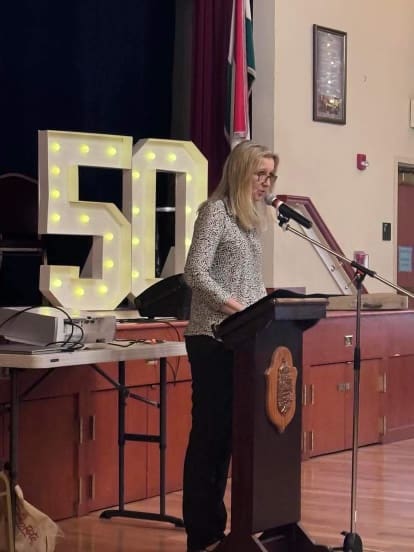
Reklám
Tas J Nadas, Esq

Stories of Hungarian Cooperation in Florida — An Online Conference

Source: hungarianconservative.com
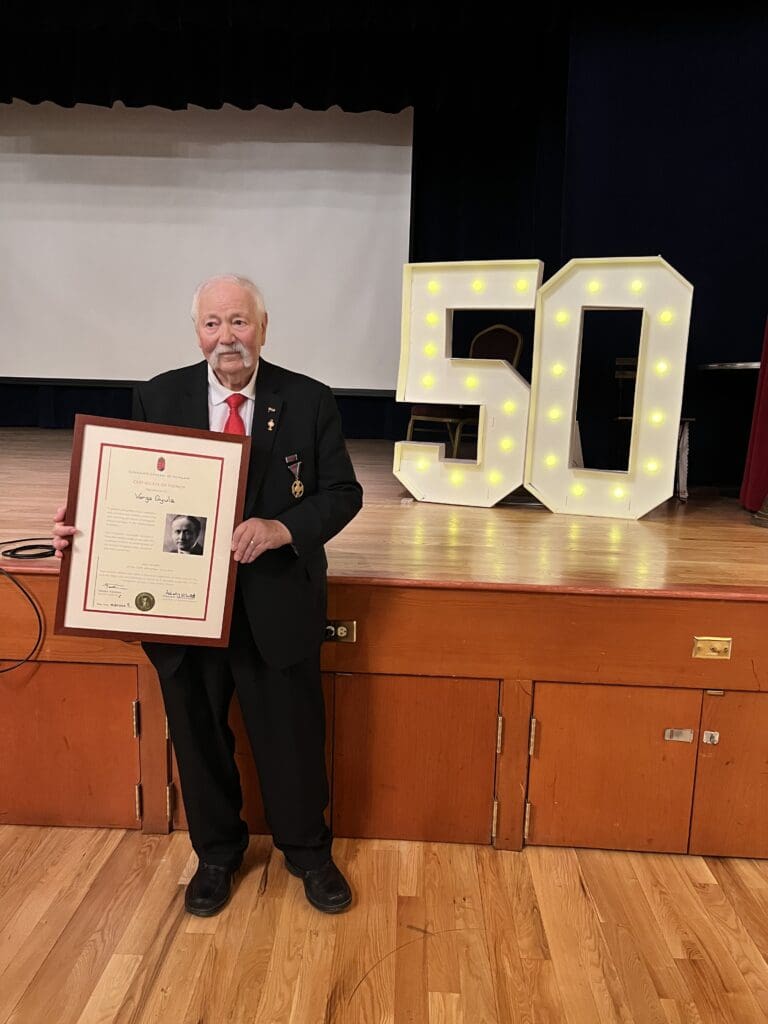
Cooperation under the Palm Trees was the title of an online conference held on 9 February, organized jointly by the Diaspora Project Network of the University of Pécs and Kerko Media Ltd. At the conference, Hungarian organizations from Florida introduced themselves and their different forms of cooperation. The event was moderated by Deputy Rector Dr Ákos Jarjabka and Director of Kerko Media Ltd János Keresnyei, while the invited panellists represented various Florida-based Hungarian organizations. The nearly 70 participants from eight countries all over the world were able to gain insight into the exemplary cooperation of Hungarians in Florida. 

Poster of the conference Cooperation under the Palm Trees

Honorary Consul Piros Pazurek opened the event by providing a summary of the life of the Hungarian community in America, in particular in Florida. Approximately 1.4 million people of Hungarian descent live in America, of which 2–300 thousand speak Hungarian, and more than 200 Hungarian organizations (churches, scout groups, weekend schools, Hungarian houses, a variety of clubs, and new types of so-called hybrid solutions) are active across the country. The State of Florida has a population of approximately 23 million people, and receives 800–1,000 new residents every day and 130 million visitors each year (of which 80 million come to Orlando). Florida is the third most populous and fourth wealthiest, that is, economically strongest state in America. By numbers, the approximately 110 thousand Hungarians living in Florida rival the Hungarian communities of New York and Cleveland, including 12–14 active Hungarian organizations and many Hungarian businesses.

Recent examples of close collaboration between local Hungarian organizations include the online charity concert titled Nyári Bernadett and Friends, by means of which they raised 50 thousand dollars for two Hungarian girls orphaned in a family tragedy; the Hurricane Fund, which helped dozens of Hungarian families in the wake of frequent hurricanes (with the active support of churches, including Calvinist bishop Dr Csaba Krasznai of Cleveland, Ohio); the monthly online meetings set up during and after the pandemic; the sports scholarship created from donations collected during Katinka Hosszú’s recent visit to Florida (she is one of the best Hungarian swimmers of all time); the traditional wheat mixing ceremony on 20 August; the annual Sarasota Hungarian Festival as one of the most important cultural and gastronomic diaspora gatherings, with 2,000 visitors per year; the HungarianHub, which gathers all information concerning Hungarians in America; and the Hungarian Summit, a professional conference that will be held for the fourth time this year, again in Daytona Beach. Before handing over the floor to the individual organizations, Piros mentioned Edit Dukai, a key member of the Diaspora Project Network, who came to Florida as a Kőrösi Csoma Sándor Programme (KCSP) fellow, and became the office manager of the HungarianHub and also an honorary citizen of the Middle-Florida Community.

Children of the Mákvirágok Hungarian Preschool and Elementary School in Orlando

Viktória Butala, the head of the Mákvirágok Hungarian Preschool and Elementary School in Orlando founded in 2014, pointed out that their school has classes every week, they work from textbooks published in Hungary, and several of their students have been able to join or return to the Hungarian education system without any problems. Their central location allows them to build relationships with all corners of Florida; two examples of which were the Talpra Hungarian Sport Cup and the Mákszemek group in Daytona Beach, run by pastor Emese Asztalos, with whom they complement each other very well, often attending each other’s events and organizing joint events.

Zsuzsanna Cajkás is the co-founder of the South Florida Hungarian Kids Club, a weekend school established in 2008, which now has 35–40 children—after initially starting with 5–6 students—and have currently six volunteer teachers. They also have an active women’s choir. Cajkás highlighted the very strong support of parents, who also donate money, which enabled the club to support a homeless elderly Hungarian lady, cover the school fees of two students, and support a children’s home in Transylvania and the Parents’ House Hungary. As Cajkás said, not having their own building makes it particularly important for them to build relationships and work together with other organizations during various national and family celebrations.

Working together is also a way of thinking together, exchanging ideas, but most importantly: a pledge to survive in the long run.

Finally, she mentioned the Hungarian Chamber of Commerce of Florida, which she established to build business relations and bridge the gap between the business and civil sectors.

South Florida Hungarian Kids Club

Zita Horváth introduced the MHFolk Hungarian Heritage Home, named after Margit Horváth (Aunt Margo), who passed away just a year ago, and which is dedicated to take care of her very rich folk costume collection, collected over 40 years. Horváth explained that their main objective is not only to save and preserve authentic folk costumes but also to help other organizations with similar objectives. She learned that after the move of the local Reformed congregation and the Hungarian Club (because the American congregation building, which had been their home, had to be sold), Mrs Horváth’s collection, the library’s many books, and the headstone and plaque commemorating the 1956 revolution also found a new home. She expressed her gratitude to the Cleveland Regös Group for taking on the responsibility of transporting and storing a container of folk costumes, which also set the stage for a future collaboration. Finally, she told us that the travelling museum was a great success at the Sarasota Hungarian Festival, and the recent community Christmas was organized together with the Mákszemek children’s club in Daytona Beach.

MHFolk at the Hungarian Festival in Sarasota

Rev Emese Asztalos was introduced as ‘not just a pastor, but a travelling pastor’. She talked about how she had come to Daytona Beach to lead Putnam Memorial Presbyterian Church, a Hungarian Community Church. She has been living in America for 20 years, previously a fellow in Atlanta, Georgia and was invited to Daytona Beach in 2015, but also serves 3–4–5 times a year in two other states (Georgia and South-Carolina). The Hungarian congregation was started with the support of the Presbyterian Diocese of Central Florida and the Putnam Bequest, and welcomes all Hungarians regardless of their denomination. They work closely with the Hungarian American Club during national commemorations and holidays and with the Mákvirágok of Orlando: for their members she also provides religious education. Asztalos sees the loss of the former location, the difficult period that followed, and the subsequent move to new premises as another opportunity for cooperation, and expressed her pleasure that the folk costumes, the huge amount of books, the headstone and the memorial plaque have all found their new homes—unfortunately, due to the the limited storage capacity of the new building, it was not possible to keep them together.

Hungarian Putman Memorial Presbyterian Church, a Hungarian Community Church

Rev Péter Pál Bodor, the Reformed pastor of the Hungarian Christian Church of Sarasota, said that he also used to serve in Miami once a month, following in his father’s footsteps. In addition to his secular job—a senior executive with a degree in mechanical engineering—he founded the congregation in 1993. He mentioned the visits of key public figures, former Hungarian President János Áder and well-known Franciscan priest Csaba Böjte, stressing the importance of ecumenism. He cited as examples of local cooperation the events held at the Petőfi and Kossuth Clubs in Miami, the wheat mixture ceremony of 20 August presented together with Rev Emese Asztalos, and the fundraising for schools in Szeklerland and Transcarpathia.

Gyula Kovács, representing the American Hungarian Club of Palm Beaches, founded in Lake Worth Beach in 1963, said that last year they had successfully completed a generational change of leadership; as a result, more and more young people are visiting their clubhouse, which was previously viewed as a seniors’ club. They do not have a weekend school (they refer applicants to the South Florida Hungarian Kids Club), but they have already purchased toys and equipment that children and young people can use to play with. They even have a permanent musician who comes from Sarasota. Rev Lóránd Csiki-Mákszem, who is based in Miami, serves at their club on a monthly basis. Among their many programs (Harvest Ball, cultural programs, regular dances etc), the most popular was the January goulash cookout with 110 participants, travelling to the event even from New Jersey and New York. Kovács has repeatedly stressed their desire to become more involved in the larger Hungarian community in Florida, therefore they have made their clubhouse available to any Hungarian organisation free of charge. Finally, he expressed his gratitude to Consul Dr Viktória Sass, based in Miami, who has helped them a lot.

Lóránd Csiki-Mákszem, pastor of the First Hungarian United Church of Christ in Miami, said that the congregation was founded in 1948 by a pastor who was on vacation there and was touched by the local Hungarians’ need for spiritual nourishment. He said it is one of the most complex congregations in South Florida, with its own church, a permanent pastor, weekly services, two fellowship halls (Kossuth Hall, a larger fellowship hall, and Petőfi Hall, mainly for youth purposes), and their own apartment available for rent. Their Sunday school has been suspended this year due to teacher shortages, but they also work with the previously mentioned Kids Club, the Lake Worth community, and Rev Peter Pál Bodor. He also referred to the collaborations previously mentioned, that is, the charity concert and the hurricane fund, and added their congregation’s Good Samaritan Mission Fund, by which they are able to support people in need. He also mentioned Consul Dr Viktória Sass, thanks to whom ‘collaborations have been revived’.

Mónika Farkas, the community leader of the Hungarian Christian Church in Safety Harbor, said that her church was built in 1960 by enthusiastic Hungarians who took out a large loan and then managed to pay it back through collecting donations. Apparently touched, she spoke of how she had come to lead the community: after listening to a performance by Tvrtko Vujity, she invited him to visit them, and he came along with the violin virtuoso Bernadett Nyári. Inspired by the success of that event, Farkas decided to shake up the community, and has been enthusiastically organizing events ever since. They also have a singing group for small children, regular lunches attended by 70⁠100 people, and Rev Dr Csaba Osváth conducts services every Sunday. Farkas quoted from the 50th anniversary commemorative book, explaining the founders’ goal, that is,

to always have a place where people could speak Hungarian, a goal she wants to pursue relentlessly.

Daytona Beach Hungarian American Club

Zsuzsanna Kovácsoutgoing president of the Daytona Beach Hungarian American Club, explained that her organization, founded in 1961, is a non-political and non-religious community that brings local Hungarian families together and keeps Hungarian culture alive by organizing monthly gatherings, outings, Hungarian holiday celebrations, and by serving Hungarian home-cooked meals. Their current location is a Presbyterian church, as they cannot afford to own or maintain a separate building. She emphasized how cohesion had helped them through economic and social high and low points.

Finally, Piros Pazurek took the floor again and, in place of the absent representatives of the Diaspora Camp (Noémi Szilágyi) organized by the Hungarian Scout Association in Exteris (KMCSSZ in Hungarian) and of the Hungarian Festival in Sarasota (Erika Klatyik, Zsolt and Tünde Szekély, Péter Rippel), emphasized that these events are also colourful elements of Hungarian life in Florida. She stressed that the festival, which attracted thousands of people and was held for the 17th time last year, is a great experience for all visitors. The organizers have put it together with their own efforts, by raising funds from civic organisations and businesses (ie it is not funded by the state or other governmental organizations), with great enthusiasm and a lot of volunteer work, similarly to the HungarianHub and the Hungarian Summit, to which they are looking forward to, welcoming all interested individuals or businesses on May 23⁠24.

The poster of the Hungarian Festival in Sarasota

Although I have been living in America for more than a year and a half, and have written numerous articles and even a book about Hungarians in America, I was not familiar with Hungarians in Florida before the conference, have only met a few of their representatives in passing, and have only recently started producing content for HungarianHub. However, this conference re-confirmed my previous take-away: the future of Hungarians in the diaspora depends on the cooperation of enthusiastic volunteers and committed church people, and the civic and church organizations they lead or operate.

Source: hungarianconservative.com
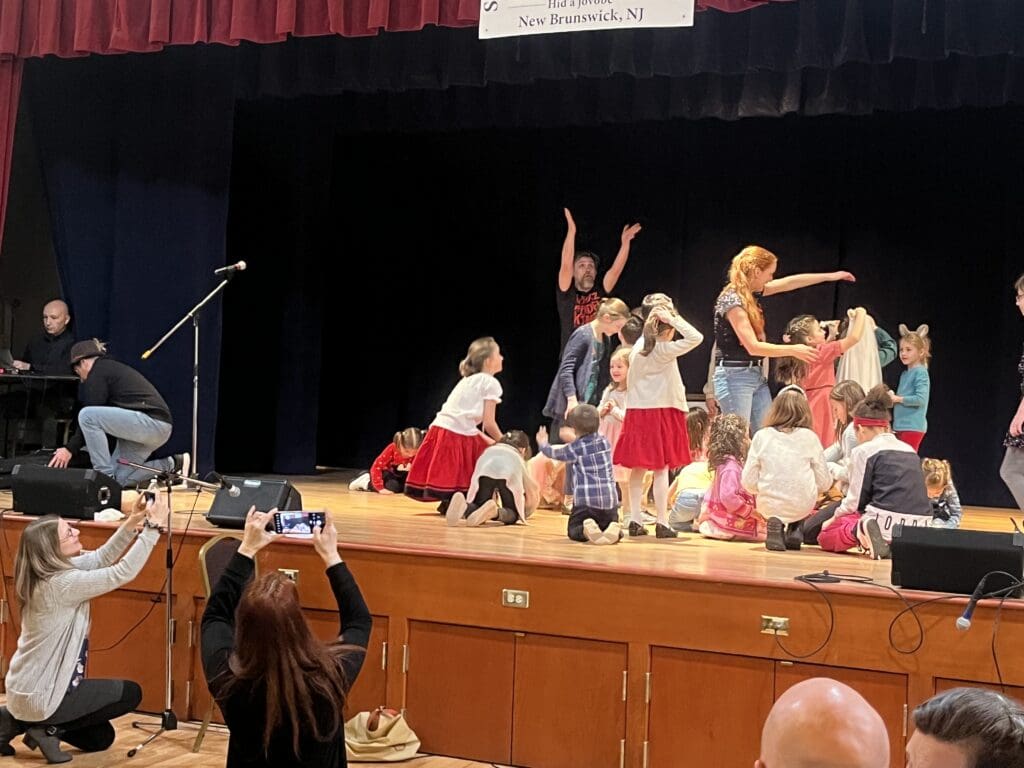
Reklám
Tas J Nadas, Esq

‘We still exist, but not as we once did’ — An Interview with Lél Somogyi

Source: hungarianconservative.com

The Secretary-General of the Árpád Academy, which was founded in 1961 by the Hungarian Association, carries a monumental family legacy both in terms of public and private life. His father, Dr. Ferenc Somogyi, a university professor and member of the Hungarian Parliament, was forced to leave Hungary in 1945 without his wife and their four children. After five years of hopelessly waiting in the refugee camps in Austria, he immigrated to America. In 1953 Ferenc remarried and started a family in the U.S. His son, Lél, carried on through his involvement in the Hungarian community, while his university student son, also named Ferenc, enthusiastically participates in Hungarian scouting and folk dancing, and even plans to dedicate his future profession to the Hungarian cause, continuing his grandfather’s legacy.

Reklám
Tas J Nadas, Esq