
by Ferenc Somogyi
2018 Easter Story – April 1, 2018
It was a cloudy day and the sky was gray and dismal. Heavy rain seemed imminent. Cold breezes whispered between the branches of largely bare trees, save for a few valiant early leaves.
The village was quiet. Aside from a few birds fluttering along the rooftops of the cottages, there was little movement in the community. Even the animals, mostly situated in small pens and barns behind the cottages, seemed hushed.

It was early afternoon, at a time when people usually would be out and about, going about their typical Friday business. Today, however, was special. Folks remained in their homes and, unless completely necessary, didn’t associate with one another for a good portion of the afternoon. Grandmothers stayed to themselves in the corners of the cottages, praying fervently under their breaths. Mothers busied themselves in the kitchens, preparing for the days ahead while gently shushing their excited children. Fathers were mostly out back alone, hidden from street view, eying their animals warily in the unusual midday quiet.
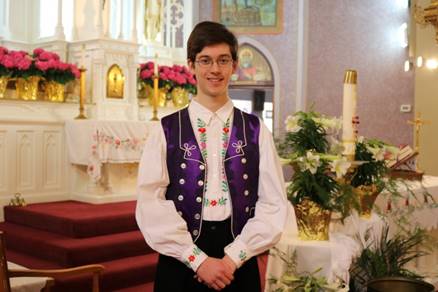
George was fifteen — a budding young man and a source of pride for his family. He was tall and somewhat lanky, with messy brown hair and a determined composure. His daily attire was ordinary and fitting for a peasant boy like him: a white shirt with wide, puffy sleeves and quarter-length buttons, and a pair of slightly dirty, light woolen drawers. Hugging his drawers were a pair of muddy black boots, George’s Sunday best, that he really shouldn’t have been wearing on just any Friday. On this particularly chilly day, George also wore a light brown sheepskin coat over his shirt to keep him warm, and a flat-topped, gray woolen cap pulled over his ears.
George was one of the few shepherd boys of the village. On his regular work days, he would wake up early and guide the sheep of the neighborhood out into the surrounding fields for grazing, where he would spend his time sitting on the grass of the valleys and the hills, playing tunes on his wooden flute and admiring nature’s work.
Nobody really wanted their sheep taken out today. After all, it was Good Friday. For at least the time between 12:00 and 3:00 pm, silence was required and work was to be kept at a bare minimum level.
In fact, George was supposed to be in his cottage with his mother, father, and sister, but through some careful convincing talk and with support from his father, George had gotten his mother to let him go out to roam the village. Even George could not deny that his heart was in the outdoors. His upbringing and occupation already had that lasting impact on him.
Now, George crunched and squelched through the muddy pebbles of the main village road, trudging past old wooden carts and his neighbors’ homes. Though the weather was unpleasant, George felt content. He consciously drew in a few deep breaths of clean rural air as he walked, savoring the moment.
While passing the village church, George saw Father Stephen crossing from the priest’s house over toward the church. The young reverend was dressed in a long black robe and had a wooden cross around his neck. Recently Father Stephen had shaved his growing beard. George rather liked the new look.
Father Stephen noticed George. Without saying a word, the priest waved kindly in the boy’s direction. George smiled and waved back. Father Stephen wasn’t too old of a priest, and George, as a child, had grown to know him quite well. Now, Father Stephen was as much of a brother to George as it was possible for a priest to be.
As Father Stephen entered the church, George realized he had no destination in mind. Without thinking about it, the wooden cross on the hill overlooking the village in one direction and the Carpathian Mountains in the other came to mind. George focused on the thought intently as he walked. It was Good Friday… he might do well to pay his respects to the Lord.
The walk to the wooden cross proved longer than George remembered it should. Once George passed the final cottage at the end of the village, he had to rely on his own sense of direction and the small dot on the hill in the distance that he knew to be the cross. The previous days’ rain had made the ground soft and under his boots it shifted to the sides as he walked… it wasn’t long before George’s boots had turned from shiny black to scuffed and dirty brown. It was one of his greatest faults, his mother said, not taking care of his boots. Nevertheless, George kept walking, his shepherd’s soul enjoying the world around him.
After what seemed too long, George felt the ground under his feet begin to tilt upward. He had reached the hill. At the top, George could now clearly make out two crossed wooden beams.
As he climbed, George realized that he wasn’t sure if he had his flute, which he always carried with him. Fumbling in his coat pockets, George was relieved to feel the small, smooth wooden pipe.
Not long after, George reached the top of the hill. He walked slowly towards the wooden cross, which he had visited before during his shepherd rounds yet never seriously examined.
The cross and its structure was about eight feet tall. It featured two wooden beams with an upward curving arc positioned over them, sort of like a rooftop. On the beams was a wooden, painted, crucified Jesus, with his head bowed and his eyes closed. Above Jesus’ head was the traditional INRI sign, and below his feet, at the base of the cross, a very small gate and an iron fence around the pedestal on which the cross stood.
The base of the cross and the pedestal itself featured several words carved into the old wood: “Our Savior at Calvary, watching over our village, March 1900. Father Daniel, who rebuilt our village church, is buried here.”
George had never noticed the date written on the base of the cross before. He was amazed that the cross was in such good condition after twenty-four years in the elements.
George gazed up at the painted face of Jesus. It was artfully done. Jesus seemed to radiate emotion. George tried to grasp the feelings of Jesus at that moment, unsuccessfully. There was a strange mixture of pain, completeness, determination, and despair. The most prominent emotion that emanated forth, however, was love.
Pure love.
George could feel Jesus’ love in him. Wide-eyed and amazed, the boy slowly came to his knees. Without thinking, he pulled his flute from his pocket. It was decorated with a few folk motifs and made of a deep-colored wood. George put the flute to his mouth. He would play a tune for the suffering Lord.
Solemnly, George blew into the pipe, playing one of the age-old folk songs of his village. The tune was slow and melancholy, but George felt that he was doing the right thing. He played flawlessly and sweetly…
…until his vision went black and the high-pitched tune became low, foreign, and monotone.
Dazed, George slowly regained his vision. Replacing the gray and green coloration of the Carpathian hill was a sandy, rocky beige and brown. George could hear cries, jeering, and sobs around him, complemented by the sound of an ancient horn being blown in the distance. Looking up, he was unexpectedly stunned by the light of the sun.
When he recovered, he was stunned yet again, and even more.
George was looking at a man — a crucified man — hanging limply on a large, bloody wooden cross. The man was pierced with nails through his feet and hands. His body was ravaged from flogging. He had a crown of thorns on his head. Above him, an INRI sign hung — spelled out.
Jesus, gasping for air, trembled in pain. Then, hanging limply once more, he looked at George. George was speechless.
The boy felt that pure love.
Jesus smiled faintly, clearly suffering. From his right eye, a single tear fell, hitting the dry ground before George silently. George stared up at the Lord, frozen in time, paralyzed, but feeling safe. Then, as quickly as he had come, he departed. His vision faded, and he returned to the Carpathian hill.
George was huddled up in a kneeling position on the ground. His flute lay in front of him in the grass, abandoned. The wooden cross was before him, still radiating the same love as before.
George looked up at the painted Jesus. He was amazed to see a droplet of water beneath the crucified Jesus’ eye. It fell in seemingly slow motion, hitting the base of the cross in front of George.
Suddenly, George felt a hand on his shoulder. He looked up to see Father Stephen smiling sympathetically down at him. George opened his mouth to tell Stephen what he had experienced, but the priest simply put out his hand, signaling to George that there was no need to speak.
“Come, George. You’re needed at the house.”
“W-why?” George stuttered quietly.
“Your mother would like to prepare the Easter eggs with you – in the traditional red of Jesus’ blood, of course,” Father Stephen answered.
George nodded slowly, getting to his feet with Father Stephen’s help. The boy picked up his flute and looked at it in his hands for a few moments. Then, putting it back into his pocket, he took one more look at the wooden cross. Jesus’ love would always be there for him.
Turning, George and Father Stephen began their journey back to the village. They walked side-by-side silently, sharing a secret and eternal understanding.
by Ferenc Somogyi