





In his regular interview on Kossuth Rádió, Prime Minister Viktor Orbán discussed the current state of the war in Ukraine, Europe’s growing involvement in the conflict, and tackling inflation at home.
Reklám


In his regular interview on Kossuth Rádió, Prime Minister Viktor Orbán discussed the current state of the war in Ukraine, Europe’s growing involvement in the conflict, and tackling inflation at home.

Source: hungarianconservative.com
This is an abridged version of the original interview first published on 777.hu.
A preface to the pamphlet commemorating the 50th anniversary of the founding of the Gábor Áron Boy Scout Troop No. 6 in Garfield contains a 10-year-old message by Gábor Bodnár, the former president of the Hungarian Scout Association in Exteris (KMCSSZ): ‘Be a scout when no one sees you, and be a Christian when everyone sees you. Serve the Hungarian community of Northern New Jersey. Educate yourself. Become thoroughly acquainted with our language and culture so that you can be ambassadors, so that you can make our values known to Hungarians and non-Hungarians in our adopted country. For forty years you have held aloft the scout flag in the service of God, country, fellow human beings and the Hungarian nation. Now, with heartfelt congratulations to your achievements, I ask the Almighty to help you with your work and guide your paths in the future.’
***
The foundation of scouting in 1907 by Lord Baden Powell (BiPi) in England was soon followed by the establishment and rapid development of scouting in Hungary: the first Hungarian scout troop was organized in 1910, while the Hungarian Scout Association (MCSSZ) was founded in 1912. The first major international success for Hungarian scouts was their excellent performance at the Danish jamboree of 1924, winning third place in the competition. Hungarian Chief Scout Count Pál Teleki was elected as a member of the International Committee of the scouting movement. In 1933, the MCSSZ organized the World Jamboree in Gödöllő, where the world’s Chief Scout, BiPi, was also present. The World Association of Girl Scouts, founded in Parád, Hungary, also organized the Pax Ting jamboree in Gödöllő in the summer of 1939 for 4,000 girl scouts.
By 1941, a thousand troops had been in existence in Hungary with 60,000 scouts, operating under increasingly difficult political and economic conditions. The first popular folk song compendium (101 Hungarian Folksongs) was published by the MCSSZ, with a foreword by Zoltán Kodály. Under the auspices of the MCSSZ, the organized research of folk traditions and the regös (scout folk tradition) movement were launched as well. Adult scouts spread the scout spirit everywhere from the workplace to the parliament. After the war, while MCSSZ could continue functioning for a while, it was ultimately disbanded and banned by the communist authorities in 1948. During the post-war years, Hungarian scout groups were formed in the refugee camps (Austria, Germany and Italy) and then, following the immigration of the refugees to a variety of countries around the world, primarily overseas.

In 1989 scouting became again legally permitted in Hungary. Consequently, the émigré MCSSZ changed its name to the current one: Hungarian Scout Association in Exteris. Nowadays it comprises more than 70 troops on four continents, in 14 countries, organized into five districts (Western Europe, South America, USA, Australia and Canada), with a total of 2,950 members. Scouts direct half of the Hungarian diaspora weekend schools in the western world. Leadership candidates have to pass tests in Hungarian language and literature, geography and history. Numerous folk dance and regös groups were organized by scouts, and their leaders later established many (non-scout) folk dance groups as well. They’ve published a significant volume of scout guides and ethnographic works. In addition to their periodicals, they provide study grants, organize leadership training camps annually and jubilee (‘Jubi’) camps once every five years. Their central leadership training camp site is in Fillmore, New York, but they have their own parks in Ohio, Australia, Germany and Brazil as well. They also own scout homes in New Brunswick and Garfield, New Jersey, Cleveland, Ohio, as well as in Sydney, Australia and Buenos Aires, Argentina.
Imre was born in 1949, near the western border of Austria. His parents fled Hungary in January of the same year. Imre went to kindergarten and first grade in Austria. They could immigrate to the U.S. in June 1956, under the so-called DP (Displaced Persons) Act regulating the acceptance of refugees after World War II. Traveling by a ship was a lifelong memory for the seven-year-old boy. ‘I remember three things: I had an accident in Austria, so I was quite a phenomenon with my head bandaged; a cartoon was screened on the ship every day, which my father and I always watched; and the first view of the Statue of Liberty from the deck of the ship which I will never forget.’ His father’s friends from Hungary, the Andreánszky family, were waiting for them. They moved to Passaic where Imre attended the English language school of the local St. Stephen’s Magyar Church. In 1956, there was no Hungarian education in Passaic, but as soon as Hungarian courses were restarted, Imre joined. Later, he was a student at the nearby Catholic high school, and then graduated in metallurgical engineering, with a bachelor’s and then a master’s degree from Stevens Institute of Technology at Hoboken, New Jersey. He joined ExxonMobil (Esso), an integrated multi-national oil company, where he spent 32 years: 10 years as an engineer and 22 years as a manager.
He met his wife, Agnes (who grew up in Toronto, Canada in a Hungarian immigrant family) through scouting: he first met her brother at a scoutmaster training course and later her two sisters at a Scout Day in Cleveland. They married in 1974 and moved to Madison, NJ, where their three children (Béla, Zsófia and Géza) were born in the late seventies. Due to Imre’s work, the family lived in Texas for two years, and later in England for four years as well. Imre believes that living abroad had a very positive impact on his family: they were able to spend much more time together than when they lived at home in New Jersey, where he was always busy with scouting and his career. The children, especially the boys, were also able to benefit from their contacts made while living abroad. Béla has been living in Hungary for well over 20 years. Géza worked in London for two years, and they both feel at home in Europe. While living in England, the family traveled around Europe, visiting Hungary at least once a year, also to meet Ágnes’ grandmother then in her eighties.
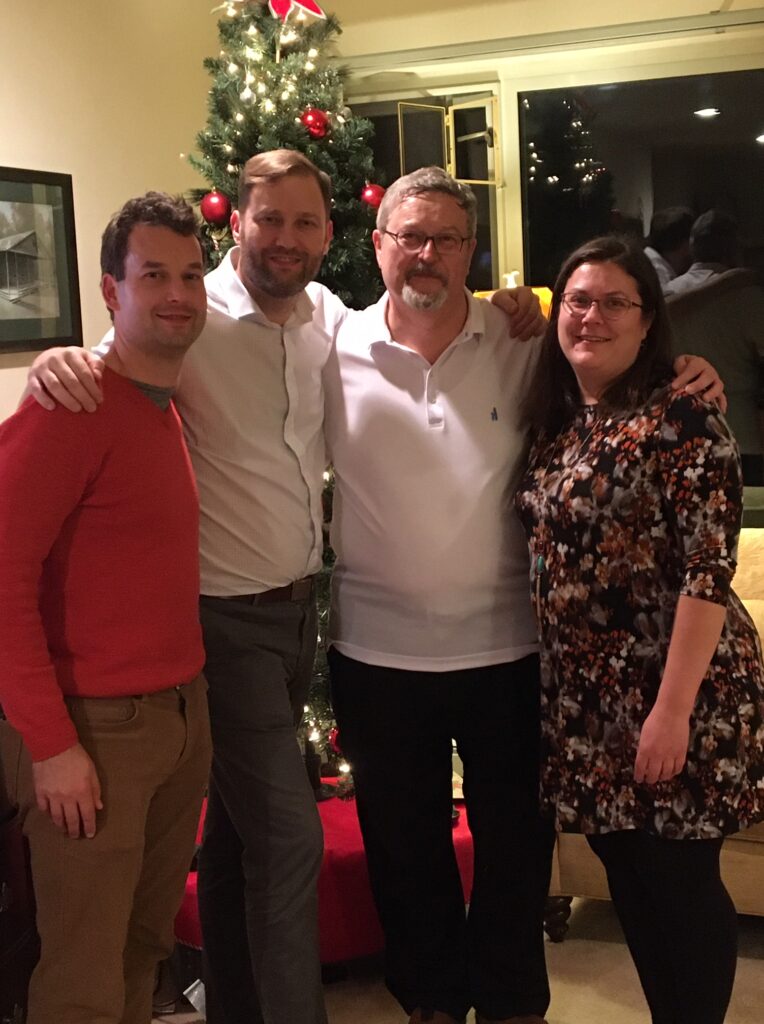
Both of his boys studied international finance. When Béla did an internship in Hungary, he felt so much at home that he didn’t want to come back, but his father insisted on him finishing his studies. Afterwards, he returned to work in Hungary and has had a successful business career there for over 25 years by now. His wife is Hungarian, and they have two children; they come to the U.S. once in every year to visit the extended family. Zsófia lives in New Jersey, has a teaching degree and has four children with her Haitian husband. They all attend the weekend Hungarian school in Montclair, are members of the Hungarian Catholic church in Passaic and scouts of the Garfield Hungarian troops. Géza also built up a career in consulting and business, and lives in New Jersey, with his Irish Italian wife and their three children.
Imre first got involved in scouting in September 1956 when his father took him to the inaugural meeting of Gábor Áron Scout Troop No. 6. ‘I’m the only child of my parents, and that fact largely defined my life. I grew up in that scout troop. My father was responsible for the KMCSSZ finances from 1958 until his death. My mother came from a traditional rural environment in Western Hungary growing up with eight brothers and sisters. When there was cleaning or cooking to be done in the scout home in Garfield, she was always there, together with the Bodnár, Jámbor and Keresztes families, who took the lead with any volunteer work supporting scouting. I went through all the ranks: from cub scout to patrol leader, from deputy leader to scoutmaster.’
Gábor Bodnár, the long-time president of KMCSSZ, also lived in Garfield and this led to a close friendship: Imre’s father was a good friend of ‘Uncle Gábor’ (‘Gábor bá’ in Hungarian), despite being 21 years older than the latter, and Gábor’s eldest son was a scout in Imre’s patrol. His parents and almost all his friends were involved in scouting. Imre spent his free time helping at the camps. Completing the leadership camps, he became even more involved taking over the patrol leader training program for which he was responsible for 15 years. Soon he became a member and later chair of the Board of the Scout Association.
‘Uncle Gábor was always giving me new responsibilities; I was never sure it was planned or simply random. My life in England was leisure time in comparison, although I also helped with organizing and participated in our European leadership training camps while there. When I came back to the U.S. in 1992, on New Year’s Eve, Gábor invited me and István Vajtay for a sit-down. Neither of us knew why. He had a military background, who treated scouting, which was his life, in a similar fashion. He chatted with us in a friendly manner for a while, then simply stated that I’d be the executive president and Pista would be the Chief Scoutmaster. We just looked at each other and swallowed hard… We told him we’d like to discuss this with our families, since these were significant responsibilities. He gave us a little time, but his expectation clearly was that we would agree. I don’t know how he’d have reacted if we said no… I was in my forties at the time, Pista was under forty, so it was a bit of a daunting responsibility, but we took it on. Gábor was 73 years old. The truth is that he should have handed it over earlier. He was in perfect health mentally, but there were problems with the organization. He had built KMCSSZ from scratch up to having thousands of Hungarian scouts around the world, he was very good at organizing and expanding its reach. However, he grew up in a very different, authoritarian world. He may have had a plan about our development as leaders, but he didn’t share it with us. He was an excellent leader and organizer, he had incredible energy, but he wasn’t a mentor type. He never took time to explain details. He simply said: “You’ll learn it”. I had a leadership background, and Pista was a high-profile lawyer with a charismatic personality. We were both ready for the job.’
In April 1993, the Biennial Meeting supported Gábor’s succession proposal. A bit later he fell ill and died in 1996. Shortly before, in 1994, György Némethy, who had been the president for 20 years, also passed away. Imre formally became president in 1997. After 12 years of being the Chief Scoutmaster, István Vajtay took a hiatus to concentrate on running New Jersey’s largest law firm, but later, in 2021 was elected vice-president.
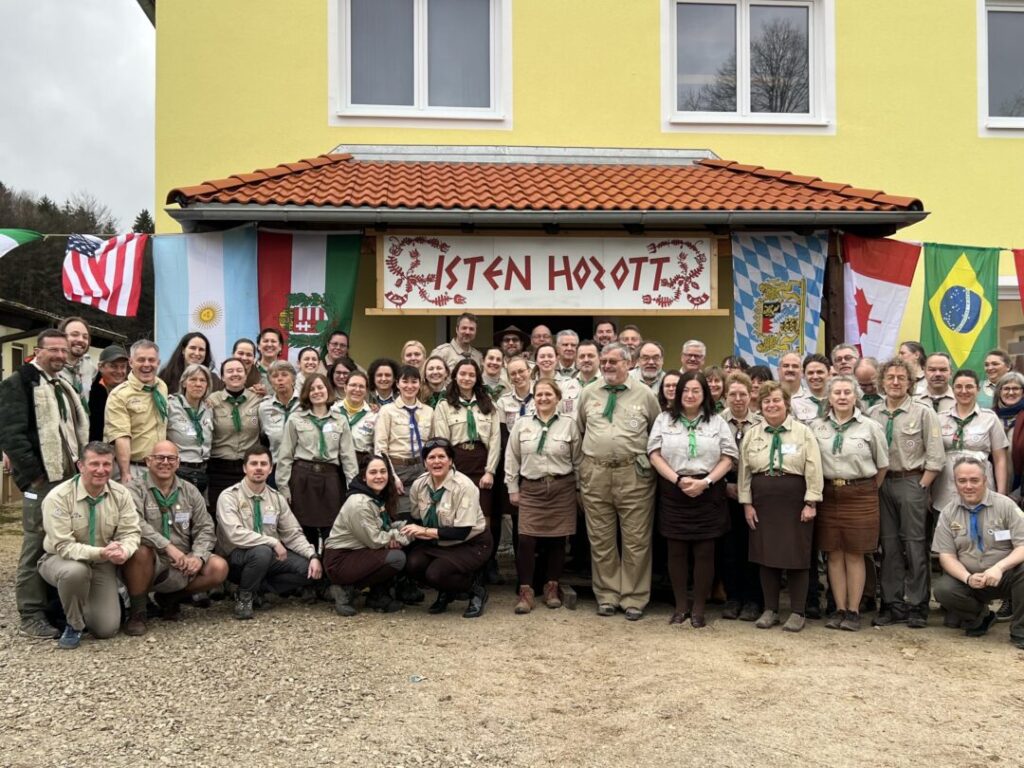
When Imre and István took over management and assessed the problems, they realized the need to focus more on Hungarian language capabilities and practical scout lore, and to ease tensions between the districts/troops and the central administration. The leadership training system was working well, it ‘just’ needed to be upgraded. They started to work on building the reputation of the organization, which ultimately brought their membership from 2,000 to 2,950 in 20 years and the participants of the leadership training camps from 200 to 320 in 15 years. ‘While most Hungarian organizations in the diaspora are in decline, we are growing. It’s a huge success’, says Imre proudly, adding that he believes this is due to a change in the mindset of the leadership. ‘KMCSSZ is an association of scout troops, not of individual members. We are very troop-centric and do everything to help the troops on the ground.’ Communication also changed significantly. ‘Unlike many organizations founded and run by post-war and 1956er refugees, we try to remain supportive of all new initiatives and requests, thus there is a generally positive atmosphere within the organization. We try to communicate with everyone, we are accountable and always helpful—for example, I always ask what we can help with instead of what we can receive. Today we are a well-known and well-respected worldwide Hungarian diaspora organization.’
The Biennial Meetings are usually held in America, but in 2023 the most recent one took place in Germany, which the European region was very pleased about. When asked about the takeaways from this latest Biennial Meeting, especially in the light of Gábor Bodnár’s previously quoted vision, Imre replied:
’The philosophy of scouting is set out in the Scout Law. It doesn’t prescribe doing a good deed when someone sees it, being gentle when others notice it, and being truthful when they know you’re not lying anyway. It sets out a positive behavior expectation, not a list of unacceptable behaviors. Scouting is a way of life. You have to be a scout not only when you are in uniform and among scouts; for someone who takes scouting seriously, it’s a lifestyle, a vocation. As regards Christianity, it’s not enough to pray quietly at home, you have to stand up for your faith and for Christianity. That’s what Uncle Gábor was referring to, and that’s how he lived his life, being a scout with all his heart and soul, and also being a practicing Catholic who participated fully in the life of the church with his whole family.’
’You have to be a scout not only when you are in uniform and among scouts; for someone who takes scouting seriously, it’s a lifestyle, a vocation’
Imre explained that scouting has three pillars: knowledge of Hungarian language and culture, scouting skills, and character building. They spent a lot of time and energy in the 1990s on strengthening the Hungarian identity, launching many related initiatives and programs. The fact that a significant percentage of their current scouts or their parents were born in the Carpathian Basin has helped a lot in this respect. Hungarian language skills have become stronger across the KMCSSZ. They’ve always struggled with scouting skills; the current target is having an acceptable level of skills, because today it’s an ever-greater challenge to get young people out into nature regularly, since they don’t go on hikes or to summer camps as much as they should. ‘Our performance is neither inadequate nor outstanding in this area, but a much bigger problem is character building; it is, I would say, our most serious problem.’
When speaking of character building, Imre noted that their scouts only spend two–three hours a week together, otherwise they largely live in a non-Hungarian linguistic, cultural and behavioral environment. ‘Besides, let’s be honest: today’s parents are typically not paragons of religious life and character role models either. This is our key challenge nowadays. As Pista put it at the most recent general assembly: we must face the changes in this world. Since we are committed to the basic aims, principles and spirit of scouting, we’ve been able to assess the changing circumstances and adapt flexibly to new situations. But an organization will only achieve its goals if its members are united by a common set of values that underpin their cooperation. These are set out in the Scout Law, which stems from our faith in God. It should guide our attitudes and behavior not only towards the outside world but also towards each other.’
Therefore, together with István Vajtay (and others, such as Toronto Jesuit Tamás Forrai, former New York District Scoutmaster Miklós Fogarasi and Regional Scoutmaster Tamás Marshall) they are formulating a set of behavioral rules in the spirit of the Scout Law. ‘This also has a religious or spiritual aspect, but it won’t be overt. Today, we can’t ‘‘sell’’ character building to scouts by emphasizing its faith-based roots and attributes. Those who’ve not received a religious education at home or in school need to also relate to these principles. However, these ultimately put them on the journey to find their relationship with God. Cardinal Mindszenty told Uncle Gábor and we also stand by his statement: “You’re responsible not only for Catholic children, but for all Hungarian children in the western world, and must give everyone the opportunity to come closer to their faith”.’
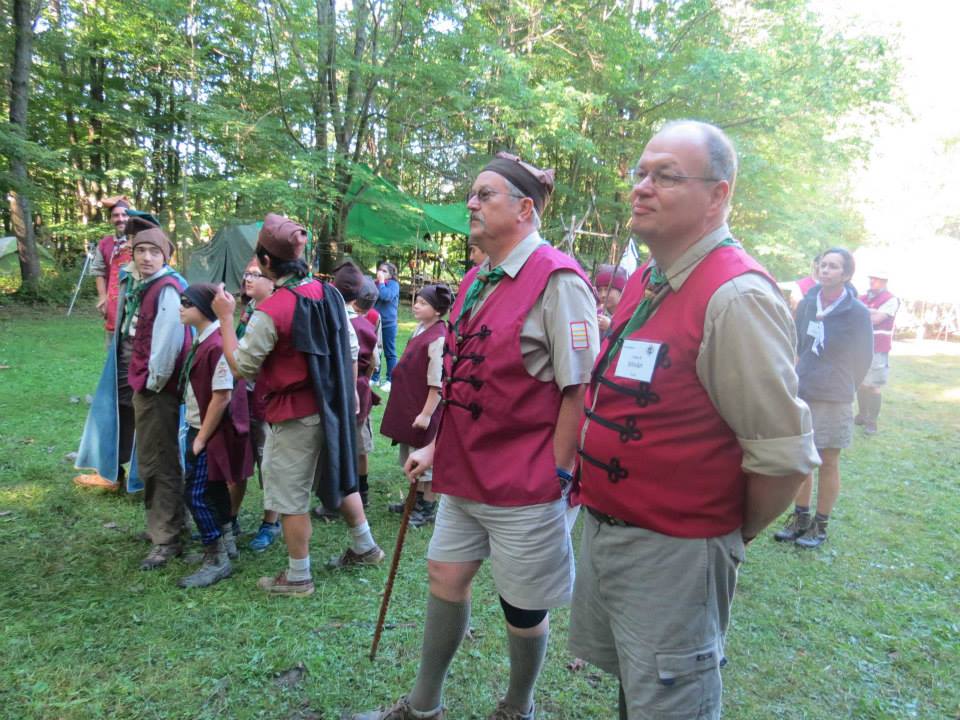
At the same time, he added, their camps in Fillmore, New York always have priests and ministers participating with religious services as part of the program, and when he looks at the children’s faces at the services, he thinks that most of them ‘don’t have the faintest idea’ about what’s happening there, because their parents don’t take them to church. ‘We teach the children to make the sign of the cross and to cite the Lord’s Prayer by heart, which should not necessarily be our job, but we have to adapt to the changes in society.’
Imre explained that currently there are two conditions for KMCSSZ membership: acceptable knowledge of the Hungarian language and faith in a higher ‘power or being’. There are scout leaders who think that Christianity should be emphasized more, but he believes that we need to provide a model for today’s children that gives them the opportunity to become good people. ‘After all, if you are a good person, you must have some relationship with a higher power or being—and that’s the direction I would like to take, so that the emphasis isn’t on going to church or being a member of one of the traditional churches. In this way, character building means that we want to raise good scouts, good citizens and good people. And to be a good person, you need a set of values that are traditionally linked to your faith in God, so indirectly we do get there. The senior leadership supports this approach, because they know that if we don’t follow this way, we’ll eventually lose the essence of scouting.’
‘Character building means that we want to raise good scouts, good citizens and good people’
The other big challenge for KMCSSZ nowadays is the great cultural diversity within the organization: they operate on four continents and thus have to cope with multiple cultural norms. ‘North America is conservative; as liberal as it may seem, but it’s still much more conservative than social-liberal Western Europe. Australia or the Anglo-Saxon world is also rather conservative; they are still highly disciplined. By contrast, South American culture is very loose, religion (i.e. Christianity) no longer has much weight there, because for many it represents former oppression (as it often does for Native Americans in North America as well).’ Scouts in Hungary are also much more disciplined than those in Germany, Austria, Switzerland or the Netherlands: they still keep all formalities, the others less so. According to him, differences have to be accepted, because they are part of members’ personalities and cultures: a Hungarian scout in the U.S. will approach a task with the American ‘can do’ spirit and will try to find a way to solve it; a European will be more hesitant, while a South American scout will allow the problem to solve itself…
‘It’s a big challenge to manage these differences; after all, even a troop from California behaves differently from one from the East Coast. I’ve always hoped that if we packed up a child in Cleveland and sent him to Buenos Aires, Sydney, or Berlin, he would be able to fit into scouting there just as well as here. I’m not saying we can do that a 100 per cent, but we’re trying very hard to create unity.’
Imre explained why it was so much easier for Uncle Gábor: everyone ‘started out’ with his and the other founding fathers’ guidance. They are still trying to train the Scoutmasters in a centralized way, and they want to pass on the same ‘philosophical principles’ to the lower levels, he concluded.
Finally, when asked about his own succession plans, he answered with a mysterious smile: this question will be relevant in 2025; they are already working on it, but the details are not yet public. He emphasized that this is no longer a one-man job; so he’s considering more people in leadership roles and a more flexible organizational model.
Source: hungarianconservative.com

Source: hungarianconservative.com
This is an abridged version of the original interview first published on 777.hu.
‘From the moment I met her, when she invited me to teach at the Hungarian school she ran, Emese was for me one of the best and most enthusiastic of the many selfless workers of the Hungarian nation…She was able to recruit selfless and dedicated teachers to head the classes, to raise the necessary funds from nothing, was teaching herself, organizing, inspiring, serving as a role model for all, and fighting without stopping against the fatigue, pettiness, resignation,’ Hungarian fellow teacher and scout István Sándor, who passed away in 2019 and whom Emese always remembers with great respect and affection, wrote about her.
***
Emese Kerkay, née Maczky and her husband László Kerkay were both born in Hungary and have been living in America for over 50 years. They have been cultivators of the rich Hungarian historical and cultural heritage and overall active contributors to the life of the Hungarian community of Passaic, New Jersey, having served at the Hungarian school for over 30 years: Emese as teacher and principal, László as treasurer. Emese has also been an active scout since the age of six and was a founding member and for 25 years curator of the American Hungarian Museum of Passaic. Regardless of several changes during these decades, she’s been able to preserve, enrich and disseminate the treasures entrusted to or discovered by her, be they children (whom she affectionately used to call ‘little Hungarians’), knowledge, publications or events. She has also actively contributed to the preservation of Hungarian folk traditions by creating several artefacts herself: she has loved painting and carving eggs, embroidering Hungarian folk patterns, burning pictures on wood, and compiling countless cultural publications.
After long months of slowly getting to know her, attending a variety of events together and reading some of her publications, she finally trusted me enough to invite me to her home in Garfield, New Jersey, where we chatted among her beautifully decorated eggs, countless photo albums and books.
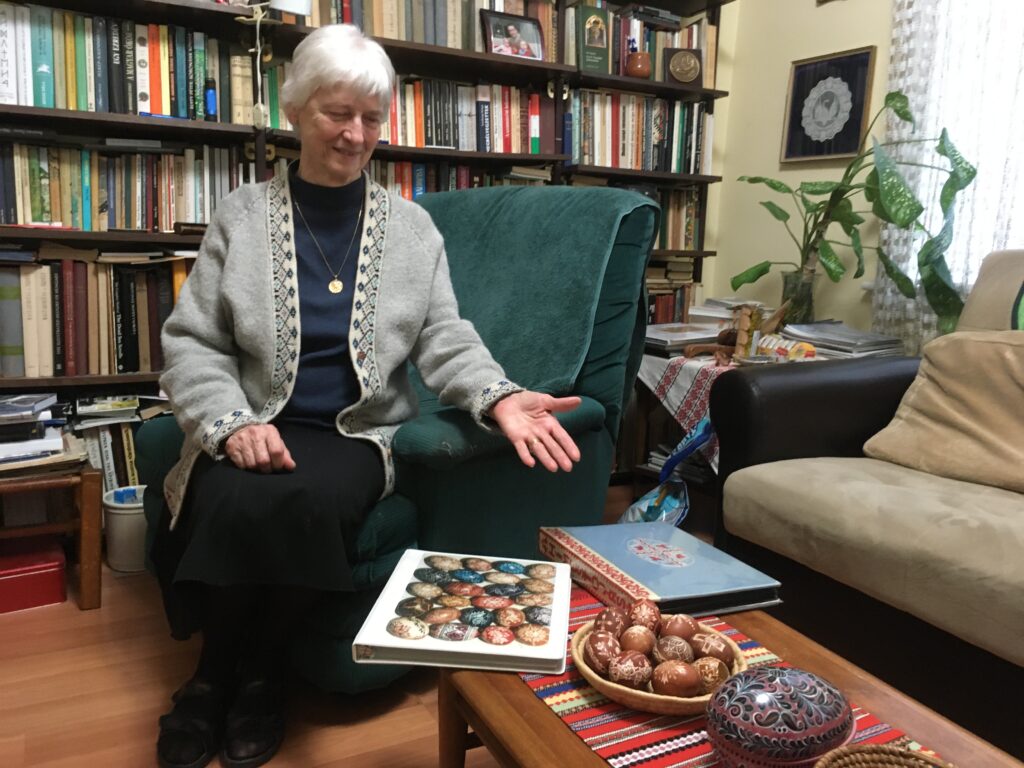
She started our conversation with her usual firmness, warning me that all she’s willing to talk about for publication is the work she had done and no details would be shared about her private life. By that time, I had already had an impression of the magnitude of her accomplishments from the books she’d lent me, but I knew very little about her private life. So I tried to persuade her to open up about the latter as well, since I was very much interested to learn where she got her extremely deep and creative affection of Hungarian identity and cultural heritage, her dedication and incredible work ethic, and last but not least the origins of the tremendous knowledge and experience she has passed on to hundreds of Hungarian families in hundreds of different ways. She wasn’t too talkative, but later I was able to map her private life a bit better from her collections and writings about her family lineage, which helped me put together a much more authentic portrait of her.
Emese’s latest research, following the history of the Kolossváry, Maczky and Fáy families, traces the origins of the ancient Transylvanian Ó-Tordai Mikola family back to Béla IV, King of Hungary in the mid-13th century. She inherited values and talents from her ancestors, including her deep commitment to her Hungarian identity, her love of the Hungarian language and culture as well as her dexterity. She believes that these aspects of character feature all the descendants of her great-grandfather, the Lajos Kossuth-loving postmaster of Heves. Her beloved grandmother was one of her role models, too. She has a treasure of knowledge and data collected about her parents and her siblings who live in four different countries (the U.S., Germany, Canada and Hungary) due to the tragic history of Hungary in the 20th century.
Emese’s grandmother, Anna Maczky (née Mikola) didn’t have an easy life. Not only did she experience poverty in the storms of Hungarian history after World War I but had to face her children’s tragic fate, too. Her son, Emil disappeared on the Eastern front at the River Don (today’s Russia) in 1943, while her other son György was beaten to death by the communists in 1945. Her beloved brothers suffered deportation by the Germans, and her husband died suddenly. She was deeply religious, and her strong faith helped her through life. In April 1945, she was evacuated to Germany with her daughter-in-law and first granddaughter, Emese, where she was tormented by a terrible homesickness. She was at rest only when, 16 months later, she moved back to Hungary with her daughter and son-in-law. She was an extraordinary woman, not only for the way she led her life, but also for the many talents she inherited from the Mikola family: she loved God, her country and family, she was fond of arts, especially music and poetry, and she was incredibly skillful and inventive overall. She wrote beautiful letters to her son and grandchildren in Germany. ‘Her letters reveal the soul of a woman of infinite intelligence and spirituality, who always included some kind of spiritual message in her letters: poems, stories, anecdotes, pictures, photos or postcards’, Emese explained.
Emese’s father, László, was Anna’s second son and a captain of the Hungarian Royal Gendarmerie (an elite unit of the Hungarian army) as well as a jurist and accountant, who became an American prisoner of war, and after being released, lived in Germany for the rest of his life. When his first child, Emese, was born, he was serving in Szolnok. In May 1941 he was transferred to Dés in Transylvania, and in 1943 was assigned to the Ministry of Internal Affairs in Budapest. His family survived the bombings of 1944 in the countryside. In December, the Ministry’s Gendarmerie Department was relocated to Szombathely to avoid being trapped in Budapest by the advancing Soviet forces. László had to leave the country, so he was separated from his family, whom he later met in Austria.
‘During the 24 years of his exile, he served the Hungarian cause in every minute of his free time until his last breath: he worked at several Hungarian organizations, supported all good Hungarian causes, gave lectures, even designed a portable hero’s monument, reorganized the Szent László Society, produced and published all alone a very successful quarterly magazine (GESTA), which was highly acclaimed by the Hungarian diaspora all around the world, and carried on a worldwide correspondence.’
With the help of his incredible memory, he hand-wrote multiple long ballads by János Arany by heart, creating the family’s first book in exile. He didn’t tell stories, but rather recited poems to his children, and in the last years of his life he wrote poems himself as well. Emese inherited the love of the beauty of the Hungarian language from him. His early death was the result of homesickness: his heart was literally broken. His wife, Erzsébet Kolossváry, survived him by nearly 47 years. In 1990 she moved in with her daughter Enikő but took care of herself until the age of 96. In her last five years, she was lovingly cared for by her three daughters.
‘God kept me, he had plans for me, and gave me parents and later children who helped me carry out those plans’
Emese was born in 1940, and arrived in Germany at the age of four, where she went to elementary school in a German convent in Altötting for four years, and then attended the Hungarian high school in Kastl, Germany for six years. ‘My training for Hungarian life began in December 1940 on the banks of the Tisza. The name I received from my parents is obligatory. I have tried to fulfil this obligation since my youth, both in Germany and here in the United States. We fled when I was only four years old, with a high fever and pneumonia. God kept me, he had plans for me, and gave me parents and later children who helped me carry out those plans.’ The 9–10-year-old girl had such a strong homesickness that while her parents were preparing to emigrate to Canada, she prayed secretly that they wouldn’t succeed. ‘My prayers were answered; they gave up their Canadian emigration plans after three failed attempts.’
Emese did eventually end up in the U.S., where she hadn’t wanted to go either, but where she believes God later led her: ‘If I had come here as a child and hadn’t attended the high school in Germany, for example, I wouldn’t have been able to fulfill my mission here. For me, the most important goal in the last 50 years has been the cultivation and spreading of Hungarian language, history and culture, especially folk art, egg painting and embroidery. For these, I had to be an adult.’
Before her marriage in Stuttgart in 1967 to László Kerkay, a 1956 refugee who had been living in the United States since 1958, Emese attended an interpreter school and worked as a translator and correspondent in Switzerland, Portugal and Germany. After their wedding, she came to America as a tourist, and six months later she received her permanent residency permit but never applied for American citizenship. After their wedding, she said goodbye to her father, not knowing that she would never see him again and that he would only know his first grandchild from a photograph.
Upon her arrival in New Jersey, Emese immediately became involved in the vibrant Hungarian community of Passaic, taking on whatever tasks came her way naturally at the (by now) 120-year-old St. Stephen’s R.C. Magyar Church and the Hungarian Weekend School, the Hungarian Scout Troop in Garfield (founded in 1953) and the Hungarian American Museum (founded in 1981, closed in 2014). Garfield still has a particularly strong scouting presence, as Gábor Bodnár lived and worked there, establishing and directing with ‘anxious love and uncompromising determination’ the headquarters of the Hungarian Scout Association in Exteris (KMCSSZ in Hungarian). Emese, being a scout since the age of six, worked closely with him until his death in 1996.
Emese first became a Hungarian school teacher and then the principal from 1979 until 2006. The most important dates and events of these close to 30 years, and the nearly 70 years that preceded them in the life of the school, are recorded in the publication 99 Years in Hungarian written by her. Reading through the adventurous history of the Hungarian school, we learn that on 7 February 1914 the sisters of the Divine Charity Order started their work in Passaic at the request of Rev. Lajos Kovács pastor. Later, ‘despite all efforts, the second generation began to forget their mother tongue at an alarming rate. Half of the 640 families in the parish neglected their religious life and began to stay away from church’, but the nuns who were invited (back) by pastor Rev. János Gáspár took over the management of the school. The issue of Hungarian education faded again after World War II, and by the time the first wave of post-war immigrants arrived in the early 1950s, the Hungarian school in Passaic ceased to exist… However, after overcoming the initial difficulties, preservation of the Hungarian language, culture and traditions became important also for the ‘new Hungarians’. Since the post-war immigrants who were mostly highly educated also brought with them the knowledge and love of scouting, the weekend Hungarian school restarted mostly with scout leaders as teachers.
The new wave of refugees after the revolution and freedom fight of 1956 were first welcomed by the Reformed Hungarian Saturday School. The Catholic school had a more difficult start, but in 1958 Rev. János Gáspár managed to (re)open the St. Stephen’s parish’s Hungarian Weekend School, too. In 1965, thanks to Rev. Dr. Antal Dunay, daily Hungarian lessons started after the English classes for more than 100 children. The one-hour daily Hungarian class had excellent results. According to Emese, ‘by successfully overcoming financial and technical difficulties, this school could have been a model for other settlements, but none of the 16 Saturday schools existing at the time could implement Hungarian education daily. Despite the great opportunity, even Hungarians of Passaic had to be regularly encouraged to join…’
A new chapter in the history of Hungarian education started in 1974, when the reformed Rev. Zoltán Király founded the Weekend Hungarian School with his wife Zsuzsanna. In 1976, the Reformed and Catholic parishes jointly reorganized the Hungarian School, in which László became the treasurer and Emese a teacher. Since then, there has been Hungarian education continuously on each Saturday between 9 am and 1 pm, from kindergarten to school for 12–14-year-old students (back in Emese’s time, even up to 18 years when there was a demand for it). Originally, there was an English class for non-Hungarian speaking students, but it wasn’t successful, so it ceased to operate in 1988.
‘I consider it most important to deepen the love for Hungary’
Therefore, during the last 20 years of Emese’s administration, a prerequisite for schooling was speaking Hungarian. She was regularly criticized for this decision, but she has always believed that ‘results can only be achieved with children where the family wants the same. We can only build on a strong foundation. Decades of experience have shown us that we cannot teach Hungarian to children 3–4 hours a week who haven’t been taught at home. If we would switch to English for them, the purpose of the Hungarian school would cease to exist, and we might as well close our doors.’ Great emphasis was placed on the acquisition of the basics, like Hungarian speech, writing, reading, composition, grammar, history, literature, geography and ethnography, traditions, singing, and activities that were sometimes supplemented by crafts and even runic writing. ‘I consider it most important to deepen the love for Hungary. Since I always taught the older classes, I focused my attention on making my students proud of their heritage, stand up for Hungarians, defend our nation when attacked, correct misconceptions about Hungarians, the Hungarian language and our ancestors when they hear about them at school. They should write on Hungarian topics when they are allowed to do so, and they should present our history, culture, art and traditions to the world.’
Emese was a leading example in doing so: when Principal Zsuzsanna Király resigned in January 1979, she took over the management of the school. Officially parish priest Rev. Béla Török pastor was the principal until 1990, but Emese did all the school-related administration until the summer of 2006. In addition to her administrative tasks and her work as principal, she also taught regularly. In fact, for eight years she cleaned the school herself, then for two years with her daughter’s help; only after that did she involve the teachers and the parents, but half the time she was still left with this ‘noble task’ until someone finally took it over from her.
Teaching traditions have always been important in Hungarian schools in general, thus folk singing has constantly been taught everywhere; in Passaic it’s been an integral part of the curriculum from the very first moment, based on the inexhaustible treasure trove of Hungarian folk songs. Folk games, sayings, readings and storytelling were always part of the kindergarten curriculum, while older children learned many folk customs, wedding songs, folk ballads. Folk dancing was not left out of the curriculum either, if there was a suitable instructor; for nine years, Emese’s and László’s two children took the lead. The students were taught handicrafts (often by Emese herself), and at year-end there was an exhibition of their creations which were often used as gifts. Later a drawing competition was introduced, and an exhibition was also held at the end of the school year. Almost every year a nativity play, as well as caroling were performed at the Christmas celebrations. The students’ favorite activities were usually painting eggs and acting.
‘The guiding thread of my life is to spread Hungarian culture as widely as possible, and I prioritized that goal over everything else’
As a curator of the American Hungarian Museum, Emese organized exhibitions, wrote several brochures and publications about e.g. Easter, Christmas, embroidery, lace-making, Hungarian costumes, folk instruments, Trianon, 1956, and the Holy Crown. The exhibitions and programs included various contemporary artists’ work, such as painter Jenő Doby, engraver József Domján, pianist László Fornwald, photographer Béla Kása, woodcarver György Pándi. She also regularly held lectures, presentations and courses on Hungarian embroidery, folk costumes, and egg decoration, mainly for English-speaking audiences. Hungarian history always provided the framework for these sessions. ‘The guiding thread of my life is to spread Hungarian culture as widely as possible, and I prioritized that goal over everything else,’ she confessed. In 2014, the City of Passaic unexpectedly gave the museum a month of notice to pack up 25 years of work and put it in storage, where it’s kept partly until today. Founder Kálmán Magyar Sr. has been working ever since to transfer the collection somewhere else where it could be on display again.
In addition to her intellectual work, Emese’s hands ‘always had to be busy with something.’ She embroidered, knitted and drew since being in elementary school where this was a requirement at the time. When she was nine years old and had to spend the Easter break in the monastery, she received two eggs from his parents visiting her, carved by her father: one had the Hungarian coat of arms, the other the map of Hungary on it. From that moment, she became a devoted believer and enthusiastic ‘activist’ of egg painting. In 1971, she learned how to blow out eggs from folk artist Zsuzsanna Kormann (née Kokron) and lace designer and industrial artist Katalin Kristó-Nagy. They together were passing on their knowledge and experience by teaching the Hungarian scouts, Hungarian schoolchildren, and even foreigners about the secrets of Hungarian egg decorating for years. They had plenty of opportunities to practice and exhibit their work, because Hungarian Americans used to observe the Central European custom of Dousing Day (whereby men and boys visit women and girls, recite poems and then sprinkle them with perfume or water), unimaginable without decorated eggs. This was taken so seriously that girls and women competed with each other with decorating eggs, while boys and men wrote their own poems (which Emese even collected). When they discovered that only Ukrainian decorated eggs were widely known in the U.S., they began to advertise the Hungarian ones by exhibiting at museums, libraries, egg shows, and writing articles about the related customs. Emese even produced a 50-page booklet in English in which she explained the meaning of the ancient Hungarian word ‘hímes’, its religious origin and related folk traditions, drew 400 Hungarian egg patterns, and detailed some of the techniques for decorating eggs (e.g. scratched, written, engraved, etched, plant paper and metal applique painted eggs).
Devoted to Hungarian patterns, she has also painted them on tiles, wood, leather, fabric, and paper. She has also burned pictures and patterns on wood. In the Hungarian school, she has made a sample of every handicraft donating almost all her own creations and embroideries. She has also decorated eggs for sale. Her publications and writings are extremely diverse but are mostly focused on collecting and recording data and stories. Emese has been ‘collecting’ her ancestors and family stories for 45 years and wrote biographies of her famous relatives. She has created countless compilations, sometimes together with her students for the Hungarian School. In addition, she has put together an endless series of scouting memoirs, events and travelogues that proves her immense work and commitment to actively nurturing and spreading Hungarian culture.
Emese and László never miss any masses or events at the St. Stephen’s R.C. Magyar Church, but when asked about her deep faith, Emese just shrugs her shoulders: ‘Faith is so natural to me that I can’t talk about it.’ Therefore, it was also natural for her and for her husband to serve the local Hungarian church community throughout their lives. ‘This was “prescribed to me” by God. As István Sándor used to say, I shared my talents all my life,’ she added. Over the decades, they had to work with many Hungarian parish priests and always got along with them. Before saying goodbye to me, Emese recalls two of her fond memories with Rev. László Vas pastor, who passed away in 2018. Every year, Emese prepared 8–10 scratched eggs for the food blessing, which she gave away as presents afterwards. On his first Easter in Passaic in 2008, Rev. László Vas also received a decorated egg from her, as did all local pastors before him. ‘The blessing of food was at noon on Saturday. To my great surprise, the next day, on Easter Sunday, there was a small table in front of the altar, with the resurrected Christ on it as well as my blessed egg. No one has ever honored a decorated egg of mine like he did’, smiled Emese. When Emese and László celebrated their 50th wedding anniversary in 2017, their son asked the pastor to get them a papal blessing, for which he needed to use all his connections in Hungary and Rome. ‘He was very anxious that the papal blessing, which caused us a great surprise, would arrive on time. He was such a spirited person. The more I got to know him, the more I loved him, but that’s another story’, concluded Emese.
Source: hungarianconservative.com

This interview was first published in Hungarian on 777.hu.
I am a sensitive man—István Horváth stated unexpectedly at the beginning of the interview. He is the Parish Council President of the last remaining Hungarian Parish on the East Coast of the United States. I was rather surprised by what he said, as this was not my first impression of him at all, but when he burst into tears several times during the interview, I began seeing him in a different light. Tall, lanky, serious, and sometimes somber, I knew little about him despite running into him almost every weekend for six months prior to our in-depth conversation, not only at Mass, but also at the events held in the Erzsébet Hall of the Parish. He can always be found there, attending to the Parish’s business—for this reason, I kept my distance in respect.

Hungary and the Vatican have a common position on three issues that are not always in line with the international mainstream, such as peace-building in Ukraine, the protection of families, and support for Christians, Minister of Foreign Affairs and Trade Péter Szijjártó said in Vatican City on Wednesday.

“The Holy Father is well aware of the efforts from Central European governments to preserve those values which others throughout the continent neglect,” Eduárd Habsburg, Hungarian ambassador to the Vatican, told La Verita, the Italian newspaper.

The largest and oldest association for Republican youth in the United States has awarded Prime Minister Viktor Orbán the John Foster Dulles Award which is given to those who take up the fight against communist forces – announced Balázs Orbán on his social media platform.

“Today’s decision of the Munkachevo (Munkács) City Council committee to remove the city’s iconic Turul statue on the Munkács castle which was restored to its original form in 2008 is deeply shocking and outrageous,” said Árpád János Potápi, state secretary in charge of policies for Hungarian communities abroad, in a statement to Magyar Nemzet. He added that,

After the overwhelming election victory of this past spring, the Fidesz-KDNP party coalition held its first party meeting in Balatonalmádi. According to Magyar Nemzet’s sources, Viktor Orbán did not hold back here either: he outlined a specific and detailed course for his members of parliament and asked them with unprecedented force to do everything in their power to protect Hungarian families. As was expected, the Russian-Ukrainian war and the failed Brussels sanctions were a main topic in the Prime Minister’s speech, but he of course commented on the domestic left as well.

Prime Minister Viktor Orbán will give the opening speech at the next Conservative Political Action Conference (CPAC) in Dallas on August 4, the PM’s press chief told state news wire MTI on Monday.

The European Jewish Association held its annual conference in Budapest. On the first day of the event, the results of a two-year study analyzing the security of Jewish communities throughout Europe were presented – and Hungary proved to be one of the safest places. Slomó Köves, Chief Rabbi of the Unified Hungarian Jewish Congregation (EMIH) – Federation of Hungarian Jewish Communities (MAZSIHISZ), said at the conference that he is pleased the study confirms the experiences of Hungarian Jewry.

The Hungarian national team achieved an astonishing 4-0 victory over England in the Nations League Division A in Wolverhampton. With the resounding win, Marco Rossi’s team continued their incredible streak of success, beating last year’s European Championship finalist England twice in only 10 days. It is the first time England conceded four goals at home since 1953, when they went down 6-3 to Hungary’s legendary Golden Team led by Ferenc Puskás.

Following her election in April, the new Hungarian President has been ceremoniously inaugurated into office. Katalin Novák became not only Hungary’s youngest head of state, but also the first female president. She had already taken office on Tuesday, but the church and state ceremony was held this Saturday morning. The inauguration began with an ecumenical service, which also served as a way to express the unity of the nation.

The Italian press paid special attention to Viktor Orbán’s visit to the Vatican. Pope Francis hosted the Hungarian Prime Minister with a private conversation which received a great deal of press coverage. Following the event, various press outlets reported that

