


The EU accession of Ukraine and the economic challenges related to China shaped the first day of the EU summit. Péter Magyar stated that only wording regarding Ukraine that the member states had already unanimously agreed on years ago was included in the summit’s final document.
“After a four-hour intense debate, we were able to conclude the first agenda item of the European Council meeting,” Péter Magyar announced on Facebook on Thursday.
The prime minister stated that, regarding Ukraine, the final document of the summit of heads of state and government ultimately included only text that the member states had already adopted by consensus years ago.


According to Magyar,
the wording of the declaration was significantly amended over the course of several weeks of consultations based on Hungarian proposals.
He emphasized that, at his initiative, the section of the document aimed at accelerating Ukraine’s EU accession was removed at the last minute.
As reported by Euractive, Ukraine’s EU accession, sanctions against Russia, and economic challenges posed by China were the focus of the European Council summit in Brussels. One of the most important outcomes of the meeting was that, for the first time since March 2025, all 27 member states jointly adopted a final declaration on Ukraine.
Ukraine’s accession faces resistance in several member states. Some countries believe that allowing Ukraine to progress too quickly would be unfair to those countries that have already met the accession criteria for many years. Others are concerned about the expected impact of Ukrainian agricultural products and labor.
I have just held a successful meeting with Roberta Metsola, President of the European Parliament.
We agreed that the Article 7 procedure launched against Hungary eight years ago — in response to concerns over the rule of law and democracy under the previous government — should… pic.twitter.com/Fi9anTPZtC
— Magyar Péter (Ne féljetek) (@magyarpeterMP) June 18, 2026
Magyar held several meetings throughout the day. As he stated, he and European Parliament President Roberta Metsola—who also belongs to the European People’s Party—agreed that the so-called Article 7 procedure against Hungary, which has now been ongoing for eight years, must be brought to an end, and
we will receive every conceivable support in this regard.”
As is well known, the European mainstream has punished Hungary for years with a wide variety of financial and legal measures, citing the erosion of the rule of law in Hungary; as Katarina Barley, Vice President of the European Parliament, put it at the time: “Orbán must be starved out.” The country has been punished for its stance on issues such as migration and gender equality.
Fact
“We will not agree on everything, but we will not argue just for the sake of arguing”: There is likely more rhetoric than substance in Péter Magyar’s statement. The fact is that the EU’s current leadership leaves member states minimal leeway, so that, at the end of the day, national interests carry little weight. Building on Magyar’s statement, one might ask: Does a consensus just for the sake of agreement make sense? With Viktor Orbán’s departure, it has become clear that his former colleagues in the EU Council used him as a lightning rod in their conflicts with Brussels. They will no longer be able to hide behind the foreign policy novice Péter Magyar: By this summit at the latest, it had become clear that, in its current configuration, Brussels remains a lame duck, unable to protect its chicks from the cunning foxes outside the European coop.
Magyar pointed out that he had participated in the meeting of the heads of state and government of the European People’s Party, as well as in the subsequent meeting of the “Friends of Cohesion.” The latter group is interested in an EU budget framework that is as generous as possible; the European Council will discuss the package—estimated at around 1,700 billion euros for the period from 2028 to 2034—on Friday.
We are relaunching the Visegrád Group!
I am pleased that the Prime Ministers of Poland, the Czech Republic, and Slovakia have all accepted my invitation to Budapest and Gödöllő on 23 June.
Let us work together for a strong Central Europe! pic.twitter.com/PlJR6SINOV
— Magyar Péter (Ne féljetek) (@magyarpeterMP) June 18, 2026
The prime minister also met with Slovak Prime Minister Robert Fico and subsequently took part in a four-way meeting with the Visegrád partners. He announced that everyone had accepted his invitation, and the prime ministers of the V4 countries would be able to meet next Tuesday in Budapest and Gödöllő. He emphasized:
There is agreement that it is important to get Visegrád cooperation back on track,
as it is a very significant forum for exchange. The Slovak news agency
reported on the meeting between Magyar and Fico: The Slovak Prime Minister told the press that they had held a brief meeting, which nevertheless represented a good start to mutual cooperation.
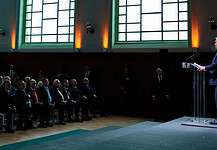
Borítókép: Péter Magyar (right) is taking part in his first EU summit. Photo: European Union